Exhibition | Ragnar Kjartansson: The Sky in a Room
From the National Museum Cardiff:
Ragnar Kjartansson: The Sky in a Room
National Museum Cardiff, 3 February — 11 March 2018
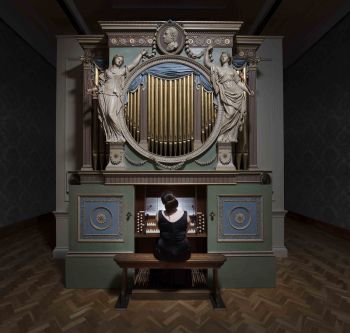
Chamber Organ, 1774, commissioned by Sir Watkins Williams Wynn for his London town house in St James’s Square. The case was designed by Robert Adam (National Museum Cardiff).
Icelandic artist Ragnar Kjartansson will return to Wales to present a brand-new site-specific performance piece, The Sky in a Room, co-commissioned by Artes Mundi and Amgueddfa Cymru – National Museum Wales. The performance will see a series of organists performing the 1959 hit song “Il Cielo In Una Stanza” (“The Sky in a Room”) on the 1774 Sir Watkins Williams Wynn organ, and it will run from 3 February to 11 March at National Museum Cardiff.
Developed after Kjartansson’s participation in Artes Mundi 6 in 2015, the exhibition is made possible by the Derek Williams Trust Purchase Prize, which enables Amgueddfa Cymru to purchase work by Artes Mundi shortlisted artists. It is also the first performance piece acquired by the Museum.
As part of the work, all of the paintings, objects and decorative furniture from the Museum’s Art in Britain 1700–1800 gallery have been removed. In the centre of the empty gallery is a solo performer, seated at a chamber organ originally commissioned by the Welsh patron of the arts Sir Watkins Williams Wynn in 1774. Throughout the day, across the five-week duration of the performance, the organist sings and plays “Il Cielo In Una Stanza,” a famous Italian love song written by Gino Paoli in 1959. The lyrics of this song recall the power of love to disappear walls into forests and ceilings into sky. Kjartansson’s work similarly transforms the Museum, dissolving space and time through the hypnotic repetition of the song.
Ragnar Kjartansson was born in Iceland in 1976. Live performance and music are central to his practice which also incorporates film, installation and painting. His film installation The Visitors featured in Artes Mundi 6.
Artes Mundi brings exceptional and challenging international artists to Wales, generating unique opportunities to engage creatively with the urgent issues of our time. Artes Mundi 8 takes place at National Museum Cardiff, 26 October 2018 – 24 February 2019.
The winner of the prestigious £40,000 Artes Mundi prize will be announced in January 2019 following a four-month exhibition of works by the shortlisted artists. The shortlist was selected from over 450 nominations spanning 86 countries and comprises five of the world’s most celebrated contemporary artists, whose works explore what it means to be human. They are: Anna Boghiguian, Bouchra Khalili, Otobong Nkanga, Trevor Paglen and Apichatpong Weerasethakul.
New Book | Pretty Gentleman
From Yale UP:
Peter McNeil, Pretty Gentleman: Macaroni Men and the Eighteenth-Century Fashion World (New Haven: Yale University Press, 2018), 256 pages, ISBN: 978 03002 17469, $45.
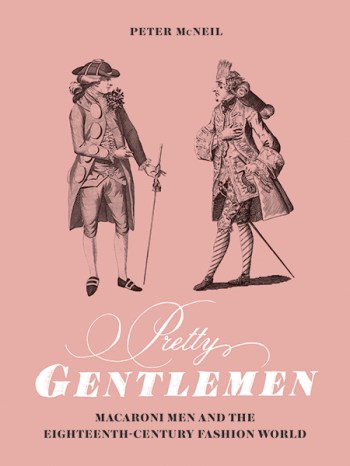 The term ‘macaroni’ was once as familiar a label as ‘punk’ or ‘hipster’ is today. In this handsomely illustrated book devoted to notable 18th-century British male fashion, award-winning author and fashion historian Peter McNeil brings together dress, biography, and historical events with the broader visual and material culture of the late 18th century. For thirty years, macaroni was a highly topical word, yielding a complex set of social, sexual, and cultural associations. Pretty Gentlemen is grounded in surviving dress, archival documents, and art spanning hierarchies and genres, from scurrilous caricature to respectful portrait painting. Celebrities hailed and mocked as macaroni include politician Charles James Fox, painter Richard Cosway, freed slave Julius ‘Soubise’, and criminal parson Reverend Dodd. The style also rapidly spread to neighboring countries in cross-cultural exchange, while Horace Walpole, George III, and Queen Charlotte were active critics and observers of these foppish men.
Peter McNeil is distinguished professor at University of Technology Sydney and Aalto University, Helsinki.
Exhibition | Classic Beauties
Looking ahead to the summer, from the Hermitage Amsterdam:
Classic Beauties: Artists, Italy, and the Aesthetic Ideals of the 18th Century
Hermitage Amsterdam, 16 June 2018 — 13 January 2019

Antonio Canova, The Three Graces, 1813–16.
The human body has fascinated artist throughout centuries. In the mid-eighteenth century this topic in art was been given a new lease on life due to spectacular archaeological discoveries in Italy. Artists like Canova, Thorvaldsen, Mengs, Kauffmann, and Batoni pursue ultimate perfection: even more perfect then the (aesthetic) ideal of the Greeks and the Romans. Many artists and elite youths set off for Italy, to see the sources of inspiration themselves. In the exhibition the visitor makes a grand tour along the finest examples of neoclassical art from the Hermitage. The exhibition Classic Beauties will offer a delightful journey through European Neoclassicism, including the unrivalled Canova collection with The Three Graces.
More information is available here»
The catalogue is published by W Books:
Thera Coppens and Arnon Grunberg, eds., Classic Beauties: Artists, Italy, and the Aesthetic Ideals of the 18th Century (Zwolle: W Books, 2018), 224 pages, ISBN: 978-9078653745, 30€.
Around the middle of the eighteenth century, Europe was enthralled by the archaeological excavations then taking place in Italy. Artists and young aristocrats from across the continent travelled there to see the country’s classical Roman and trendsetting contemporary art for themselves. The Grand Tour often lasted many months. Among those who made it were Goethe and the ‘Count and Countess of the North’ (the later Russian Tsar Paul I and his wife). In Rome, they met renowned artists like Pompeo Batoni, Anton Raphael Mengs, Hubert Robert, Angelica Kauffmann, and—most famous of all—Antonio Canova. In short, all the great names of eighteenth-century Neoclassicism. Classic Beauties allows readers to share the adventures of the Grand Tourists and meet the leading Neoclassical artists of the day. Their accounts and the book’s many illustrations—both of works of art and of contemporary tourist attractions—paint a vivid picture of a period in which the quest for classical beauty and the ideal nude was at the forefront of people’s minds.
Note (added 18 June 2018) — The posting was updated to include catalogue information.
Exhibition | First Academies: Benjamin West

Benjamin West, Death on the Pale Horse, 1817, oil on canvas, 447 × 765 cm
(Philadelphia: PAFA, 1836.1)
◊ ◊ ◊ ◊ ◊
Opening next month at PAFA:
First Academies: Benjamin West and the Founding of the RA of Arts and PAFA
Pennsylvania Academy of the Fine Arts, Philadelphia, 2 March — 3 June 2018
Curated by David Brigham
Investigating the role of Benjamin West in the founding of arts academies in England and the United States.
On the occasion of the 250th anniversary of the founding of the Royal Academy of Arts (RA) in London, the Pennsylvania Academy of the Fine Arts (PAFA) is pleased to recognize the role that Benjamin West (1738–1820) played in founding each of these first sustained academies in England and the United States. Born outside of Philadelphia, West traveled to Europe at age twenty-one to study painting and, rather than return home, he was lured by immediate patronage and recognition to remain in England where he would become one of the founders in 1768 of the RA, its second president, and court painter to George III. While West never returned to America, he educated three generations of American artists in his London studio, including Charles Willson Peale, Gilbert Stuart, Thomas Sully, and Rembrandt Peale.
In 1805, when PAFA was founded, West was selected as the first Honorary Academician. By lending his name to the first sustained art academy in North America, then RA President West contributed to PAFA’s nascent reputation and importance. West accepted the honor and wrote, “It is my wish that your Academy should be so indowed [sic] in all points which are necessary to instruct, not only the mind of the student in what is excellent in art—but that it should equally instruct the eye and the judgement [sic] of the public to know, and properly appreciate Excellence when it is produced….”
This exhibition explores West’s important role in the establishment of the RA and PAFA through more than sixty paintings, drawings, prints, sculptures, manuscripts, and books. In addition to the founding stories of the RA and PAFA, this exhibition recognizes the other artist-founders of PAFA, West’s role as the teacher of eighteenth- and early-nineteenth-century American artists, and the development of monumental history paintings such as Christ Rejected and Death on the Pale Horse.
Call for Papers | SAHGB Architectural History Workshop, 2018
Call for Participation from SAHGB:
The Society of Architectural Historians of Great Britain
Workshop for Doctoral Students and Early Career Scholars
The Gallery, London, 17 March 2018
Proposals due by 16 February 2018
The Society of Architectural Historians of Great Britain (SAHGB) invites proposals for the 2018 Architectural History Workshop. This is our annual event for postgraduate students and early career scholars to share and develop their ideas; it aims to provide an informal space away from your own institution where you can discuss, debate, practice and enjoy the company of like-minded researchers working within the history of the built environment, broadly conceived.
We invite participation in a number of ‘lightning’ rounds, where contributors are asked to speak for no more than ten minutes in any appropriate format that engagingly explores and presents your research. This research can be at any stage from a research proposal that you wish to talk about, issues arising from your research, final work as you write-up, post-doctoral reflections, or anything in-between. Speakers from previous events are particularly welcome to update us on the progress of their work.
The event is limited to postgraduate students (full-time or part-time) and early career scholars (those who have completed their PhDs within the last 5 years). We particularly encourage participation from:
• Masters students considering doctoral study
• Doctoral students in relevant disciplines
We are interested in all periods and regions of study, and the full range of methodological approaches to architectural history. The society welcomes submissions of work relating to the history of the built environment from all disciplines, including but by no means limited to:
• Architecture
• Art History
• History (including urban, social and cultural history)
• Archaeology
• Anthropology
• Geography
On as diverse a range of themes as possible, including:
• Histories of design
• Histories of planning
• Histories of construction
• Histories of buildings in use
• Histories of interiors and interior design
• Histories of practice and professionalism
Alongside presentations, the workshop will feature a session on ‘Careers in Architectural History’ presented by a panel of invited speakers from museums, heritage bodies, architectural practices, and more. Speakers will be announced in the near future. The keynote speaker will be the Chairman of the SAHGB, Professor Anthony Geraghty (University of York).
If you are interested in making a contribution, please complete the submission form on our website. The closing date for applications is Friday, 16 February 2018. The result of all applications will be communicated by Tuesday, 20 February, with confirmation from the speakers requested by Thursday, 22 February. The workshop will take place on Saturday, 17 March at The Gallery, 70, Cowcross Street, London, EC1M 6EL. No funding is available. A contribution of £10 is requested from all attendees to cover costs (inclusive of all catering). Details of the 2017 workshop can be viewed on the Society’s website. For further information or clarification of any sort please contact the conference organizers at ahw2018@sahgb.org.uk.
New Book | The Challenge of the Sublime
From Manchester UP:
Hélène Ibata, The Challenge of the Sublime: From Burke’s Philosophical Enquiry to British Romantic Art (Manchester: Manchester University Press, 2018), 336 pages, ISBN: 978 15261 17397, £75 / $115.
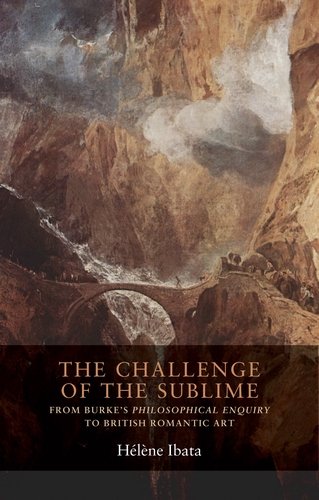 This book examines the links between the unprecedented visual inventiveness of the Romantic period in Britain and eighteenth-century theories of the sublime. Edmund Burke’s Philosophical Enquiry into the Origin of our Ideas of the Sublime and Beautiful (1757), in particular, is shown to have directly or indirectly challenged visual artists to explore not just new themes, but also new compositional strategies and visual media such as panoramas and book illustrations, by arguing that the sublime was beyond the reach of painting. More significantly, it began to call into question mimetic representational models, causing artists to reflect about the presentation of the unpresentable and drawing attention to the process of artistic production itself, rather than the finished artwork.
Helene Ibata is Professor of English and Visual Studies at the University of Strasbourg
C O N T E N T S
Introduction
Part I: From the Enquiry to the Academy
1 The Philosophical Enquiry, Theories of the Sublime and the Sister Arts Tradition
2 Presenting the Unpresentable: The Modernity of Burke’s Enquiry
3 Reynolds, the Great Style, and the Burkean Sublime
4 The Sublime Contained: Academic Compromises
Part II: Beyond the ‘Narrow Limits of Painting’
5 Immersive Spectatorship at the Panorama and the Aesthetics of the Sublime
6 Frames, Edges, and ‘Unlimitation’
7 ‘Sublime Dreams’: Ruin Paintings and Architectural Fantasies
Part III: Relocating the Sublime: Blake, Turner and Creative Endeavour
8 Against and beyond Burke: Blake’s ‘Sublime Labours’
9 Turner: From Sublime Association to Sublime Energy
Conclusion
Bibliography
Index
New Book | Tiepolo’s Pictorial Imagination
The Second Annual Thaw Lecture presented by William Barcham in May 2016 at The Morgan Library & Museum is now available in print from the museum’s shop:
William Barcham, Tiepolo’s Pictorial Imagination: Drawings for Palazzo Clerici (New York: The Morgan Library & Museum, 2017), 63 pages, ISBN: 9780875981819, $17.
 In 1740 Giambattista Tiepolo completed his grand ceiling fresco for the Gallery of Palazzo Clerici, Milan. Unlike his previous ceilings, this was a long gallery that could not be seen in its entirety from a single viewpoint; instead, the ceiling unrolls overhead in a scroll-like manner as visitors pass down the long Gallery. A large group of preparatory studies survives for the ceiling, and these permit us to consider how Tiepolo responded to this daunting assignment and produced a series of interrelated figure groups to decorate the vault. Nearly all today at the Morgan Library & Museum and the Metropolitan Museum of Art in New York and the Museo Horne in Florence, these drawings have long been recognized as studies for the ceiling, but never before has there been a sustained attempt to trace Tiepolo’s creative process through the dozens of sheets. William Barcham’s study of the Clerici drawings thus offers new perspectives not only on the Clerici ceiling but more broadly on Tiepolo’s pictorial imagination and inventive genius.
Queen’s House Lecture Series: Remarkable Women

From Royal Museums Greenwich:
Queen’s House Lecture Series: Remarkable Women
Queen’s House, Greenwich, Thursdays in March 2018
Hear about the lives of five remarkable women through our Queen’s House lecture series this National Women’s History Month. Spanning the Elizabethan and Victorian Ages, follow the lives of five extraordinary women: matriarch and entrepreneur Bess of Hardwick, poet and writer Lady Mary Wortley Montagu, local Deptford businesswoman Mary Slade, antiquarian collector Sarah Sophia Banks, and the world traveller Annie Russell-Cotes. Thursdays in March, 10.30–12.30, £8 (concession £6), Orangery & South Parlours.
1 March
Christine Riding (Royal Museums Greenwich) — Lady Mary Wortley Montagu
8 March
Arlene Leis — Sarah Sophia Banks (1744–1818): A ‘Truly Interesting Collection of Visitor Cards and Co.’
15 March
David Taylor (National Trust) — Exalting the Divine: Bess of Hardwick’s Picture Collection at Hardwick Hall
22 March
Margarette Lincoln — Mary Slade and Working Women in Eighteenth-Century Deptford
29 March
Amy Miller — Annie Russell-Cotes
Urban History, February 2018
The eighteenth century in the latest issue of Urban History:
 Urban History 45 (February 2018)
A R T I C L E S
Matthew Jenkins, “The View from the Street: The Landscape of Polite Shopping in Georgian York,” pp. 26–48.
Shopping during the eighteenth century is increasingly viewed by scholars as an important leisure activity and an integral part of wider schemes of urban improvement. However, the physical evidence in the form of standing buildings is rarely considered. This article will demonstrate how a detailed examination and reconstruction of the urban landscape of York can illuminate how these practices were performed. The use of building biographies also allows owners to be identified and linked with specific shop types and surviving fabric. This enables exploration of how the physical environment influenced perceptions of the streetscape and the experience of interior retail space.
David Gilks, “The Fountain of the Innocents and Its Place in the Paris Cityscape, 1549–1788,” pp. 49–73.
This article analyses how the Fountain of the Innocents appeared and also how it was used and perceived as part of the Paris cityscape. In the 1780s, the plan to transform the Holy Innocents’ Cemetery into a market cast doubt on the Fountain’s future; earlier perceptions now shaped discussions over reusing it as part of the transformed quarter. The article documents how the Fountain was dismantled in 1787 and re-created the following year according to a new design, explaining why it was created in this form. Finally, the article considers what contemporary reactions to the remade Fountain reveal about attitudes toward the authenticity of urban monuments before the establishment of heritage institutions and societies.
Boris Stepanov and Natalia Samutina, “An Eighteenth-Century Theme Park: Museum-Reserve Tsaritsyno (Moscow) and the Public Culture of the Post-Soviet Metropolis,” pp. 74–99.
The article discusses the dramatic history of the Tsaritsyno Park and museum-reserve. By the mid-2000s, it had become one of Moscow’s iconic places and a zone where urban public culture was shaped. The authors trace the history of this architectural ensemble and park in terms of their role in сity culture and analyse changes in the historical culture of contemporary post-Soviet Moscow. The Tsaritsyno Park and museum exemplify these changes. An unfinished country residence of Catherine II, with a Grand Palace that had stood as a ruin for over 200 years, it has been radically renewed by the Moscow city authorities in what came to be labelled ‘fantasy restoration’. The palace was finished and now serves as the core of the museum, organized according to a controversial historical policy. Tsaritsyno as a whole became a cultural oddity featuring historical attractions for the public, effectively an ‘eighteenth-century theme park’.
Study Day | Pots, Prints & Politics: Ceramics with an Agenda
From the programme:
Pots, Prints, and Politics: Ceramics with an Agenda
The British Museum, London, 16 February 2018

Creamware Mug, Staffordhire, ca. 1803 (London: The British Museum).
Join British Museum curators from the Departments of Asia, Prints and Drawings, and Britain, Europe, and Prehistory in this one-day study day—held in conjunction with the exhibition Pots with Attitude: British Satire on Ceramics, 1760–1830—addressing historical and modern ceramics that have political and other messages, which have been inspired by prints and printmaking.
Since the introduction of paper and woodblock printing in China around AD 600, through to the invention of woodcuts printed on paper and the printing press in Germany in the 15th century, the print medium has been used around the world to disseminate ideas and knowledge. Ceramic artists across time and cultures have adapted these graphic sources as painted or transfer-printed images applied onto glazed or unglazed surfaces to express issues including piety, propaganda, self-promotion, gender, national, and regional identities.
This study day is open to all and will draw on the over 500,000 records catalogued by the Prints and Drawing department, which can be searched on the British Museum’s collection online. Stevenson Lecture Theatre, British Museum, Friday, 16 February 2018; £15 / £12.50 concessions. Book online here.
P R O G R A M M E
9:30 Registration
10:00 Session A
• Patricia Ferguson (Project Curator, Monument Trust, 18th-Century Prints and Ceramics, Britain, Europe and Prehistory, and Prints and Drawings), Introduction
• Yu-ping Luk (Curator: Chinese Paintings Prints and Central Asia, Asia), Woodblock Prints and Images on Ceramics in China: Some 14th- to 17th-Century Examples
• Dora Thornton (Curator: Renaissance Collection, Waddesdon Bequest, Britain, Europe and Prehistory), ‘Take Note’: Looking at Italian Renaissance Potters, Printmaking, and Politics through the Lens of the British Museum Collection
11:00 Coffee Break
11:30 Session B
• Eloise Donnelly (Collaborative Doctoral Award Student, Britain, Europe and Prehistory), Prints, Pots, and Protestantism: The Thomas Collection of German Stoneware
• Jessica Harrison-Hall (Curator: Chinese Ceramics, Percival David, Asia), Shameless Self-Promotion? European Eighteenth-Century Prints and Chinese Pots
12:30 Lunch — available for purchase in the Museum cafes
14:00 Session C
• Sheila O’Connell (Former Curator, British Prints, Prints and Drawings), Jefferyes Hamett O’Neale (fl.1750–1801): Pots and Prints
• Patricia Ferguson (Project Curator, Monument Trust), Spode and the French Invasion Scare: Profiteering or Propaganda?
• Antony Griffiths (Former Keeper, Department of Prints and Drawings), Thoughts on Prints and Pots: Beyond Politics
15:15 Coffee Break
15:45 Session D
• Mary Ginsberg (Research Fellow, Asia), Appropriated Heroes: Prints, Pots, and Politics in Revolutionary China
• Eleanor Hyun (Curator, Korean Collections, Asia), Circulating Images: North Korean Pots and Prints
16:30 Tour of Pots with Attitude: British Satire on Ceramics, 1760–1830, in Room 90a.










leave a comment