Lectures | Michael Fried, ‘David – Manet, une affinité ignorée’
As noted at Le Blog de l’ApAhAu:
Michael Fried, David – Manet, une affinité ignorée
Collège de France, Paris, 21 and 28 March 2013
Les professeurs du Collège de France, sur la proposition du professeur Marc Fumaroli, ont invité :
Michael Fried (J.R. Herbert Boone Professor of Humanities and the History of Art, John Hopkins University, Baltimore)
à donner une conférence sur le sujet suivant:
David – Manet, une affinité ignorée
Ces leçons auront lieu les jeudis 21 et 28 mars 2013, à 11 heures dans l’Amphithéâtre Maurice Halbwachs, 11, place Marcelin-Berthelot, 75005, Paris.
Exhibition | Precision and Splendor: Clocks and Watches at The Frick
With time on our minds, it seems like an appropriate posting to begin the new year. It’s easy enough still to connect ‘precision’ to our twenty-first conceptions of time (even if my own clocks are anything but precise). Yet, I imagine ‘splendor’ is a more difficult association for us to make. And yet what a lovely thought! A very happy 2013 to all of you! -CH
◊ ◊ ◊ ◊ ◊
Press release (7 December 2012, as PDF) from The Frick:
Precision and Splendor: Clocks and Watches at The Frick Collection
The Frick Collection, New York, 23 January 2013 — 2 February 2014

Garniture of One Clock and Two Vases, ca. 1770, clock movement by Jean Martin, Chinese hard-paste porcelain garniture, Qing dynasty, Qianlong period, with French gilt-bronze mounts, clock 21 x 8 inches, vases 14 x 9 inches, Horace Wood Brock Collection
Today the question “What time is it?” is quickly answered by looking at any number of devices around us, from watches to phones to computers. For millennia, however, determining the correct time was not so simple. In fact, it was not until the late thirteenth century that the first mechanical clocks were made, slowly replacing sundials and water clocks. It would take several hundred years before mechanical timekeepers became reliable and accurate. This exhibition explores the discoveries and innovations made in the field of horology from the early sixteenth to the nineteenth century. The exhibition, to be shown in the new Portico Gallery, features eleven clocks and fourteen watches from the Winthrop Kellogg Edey bequest, along with five clocks lent by the collector Horace Wood Brock that have never before been seen in New York City. Together, these objects chronicle the evolution over the centuries of more accurate and complex timekeepers and illustrate the aesthetic developments that reflected Europe’s latest styles. Precision and Splendor: Clocks and Watches at The Frick Collection was organized by Charlotte Vignon, Associate Curator of Decorative Arts, The Frick Collection. Support for the exhibition is generously provided by The Selz Foundation, Peter and Gail Goltra, and the David Berg Foundation.
Timekeeping during the Renaissance

Isaac Thuret or Jacques Thuret, case attributed to André-Charles Boulle, Marquetry-Veneered Barometer Clock, ca. 1690–1700, case veneered with marquetry of ebony, tortoiseshell, and brass, mounted with gilt bronzes, H.: 45 1/4 inches (New York: The Frick Collection, Bequest of Winthrop Kellogg Edey) Photo: Michael Bodycomb
It is not known when, where, or by whom the first mechanical clock was invented, but by the mid-fifteenth century several European towns had a monumental timekeeper, powered by falling weights, incorporated into the architecture of a church or public hall. Smaller versions of weight-driven clocks could also be found in the homes of a few wealthy individuals. The existence of mechanical clocks was made possible by an invention known as an escapement. Falling weights (and later springs) provided the energy to power the clock’s mechanism, while the escapement regulated the rate at which that energy was delivered to the oscillator (at first a simple balance and later a pendulum). The introduction of the escapement gradually caused the shift away from time-finding devices (sundials) and time-measuring devices (water clocks) to timekeepers (clocks and later watches) as advances in science and technology were made.
In the fifteenth century progress in metallurgy made possible the production of springs, which ultimately led to the development of portable clocks powered by a coiled spring rather than a weight. The origins of the spring-driven clock are almost as obscure as the invention of the weight-driven clock. Evidence suggests that the idea came from Italy. In the early 1400s Filippo Brunelleschi and others made drawings of spring-driven devices that made the invention of the portable timekeeper possible. One of these devices was the fusee, a cone-shaped spindle that equalizes the diminishing force of a coiled spring as it unwinds. Ornate and prohibitively expensive, clocks at this time were regarded as objects of curiosity; their principal function was to display the wealth and erudition of their owners and to entertain guests at banquets.
The earliest example in the exhibition that incorporates an escapement, a coiled spring, and a fusee is a gilt-brass table clock made in Aix-en-Provence about 1530 by Pierre de Fobis. One of the most famous French clockmakers of his time, Fobis is still recognized today for his durable and highly refined movements. The Frick’s clock is among Fobis’s rare surviving works and is one of the earliest extant spring-driven timekeepers. Its complex movement is set into a typical sixteenth-century French clock case, inspired by classical architecture and ornament rediscovered during the Renaissance. Except for the small dial in blue enamel, the hexagonal gilt-brass case is covered entirely with acanthus scrolls, urns, winged heads, and tiny figures whose limbs morph into elegant, intertwining foliage. The initials “IM” found on each face may refer to the original owner, perhaps Jean Martin, who was instrumental in bringing Renaissance architecture to France.
Germany was a leading producer of clocks during the Renaissance, and, by the late sixteenth century, Augsburg was an important center of their manufacture. The gilt-brass and silver table clock made by David Weber around 1653, most likely for his admission to the Augsburg clockmakers’ guild, exemplifies his expertise. Although Weber chose a popular form for the clock’s case, he demonstrated his imagination and hand skills in its finely worked surfaces. The tower, composed of two tiers, rises to the formidable height of nearly two feet. Balancing precariously atop a winged sphere, a female figure represents the Roman goddess Fortuna and serves as a reminder of the capriciousness of life.Because of this association, Fortuna was often used to adorn timekeepers, even as their orderly mechanisms worked to undermine her. Floral motifs decorating the clock elaborate on its symbolic message: carnations, like Fortuna, allude to capriciousness; tulips symbolize luck and plentitude; and narcissi remind us of fleeting youth and rebirth. The base depicts the four elements—air, water, fire, and earth—symbolizing cosmic order and harmony. The complex mechanism includes seven dials that provide astronomical, calendrical, and horary information. The prominent central dial is an astrolabe with twenty-one star pointers and two concentric hands, which relate to the sun and moon. The smaller dial beneath it is an alarm.
Development of the Watch
Watches were introduced in the middle of the sixteenth century following the refinement of spring-driven clocks. Like the early clocks, the first watches were inaccurate, valued primarily as luxury items and fashion accessories by men and women of distinction. Just as clocks were unreliable until the pendulum clock was invented in 1653, watches became more accurate only after 1675 when the balance spring was introduced. During the seventeenth and eighteenth centuries, the most sought-after watches were decorated with enamels to resemble miniature paintings on paper, parchment, or ivory. A stunning example is an early balance-spring watch made in Switzerland about 1685. The movement by Henry Arlaud is set into a lavish enamel case by Pierre Huaud II. Both men were the sons of French Protestants who had fled France and established themselves in Geneva in the early seventeenth century. The Huaud family popularized the practice of decorating watchcases with miniature paintings created with opaque colored enamels over a ground of pure white enamel. A painting or a print usually inspired the scenes. In this case, Huaud based his composition after The Toilet of Venus, a large canvas of around 1640 by the French artist Simon Vouet. It is unlikely that Huaud ever saw the painting (now at the Carnegie Museum of Art, Pittsburgh), copying instead the engraving of 1651 made by Vouet’s son-in-law, Michel Dorigny. Indeed, the scene on the watch is oriented like the engraving, which is a reverse image of the original painting. Huaud chose to execute the composition using the rich and vivid colors that were his family’s trademark.
Eighteenth-Century Splendor: Remarkable Loans

Clock with Study and Philosophy, movement by Renacle-Nicolas Sotiau, figures after Simon-Louis Boizot, ca. 1785−90, patinated and gilt bronze, marble, enameled metal, and glass, H.: 22 inches, Horace Wood Brock Collection
The precision and splendor of the art of clockmaking in France during the eighteenth century is extremely well represented by several clocks from the collection of Horace Wood Brock. Although by this point their mechanisms had become both reliable and accurate, clocks continued to be valued as objects of distinction used to display their owners’ wealth and refinement. A perfect example is the lavish clock with its two matching vases. Made of a rare type of Chinese porcelain known as celadon bleu fleuri, the already costly vases were embellished with a movement by Jean Martin and gilt-bronze mounts shortly after their importation to France, in an attempt to satisfy French collectors’ perpetual quest for increasingly more elaborate and novel luxury items. The mounts reflect the latest style, the goût grec (Greek taste), which developed in the 1760s and 1770s as a reaction to the rococo style favored by Louis XV and his court. Here the beautifully chased mounts include crowns of laurel, acanthus leaves, pilasters, lion’s masks, and other motifs inspired by classical Greek and Roman architecture. A gilded snake indicates the time.
Cases for clocks reached new heights of elaborateness in France during the late eighteenth century, often incorporating sculptures in bronze made by or after renowned artists. One such example is the stunning mantel clock of about 1785 to 1790 representing Study and Philosophy after a sculpture by Simon-Louis Boizot. A classical symmetry is achieved by placing within an imaginary equilateral triangle the figure of Study on the left, Philosophy on the right, and a column topped by a globe in the center. This composition is completed by the harmonious contrast between the dark patinated figures, the clock’s white marble column and dial, and its gilt-bronze ornamentation.
Breguet: Innovative Horologists

The Dance of Time, Three Nymphs Supporting a Clock, movement by Jean-Baptiste Lepaute, sculpture by Claude Michel Clodion, 1788, terracotta, gilt brass, and glass, H.: 40 3/4 inches (New York: The Frick Collection, bequest of Winthrop Kellogg Edey) Photo: Michael Bodycomb
The exhibition concludes with important watches and clocks by the innovative horologist Abraham-Louis Breguet and his son, Antoine-Louis Breguet, who, at the end of the eighteenth and beginning of the nineteenth century, created highly accurate movements set in sober and elegant cases. Writing in 1982 Winthrop Edey—who bequeathed his collection of clocks to the Frick in 1999—described the elder Breguet as “a phenomenon without parallel. He was the genius of his age, perhaps the most outstanding horologist of all time.” Indeed, Breguet’s combination of technical skill, refined design, and exquisite craftsmanship gave him an unrivaled reputation. His patrons included Louis XVI, Napoleon, and most of the civil and political leaders of his day.
A modern looking watch by the Breguets is one of the very few watches or clocks to include both traditional and decimal dials. The decimal system, introduced during the French Revolution, affected not only weights and measures, but also time. (Decimal time divided the day into ten hours and the year into ten months.) This new division of time, however, proved impossible to enforce: the Republican calendar, introduced on the autumnal equinox in 1792, remained in use for only thirteen years; the decimalization of the day, issued by a 1793 decree, was abandoned in less than eighteen months. The Breguet watch was probably made shortly before or after Abraham-Louis returned to Paris from Switzerland in April 1795. The traditional twelve-hour dial was made after 1807, when his son joined the business. The provenance of the watch is notable as well: it belonged to the influential politician and art collector Antoine-César Praslin, duc de Choiseul.
◊ ◊ ◊ ◊ ◊
Course with Joseph Godla and Charlotte Vignon — The Art and Science of Horology
The Frick Collection, New York, 7 February 2013, 5:30pm
Curious about clocks and watches? It’s about time you joined us for this after-hours session for undergraduates and recent graduates. Participants will learn about stylistic and technical advances in European timepieces made between 1500 and 1830 and study examples from the Frick’s special exhibition up close.
The Frick is pleased to offer courses for college students and recent graduates under the age of 35. Space is limited to twenty participants, and advance registration is required; please visit our Web site or e-mail students@frick.org. A $25 annual fee is payable upon acceptance and includes student membership to The Frick.
◊ ◊ ◊ ◊ ◊
Seminar with Joseph Godla and Charlotte Vignon — What Time Is It?
The Frick Collection, New York, 14 March 2013, 6:00pm
For centuries, “What time is it?” was a difficult, almost impossible, question to answer. This seminar examines several clocks and watches from the sixteenth to the early nineteenth century that attempted—sometimes successfully, sometimes not—to measure time.
Seminars provide unparalleled access to works of art and encourage thought-provoking discussion with experts in their fields. Sessions, held when the galleries are closed to the public, are limited to twenty participants. Advance registration is required; register online or by calling 212.547.0704. $100 ($90 for Members).
◊ ◊ ◊ ◊ ◊
William J. H. Andrewes (museum consultant and sundial maker) — The Tapestry of Time
The Frick Collection, New York, 17 April 2013, 6:00pm
Time is woven throughout the fabric of our civilization. Although its impact on our society today is greater than ever before, most people know very little about its history or the origins of the intervals that control our lives. Through images of major works of the art and science of horology, this talk will describe the evolution of time measurement from around 1600 to the present.
This lecture is free. No reservations are necessary, and seating is on a first-come, first-served basis. This program will be webcast live and thereafter can be viewed on our Web site or The Frick Collection’s channel on FORA.tv.
Scholars in Residence this Spring at the YCBA
From The Yale Center for British Art:
Visiting Scholars
The Yale Center for British Art offers short-term residential awards to scholars undertaking research related to British art. The awards are intended to enable scholars working in any discipline, including history, the history of art, literature, and other fields related to British visual and material culture, to study the Center’s collections of paintings, sculptures, drawings, prints, rare books, and manuscripts, as well as primary and secondary reference materials. The Visiting Scholars for Spring 2013 are as follows:
January 7 – February 1
William L. Coleman, PhD candidate, History of Art Department, University of California, Berkeley. To conduct research for a dissertation entitled “Constable, Cole, and the Country House: The Domesticated Landscape in Anglo-American Art, 1800-1850.” Coleman’s dissertation project studies the way in which the art of house portraiture participated actively in dialogues about aesthetics, wilderness, leisure, and class in Britain and the United States in the early nineteenth century. The Center’s rich collection of country house portraits, including one of Constable’s earliest house portraits, Trentham Park (ca. 1801), will be examined.
January 7 – March 1
Matthew C. Hunter, Assistant Professor, Department of Art History and Communication Studies, McGill University. To conduct research for a project entitled “Joshua Reynolds’s ‘Nice Chymistry.’” Drawing upon collections and archival materials uniquely available at the Center, Coleman’s project uses Reynolds’s complex engagement with painting’s “nice chymistry” to reconsider this crucial figure in British art and the longer legacies of his practice.
January 14 – March 8
Chi-ming Yang, Assistant Professor of English, University of Pennsylvania. To pursue research for a book project entitled Global Chinoiserie and the Lives of Objects, 1660-1800. This project examines how Asian decorative art shaped English discourses of racial difference in eighteenth-century literary and visual culture.
February 3 – March 1
Ada Sharpe, PhD candidate, Department of English and Film Studies, Wilfrid Laurier University. To conduct research for a dissertation entitled “Rapture at Work: Romanticism and the Discourses of Female Accomplishment.” Materials to be consulted from the Center’s Rare Books and Manuscripts collection include a number of handbooks (some explicitly aimed at female readers) that provide instruction on the decorative arts, as well as commonplace books compiled by women living in Britain during the late eighteenth and early nineteenth centuries.
February 3 – May 24
Joerg Trempler, Privatdozent, Member of the Collegium for the Advanced Study of Picture Act and Embodiment, Humboldt University, Berlin. To conduct research for a project entitled “On Representations of Elemental Violence or the Invention of the Image of Catastrophe.” A range of materials from the Center’s collections which focus on the subject of catastrophes will be explored, including images and accounts of the Great Fire of London of 1666.
March 3 – March 29
Sean Willcock, PhD candidate, Department of History of Art, University of York. To conduct research for his PhD thesis, “Consolidating the Colonies: Art and Unrest in the British Empire, c.1850-1900.” Taking the form of a series of case studies predominately relating to colonial India, Willcock’s project considers moments of turbulence or crisis in which the British invoked graphic and photographic practices with a degree of ideological urgency and with an eye to their military or diplomatic utility. Among the materials to be consulted at the Center are William Simpson’s sketchbooks (of which over 200 are in the YCBA) and Sir Charles D’Oyly’s watercolors.
April 3 – April 27
Stephen Bann, Emeritus Professor of History of Art, University of Bristol, will be at the Center as a Senior Visiting Scholar. Professor Bann will be bringing to completion a major edition of the letters of Ian Hamilton Finlay, which extends over the years 1964-74. This correspondence covers the vital period in which Finlay built upon his decisive move from metrical to concrete poetry, producing innovatory poster poems and poems sand-blasted on glass, and finally establishing his celebrated garden of Stonypath/Little Sparta, in the Pentland Hills, near Edinburgh. Professor Bann will also be initiating a project on “British Prints and Printmakers in the Long Nineteenth Century.” Senior Visiting Scholars are invited to spend one month at the Center annually for a term of three years, pursuing their research and participating in the intellectual life of the Center and Yale University. This is Professor Bann’s second year at the Center.
◊ ◊ ◊ ◊ ◊
Andrew W. Mellon Foundation Curatorial Scholars
This spring the Center welcomes four curators from different British museums as part of a new program generously funded by the Andrew W. Mellon Foundation. This program provides four-week residential fellowships to curators based in museums in regions in the UK, beyond London, whose curatorial remit or activities encompass British art. These awards are intended to enable curators to make use of the resources and collections of the Center, and other Yale holdings where relevant, in order to advance research on their own collections or curatorial projects. While in residence, visiting curators will be encouraged to engage with the scholarly community of the Center and at Yale, discuss their research projects, and share information about the collections they oversee. Our first curatorial scholars in this program, all visiting in Spring 2013, are:
March
Charlotte Keenan, Tomlinson Curator of Works on Paper, across the three art galleries managed by National Museums Liverpool; the Walker Art Gallery, Lady Lever Art Gallery and Sudley House. She will conduct research into the British artist Walter Sickert for a catalogue and major exhibition of works by the artist from their collection, planned for 2014 and tentatively titled Walter Richard Sickert: The Hand behind the Brush.
April
Sara Cooper, Collection Curator at the Towner, a contemporary art museum in Eastbourne, East Sussex, will investigate works in the Center’s collection by the British artist Robert Bevan, who was local to Eastbourne but is not yet represented in the Towner collection. She will examine Bevan’s connections with his contemporaries, including Sickert, Wadsworth and Nash, who are well-represented in the Center’s collections as well as in those at the Towner.
May
Anna Rhodes is Assistant Collections Officer, Buxton Museum and Art Gallery, and coordinator for Enlightenment! Derbyshire, part of the Heritage Lottery Funded Enlightenment Project, a partnership focused on the enhancemnt and interpretation of collections relating to Derbyshire. She will investigate the Center’s holdings relating to 18th- and 19th-century Derbyshire, particularly topographical art by professional and amateur artists.
Lucy Salt, Keeper of Art for Derby Museums and Art Gallery, will conduct preliminary research for a major retrospective of Joseph Wright of Derby, which aims to revisit his artistic and Enlightenment legacy and explore the artist’s place in the shaping of the modern world, utilizing the YCBA’s own important collection of works by Wright and his contemporaries.
Call for Papers | Medieval Manuscripts in the Eighteenth Century
Collections, remaniements, expositions: Les vies du manuscrit médiéval
aux périodes moderne et contemporaine
Institut national d’histoire de l’art, Paris, 18 November 2013
Proposals due by 19 May 2013
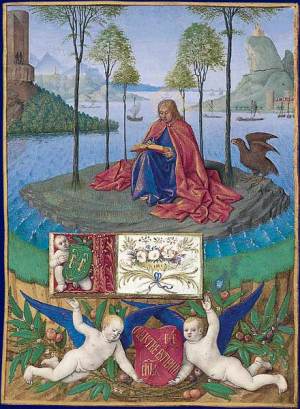
Saint Jean à Pathmos. Heures d’Étienne Chevalier, enluminées par Jean Fouquet (Chantilly: Musée Condé) Photo from Wikimedia Commons
Dismantled codices, where pages have been extracted from their original contexts, have provided museums with important examples of medieval and Renaissance illumination. Although artists of the late medieval period began to create single-leaf illuminations, many of the pages donated and purchased by museums resulted from the cutting and reshaping of complete manuscripts during the eighteenth century, a phenomenon which was spurred by changing collecting practices that favoured the presentation of single objects as a works of art.
Despite their importance to the history of the book, these objects are rarely displayed, little studied, and generally unknown. In the fall of 2013, a series of three exhibitions will be presented in collaboration with the INHA (the French National Institute for Art History): the first at the Musée des Beaux-Arts in Angers, followed by the Palais des Beaux-Arts in Lille, and then the Musée des Augustins in Toulouse. These exhibitions, which will help to inform audiences about this fragile heritage, will bring together objects from the collections of museums and learned societies in regions such as the Centre and Pays de la Loire, Nord-Pas-de-Calais, Picardy and
Champagne-Ardenne, Midi-Pyrénées and Languedoc-Roussillon.
To mark this occasion, the INHA will organize a one day conference on the 18th of November, 2013. This Journée d’études will consider the history of modern and contemporary manuscript collections, paying special attention to the practice of cutting, pasting, and revising medieval works during the eighteenth century. Issues relating to the conservation, restoration, and exhibition of these objects in museums will also be taken into account.
The famous manuscripts known as the Hours of Etienne Chevalier by Jean Fouquet is an example of this phenomenon. Dismembered during the eighteenth century, its miniatures were pasted on panels to create independent images satisfying the desires of collectors. For both economic and aesthetic reasons, the history of medieval books is full of similar examples of assembly from several manuscripts, collections of initials, and detached single leaves. Such practices reveal the tastes and the aspirations of collectors, some of whom were famous for their approach to illuminated manuscripts (J. Granger and J. Bagford during the eighteenth century, or Luigi Celotti during the nineteenth century). Collectors and learned societies played an important role in the constitution of certain collections, facilitating the preservation of many illuminated works. Papers may thus address the following questions:
• Practices of collectors concerning illuminated manuscripts from the beginning of the modern era to the contemporary period (cutting, reshaping, destruction, creation of false/fakes/false leaves, etc.)
• The development of manuscripts collections in museums
• The conservation, restoration and presentation of manuscripts in museums or private collections and learned societies from the nineteenth century to the present day
Communications in English, French or Italian. Please send an abstract of 250 words with a CV (maximum two pages) to Tania Lévy (tlevy@info-histoire.com) and Judith Soria (judith.soria@yahoo.fr) before the May 19th, 2013. The program will be announced in July 2013.
For the call for papers in French, click here»
Exhibition | The Patina of Time
From the Musée Cognacq-Jay:
La Patine du Temps: Conservation et restauration des oeuvres d’art
Musée Cognacq-Jay, Paris, 11 September — 30 December 2012
 Le musée Cognacq-Jay conserve essentiellement des œuvres du XVIIIe siècle et certaines sont plus anciennes encore : elles ont donc plusieurs siècles d’âge et toutes n’ont pas traversé le temps sans dommage. Sous le titre La Patine du temps, un parcours est proposé au visiteur, dans les salles-mêmes du musée, pour lui permettre de comprendre la fragilité des œuvres d’art, la manière dont elles vieillissent, ce que l’on peut faire pour freiner ce vieillissement ou ce que l’on doit attendre d’une restauration. Quatorze panneaux pédagogiques scandent la visite : À quoi ressemble un tableau en bon état ? Que faire d’une sculpture cassée ? figurent ainsi parmi les questions qui sont abordées.
Des restaurations récemment effectuées sur L’Ânesse de Balaam de Rembrandt et Le Retour de chasse de Diane de François Boucher, deux peintures majeures du musée Cognacq-Jay, font l’objet d’une étude plus minutieuse. Mais la conservation et la restauration des pastels, des sculptures ou du mobilier sont aussi évoquées en prenant des exemples éclairants parmi les œuvres du musée. De fait, ce sont aussi aux techniques de fabrication des
œuvres que le visiteur est initié.
Ce parcours fait suite à l’ouvrage publié sous le même titre en 2011, La Patine du temps, rédigé par Georges Brunel, directeur honoraire, et José de Los Llanos, actuel directeur du musée Cognacq-Jay.
◊ ◊ ◊ ◊ ◊
Catalogue: Georges Brunel and José de Los Llanos, La Patine du Temps (Paris: Paris-Musées, 2011), 71 pages, ISBN: 978-2759601547, 12€.
Techniques « Tous les êtres ont leur histoire : toi et moi en avons une, les oeuvres d’art aussi. L’histoire, c’est toute l’épaisseur du temps écoulé depuis que l’on est venu au monde. Il s’est pour ainsi dire condensé dans des craquelures, des accidents de surface, un changement des teintes… » Avec ce douzième titre de la collection « Petites Capitales », le lecteur est confronté aux questions délicates soulevées par la restauration des oeuvres d’art. Le temps ne se remonte pas… Comment présenter son passage sous le jour le plus favorable ? Beau sujet de débat entre Fiordiligi et Dorabella, deux jeunes Italiennes en visite au musée Cognacq-Jay. La vivacité de leur dialogue nous entraîne dans une méditation sur l’oeuvre et le temps, sur l’évolution du goût, à partir des restaurations exemplaires du Retour de chasse de Diane de Boucher et de L’Ânesse du prophète Balaam de Rembrandt, deux chefs d’oeuvre du musée Cognacq Jay. Rendre compte de la richesse du patrimoine parisien, de ses deux mille ans d’histoire et de la diversité des collections de la Ville de Paris, voilà l’ambition de la collection « Petites Capitales ». Le principe de chaque ouvrage est de rassembler une trentaine d’oeuvres emblématiques – peintures, dessins, sculptures, photographies, archives – autour d’un thème, en privilégiant le détail révélateur ; en regard de chaque illustration, des textes et de brefs commentaires créent un jeu de correspondances toujours éclairantes, sur le mode d’une érudition sensible et accessible à tous.
◊ ◊ ◊ ◊ ◊
Bénédicte Bonnet Saint-Georges reviewed the exhibition for The Art Tribune (available in English and French) . . .
The Musée Cognac-Jay is inviting visitors to rediscover their collections by taking a close look at the patina of time. Painting on canvas or wood, marquetry or upholstered furniture, terracotta sculpture…each object presents specific conservation, renovation and restoration problems. Though restorations must be reversible, legible and not alter the nature of the work since the signing of the Venice Charter in 1964, this has not always been the case.
Fourteen explanatory panels dealing with these various problems are scattered throughout the museum using examples of objects on view in the respective rooms. The didactic theme addresses the general public as does the publication behind this hang : written by Georges Brunel and José de Los Llanos, it is in the form of a dialogue between two women visiting the Musée Cognac-Jay. . . .
The full review is available here»
Fellowships | History of the Material Text at UCLA
Visiting Fellows in History of the Material Text
University of California Los Angeles
Applications due by 1 February 2013
The UCLA Center for 17th- and 18th-Century Studies announces two two-year visiting positions in History of the Material Text, to be housed in the Departments of History and English, respectively. These positions are designed to enable participation in the life of the Center and the appropriate Department, as well as fuller use of the riches of the William Andrews Clark Memorial Library and the Special Collections of the UCLA Libraries. We seek scholars of early modern studies (16th-18th centuries), broadly defined, whose expertise includes but is not limited to book history, history of the material text, and print cultures, in Europe and beyond. Applicants should have received their doctorates in the last six years (no earlier than July 1, 2007 and no later than September 30, 2013).
Visiting fellows will teach two courses per year in their respective Department, one of which would be at the Clark Library. Fellows are also expected to make a substantive contribution to the Center’s working groups and other research initiatives. Fellows will receive a stipend of $50,000 per year, plus benefits for the fellow and dependents and a $3000 research fund.
Candidates should submit a letter of application, curriculum vitae, 20-page writing sample, and three letters of recommendation to:
Barbara Fuchs, Director
Center for 17th- and 18th-Century Studies
310 Royce Hall Box 951404
UCLA
Los Angeles CA 90095-1404
Letters of recommendation may be also be submitted electronically to: c1718cs@humnet.ucla.edu. Application dossiers are due by February 1, 2013.
Imperial Apartments at the Correr Museum Restored
This article by Gildas le Roux from the AFP appeared on Sunday, 16 December 2012 at ArtDaily:

Piazza San Marco with View of Museo Correr
(Photo March 2007 by Andrew Balet, Wikimedia Commons)
◊ ◊ ◊ ◊ ◊
After a century of neglect, a magnificent palace built by Napoleon in Venice has re-opened its doors to the public on the island city’s famous St Mark’s Square thanks to a French restoration effort. The reasons for the long abandonment are easily explained — Venice is not Napoleon’s biggest fan. Nor do canal residents have fond memories of the Royal Palace’s most famous resident — 19th-century Austrian empress Elisabeth or ‘Sisi’ — a symbol of the city’s imperial domination. “In popular consciousness, Napoleon is primarily the man who ended the glorious republic of Venice (697-1797),” said Andrea Bellieni, director of the Correr Museum which oversees the Royal Palace.
A group called French Committee for Safeguarding Venice [Comité Français de Sauvegarde de Venise in partnership with the Napoleon Foundation] has financed the restoration of this sumptuous palace, which was in a pitiful state. With a budget of 2.5 million euros ($3.2 million) from private donors, the committee has restored the main halls and the empress’s apartment to its old-time splendour when a 19-year-old ‘Sisi’ and her husband, Emperor Franz Joseph I, stayed there. The furniture decorating the restored chambers is in the same neo-Baroque style popular at the imperial court in Vienna at the time. The empress’s boudoir is a highlight with its images of feminine allegories and flowery garlands.
Napoleon proclaimed himself King of Italy in 1805 and ordered the palace built in 1807 in front of the iconic St Mark’s Basilica after visiting Venice, but never actually lived in it. Built in six years and decorated by French-inspired painter Giuseppe Borsato, the structure is now the only neo-Classical royal palace in Italy. . .
The full article is available here»
Eighteenth-Century Art and the Marketing of Classical CDs
B Y M I C H A E L Y O N A N
The visuals that adorn classical recordings are not usually of terribly high quality. CD packaging often seems an afterthought, and when designers try to be creative, bad things sometimes happen (as demonstrated by this Pinterest collection of Worst Classical Album Covers Ever). The age of early stereo LPs probably marked the peak of production values. The famous Dario Soria series of recordings on RCA, issued in the 1960s, featured deluxe packaging with lavish booklets printed on embossed cardstock and brimming with reproductions of art works, recording session photos, and scholarly essays. They remain prized collectors’ items.
The 1970s saw packaging standards decline, and the advent of CDs in the 1980s just made things worse. The smaller format of compact discs reduces the impact of visuals, and the paper inserts are typically flimsy and poorly printed. You might be buying good music, but you typically get an ugly object.
 Why does it matter, one might ask? Isn’t the music the point? It is, but the visual aspects still work to entice buyers and, in the case of obscure classical music, to suggest what they’re buying. For many, the real item on offer is a mood. Music creates mood, and savvy music marketers know that the right packaging helps. You might even say that since handling the packaging precedes listening to the music, it inflects how one comprehends what one hears.
Recent moves to improve the physical character of classical CDs have enlisted eighteenth-century art to work its magic. Exceptionally successful in this regard is an independent publisher from Belgium, Out There Music. One of its labels, Alpha, notably pairs excellently performed music and strikingly beautiful packaging. In fact, Alpha claims to make “records that are as beautiful to look at as to listen to…”, striving to “shape each production into a unique object reflecting the centuries-old links between various forms of artistic expression.”
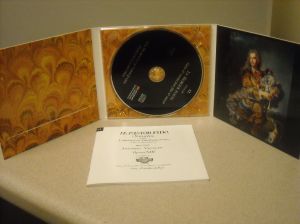 Take, for example, the CD, “Le Berger poète” (Alpha 148), which features eighteenth-century French music for flute and musette de cour. On the cover is a detail of Hyacinthe Rigaud’s Portrait of Gaspard de Gueidan Playing the Musette de cour, 1738. This image on a simple level helps the buyer visualize a musette, an instrument most of us have never seen. It’s a small bagpipe that enjoyed great popularity among French nobles with rustic proclivities. Its sound is reminiscent of an oboe’s or, less charitably, a kazoo’s. Inside there is a full reproduction of Rigaud’s painting and an additional detail from Gueidan’s garments, both framed by richly colored marbling. Included is a 45-page booklet introduced by a reproduction of an eighteenth-century musical title page. If the recording aims to evoke the world out of which this music comes, then the pictures help, and as someone who loves recorded music, I can say that the combination of visual and aural together powerfully suggest a long lost ambience.
 “Le Berger poète” isn’t unique. Other Alpha CDs feature high-resolution details of images by Vigée-Lebrun, Goya, Nattier, Liotard, and Tiepolo in equally creative and often gorgeous packaging. Ramée, another label from Out There, uses a similar design principle but shifts the focus from images to objects. Ramée’s covers feature pictures of early modern textiles, metalwork, silver, furniture, architectural elements, and machines. Both labels make frequent use of cropping and details, design choices that counteract the CD’s physical limitations. I’d like to think that such choices are especially apposite for the eighteenth century, an era so fascinated by fragments, ruins, and oblique views. Ramée’s mission statement is even bolder than Alpha’s in that they seek to “create CDs as complete objets d’art,
because we believe the ear’s pleasure is intimately tied together
with that of the eye and the hand.” I agree.
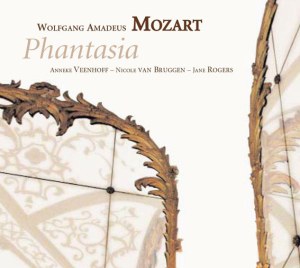 I find it interesting that as we increasingly download our music, a process that would indicate the obsolescence of the CD altogether, not only is the CD not (yet?) going away, but in fact it is becoming more and more beautiful (Out There offers recordings both as digital downloads and as CDs). Even with downloaded music, art can remain a component of the musical experience. The new iTunes redesign continues to let you pair every song with a picture, be it the album cover or an image of one’s choice. It’s another way of doing what Soria did earlier and Alpha and Ramée do now, namely setting the tone for the ear’s experience.
Holiday Gift Ideas | Four Novels and One Biography
This may be a list less of possible gift ideas than one of small self-indulgences, especially for those of you who struggle to fit in fiction. I make no claims for literary accomplishment (I haven’t read any of these — yet!), but it is interesting to see the eighteenth century put to fictional purposes or, in the case of the biography of Samuel Foote, to see how fiction could serve life within the eighteenth century. -CH
◊ ◊ ◊ ◊ ◊
Donna Leon, The Jewels of Paradise (New York: Atlantic Monthly Press, 2012), 256 pages, ISBN: 978-0802120649, $25.
 Donna Leon has won heaps of critical praise and legions of fans for her best-selling mystery series featuring Commissario Guido Brunetti. With The Jewels of Paradise, Leon takes readers beyond the world of the Venetian Questura in her first standalone novel.
Caterina Pellegrini is a native Venetian, and like so many of them, she’s had to leave home to pursue her career. With a doctorate in baroque opera from Vienna, she lands in Manchester, England. Manchester, however, is no Venice. When Caterina gets word of a position back home, she jumps at the opportunity.
The job is an unusual one. After nearly three centuries, two locked trunks, believed to contain the papers of a baroque composer have been discovered [the real-life Agostino Steffani (1654-1728), whose arias have recently been recorded by Cecilia Bartoli]. Deeply-connected in religious and political circles, the composer died childless; now two Venetians, descendants of his cousins, each claim inheritance. Caterina’s job is to examine any enclosed papers to discover the “testamentary disposition” of the composer. But when her research takes her in unexpected directions she begins to wonder just what secrets these trunks may hold. From a masterful writer, The Jewels of Paradise is a superb novel, a gripping tale of intrigue, music, history and greed.
In the judgment of Jane Jakeman, writing for The Independent (10 October 2012) . . .
Leon shows us the balancing-act required to mediate between the world and the spiritual life as a feature of the present as well as of the 18th century. From Steffano’s patchy biography, Leon has forged a fascinating historical mystery. Full of authentic detail and wittily recounted (Caterina’s sojourn at a British university with its badly dressed scholars is a joy), Leon’s 22nd novel has a freshness which indicates her delight in her subject, and perhaps celebrates a release from the treadmill of the Brunetti stories.
◊ ◊ ◊ ◊ ◊
Robin Blake, A Dark Anatomy (London: Pan Macmillan, 2011), 368 pages, 978-1250006721, $25.
 Bloodshed and mystery in 1740s England
The first Cragg and Fidelis mystery begins with Coroner Titus Cragg being called to the corpse of a lady, the wife of the local squire, when it is found in woods near Preston. Her throat has been cut. It is his job to call an inquest that will reach a right verdict, and the investigation that follows has a number of twists and turns as Cragg tries to discover the evidence the jury will need to consider . His friend Dr Luke Fidelis provides medical and scientific knowledge and his wife Elizabeth gives him staunch moral support, in face of determined opposition to his methods from the town’s corporation.
Christopher Fowler writes in The Financial Times (4 April 2011):
Beer and beef for breakfast, and the Devil come down to earth: we are in 1740s Preston, Lancashire. Titus Cragge, the local coroner, has been summoned to investigate the death of a “rough riding hoyden”, the squire’s wife Dolores Brockletower, who has plunged through a tree to lie gashed, bashed and part-buried in the soil at its roots.
George II might hold the throne in the capital, but out in the wilds superstition and hearsay rule. Cragge teams up with energetic young doctor Luke Fidelis and the pair take faltering steps into the as-yet-unknown science of forensic pathology. Soon they’re crossing swords with the victim’s husband, and discovering that the corpse has taken a walk.
Despite hinging on an improbable act of physics, coupled with an 11th-hour surprise that makes Preston seem rather exotic, this is rollicking stuff. . .
More information on the book and Blake are available at his website»
◊ ◊ ◊ ◊ ◊
Ian Kelly, Mr. Foote’s Other Leg (London: Picador, 2012), 462 pages, 978-0330517836, £17.
 In 1776 Foote’s was the most talked-of name in the English-speaking world. By 1777 it was almost unmentionable. Samuel Foote, friend of David Garrick and Dr Johnson, is the greatest lost figure of the eighteenth century; his story defies belief and has only been forgotten for reasons both laughable and shocking.
Foote’s rise to fame was based on three unrelated accidents: his extraordinary gifts as an impressionist, a murder within his family which he turned into a true-crime bestseller, and the loss of his leg after a disastrous practical joke. Out of this was born the most singular career in stage history. He flouted convention in transvestite roles, evaded the censors by selling his scurrilous satires as ‘Tea Parties’, wrote a series of plays for one-legged actors – accordingly not much revived – and established London’s Theatre Royal, Haymarket. Then came two scandalous trials that rocked Georgian high society. Trials of such magnitude they kept America’s Declaration of Independence from the front pages of the London papers.
In a unique conflation of biography and social and medical history, award-winning historian Ian Kelly uncovers the hidden world of ‘the Hogarth of the stage’. From Sheridan to Dickens to Dudley Moore, Foote’s influence continues, but Mr Foote’s Other Leg is not just a tragicomic tale of this Oscar Wilde of the eighteenth century, it is also the story of the first media storm, the first true-crime bestseller, the first victim of celebrity culture, and a joyous hop around the mad theatre of London life – high and low.
Anne Sebba writes in The Telegraph (24 October 2012):
This is a stunningly good and long overdue biography of a man largely forgotten today. Why he has been out of the limelight for so long remains a puzzle. His plays may be conceived as dated, yet Kelly makes the case that they are important for the way they ridiculed vanity and class pretension. But his real claims on posterity come from his courageous refusal to bow to convention or artistic safety, which, in the end, destroyed him. It is this trait that commands our attention, Kelly insists. It is hard to think of anyone who could have written his life story with greater sympathy, understanding of his talent and the difficulties he faced.
◊ ◊ ◊ ◊ ◊
P.D. James, Death Comes to Pemberley (New York: Knopf, 2011), 304 pages, 978-0307959850, $26.
 A rare meeting of literary genius: P. D. James, long among the most admired mystery writers of our time, draws the characters of Jane Austen’s beloved novel Pride and Prejudice into a tale of murder and emotional mayhem.
It is 1803, six years since Elizabeth and Darcy embarked on their life together at Pemberley, Darcy’s magnificent estate. Their peaceful, orderly world seems almost unassailable. Elizabeth has found her footing as the chatelaine of the great house. They have two fine sons, Fitzwilliam and Charles. Elizabeth’s sister Jane and her husband, Bingley, live nearby; her father visits often; there is optimistic talk about the prospects of marriage for Darcy’s sister Georgiana. And preparations are under way for their much-anticipated annual autumn ball.
Then, on the eve of the ball, the patrician idyll is shattered. A coach careens up the drive carrying Lydia, Elizabeth’s disgraced sister, who with her husband, the very dubious Wickham, has been banned from Pemberley. She stumbles out of the carriage, hysterical, shrieking that Wickham has been murdered. With
shocking suddenness, Pemberley is plunged into a frightening mystery.
Inspired by a lifelong passion for Austen, P. D. James masterfully re-creates the world of Pride and Prejudice, electrifying it with the excitement and suspense of a brilliantly crafted crime story, as only she can write it.
◊ ◊ ◊ ◊ ◊
Lloyd Shepherd, The English Monster: or, The Melancholy Transactions of William Ablass (London: Simon & Schuster, 2012)2012), 432 pages, 978-1451647570, $16.
 Two moments in England’s rise to empire, separated by centuries, yet connected by a crime that cannot be forgiven . . .
London, 1811. Along the twisting streets of Wapping, bounded by the ancient Ratcliffe Highway and the modern wonder of the London Dock, many a sin is hidden by the noise and glory of Trade. But now two families have fallen victim to foul murder, and Charles Horton, a senior officer of the newly formed Thames River Police Office, must deliver revenge to a terrified populace.
Plymouth, 1564. Young Billy Ablass arrives in the busy seaport with the burning desire of all young men: the getting and keeping of money. Setting sail on a ship owned by Queen Elizabeth herself seems the likely means to a better life. But the kidnapping of hundreds of human souls in Africa is not the only cursed event to occur on England’s first official slaving voyage. On a sun-blasted Florida islet, Billy too is to be enslaved.
Based on the true story of the gruesome Ratcliffe Highway murders, The English Monster is a breathtaking voyage across centuries, from the Age of Discovery to the Age of Empire, illuminating what happens to Britain as she gains global power
but risks losing her soul.
The Popol Vuh: An Eighteenth-Century Manuscript Copy
With the December 21st solstice marking the end of a 5,125-year cycle of the Mayan ‘Long Count’ calendar, a posting on the oldest copy of the Mayan sacred text, the Popol Vuh, seems appropriate. The manuscript was produced in 1701-03 and is now part of the collection of the Newberry Library in Chicago.
◊ ◊ ◊ ◊ ◊
From The Newberry:
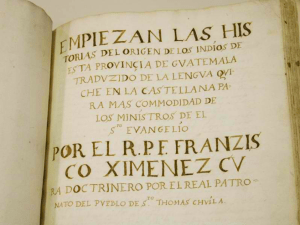
Title page, Popol Vuh. 1701-03 (Chicago: The Newberry Library, Vault Ayer MS 1515)
The Popol Vuh, which has been translated as Book of the Council, Book of the Community, Book of the People, and The Sacred Book, is the creation account of the Quiché Mayan people. It contains stories of the cosmologies, origins, traditions, and spiritual history of the Mayan people. It is considered by many Mayans as their equivalent to the Christian Bible and is held in deep reverence by them. In an effort to make it more widely available and reduce non-essential handling of the text, an important digitization project is underway and almost complete. It includes the complete conservation of the manuscript.
The Newberry’s manuscript of the Popol Vuh is one of the most widely known and possibly the earliest surviving copy. Quiché nobility probably wrote the original manuscript of the Popol Vuh in the mid-sixteenth century, in the Quiché language, using Latin orthography. The Newberry’s Popol Vuh was most likely copied from this original manuscript (now lost) in 1701-03, in the Guatemalan town of Chichicastenango, by Dominican Father Francisco Ximenez. His copy includes the Quiché text and a Spanish translation in side-by-side columns. In addition to the Popol Vuh, the manuscript also contains a Cakchikel-Quiché-Tzutuhil grammar, Christian devotional instructions, and answers to doctrinal questions and other material by Ximenez.
Conservation preparation and treatment are major components of the Popol Vuh digital project. With increased handling of the delicate manuscript during the filming and scanning process, it is absolutely critical to stabilize the paper and inks. A multi-disciplinary group of curators, librarians, conservators, and other experts reviewed the Popol Vuh’s condition and created the following procedure to provide appropriate conservation of the document.
The group decided that the binding, which was not original, should be removed and the ink checked under a microscope and stabilized. Removal of the binding included: separation of the covers from the text, cleaning the glue and paper linings from the spine, cutting the sewing threads, and separating the pages. By removing the old binding, the pages laid flat for filming. After the text was digitized, the manuscript was mended, page-by-page. Mending rejoins tears and strengthens any weak areas of the page, such as loss from insects, moisture damage, or wear from use. After additional consultation, a new binding style was chosen that was sympathetic to the Popol Vuh’s history, and a custom fitted enclosure created to house the Popol Vuh.
The new electronic versions of the Popol Vuh make the manuscript more accessible to a larger number of readers. In order to preserve the item for future generations of researchers, access to the actual sacred text of the Popol Vuh is available by appointment only. To make an appointment, please contact John Brady, Director of Reader Services, at bradyj@newberry.org.
Visitors to the Newberry may access the new electronic versions of the Popol Vuh in the Reference Center on the third floor. Ohio State University has recently released a digital version of the Popol Vuh. In addition, Brigham Young University’s Neal A. Maxwell Institute for Religious Texts (formerly the Institute for the Study and Preservation of Ancient Religious Texts) produced a DVD-ROM of the Popol-Vuh. This DVD is available for use in the 3rd floor reference area and is also for sale in the Newberry Bookstore. A facsimile of the work is also available in the Reference Center.
More information is available here»










 Enfilade
leave a comment