Conference | Entangled Landscapes: China and Europe
Recently on a number of list-servers, the following conference was categorized under ‘call for papers’. In fact, the organizers are not soliciting proposals. It does, however, look really interesting. For more information, see the conference website.
◊ ◊ ◊ ◊ ◊
Entangled Landscapes: Re-thinking the Landscape Exchange between China and Europe
Institute of Art History, University of Zurich, Switzerland, 10-12 May 2013
The exchange of landscape culture between China and Europe in the 16th-18th centuries has received considerable attention in terms of its cultural qualities and significance. The expression of this cultural exchange includes art (e.g. drawings, prints, architecture, landscape architecture, and sculptures), literature (e.g. letters, travelogues, and novels) and material culture (e.g. porcelain and furniture). Traditional scholarship examines these objects as static and fixed in their narrow disciplinary specialty rather than considering them within a multidisciplinary contextual matrix. Some emerging conceptions and understandings of culture and landscape shed new light on the exchange of landscape culture. ‘Entangled histories’, for example, does not consider cultures as separated entities with fixed boundaries, but rather cultures as being constituted by intertwined processes of interaction, translation and hybridization within interconnected societies. Meanwhile, landscape is increasingly being understood as not a mere pictorial representation, but ‘an instrument of cultural power,’ a cultural practice ‘by which social and subjective identities are formed.’ In both Chinese and European traditions, landscape has complex relations with notions such as nature and land – territory, nation, and state. Both landscape traditions have been investigated within multidisciplinary (social, cultural, economic and political) perspectives.
Against this background, the symposium proposes to re-think the landscape exchange between China and Europe during the 16th-18th centuries within an ‘entangled landscapes’ approach. By using this term, we do not understand the cross-cultural Chinese-European landscape representations as a mere artistic exchange between two isolated ‘islands’. Rather, we consider these landscape representations being used to manifest and perform interactions among different cultures, religions, and powers within their cultural, social and political contexts. The ‘entanglement’ of these cross-cultural landscapes is traceable in aspects such as the appropriation of representational methods, the hybridization of landscape styles, and the negotiation of aesthetic concepts. The main goal of the symposium is to achieve a deeper understanding of Chinese-European landscape exchange through examination of these three often complex aspects.
Landscape exchange has taken place between China and Europe on occasions provided by trade, Christian missions and diplomacy (ceremonials), which are inseparable from their backgrounds such as economic expansion, the circulation of knowledge, the transfer of technologies (e.g. scientific technologies and technologies of governance), and the negotiation of ideologies and power structures. We are interested in analyzing these landscape entanglements (appropriation of representational methods, transplantation of styles, and negotiation of concepts) in relation to the above backgrounds, as well as face-toface interaction and dynamics between the discourse of arts and social, economic and political practices. As examples, ‘linear perspective’ as a landscape representational method was adopted by early Qing court artists to promote the Manchu emperor’s statecraft (in terms of morality, science and epistemology); ‘the Chinese style of gardening’ was advocated by the English/British elite in the late seventeenth and eighteenth century to promote the physiocrats’ economy and enlightened polity; and concepts like ‘the grotesque’ were indicative of the nature, as well as the results, of crises, conflicts and cultural clashes.
By addressing such topics, our objectives are to understand: 1. how different perceptions of landscape, nature, and land by the people of China and Europe constructed the representations of cross-cultural landscapes; and conversely, how the representation of cross-cultural landscapes influenced Chinese and European perceptions of landscape, nature and land. 2. how different national, social and individual identities were formed through the appropriation, transplantation and negotiation of landscape representations; and conversely, how transcultural landscapes were influenced by these different identities.
Through this symposium, we hope to explore and discuss different theoretical, empirical and methodological perspectives of landscape representation between Europe and China across disciplines and national boundaries. In summary, we seek not only a more thorough understanding of the exchange of landscape culture, but also a deeper understanding of the formation of cultural identities in China and Europe, and the relation between China and Europe during the 16th-18th centuries.
At Auction | Joseph Wright’s ‘A Blacksmith Shop’
Warm thanks to John Chu for pointing out the results of this Christie’s auction, notable for its inclusion of a long-untraced painting by Joseph Wright. -CH
◊ ◊ ◊ ◊ ◊
From Christie’s:
Christie’s Old Master & British Paintings Evening Sale (Sale 5964)
London, King Street, 4 December 2012

Joseph Wright of Derby, A Blacksmith’s Shop, 1771-73 [estimate £400,000 – £600,000; sold for £914,850]
Wright’s dramatic portrayal of a lowly Blacksmith’s Shop is a highly significant re-discovery, having been untraced since it was exhibited at the Graves Galleries in 1910. Known only through an engraving executed by William Pether in 1771 (fig. 1), Benedict Nicolson, in his complete catalogue of Wright’s works published in 1968, lamented: ‘We have lost a fine invention’ (op. cit., p. 50). One of a group of five Blacksmith’s Shops and Iron Forges executed between 1771 and 1773, and the only one to remain in private hands, this painting is both an expression of Wright’s close engagement in the spirit of the Industrial Revolution and a sophisticated example of his mastery of chiaroscuro effects.
Wright was not the first British painter to depict contemporary industrial scenes. Thomas Smith had executed two detailed topographical views of a Shropshire industrial site as early as 1758, Edward Penny exhibited The Gossiping Blacksmith at the Royal Academy’s inaugural exhibition in 1769, and Sandby and Ibbetson made numerous sketches of mines, coal-pits and factories in the North of England. He was, however, the first artist of his generation to explore its full potential as a subject for serious, academic art. . .
The Old Master & British Paintings Evening Sale realised £11,562,250/$18,603,660/€11,426,147, selling 54% by lot and 70% by value.
The full catalogue entry is available here»
Call for Papers | Materializing the Spirit: Cultures of Women Religious
From the H-WRBI:
Materializing the Spirit: Spaces, Objects, and Art in the Cultures of Women Religious
Institute of Historical Research, Senate House, London, 5-7 September 2013
Proposals due by 1 February 2013
The History of Women Religious of Britain and Ireland Annual Conference will be hosted by the Institute of Historical Research, University of London, on 5-7 September 2013.
Paper proposals are now invited. Presentations should be 20 minutes in duration, and should address some element of the conference theme, with reference to British and/or Irish contexts. The devotional and vocational activities of women religious sculpted the physical space of religious houses in unique ways. Patterns of use were etched into the fabric of buildings, guiding structural design and interior decoration. But buildings also shaped practice: whether the formal monastic sites of early or revived enclosed orders or the reused secular buildings of active congregations, women both adapted and adapted to their material surroundings.
A growing body of literature has addressed itself to convent art, exploring nuns as patrons, consumers and manufacturers of material and visual culture. These practices span the history of women’s religious life – from the early Middle Ages to the present day – and suggest a hidden but dynamic tradition of artistic enterprise. This conference explores the creative output of women religious including but not limited to textiles and the decorative arts, illuminated manuscripts and printed books, women’s patronage of painting and architecture, the commercial production of ecclesiastical textiles in the nineteenth-century, production of liturgical and devotional art in recent periods, and the development of unique convent and institutional spaces by and for women religious.
Key aims of the conference will be to highlight the scholarly value of these under-researched and little known spaces and collections and also to raise awareness and discuss the threats that they face as communities decline, buildings close, artefacts and archives are dispersed.
This conference will take a broad and diverse view on what constitutes ‘material culture’, emphasizing the conception, production, and meanings of the many material outputs of convents and monasteries. Papers are welcomed from a diverse range of disciplines: scholars from social and religious history, art and architecture, theology, anthropology, psychology and beyond are invited to offer fresh and innovative perspectives in order to illuminate ways in which women religious in Britain and Ireland created and were formed by material histories for over a thousand years.
Please send 200-word proposals for 20-minute papers to conference conveners Kate Jordan (kate.jordan.09@ucl.ac.uk) and Ayla Lepine (ayla.lepine@gmail.com) by no later than 1 February 2013.
Call for Papers | Encounters, Affinities, Legacies
Encounters, Affinities, Legacies: The Eighteenth Century in the Present Day
University of York, 28-29 June 2013
Proposals due by 19 April 2013 (extended from previous due date of 1 March 2013)
As the field of eighteenth-century studies continues to boom within the academy, the eighteenth century – invoked around names like Rousseau, Voltaire, and Adam Smith – is becoming an increasingly frequent interlocutor in contemporary debates in the international media about society, democracy, human rights, and the economy. Whilst social and political commentators are reading our present in dialogue with our eighteenth-century past, cultural appetites for the eighteenth century on page, stage, and screen continue to grow: powerful suggestions that intertwined discourses like (E)nlightenment and modernity, central to so much eighteenth- and twentieth-century thought, remain vital to the social, political and cultural construction of our contemporary moment. This interdisciplinary conference seeks to explore the complex webs of interconnection between the long eighteenth century and the ‘long’ twentieth century, from 1900 to the present.
Keynote speakers: Donna Landry (University of Kent) and Markman Ellis (Queen Mary, University of London)
The conference will take place at the heart of a festival of public engagement events including public lectures, fashion, music, performance, and photography. Any proposals for involvement in the festival would also be received with interest, and should be emailed to Adam Perchard at agkp500@york.ac.uk by the end of January 2013.
The conference organisers welcome submissions for presentations in the following formats:
• Pre-formed panels, approximately one hour in length. Panels can contain two, three or exceptionally four speakers, and should identify an appropriate panel chair. We particularly encourage interdisciplinary panels.
• Individual papers, approximately 20 minutes in length.
We welcome presentations in original and innovative formats, such as interactive demonstrations, Q&A/debating sessions, or exhibitions. These should be no longer than 30 minutes per contributor. Topics may include, but are not limited to, the following:
• intertexts/intersects: engagements between eighteenth- and twentieth-century texts, images, and performances
• the eighteenth century on the twentieth-century stage, page and screen
• nostalgia and rejection: twentieth-century historiographies of the eighteenth century
• global centuries: (post-)empire, race, and cosmopolitanisms
• legacies and disconnects: constructing and reforming society
• print culture and satire: resistance, radicalism, and freedom of speech
• ‘the rise of the novel’: literary grand narratives
• place and space: architecture between centuries
• Romantic Modernisms/Modern Romanticisms
Panel submissions: Please send a 250-300 word abstract for each paper in the panel, along with a panel overview of 300 words, explaining how the individual papers relate to one another. Include the name and contact details for your chair, as well as each of the contributors.
Individual paper submissions: Please send a 250-300 word abstract outlining your paper. Include your name and contact details.
Alternative format submissions: Please send a 300-350 word outline of your presentation, outlining the content and format. Where presentations are made by more than one contributor, longer proposals will be considered. Include the names and contact details of all contributors.
Please send abstracts to encounters.2013@gmail.com no later than 1 March 2013.
Half-Day Workshops | Ornament, Models, and Objects
Conference program (PDF) from the Centre Chastel:
Ornements et décor : du modèle à l’objet
Institut national d’histoire de l’art, Paris, 15 January — 30 April 2013
 Demi-journées d’études organisées par Jérémie Cerman (Université Paris-Sorbonne, Centre Chastel) et Julie Ramos (INHA), avec la collaboration de Dominique Morelon et Lucie Fléjou (Bibliothèque de l’INHA), Michael Decrossas, Elli Doulkaridou et Céline Ventura-Teixeira (INHA).
Contacts : julie.ramos@inha.fr ou jeremie.cerman@paris-sorbonne.fr
Le catalogage et la numérisation du fonds de recueils d’ornements de la bibliothèque de l’INHA-collections Jacques Doucet, riche d’environ 650 volumes pour une période allant du XVIe siècle au début du XIXe siècle, constitue l’axe central du programme Histoire de l’ornement. Dans ce cadre, l’Institut national d’histoire de l’art a choisi de faire porter sa réflexion sur les relations entre les modèles et les objets. De janvier à avril 2013, quatre demi-journées d’études thématiques, organisées en partenariat avec le Centre Chastel, proposeront ainsi des échanges que l’intérêt actuellement suscité par l’ornement et les arts décoratifs rend propice. Dans une perspective chronologique et disciplinaire étendue, elles s’attacheront à considérer les modèles d’ornements sur le plan de leur circulation et de leurs usages pratiques ; elles envisageront les recueils en tant qu’objets de collection mais aussi comme sources d’inspiration pour les artistes, les artisans et les industriels. Sans se limiter au domaine des arts décoratifs, l’ornement sera également envisagé dans ses relations aux autres champs de la création, de l’architecture à la sculpture en passant par la photographie. Enfin, sa propension à stimuler l’imaginaire, tant chez le créateur que chez le spectateur ou l’usager, sera interrogée.
◊ ◊ ◊ ◊ ◊
15 janvier 2013, 14h-18h | Modèles d’ornements et collectionnisme
Modérateur : Rossella Froissart (Université de Provence)
• Lucie Fléjou (Bibliothèque de l’INHA) : Edmond Foulc (1828 -1916), collectionneur d’estampes d’ornements
• Jean-François Bédard (Syracuse University, New York) : Entre collection et décoration : ornement et construction de soi à l’âge des Lumières
• Sylvain Cordier (Université Paris-Sorbonne) : Percier, Jacob, Bellangé: autour de quelques recueils de dessins d’ornements et d’ameublement de l’époque Empire conservés aux États-Unis
• Wilfried Zeisler (Université Paris-Sorbonne) : Des collections de recueils et de modèles dans les ateliers de création et de leur usage
◊ ◊ ◊ ◊ ◊
12 février 2013, 14h-18h | De l’ornement à l’objet : imitation, inspiration, réinterprétation
Modérateur : Agnès Callu (Musée des arts décoratifs, Paris)
• Céline Ventura-Teixeira (Université Paris-Sorbonne / INHA) : De la parure au motif : la pointe de diamant. Entre diffusion et adaptation d’un modèle ornemental au XVIIe siècle
• Anne Perrin-Khelissa (Université catholique de l’Ouest, Angers) : «D’excellens modèles » pour des objets d’arts « dans tous les genres ». Les Collections de culs de lampes et fleurons de Jean-Jacques Bachelier, extraites des Fables de La Fontaine illustrées par Jean-Baptise Oudry
• Odile Nouvel (Musée des arts décoratifs, Paris) : De l’élaboration à la réutilisation des modèles : quelques réflexions autour des fonds Odiot et Biennais du Musée des Arts décoratifs
• Audrey Millet (Universités Paris 8 et Neuchâtel) : La fabrique de l’ornement. De l’imitation à l’invention, l’art de dessiner des indiennes dans les grands centres européens (XVIIIe-XIXe siècles)
• Valérie Nègre (École nationale supérieure d’architecture Paris-La Villette) : Du dessin à l’objet. Quelques remarques sur les usages des recueils d’ornements commerciaux au XIXe siècle
◊ ◊ ◊ ◊ ◊
26 mars 2013, 14h-18h | L’ornement et les arts
Modérateur : Jean-Paul Midant (École nationale supérieure d’architecture Paris-Belleville)
• Michaël Decrossas (INHA) : Jean Lemoine de Paris (1638 – 1709), peintre et ornemaniste
• Sébastien Quéquet (INHA) : L’artiste peintre et la manufacture : la régénération de la céramique par les beaux-arts
• Sébastien Bontemps (Université de Provence) : Polarité du programme architectural et de son serviteur, l’ornement : les travaux des sanctuaires parisiens de Saint-Germain-l’Auxerrois et de Saint-Merry au milieu du XVIIIe siècle
• Hélène Bocard (INHA) : « Des modèles pour les artisans » : la collection d’arts décoratifs du baron Alexander von Minutoli (1806-1887) et sa diffusion par la photographie
• Frédéric Dassas (Musée du Louvre) : L’histoire du meuble à l’épreuve des arts graphiques : le cas d’André-Charles Boulle (1642-1732)
◊ ◊ ◊ ◊ ◊
30 avril 2013, 14h-18h | L’objet imaginaire
Modérateur : Rémi Labrusse (Université Paris Ouest Nanterre La Défense)
• Elli Doulkaridou (Université Paris 1 Panthéon-Sorbonne / INHA) : Les jeux de l’ornement : réflexions autour de quelques manuscrits enluminés romains du XVIe siècle
• Nicolas Cordon (Université Paris 1 Panthéon-Sorbonne) : L’ornement de stuc comme lieu du simulacre
• Jean-Louis Gaillemin (Université Paris-Sorbonne) : Ornement et surréalisme
Exhibition | Between Orient and Occident: Kremlin Treasures
Press release from the Staatliche Kunstsammlungen Dresden:
Between Orient and Occident: Treasures of the Kremlin from Ivan the Terrible to Peter the Great
Royal Palace, Dresden, 1 December 2012 — 4 March 2013
Curated by Ulrike Weinhold

Lidded dish Kremlin workshops, 1694
© Moscow Kremlin Museums
The Residenzschloss (Royal Palace) in Dresden is home to two world-class museums, the Grünes Gewölbe (Green Vault) and the Kupferstich-Kabinett (Collection of Prints, Drawings and Photographs), while the Rüstkammer (Armoury), one of the most important collections of its kind, also has a significant presence here, with its Türckische Cammer (Turkish Chamber). Before the Rüstkammer opens the outstanding new presentation of another part of its collection here in the Riesensaal (Giants Hall) on 18 February 2013, the Residenzschloss hosts a museum organisation of international stature, the Moscow Kremlin Museums. From 1 December 2012 to 4 March 2013, the exhibition Between Orient and Occident: Treasures of the Kremlin from Ivan the Terrible to Peter the Great is being shown in the State Apartments, in surroundings where reconstruction work is as yet unfinished. There could hardly be a more appropriate place to hold an exhibition with this theme: like the Kremlin, the Residenzschloss, the very heart of the Staatliche Kunstsammlungen Dresden, is a place of encounter between Orient and Occident. In this unique special exhibition, the first ever to highlight the significance of the Kremlin as a crossroads of eastern and western cultures, around 140 outstanding exhibits are displayed in an area of some 700 sq. m. in all. Masterpieces by European goldsmiths, superb ceremonial weapons crafted by Persian and Turkish armourers, precious objects, splendid vessels and opulent garments are displayed alongside exquisite pieces produced in the Kremlin workshops, but clearly showing influences from beyond Russia.
The exhibition focuses on a clearly defined period, from 1547, when Ivan the Terrible (1530–1584) was crowned as tsar, to 1712, when Peter the Great (1672–1725) designated St Petersburg as the new capital of the Russian Empire. Magnificent objects acquired by the tsars, and sumptuous gifts presented by foreign emissaries from both west and east impressively demonstrate to today’s visitors the great power and wealth of Russia, and the significant role it played in the political and economic structures of that time. Inspired by works of art from abroad, the Kremlin workshops created treasures which are a synthesis of European and oriental taste and ancient Russian traditions.
The current exhibition is to some extent a reciprocal visit: in 2006, before the Grünes Gewölbe moved back to its original home on the ground floor of the Residenzschloss, it presented an exhibition in Moscow, entitled The Jewel Cabinet of August the Strong, hosted by the Kremlin Museums. The SKD already have close scholarly and scientific working relationships of long standing with these Russian museums, as well as with the State Hermitage in St Petersburg and the Pushkin Museum in Moscow. This special exhibition, Between Orient and Occident: Treasures of the Kremlin from Ivan the Terrible to Peter the Great, is a major contribution to the continuing exchange between the respective museums. Finally, but not least, it is also a contribution to the Year of Russia in Germany and Germany in Russia 2012/13.
In the Fall 2012 Issue of ‘American Art’
Ethan W. Lasser, “Selling Silver: The Business of Copley’s Paul Revere,” American Art 26 (Fall 2012): 26-43.
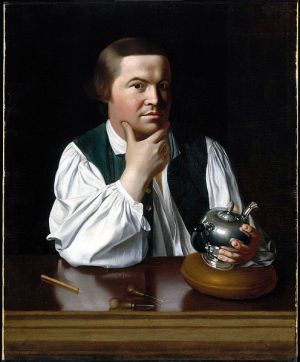
John Singleton Copley, Paul Revere, 1768. Oil on canvas, Museum of Fine Arts, Boston, Gift of Joseph W., William B., and Edward H. R. Revere (Photo: Wikimedia Commons)
. . . Few examples of colonial American painting have been studied as extensively as Copley’s Paul Revere. Scholars have argued that the portrait depicts Revere in his workshop as he pauses while engraving a silver teapot and have proposed a range of explanations to account for this subject matter. They have analyzed Copley’s sources, searched for (and ultimately uncovered little) information about the commission of the portrait, and speculated about the connection between the painting and Revere’s radical politics[note 2]. But interpreters have yet to consider seriously the connection between the portrait and the increasingly dire state of Revere’s financial affairs. Though Copley depicted the silversmith plying his trade, the bottom-line realities of this trade have been left out of the story of this iconic painting [p. 27]. . . .
My interpretation will draw on two different types of evidence. First is the portrait itself. Paul Revere is a far richer and more singular work than past scholars have acknowledged. While many writers have discussed the subject matter of the painting, few have seriously explored the portrait’s exceptional
composition. . . .
Since this is an image of a craftsman that emphasizes artisanal practice, questions about the processes of making, raising, and decorating silver teapots will also figure centrally in my account. In the period when Copley painted Paul Revere, elites grew increasingly interested in and familiar with artisanal materials and techniques [p. 28]. . . .
In proposing Paul Revere as such a strategic image, my argument locates the portrait within a broader field of eighteenth-century painting that functioned to promote the wares of particular retailers and artisans. This field includes genre paintings like Jean-Antoine Watteau’s iconic Shop Sign [p. 29] . . .
The full article is available here (J-Stor subscription required)
Call for Papers | Traces of Early America
Traces of Early America: An Interdisciplinary Graduate Student Conference
The McNeil Center for Early American Studies, University of Pennsylvania, 26-28 September 2013
Proposals due by 15 March 2013
Scholars encounter early America through its traces, the vestiges and fragments left behind. And in reconstructing the fleeting and ephemeral, scholars also attempt to trace early American encounters. This conference will bring together graduate students from a wide variety of disciplines to explore the various meanings of traces—as material objects, cultural representations, and academic practices. Papers might consider how people deliberately and unwittingly left traces as they moved through space and time; what traces or remnants of the past get privileged while others are marginalized or occluded; how written, visual, and other texts are both material objects and traces of lives and experiences; and where we look for the traces of different communities and conflicts in early America. More generally, papers might address tracing as a method of historical inquiry, one that both uncovers and constitutes objects and archives, as well as the methodological traces that have reconfigured early American studies, such as Atlantic history, diaspora studies, hemispheric studies, and circum-Caribbean and Latin American studies.
We welcome applicants from a wide variety of disciplines—among them history, literature, gender studies, ethnic studies, anthropology, archeology, geography, art history, material culture, religious studies, and political science—whose work deals with the histories and cultures of North American and the Atlantic world before 1850. Applicants should email their proposals to mceas.traces.2013@gmail.com by March 15, 2013. Proposals should include an abstract of no more than 250 words along with a one-page c.v. Paper presentations should be no more than 20 minutes. Limited financial support is available for participants’ travel expenses. Decisions will be announced by May 15, 2013.
Any conference-related questions can be directed to: mceas.traces.2013@gmail.com.
Call for Papers | London and the Emergence of a European Art Market
London and the Emergence of a European Art Market, c. 1780-1820
The National Gallery, London, 21-22 June 2013
Proposals due by 15 February 2013
The French Revolution and the ensuing Napoleonic Wars with occupations of Italy, Spain and the Low Countries, instigated a sweeping redistribution of art. At the same time, the Papacy’s loss of temporal power undermined the enforcement of export laws in the Papal States. This convergence of events ensured that large volumes of paintings—often entire collections, from European monasteries, churches, and private palaces—were widely dispersed via auction and private treaty sales in a true diaspora of art. Current scholarship posits that amidst these large-scale market transformations London emerged as the new hub of the international art trade, replacing Paris. The well-known example of the move of the Orléans collection to London, where it was sold through various private treaty transactions and a series of auctions between 1798 and 1802, is often considered a pars pro toto for the British assumption of power on the international art market.
While some studies have begun to address the velocity and scale of this redistribution, little has been done to analyze the dynamic networks of agents who provided the infrastructure for the circulation of art works and sales information throughout Europe. Economist Neil de Marchi recently pointed out that the financial market linking crucial centers such as Amsterdam, London, and Paris has been studied in depth, but comparable research into the “mechanism of the painting trade and the extent to which it was integrated across those centers has barely begun.” This conference aspires to tackle this issue by convening scholars and experts from a range of disciplines to discuss broad research questions such as: Did the long-term effects of the political turmoil in France alter the existing personal and professional networks of dealers and connoisseurs? What would have been the motivations to ship art works to foreign market places? How integrated was the European art market around 1800, or were there still relatively independent local markets? Was there an implied hierarchy of metropolitan markets or were conditions too volatile and fluid for fixed patterns to emerge?
Given the vast amount of historical evidence now available to scholars, we have the capacity to address these micro and macro developments in innovative ways. Over the last two years the National Gallery, London, and the Getty Research Institute, Los Angeles, have collaborated on a project to research, transcribe, and index auction catalogues published in Great Britain between 1780 and 1800. By January 2013, almost 100,000 new sales records from c. 1,200 catalogues will be published online, via the Getty Provenance Index® databases. This will add significantly and strategically to the already extant data-pool of approximately half a million records from British, French, German, Dutch, Belgian, and Scandinavian Sales, spanning the period of c. 1780 to 1820.
One of the main objectives of this international conference is to work towards a methodological synergy of art historical case studies and data-driven socioeconomic analysis in order to understand better the mechanisms of the international art trade at this pivotal period as well as the long-term implications for the history of collecting, the establishment of museums, and the formation of the discipline of art history.
Topics for consideration include, but are not limited to:
• A R T W O R K S Cross-border traffic of objects (cultural transfers, customs regulations, arbitrage, etc.) and its effect on the formation of private and public collections.
• A G E N T S Market integration throughout Europe (national/transnational dealer networks, centre and periphery, impact of revolution and war, etc.)
• I N F O R M A T I O N Auction catalogues as economic tool and literary genre (classification systems, lot sequence, transparency, connoisseurship, etc.)
• V A L U E S Idea of art as an investment (different national canons and currencies, growth of investment-minded collectors, ascendancy of the banker as a key player, price manipulation, etc.)
Please send proposals for papers (to last 30 minutes) of no more than 250 words by 15 February 2013 to either/both:
Susanna Avery-Quash
Research Curator in the History of Collecting and Display
The National Gallery, London
susanna.avery-quash@ng-london.org.uk
Christian Huemer
Managing Editor, Project for the Study of Collecting and Provenance
The Getty Research Institute, Los Angeles
chuemer@getty.edu
Fellowship | Newberry-Kress in European Art and Art History
From The Newberry:
Newberry-Kress Fellowship in European Art and Art History
The Newberry Library, Chicago
Applications due by 15 January 2013
This fellowship offers support for PhD candidates or postdoctoral scholars; qualified applicants must be working on a European art history project covering the period prior to 1830.
The Newberry houses a variety of European art and the history of art and architecture within its collection. Most of these works relate to subject areas for which the library’s holdings are particularly strong. Particular collection strengths include medieval manuscripts; post-1500 European manuscripts; book illustrations; printing and book arts; calligraphy; maps, views, and topographical prints; caricatures and cartoons; and printed books and serials relating to the field of art history.
The total stipend for this fellowship is $2,500 for one month in residence. Please visit The Newberry website for more information.










 Enfilade
leave a comment