George Washington’s Constitution Sells for Record Price
With the Constitution of the United States as ideologically charged as ever, it’s hardly a surprise that George Washington’s own annotated copy would sell for a record price — almost $10 million. While I’m glad to know that it’s going back to Mount Vernon, my hunch is that this hardly marks the end of the politicization of this crucial historical document. -CH
◊ ◊ ◊ ◊ ◊
As Patrick Hruby reports for The Washington Times (22 June 2012) . . .
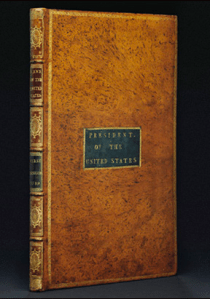 Having set a world record, George Washington’s personal copy of the Constitution is heading home. A book containing Washington’s annotated Constitution and a draft of the Bill of Rights was purchased for almost $10 million by the Mount Vernon Ladies’ Association in an auction Friday [22 June 2012] at Christie’s in New York.
Printed and bound in 1789, the book featuring Washington’s signature on the title page sold for a winning bid of $9,826,500 — an amount the venerable auction house said was a world auction record for an American book or historical document.
Part of Washington’s original private library at Mount Vernon, the book will once again be housed at the historic Virginia estate as part of the collection at the Fred W. Smith National Library for the Study of George Washington, currently under construction and set to open next fall. . .
The full article is available here»
◊ ◊ ◊ ◊ ◊
The Mount Vernon website provides an overview of the National Library for the Study of George Washington, including the following:
The 45,000-square-foot library will occupy a 15-acre site to the west of George Washington’s historic home on the banks of the Potomac River. A drive winding through a woodland of native trees and plantings will lead to the building’s entrance court and visitor parking area. A 6,000-square-foot Scholars’ Residence adjacent to the library will provide living quarters for up to eight resident scholars. . .
Display | The Atlantic World at Tate Britain
From Tate Britain:
Atlantic Britain
Tate Britain, London, 5 December 2011 – 4 November 2012
Curated by Martin Myrone

James Barry, William Pitt, Earl of Chatham, Etching, line-engraving and aquatint on paper (London: Tate Britain)
The history of British art has often been told as an ‘island story’, as if the visual arts were directly shaped by the immediate social and physical environment. The modesty and naturalism of British art has been explained with reference to a mythic ‘national character’. However, all the paintings displayed here illuminate a different history – that of the ‘Atlantic world’ which connected Africa, Europe and the Americas.
British investments and colonial settlement in North America and the West Indies expanded enormously in the eighteenth century. Military successes during the Seven Years War (1756-63) resulted in Britain becoming the dominant European force in the American colonies. Even after the declaration of political independence by the North Americans in 1776, Britain remained tied to an Atlantic economy. The circulation around the Atlantic of money, goods, ideas and people (not least in the form of enslaved Africans) underpinned economic and cultural development well into the
nineteenth century.
Britain’s imperial and economic relationships were rarely addressed directly by artists in the period. But underlying these apparently unrelated works are stories which reveal how even the most parochial-looking of British paintings may be connected to a larger history of trade, war and imperial exploitation.
An illustrated checklist of all works included in the display is available here»
Announcement | Steven Pincus Appointed Editor of ECS
Many of you will have seen this announcement (2 July 2012) regarding Eighteenth-Century Studies (I’ve inserted the links). -CH
◊ ◊ ◊ ◊ ◊
It is a pleasure to inform you that the Executive Board of the American Society for Eighteenth-Century Studies has appointed Steven Pincus, Yale University, as Editor of Eighteenth-Century Studies for a five-year term effective 1 July 2012. We want to thank the Yale University community for their willingness to assume this important responsibility and to provide support for this flag-ship journal.
Finally, the officers and Executive Board of ASECS wish to thank Julia Simon for her outstanding service as editor of ECS, and wish her the best of luck on her retirement from the journal.
Byron R. Wells
Executive Director, ASECS
Online Resource | Le Comte de Caylus
A cooperative project involving the Bibliothèque nationale de France (BnF), the Institut National d’Histoire de l’Art (INHA), and the Centre d’Anthropologie et d’Histoire des Mondes Anciens (Centre ANHIMA), this online resource provides a wealth of information on Caylus (biographical and bibliographical) as well as digital access to the seven volumes of the Recueil d’Antiquités. There is also a searchable catalogue of the collection of objects. Thanks to Hélène Bremer for noting such an important resource.

◊ ◊ ◊ ◊ ◊
From the website:
Le comte de Caylus (1692-1765) a été un personnage clé du XVIIIe siècle, à la fois homme de lettres aux talents multiples, dramaturge, romancier fin observateur des mœurs de son temps, conteur, traducteur, mais aussi antiquaire érudit, collectionneur, mécène, graveur, membre de l’Académie de peinture et de sculpture en 1731, de l’Académie des Inscriptions et Belles Lettres en 1742, de l’Académie de France à Rome, ardent défenseur de la grande peinture et du goût à l’antique.
Ce site explore une de ces multiples facettes, son rôle de pionnier de l’archéologie, par l’édition numérique commentée et enrichie de son œuvre majeure, le Recueil d’antiquités égyptiennes, étrusques, grecques, romaines et gauloises, publiée en sept volumes entre 1752 et 1767.
Dans ce recueil, Caylus a étudié et fait dessiner près de 2900 objets, provenant majoritairement de ses collections, offertes au roi au fur et à mesure de l’avancement de ses travaux. En effet, sa collection n’était pas un but en soi, mais un laboratoire d’étude et d’expérimentation, ainsi qu’il l’écrit : « Je ne fais point un cabinet, je fais un cours d’antiquité, et je cherche les usages, ce qui les prouve, les pratique, ce qui les démontre. » (lettre à Paciaudi, 1758). L’objet, si modeste soit-il, devient un moyen de connaissance du passé et la base d’une réflexion sur l’histoire des arts
L’exégèse et le dépouillement systématique du recueil ont pour but de mettre en lumière la démarche de Caylus, qui apparaît comme un précurseur de la méthode typologique, de proposer un panorama du savoir antiquaire au XVIIIe siècle et du réseau intellectuel européen.
Le site s’articule autour de trois axes :
• La personnalité du comte de Caylus, sa biographie, sa bibliographie ainsi qu’une bibliographie de ses œuvres relatives à l’art et à l’archéologie.
• Le Recueil d’Antiquités avec accès à la version numérisée – tout d’abord en mode image, puis, dans un futur proche, en mode texte ; une analyse du Recueil et de la méthode de Caylus ; le recensement des sources utilisées dans le Recueil, qui forment en quelque sorte la « bibliothèque » de Caylus.
• Le catalogue des objets(« base Caylus »), qui présente en vis-à-vis l’analyse de Caylus et celle que nous pouvons faire aujourd’hui. Cette confrontation de deux fiches , la fiche « ancienne » qui reprend en les synthétisant les notices de Caylus – qui peuvent s’étendre de quelques lignes à plusieurs pages – et classe le riche matériel fourni, et la fiche moderne qui propose datation, attribution et bibliographie, est complétée par la mise en regard de la gravure faite pour le Recueil et de la photographie de l’objet dans son état actuel. Les photographies, encore peu nombreuses, seront insérées peu à peu . 60% environ des œuvres ont été retrouvées, nous espérons que cette publication permettra de faire ressurgir de l’oubli celles qui ont été dispersées
Des enrichissements sont prévus :
• une base de données biographiques et bibliographiques sur les érudits mentionnés dans le Recueil, qui permettra de mieux appréhender le réseau intellectuel de Caylus
• l’accès direct à la numérisation des ouvrages utilisés par Caylus, de ses sources manuscrites et iconographiques
Le site est le fruit d’une coopération entre la Bibliothèque nationale de France (BnF), l’Institut National d’Histoire de l’Art (INHA) et le centre d’Anthropologie et d’Histoire des Mondes Anciens (ANHIMA).
At Christie’s | Old Master and Early British Drawings and Watercolors
Press release, dated 22 June 2012, from Christie’s:
Old Master and Early British Drawings and Watercolours (Sale 5688)
Christie’s, London, 3 July 2012

Lot 68: Charles de La Fosse, A Mounted Soldier, Seen from Behind, black, red and white chalk on buff paper, Christie’s Estimate: £20,000 – 30,000
Christie’s announced the sale of Old Master and Early British Drawings and Watercolours which will take place on 3 July 2012, during London’s Master Drawings week. Featuring a selection of works by Old Masters that have been recently discovered, this auction offers the opportunity to acquire drawings and watercolours which have not been seen in public for up to 100 years. Comprising 168 lots, the sale is expected to realise in excess of £3 million. Headlining an important group of newly discovered drawings by Rembrandt (1606-1669) and his school is A Blind Beggar with a Boy and a Dog (estimate: £50,000 – 80,000). This group of six previously unpublished drawings was discovered in the attic of a Scottish country house in 2012 and has not been seen for over 100 years.
Benjamin Peronnet: International Head of Department, Old Master Drawings: “It is always a thrill to discover and to have the opportunity to offer for sale previously unrecorded drawings. This group is particularly exciting as it includes a drawing by Rembrandt himself and six by his pupils. They offer a rare overview of his studio practices and how his pupils reinterpreted and developed his technique.” The group also contains works after Willem Drost and by Samuel van Hoogstraten (1627-1678). An intricate drawing by Ferdinand Bol (1616-1680), Jacob and Rachel, bears all the trademarks of Bol’s style depicting figures in historic dress and also shows the strong influence Rembrandt’s work had on Bol (estimate: £20,000-30,000). This exceptional group is expected to realise a combined total in the region of £100,000.
Further highlights include a rare survival: a cartoon by Michelangelo Anselmi (1491-1554) for his frescoes in the Cathedral of Parma. The frescoes have since been overpainted but this cartoon section of Putti dancing with hoops hints at the elaborate design that once filled the vaults of the Duomo and is the only surviving segment of the cartoons. It is expected to realise between £150,000 and £250,000.
Also on offer is a previously unpublished drawing by Giovanni Battista Tiepolo (1696-1770) estimated at £100,000 – 150,000. This large-scale drawing includes preparatory studies for the figure of Mars and for a prostrate captive, both of whom appear in the fresco of Apollo and the Continents above the main staircase of the Residenz at Würzburg, considered to be Tiepolo’s greatest masterpiece. Between 1750 and 1753, Giovanni Battista Tiepolo and his sons Domenico and Lorenzo executed a monumental decorative scheme in this palace of the Prince-Bishops of Würzburg, which had been completed only a few years previously.

Lot 69: Jean-Etienne Liotard, A Pensive Woman on a Sofa, tempera on vellum, pen and black ink framing lines on the left and top edges, on cardboard. Estimate: £400,000 – 600,000
Coming to auction for the first time is an exquisite work on vellum by Jean-Etienne Liotard (1702-1789); Pensive Woman on a Sofa is based on a lost drawing of which only a counterproof is known, now in the Louvre. One of Liotard’s most compelling compositions executed on an intricate scale it is estimated at £400,000 – 600,000. The drawing was executed by the artist during his travels in the Greek islands and Turkey between 1738 and 1742. The subject sits in a pose which echoes Dürer’s Melencolia, with a crumpled letter discarded beside her, symbolizing the end of a relationship. Another pensive figure is seen in an imposing work by Caspar David Friedrich (1774-1840), A Seated Man with a Telescope on White Chalk Cliffs, in which a tiny figure of a man is shown in a vast landscape looking into the infinite distance (estimate: £200,000-300,000). (more…)
Francis Haskell Memorial Fund
As noted in the latest issue of CAA News (20 June 2012) and posted at CAA (from The Burlington Magazine) . . .
Francis Haskell Memorial Fund
Applications due by 10 September 2012
Grants of up to £2000 will be awarded from the Francis Haskell Memorial Fund this year to enable scholars to spend time in libraries or archives carrying out advanced research in the history of western art. Preference may be given to candidates in the early stages of their careers; to subjects related to the commissioning, collecting or interpretation of works of art made before 1914; and to research carried out outside the applicant’s country of residence. Scholars from any country may apply.
Applications, including a two-page proposal, a C.V. and a budget, should be sent by email to carolineelam@yahoo.co.uk by 10th September 2012 – please label all attachments with surname of applicant. There is no application form. Applicants should ask two referees to write separately to the same email address by the same deadline in support of their proposals. Awards will be made by 31st October 2012.
New Title | Plumes et Pinceaux: Discours de femmes sur l’art en Europe
This new collection of essays, with a number of contributions from HECAA members, is published in memory of Anne Schroder and Angela Rosenthal. Now available in hard copy, it’s scheduled to appear online in three years, joining the second volume, an anthology of primary sources, already online at the INHA website.
◊ ◊ ◊ ◊ ◊
From the publisher:
Edited by Mechthild Fend, Melissa Hyde, and Anne Lafont, Plumes et Pinceaux: Discours de femmes sur l’art en Europe (1750-1850) – Volume 1 (Dijon: Les Presses du Réel, 2012), 336 pages, ISBN: 9782840664574, €28.

Introduction
• Mary D. Sheriff — Portrait de l’artiste en historienne de l’art : à propos des Souvenirs de Mme Vigée-Lebrun
• Noémie Étienne — La pensée dans la pratique : le cas de Marie-Jacob Godefroid, restauratrice de tableaux au XVIIIe siècle
• Sarah Betzer — Marie d’Agoult : une critique d’art « ingriste »
• Anne L. Schroder — « Elle était née pour peindre les héros ! » : l’éducation artistique des filles et les femmes peintres vue par Mme de Genlis
• Isabelle Baudino — Les voyageuses britanniques à Paris : un point de vue féminin sur l’art ?
• Satish Padiyar — Les lettres de Mme Récamier à Canova (1813-1819) : une écriture féminine entre grâce et exil
• Heather Belnap Jensen — Quand la muse parle : Julie Candeille sur l’art de Girodet
• David Blankenstein, Nina Struckmeyer et Malte Lohman — Helmina von Chézy, une historienne de l’art (?) berlinoise à Paris sous l’Empire
• Susan L. Siegfried — Expression d’une subjectivité féminine dans les journaux pour femmes, 1800-1840
• Charlotte Foucher — Le bas-bleu artistique : portrait au vitriol de la femme critique d’art
• France Nerlich — Johanna von Haza, alias Heinrich Paris. De la critique d’art comme critique sociale
Index
Crédits photographiques
◊ ◊ ◊ ◊ ◊
The second volume, as described at Les presses du réel:
Edited by Anne Lafont, with Charlotte Foucher and Amadine Gorse, Plumes et Pinceaux: Discours de femmes sur l’art en Europe (1750-1850) – Volume 2, Anthologie (Dijon: Les Presses du Réel, 2012), 560 pages, ISBN: 9782840664581, €32.
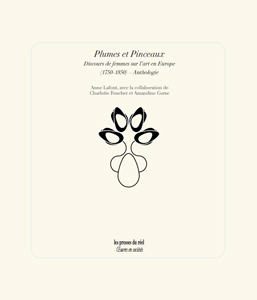 Si Germaine de Staël et Marceline Desbordes-Valmore sont connues pour leurs réflexions sur l’art, d’autres écrits et pensées de femmes des années 1750-1840 en France, mais aussi en Angleterre et en Allemagne, le sont moins, ou pas du tout. C’est un florilège de ces voix qui est donné à lire dans ces pages : de Mme de Beaumer à Edmée de Syva, en passant par Félicité de Genlis (dont sont publiés ici deux textes inédits, Essai sur les arts et Catalogue pittoresque du cabinet de tableaux de Monsieur le comte de Sommariva), Élisabeth Vigée-Lebrun, Helmina von Chézy, Anne Plumptre, parmi une quinzaine d’autres. Journalistes, critiques d’art, artistes ou voyageuses curieuses et averties visitant les musées européens avec passion, elles usent de tous moyens littéraires, pour faire entendre des positions esthétiques, morales, voire politiques sur l’art et
son histoire. Elles portent un regard aigu, mais pourtant jamais univoque, sur les grands événements de leur temps – de la Révolution
française à la conquête napoléonienne et à ses conséquences –, et sur
l’art et la création artistique.
At Sotheby’s | Treasures, Princely Taste
Press release from Sotheby’s:
Treasures, Princely Taste (L12307 )
Sotheby’s, London, 4 July 2012
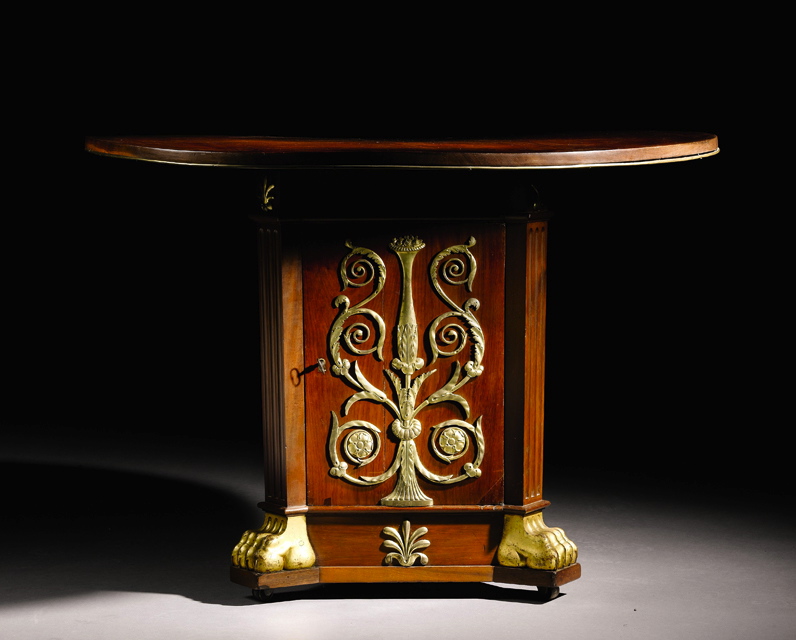
A gilt-bronze-mounted mahogany table “À l’Antique” designed by Jacques-Louis David (1748-1825), attributed to Georges Jacob (1739-1814), Louis XVI circa 1785-89 (est. £200,000-300,000). Photo: Sotheby’s.
Sotheby’s London will hold its third Treasures, Princely Taste auction on 4th July, 2012 (L12307) . The sale will comprise an outstanding selection of rare and important furniture, silver, objets de vertu and tapestries, many with aristocratic provenance and each displaying the remarkable qualities of princely taste. The centrepieces of the sale are a historic gilt-bronze-mounted table by Jacques-Louis David (est. £200,000-300,000), which appears in a painting by David in the collection of the Louvre Museum, and the Shah of Persia’s golden elephant automaton clock, an 18th-century, British-made technical marvel and a dazzling sight (est. £1-2 million). The sale comprises 42 lots, which are estimated to realise a total in excess of £12 million. Mario Tavella, Sotheby’s Deputy Chairman, Europe, comments: “Each of the masterpieces in this, our third offering of Treasures, Princely Taste, has its own compelling story to tell. In the case of the table designed by Jacques-Louis David, its history is recorded for posterity in a painting in the Louvre which communicates not just its sophisticated craftsmanship, but the extraordinary partnership between one of France’s greatest 18th-century ébénistes and one of the greatest painters of the day. The extraordinary Shah of Persia’s Elephant Automaton, was created specifically to redress the yawning trade balance between Britain and China. All the works we have selected reflect connoisseurs’ continued demand for the very finest pieces at the top-end of the market. Many of these spectacular and meticulously sourced works have aristocratic provenances, and represent the very pinnacle of the decorative arts of their era.”
Sale Highlights

Jacques-Louis David, The Lictors Bring to Brutus the Bodies of His Sons, 1789 (Paris: Louvre)
A gilt-bronze-mounted mahogany table À l’Antique designed by Jacques-Louis David (1748-1825), attributed to Georges Jacob (1739-1814), Louis XVI circa 1785-89 (est. £200,000-300,000). This exceptional table appears in David’s famous painting Les Licteurs rapportent a Brutus les corps de ses fils of 1789, in the Louvre. David designed and commissiond various pieces of furniture to use in his paintings. These were executed by the prominent Parisian cabinet-maker, Georges Jacob, who crafted the chairs for Marie-Antoinette’s laiterie at Rambouillet. The table can be considered as one of the most important precursors of what would be defined as the Empire style. A brass plaque inside the pedestal tells that the table was left to David’s great
granddaughter by David’s grandson, Jules David Chassagnol.
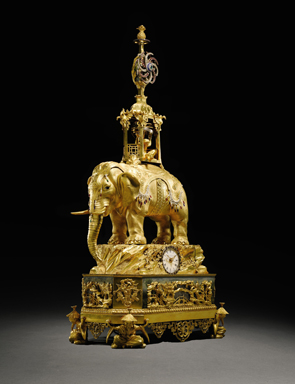
The Shah of Persia’s Elephant Automaton Clock – George III paste-set ormolu musical automaton clock, ca 1780, signed by Peter Torckler (est. £1-2 million). Photo: Sotheby’s.
The Shah of Persia’s Elephant Automaton Clock – A George III paste-set ormolu musical automaton clock, circa 1780, signed by Peter Torckler (est. £1-2 million). This magnificent automaton clock of a rare and impressive scale stands over one metre tall and was probably acquired by Naser al-Din Shah of Persia (1831–96) in London in the 1890s. The Shah had been mesmerized by similar clocks he saw while visiting Baron Ferdinand de Rothschild at Waddeson Manor in 1889. It typifies the intriguing and inventive objects produced in London by skilled British craftsmen in the second half of the 18th century and would have originally been destined for the Chinese market. Promoted by the East India Company, such objects played a key role in lessening the trade deficit between Britain and China and were articles of tribute in Chinese society, where gifts flowed through the official hierarchy, passing through the system to superiors and eventually, the Emperor. Similarly ornate elephant figures were frequently found throughout the Chinese Imperial Palaces and a large number remain in the Palace Museum, Beijing. The iconography of an elephant supporting a vase on its back forms
the auspicious rebus Daping Jingxian, or Daping Youxian,
representing the message of Peace and Harmony.

Sèvres soft-paste porcelain vases, with gilt-bronze mounts attributed to Pierre-Philippe Thomire (1751-1843), ca 1788-90 (est. £600,000-1,000,000). Photo: Sotheby’s.
A pair of important gilt-bronze-mounted Sèvres soft-paste porcelain vases, almost certainly supplied by the marchand-mercier Dominique Daguerre, the mounts attributed to Pierre-Philippe Thomire (1751-1843), circa 1788-1790 (est. £600,000-1,000,000). This magnificent pair of vases is exceptional in both form and decoration. The rare sky-blue colour was developed specifically for Louis XVI and Marie-Antoinette by the Royal Manufacture of Sèvres, during the king’s building and decoration of his Rambouillet estate. The design is by celebrated Parisian marchand-mercier Dominique Daguerre, who was the chief supplier to the court of Louis XVI, while the finely cast and chased gilt-bronze mounts can be almost certainly attributed to Pierre-Philippe Thomire, the renowned bronzier who made pieces for Louis XVI’s bedchamber at Compiègne and for Marie-Antoinette’s apartments at Versailles.
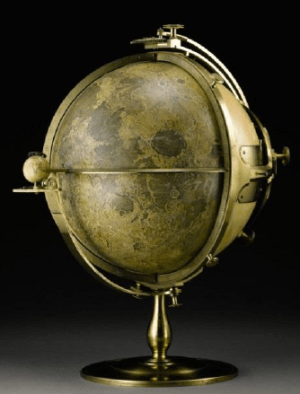
George III 12-inch diameter Selenographia, ca 1797 (est. £200,000-300,000). Photo: Sotheby’s.
A George III 12-inch diameter Selenographia, circa 1797 (est. £200,000-300,000). John Russell R.A., who patented this ‘moon globe’ in 1796, was a highly successful society portraitist, Royal Academician and painter to King George III and the Prince of Wales. Russell had a passion for astronomy and was so “stricken by the beauty of the Moon” that he devoted considerable time to observing, mapping and drawing it. This Selenographia apparatus accurately depicts the Moon, while a small globe of the Earth demonstrates the oscillations of the Moon in relation to the planet. The globe was first purchased by George O’Brien Wyndham, the 3rd Earl of Egremont (1751-1837), who also had an interest in science. The Earl’s mistress, ‘Mrs Wyndham’, was also a lady of great scientific repute and for whom much scientific equipment was purchased, so it is possible that it may have been purchased with her in mind. Only a few examples of Selenographia globes are known to have survived, and are currently held in prominent science museums in London, Oxford and Madrid as well as other private collections. (more…)
Exhibition | The Horse: From Arabia to Royal Ascot
While you probably wouldn’t know it from the description provided below, the eighteenth century is a major theme for this exhibition on horses at The British Museum — with a good showing of Stubbs, including Letitia, Lady Lade from the Royal Collection, but other treats, too. I found it immensely instructive, one of the most interestingly layered exhibitions I recall seeing in a long time. There’s something for everyone — antiquity and the role of the horses in early civilizations and empires of Mesopotamia and Egypt, extraordinary Persian and Mughal miniatures, textiles, equestrian rock art (photographed in stunning detail), paintings, books, portraiture, agrarian history, and sport. The challenge, however, is not simply putting together a varied exhibition but imparting coherence, and given just how much is covered in this relatively modest sized show, it succeeds brilliantly, appropriately acknowledging both the Diamond Jubilee and the Olympics without being obsequious to either one. It also offers, I think, an example of how projected photographs and video can be used effectively in an exhibition without taking over or supplanting the objects on display. For better or worse, I’m guessing we’ll see lots more moving images in the exhibitions of the future. Integrating that technology thoughtfully into the larger intellectual program of a show is a tall order. The Horse: From Arabia to Royal Ascot offers a start and plenty else besides.
-Craig Hanson
◊ ◊ ◊ ◊ ◊
From The British Museum:
The Horse: From Arabia to Royal Ascot
The British Museum, London, 24 May — 30 September 2012
Curated by John Curtis and Nigel Tallis
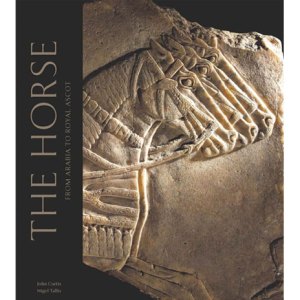 The history of the horse is the history of civilisation itself. The horse has had a revolutionary impact on ancient civilisations and this major exhibition explores the influence of horses in Middle Eastern history, from their domestication around 3,500 BC to the present day. Britain’s long equestrian tradition is examined from the introduction of the Arabian breed in the 18th century to present day sporting events such as Royal Ascot and the Olympic Games.
Important loans from the British Library, the Fitzwilliam Museum and the Royal Armouries, as well as rare material from Saudi Arabia, will be seen alongside objects from the British Museum’s exceptional collection, including famous pieces such as the Standard of Ur and Achaemenid Persian reliefs. Supported by the Board of Trustees of the Saudi Equestrian Fund, the Layan Cultural Foundation and Juddmonte Farms. In association with the Saudi Commission for Tourism & Antiquities. (more…)
Call for Papers | AAH 2013 at Reading
From AAH:
39th Annual Association of Art Historians Conference
University of Reading, 11-13 April 2013
Proposals due by 12 November 2012
 AAH2013 will represent the interests of an expansive art-
historical community by covering all branches of its discipline/s and the range of its visual cultures. Academic sessions will reflect a broad chronological range, as well as a wide geographical one. We will address topics of methodological, historiographical, and interdisciplinary interest as well as ones that open up debates
about the future of the discipline/s.
Keynote Speakers: Adrian Forty (Professor of Architectural History, The Bartlett, University College London) and Okwui Enwezor (Curator and Director of Haus der Kunst, Munich)
If you would like to propose a paper for one of the sessions listed below, please follow the proposal guidelines outlined on the paper proposal form.
◊ ◊ ◊ ◊ ◊
The following selections might be relevant for dixhuitièmistes. A full list of panels along with descriptions is available here (as a PDF file).
• (In)formal Networks and the Professionalisation of Art and Design History: Conversations with art and design historians
Liz Bruchet (Voices in Art History) and Joanne Gooding (Design History Society)
• Painted Gladiatrices: Women, art and the 18th-century social arena
Heather Carroll and Lauren Puzier (Sotheby’s)
• Landscape and Economy
Kevin Chua (Texas Tech University) and Ross Barrett (University of North Carolina)
• Poster Session
Susan Grange (Independent) and Lawrence Buttigieg (Independent)
• The Art History of the Animal
Alastair Harden (University of Reading)
• Ceremonial and the City
Caroline Arscott (Courtauld Institute of Art) and Pat Hardy (Museum of London)
• Rhythm in Art and Life
Michelle Ying-Ling Huang (Hong Kong Baptist University) and Charlotte de Mille (Courtauld Institute of Art)
• ‘Action Painting’: The theatrical and the dramatic in narrative art
Mark Ledbury (University of Sydney) and Andrei Pop (University of Basel)
• Shut your Eyes! Iconophobia in the modern era
Sarah Lippert (University of Michigan-Flint)
• The Permanence of the Transient: Precariousness in art
Camila Maroja (Duke University) and Caroline Menezes (University of the Arts – UAL)
• The Knowing Gaze: The shifting role of the connoisseur and connoisseurship in art and its histories
Jordan Mearns (University of Edinburgh Jordan) and Tom Denman (University of Reading)
• Into the Light: The changing significance of light in art, design and architecture
Melissa Miles (Monash University)
• The Imaginary Drinker: Bodies and beverages in art and society
Frédérique Desbuissons (Institut national d’histoire de l’art) and Edward Payne (Courtauld Institute of Art)
• From Utopian Teleologies to Sporadic Historiographies: ‘Interfaces’ of art and cybernetics
Maia Toteva (Montana State University) and Jennifer Way (University of North Texas)
• Twitchers: Birds and art
Tracey Warr (Oxford Brookes University), Paul Kilsby (Oxford Brookes University), and Clair Chinnery (Oxford Brookes University)
• Photography and the Histories of Sculpture: What role has photography played in forming sculpture’s place in art history?
Lisa Le Feuvre (Henry Moore Institute) and Jon Wood (Henry Moore Institute)
• Student Session: Collaboration
Sibyl Fisher (University of Leeds)
• Visualising Architecture: Fictive buildings c.1300 – c.1750
Amanda Lillie (University of York)
• Sculpture and the Sea: Figureheads and ship sculpture
Alison Yarrington (University of Hull), Douglas Hamilton (University of Hull and Maritime Historical Studies Centre), and Julia Kelly (University of Hull)
• Museums & Exhibitions Session: Curating the Book: Exhibiting books, archives and manuscripts
Layla Bloom (Stanley & Audrey Burton Gallery, University of Leeds) and Ben Thomas (University of Kent)










leave a comment