Call for Papers | The Permissive Archive
From CELL:
The Permissive Archive: A CELL Conference
Queen Mary, University of London, early November 2012
Proposals due by 31 July 2012
For ten years, the Centre for Editing Lives and Letters has pioneered original archival research that illuminates the past for the benefit of the modern research community, and beyond. To celebrate this anniversary, in early November 2012 we will be holding a conference examining the future of the ‘Permissive Archive’. The scope of archival history is broad, and this conference seeks presentations from a wide range of work which opens up archives – not only by bringing to light objects and texts that have lain hidden, but by demystifying and demonstrating the skills needed to make new histories. Too long associated with settled dust, archival research will be championed as engaged and engaging: a rigorous but permissive field.
We welcome proposals for papers on any aspect of early modern archival work, manuscript or print, covering the period 1500 – 1800. Topics may include, but are not limited to:
 • The shape of the archive – ideology and interpretation
• The permissive archive: its definition and its past, present and future
• Alternatives to the permissive archive
• Archival research as discovery or construction
• The archive which challenges or disrupts
• Uncatalogued material – how to find it, how to access it, how to use it
• New findings
• Success and failure
• Broken or dispersed collections
• The archive and the environment
• The archivist and the historian
• The ethics of the archive
• The comedy of the archive
• Order and anarchy
Please send 300-word proposals to hjgrahammatheson@gmail.com by 31 July 2012. Submissions are not limited to the 25-minute paper. CELL will be holding a work-shop on the use of archival materials, and we are keen to hear from scholars with ideas for alternative presentations such as group sessions, trips or guided walks. Submissions will be peer-reviewed by Professor Lisa Jardine.
Display | The Comte de Vaudreuil: Courtier and Collector
I included notice of this display in April, but here’s a bit more information, including a portion of the wall text. -CH
From the National Gallery of Art:
The Comte de Vaudreuil: Courtier and Collector
National Gallery, London, 7 March — 12 June 2012
 The Comte de Vaudreuil (1740–1817) was one of the leading courtiers and collectors of paintings in Paris during the 1780s. This display features Dutch and Flemish Old Master paintings in the National Gallery’s collection that were once owned by Vaudreuil or were in Parisian collections at that time. Vaudreuil’s collection provides an example of the decoration of wealthy homes in pre-Revolution Paris. Reflecting the fashion of the time, the paintings are hung according to their size and symmetry rather than by subject or chronology.
The Paintings
The display features paintings from the Comte’s collections by artists Jan Wijnants, Jacob van Ruisdael, Jan Steen and Adriaen van Ostade. Alongside these are works that were in French collections in the same period by artists Nicolaes Berchem, Aelbert Cuyp, Willem van de Velde and Gabriel Metsu. The paintings show a variety of subjects, from portraits of peasants to social life in 17th-century Holland to landscapes with ruined castles.
From the Wall Text of the Display
Vaudreuil gained his position in Parisian society thanks to his aristocratic status and the wealth generated from his sugar plantations in the French colony of Saint-Domingue (now Haiti). His advancement at court was secured through the purchase of military office and by his friendship with the Duchesse de Polignac, the favourite of the queen, Marie-Antoinette.
Vaudreuil’s collection provides an example of the decoration of wealthy homes in Paris during this period. The largest part of it comprised Dutch and Flemish Old Master Paintings, four of which are displayed here alongside other Northern paintings then in Parisian collections. Reflecting the fashion of the time, they are hung according to size and symmetry rather than by subject of chronology (see also the display of pictures in Danloux’s Baron de Besenval in his Salon de Compagnie, Room 33).
In 1784 Vaudreuil decided to sell his Italian, Dutch, and Flemish works in order to focus his interest extensively on French paintings. His collection comprised both works by fashionable contemporary artists, such as a version of David’s Oath of the Horatii [now in the Toledo Museum of Art], and those from the past, including Poussin’s Bacchanalian Revel before a Term (Room 19).
Checklist
• François-Hubert Drouais, Le Comte de Vaudreuil, 1758
• Willem van de Velde, Dutch Ships in a Calm, ca. 1660
• Aelbert Cuyp, A Herdsman with Five Cows by a River, ca. 1650-55
• Nicolaes Berchem, Peasants with Cattle Fording a Stream, 1670s
• Gabriel Metsu, An Old Woman with a Book, ca. 1660
• Jan Wijnants, A Landscape with a Dead Tree, 1659 [from Vaudreuil’s collection]
• Adriaen van Ostade, A Peasant Holding a Jug and a Pipe, ca. 1650-55 [from Vaudreuil’s collection]
• Jan Steen, Skittle Players outside an Inn, probably 1660-63 [from Vaudreuil’s collection]
• Jacob van Ruisdael, A Ruined Castle Gateway, ca. 1650-55 [from Vaudreuil’s collection]
• Nicolaes Berchem, Peasants by a Ruined Aqueduct, 1655-60
◊ ◊ ◊ ◊ ◊
 Usually on display in Room 15 are paintings by Claude and J.M.W. Turner. Claude’s Seaport with the Embarkation of the Queen of Sheba and Landscape with the Marriage of Isaac and Rebecca are shown with Turner’s Dido Building Carthage and Sun Rising through Vapor, as stipulated in the latter’s will. All four pictures were part of the exhibition, Turner Inspired: In the Light of Claude in the National Gallery’s Sainsbury Wing. The exhibition was itself useful for the eighteenth century in terms of collectors’ interest in Claude and the eighteenth-century origins of Turner’s work.
Conference | Curiosly Drawn: Eary Modern Science as a Visual Pursuit
From the Royal Society’s website:
Curiously Drawn: Early Modern Science as a Visual Pursuit
Royal Society, London, 21-22 June 2012
Science produces some of the most intriguing and arresting images in modern culture, from wildlife photographs to scanning electron microscope images. Yet the historical links between scientific research and visual representation are not always apparent. This conference brings together historians of science and art in order to examine the relationship between science and visual culture in the first hundred years of the Royal Society. We hope that the meeting will demonstrate how art, artists, and print-makers enabled creativity and innovation in science, and the extent to which naturalists and natural philosophers, in turn, transformed visual resources and strategies into something of their own.
This meeting is supported by the AHRC as part of an international network on ‘Origins of science as a visual pursuit: the case of the early Royal Society’. Relevant printed books and manuscripts from the Royal Society’s collections will be on display during the meeting.
Registration details are available here»
◊ ◊ ◊ ◊ ◊
Thursday, 21 June
10:00 Registration and coffee
10:30 Sachiko Kusukawa (University of Cambridge), Welcome and Introduction
11:00 Paula Findlen (Stanford University), The Specimen and the Image: John Woodward, Agostino Scilla, and the Depiction of Fossils
12:00 Kim Sloan (The British Museum), Sir Hans Sloane’s Pictures: The Science of Connoisseurship or the Art of Collecting?
1:00 Lunch
2:00 Domenico Bertoloni-Meli (Indiana University, Bloomington), Disease in the Philosophical Transactions
3:00 Urs B. Leu (Zentralbibliothek Zürich), Swiss Mountains and English Scholars: Johann Jacob Scheuchzer’s Contributions to the Philosophical Transactions of the Royal Society
4:00 Tea
4:30 Scott Mandelbrote (University of Cambridge), Illustrating the History of the Earth
5:30 Opportunity to view the exhibition
6:00 Public lecture by John Barrow (FRS), Pictures, Images, and Visualization in Science
Friday June 22
9:30 Nathan Flis (Oxford University), Barlow’s Pursuits: Pictures of Birds and Beasts before the Era of Modern Scientific Illustration
10:30 Coffee
11:00 Lorraine Daston (Max-Planck Institute for the History of Science, Berlin), Super-Vision: Weather Watching across Space and through Time at the Early Royal Society and Académie Royale des Sciences
12:00 Matthew Hunter (McGill University), Joshua Reynolds, the Royal Society, and the Temporally-Evolving Chemical Object in the British Enlightenment
1:00 Lunch
2:00 Michael Hunter (Birkbeck, University of London, Emeritus), Commentary
3:00 Further avenues of research
◊ ◊ ◊ ◊ ◊
Correction: An earlier version of this posting, following a preliminary programme, did not include the title for John Barrow’s talk, and Matthew Hunter’s presentation was described as ‘Commentary’.
Film | A Royal Affair
Inspired by, though not based upon, Per Olov Enquist’s 1999 novel The Visit of the Royal Physician, A Royal Affair (En kongelig affære) brings the eighteenth-century Danish court to cinema screens this summer. As noted at Screen Daily (19 May 2011), much of this $8million film was shot in the Czech Republic. For more information, consult the film’s website.
◊ ◊ ◊ ◊ ◊
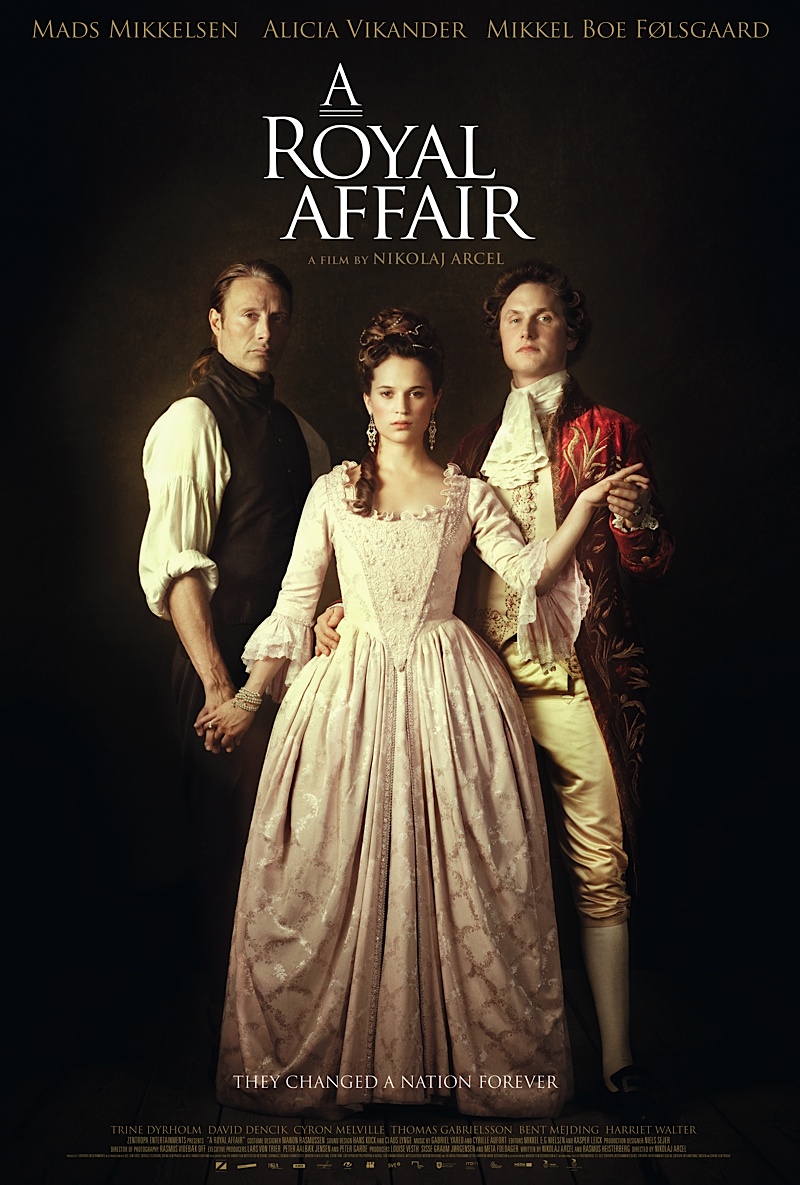 Winner of the Best Actor and Best Screenplay awards at the Berlin Film Festival, and written and directed by Nikolaj Arcel (co-writer of The Girl with the Dragon Tattoo), A Royal Affair is an epic tale of a passionate and forbidden romance that changed an entire nation.
Denmark, 1766, and Caroline Mathilde is married to the mad and politically ineffectual King Christian VII. Ignored by the wild King who chooses to live scandalously, Caroline grows accustomed to a quiet existence in oppressed Copenhagen. When the King returns from a tour of Europe accompanied by Struensee, his new personal physician, Queen Caroline finds an unexpected ally within the kingdom. The attraction between the two is initially one of shared ideals and philosophy, but it soon turns into a passionate and clandestine affair.
Committed to the ideals of the Enlightenment that are banned in Denmark, Struensee convinces the King to assert his previously untapped power to remove the conservative political council and implement drastic changes to Danish society. As the Court plot their return to power and the downfall of the Queen and Struensee, the consequences of their affair are made clear and the entire nation will be changed forever.
Director’s Statement
A Royal Affair is based on one of the most dramatic events in Danish and indeed European history; whenever I used to pitch the film to foreign investors, people had a hard time believing that the story was true, that these momentous events had actually happened in the late 1700s. In Denmark however, it is taught in school, more than 15 books have been written about it (both factual and fictional) and there has even been an opera and a ballet. I feel honored and extremely lucky to finally bring the full story to the screen.
Tonally, I was inspired by the great epics from the 40s and 50s where films would often feel like literary works, structured around characters and the passage of time, and not clearly following the obvious screenplay roadmaps. But my creative team and I were also fired up by the idea of bringing the Scandinavian historical drama into the new century. We wanted to achieve this by adhering to a self imposed rule; we didn’t want to ‘show’ history, didn’t want to dwell pointlessly on the big official events, the fancy dresses and hairdos, or the way the food was served.
Rather, we wanted people to simply experience the story through the eyes of the characters, taking the 1760s for granted. Even though the period is obviously there in the set designs, the costumes (Mikkel Foelsgaard who plays King Christian still insists our tagline should have been ‘Big emotions, Big wigs’), it was filmed and edited as we would have filmed and edited a film taking place in modern Copenhagen.
Finally, Gabriel Yared and Cyrille Aufort’s beautiful score has brought the film full circle, and home to its epic roots.
— Nikolaj Arcel
Call for Papers | Art and Its Afterlives at The Courtauld
From The Courtauld:
Fourth Early Modern Symposium: Art and Its Afterlives
The Courtauld Institute of Art, London, 17 November 2012
Proposals due by 1 July 2012
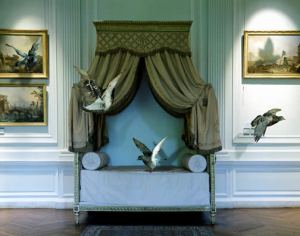
Karen Knorr, The Green Bedroom of Louis XVI. © Eric Franck Fine Art
Art and Its Afterlives aims to address the ways in which the work of art continues to resonate after its creation. While much art history takes as its focus the initial facture of the work of art, this one-day symposium explores what happens to early modern art after the moment of its making. How did early modern works continue to be created in their display, preservation, and reception from the moment of their creation on? Papers will examine how art is shaped by its afterlives – whether these collect, curate, cut up, cut out, copy or correct it – and the ways in which art both persists and changes through time as a material object, a field of generative meaning, and a subject of debate and interpretation. Material, technical and social histories as well as theoretical approaches drawn from the discipline of art history and other fields of the humanities
are welcome. Accounts from curatorial practice and the field
of museology are also encouraged. (more…)
Forthcoming | ‘London: A Social and Cultural History’
Robert Bucholz, Professor of History at Loyola University Chicago, has been teaching a thematic course on London for years (a version is available at The Great Courses). Long dissatisfied with the available options for texts, he finally decided — with his co-author Joseph Ward — to write one. With its emphasis on the experience of living in early modern London and the varied lives of the city’s residents, the book is good news for anyone trying to fit the city into a semester. -CH
◊ ◊ ◊ ◊ ◊
From Cambridge UP:
Robert O. Bucholz and Joseph P. Ward, London: A Social and Cultural History, 1550–1750 (New York: Cambridge University Press, 2012), 415 pages, ISBN: 9780521896528, $28.
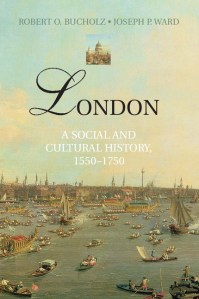 Between 1550 and 1750 London became the greatest city in Europe and one of the most vibrant economic and cultural centres in the world. This book is a history of London during this crucial period of its rise to world-wide prominence, during which it dominated the economic, political, social and cultural life of the British Isles, as never before nor since. London incorporates the best recent work in urban history, contemporary accounts from Londoners and tourists, and fictional works featuring the city in order to trace London’s rise and explore its role as a harbinger of modernity, while examining how its citizens coped with those achievements. London covers the full range of life in London, from the splendid galleries of Whitehall to the damp and sooty alleyways of the East End. Readers will brave the dangers of plague and fire, witness the spectacles of the Lord Mayor’s Pageant and the hangings at Tyburn, and take refreshment in the city’s pleasure-gardens, coffee-houses and taverns.
Contents
Introduction: London’s Importance
1. London in 1550
2. The Socioeconomic Base
3. Royal and Civic London
4. Fine and Performing Arts
5. The Public Sphere and Popular Culture
6. The People on the Margins
7. Riot and Rebellion
8. Plague and Fire
Conclusion: London in 1750
New Title | ‘London in the Eighteenth Century’
From the Random House Group:
Jerry White, London in the Eighteenth Century: ‘A Great and Monstrous Thing’ (London: Bodley Head, 2012), 704 pages, 9781847921802, £25.
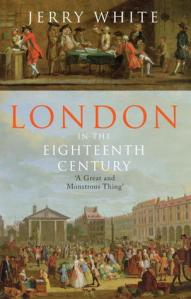 London in the eighteenth century was very much a new city, risen from the ashes of the Great Fire. With thousands of homes and many landmark buildings destroyed, it had been brought to the brink. But the following century was a period of vigorous expansion, of scientific and artistic genius, of blossoming reason, civility, elegance and manners. It was also an age of extremes: of starving poverty and exquisite fashion, of joy and despair, of sentiment and cruelty. Society was fractured by geography, politics, religion and history. And everything was complicated by class. As Daniel Defoe put it, London really was a ‘great and monstrous Thing’.
Jerry White’s tremendous portrait of this turbulent century explores how and to what extent Londoners negotiated and repaired these open wounds. We see them going about their business as bankers or beggars, revelling in an enlarging world of public pleasures, indulging in crimes both great and small – amidst the tightening sinews of power and regulation, and the hesitant beginnings of London democracy.
In the long-awaited finale to his acclaimed history of London over 300 years, Jerry White introduces us to shopkeepers and prostitutes, men and women of fashion and genius, street-robbers and thief-takers, as they play out the astonishing drama of life in eighteenth-century London.
Exhibition | Measuring the Universe and the Transit of Venus
The last transit of Venus was in 2004, but the next one won’t occur until 2117. From Captain Cook’s first voyage to the construction of the Kew Observatory, these celestial events were enormously important in the eighteenth century: 1761 and 1769 (click on either date for details at the Royal Society’s website). For a sense of just how important, see the eighteenth-century bibliography compiled by Utrecht’s Institute for History and Foundations of Science. -CH
◊ ◊ ◊ ◊ ◊
From Royal Museums Greenwich:
Measuring the Universe: From the Transit of Venus to the Edge of the Cosmos
Royal Observatory Greenwich, London, 1 March — 2 September 2012

Royal Observatory, Greenwich, photographed on 24 July 2006 (Wikimedia Commons)
On 5-6 June 2012 a very rare astronomical event takes place: the planet Venus will pass directly between the Earth and the Sun, appearing as a small black dot against the face of our parent star. These transits of Venus occur in pairs eight years apart, but each pair is separated by more than a century. The last one was in 2004 and, after June 2012, the next won’t be until December 2117.
Historically, transits of Venus were used by astronomers to give the first accurate measure of the distance between the Earth and the Sun. To be sure of observing these twice-in-a-lifetime events expeditions were sent around the world in the 18th and 19th centuries and the story involves many famous characters. Captain Cook was sent to Tahiti to observe the transit of 1769, and King George III had Kew Observatory built so that he could view the transit himself (the telescope he used will be on display in the Royal River exhibition at the National Maritime Museum).
By the 21st century the distance to the Sun was well-established, with confirmation by radar studies and space missions. But the 2004 transit still excited the interest of the press and public and was even the subject of a series of photographs by Turner Prize-winning artist Wolfgang Tillmans, some of which can be seen in the Royal Observatory’s free exhibition Measuring the Universe. And now the idea of transits has acquired a new significance for astronomers as they are used to discover new planets orbiting distant stars.
◊ ◊ ◊ ◊ ◊
As Paul Cockburn writes for Time Out London (28 May 2012) . . .
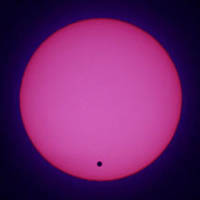
2004 transit of Venus taken from the Royal Observatory
‘This one really is your “last chance to see”,’ explains Dr Marek Kukula, public astronomer at the Royal Observatory, Greenwich. ‘The next one is not until December 2117 – very few, if any, people alive today are going to see that.’
‘When watching a planet slide in front of the Sun, the mechanics of the heavens are laid open for anyone to see,’ Kukula says. And, as the exhibition Measuring the Universe, currently running at the Royal Observatory, explains, the transit of Venus has played an important historical role in helping astronomers calculate the size of the solar system.
‘In the eighteenth century, the transits were among the first examples of international big science collaborations,’ says Kukula. ‘Despite a lot of national tensions within Europe, scientists were communicating with each other across borders. These were also early examples of government-sponsored science; Captain Cook’s first voyage to the South Seas was funded so that he could observe the 1769 transit from Tahiti.’ On the way back, of course, he went on to discover New Zealand and Australia.
There were practical considerations in all this. ‘By measuring the transit accurately, you gained a new level of understanding in how the heavens worked, and that actually was very useful for navigation,’ says Kukula. ‘Even in the eighteenth century, though, the observations were not quite good enough to really nail it. For the nineteenth-century transits – in 1874 and 1882 – you have Greenwich sending out numerous expeditions around the world. Armed with photography, they can at last make accurate observations.’ . . .
The full article, with directions for safe viewing, is available here»
‘Gloriana’ to Lead the Flotilla for the Diamond Jubilee in London

The Gloriana launched in April 2012; from Leon Watson’s
story for the Mail Online, 19 April 2012; Photo by David Parker
◊ ◊ ◊ ◊ ◊
From The BBC (19 April 2012)
The £1m boat that will the lead the Thames Diamond Jubilee Pageant has been launched on the river. The 94ft (28.6m) royal barge Gloriana was escorted through the streets of London on the back of a truck. It had been transported from a unit in Brentford to Isleworth, west London, where it was placed in the Thames. A pageant of more than 1,000 boats involving some 20,000 people will sail down the river on 3 June to mark the Queen’s 60 years on the throne. . . .
Lord Sterling said: “I became enamoured with the idea of building something timeless and got inspiration from Canaletto’s paintings that showed the great barges of the 18th Century and decided to build one. If we had to give it a style, it would be Regency. Including 18 rowers, it will carry 52 people. No-one’s really built anything like this for 200 years and the way we’ve built it, it will last for 200 years if looked after” . . .
◊ ◊ ◊ ◊ ◊
From the official event website:

Photo from ‘Luxatic’; click image to access the article.
On Sunday 3rd June 2012, over one thousand boats will muster on the River Thames in preparation for Her Majesty The Queen to take part in the Thames Diamond Jubilee Pageant. The formal river procession will be between 2pm and 6pm, starting upriver of Battersea Bridge and finishing downriver of Tower Bridge. The boats will muster between Hammersmith and Battersea and disperse from Tower Bridge to West India Docks.
It will be one of the largest flotillas ever assembled on the river. Rowed boats and working boats and pleasure vessels of all shapes and sizes will be beautifully dressed with streamers and Union Flags, their crews and passengers turned out in their finest rigs. The armed forces, fire, police, rescue and other services will be afloat and there will be an exuberance of historic boats, wooden launches, steam vessels and other boats of note.
The flotilla will be bolstered with passenger boats carrying flag-waving members of the public placed centre stage (or rather mid-river) in this floating celebration of Her Majesty’s 60 year reign. The spectacle will be further enhanced with music barges and boats spouting geysers. Moreover, there will be specially constructed elements such as a floating belfry, its chiming bells answered by those from riverbank churches.
The opening ceremony of London’s Olympic Games will be just six weeks away and the public that crowd the riverbanks and bridges will give a rousing reception to the many boats that have travelled from far and wide to represent UK port cities, the Commonwealth countries and other international interests. Downriver of London Bridge, there will be a gun salute and the flotilla will pass through a spectacular Avenue of Sail made by traditional Thames sailing boats, oyster smacks, square riggers, naval vessels and other impressive ships.
The Thames Diamond Jubilee Pageant celebrates Her Majesty’s 60 years of service by magnificently bringing the Thames to life; making it joyously full with boats, resounding with clanging bells, tooting horns and sounding whistles; recalling both its royal heritage and its heyday as a working, bustling river.
Exhibition | ‘Shelf Lives: Four Centuries of Collectors’
Two of the collectors from this Cambridge exhibition come from the eighteenth century: John Moore (1646-1714) and George Lewis (d. 1729), as noted below. From the exhibition website:
◊ ◊ ◊ ◊ ◊
Shelf Lives: Four Centuries of Collectors and Their Books
Cambridge University Library, 18 January — 16 June 2012
 With more than eight million items on its shelves, Cambridge University Library is one of the largest accumulations of books and manuscripts in Europe, and one of the most important in the world. But its holdings are not a single, uniform entity: instead they consist of a great variety of different collections which, over the centuries, by one route or another, have come to be housed under the same roof. Some of the most remarkable of these are the collections gathered by ardent individual book-lovers, whose intensely personal passions for acquiring rare and beautiful volumes have, through the eventual deposit of their treasures in the Library, gone on to enrich the national heritage.
This exhibition presents ten such collectors, whose lives span the sixteenth to the twentieth centuries. As well as placing on display some of the most splendid, distinctive and—in a few cases—unexpected items held in the Library, it allows us to observe the changing motives, fashions and tastes of book-collectors over the course of four hundred years.
◊ ◊ ◊ ◊ ◊
Great Industry, Accurate Judgement and Royal Favour: John Moore
John Moore (1646–1714), an undergraduate of Clare College and later Bishop of Norwich (1691–1707) and Ely (1707–1714), was one of the greatest bibliophiles of his day, celebrated for his collection of early English ‘black letter’ printing. The range of manuscripts and early printed books he acquired reflected the breadth of his interests, above all in medicine.
After he died, on 31 July 1714 (one day before Queen Anne), the collection was bought by King George I at Lord Townshend’s suggestion and presented to the University as a reward for Cambridge’s loyalty to the Hanoverian succession during the Jacobite rebellion of 1715. It was known henceforth as the Royal Library. The manuscripts include such treasures as the Moore Bede and the Book of Cerne, and number among them some of the most valuable items in the Library. Yet in many cases comparatively little is known about their origins and provenances: the Library’s greatest accession of all remains in large part mysterious.
◊ ◊ ◊ ◊ ◊
The Archdeacon and his ‘Bibliotheca Orientalis’: George Lewis
George Lewis’s valuable collection of 76 manuscripts, mainly in Persian, came to the Library in 1727 in a wooden cabinet inscribed ‘Bibliotheca Orientalis’.
Lewis (d. 1729) was educated at Queens’ College in the 1680s and subsequently entered the Church. He travelled to India in 1692 where he was Chaplain to the East India Company settlement in Madras until 1714. He was a gifted linguist, proficient in Persian, and during his stay in India he collected manuscripts which closely reflected his own interests and expertise. The collection is strong in religious texts (Qur’ans and translations of the Bible into Persian), manuscripts on grammar, and dictionaries, including Lewis’s own unfinished dictionary of Persian. Significantly, there are texts by poets such as Hātifī and Jāmī and a rare volume by Rahā’ī—the literary traditions of the Islamic world were little known in Europe at this date.
Along with the manuscripts came an assortment of curiosities: coins, weights, inscriptions, miniature Indian playing cards on wood and tortoiseshell, and a pair of embroidered slippers.
◊ ◊ ◊ ◊ ◊
For more information, see the exhibition website.










1 comment