Iza Wojciechowska on Polish Palaces for The NY Times
From The NY Times:
Iza Wojciechowska, “Palace Hopping in Poland,” The New York Times (15 June 2012). . .
 WHEN I was a little girl living in Texas and visited my family in Poland, my grandfather would always take us to palaces. He had been an art historian and curator of a couple of the palaces around Warsaw during some of Poland’s bleakest years of Communism, and even though I was too young to understand that era, or much of Poland’s complicated history, I knew that through these palaces, something about Poland and its once-luxurious glory had been preserved. My imagination conjured images of princesses running through lavishly decorated hallways and grand, echoing rooms.
There are about 250 palaces in the province that surrounds Warsaw and about 2,800 throughout all of Poland. Most were built for kings or aristocrats in the 17th and 18th centuries; since then, government ministries have restored many of them, which now serve as museums. . .
The full article is available here»
Forthcoming | French Funerary Arts and Tomb Cult, 1750-1870
Due out in September from Ashgate:
Suzanne Glover Lindsay, Funerary Arts and Tomb Cult: Living with the Dead in France, 1750–1870 (Aldershot: Ashgate, 2012), 260 pages, ISBN: 9781409422617.
Even before the upheaval of the Revolution, France sought a new formal language for a regenerated nation. Nowhere is this clearer than in its tombs, some among its most famous modern sculpture-rarely discussed as funerary projects. Unlike other art-historical studies of tombs, this one frames sculptural examples within the full spectrum of the material funerary arts of the period, along with architecture and landscape. This book further widens the standard scope to shed new and needed light on the interplay of the funerary arts, tomb cult, and the mentalities that shaped them in France, over a period famous for profound and often violent change. Suzanne Glover Lindsay also brings the abundant recent work on the body to the funerary arts and tomb cult for the first time, confronting cultural and aesthetic issues through her examination of a celebrated sculptural type, the recumbent effigy of the deceased in death. Using many unfamiliar period sources, this study reinterprets several famous tombs and funerals and introduces significant enterprises that are little known today to suggest the prominent place held by tomb cult in nineteenth-century France. Images of the tombs complement the text to underline sculpture’s unique formal power in funerary mode.
Contents
Introduction: Revisiting 18th- and 19th-Century French Tombs
1. Reforming Funerary Cult in France, 1750–1870
2. 18th-Century France: Rethinking Sculpture and the Body
3. The Bonchamps Project: Reinventing the Effigy Tomb
4. Louis-Philippe’s Tombs: Burying a Modern Royal Family
5. The Poetics of the Exhumed Corpse I: A Tomb for Napoléon
6. The Poetics of the Exhumed Corpse II: The Cavaignac Tomb
Bibliography
Index
New Title | Treasures of Chinese Export Ceramics
From Yale UP:
William R. Sargent, with an essay by Rose Kerr, Treasures of Chinese Export Ceramics from the Peabody Essex Museum (New Haven: Yale University Press), 568 pages, ISBN: 9780300169751, $65.
 Beginning in the sixteenth century when Portuguese traders started importing blue and white porcelain to Europe, Chinese ceramics manufacturers produced goods specifically for export to the West. The industry flourished through the early twentieth century as the market for fine porcelain expanded in Europe and the Americas. Among the Peabody Essex Museum’s founders in 1799 were sea captains and supercargoes involved in extensive trade with Asia, and many of the remarkable examples of export wares they brought back provided a foundation for the Museum’s world-renowned collection of Chinese export ceramics.
Written by William R. Sargent, a leading expert in the field, Treasures of Chinese Export Ceramics is one of the most authoritative sources on this topic. Its scholarly entries on 287 representative objects that date from the fifteenth to the twentieth century are divided into sections by type of ware. Although these examples only hint at the Museum’s vast holding, together they encompass its broad range of Chinese export ceramics. An essay on Jingdezhen, the “Porcelain City,” by Rose Kerr, a glossary of ceramics terminology, and appendix on armorials, and an extensive bibliography all contribute to making this an invaluable resource.
William R. Sargent is the former H. A. Crosby Forbes Curator of Asian Export Art at the Peabody Essex Museum. Rose Kerr is Curator Emeritus of the Far Eastern Collection of Chinese Ceramics at the Victoria and Albert Museum, London.
Workshops on Sloane’s Treasures: A Plan for Reconstructing Sloane
I was lucky enough to attend the second workshop for the Sloane’s Treasures Project, held on 31 May at The British Museum, and I’m thrilled at the prospects of this massive research programme. The benefits will be enormous for a wide range of audiences. In addition to the following description from the BM’s website, see the advertisement for two collaborative doctoral awards. -CH
◊ ◊ ◊ ◊ ◊
Sloane’s Treasures
The Natural History Museum, The British Museum, The British Library, London, 2012
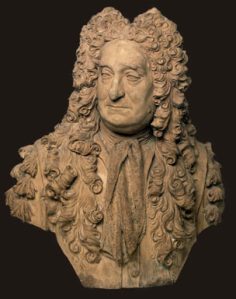 From the time of his voyage to Jamaica in the 1680s, Sir Hans Sloane (1660-1753), physician, natural historian and man of letters, began to gather together one of the largest and most comprehensive collections of ‘natural and artificial rarities’ ever formed. Sloane was later Physician to Queen Anne, George I and II, President of both the Royal College of Physicians and the Royal Society, and his manor in Chelsea included the Apothecaries’ Garden (now the Chelsea Physic Garden). At the centre of a worldwide network, he created an encyclopaedic collection of mineral, botanical, and zoological specimens, ethnographic objects, antiquities, prints, drawings, books and manuscripts, often inheriting or purchasing entire collections formed by others.
On his death in 1753 Sloane’s collection was acquired for the nation by an Act of Parliament which created the British Museum. But as the Museum re-organized its collections and acquired further objects, Sloane’s collection was dispersed among different departments and eventually also to the Natural History Museum in 1881 and to the British Library in 1973. This dispersal has hindered the study and understanding of ‘Sloane’s Treasures’, their sources, and their historical relationships with each other. This project will begin to address these problems.
Between February and September 2012, an Advisory group will be formed, workshops with invited attendees will be held (Natural History Museum, April, British Museum, May and British Library, July) and reports created, including recommendations for a larger project. The constitution of the Advisory group, summaries and videos of parts of the workshops, and updates on their outcomes will be made available, and news of project developments, including information on other research and public events related to Sloane and his collections, will be published here. If you are working on a Hans Sloane-related project or have an associated research or public engagement idea, contact a member of the project team.
Project Team
• Kim Sloan, Curator of British Drawings and Watercolours before 1880, The British Library, Department of Prints and drawings
• JD Hill, Research Manager
• Arnold Hunt, Curator of Modern Historical Manuscripts, The British Library
• Julie Harvey, Manager, Centre for Arts and Humanities Research, The Natural History Museum
Collaborative Doctoral Awards | Reconstructing Sloane
Collaborative Doctoral Award Studentships: Reconstructing Sloane
Applications due 29 June 2012; must be available for interview on 19 July 2012
 Applications are invited for two Collaborative Doctoral Award studentships, available under the rubric Reconnecting Sloane: Texts, Images, Objects, to commence in Autumn 2012. The first CDA will be at King’s College London/The British Library and will focus on the correspondence (i.e. ‘texts’) of Sir Hans Sloane. The second will be at Queen Mary University London/The Natural History Museum and will focus on Sloane’s vegetable substances (i.e. ‘objects’). A third has already been awarded and will be at King’s College London/The British Museum and will focus on Sloane’s natural history drawings (i.e. ‘images’).
Together the CDAs will explore and develop our understanding of Sir Hans Sloane and his contribution to eighteenth-century intellectual life through his activities as a physician, collector, natural philosopher and man of letters. The Research Programme aims to examine the role of a major early Enlightenment collection, and its collector, in the making of knowledge about nature. Sir Hans Sloane’s (1660-1753) extensive collection of texts (in print and manuscript), images (paintings, drawings and prints) and objects (including specimens and herbaria) formed the founding collection of the British Museum (BM) in 1753, but was subsequently dispersed, primarily to the British Library (BL) and the Natural History Museum (NHM). For Sloane and his contemporaries, the collection would have been understood as a whole, and its uses would have involved working between texts, images and objects. The programme’s three linked studentships – each of which will be conducted with the partner organization that now holds the part of Sloane’s collection that will be studied – will aim to ‘Reconnect Sloane’ by examining the making and use of this collection in terms of the specific material within it – texts, images and objects – and also the connections between materials. Working across the separate collections in the way this will provide new insight into Sloane’s role in the making of natural knowledge.
The deadline for applications is 29th June, and you must be available for interview on 19th July. For more information on how to apply, please see the attached documents included below. Please note, the AHRC has strict residential eligibility criteria governing the students that can be nominated for this award. If you are not a British citizen and/or not usually resident in the UK (and have not been for the past three years), please check your eligibility and discuss this with the project supervisors so that your eligibility can be determined.
Catalogue of Cleveland’s Portrait Miniatures Published Online
Press release from The Cleveland Museum of Art:
◊ ◊ ◊ ◊ ◊
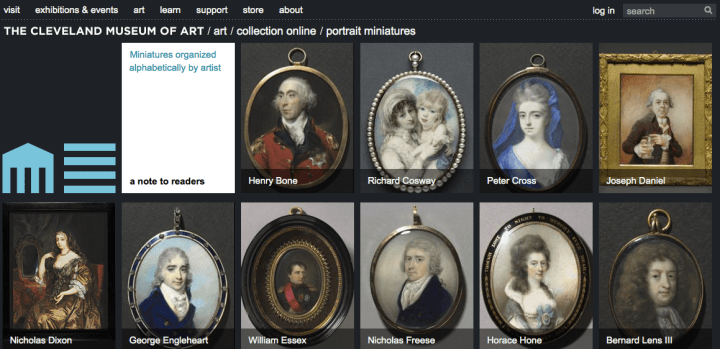
The Cleveland Museum of Art announces its pilot project in digital publishing, British Portrait Miniatures from the Cleveland Museum of Art. This catalogue showcases a substantial portion of the museum’s internationally known collection of around 170 portrait miniatures, one of the most significant in the country. The first stage of this searchable online catalogue includes 54 British portrait miniatures from the 17th, 18th, and 19th centuries, with publication of the remaining British works ongoing though out the year. The catalogue presents new research on the individual miniatures, explores the museum’s collection holistically and incorporates comparative images of works from other public and private collections. The miniatures catalogued online can be viewed at actual size, from the front and the back, and in unprecedented detail.
Authored by Cory Korkow, PhD, a Paintings and Drawings Society curatorial fellow whose initial research was funded by grants from the Samuel H. Kress Foundation, the catalogue includes new research about the artists, sitters, and successive owners of these miniatures, while incorporating conservation photographs and allowing the collection be studied in great detail for the first time. “This innovative project illustrates not only our deep commitment to original scholarly research on our collection, but our creativity in the presentation and dissemination of that knowledge,” said David Franklin, the Sarah S. and Alexander M. Cutler director.
Access to the British Portrait Miniatures catalogue is available here» (more…)
Queen Lovisa Ulrika’s memorial cup
Press release from Sweden’s National Museum:
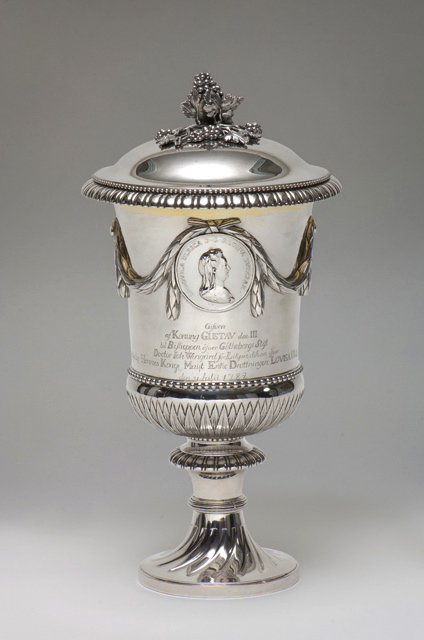
Pehr Zethelius, Queen Lovisa Ulrika’s Memorial Cup, silver, ca. 1782. Photo: Hans Thorwid/Nationalmuseum.
Queen Lovisa Ulrika’s memorial cup was donated to the museum at the annual meeting of the Friends of Nationalmuseum. This unique object was made by silversmith Pehr Zethelius and presented as a memento to Johan Wingård, Bishop of Gothenburg, in thanks for the funeral sermon that he gave for the deceased Queen in 1782.
The existence of Queen Lovisa Ulrika’s memorial cup, donated by the Friends of Nationalmuseum, has been unknown to most people until now. The silver cup is an impressive size and weighs almost three kilos, as befits a sister of King Fredrik the Great of Prussia. The rediscovery of the memorial cup adds an important jigsaw piece to the history of Swedish design at the Nationalmuseum. At the same time, this magnificent piece is an example of the long royal tradition of presenting an expensive gift to the key officials at ceremonies of state such as christenings and funerals.
The Dowager Queen Lovisa Ulrika died at Svartsjö Palace on 16 July 1782 and was buried in Riddarholmen Church on 31 July. The funeral sermon was given by Chaplain to the Queen Johan Wingård, Bishop of Gothenburg. In thanks for this, he was given this specially commissioned cup, which was then passed down through the family. The craftsman who made the memorial cup was Pehr Zethelius (1740-1810), a leading light in Swedish silversmithing during the late 18th century. Pieces from his workshop show both high artistic and technical quality. Zethelius became a real trendsetter and was responsible for introducing new styles from the Continent.
The memorial cup was donated in memory of Henry Montgomery (1927-2010), chairman of the Friends of Nationalmuseum from 1982-1994. The Barbro and Henry Montgomery Donation Fund was established in 1998 and is managed by the Friends of Nationalmuseum.
Exhibition | Napoleon: Revolution to Empire
Press release from the NGV:
Napoleon: Revolution to Empire
National Gallery of Victoria, Melbourne, 2 June — 7 October 2012
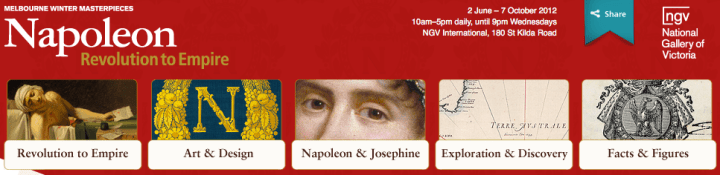
On 2 June 2012 the National Gallery of Victoria will opened this year’s spectacular Melbourne Winter Masterpieces exhibition, Napoleon: Revolution to Empire, examining French art, culture, and life from the 1770s to the 1820s. Its story runs from the first French voyages of discovery to Australia during the reign of Louis XV to the end of Napoleon’s transforming leadership as first Emperor of France.
Premier and Minister for the Arts Ted Baillieu said, “Now a well-established highlight of our major events calendar, the Melbourne Winter Masterpieces series has set the benchmark for blockbuster exhibitions in this country. I’m pleased to welcome the latest installment, Napoleon: Revolution to Empire. Through hundreds of priceless treasures, never before seen in Australia, this exhibition brings to life the legend one of history’s most extraordinary and complex figures. It’s another great Melbourne exclusive, another tourism drawcard for Victoria and another stunning exhibition for the NGV.”
This panoramic exhibition features nearly 300 works, dating from the 1770s to the 1820s, objects of breathtaking opulence and luxury – from paintings, drawings, engravings, sculpture, furniture, militaria, textiles, porcelain, gold and silver, fashion and jewellery.
Dr Gerard Vaughan, Director NGV, said, “Napoleon: Revolution to Empire continues the tradition of spectacular NGV exhibitions which have become a winter highlight in Victoria’s cultural calendar. This year visitors will be intrigued by the life of Napoleon, a man who held the world captive to his ambition. He had a vision of a united Europe, but a Europe controlled by France and united through conquest. Napoleon is well known as a master military strategist; this exhibition reveals that he was also a passionate lover and dedicated patron of the arts, sciences and literature.”
Napoleon: Revolution to Empire explores, amongst other themes, the stormy period of social change forced upon France through the outbreak of the French Revolution, the execution of Louis XVI and Marie-Antoinette, and the rise to power of the young Napoleon Bonaparte and his new wife Josephine, as the couple worked to cement their place as France’s new political and social leaders.
Ted Gott, Senior Curator International Art, NGV said, “World leaders in the Age of Exploration, Napoleon and Josephine were a true power couple- famous and stylish. The stunning artworks and objects in this exhibition illustrate their belief that the advancement of knowledge was integral to social order; they welcomed scientists and artists to receptions and dinners where world affairs were reshaped under their rule.”
Personal items will give visitors a glimpse into an extravagant private world of the couple. Jewels owned by Josephine, Napoleon’s personal weapons, lavish furniture from private residences and a lock of Napoleon’s hair feature alongside spectacular decorative objects, bejewelled gifts given to dignitaries, military uniforms and a beautiful court dress- the only surviving garment worn at Napoleon’s coronation ceremony in 1804.
Napoleon: Revolution to Empire also considers the enormous cultural and scientific contact between Australia and France from the 1770s to the 1820s. This is a story that is not often told. Both Napoleon and Josephine were captivated by Australia, which had newly entered the world’s imagination following the publication of Captain Cook’s travels. The exhibition tells the story of how this fascination spurred Napoleon to fund a voyage in 1805 that collected information about the continent and produced the first map of the southern Australian coastline with the land we now know as Victoria, but which was at the time first named Terre Napoléon (Napoleon Land). French voyages to Australia returned with collection’s of Australian flora and fauna, much specifically earmarked for the hothouses and enclosures of Napoleon and Josephine’s country residence Malmaison. Captivating works in the exhibition show kangaroos, black swans and a range of native Australian plants in the grounds of this quintessentially French estate.
Organised in partnership with the Fondation Napoléon in Paris, who are lending many of their greatest works, the exhibition also features incomparable treasures drawn from Europe’s most important Revolutionary and Napoleonic collections, including the Château de Malmaison, Château de Versailles, Musée Carnavalet and Musée de l’Armée in France, the Napoleonmuseum Thurgau in Switzerland, and the Museo Napoleonico in Rome.
More information is available at the exhibition website.
◊ ◊ ◊ ◊ ◊
From the NGV:
Catalogue: Ted Gott and Karine Huguenaud with contributing authors, Napoleon: Revolution to Empire (Melbourne: National Gallery of Victoria, 2012), 336 pages, ISBN: 9780724103560 (hardback) /978072410355-3 (paperback).
 This panoramic volume tells the story of French art, culture and life from the 1770s to the 1820s: the first French voyages of discovery to Australia, the stormy period of social change with the outbreak of the French Revolution, and the rise to power of the young Napoleon Bonaparte and his wife Josephine. Together the couple defined taste for a new century, and in the age of exploration developed a particular fascination for Australia. As well as telling the remarkable story of France’s close involvement with Australia in the early 1800s, Napoleon: Revolution to Empire showcases hundreds of works of breathtaking opulence and luxury. Featuring insightful writing by world-renowned historians of Napoleonic art and design, this authoritative publication celebrates the vital contributions to the visual arts made by Napoleon as first Emperor of France.
New Title | ‘Don’t Ask for the Mona Lisa’
This small book looks useful not only for those new to working on exhibitions but also as a model for how a conference session with real-world application could be shaped into a publication and made available to a larger audience through print-on-demand (POD) services like Lulu.com. –CH
◊ ◊ ◊ ◊ ◊
From the AAH:
Heather Birchall and Amelia Yeates, Don’t Ask for the Mona Lisa: Guidelines for Academics on How to Propose, Prepare, and Organise an Exhibition (London: Association of Art Historians, 2012), 36 pages, ISBN: 9780957147706, £5 (hardcopy) / £3 (PDF download), available at Lulu.com.
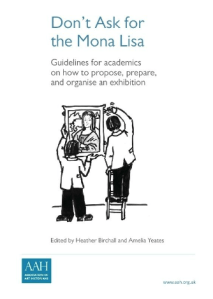
36 pages, ISBN: 9780957147706
The writing and publication of these guidelines was prompted by an event held by the Committee of the Museums & Exhibition Members Group of the Association of Art Historians (AAH), at the AAH Annual Conference at Manchester Metropolitan University in 2009. The session, entitled Curators Don’t Bite, attracted a large crowd of academics and museum professionals eager to hear about the experiences, both positive and negative, of other academics and curators who had organised exhibitions. Following the event, it was clear that there was a demand for some advice on how to propose exhibitions and, once a show had been agreed, the practicalities of working with curators and other museum staff. This publication therefore aims to provide an introduction to key aspects of exhibition curation, from the early planning stages to the design and opening of the show.
Of course, every exhibition is different and, whilst this document cannot cover every aspect of exhibition planning, it does provide assistance to those organising both small-scale and large exhibitions, as well as offering guidance on working with paintings, sculptures, and contemporary installations. Whether your exhibition is to be held at a large venue, such as Tate Britain, with a team of curators, conservators, and technicians, or a smaller institution with only one or two members of staff, the intention of the authors has been to outline the possible eventualities and responsibilities associated with exhibition planning.
The first part of this publication gives guidance on why and how to propose an exhibition, and offers general advice on exhibition planning and installation. It describes the roles performed by certain staff members in galleries and museums, and the responsibilities they carry when an exhibition is being put together. Some technical terms are highlighted in bold in the main text, and defined in the
margin.
The second part comprises case studies by academics who have worked on exhibitions for both large organisations, such as Birmingham Museum and Art Gallery, and small venues, including the Henry Moore Institute. This section also includes an interview with an exhibition designer that sets out some of the demands of fitting the design around the show’s theme, and sheds light on how to create a space that doesn’t overwhelm the exhibits.
At a time when museums and galleries are constantly tightening their budgets, a page at the end of this publication includes a list of funders to be approached if the museum’s budget cannot cover all the costs associated with the show, such as producing a catalogue or organising an associated study day or conference. Although the publication is primarily aimed at academics, and also freelances and students who may be considering putting together an exhibition proposal, we hope that it will also be useful for curators in the early stages of their careers working in a museum or gallery.
Information on ordering a copy is available here»
Call for Entries | Travellers’ Conceptions of Unlikely Creatures
As noted at Le Blog de L’ApAhAu:
Dictionnaire des créatures mythiques, légendaires et improbables des voyageurs
Proposals due 15 August 2012; completed entries for approved topics due 31 January 2013
Le but de ce dictionnaire serait, dans la lignée du numéro spécial consacré par la revue Chemin d’étoiles, dirigée par Emeric Fisset et Julie Boch, au Bestaire des voyageurs, de présenter les créatures humaines et animales, aperçues, décrites, imaginées, rêvées ou fantasmées par les voyageurs de l’Antiquité au XXIe siècle.
Parmi ces créatures et parmi une liste non exhaustive figureront le Géant patagon, le nain fuégien, le Lapon, le Hottentot, le Niam-Niam, l’Amazone, le Sciopode, le Blemye, le Garamante, le Monoculus, la Sirène, le Kraken, le Lézard du Cap, la Vache marine, l’Ile baleine… Les notices devront allier informations scientifiques et anecdotes. Le style devra être vif, alerte, éviter le jargon. Le lecteur devra pouvoir en même temps se cultiver et se distraire.
Il s’agira pour chacune d’entre elles de remonter à ses origines, de présenter ses représentations, de mettre en évidence leur évolution et leur fortune, dans la culture populaire, dans la culture littéraire et dans la culture scientifique ; dans l’imaginaire des voyageurs comme dans l’imaginaire collectif appréhendé de manière plus globale.
Toutes les personnes désireuses de rédiger une ou plusieurs notices sont priées de m’indiquer la ou les notices sur lesquelles elles souhaiteraient travailler, au plus tard au 15 août, afin que Valérie Dumeige et moi-même puissions établir la liste des entrées. Une fois celle-ci établie et les notices confirmées avec chaque auteur, les textes, établis suivant le protocole indiqué ci-dessous, devront m’être adressés au plus tard le 31 janvier 2013 par courriel à l’adresse suivante : dominiquelanni@yahoo.fr (more…)










leave a comment