Eighteenth-Century Accessories Exhibition in Aarhus, Denmark
As noted at Fashioning the Early Modern (thanks to Kimberly Chrisman-Campbell for pointing it out) . . .
Shoes and Accessories: Fashion and Frills in the 1700s
Den Gamle By (The Old Town), Aarhus, Denmark, 9 March — 30 December 2012
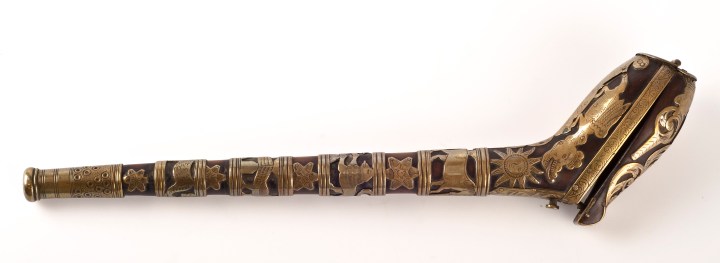
Holder for chalk pipes, eighteenth century
◊ ◊ ◊ ◊ ◊
The style specialists at Den Gamle By have gone trend-spotting, bringing you the hottest accessories and the coolest gadgets for fashionable ladies and gents to flaunt in high society. Must-haves of the 1700s include silk fans with the latest in ivory fan-sticks, practical chalk-pipe cases, English pocket watches, and silk slippers à la Madame de Pompadour, the style icon of the era. For an intimate look at eighteenth-century extravagance, complete with fashion tips from the 1700s, visit Shoes and Accessories at Den Gamle By. Be there, or be square! On show at the Mintmaster’s Mansion – a grand house from the 1700s with marble-painted Baroque Italian staircase and hand-printed Rococo wallpaper.
Call for Papers: AAH Student Symposium

AAH Summer Symposium 2012 Art and Science: Knowledge, Creation and Discovery
The Linnean Society of London, Burlington House, 28-29 June 2012
Proposals due by 29 April 2012
Though their academic paradigms may at first seem diametrically opposed, the association between the arts and the sciences has survived renaissances, revolutions and beyond. This intellectual conjunction has motivated artistic practice and production throughout history, forming the conceptual nucleus of some of the most stimulating forms of creative expression. By engaging with this inter-relationship, we hope to address the assumed divisions that have kept the arts and sciences as separate areas of academic enquiry, whilst at the same time questioning if such an alliance is necessary or profitable for either discipline.
As well as considering general ideas of artistic and scientific collaboration, this year’s Summer Symposium will investigate the interaction between art and science throughout artistic practice, theory and history. Topics for papers could include, but are not limited to:
- Artists who work directly or indirectly with science
- Medical and anatomical images, diagrams, and the art of science
- Architecture and the body
- Histories of collection, taxonomies, display and acquisition in the arts and sciences
- The role of the science of perception in the development of perspective, figuration and abstraction
- The idea of the modern as related to science and technology
- The figure of the polymath
- Neuroscience and histories of vision
- Photography between science and art
- Mathematics and beauty – the Golden Section
- Technology and the evolving dissemination of art history
- Science in art historical conservation and research
Papers should be 20 minutes in length and abstracts of no more than 300 words should be submitted with a brief biography to: aah.art.science@gmail.com by 29 April 2012. The conference is open to all but speakers need to be student AAH members.
Symposium Organisers
Arlene Leis, University of York, acl914@interfree.it
Rebecca Norris, University of Cambridge, rn290@cam.ac.uk
Freya Gowrley, University of Edinburgh, f.l.gowrley@gmail.com
Call for Papers: Third Annual Feminist Art History Conference
Third Annual Feminist Art History Conference
American University, Washington D.C., 9-11 November 2012
Proposals due 15 May 2012
This conference builds on the legacy of feminist art-historical scholarship and pedagogy initiated by Norma Broude and Mary D. Garrard at American University. To further the inclusive spirit of their groundbreaking anthologies, we invite papers on subjects spanning the chronological and geographic spectrum to foster a broad dialogue on feminist art-historical practice. Speakers may address such topics as: artists, movements, and works of art and architecture; cultural institutions and critical discourses; practices of collecting, patronage, and display; the gendering of objects, spaces, and media; the reception of images; and issues of power, agency, gender, and sexuality within visual cultures.
Sessions and keynote will be held on AU’s campus with additional events at the National Museum of Women in the Arts in conjunction with its 25th Anniversary celebration
Keynote address
“Guess Who’s Coming to Dinner? Feminism, Art History and the Story of a Book”
Whitney Chadwick, Professor Emerita of Art History, San Francisco State University
Please submit via email a one-page, single-spaced proposal and two-page curriculum vita by May 15, 2012 to fahc3.cfp@gmail.com. Notification of acceptance by July 1, 2012
Sponsored by the Art History Program, Department of Art, College of Arts and Sciences at American University
Organizing committee: Kathe Albrecht, Juliet Bellow, Norma Broude, Kim Butler, Mary D. Garrard, Namiko Kunimoto, Helen Langa, and Andrea Pearson
Material World Conference at Peabody Essex Museum
From the PEM:
A Material World: The Art and Culture of Global Connections
Peabody Essex Museum, Salem, Massachusetts, 22 March 2012
 Join us for a dynamic symposium that explores how the global movement of objects — luxury goods, traded commodities and diplomatic gifts — created an increasingly interconnected world from the 1500s to the 1800s. How did these works shape people’s ideas about the wider world? What can these works continue to tell us about early global networks? Nine international speakers focus on different cross-cultural connections in this daylong program highlighting works of art from PEM’s collection.
◊ ◊ ◊ ◊ ◊
S P E A K E R S
Donna Pierce (Denver Art Museum), Chinese Export Silk and Porcelain in Colonial Mexico
Daniel Finamore (Peabody Essex Museum), Mexican Featherwork Fan for the Spanish Market, Early 1600s
Susan Stronge (Victoria and Albert Museum, London), Foreign Luxuries at the Mughal Court
Giorgio Riello (Warwick University), Portrait of Two English Boys in Asian Clothing by Tilly Kettle, 1780s
Jean Michel Massing (University of Cambridge, England), Luso-African Ivories: A New Provenance
Karina Corrigan (Peabody Essex Museum), Chinese Export Lacquer and Enamel Furniture, 1730s
Timon Screech (School for Oriental and African Studies, London), Linnaeus and the Origin of Japanese Numismatics
Christina Hellmich (Fine Arts Museums of San Francisco), Alaskan Overcoat Owned by the King of the Hawaiian Islands, Given to PEM before 1821
Anne Gerritsen (Warwick University, England), Things in Global Context: Mr Nobody Comes Home
◊ ◊ ◊ ◊ ◊
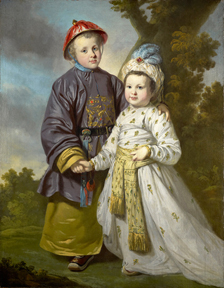
Tilly Kettle (1734-1786), "Portrait of Two English Boys in Asian Clothing," 1780s (Peabody Essex Museum)
This daylong program concludes with a cocktail reception. Registrants will also have the opportunity to attend PEM’s mid-winter Evening Party and opening for FreePort [No. 005]: Michael Lin following the reception. Learn more about FreePort [No. 005]: Michael Lin
Reservations by March 15
Members $85, nonmembers $95, students with ID $20
For more information, call 978-542-1625 or email symposium@pem.org
Related lecture — Timothy Brook, Vermeer’s Hat: The Seventeenth Century and the Dawn of the Global World, Wednesday, March 21.
A Material World: The Art and Culture of Global Connections is sponsored in part by a grant from the Arts and Humanities Research Council (UK). The AHRC grant has funded a two-year international academic partnership exploring global commodities and the material culture of early modern connections, 1400-1800. Partner institutions include Warwick University, Coventry, England; The Victoria and Albert
Museum, London, England; Bilgi University, Istanbul, Turkey; and the
Peabody Essex Museum, Salem, Massachusetts, USA.
Farrow & Ball at the Met
I realize this exhibition — which I’ve not seen but have heard terrific things about — hardly falls in the eighteenth century — even a really long eighteenth century. But I’m completely intrigued by Farrow & Ball’s sponsorship and their use of the support in advertising. I received an email a few days ago, noting the precise paint colors with links to the company’s website (to be clear, I was already on their email list). In some ways this makes perfect sense to me, and the partnership is far less intrusive or annoying than other forms of support; personally, I’m quite glad to know the colors. And yet, the arrangement still somehow feels funny to me. Maybe this has been going on for years, and I’ve just never noticed (it would hardly be the first instance of that). -CH
◊ ◊ ◊ ◊ ◊
From Farrow & Ball:
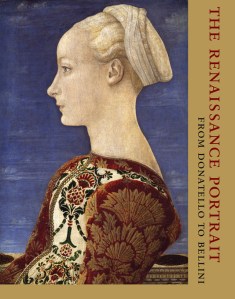 Farrow & Ball paint colours are used around the world to adorn the walls of some of the most prestigious properties and art galleries. Visit them at:
The Metropolitan Museum of Art, New York
The Renaissance Portrait from Donatello to Bellini
December 21, 2011 to March 18, 2012
The Metropolitan Museum of Art hosts an exhibition celebrating the first great age of portraiture in Europe. Farrow & Ball paint colours Black Blue, Down Pipe, Studio Green, Mouse’s Back, Light Gray and Hague Blue provide a fitting backdrop to approximately 160 works, by artists including such masters as Donatello, Filippo Lippi, Botticelli and Bellini. The works of art on display range from exquisite painting and manuscript illumination to marble sculpture and bronze medals from the 15th Century.
At Christie’s: Old Masters Week in New York
At Christie’s, New York, 25 January 2012, Old Master Paintings (Sale 2534)
◊ ◊ ◊ ◊ ◊
Pompeo Girolamo Batoni, Portrait of a Gentleman, oil on canvas, 39 x 29 in. (99 x 73.6 cm.) — estimate, $400,000-600,000, sold for $866,500.
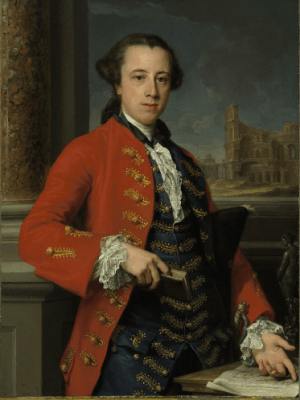 Three-quarter-length, in a red coat and a blue waistcoat with gold embroidery, holding a book and a tricorn hat, with a bronze statuette of the Venus de’ Medici on the table, the Colosseum in the distance.
Provenance
(Possibly) by descent within the Tew family.
Mr. J. Eyles; Christie’s, London, 17 December 1904, lot 111, as ‘Van Loo’ (36 gns. to Shepherd).
Anonymous sale; Sotheby’s, London, 5 July 1984, lot 272.
with Leger Galleries, London, 1990, where acquired by the present owner.
While the sitter in this portrait remains unidentified, his dress – particularly his scarlet coat – suggests that he was one of the many Grand Tourists who had their likeness captured by Batoni during their stay in Rome. The perfect souvenir of an educational voyage to the Italian peninsula, this painting presents the young gentleman as the consummate, erudite aristocrat. . . .
The full entry is available here»
◊ ◊ ◊ ◊ ◊
Giambattista Tiepolo, The Arrival of Henry III at the Villa Contarini, oil on canvas, 28¼ x 42 in. (71.7 x 106.7 cm.) — estimate, $4-6million, sold for $5.9million.
 Provenance
Count Francesco Algarotti, Venice, by 1756.
Wilhelm Rothschild, Schloss Grünberg, Frankfurt am Main, and (presumably) by descent to his daughter, Adelheid de Rothschild, and by descent in the Rothschild family;
Confiscated in Paris by the Einsatzstab Reichsleiter Rosenberg following the Nazi Occupation of Paris, May 1940;
Acquired for Hermann Goering on 4 December 1941 (inv. RM 1150);
Transferred to the Munich Collecting Point by Western Allied Forces (MCCP no. 6759);
Repatriated to Paris on 19 September 1946. Baron Edmond de Rothschild, Château de Prégny, Geneva, until 1980.
with Colnaghi’s, London, 1981, where acquired by S.T. Fee, Oklahoma City; Christie’s, New York, 9 May 1985, lot 20.
with Newhouse Galleries, New York, from whom acquired by the present owner.
Henri de Valois (1551-1589), third son of Henri II and Catherine de Medici, was elected King of Poland in May 1573, but it would not be until January of the following year that he would arrive at the Polish border and 21 February 1574 before he would be crowned in Warsaw. Less than four months later, Henry would abdicate the throne and depart Poland in unseemly haste, returning to France upon the news that his elder brother, Charles IX, had died and the French throne was his to claim. He was to be crowned Henri III, King of France, at the Cathedral of Reims on 13 February 1575.
Henri returned home by way of Vienna and Venice. He arrived in Venice on 18 July 1574 and stayed for ten days of official festivities and sightseeing. His welcome in front of the church of San Nicolò on the Lido was a lavish affair for which Palladio erected a triumphal arch and open loggia supported by ten Corinthian columns. This temporary loggia was decorated with scenes from the young king’s life painted by Tintoretto and Veronese and the ceiling was decorated with winged victories carrying wreaths as if to crown Henri when he passed beneath them. . . .
The full entry is available here»
◊ ◊ ◊ ◊ ◊
Andrea Locatelli, The Roman Forum, oil on copper, 29 x 37 in. (73.7 x 94 cm.) — estimate, $300,000-500,000, sold for $1,082,500.
 Provenance
Liechtenstein family collections, Vienna.
with Hazlitt, Gooden & Fox, London, 1997-1998, from whom acquired by Christian B. Peper.
This luminous view of the Roman Forum was almost certainly painted as a pendant to the View of the Piazza Navona with a market (fig. 1), signed and dated 1733, that was given to the Gemäldegalerie der Akademie der Bildenden Künste, Vienna by the estate of Prince Johann of Liechtenstein in 1881. Both compositions share the same dimensions and large copper support, which Locatelli only used on rare occasions. In fact, both panels stand out in the artist’s oeuvre as part of a remarkably small group of topographically accurate view paintings. In addition to the Vienna panel, Locatelli’s other known vedute reali are the pair of large perspective views of the projected Castello di Rivoli that the artist painted for another illustrious patron, (Castello di Racconigi, Turin), a view of the Tiber with the Ponte Rotto (Städtische’s Museum-Gemäldegalerie, Wiesbaden), and a View of the Tiber with the Castel Sant’Angelo (private collection, Rome).
The Vienna panel represents the same view from the piano nobile of the Palazzo Massimo Lancelotti that, working a generation earlier, Gaspare Vanvitelli had employed for a series of paintings datable from 1688 to 1723 (for an example, see lot 39 of this sale). In no small part due to Bernini’s unforgettable Four Rivers Fountain and the magnificent undulating façade of Borromini’s Sant’Agnese church, that the Piazza Navona became one of the most popular squares in Rome in the seventeenth and eighteenth centuries, and was often represented by view painters. The present composition appears to be entirely conceived by Locatelli and its pairing with the Piazza Navona is uncommon – views of the Piazza Navona were most frequently paired with views of the piazza of Saint Peter’s. . . .
The full entry is available here»
Art, Agency, Empire: India in Global Contexts
From the YCBA:
Art, Agency, Empire: India in Global Contexts — Graduate Student Symposium
Yale Center for British Art, New Haven, 11 February 2012

Edward Lear, "Kangchenjunga from Darjeeling," detail, 1879 (New Haven: Yale Center for British Art)
This one-day graduate student symposium is informed by the recent proliferation of projects on India’s visual and material culture, including two exhibitions that opened at the Center in the fall of 2011: Johan Zoffany RA: Society Observed (October 27, 2011– February 12, 2012), which includes a substantial section devoted to the works the artist produced during his residence in India, between 1783 and 1789; and Adapting the Eye: An Archive of the British in India, 1770–1830 (October 11–December 31, 2011), which concentrated on the complex networks of British and Indian artists, patrons, and scholars in the late eighteenth and early nineteenth centuries.
Art, Agency, Empire: India in Global Contexts explores how, in a postcolonial period, it has become increasingly pressing to reevaluate India as a site of multifarious cultural (indeed intercultural) production, which has provoked global responses across media. The symposium is free and open to the public; registration is required. Online registration is available from January 16 to February 9, 2012. Onsite registration is available on February 11 from 8:30 am.
The program will include papers by graduate students (listed here) as well as breakout sessions in the Johan Zoffany exhibition and Center’s collections.
◊ ◊ ◊ ◊ ◊
Keynote Lecture, 5:30 pm
Gillian Forrester (Curator of Prints and Drawings Yale Center for British Art)
In the Cock-Pit: Zoffany and the Performance of Empire in India
Exhibition: Colorful Realm in Washington
Thanks to Courtney Barnes at Style Court for noting this one. From the National Gallery of Art:
◊ ◊ ◊ ◊ ◊
Colorful Realm: Japanese Bird-and-Flower Paintings by Itō Jakuchū (1716–1800)
National Gallery of Art, Washington, D.C., 30 March — 29 April 2012
 Celebrating the centennial of Japan’s gift of cherry trees to the nation’s capital, this exhibition features one of Japan’s most renowned cultural treasures, the 30-scroll set of bird-and-flower paintings by Itō Jakuchū. Titled Colorful Realm of Living Beings (J. Dōshoku sai-e; c. 1757–1766), these extraordinary scrolls are being lent to the National Gallery of Art by the Imperial Household. Their exhibition here—for one month only—provides a unique, once-in-a-lifetime opportunity: not only is it the first time all 30 paintings will be on view in the United States, but it is also the first time any of the works will be seen here after their six-year-long restoration.
Colorful Realm stands as the most dynamic and comprehensive—yet meditative and distilled—expression of the natural world in all of Japanese art. Synthesizing numerous East Asian traditions of bird-and-flower painting, the set depicts each of its 30 subjects in wondrously meticulous detail, but in such a way as to transcend surface appearances and capture the otherwise ineffable, vital essence of the cosmos, the Buddha nature itself. To present the full significance of Colorful Realm, the exhibition and its catalogue reunite this masterpiece with Jakuchū’s triptych of the Buddha Śākyamuni from the Zen monastery Shōkokuji in Kyoto. Jakuchū had donated both works to the monastery, which displayed them in a large temple room during Buddhist rituals.
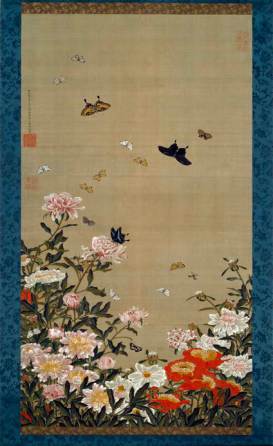 Recent conservation of Colorful Realm has generated an entirely new awareness of the material profile of the set and the technical means by which Jakuchū created each scroll. Drawing upon these findings as well as the most recent research on Jakuchū’s life and cultural environment, this exhibition offers a multifaceted understanding of the artist’s virtuosity and experimentalism as a painter—one who not only applied sophisticated chromatic effects but also masterfully rendered the richly symbolic world in which he moved.
The earliest of the 30 scrolls, Peonies and Butterflies, combines two subjects that enjoyed great popularity in East Asian pictorial traditions. On the one hand, the peony flower was likened to both feminine beauty and prosperity. It became the preferred garden flower of the imperial and aristocratic elite during China’s Tang dynasty (618–907) and at the court of Emperor Xuanzong in particular; in East Asian literary traditions Li Bai’s verse likening the beauty of Xuanzong’s favorite consort Yang Guifei (719–756) to a peony cemented the flower’s association with feminine beauty. Meanwhile, its full and gorgeous appearance lent itself to uncomplicated associations with affluence and good fortune. The butterfly also served as an auspicious symbol, though its popularity was equally attributable to its appearance in one of the most famous parables in early Chinese thought: Zhuangzi’s dream of a butterfly. According to this parable, the legendary sage Zhuangzi dreams that he is a carefree yellow butterfly. Upon awakening, however, “he didn’t know if he was Zhuangzi who had dreamt he was a butterfly, or a butterfly dreaming he was Zhuangzi.” Paintings of butterflies inevitably invoked the oneiric setting and queried selfhood of the Zhuangzi anecdote in most East Asian contexts and particularly in Jakuchū’s circle of erudite Sinophile monks, scholars, and merchants. While visually opulent, Peonies and Butterflies also suggests the uncertainty of a just-awoken dreamer who momentarily confuses reverie with reality.
Careful study of the painting’s pigmentation points to Jakuchū’s remarkable distillation and intensification of traditional East Asian coloration techniques. Different grades of opacity and transparency are achieved in the butterflies, flowers, stems, and leaves by varying the use of mineral and vegetal pigments, occasionally layering them one on top of another and adding a sublayer of color on the back of the silk. This complex stratigraphy of colors results in a convincing imbrication of the motifs in their surroundings. Indeed, when Jakuchū’s cultural and spiritual mentor Daiten (1719–1801) encountered the painting in 1760, he titled it “Beautiful Mist and Fragrant Wind” (Enka kōfū), suggesting that the real subject here was not the peonies and butterflies, but the conceptual atmosphere that enveloped them, the invisible ether within which they swayed and glided.
◊ ◊ ◊ ◊ ◊
Exhibition catalogue: Yukio Lippit, with Ota Aya, Oka Yasuhiro, and Hayakawa Yasuhiro, Colorful Realm: Japanese Bird-and-Flower Paintings by Itō Jakuchū (Chicago: University of Chicago Press, 2012), 224 pages, ISBN: 9780226484600, $50.
◊ ◊ ◊ ◊ ◊
Public Conference: The Art of Itō Jakuchū
National Gallery, East Building Concourse, Auditorium, 30 March 2012, 10:00 to 5:00
Illustrated lectures by noted scholars and conservators of Japanese art. This program is co-organized by the Center for Advanced Study in the Visual Arts, National Gallery of Art, and the Freer Gallery of Art and the Arthur M. Sackler Gallery, Smithsonian Institution. Presented in honor of the National Cherry Blossom Festival.
Exhibition: Copycat at The Clark
Press release from The Clark:
Copycat: Reproducing Works of Art
The Sterling and Francine Clark Art Institute, Williamstown, MA, 29 January — 1 April 2012
Curated by Alexis Goodin and James Pilgrim, in collaboration with Richard Rand and Jay A. Clarke

Francesco Bartolozzi, "The Libyan Sibyl," ca. 1780, etching and color etching on paper © Sterling and Francine Clark Art Institute, Williamstown, Massachusetts
The Sterling and Francine Clark Art Institute will open its latest exhibition, Copycat: Reproducing Works of Art, on January 29. Exploring the line between innovation and imitation, the exhibition features 50 prints and photographs that are both original works of art and repetitions of drawings, prints, paintings, sculptures, and architecture created by other artists. The exhibition highlights the complex process of copying by studying replications of many rarely seen works from the Clark’s permanent collection, including those by Albrecht Dürer, Paul Cézanne, Eugène Delacroix, Rembrandt van Rijn, Roger Fenton, and Édouard Manet, among others. The exhibition also marks the first public presentation of one of the Clark’s recent acquisitions, Jean Dughet’s series The Seven Sacraments. Copycat will be on view in the Clark’s Manton Research Center building through April 1, 2012.
Copycat is one of the ClarkNOW exhibitions that the Institute announced last autumn in conjunction with the launch of its campus expansion project. ClarkNOW is a series of more than 60 programs that the Clark will present in Williamstown, New York, and abroad over the next two
years as it extends the Clark’s reach and engagement during a time of
transformation on its campus. (more…)
CAA 2012, Los Angeles
The 2012 College Art Association conference takes place in Los Angeles, February 22-25, at the Los Angeles Convention Center. HECAA will be represented by two panels, as listed here. The following sessions may also be of interest for dixhuitièmistes. A full list of panels is available here»
H E C A A E V E N T S
Pictures in Place: Depicting Location and the Siting of Representation in the Eighteenth Century
Friday, February 24, 2:30–5:00, Concourse Meeting Room 408B
Chair: Craig Ashley Hanson (Calvin College)
- Dawn Odell (Lewis and Clark College) Place as a Thing: Chinese Screens in Dutch Colonial Contexts
- Hannah Williams (University of Oxford), From Salon to Altar: Relocating Religious Art in Eighteenth-Century Paris
- Julie M. Johnson (University of Texas at San Antonio), A Surplus of Frames: Allegorizing Collecting in the 1720 Stallburg Installation
- Jocelyn Anderson (Courtauld Institute of Art), Paintings in Country Houses and the Development of British Cultural Heritage
- Heather McPherson (University of Alabama at Birmingham), Branding Shakespeare: Boydell’s Shakespeare Gallery and the Politics of Display
◊ ◊ ◊ ◊ ◊
New Scholars Session
Saturday, February 25, 12:30–2:00, West Hall Meeting Room 501ABC
Chair: Kevin Chua (Texas Tech University)
- Lauren Cannady (Institute of Fine Arts, New York University), The Garden Landscape and the French Interior
- Christina Smylitopoulos (University of McGill), “Last Visit from the Doctors Assistant”: Thomas Rowlandson’s Tribute to the “Dying Nabob” and the Birth of the British Body Abroad
- Abigail Zitin (Trinity University), Hogarth among the Moderns
◊ ◊ ◊ ◊ ◊
O T H E R S E S S I O N S R E L A T E D T O T H E 1 8 T H C E N T U R Y
Where the Bodies Lie: Landscapes of Mourning, Memory, and Concealment
Wednesday, February 22, 9:30–12:00, West Hall Meeting Room 501ABC
Chairs: Cynthia Mills (Smithsonian American Art Museum, emeritus) and Kate C. Lemay (Georgia O’Keeffe Museum Research Center); Discussant: Petra ten-Doesschate Chu (Seton Hall University)
- Jennifer Van Horn (Towson University), Civilizing Cemeteries: Portrait Gravestones in Colonial Charleston
- Caterina Y. Pierre (Kingsborough Community College, CUNY), The Corpse Revealed: The Gisant and Modern Memorials at the Fin de Siècle
- Karen Shelby (Baruch College, CUNY), In Flanders Fields: Collection Cemeteries for the German Dead
- Emily Mark-Fitzgerald (University College Dublin), Remembering the Irish Famine: Commemorating the Famine Graveyard and Workhouse, 1990-2011
- Patricia Cronin (Brooklyn College, CUNY), Until Death Do Us Part: National Politics, Modern Love, and “Memorial to a Marriage”
◊ ◊ ◊ ◊ ◊
Icons of the Midwest: Henry Fuseli’s Nightmare (Midwest Art History Society)
Wednesday, February 22, 12:30–2:00, Concourse Meeting Room 405
Chairs: Laura D. Gelfand (Utah State University) and Judith W. Mann (Saint Louis Art Museum)
- Salvador Salort-Pons (Detroit Institute of the Arts), Living with Fuseli’s “Nightmare”
- Beth S. Wright (University of Texas at Arlington), “As I Was Perpetually Haunted by These Ideas”: Fuseli’s Influence on Mary Shelley’s Mathilda and Frankenstein
- Scott Bukatman (Stanford University), Dreams, Fiends, and Dream Screens
◊ ◊ ◊ ◊ ◊
Feminism and Early Modern Art (Society for the Study of Early Modern Women)
Wednesday, February 22, 12:30–2:00, Concourse Meeting Room 407
Chair: Andrea Pearson (American University); Discussant: Mary D. Garrard (American University)
- Jane C. Long (Roanoke College), Shaping Feminine Conduct in Renaissance Florence
- Sarah Joan Moran (Universität Bern), The Word of God on Women’s Shoulders? Pulpits in the Beguine Churches of the Southern Low Countries, ca. 1650-1725
- Corine Schleif (Arizona State University), From Early Modern to Postmodern, from Female to Feminisms to Feminizing: Where Do We Find Our Subjects and Ourselves after 100 Years in the College Art Association?
◊ ◊ ◊ ◊ ◊
Future Directions in the History of British Art (Historians of British Art)
Thursday, February 23, 2:30–5:00, Concourse Meeting Room 403B
Chair: Peter Trippi, Fine Art Connoisseur and Projects in 19th-Century Art, Inc.; Discussant:Kimberly Rhodes, (Drew University)
- Roberto C. Ferrari (The Graduate Center, CUNY), Reconsidering John Gibson, Remolding British Sculpture
- Cristina S. Martinez (University of Toronto ), Legal Thinking: The Rise of Eighteenth-Century British Art
- Corey Piper (Virginia Museum of Fine Arts), Doing the Thing and the Thing Done: The Social World of the British Sporting Print, 1750-1850
- Irene Sunwoo (Princeton University), From the “Well-Laid Table” to the “Market Place”: The Architectural Association Unit System
- Amy M. Von Lintel (West Texas A&M University), Art within Reach: The Popular Origins of Art History in Victorian Britain
◊ ◊ ◊ ◊ ◊
National Endowment for the Humanities Funding Opportunities (NEH)
Thursday, February 23, 5:30–7:00, Concourse Meeting Room 406AB
Chair: Danielle Shapiro (National Endowment for the Humanities)
- Linda Komaroff (Los Angeles County Museum of Art)
- Amy Lyford (Occidental College)
◊ ◊ ◊ ◊ ◊
How to Get Published and How to Get Read: (Arts) Journals in the Digital Age
Friday, February 24, 12:30–2:00, Concourse Meeting Room 404B
Chair: Loren Diclaudio (Routledge, Taylor & Francis Group)
- Jennifer Roberts (Routledge, Taylor & Francis Group)
- Christine L. Sundt (Visual Resources: An International Journal of Documentation)
- Natalie Foster (Routledge, Taylor & Francis Group)
◊ ◊ ◊ ◊ ◊
New Research in the Early Modern Hispanic World (American Society for Hispanic Art Historical Studies)
Saturday, February 25, 9:30–12:00, West Hall Meeting Room 511BC
Chairs: Michael A. Brown (Denver Art Museum) and Sofia Sanabrais (Los Angeles County Museum of Art)
- Laura Leaper (Institute of Fine Arts, New York University), Old Meets New: Classicizing Visions in Diego de Valadés’s “Rhetorica Christiana”
- Niria Leyva-Gutiérrez (Institute of Fine Arts, New York University), Soldier Ecclesiasticus: Images of the Archangel Michael in New Spain
- Sylvia Shorto (American University of Beirut), Dovetailed Cultures
- Luis Gordo-Peláez (University of Texas at Austin), “A Palace for the Maize”: The Granary of Granaditas in Guanajuato and the Neoclassical Civic Architecture in Colonial Mexico
- Daniela Bleichmar (University of Southern California), Visible Empire: Science, Imperial Knowledge, and Visual Evidence in the Hispanic World
◊ ◊ ◊ ◊ ◊
Art and Architecture in Europe: 1600-1750
Saturday, February 25, 9:30–12:00, Concourse Meeting Room 408A
Chair: John Beldon Scott (University of Iowa)
- Karen J. Lloyd (Tulane University), A New Samson: Scipione Borghese and the Representation of Nepotism in the Vatican Palace
- Jason Ciejka (Agnes Scott College), Rhetoric and Narrative in the Architecture of Carlo Rainaldi
- Sabina de Cavi (Getty Research Institute), Artistic Practices and Raw Materials for the Collaborative Art Form of the Festino in Baroque Palermo (1625-1750)
- Robin L. Thomas (Pennsylvania State University), The Bourbon Theater of State: Decorating the Royal Palace at Portici (1744-1745)
- Simone Zurawski (DePaul University), Revealing the Crossroads of Paris at the Cusp of the Revolution: The Works of Henri-Louis Duhamel du Monceau at the Clos Saint-Lazare
◊ ◊ ◊ ◊ ◊
“Useful to the Public and Agreeable to the King”: Academies and Their Products in Spain and New Spain (American Society for Hispanic Art Historical Studies)
Saturday, February 25, 12:30–2:00, Concourse Meeting Room 402AB
Chair: Kelly Donahue-Wallace (University of North Texas)
- Andrew Schulz (University of Oregon), Shifting Attitudes toward Cultural Patrimony in the Madrid Royal Academy of San Fernando, 1755-1808
- Kelly Donahue-Wallace (University of North Texas), Jerónimo Antonio Gil and the Formation of a Director General
- Susan Deans-Smith (University of Texas at Austin), “Open the Door so that Misery Can Leave”: The Rhetoric of Public Utility of the Royal Academy of San Carlos and Public Responses in Late Colonial Mexico
◊ ◊ ◊ ◊ ◊
New Approaches to Post-Renaissance Florence, ca. 1600–1743
Saturday, February 25, 2:30–5:00, Concourse Meeting Room 404A
Chairs: Eve Straussman-Pflanzer (The Art Institute of Chicago) and Eva Struhal (Université Laval)
- Morten Steen Hansen (Stanford University), Ariosto’s Florentine Fortune
- Nina E. Serebrennikov (Davidson College), Manipulating the Miniscule: The Case of Jacques Callot
- Rebecca J. Long (Indianapolis Museum of Art), Florentine Paintings for a Spanish Queen: The Medici Gift in the Convento de las Descalzas Reales, Valladolid
- Elena Ciletti (Hobart and William Smith Colleges), “Ne Posteri Ignorent Quid Factum Sit”: Anna Maria Luisa de’Medici at San Lorenzo
- Jacqueline Marie Musacchio (Wellesley College), Florence, the Medici, and Bianca Cappello through the Eyes of Horace Walpole










leave a comment