Study Day: Sculpture for the Academy
As noted at H-ArtHist:
Morceau de reception, Dono, and Diploma Piece
Histories of a Self-reflective Genre of Sculpture
Kunstakademie, Düsseldorf, 18 May 2012
Organized by Tomas Macsotay and Johannes Myssok
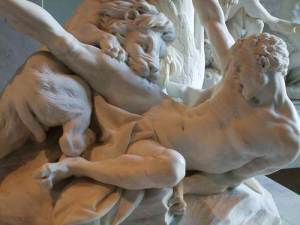
Étienne-Maurice Falconet, "Milo of Croton," marble, 1754 (Paris: Louvre)
In the seventeenth and eighteenth centuries, the significance of a practice of sculpture was to a great extent determined by the incorporation of individual sculptors into royal academies and city guilds, powerful institutions of Ancien Régime society fueled by conflicting socio-economic interests, ethic convictions and aesthetic creeds. For sculptors, the centerpiece of such acts of consecration consisted in marble carvings executed in reduced scale and rendering noble subjects that ranged from the Saints to Ovid and Roman History. As guilds lost ground and influence to academies, the figures became an indispensable means of forging a reputation: they grew increasingly complex and in a few cases, as with Falconet’s Milo, Sergel’s Othryadès and Banks’ Falling Titan, strike the modern viewer as being strangely at odds with stylistic mainstreams of baroque and neo-classicism. What resulted is one of the first forms of sculpture produced independently from overt purposes of noble representation or religious experience, and therefore capable of being called ‘autonomous’. Often lodged within or close to the spaces where academy members convened and held seminars, academic marbles come closest to representing a programmatic statement on the nature of sculpture at the dawn of modernity.
The study day will examine the converging histories of the dono, the morceau de réception and the diploma piece. An international array of scholars will venture into the difficult task of identifying what (if anything) these pieces purport to teach the viewer about the art of sculpture. What are the origins of its typical conventions — among the
private genres of the reproductive bronze, the ivory and the ornamental relief, or among the public sculpture on permanent display in churches, townhouses and squares — and what support is provided modern scholars by academic theoretical discourses? The insistent three-dimensionality of the French morceau de réception seems particularly predictive of a now familiar paradigm of the medium, with its understanding that sculptural objects display non-pictorial properties that fuel a relationship with the beholder through modalities of hard, handled
substance, through the play of spatial presence and multiple viewpoints, and through quasi-architectural framing elements and supports such as pedestals and niches. But does this Ancien Régime embodiment of sculpture really anticipate a modern sensibility to sculptural form?
Admission to the study day is free. Registration is not required.
◊ ◊ ◊ ◊ ◊
P R O G R A M M E
9:00 Reception and coffee
9:25 Johannes Myssok, Welcome and introduction
SESSION 1: Between the Individual and the Institutional, chaired by Johannes Myssok
9:40 Susanne Adina Meyer (Rome): “Die Akademie in der ‘Akademie der Welt’: Wettbewerbe und bildhauerische Aufnahmestücke der Accademia di San Luca in Rom im 18. Jh.”
10:10 Marjorie Trusted (London), “The Beginnings of the Royal Academy in London: Diploma Pieces in the Eighteenth Century”
10:40 Discussion and coffee Break
SESSION 2: Falconet: Exception or Rule?, chaired by Guido Reuter
11:10 Kristina Dolata (Berlin): “Naturstudium und ‘horreur’. Falconets Milon von Kroton”
11:40 Tomas Macsotay (Barcelona), “The Free-standing Morceau de Réception and the Community of Experiment: Thoughts on De Piles and Falconet”
12:10 Discussion
12:30 Lunch
SESSION 3: Sculpture about Sculpture: An Academic Aesthetics, chaired by Tomas Macsotay
14:00 Ursula Ströbele (Berlin): “Vom bas-relief zum ronde-bosse. Narration und Zeitlichkeit bei den Bildhaueraufnahmestücken der königlichen Akademie in Paris”
14:30 Martin Myrone (London), “Extravagance, Excess, Expertise: Thomas Banks’s Falling Titan”
15:00 Discussion and break
15:40 Additional contribution by Magnus Olausson and/or respondent (to be confirmed); final discussion
Emma Barker on the Greuze Girl in ‘Representations’
Emma Barker, “Reading the Greuze Girl: The Daughter’s Seduction,” Representations 117 (2012): 86-119.
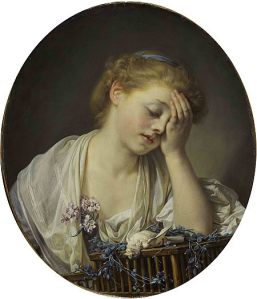
Jean-Baptiste Greuze, "Girl with a Dead Canary," 1765 (Edinburgh, National Galleries of Scotland)
Abstract: This essay challenges the generally accepted interpretation of Greuze’s Girl Weeping over a Dead Bird (1765) as an allegory of lost virginity by considering the painting in relation to eighteenth-century representations of the young girl in a range of discourses, including aesthetic theory, sentimental fiction and medical literature. Its central contention is that the implied spectator to whom the painting is addressed is not a lover as such, but a quasi-paternal figure, who disavows his own desire for the girl whilst nevertheless enjoying an eroticized intimacy with her. In thereby raising the specter of incest even as it represses it, Weeping Girl exemplifies deep-seated tensions within later eighteenth-century French culture.
Exhibition: Slavery at Jefferson’s Monticello
This exhibition looks intriguing for its subject alone, but even more interesting given that it’s the work (in partnership with Monticello) of a museum that doesn’t break ground until later this month. As reported by Brett Zongker of the Associated Press, the National Museum of African American History and Culture (NMAAHC) is organizing exhibits before the museum opens, in 2015, as a way to assess strategies for productively reaching large audiences with difficult subjects. -CH

◊ ◊ ◊ ◊ ◊
Slavery at Jefferson’s Monticello: Paradox of Liberty
National Museum of American History, Washington, D.C., 27 January — 14 October 2012
Atlanta History Center, 1 February — 7 July 2013
Missouri History Museum, St. Louis, 10 August 2013 — 2 March 2014
National Constitution Center, Philadelphia, 9 April 2014 — 4 January 2015
African American Museum, Dallas, 22 September — 31 December 2018 (extended to 21 January 2019)
The Smithsonian’s National Museum of African American History and Culture and Monticello will present Slavery at Jefferson’s Monticello: Paradox of Liberty, an exhibition of artifacts from the Smithsonian’s collections and from excavations at Jefferson’s Virginia plantation. Thomas Jefferson drafted the Declaration of Independence and called slavery an “abominable crime,” yet he was a lifelong slaveholder. The exhibition will provide a look at the lives of six slave families living at Monticello alongside Jefferson and his family. Personal belongings and working tools will be on display, and visitors will have a chance to learn about the families’ connections to one another, their religious faith and their efforts to pursue literacy and freedom.
◊ ◊ ◊ ◊ ◊
Note (added 23 September 2018) — The posting was updated to include the four additional venues.
Reviewed: The English Virtuoso
On a personal note, I want to say how much I appreciate Janice Neri’s thoughtful review. Her reading of my book is, I think, careful and fair. More importantly, her questions and criticisms are spot-on. Thanks as well to Laura Auricchio for doing such a terrific job coordinating reviews as the field editor for the eighteenth century! -CH
Recently added to caa.reviews:
Craig Ashley Hanson, The English Virtuoso: Art, Medicine, and Antiquarianism in the Age of Empiricism (Chicago: University of Chicago Press, 2009), 344 pages, ISBN: 9780226315874, $50.
Reviewed by Janice Neri, Boise State University; posted 28 December 2011.
To the modern day reader, hospitals and scientific societies might seem to be unlikely settings for exhibiting and discussing contemporary art. In ‘The English Virtuoso: Art, Medicine, and Antiquarianism in the Age of Empiricism‘, Craig Ashley Hanson shows how it made perfect sense that such venues would foster art theory and practice in seventeenth- and eighteenth-century England. The leading role in this book is played by the figure of the virtuoso, whose eclectic interests were united under the umbrella of curiosity. Encompassing activities as wide ranging as medicine (learned and unlearned), classical studies, and art collecting, patronage, practice, and theory, Hanson’s study of English virtuoso culture makes an important contribution to an understanding of the intellectual foundations of art scholarship and writing. In illuminating the complex world of the virtuoso, this insightful book also shows how early forms of interdisciplinarity actually worked. Drawing connections between the seventeenth and eighteenth centuries, ‘The English Virtuoso’ provides an opportunity to reflect on the ways that boundaries were often blurred between intersecting areas of knowledge. . . .
The full review is available here» (CAA membership required)
Reviewed: Architectural Space in Eighteenth-Century Europe
Recently added to caa.reviews:
Denise Amy Baxter and Meredith Martin, eds., Architectural Space in Eighteenth-Century Europe: Constructing Identities and Interiors (Burlington: Ashgate, 2010), 284 pages, ISBN: 9780754666509), $119.95.
Reviewed by Heather Hyde Minor, University of Illinois, Urbana-Champaign; posted 13 December 2011.
Eighteenth-century Europe was home to a dazzling array of architectural interiors, from priest-holes designed to hide ecclesiastics from Protestant authorities in England to the home theaters of courtesans in Paris. Diverse characters populated these domains. Bluestockings gathered in a Chinoiserie room while guests waited to be served refreshments before taking in Europe’s premier public collection of ancient sculpture.
‘Architectural Space in Eighteenth-Century Europe’ examines all of these environments and personages, exploring the role architecture and interiors played in fashioning identity in the eighteenth century. The ten essays that it gathers together seek to demonstrate that these spaces served to form a sense of self in creative ways. The book’s editors, Denise Amy Baxter and Meredith Martin, are to be commended for addressing this important question, one that spans a range of fields, and for gathering essays written by scholars from a range of disciplines. Contributing to the recent explosion of interest in eighteenth-century interiors, the volume builds on the work of Katie Scott, Mimi Hellman (both of whom are cited in the introduction), and others. . . .
The full review is available here» (CAA membership required)
Conference: The British Monarchy and Modernity
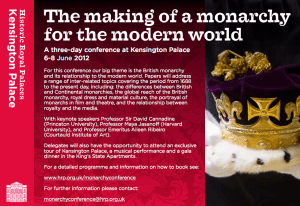
The Making of a Monarchy for the Modern World
Kensington Palace, London, 6-8 June 2012
 There will soon be only five kings left – the Kings of Diamonds, Heart, Spades and Clubs, and the King of England.
– King Farouk of Egypt
For this conference our big theme is the British monarchy and its relationship to the modern world. Papers will address a range of inter-related topics covering the period from 1688 to the present day, including:
- the difference between British and Continental monarchies
- the global reach of the British monarchy
- the relationship between royalty and the media
- monarchical dress and material culture
- the portrayal of monarchs in film and theatre
Delegates will also have the opportunity to attend an exclusive
tour of Kensington Palace, a musical performance and a gala
dinner in the King’s State Apartments.
Keynote speakers for the conference are:
Professor Sir David Cannadine (Princeton University)
Professor Maya Jasanoff (Harvard University)
Professor Emeritus Aileen Ribeiro (Courtauld Institute of Art)
A full programme is available here»
◊ ◊ ◊ ◊ ◊
Note (added 1 July 2012) — Many of the presentations are now available as podcasts from the Historic Royal Palaces and some for viewing at YouTube.
Wiebenson Prize Deadline Approaching Soon
Each year HECAA awards the Wiebenson Prize for an outstanding graduate student paper presented during the previous calendar year at a scholarly conference or as a sponsored lecture. Announced at HECAA’s annual luncheon (each spring at ASECS), the prize includes modest remuneration.
The prize is named for Dr. Wiebenson, Professor Emerita at the University of Virginia School of Architecture.
By 15 February 2012, each applicant should submit an electronic copy of the paper for consideration – as read, without notes, but with illustrations – to Julie Plax, who will then forward the submissions to an ad hoc committee responsible for selecting the winner. Honorable mention is also an option for papers of distinction not chosen for the prize. Recipients must be HECAA members in good standing.
Exhibition: Royalists to Romantics
The following exhibition soon opens at the National Museum of Women in the Arts (in conjunction, artist-in-residence Celia Reyer will be creating a Brunswick traveling coat inspired by 18th-century fashion). -AH
◊ ◊ ◊ ◊ ◊
Royalists to Romantics: Women Artists from the
Louvre, Versailles, and Other French National Collections
National Museum of Women in the Arts, Washington, D.C., 24 February — 29 July 2012

Rose Adélaïde Ducreux, "Portrait of the Artist," ca. 1799 (Rouen: Musée des beaux-arts)
In keeping with its mission to rediscover and celebrate women artists of the past and demonstrate their continued relevance, the National Museum of Women in Arts (NMWA) presents Royalists to Romantics: Women Artists from the Louvre, Versailles, and Other French National Collections. The exhibition features 77 paintings, prints, and sculptures dating from 1750 to 1850—many of which have never been seen outside of France. To develop the exhibition, NMWA spent months scouring the collections of dozens of French museums and libraries to cull rarely-seen works by women artists. Royalists to Romantics showcases these exceptional works and reveals how the tumultuous period that saw the flowering of the court of Louis XVI and Marie Antoinette, the terrors of the French revolution, the rise and fall of Napoleon, and the restoration of the monarchy affected the lives and careers of women artists.
Featuring 35 artists, including Marguerite Gérard, Antoine Cecile Haudebourt-Lescot, Adélaïde Labille-Guillard, Sophie Rude, Anne Vallayer-Coster, and Élisabeth Louise Vigée-Lebrun, the exhibition explores the political and social dynamics that shaped their world and influenced their work. Some of these artists flourished with support of such aristocratic patrons as Marie Antoinette, who not only appointed her favorite female artists Élisabeth Louise Vigée-LeBrun and Anne Vallayer-Coster to court, but advocated their acceptance into the Académie Royale de peinture et de sculpture. The political upheavals of the French Revolution and the following decades brought a new set of challenges for women artists. Royalists to Romantics explores the complex ways that women negotiated their cultural positions and marketed their reputations in France’s shifting social, political and artistic environment.
Royalists to Romantics: Women Artists from the Louvre, Versailles, and other French National Collections has been organized by the National Museum of Women in the Arts, Washington, D.C., with logistical support from sVo Art, Versailles.
◊ ◊ ◊ ◊ ◊
 Laura Auricchio, Melissa Hyde, and Mary D. Sheriff have contributed essays to the catalogue:
Jordana Pomeroy, ed. Royalists to Romantics: Women Artists from Versailles, the Louvre, and Other French National Collections (New York: Scala Publishers, 2012), 144 pages, ISBN: 9781857597431, $45.
This beautifully illustrated book examines eighteenth-century French theories of sexual difference and their influence on the ‘woman-artist question’; paradoxical Revolutionary attitudes toward women artists, who encountered as many new limitations as opportunities; and the complex ways that women marketed their reputations and managed their cultural positions in France’s intricate social and artistic hierarchy.
Dumfries House in Architectural Digest, February 2012
It’s a widely-shared sentiment, but I think Margaret Russell is doing a fantastic job as editor at Architectural Digest (Penelope Green’s New York Times coverage of the appointment is available here). This month’s issue of AD includes a fine feature, with lovely photos by Derry Moore, on Dumfries House (having just returned from Venice, I’m especially struck by the stunning Murano chandeliers!, original to the house). A Christie’s press release for the planned 2007 sale underscores just how fortunate we are to have the house and its contents still intact. The design team included Piers von Westenholz and David Mlinaric (along with the 2008 book on Mlinaric’s work from Frances Lincoln publishers, there’s an interesting interview with him at the V&A’s website) . -CH
◊ ◊ ◊ ◊ ◊
From Architectural Digest:
James Reginato, “Prince Charles Unveils Dumfries House,” Architectural Digest (February 2012): 58-69.
Scotland’s most dazzling historic country house opens its doors after a rejuvenation spearheaded by His Royal Highness the Prince of Wales

John and Robert Adam, Dumfries House, Ayrshire, Scotland, 1754-59 (Photo by Derry Moore for Architectural Digest)
Several years ago, a major drama unfolded in Great Britain when Dumfries House, one of the most significant and beautiful historic properties in the Commonwealth, teetered on the verge of sale and dispersal. The 18th-century Palladian villa in Ayrshire, Scotland, is a seminal work of renowned architect Robert Adam and his brothers, John and James; it contains a world-class collection of British Rococo furniture, including some 50 examples from a fledgling cabinetmaker named Thomas Chippendale. Ordered straight from the craftsman’s workshop in 1759 by the fifth Earl of Dumfries, who commissioned the house and took up residence there the following year, the furnishings now form part of a magnificent
ensemble that embodies, in the words of His Royal Highness
the Prince of Wales, “British craftsmanship at its best.”

Blue Drawing Room, Dumfries House (Photo by Derry Moore for Architectural Digest)
The fate of the mansion had begun to seesaw in 2005, when John Crichton-Stuart, the seventh Marquess of Bute (a celebrated Formula One driver whose family had inherited the Dumfries title in the early 19th century), felt the strain of balancing its ownership with that of Mount Stuart, the immense Victorian Gothic palace and grounds where he currently resides. Dumfries, exquisite and well looked after though it was, had not been lived in by the family for some 150 years, except for a near-40-year residency by the fifth marquess’s widow, from 1956 to 1993. It truly was a sleeping beauty.

Family Bedroom, Dumfries House (Photo by Derry Moore for Architectural Digest)
When a deal to sell the 2,000-acre property to the Scottish National Trust fell through, Lord Bute took the bold move of marketing it via an estate agency and hiring Christie’s to sell off its holdings. Experts at the auction house began documenting the contents of the mansion; a two-volume catalogue was produced, and sale dates were set for July 12 and 13, 2007.
Just weeks before the auction, however, Dumfries’s plight came to the attention of Prince Charles—a tireless, and rather fearless, advocate of British heritage. . . .
More of the online excerpt of the story and additional photos are available at Architectural Digest.com
◊ ◊ ◊ ◊ ◊
For bloggers and bloggers-to-be, there’s a useful video clip of Margaret Russell speaking in New York at Kravet’s Design BlogFest (18 May 2011). Her appearance underscores, I think, both how hard she’s working to breathe new life into AD and how much blogs have changed the design landscape.
UK’s National Oil Painting Collection Online at the BBC Website
 Your Paintings is a project to put the UK’s entire national collection of oil paintings on one website. It is a partnership between the BBC, the Public Catalogue Foundation and 3,000 collections around the United Kingdom including museums, universities, civic collections, the Arts Council and the National Trust.
The purpose of the project is to open up the UK’s 200,000-strong oil painting collection for learning, research and public enjoyment. To this end, over the last nine years the PCF has been making a photographic record of all oil paintings in public ownership in the United Kingdom. 80% of these paintings are in storage. And at least two thirds of these paintings have not been photographed before.
When complete at the end of 2012 the website will show 200,000 paintings by some 40,000 artists.
Discover the website – Over 100,000 paintings are already online










leave a comment