Reynolds at Auction?
On 11 December 2011 (Sale 131), Grogan and Company Fine Art Auctioneers and Appraisers sold a portrait of Captain Benjamin Davies by Joshua Reynolds, along with an unattributed portrait of the captain’s wife, Elisabeth Viscount Davies, for $8470 (surpassing the estimate of $3000-5000). With the paintings having been handed down within the family from generation to generation, this was the first time they were offered on the open market. The following description comes from ArtDaily:

Sir Joshua Reynolds, Portrait of Captain Benjamin Davies
with unattributed Portrait of Elisabeth Viscount Davies, 1761-72
◊ ◊ ◊ ◊ ◊
Benjamin Davies was born in 1728 in Bristol, England and immigrated to New York in 1750. His seafaring career began with a voyage to China, as an apprentice to Captain William Sedgwick, Commander of the London East India Company Service. He also accompanied Captain George Jackson to India before taking passage to New York in 1850 aboard the Neptune. In 1753 he married Elizabeth Viscount, a recent widow of Dutch descent. The next 13 years was spent in the seafaring trade with many partners, much of which is documented in his Diaries, currently located in the Colgate papers at Yale University Library.
In 1765, when the Stamp Act was to be established in the Colonies, Davies took command of the ship Hope and sailed to England with his wife Elisabeth to secure items for his mercantile business. While there, he had a pendant portrait made of his wife with the ship Hope in the background to match the earlier portrait he commissioned from Sir Joshua Reynolds. The Beekman Mercantile Papers at the New York Historical Society contains references to Benjamin Davies making multiple voyages as Captain of the ship Hope between England and American between 1765-1771. . . .
The full article at ArtDaily is available here»
Call for Papers: Undergraduate Symposium on the Body
The Body in Visual Culture: An Undergraduate Student Symposium
University of Massachusetts Dartmouth, 4 May 2012
Proposals due by 1 April 2012
Keynote Speaker: Gregory Williams, Assistant Professor of Art History at Boston University and author of Permission to Laugh: Humor and Politics in Contemporary German Art (University of Chicago Press, 2012)
Bodies function as indicators of identity. A toned and muscular body indicates a laborer, or someone who is concerned with their health whereas a frail or emaciated body may indicate trauma or an eating disorder. An obese body could indicate sloth or illness, although historically it has been a sign of wealth and even beauty. A body plastered in tattoos could designate gall, a passionate form of expression, one who loves art, or one who has lost a lot of bets. Based on cultural “standards,” some bodies, such as those of women and minorities, have at times indicated inferiority, while others, such as those of Aryan men, have stood for superiority. However, the practice of identifying someone by their body is nothing more than assumption, which is rarely accurate in comparison to the way one defines their own identity. Throughout history, this disparity has resulted in detrimental action in society including stereotyping, discrimination, oppression, and in extreme cases, genocide.
The College of Visual and Performing Arts (CVPA) Art History Club at the University of Massachusetts Dartmouth seeks proposals for an undergraduate student symposium on the topic of the body in visual culture. We are interested in projects that address the role of the sexuality, oppression, gender, identity in the representation of the body as well as the transformation of the body at the hands of technology. (more…)
Kark Kirk to Head up Getty Publications
Press release (25 January 2012) from the Getty:
 The J. Paul Getty Trust announced today the appointment of Kara Kirk as publisher of Getty Publications, effective April 13. Kirk, who was chosen after an international search, most recently served for six years as associate publisher at The Museum of Modern Art (MoMA) in New York, where she worked on all aspects of the publications process, from editorial development to distribution and sales. In addition, she managed a variety of new media projects and worked as part of a museum-wide team to develop a strategic plan for MoMA’s digital publishing initiatives.
Prior to moving to New York, Kirk served as the Getty’s general manager of publications from 2002–2006. Previously, she was the director of publications and graphic design at the San Francisco Museum of Modern Art. She holds an MLA from Stanford University and a BA from Pomona College.
As publisher, Kara will work to ensure that the Getty is a leader in art publishing in both print and new media. “Our goal is to create a list that reflects the Getty’s current activities and aspirations, one that builds on a record of excellence to achieve real eminence,” said Deborah Marrow, director of the Getty Foundation, who oversees the work of Getty Publications. “We are delighted that Kara will be the one to guide us on this path.”
“I am delighted to be returning to the Getty and to have the chance to work with such a stellar team. It is an interesting moment to be a publisher and I look forward to addressing the many challenges and opportunities afforded by the changing terrain to insure that the Getty continues to make valuable and lasting contributions to art history publishing.
Exhibition: Shakespeare on Canvas at YCBA
From YCBA:
‘While these visions did appear’: Shakespeare on Canvas
Yale Center for British Art, New Haven, 3 January — 3 June 2012
Curated by Eleanor Hughes and Christina Smylitopoulos
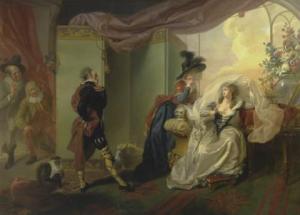
Johann Heinrich Ramberg, "Olivia, Maria, and Malvolio, from 'Twelfth Night', Act III, Scene iv," 1789, oil on canvas (Yale Center for British Art, Paul Mellon Fund)
“While these visions did appear,” a selection of Shakespearian subjects drawn from the Center’s permanent collection of paintings, forms part of Yale’s university-wide celebration of the works of William Shakespeare (1564–1616). This display focuses primarily on depictions of Shakespeare’s comedies, but also draws on comedic elements from the tragedies and histories, and encourages consideration of the multifaceted ways—verbal and visual—in which Shakespeare’s plays have inspired painters and audiences alike.
Artists and patrons in the eighteenth century responded to and encouraged the assertion of Shakespeare as Britain’s foremost national playwright. Through the remarkable efforts of David Garrick, the actor and Drury Lane theater manager, the plays flourished on the stage, while the promotion of the playwright as the “immortal bard” was seized as an opportunity to foster a British school of history painting.
Combining commerce and connoisseurship, entrepreneurial publishers like John “Alderman” Boydell and James Woodmason commissioned works such as a scene from Twelfth Night by Johann Heinrich Ramberg, and Francis Wheatley’s scene from The Two Gentlemen of Verona, respectively, creating what amounted to a new genre: the Shakespearean conversation piece. Strategies of representation included the depiction of famous actors and actresses in favored roles, such as Benjamin van der Gucht’s portrait of actor Henry Woodward in the role of Petruchio in David Garrick’s adaptation of The Taming of the Shrew, and James Northcote’s portrait of the child actor William Henry West Betty in the role of Hamlet. Other compositions, destined to be illustrations for new print editions of Shakespeare’s plays, depict characters in pivotal dramatic moments, such as Phillippe-Jacques de Loutherbourg’s portrait of Falstaff from Henry IV. (more…)
Session on Cosmopolitanism and Nationalism at AAH 2012
A former Enfilade intern, Freya Gowrley, is organizing a session at this year’s AAH meeting at the Open University in Milton Keynes (29-31 March) with Viccy Coltman. The session, on ‘Conflicting Art Histories’, has its own website with presentation abstracts. The site raises an interesting question of how one might maximize the effectiveness of a conference session generally, along with the possibility that it might sometimes mean venturing beyond (or at least supplementing) the normal conference parameters of communication . . . -CH
◊ ◊ ◊ ◊ ◊
CONFLICTING ART HISTORIES: DIALOGUES OF COSMOPOLITANISM AND NATIONALISM IN EIGHTEENTH-CENTURY BRITISH CULTURE (more…)
Call for Papers: Le Salon de l’Académie Royale de Peinture et Sculpture
From Fabula:
The Salon of the Royal Academy of Painting and Sculpture: Archaeology of an Institution
National Museum of Fine Arts, Quebec, 13-15 September 2012
Proposals due by 15 March 2012
International Symposium by Centre Interuniversitaire d’étude sur la République des lettres (CIERL), under the direction of Dr Isabelle Pichet
The historiography of the Salon of the Royal Academy of Painting and Sculpture in Paris is often bereft of a key part of its history: how the Salon itself became an art institution. Originally integrated into the fêtes de l’Académie, over time the Salon came to be best known in the form of a temporary, independent, and recurrent exhibition. This event developed little by little, reimagining itself through and eventually blossoming as the popular biennal exhibition. The unique character of the Salon was established through the regular repetition of the exhibition cycle, a sequence that helped to root the event’s particular characteristics in the minds of the public and in the regard of other institutions. In creating this rhythm within Parisians’ horizon of expectation, the Salon provided a habitus for their audience; moreover, the Salon inspired curiosity and desire in the provinces and nations that sought to imitate it.
This conference seeks to define and better understand the trajectory followed by the Salon from its emergence in the late 17th century to its full maturity in the second half of the 18th century. This symposium aims also to identify the diverse parameters and conditions that contributed to the development and helped to affirm the singularity of the Salon. This call for papers solicits proposals that will increase our understanding of the foundations and limits that shaped the form and content of the Salon as well as help us to survey the influence and impact of these exhibitions on various aspects of French and European society. As a multidisciplinary event, this conference is a laboratory and reflection on current research and scholarly approaches that consider the Salon and its place in the “art worlds,” as well as literature, philosophy, politics, and history.
New, unpublished papers shall not exceed the twenty minutes allocated to each participant. Proposals for papers (title and abstract of 250 words, institutional affiliation) should be sent to the committee before March 15, 2012 at the following address: colloque.salon@lit.ulaval.ca
Plenary lecture by Dr. Kim de Beaumont, Adjunct professor at Hunter College, Art Historian specialist of Gabriel de Saint-Aubin
Curatorial Fellowship at the Indianapolis Museum of Art
Allen Whitehill Clowes Curatorial Fellowship
Indianapolis Museum of Art, 2012-2013
Applications due by 30 March 2012
The Indianapolis Museum of Art is pleased to announce a nine-month curatorial fellowship. The fellowship supports scholarly research related to the Clowes Collection at the IMA and provides curatorial training in the field of European painting and sculpture. The Clowes Fellow is fully integrated into the curatorial division of the Museum and has duties comparable to those of an assistant curator, ranging from collection research and management to exhibition development and the preparation of interpretive materials and programs.
To be eligible for the fellowship, the applicant must be enrolled in a graduate course of study leading to an advanced degree in the history of art or a related discipline, or be a recent degree recipient (within the last two years). Applicants must demonstrate scholarly excellence and promise, as well as a strong interest in the museum profession. U.S. citizenship is not required.
The Clowes Fellow will receive a stipend of $18,000 and an educational travel allowance of $2,000. Housing is provided in a scholar’s residence on the grounds of the museum. The nine-month fellowship period will begin September 4, 2012. The appointment is renewable. (more…)
New Resource for the History of Paper
Though especially concerned with issues of book production, this research and the resulting website have implications for all early modern print culture. Aimed at a wide range of audiences — “from the complete novice to the paper-conservation scientist” — the site might be especially helpful for teaching purposes.. –CH
◊ ◊ ◊ ◊ ◊
From a UICB press release (17 January 2012) . . .
Tim Barrett of the University of Iowa Center for the Book Launches Paper History Website

Research by a University of Iowa led team reveals new information about why paper made hundreds of years ago often holds up better over time than more modern paper. Led by Timothy Barrett, director of papermaking facilities at the UI Center for the Book, the team analyzed 1,578 historical papers made between the 14th and the 19th centuries. Barrett and his colleagues devised methods to determine their chemical composition without requiring a sample to be destroyed in the process, which had limited past research. The results of this three-year project show that the oldest papers were often in the best condition, in part, Barrett says, due to high levels of gelatin and calcium.
“This is news to many of us in the fields of papermaking history and rare book and art conservation,” says Barrett. “The research results will impact the manufacture of modern paper intended for archival applications, and the care and conservation of historical works on paper.”
Barrett says one possible explanation for the higher quality of the paper in the older samples is that papermakers at the time were attempting to compete with parchment, a tough enduring material normally made from animal skins. In doing so, they made their papers thick and white and dipped the finished sheets into a dilute warm gelatin solution to toughen it. . . .
◊ ◊ ◊ ◊ ◊
From the project website, Paper through Time . . .
This website is designed for use by a wide range of visitors, from the complete novice to the paper-conservation scientist. Newcomers to the site may want to begin with the PROJECT OVERVIEW & AUTHORS and CONCLUSIONS sections for a quick sense of our research and what we learned. Those unfamiliar with papermaking history and technique may wish to start with European Papermaking Techniques 1300-1800 (under BACKGROUND) for an introduction to the craft. Visitors with a strong interest in papermaking history, materials and processes, paper permanence, paper science, and paper conservation are advised to begin at the top of the menu to the left and click on each tab, reading as interest and time permit. The site will be updated regularly. Suggestions for changes are welcome via email messages . . .
Things: Material Culture at Cambridge
Programming from CRASSH at the University of Cambridge:
Things: Material Cultures of the Long Eighteen Century
Centre for Research in the Arts, Social Sciences and Humanities (CRASSH), Cambridge, ongoing series
Please note the change to the time and location of the seminar:
We meet alternate Tuesdays 12.30-2.30pm in the CRASSH Seminar Room at 7 West Road on the Sidgwick Site.
◊ ◊ ◊ ◊ ◊
 The eighteenth century was the century of ‘stuff.’ Public production, collection, display and consumption of objects grew in influence, popularity, and scale. The form, function, and use of objects, ranging from scientific and musical instruments to weaponry and furnishings were influenced by distinct features of the time. Eighteenth-century knowledge was not divided into strict disciplines, in fact practice across what we now see as academic boundaries was essential to material creation. This seminar series will use an approach based on objects to encourage us to consider the unity of ideas of the long-eighteenth century, to emphasise the lived human experience of technology and art, and the global dimension of material culture. We will re-discover the interdisciplinary thinking through which eighteenth-century material culture was conceived, gaining new perspectives on the period through its artefacts.
Each seminar features two talks considering the same type of object from
different perspectives.
24 January 2012 — Fashion
Professor John Styles (University of Hertfordshire) and Amy Miller (National Maritime Museum)
7 February 2012 — Advertising
Dr Philippa Hubbard (Adam Matthew Digital) and Jenny Basford (University of York)
21 February 2012 — Porcelain
Dame Rosalind Savill (Wallace Collection) and Dr Anne Gerritsen (University of Warwick)
6 March 2012 — Artist’s Things
Dr Katie Scott (Courtauld Institute of Art) and Dr Hannah Williams (University of Oxford)
◊ ◊ ◊ ◊ ◊
Subscribe to the group mailing list at https://lists.cam.ac.uk/mailman/listinfo/crassh-things
Visit the external blog at http://thingsc18th.wordpress.com/
Call for Papers: Emblems of Nationhood, Britishness
From the conference website:
Emblems of Nationhood: Britishness, 1707-1901
University of St Andrews, 10-12 August 2012
Proposals due by 1 March 2012
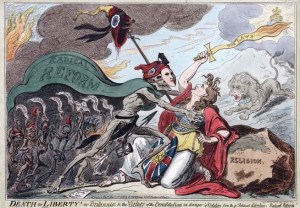
George Cruikshank, "Death or Liberty!" 1819 ( The Lewis Walpole Library, Yale University)
National identity is a central point of enquiry that is repeatedly called upon in contemporary social and political rhetoric. Our conference, ‘Emblems of Nationhood, 1707–1901’, will address the roots of this theme by discussing depictions of Britain and Britishness in literature, philosophy, and art between the Act of Union in 1707 and the death of Queen Victoria in 1901. Over the course of this multidisciplinary conference, we aim to explore how expressions of nationalism have moulded both critical perspectives on national identity and their creative products.
Discussing emblems of nationhood in 2012 is a fitting way to mark the twentieth anniversary of Linda Colley’s seminal account of Britishness, Britons: Forging the Nation, and coincides with the Queen’s Diamond Jubilee. Several broad questions could potentially be explored in the course of the conference: What did Britishness mean in the eighteenth and nineteenth centuries, and how was it represented and perceived? To what extent is nationalism tied with military events and empire building? How “British” was Britain before the launch of the Empire? (more…)










leave a comment