Exhibition | Fashioning Switzerland
From The Fitzwilliam:
Fashioning Switzerland: Portraits and Landscapes by Markus Dinkel and His Contemporaries
The Fitzwilliam Museum, Cambridge, 4 June — 15 September 2013
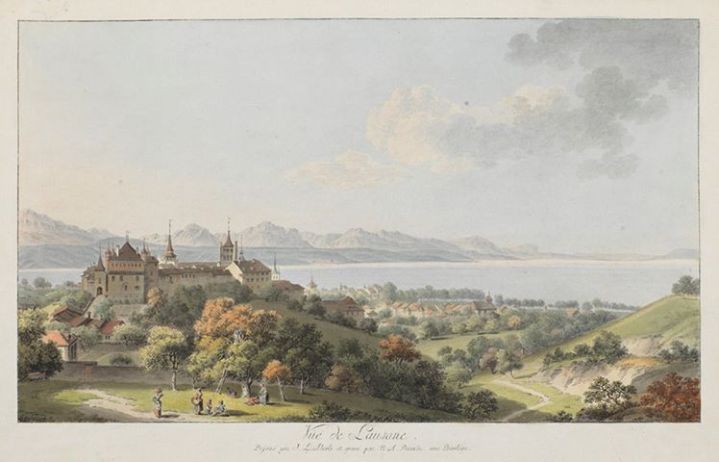
Vue du Lausane (Cambridge: The Fitzwilliam Museum)
◊ ◊ ◊ ◊ ◊
An exhibition of Swiss watercolours and prints featuring a rare selection of finely drawn and coloured portraits of Swiss women in regional costume, by the Bernese artist Markus Dinkel (1762–1832). These are accompanied by other artists’ picturesque views of the Swiss landscape, largely etched and each one delicately hand finished in watercolours.
The prints and drawings on show were made in the century before the establishment of the Swiss federal state in 1848, at a time when foreign tourists were discovering the delights of the various cantons (districts). The images show an affectionate attachment to Swiss landscapes and culture, felt not only by those native to the country, but by the many foreign visitors who collected them as permanent reminders of their travels.
◊ ◊ ◊ ◊ ◊
From Averil King’s review of the exhibition for Apollo Magazine ( 28 June 2013) . . .
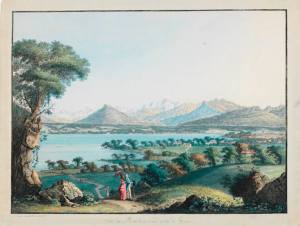
Carl Ludwig Hackert, Vue du Montblanc et Une Partie de Genéve, 1781 (Cambridge: The Fitzwilliam Museum)
Fashioning Switzerland is built around two bequests to the Fitzwilliam Museum: one, in 1910, by the Master and Fellows of Trinity College, Cambridge, of works by the Swiss watercolourist Markus Dinkel (1762–1832); and a later donation, by the Reverend Alfred Valentine-Richards of the Cambridge University Alpine Club, of a number of early views of Swiss mountain scenery. While we may be aware of Swiss artists such as Arnold Böcklin, Jean-Étienne Liotard, Félix Vallotton and Giovanni Giacometti, Dinkel’s name is not a familiar one, and this exhibition, showing his engaging watercolours of Swiss women in regional costume alongside landscapes by his contemporaries, comes as an agreeable surprise. . .
By the late 18th century the formidable mountain chain comprising the Mönch, Eiger and Jungfrau, in the Bernese Alps, was already becoming a tourist destination. So too was the nearby Chamonix (Mont Blanc) range, situated in south-eastern France but clearly visible from the Swiss city of Geneva (as shown in Carl Ludwig Hackert’s View of Mont Blanc and Part of Geneva, 1781). For sightseers, often English Grand Tourists wanting to extend their journeys, the Bernese ‘Three Sisters’ would in time become truly iconic, being portrayed by artists as diverse as Ferdinand Hodler and Emil Nolde. . .










 Enfilade
leave a comment