Fire Severely Damages the Hôtel Lambert in Paris
As reported by BBC News (10 July 2013) . . .
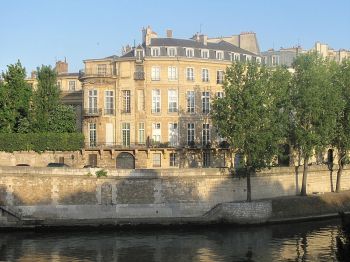
Hôtel Lambert, 2 rue Saint-Louis-en-l’Île, Paris
(Photo: Wikimedia Commons, 2010)
A fire has damaged the landmark 17th-century Hotel Lambert in Paris. Dozens of firefighters tackled the blaze, which broke out overnight on the roof of the riverside mansion in the centre of the French capital. The building was being renovated after its purchase by a Qatari prince in 2007. Located on the World Heritage-listed Seine embankment, the mansion was once home to the 18th-century philosopher Voltaire.
It took six hours for the fire brigade to put out the blaze, which started in an area below the rooftop which emergency services found difficult to access. A large portion of the roof has been destroyed. A spokesman for the fire service, Lieutenant Colonel Pascal Le Testu, said 650 square metres (7,000 sq ft) of the roof had gone, along with a section of a central staircase. Some of the brickwork on the front of the building has collapsed. Renowned fresco ceiling paintings by Charles Le Brun in the Gallery of Hercules were also “severely damaged by smoke and water”, Lt Col Testu said. . .
The full article is available here»
Call for Papers | Questioning the Frame in Decorative Systems
Questioning the Frame in the Decorative Systems of the Modern Era
Jeux et enjeux du cadre dans les systèmes décoratifs à l’époque moderne
Institut national d’histoire de l’art, Paris, 9–10 May 2014
Proposals due by 15 October 2013
International symposium organized by the CHAR (HICSA, University Paris 1 Panthéon – Sorbonne), the Centre François-Georges Pariset (Université Michel de Montaigne – Bordeaux 3) and the GEMCA (Catholic University of Louvain)
In its ability to create systems, modern decor emerges as a phenomenon of artistic practice that deserves further analysis. Between the fifteenth and eighteenth centuries, decoration reached a particularly high degree of elaboration and complexity through the multiplication of presentation devices in the visual discourse, while simultaneously integrating the spatial constraints imposed by supports. This symposium seeks to explore the originality of this phenomenon through the question of the frame. Often neglected and marginalized in studies pertaining to decoration, the frame constitutes one of its essential dimensions, which conditions not only modes of perception but also provides paths towards understanding the mechanisms of decorative systems. Indeed, if decorative systems are the place par excellence of experimentation with the boundaries between real and representational spaces, subtle and varied framing games are the active agents, and shall be explored during this event.
Quadri riportati, architectural elements, anthropomorphic and hybrid figures, feigned materials (tapestries, parchment, leather, etc.), medallions, cartouches, and festoons are some examples of framing devices which, far from being accessory or gratuitous, carry a multitude of illusionistic, syntactic, and semantic implications, all-the-while participating in the visual splendor and the mise-en-scène of the representation. Through the definition and articulation of these particular spaces and discursive registers, framing devices create interpretative solutions, conditioning and guiding the perception and comprehension of visual discourse. Even when the frame appears as a disjunctive element, which separates and differentiates, it can still allow for conjunctions and transitions through space, or, through an excess of reflexivity and a tendency for autonomy, blur and provoke a crisis in the hierarchy between the visual regions. By taking into consideration this perpetual shifting of frontiers, these games and perspectival challenges, the goal of this symposium is to question the framing devices of decorative systems in the modern era. In other words the objective is to understand how the frame participates in the transformation of decor into a system that produces meaning across a variety of supports and mediums.
Among the many issues raised by this topic, some possible themes include:
• What are the specific mechanisms in decorative practice used for defining and creating spaces, images, and graphic or symbolic representations? Could this use of the frame contribute to the definition of certain tendencies or aesthetic currents?
• In terms of reception, what are the devices used to create frontiers or passages between the decor and the viewer? In what ways does decor create effects of presence and distance, thus contributing to the viewer’s experience?
• How does the ornament of the frame respond to the principle of decorum? To what extent does this constitute a transgression? How does the relationship between ergon and parergon apply in this context? How do the boundaries and transitions between these different areas challenge the traditional hierarchies of representation and create spaces of freedom and autonomy?
• How can the transition between different mediums and contexts provoke, for similar devices, varied readings corresponding to particular challenges? How does the use of different materials, real or feigned, participate in the framing process, from an aesthetic as well as a symbolic point of view?
Developing on studies which, since the 1960s, have been problematizing the issues of the frame in the visual arts, and adhering to the current revival of interest in question of the ornamental, this symposium aims to shed light on this essential issue in the art of the modern era, which is the decor. Abstracts of no more than 300 words (in French or English) should be sent before October 15, 2013 by email to the address: cadre.decor.2014@gmail.com
Organizing Committee: Nicolas Cordon, Edouard Degans, Elli Doulkaridou, Caroline Heering
Scientific Committee: Pascal Bertrand, Nicolas Cordon, Edouard Degans, Ralph Dekoninck, Elli Doulkaridou, Caroline Heering, Philippe Morel, Victor Stoichita
The Call for Papers in French is available at L’ApAhAu»
Call for Articles | Museum and Curatorial Studies Review
Museum and Curatorial Studies Review is a new peer-reviewed journal powered by the University of California, Berkeley Electronic Press, and the California Digital Library. Each issue will feature full-length academic articles, exhibition reviews, book reviews and dialogic contributions (such as interviews and open letters).
Volume 1, Number 1 will be published very soon. The editors are now seeking contributions to journal’s second issue. All submissions should be sent electronically in MS Word format and follow The Chicago Manual of Style. The details for each submission type are below:
• Articles (6000–9000 words): send a fully drafted, polished version of the paper to be blind peer reviewed.
• Interviews, open letters, or other conversational pieces (2000–6000 words): send a 300- to 400-word proposal for the item [Note: interviewers are responsible for all transcription work]. Final drafts are also welcome.
• Exhibition reviews (1000–2500 words): send a 250-word proposal that includes a description of the exhibition you intend to review and a brief discussion of its significance to the field of museum and curatorial studies.
• Book reviews (1000–1500 words): send a 250-word proposal that includes a description of the book you intend to review and a brief discussion of its significance to the field of museum and curatorial studies.
Email submissions and inquiries to: macs.review@gmail.com
Exhibition | Shunga: Sex and Pleasure in Japanese Art, 1600–1900
Press release from The British Museum:
Shunga: Sex and Pleasure in Japanese Art, 1600–1900
The British Museum, London, 3 October 2013 — 5 January 2014
Curated by Tim Clark

Torii Kiyonaga, Sode no maki (Handscroll for the Sleeve), ca. 1785
(London: British Museum)
◊ ◊ ◊ ◊ ◊
In early modern Japan, 1600–1900, thousands of sexually explicit paintings, prints, and illustrated books with texts were produced, known as ‘spring pictures’ (shunga). Official life in this period was governed by strict Confucian laws, but private life was less controlled in practice. Often tender, funny and beautiful, shunga were mostly done within the popular school known as ‘pictures of the floating world’ (ukiyo-e), by celebrated artists such as Kitagawa Utamaro (died 1806) and Katsushika Hokusai (1760–1849). This was very different from the situation in contemporary Europe, where religious bans and prevailing morality enforced an absolute division between ‘art’ and ‘pornography’.
 Early modern Japan was certainly not a sex-paradise. However, the values promoted in shunga are generally positive towards sexual pleasure for all participants. Women’s sexuality was readily acknowledged and male-male sex recognised in particular social contexts.
Shunga is in some ways a unique phenomenon in pre-modern world culture, in terms of the quantity, the quality and the nature of the art that was produced. This exhibition — which features some 170 works of explicit shunga paintings, sets of prints and illustrated books drawn from collections in the UK, Japan, Europe and USA — explores some key questions about what is shunga, how it circulated and to whom, and why was it produced. In particular it begins to establish the social and cultural contexts for sex art in Japan.
During the late nineteenth and twentieth centuries, shunga was all but removed from popular and scholarly memory in Japan and became taboo. The ambition of the exhibition is to reaffirm the importance of shunga in Japanese and world history. In conjunction with the exhibition, British Museum Press will publish a lavish scholarly catalogue of some 550 pages and with 400 colour illustrations, edited by Timothy Clark (British Museum), C. Andrew Gerstle (SOAS, University of London), Akiko Yano (SOAS) and Aki Ishigami (Ritsumeikan University, Kyoto), and with contributions from more than thirty authors worldwide.
The exhibition is part of Japan400, a nationwide UK series of events celebrating 400 years of Japan-British relations.
◊ ◊ ◊ ◊ ◊
Timothy Clark, C. Andrew Gerstle, Aki Ishigami, and Akiko Yano, eds., Shunga: Sex and Pleasure in Japanese Art (London: The British Museum Press, 2013), 560 pages, ISBN: 978-0714124766, £50.
As reported by AFP, the exhibition includes an age limit requiring visitors under 16 to be accompanied by an adult.
Display | The Trappings of Trade at Osterley Park and House
Opening at Osterley in July:
The Trappings of Trade: A Domestic Story of the East India Company
Osterley Park and House, Hounslow, London, 27 July — 3 November 2013
Curated with UCL’s East India Company at Home Project

◊ ◊ ◊ ◊ ◊
The display explores the story of the East India Company at Osterley. This country house, famous for its extraordinary Adam interiors, holds not only European antiques but is packed with treasures from the East.
Discover the luxuriant materials that transformed the English country houses of Britain during this time and the ships that travelled the perilous trade routes in the 18th century to bring them here. Make discoveries of your own in our activity room for families with a sea-faring theme. See local people and community groups as part of the oral history initiative, which draws connections between Osterley’s early history as an East India Company home and life in contemporary Hounslow.

New Book | Daniells’ India: Views from the Eighteenth Century

◊ ◊ ◊ ◊ ◊
From ACC Distribution:
Thomas and William Daniell, Daniells’ India: Views from the Eighteenth Century, introduction and foreword by B. N. Goswamy (New Delhi: Niyogi Books, 2013), 184 pages, ISBN: 978-9381523636, $200.
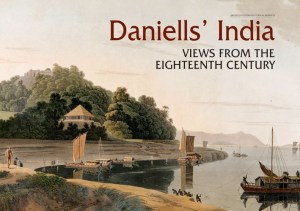 Thomas Daniell was thirty-six years old when he and his nephew William, barely sixteen, sailed out from Gravesend in April 1785, headed for the East. They arrived in Calcutta via China the next year. The Daniells traveled across India, painting oriental scenery wherever they went. Their views were widely appreciated and are representative of that fascinating period. The Daniells returned to England in September 1794. This special book presents a selection of their work in India, bringing alive the scenery and architecture of that age.
Additional images are available here»
B. N. Goswamy, distinguished art historian and author of several books on Indian Art, is Professor Emeritus of Art History at the Punjab University, Chandigarh. His work covers a wide range and is regarded, especially in the area of Indian painting, as having influenced much thinking. The recipient of many honors, Professor Goswamy has taught as Visiting Professor at several universities across the world.
Exhibition | Sacred Stitches: Ecclesiastical Textiles at Waddesdon Manor
Paul Holberton published the catalogue for this exhibition now on view at Waddesdon Manor:
Sacred Stitches: Ecclesiastical Textiles in the Rothschild Collection at Waddesdon Manor
Waddesdon Manor, Buckinghamshire, 27 March – 27 October 2013
Curated by Rachel Boak
 Sacred Stitches accompanies an exhibition that assembles together for the first time fragments of opulent and unique ecclesiastical textiles drawn from the stored collections at Waddesdon Manor, the astonishing Renaissance-style château that is one of the rare survivors of the splendour of the ‘goût Rothschild’. Dating from c. 1400 to the late 1700s, the textiles were acquired by several members of the Rothschild family, the greatest collectors of the 19th century, who sought the highest quality of workmanship with a keen sense of historical importance.
Although it might seem strange for a Jewish family to collect objects associated with the Christian Church, the textiles were prized for their technical and artistic brilliance. Parts of altar frontals, vestments and other church furnishings, they survive as fragments, cushions, banners, hangings and furniture upholstery, as their original purposes were altered to suit tastes and interior styles of the late 1800s. Baron Ferdinand de Rothschild used them in the Bachelors’ Wing at Waddesdon, the first part of the house to be completed in 1880. His sister, Alice, also had an eye for the finest ecclesiastical embroideries, displayed as decorative hangings in her own house nearby. A passionate collector of costume and textiles, Ferdinand and Alice’s niece, Baroness Edmond de Rothschild, shared their interest and added to the collection.

Dress fabric, now a chalice veil, ca. 1745-50, (Rothschild Collection at Waddesdon Manor, acc. #523). Photo by Mike Fear.
Rachel Boak, Curator at Waddesdon Manor, first considers the changing manufacture and style of vestments and furnishings for the Church in the Medieval and early Renaissance period, as well as the impact of the Reformation and the French Revolution, when many vestments and textile furnishings became redundant, were destroyed and their precious metal threads melted down. Her main focus, however, is the collecting habits of Ferdinand, Alice and Baroness Edmond in the context of 19th-century Britain, where George IV’s historicizing coronation of 1821, at which guests wore Tudor-style dress, had brought about a renewed interest in Medieval and Renaissance collecting, design and costume, and the Oxford Movement in 1833 meant a revival of vestments associated with the celebration of the Eucharist.
Each Waddesdon object – its iconography, manufacture and history – is considered individually, illustrated with beautiful new photography that captures all the detail, texture and intricate stitching.
Rachel Boak, Sacred Stitches: Ecclesiastical Textiles in the Rothschild Collection at Waddesdon Manor (London: Paul Holberton, 2013), 80 pages, ISBN: 978-0954731038, £15.
Display at Waddesdon | A Selection of Lace
Now on view at Waddesdon:
Costume at Waddesdon: A Selection of Lace
Waddesdon Manor, 27 March – 27 October 2013
Curated by Rachel Boak
 A selection of lace acquired by Baroness Edmond de Rothschild (1853–1935) is displayed outside the Family Room and shows eighteenth-century lappets, part of a fashionable woman’s headdress. Baroness Edmond collected the exquisite French, Brussels and Venetian lace now at Waddesdon, along with the popular buttons, on long-term display.
A sample from the collection is available here»
Display and New Catalogue | Printed Books and Bookbindings
Now on view at Waddesdon Manor:
 A Celebration of Books and Bindings
Waddesdon Manor, Buckinghamshire, 10 July — 27 October 2013
To mark the publication this year of Giles Barber’s magisterial catalogue of the French 18th-century books and bindings at Waddesdon, a number of highlights of the collection will be on display in the Morning Room at the Manor. The books were collected by Baron Ferdinand de Rothschild towards the end of his life, partly to complement the collections of 18th-century paintings and decorative arts, but also as works of art in their own right thanks to their intricately decorated gold-stamped bindings. The Waddesdon collection is one of the finest in the world, and the publication of the catalogue marks the first time which many of these treasures have been revealed in public.
◊ ◊ ◊ ◊ ◊
Press release from Waddesdon Manor:
Giles Barber, Catalogue of Printed Books and Bookbindings: The James A. de Rothschild Bequest at Waddesdon Manor (London: The Rothschild Foundation, 2013), 1162 pages, ISBN: 978-0954731083, £300.
A new catalogue of Printed Books and Bookbindings marks the completion of the important Waddesdon Catalogue Series, and the final publication of eminent author and book specialist, Giles Barber. The James A. de Rothschild Bequest: Printed Books and Bookbindings, published by the Rothschild Foundation, 2013, presents a scholarly analysis of Waddesdon’s outstanding collection of largely 18th-century French books. These were collected by Baron Ferdinand de Rothschild towards the end of his life, partly to complement the collections of 18th-century paintings and decorative arts, but also as works of art in their own right thanks to their intricately decorated gold-stamped bindings. The Waddesdon collection is one of the finest of its kind in the world, and the publication of the catalogue allows many of these treasures to be revealed to public for the first time. A monumental work in two volumes, the first offers a series of essays, which chart the history of bookbinding, from the materials and techniques used, the histories of the binders themselves, the role of the patron and collector and the fluctuations of the market. One unique feature is the photographic index of every tool used on each book in the catalogue. All the books have been scanned and the individual tools isolated reprographically and reproduced at actual size. As many as 50 separate tools could be used in the creation of a prestigious binding, and being able to identify each one precisely allows comparisons with books in other collections and attributions to particular workshops to be made more accurately than ever before.
The Books and Bookbindings catalogue is also the final publication in the thirteen-volume Waddesdon Catalogue series, which covers the James A. de Rothschild Collection at the Manor as bequeathed to the National Trust. Waddesdon holds one of the most significant collections of 18th-century works of art in the world, comparable with similar holdings in the V&A, the Louvre, the Metropolitan Museum and the Wallace Collection. The impetus to create the catalogue series arose when, on the death of James de Rothschild, the house was bequeathed to the National Trust and the need to make the collections accessible to the public and scholars became pressing. James’s widow, Dorothy, who took over the management of the house and ran Waddesdon until her death in 1988, set up a Catalogue Committee, headed initially by Anthony Blunt, then Director of the Courtauld Institute of Art. He was succeeded as General Editor of the series by Geoffrey de Bellaigue, later Director of the Royal Collection. The first volume, Paintings, by Ellis Waterhouse, appeared in 1967, and over the ensuing half century all the major subject areas of the Collections have been covered, each catalogue written by an eminent specialist in the field. The result is an exemplar in art publishing, with many of the titles, in which world-class objects benefit from exhaustive expert research, setting the standard in their fields.
This tradition of inviting eminent specialists to write the catalogues was especially true of Giles Barber, an internationally acknowledged expert with an unique encyclopaedic knowledge of the French bookbinders’ art. Barber’s career encompassed the Bodleian and the Taylor Institution at Oxford alongside independent writing and research, and included this last extensive catalogue for Waddesdon. Very sadly, Giles died unexpectantly in 2012, leaving the overseeing of the final editorial stages to the former Keeper of the Collections at Waddesdon, Rosamund Griffin, a role she has carried out on almost all the previous catalogues.
Call for Papers | Artistic Practices in Southern Asian Art
Artistic Practices in Southern Asian Art in the Long Eighteenth Century
College Art Association, Chicago, 12-15 February 2014
Proposals due by 15 July 2013
Session sponsored by the American Council of Southern Asian Art (ACSAA)
Panel Chair: Yuthika Sharma, Postdoctoral Fellow, Max Planck Institute of Human Development, Berlin
The eighteenth century in South Asia was an era of transition that saw the gradual decentralization of the Mughal State, the rise of autonomous regional polities as economic hubs and consolidation of the English East India Company as an administrative power. The artistic culture of this period underwent a fundamental change with increasing diversification of the patronage base, the rise of the domestic art market and the consolidation of regional identities. With the Mughal court no longer a dominant venue of artistic production, artists cut across of divides of genres and styles and acquired greater mobility. The rise of collecting, in turn, also indexed a demand for historical paintings and manuscripts contributing to a burgeoning market for copies. Taking a longue durée span between the closing years of the 17th century to the opening decades of the 19th century, we invite papers to consider a range of complexities that signal important shifts within artistic practice in this period. How can we think about in this period differently, reaching beyond conventional art historical categories or regional paradigms of analysis? How did the mobility of artists, ideas, and the rise of new media and print culture create new modes of visual expression? How did artists invent new visual vocabularies to address their cross-cultural contexts? What were the private and public channels through which artworks circulated? What was the role of copies in this period? This panel asks how the art of this transition era can bear upon the present methodologies of art historical analysis and how they can further inform questions about the nature of modernity in this period. While the term modern is taken here as a research problematic, this panel is concerned with explicit and implicit expressions of newness in artistic practices that can enrich new perspectives within South Asian art history.
Please send an abstract (300 words) and a brief one page CV by July 15, 2013 with the subject heading CAA-ACSAA Long 18th Century to: yuthika.sharma@gmail.com.










 Enfilade
4 comments