Exhibition | Think Pink
From the exhibition press release (24 September 2013) . . .
Think Pink
Museum of Fine Arts, Boston, 3 October 2013 — 26 May 2014
◊ ◊ ◊ ◊ ◊
An evening dress blooming with roses, fuchsia designer heels, and a glittering pink topaz brooch are among the fashions on view in Think Pink, opening October 3 at the Museum of Fine Arts, Boston (MFA). To mark the exhibition opening and honor Breast Cancer Awareness Month, the MFA will host an Illumination Ceremony on the evening of October 2, and light the Museum pink each evening for the remainder of the month. Think Pink features approximately 70 objects, including dresses, suits, jewelry, and accessories by designers such as Christian Dior, Dolce & Gabbana, Ralph Lauren, Christian Louboutin, and Oscar de la Renta and is complemented by graphic illustrations, photography, and paintings. On view through May 26, 2014 in the Museum’s Loring Gallery, Think Pink will also highlight dresses and accessories from the personal collection of the late Evelyn H. Lauder, who was instrumental in creating awareness of breast cancer by choosing the color as a visual reference. . .
“We are pleased to present this unique exhibition that traces the evolution of the color pink, illustrated with spectacular examples of high fashion throughout history,” said Malcolm Rogers, Ann and Graham Gund Director of the MFA. “The exhibition features, among other treasures, a recent gift of clothing and accessories from the late Evelyn Lauder, a great friend of the Museum whose collection shines in the context of fashion and accessories from the MFA’s collection.”
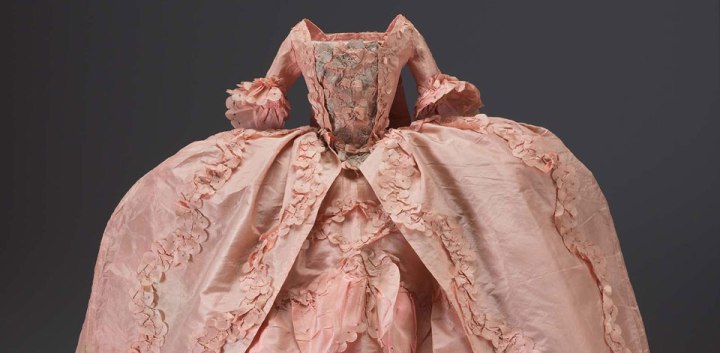
Drawn from across the MFA collections and complemented by a selection of loans and recent acquisitions, Think Pink presents rarely seen objects that explore the color’s social impact as its popularity ebbed and flowed over time. Closely tied to modern fashion and femininity, the color pink carries a unique level of social significance. By exploring the history and changing connotations of the color in fashion and visual culture from the 18th century to the present, Think Pink sheds light on changes in style, the evolution of pink for girls/blue for boys and advances in color dyeing techniques. The iconic color came into fashion during the 17th century and was worn by both men and women through the 18th century, as seen in pieces such as a dashing Man’s formal suit (1770–80) or a silk Stomacher (1700–30) for a dress. The Gem-set brooch with pendant drop (about 1850) features a stunning pink topaz stone, showing off the timeless popularity of pink accessories and jewelry.
It wasn’t until the 19th century that pink became more associated with clothing for women, as men adopted the dark, sober business suit as a way to distinguish from the lighter hues that were perceived as more feminine—a trend that was firmly established by the 1920s and 1930s. After WWII, the slogan ‘think pink’ was meant to encourage women to embrace their femininity after men returned from the war. Pink tones were seen not only in clothing but consumer goods, appliances and even automobiles. The association of pink with women was well established by 1957, when the Audrey Hepburn film Funny Face included a scene where a character resembling fashion columnist Diana Vreeland designed an issue of her magazine around the color, singing and dancing to the George Gershwin number “Think Pink.”
The transformation of pink fashion for men would come full circle in the 1970s when Robert Redford wore Ralph Lauren’s bold pink suit in The Great Gatsby movie. The pink Man’s Suit (2013) displayed in the exhibition is a copy of Lauren’s ensemble, made exclusively for Vogue’s international editor-at-large Hamish Bowles—complete with silk taffeta tie, nubuck shoes, and silk cord cuff links. While pink styles for men continue to evolve, the ubiquity of pink for women continues, seen everywhere from globe-trotting socialites picking their favorite fashions to little girls engulfed by pink toys and trinkets. The photograph Seo Woo and Her Pink Things (2006) by JeongMee Yoon comments on the persistent gender associations of color in contemporary life.
“Pink is one of the most evocative yet socially meaningful colors in the spectrum. Fashionable, symbolic and immensely popular, its use and meanings have a rich, complex and sometimes contradictory history,” said Michelle Finamore, Curator of Fashion Arts at the MFA. “Delving into that history through images, fashion and objects from the Museum’s collection explains our contemporary notions of pink as a cultural phenomenon, which only recently has become associated with the feminine.”
The links between the color pink, flowers and femininity will also be explored through objects such as flowered dresses and fashion accessories with floral motifs, including the intricate Woman’s Hat (1945–1955) from Flo-Raye. Dior’s introduction of his dramatic ‘New Look’ in 1947 was based upon the petals at a flower’s center (the corolla). Accentuating a woman’s curves with softly rounded silhouettes, he created what he called “women-flowers,” which can be seen in the designer’s evening ensemble from 1956. Similar associations continue into the present day, as seen in Dolce & Gabbana’s cabbage rose-patterned Woman’s dress (1995–96). The garment’s peek-a-boo bra alludes to yet another association with the color pink—that of lingerie and undressing. Kenneth Paul Block’s fashion illustration Female model in pink satin and lace nightgown (1978) by British designer Janet Reger is an earlier example of the affiliation, while the Ivory and pink silk and lace corset previously worn by the performer Dita Von Teese is a more modern instance.
More recently, pink has come to symbolize the effort to combat breast cancer around the world. Evelyn Lauder, who founded The Breast Cancer Research Foundation—now headed by Mrs. Lauder’s husband Leonard—was instrumental in creating this association. Think Pink will feature several items from Mrs. Lauder’s personal collection, including a 2010 Oscar de la Renta dress, Christian Louboutin Greissimo pumps (about 2005), Boho Fuzzy Felt Mules (2005) designed by Emma Hope, a Feathered headpiece (mid-20th century) designed by fashion photographer Bill Cunningham (who worked as a milliner under the label ‘William J.’ in the 1940s and 1950s), and a contemporary evening dress by designer Naeem Khan. . .










 Enfilade
leave a comment