Call for Papers | Paragone Studies
Paragone Studies
Musée des Beaux-Arts du Québec, 18–20 September 2014
Proposals due by 1 April 2014
Papers are invited for The 3rd Annual International Conference in Paragone Studies, to be held at the Musée des beaux-arts du Québec, just outside of the old quarter of the City of Québec in Canada. The conference’s purpose is to support the scholarly investigation of the paragone, or rivalry in the arts, as it has been manifested in all media across history. The conference will also include a round-table session featuring artists who choose to discuss how competition in the arts, past or present, has impacted their work or their professional lives. To apply, please submit a 300-word abstract using the paper or round-table presenter appropriate form on the conference website and send to paragonestudies@gmail.com. Please include a c.v.
Exhibition | Le Bivouac de Napoléon: Luxe impérial en campagne
From the Palais Fesch:
Le Bivouac de Napoléon: Luxe impérial en campagne
Palais Fesch, Musée des Beaux Arts, Ajaccio, 13 February — 12 May 2014
 Napoléon Ier passe une grande partie de son existence en campagne ou en voyage. Il possède pour ses déplacements et ses bivouacs, une organisation particulière reproduisant pour partie l’étiquette impériale. Ses tentes de campagne sont de véritables palais tissés mobiles, ses bagages, – lit, table, fauteuil, écritoire, nécessaire ou encore chaise d’affaires – constituent un ameublement pliant et luxueux en boite. Les nombreuses voitures qui transportent les effets de l’empereur en campagne, escortées et conduites par un personnel de service nombreux, forment un véritable convoi.
Cet ouvrage, sous la direction de Jehanne Lazaj, conservatrice au Mobilier national, entend montrer l’ingéniosité d’objets prestigieux tout comme la somptuosité de l’artisanat d’Empire à travers l’étude de plus de 70 œuvres qui sont autant d’éléments de campements, de contexte ou de documents iconographiques. Le lecteur s’installe, ainsi, sous le tente de Napoléon pour appréhender une vision la plus
complète possible de la vie des bivouacs, les soirs de
victoire comme de défaite.
Call for Papers | Amateurs: Practices and Representations
From Le Blog de L’ApAhAu:
L’amateurisme dans l’Europe du XVIIIe siècle. Pratiques et représentations
Paris, Université Sorbonne Nouvelle, 3–4 October 2014
Proposals due by 30 April 2014
Le XVIIIe siècle a souvent été décrit comme l’âge d’or de l’amateur. De cette consécration, le signe le plus visible est la création en France du titre d’« amateur honoraire » à l’Académie royale de peinture et de sculpture, dont la personne du comte de Caylus fut l’un des plus brillants représentants. Dans son abstraction, le terme renvoie moins à une fonction déterminée qu’à un goût pour l’art, lequel recouvre concrètement une configuration d’aptitudes ou de rôles (du collectionneur, du mécène, de l’esthète, du savant, du praticien) : parce qu’il combine ces différents usages du goût, le modèle académique constitue un type idéal et accompli de l’amateur, au point qu’on a pu identifier le déclin de ce modèle à la disparition de cette figure au siècle suivant.
Dépassant ce cadre d’analyse centré sur les beaux-arts et le cas français, on se fondera ici sur une compréhension extensive du terme, qui s’étendra aux domaines artistiques autres que les arts plastiques (théâtre, architecture, musique, arts des jardins, etc.) voire au champ esthétique en général (incluant à ce titre le paysage) et l’on abordera cet objet d’étude dans une perspective comparatiste, ouverte sur les particularités lexicales et sémantiques qui caractérisent sa conceptualisation dans les différentes langues et cultures européennes.
On s’interrogera sur les antagonismes et les évolutions qui travaillent la définition de l’amateur, au sein d’un champ de forces où s’affrontent des intérêts divergents. Pour être d’institution récente, la figure de l’amateur académique n’en reste pas moins partiellement tributaire des structures et des valeurs propres à cette sociabilité aristocratique au sein de laquelle s’est constituée une tradition du loisir cultivé et qui définit, depuis le XVIIe siècle, le cadre de la pratique de l’amateur des belles-lettres. Or la campagne que les « gens de lettres », Diderot en tête, vont mener contre Caylus et ses confrères à partir du milieu du XVIIIe siècle, contribue à élargir l’horizon de communication dans lequel se déploie l’activité de l’amateur. Dénonçant la restriction du domaine de juridiction en matière esthétique aux relations entre particuliers à l’intérieur de cercles d’initiés, les critiques d’art revendiquent leur rôle « dans la formation d’un espace public et civique du goût » (Charlotte Guichard, Les amateurs d’art à Paris au XVIIIe siècle, 2008). Ils promeuvent une nouvelle vision de l’amateurisme sous l’espèce du critique d’art, qui prétend former le goût général en s’exprimant en tant que personne particulière, sans être un professionnel ni un praticien. (more…)
Attingham’s French Eighteenth-Century Studies Course
From The Attingham Trust:
The Attingham Trust’s French Eighteenth-Century Studies Course
The Wallace Collection, London, 12–17 October 2014
Applications due by 30 April 2014

François Boucher, Shepherd Piping to a Shepherdess, ca. 1747–50
(London: Wallace Collection)
◊ ◊ ◊ ◊ ◊
French eighteenth-century studies is organised by The Attingham Trust on behalf of the Wallace Collection. Based at Hertford House, this intensive, non-residential study programme aims to foster a deeper knowledge and understanding of French eighteenth-century fine and decorative art and is intended primarily to aid professional development. A day at Waddesdon Manor, Ferdinand de Rothschild’s former country house, will help broaden the scope of the course still further.
The academic programme will provide privileged access to the world-class collections of furniture, paintings, sculpture, textiles, metalwork and porcelain in these two collections. The group will be limited to fifteen people to allow for detailed, object-based study, handling sessions and a look at behind-the-scenes conservation.
Study sessions and lectures will be led by Dr. Christoph Vogtherr, Director of the Wallace Collection, and the relevant curatorial staff; other international authorities and the curators at Waddesdon will provide further specialist teaching. The Course Director is Dr. Helen Jacobsen, Curator of French eighteenth-century Decorative Arts at the Wallace Collection. This course is primarily aimed at curators and other specialists in the fine and decorative arts.
More information is available here»
Exhibition | Richard Wilson
To mark the opening of Richard Wilson and the Transformation of European Landscape Painting, curators Robin Simon and Martin Postle will be in New Haven this evening (5:30, Wednesday, 5 March 2014) for a session entitled “Putting Wilson on the Spot: Landscape, Art, and Location.” Exhibition press release from the YCBA:
Richard Wilson and the Transformation of European Landscape Painting
Yale Center for British Art, New Haven, 6 March — 1 June 2014
National Museum Cardiff, 5 July — 26 October 2014
Curated by Robin Simon and Martin Postle
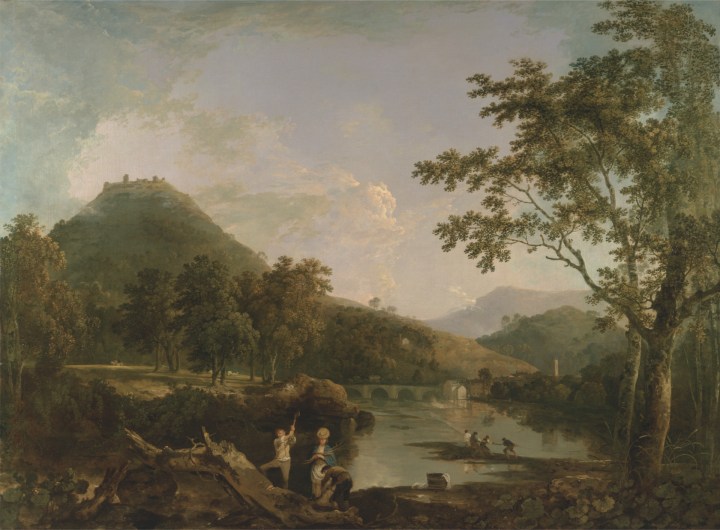
Richard Wilson, Dinas Bran from Llangollen, 1770–71, oil on canvas,
Yale Center for British Art, Paul Mellon Collection
◊ ◊ ◊ ◊ ◊
This spring, the Yale Center for British Art presents the first major exhibition in more than thirty years devoted to Welsh painter Richard Wilson (1714–1782), considered by many to be the father of British landscape painting. Richard Wilson and the Transformation of European Landscape Painting, opening on March 6, 2014, will demonstrate the extent of Wilson’s influence throughout Europe and explore his work in its international context. The exhibition will focus on the nearly seven years he spent working in Rome in the 1750s, a transformational period for Wilson and for European landscape art.
The exhibition will feature many of Wilson’s greatest paintings and drawings alongside works by European masters who preceded Wilson, contemporaries whose practice directly influenced his, and artists who were in turn taught or influenced by him. Other artists in the exhibition will include the old masters Claude Lorrain and Gaspard Dughet, as well as many of Wilson’s contemporaries such as Claude-Joseph Vernet, Pompeo Batoni, and Anton Raphael Mengs. Also presented will be works by many of Wilson’s pupils and followers, including the little-known artists Robert Crone and Adolf Friedrich Harper—both of whom studied with Wilson in Italy, as well as major figures such as John Constable and J. M. W. Turner.
As part of a cosmopolitan group of artists in Rome, Wilson pioneered a serious and powerfully original approach to landscape that reflected the nascent neoclassicism being advanced by his friends Anton Raphael Mengs and Johann Winckelmann. Wilson’s pupils in Rome transmitted his style across northern Europe. Setting up in London after his Italian sojourn, he established a large and successful studio and gained a European reputation with grand historical landscapes—such as The Destruction of the Children of Niobe (1760)—which were featured at the new public art exhibitions in London and widely disseminated through popular engravings. His treatment of British landscapes, particularly of his native Wales, borrowed their conceptual framework from the paintings of the seventeenth-century masters Claude Lorrain and Gaspard Dughet, but with a specificity of lighting conditions and weather that was an enduring legacy to the British landscape school.
Wilson’s great success during the 1760s slipped away in the following decade, as there was less demand for his work and his health deteriorated. By the time of his death he was largely forgotten. However, within a few years his critical reputation began to revive, and by the early nineteenth century he was celebrated as a pioneering figure of the British school. His innovations in landscape painting were crucial to the development of the genre during the romantic period, which saw its greatest expression in the work of J. M. W. Turner and John Constable, both profound admirers of Wilson.
This is the first exhibition the Center has co-organized with Amgueddfa Cymru– National Museum Wales. The exhibition has been co-curated by Robin Simon, Honorary Professor of English, University College London, and Editor, The British Art Journal, and Martin Postle, Deputy Director of Studies, The Paul Mellon Centre for Studies in British Art, London. The organizing curator at the Center is Scott Wilcox, Chief Curator of Art Collections and Senior Curator of Prints and Drawings; and, at Amgueddfa Cymru–National Museum Wales, Oliver Fairclough, Keeper of Art.
◊ ◊ ◊ ◊ ◊
From Yale UP:
Martin Postle and Robin Simon, eds., with contributions by Steffen Eggle, Oliver Fairclough, Jason Kelly, Ana María Suárez Huerta, Lars Kokkonen, Kate Lowry, Paul Spencer-Longhurst, Jonathan Yarker, Scott Wilcox, and Rosie Ibbotson. Richard Wilson and the Transformation of European Landscape Painting (New Haven: Yale University Press, 2014), 416 pages, ISBN: 978-0300203851 $80.
 Long known as the father of British landscape painting, Richard Wilson (1713–1782) was in fact at the heart of a profound conceptual shift in European landscape art. This magnificently illustrated volume not only situates Wilson’s art at the beginning of a native tradition that would lead to John Constable and J. M. W. Turner, but compellingly argues that in Rome during the 1750s Wilson was part of an international group of artists who reshaped the art of Europe. Rooted in the work of great seventeenth-century masters such as Claude Lorrain but responding to the early stirrings of neoclassicism, Wilson forged a highly original landscape vision that through the example of his own works and the tutelage of his pupils in Rome and later in London would establish itself throughout northern Europe.
Martin Postle is assistant director of the Paul Mellon Centre for Studies in British Art. Robin Simon is honorary professor of English at University College
London, and editor of The British Art Journal.
Portraits and Other Pictures Return to Osterley
From the UK’s National Trust:
Rare portraits and Other Works of Art Now on Display at Osterley Park and House in West London
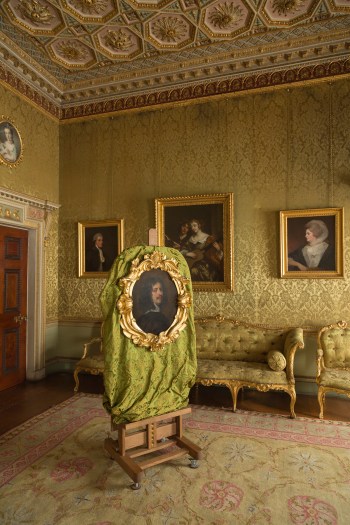
William Dobson’s self-portrait on display at Osterley together with the portraits of Robert and Sarah Child and The Music Lesson by Sir Peter Lely. ©National Trust/Chris Lacey
Once described by Horace Walpole as the ‘palace of palaces’, Osterley Park and House’s spectacular interiors were created in the 18th century by the Child family, the owners of Child’s Bank. But for over sixty years their portraits have been absent. Now a major ten-year loan marks the return of the Child family to the house they so lovingly transformed with rare items of furniture and over twenty paintings including many portraits of family members. Among the most famous artworks to return is a self-portrait by William Dobson (1611–1646), court painter to King Charles I, which was bought by the family in the early 18th century and has not been on public display at Osterley since 1949.
The family portraits
•Francis Child III — He succeeded to Osterley in 1756 and began transforming the house with the help of fashionable architect Robert Adam.
•Robert Child — Francis’ brother, he inherited Osterley Park and House in 1763 and continued to employ Adam who worked at Osterley until 1781.
• Sarah Jodrell — Robert’s wife and a woman of many accomplishments which included her exquisite embroidery, examples of which can be seen at Osterley Park and House.

Alan Ramsay, Portrait of Francis Child III (1735-63). ©National Trust/John Hammond
• Sarah Anne Child — Robert and Sarah’s beloved daughter and a talented musician, whose harpsichord is still on display in the house. She was disinherited from her father’s fortune for eloping to Gretna Green to marry the Earl of Westmorland.
Claire Reed, Osterley’s House and Collections Manager explains: “This is an exciting moment as it really feels as though the family are returning to Osterley. We have beautiful interiors and fascinating objects at the house but until now visitors couldn’t see the faces behind the names of those who made this such a wonderful place.”
Other art works include The Music Lesson by Sir Peter Lely and a large painting of Temple Bar, a detailed London scene depicting the area close to the location of Child’s Bank. Rare pieces of lacquer furniture and other treasured family objects will also be on display, telling stories of the fashions and tastes for collecting in the 18th century.
Osterley Park and House was first opened to the public by the 9th Earl of Jersey in 1939 following a steady stream of requests to see inside the house. It was then transferred to us in 1949. This ten-year loan has been made by the trustee of the Earldom of Jersey Trust, following consultation and backing from the 10th Earl of Jersey.
Also see the posting at Emile de Bruijn’s Treasure Hunt (27 February 2014)»
New Book | Antique Sealed Bottles, 1640–1900
Happy Mardi Gras!
David Burton, Antique Sealed Bottles 1640–1900 and the Families that Owned Them (Antique Collectors’ Club, 2014), 1800 pages (3 volumes), ISBN: 978-1851497553, £250.
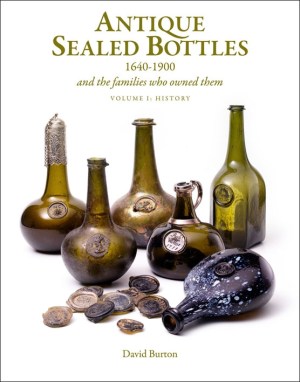 Time in a bottle; this is a collection that explores the unlocking of history through the identification of its unique seals, using crests and coats-of-arms as the ‘keys’ towards identifying the original owner. This three-volume collection examines the evolution of the sealed bottle from the 1640s to the late 1800s and provides a detailed description to accompany each entry, supported by numerous photographs, including the number of examples known, their condition, and the collections where the bottles and detached seals are held.
The laying down of wine to improve its quality and longevity related to the social history of the day, the design of the bottles, their evolution and manufacture, are a reflection of the individuals who ordered and used the bottles at home or in the private gentlemen’s clubs, much influenced by the historic events of the 17th through to the 20th centuries.
Wine consumption has a place in cultural history; these collected bottles existed at times of incredible upheaval and social change. From the early colonial settlements of the New World, into the slave markets of Richmond, VA, New Orleans, Charleston, SC, and Philadelphia, and with the plantation owners who amassed vast wealth and prestige as a result of this trade. In the taverns and coffee houses of London, alongside the bear baiting and cock fighting to be found across the River Thames in Southwark, in the cellars of the Oxford colleges and Inns of Court, these sealed bottles give much information on the early drinking habits of the aspiring and upwardly mobile, and the established aristocracy.
C O N T E N T S
Volume One
Dated Sealed Bottles, 1650–1900
Volume Two
Undated Sealed Bottles, Seventeenth Century; Undated Sealed Bottles, 1700–1900; Crests and Coats of Arms, pre-1700 identified; Crests and Coats of Arms, pre-1700 unidentified; Crests and Coats of Arms, post-1700 identified; Crests and Coats of Arms, post-1700 unidentified
Volume Three
Chapter One: What is a Sealed Bottle? Chapter Two: Sealed Bottles from the Seventeenth Century; Chapter Three: Sealed Bottles from the Eighteenth and Nineteenth Centuries; Chapter Four: Heraldry and Sealed Bottles; Chapter Five: Sealed Bottles from the West Country; Chapter Six: Sealed Bottles from Wales; Chapter Seven: Sealed Bottles associated with the American Colonies; Chapter Eight: Sealed Bottles in Major Public Collections; Chapter Nine: Building a Collection; Chapter Ten: Price Guide and Price Trends

Exhibition | Art and Appetite: American Painting
In comparison to the nineteenth century, the eighteenth-century offerings are slim, but it’s still hard to tell this story without the latter. Press release (11 December 2014) from the Amon Carter:
Art and Appetite: American Painting, Culture, and Cuisine
The Art Institute of Chicago, 12 November 2013 — 27 January 2014
Amon Carter Museum of American Art, Fort Worth, Texas, 22 February — 18 May 2014
Curated by Judith A. Barter

John Greenwood, Sea Captains Carousing in Surinam, ca.1752–58
(Saint Louis Art Museum)
◊ ◊ ◊ ◊ ◊
This spring, the Amon Carter Museum of American Art invites visitors to feast their eyes on the rich tradition of food in American art with the opening of the exhibition Art and Appetite: American Painting, Culture, and Cuisine. Exploring the many meanings and interpretations of eating in America, Art and Appetite brings together 65 paintings from the 18th through the 20th centuries to demonstrate how depictions of food have allowed American artists to both celebrate and critique everything from trends in the national diet to the broader issues of society and politics. Featuring many iconic works by such noted artists as Edward Hopper, Norman Rockwell and Andy Warhol, the exhibition is on view from February 22 through May 18, 2014. Art and Appetite is organized by the Art Institute of Chicago; admission is free.
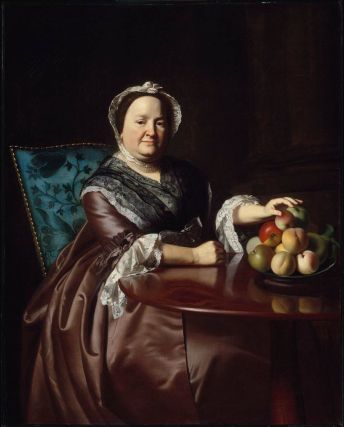
John Singleton Copley, Portrait of Mrs. Ezekiel Goldthwait (Elizabeth Lewis), 1771 (Boston: Museum of Fine Arts)
Art and Appetite takes a different approach to the subject of food in American art, contextualizing works to rediscover the meanings they held for their makers and their audiences. Despite the prevalence of works about food, research has rarely focused on the cultural significance of the objects depicted in these paintings, nor has it addressed how these images embodied changing ideals throughout the nation’s history. Thematically and chronologically organized, Art and Appetite breaks with the traditional histories of the genre to explore how these works illuminate American attitudes about patriotism and politics, identity and gender, progress and history, and production and consumption. The exhibition examines 250 years of American art, from the agricultural bounty of the “new world” to Victorian-era excess, debates over temperance, the rise of restaurants and café culture, the changes wrought by 20th-century mass production, and much more.
From the earliest years of the newly established United States, American artists such as Raphaelle Peale used still-life painting to express cultural, political and social values, elevating the genre to a significant aesthetic language. Later, in the antebellum era, depictions of food highlighted abundance, increasing wealth and changing social roles, while elegant decanters of wine and spirits in still-life paintings by John F. Francis reflect the prevalence of drinking and the mid-century debates over temperance. During the Gilded Age, despite the implications of the term, American artists moved away from excess and eschewed high Victorian opulence in favor of painting the simple meal. Many artists, such as William Harnett and De Scott Evans, also used images of food to serve up biting political commentary that addressed the social and economic transformations of the 1880s and 1890s.
In the 20th century new ways of eating and socializing began to change depictions of food in art. Restaurant dining—still novel in the United States in the late 19th century—became a common subject in the works of William Glackens, John Sloan and others. Café and cocktail culture, described in the work of Stuart Davis and Gerald Murphy, became increasingly important even as Prohibition banned the consumption of alcohol. Modern artists employed food in their radically new explorations of pictorial form, all the while challenging national ideals of family and home. Finally, during the 1950s and 1960s, Pop artists, among them Andy Warhol and Roy Lichtenstein, addressed the ways in which mass production and consumption dramatically altered the American experience of food. Hamburgers, fries and cakes were depicted as objects of mass-produced foodstuffs without human referent. Artists employed new means to explore the visual power of advertising, the standardization of factory-produced meals and the commercialization of American appetites.
Today, as professional and home chefs increasingly turn toward local, organic food and American society ponders its history as a fast-food nation, this exhibition offers visitors the chance to look at depictions of American food and culture with new meaning and fresh eyes.
Art and Appetite: American Painting, Culture, and Cuisine was organized by the Art Institute of Chicago. It is supported in part by generous contributions from Central Market, the Fort Worth Promotion and Development Fund, and the Ben E. Keith Foundation.
Also, see the online cookbook from The Art Institute of Chicago.
◊ ◊ ◊ ◊ ◊
From Yale UP:
Judith A. Barter, ed., with essays by Judith A. Barter, Annelise K. Madsen, Sarah Kelly Oehler, and Ellen E. Roberts, Art and Appetite: American Painting, Culture, and Cuisine (New Haven: Yale University Press, 2013), 248 pages, ISBN: 978-0300196238, $50.
 Food has always been an important source of knowledge about culture and society. Art and Appetite takes a fascinating new look at depictions of food in American art, demonstrating that artistic representations of edibles offer thoughtful reflection on the cultural, political, economic, and social moments in which they were created. Artists used food as prism through which they could celebrate and critique their society, expressing ideas relating to politics, race, class, and gender. With a focus that ranges from Colonial still lifes of the 18th century through the Pop artists of the 20th century, this lively publication investigates the many interpretations of eating in America.
Art and Appetite features still-life and trompe l’oeil painting, sculpture, and other works by such celebrated artists as John Singleton Copley, Raphaelle Peale, Lilly Martin Spencer, William Michael Harnett, William Merritt Chase, Elizabeth Paxton, Norman Bel Geddes, Stuart Davis, Edward Hopper, Alice Neel, Wayne Thiebaud, and Roy Lichtenstein, among others. Essays by leading experts address topics including the horticultural and botanical underpinnings of still-life painting, the history of alcohol consumption in the United States, the cultural history of Thanksgiving, and the commercialization of food in the world of Pop art. In addition to the images and essays, this book includes a selection of vintage recipes for all-American dishes.
Judith A. Barter is the Field-McCormick Chair and Curator, Department of American Art, at the Art Institute of Chicago.
Exhibition | Think Pink
From the exhibition press release (24 September 2013) . . .
Think Pink
Museum of Fine Arts, Boston, 3 October 2013 — 26 May 2014
◊ ◊ ◊ ◊ ◊
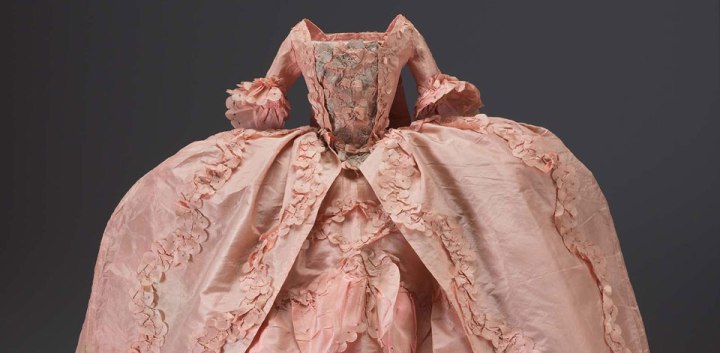
An evening dress blooming with roses, fuchsia designer heels, and a glittering pink topaz brooch are among the fashions on view in Think Pink, opening October 3 at the Museum of Fine Arts, Boston (MFA). To mark the exhibition opening and honor Breast Cancer Awareness Month, the MFA will host an Illumination Ceremony on the evening of October 2, and light the Museum pink each evening for the remainder of the month. Think Pink features approximately 70 objects, including dresses, suits, jewelry, and accessories by designers such as Christian Dior, Dolce & Gabbana, Ralph Lauren, Christian Louboutin, and Oscar de la Renta and is complemented by graphic illustrations, photography, and paintings. On view through May 26, 2014 in the Museum’s Loring Gallery, Think Pink will also highlight dresses and accessories from the personal collection of the late Evelyn H. Lauder, who was instrumental in creating awareness of breast cancer by choosing the color as a visual reference. . .
“We are pleased to present this unique exhibition that traces the evolution of the color pink, illustrated with spectacular examples of high fashion throughout history,” said Malcolm Rogers, Ann and Graham Gund Director of the MFA. “The exhibition features, among other treasures, a recent gift of clothing and accessories from the late Evelyn Lauder, a great friend of the Museum whose collection shines in the context of fashion and accessories from the MFA’s collection.”
Drawn from across the MFA collections and complemented by a selection of loans and recent acquisitions, Think Pink presents rarely seen objects that explore the color’s social impact as its popularity ebbed and flowed over time. Closely tied to modern fashion and femininity, the color pink carries a unique level of social significance. By exploring the history and changing connotations of the color in fashion and visual culture from the 18th century to the present, Think Pink sheds light on changes in style, the evolution of pink for girls/blue for boys and advances in color dyeing techniques. The iconic color came into fashion during the 17th century and was worn by both men and women through the 18th century, as seen in pieces such as a dashing Man’s formal suit (1770–80) or a silk Stomacher (1700–30) for a dress. The Gem-set brooch with pendant drop (about 1850) features a stunning pink topaz stone, showing off the timeless popularity of pink accessories and jewelry. (more…)
MFA Director Malcolm Rogers Announces Retirement Plans
Press release (27 February 2014) from Boston’s MFA:
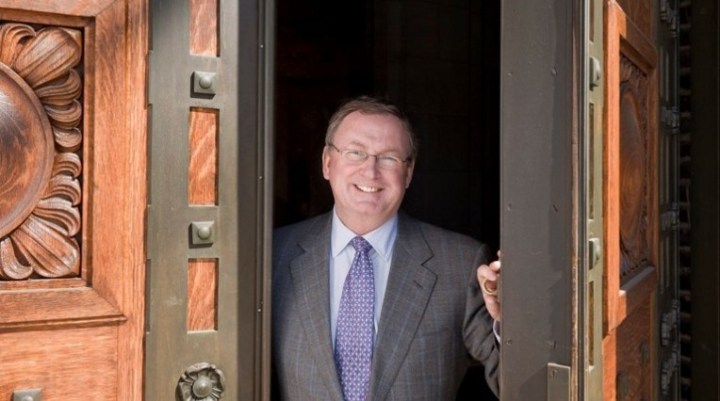
Today, Malcolm Rogers, Ann and Graham Gund Director of the Museum of Fine Arts, Boston (MFA), announced to the MFA’s Board of Trustees his future plans to retire. Throughout his nearly 20 years at the Museum, Rogers—who in May becomes the longest-serving Director in the MFA’s 144-year history—established a legacy of “opening doors” to communities from Boston and around the world. The Board will establish a committee to oversee a global search for the Museum’s next director, with Rogers remaining at the helm until a successor is identified and appointed…
Keep reading here»










 Enfilade
leave a comment