New Book | Soul Food
The 2014 James Beard Awards were announced this week, with Adrian Miller’s Soul Food taking top honors for Reference and Scholarship. (Also nominated was William Sitwell’s A History of Food in 100 Recipes, which, while employing a much larger scope, may also appeal to Enfilade readers; 7 of the recipes date from the eighteenth century). From UNC Press:
Adrian Miller, Soul Food: The Surprising Story of an American Cuisine, One Plate at a Time (Chapel Hill: The University of North Carolina Press, 2013), 352 pages, ISBN 978-1469607627, $30.
 In this insightful and eclectic history, Adrian Miller delves into the influences, ingredients, and innovations that make up the soul food tradition. Focusing each chapter on the culinary and social history of one dish—such as fried chicken, chitlins, yams, greens, and ‘red drinks’—Miller uncovers how it got on the soul food plate and what it means for African American culture and identity.
Miller argues that the story is more complex and surprising than commonly thought. Four centuries in the making, and fusing European, Native American, and West African cuisines, soul food—in all its fried, pork-infused, and sugary glory—is but one aspect of African American culinary heritage. Miller discusses how soul food has become incorporated into American culture and explores its connections to identity politics, bad health raps, and healthier alternatives. This refreshing look at one of America’s most celebrated, mythologized, and maligned cuisines is enriched by spirited sidebars, photographs, and 22 recipes.
Adrian Miller is a writer, attorney, and certified barbecue judge who lives in Denver, Colorado. He has served as a special assistant to President Bill Clinton, a senior policy analyst for Colorado Governor Bill Ritter Jr., and a Southern Foodways Alliance board member.
New Book | The Gardener of Versailles
From Rizzoli:
Alain Baraton, The Gardener of Versailles: My Life in the World’s Grandest Garden, translated by Christopher Brent Murray (New York: Rizzoli, 2014), 296 pages, ISBN: 978-0847842681, $27.
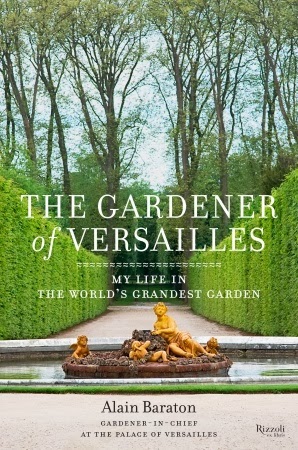 For gardening aficionados and Francophiles, a love letter to the Versailles Palace and grounds, from the man who knows them best. In Alain Baraton’s Versailles, every grove tells a story. As the gardener-in-chief, Baraton lives on its grounds, and since 1982 he has devoted his life to the gardens, orchards, and fields that were loved by France’s kings and queens as much as the palace itself. His memoir captures the essence of the connection between gardeners and the earth they tend, no matter how humble or grand.
With the charm of a natural storyteller, Baraton weaves his own path as a gardener with the life of the Versailles grounds, and his role overseeing its team of eighty gardeners tending to 350,000 trees and thirty miles of walkways on 2,100 acres. He richly evokes this legendary place and the history it has witnessed but also its quieter side that he feels privileged to know. The same gardens that hosted the lavish lawn parties of Louis XIV and the momentous meeting between Marie Antoinette and the Cardinal de Rohan remain enchanted, private places where visitors try to get themselves locked in at night, lovers go looking for secluded hideaways, and elegant grandmothers secretly make cuttings to take back to their own gardens. A tremendous best seller in France, The Gardener of Versailles gives an unprecedentedly intimate view of one of the grandest places on earth.
Alain Baraton is the best-selling author of many books on gardening and the host of weekly gardening programs on French radio and television.
New Book | The Gardens of Venice and the Veneto
The particular appeal of this book lies in the fact that the gardens included are accessible to the public. From Frances Lincoln:
Jenny Condie, with photographs by Alex Ramsay, The Gardens of Venice and the Veneto (London: Frances Lincoln, 2013), 224 pages, ISBN: 978-0711234048, £35 / $60.
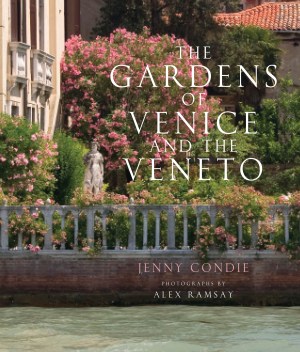 The Gardens of Venice and the Veneto draws together an amazing variety of 22 spellbinding garden retreats, from monastery gardens quietly cultivated in the islands of the lagoon to magnificent villas on the Brenta Canal, and baroque masterpieces in the hills beyond. Highlights include an eerie Masonic garden complete with gothic chapel and cavernous grottoes, a pleasure garden made for his workers by a benevolent nineteenth-century industrialist, and a flower-filled delight by the banks of the Grand Canal.
This is a book of ravishing images and intriguing stories. The garden behind Henry James’s Aspern Papers is here, along with the garden which so beguiled Margaret Symonds, the young English author of Days Spent on a Doge’s Farm. With an emphasis on gardens that can be visited, longtime resident Jenny Condie elucidates the dynastic triumphs, the reversals of fortune, and the shifts in taste and influence which have shaped these
extraordinary places.
Jenny Condie was born in Edinburgh and took a degree in Italian and History of Art at UCL. She has translated a number of substantial works in the area of art and literary history and criticism, and she has also written in Italian as a journalist. More recently she has worked with the Fondazione di Venezia to originate and run workshops on English Literature for children in local schools. Jenny Condie has lived in Venice since 2002 with her husband, the novelist Enrico Palandri, and their three children.
Alex Ramsay lives in the Welsh Marches. He is a photographer of international repute whose work has appeared in many books published by Frances Lincoln, including Italian Gardens: A Cultural History (recently reissued in paperback) and Italy’s Private Gardens: An Inside View, both written by his wife, the garden historian Helena Attlee.
◊ ◊ ◊ ◊ ◊
C O N T E N T S
 The Gardens of Venice
Island gardens
• The Giudecca
Religious gardens
• San Francesco della Vigna
• Ca’ Morosini del Giardin
Palazzi gardens
• Ca’ Rezzonico
• Ca’ Tron
• Ca’ Zenobio
• Palazzo Cappello Malipiero Barnabò
• Palazzo Contarini Dal Zaffo
• Palazzo Rizzo Patarol
• Palazzo Soranzo Cappello
• Querini Stampaglia
The Gardens of the Brenta Canal
•Villa Brusoni Scalella, Dolo
• Villa Pisani, Stra
The Gardens of Padua
• Orto botanico, Padua
• Ca’ Marcello, Levada di Piombino Dese
• Villa Barbarigo Pizzoni-Ardemani, Valsanzibio
• Villa Ca’ Dolfin, Marchiori, Lendinara s
• Villa Emo, Rivella di Monselice
• Villa Pisani Bolognesi Scalabrin, Vescovana
• Villa Valmarana a Citadella Vigodarzere, Saonara
The Gardens of Treviso
• Villa Barbaro di Maser
The Gardens of Verona
• Giardino Giusti, Verona
• Giardino di Pojega, Villa Rizzardi, Negrar
• Villa Allegri Arvedi, Cuzzano s
• Villa della Torre, Fumane
• Villa Trissino Marzotto, Trissino
The Gardens of Vicenza
• Villa Fracanzan Piovene, Orgiana
• Villa Godi Malinverni and Villa Piovene Porto-Godi, Lonedo di Lugo Vicentino
• Villa da Schio , Costozza
• Villa Valmarana ai Nani
Visiting the gardens
Books to read
Journées d’études | Questioning the Frame in Decorative Systems
From the INHA:
Jeux et enjeux du cadre dans les systèmes décoratifs à l’époque moderne
Institut national d’histoire de l’art, Paris, 9–10 May 2014
Pouvant être considérés comme de véritables systèmes, les décors modernes s’imposent comme un phénomène propre de la pratique artistique, qu’il convient d’étudier comme tel. Le décor atteint en effet entre les XVe et XVIIIe siècles un degré d’élaboration et de complexité tout particulier, multipliant les dispositifs de présentation du discours visuel tout en intégrant les contraintes spatiales imposées par ses supports.
Ces journées d’études entendent appréhender l’originalité de ce phénomène à travers la question du cadre. Souvent laissé à la marge des études sur le décor, le cadre en constitue pourtant l’une des dimensions essentielles, qui en conditionne non seulement les modes de perception mais permet aussi d’en comprendre les mécanismes de fonctionnement. En effet, si les systèmes décoratifs sont par excellence, à l’époque moderne, le lieu d’une expérimentation des frontières entre l’espace réel et celui de la représentation, c’est notamment à travers des jeux d’encadrement subtils et variés, que nous aurons à cœur d’explorer au cours de cette rencontre.
Organisées par le Centre d’histoire de l‘art de la Renaissance, HiCSA, Université Paris I Panthéon-Sorbonne ; le Centre de recherches François-Georges Pariset, Université Bordeaux Montaigne ; et le Groupe d’analyse culturelle de la première modernité, Université catholique de Louvain.
V E N D R E D I , 9 M A I 20 1 4
10.00 Accueil des participants
10.15 Ouverture des journées d’études par Philippe Morel (Université Paris I Panthéon-Sorbonne)
10.30 Introduction et présentation des journées d’études par Nicolas Cordon, Édouard Degans, Elli Doulkaridou et Caroline Heering
Session 1: Autonomie du cadre
Président de séance : Pascal Bertrand (Université Bordeaux Montaigne)
11.00 Caroline Heering (UCL), Un ornement mobile et détachable : le cartouche dans les systèmes décoratifs modernes
11.20 Laurent Paya (CESR, Tours), Les « Compartiments » et « Bordures » des jardins maniéristes : dynamiques ornementales et glissements métonymiques
11.40 Vincent Dorothée (Université Paris I Panthéon-Sorbonne), La Pompe funèbre de Charles III ou les mensonges du cadre
12.00 Discussion
12.30 Déjeuner
Session 2: Encadrer l’écrit
Président de séance : Agnès Guiderdoni (FNRS UCL)
14.00 Marina Vidas (The Royal Library, Copenhagen), Framing strategies in three Italian fifteenth-century illuminated manuscripts
14.20 Elli Doulkaridou (Université Paris I Panthéon-Sorbonne/INHA), Dans la marge, à travers le cadre et au-delà : dispositifs d’encadrement dans les manuscrits enluminés romains, de Léon X à Paul III
14.40 Discussion
15.10 Pause
15.40 Annelyse Lemmens (FNRS UCL), Le frontispice comme encadrement : statuts et fonctions d’un système décoratif (Anvers, XVIe-XVIIe siècles)
16.00 Gwendoline de Mûelenaere (FNRS UCL), Les encadrements gravés des affiches de thèse dans le décor des soutenances publiques (XVIIe-XVIIIe siècles)
16.20 Discussion
S A M E D I , 1 0 M A I 2 0 1 4
Session 3 : Perméabilité et transgression du cadre
Président de séance : Philippe Morel (Université Paris I Panthéon-Sorbonne)
9.30 Édouard Degans (Université Bordeaux Montaigne/Università degli Studi di Firenze), Portes, cadres, ornements et figures feintes dans les systèmes décoratifs maniéristes
9.50 Kristen Adams (Ohio State University), Tapestries Real and Feigned: Framing Devices in Rubens’s Triumph of the Eucharist Series
10.10 Discussion
10.40 Pause
11.00 Sandra Bazin (Université Paris IV Sorbonne), Des « tableaux mouvants » : rôles et enjeux de l’encadrement des miroirs dans la mise en scène des grands décors aristocratiques en Europe (XVIIe- XVIIIe siècles)
11.20 Maria do Rosario Salema De Carvalho (Lisbon University), The frames of Portuguese Baroque Azulejos’
11.40 Lauren Cannady (Centre allemand d’Histoire de l’art), Framing nature: rococo decoration for a cabinet de curiosités
12.00 Discussion
12.30 Déjeuner
Session 4 : Cadre, mur et relief
Président de séance : Ralph Dekoninck (UCL)
14.00 Nicolas Cordon (Université Paris I Panthéon-Sorbonne), L’Ignudo de Michel Ange et sa version de stuc : le cadre comme attribut
14.20 Émilie Passignat (Université de Pise), La sculpture encadrée : observations sur l’encadrement dans les ensembles sculptés aux XVIe et XVIIe siècles
14.40 Discussion
15.10 Pause
15.40 Catherine Titeux (École Nationale supérieure d’Architecture de Montpellier), Cadres et encadrements dans l’architecture française des XVI et XVII siècles
16.00 Discussion
Comité organisateur : Nicolas Cordon, Édouard Degans, Elli Doulkaridou, Caroline Heering
Comité scientifique : Pascal Bertrand, Nicolas Cordon, Édouard Degans, Ralph Dekoninck, Elli Doulkaridou, Caroline Heering, Philippe Morel, Victor Stoichita
A. Boogert’s 1692 Treatise on Colors

The Leiden-based, medieval book historian Erik Kwakkel posted notice of this 1692 manuscript at his blog, which was then picked up by Colossal and Gizmodo. From Colossal (5 May 2014):
A. Boogert, Traité des couleurs servant à la peinture à l’eau, Aix-en-Provence, Bibliothèque municipale/Bibliothèque Méjanes, MS 1389 (1228). The entire book can be viewed here, in hi-resolution, zoomable images.
In 1692 an artist known only as “A. Boogert” sat down to write a book in Dutch about mixing watercolors. Not only would he begin the book with a bit about the use of color in painting, but would go on to explain how to create certain hues and change the tone by adding one, two, or three parts of water. The premise sounds simple enough, but the final product is almost unfathomable in its detail and scope.
Spanning nearly 800 completely handwritten (and painted) pages, Traité des couleurs servant à la peinture à l’eau, was probably the most comprehensive guide to paint and color of its time. According to Medieval book historian Erik Kwakkel who translated part of the introduction, the color book was intended as an educational guide. The irony being there was only a single copy that was probably seen by very few eyes. . .
The full posting is available here»

◊ ◊ ◊ ◊ ◊
Kwakkel followed up with this note:
Full disclosure (6 May, 2014): While this colourful book is first presented to a larger audience in this post and there are no Dutch publications devoted to it, I have since posting discovered that it is known by at least one other Dutch scholar. It is currently being studied and will be included in a PhD study to be completed in 2015 at the University of Amsterdam. While it is great that blogs such as The Colossal (here) and Gizmodo (here) have picked it up, it is important to know that I was not the one “discovering” the manuscript. I merely put it on the bigger podium it deserves, via this blog.
Journées d’étude | Animals and the Limits of Still Life
As noted at INHA:
L’Animal, ou la Nature Morte à ses Limites
Musée de la Chasse et de la Nature, Paris, 15–16 May 2014
 Journées d’étude organisées par l’Institut national d’histoire de l’art en partenariat avec le musée de la Chasse et de la Nature
Au sein du genre pictural si délicat à définir en soi qu’est la nature morte, « l’animal » constitue un objet paradoxal qui semble fragiliser sa définition même, et, au-delà, celle des genres et de leurs hiérarchies. En effet, si la catégorie de « l’animal » peut être considérée comme un lieu commun permettant aux hommes de se distinguer entre toutes les espèces et de s’accorder une prééminence parmi les êtres vivants, il revient à la nature morte de contribuer à son élaboration tout en questionnant sa validité, celle du système classificatoire dans lequel il s’inscrit et de l’idéologie qui les fondent tout deux. Sous la triple forme de l’être vivant, du cadavre et de la viande, les figures animales perturbent l’ordonnancement des objets inanimés qui caractérise la nature morte. Vivant, l’animal détonne parmi l’amoncellement de matière inerte et rivalise avec la figure humaine dans sa capacité à raconter et émouvoir. Mort, il force la prise en compte du sens le plus littéral de la terminologie française, ouvrant le genre à la représentation triviale de la mort, en deçà des méditations du memento mori, notamment lorsqu’il s’associe à la chasse et à la dévoration qu’elle présage. Entier, la multiplicité de ses formes – loup, cerf, cygne, faisan, lapin, mouton, serpent, poisson, homard, huître… – questionne le principe même de l’unité du règne animal. Ouvert, démembré et présenté en morceaux sur une quelconque table, il se métamorphose en viande et s’invite dans la culture alimentaire. Cette journée d’études examinera les perturbations spatiales, temporelles et critiques qu’introduit la présence animale dans la nature morte, opérant à ses limites et les troublant.
Comité d’Organisation
Raphaël Abrille, conservateur-adjoint, musée de la Chasse et de la Nature
Claude d’Anthenaise, directeur du musée de la Chasse et de la Nature
Frédérique Desbuissons, conseillère scientifique, INHA
Catherine Girard, doctorante à Harvard University, boursière Kress à l’INHA
Marie-Christine Prestat, conservateur-adjoint, musée de la Chasse et de la Nature
Emmanuel Ussel, chargé d’études et de recherches, INHA
Musée de la Chasse et de la Nature
Hôtel de Mongelas
62, rue des Archives 75003 Paris
Métro Hôtel de Ville ou Rambuteau
Bus 29 ou 75
J E U D I , 1 5 M A I 2 0 1 4
10.00 Accueil des participants
10.15 Introduction par Frédérique Desbuissons, conseillère scientifique, INHA
10.30 Ouverture par Claude d’Anthenaise, directeur du musée de la Chasse et de la Nature, Enjeux de la figuration de la mort animale dans l’art contemporain
Variété et multiplicité
Modératrice : Anne Lafont, rédactrice en chef de Perspective. La revue de l’INHA
11.30 Étienne Jollet, professeur d’Histoire de l’art moderne, université Paris I Panthéon- Sorbonne, Aux limites de l’humanité : absence de l’homme, présences de l’animal dans les natures mortes des Temps modernes
12.30 Pause
Corps et morceaux
Modératrice : Catherine Girard, INHA
14.30 Raphaël Abrille, conservateur-adjoint, musée de la Chasse et de la Nature, Trophées de chasse peints en France aux XVIIe et XVIIIe siècles
15.30 Valérie Boudier, maître de conférences en Histoire de l’art moderne, université Lille III, et Anne-Elène Delavigne, ethnologue, chercheuse associée, UMR 7206 CNRS-MNHN Éco-anthropologie et ethnobiologie, Le motif de la tête animale comme trophée : perceptions spéculaire de la mort, rapport aux animaux
V E N D R E D I , 1 6 M A I 2 0 1 4
Surfaces et intériorités
Modératrice : Daniela Gallo, professeure d’histoire de l’art moderne, université Pierre Mendès- France Grenoble 2
9.00 Tom Balfe, Visiting Lecturer, Courtauld Institute of Art, Londres et University of Warwick, Fake Fur: The Animal Body Between Pleasure and Violence
10.00 Sarah Cohen, professeur d’histoire de l’art, University at Albany, State University of New York, Ecocriticism as a critical strategy applied to animal still lives: Chardin
11.00 Pause
11.30 Catherine Girard, doctorante en histoire de l’art, Harvard University, boursière Kress, INHA, Refuge animal. Le devenir d’Anne Vallayer-Coster dans la nature morte
12.30 Pause
Portraits d’animaux
Modératrice : Frédérique Desbuissons
14.00 Emmanuelle Héran, conservateur en chef du patrimoine, chargée de mission au musée du Louvre, Derniers portraits d’animaux
15.00 Izabel Gass, doctorante en histoire de l’art, Yale University, Le Chat mort : Théodore Géricault’s subversion of the French Still Life Tradition
16.00 Pause
16.30 Johanne Lamoureux, professeur d’histoire de l’art contemporain, Université de Montréal, Le regard de la viande. Magritte entre les genres
17.30 Conclusion par Catherine Girard
New Book | Chinese Wallpaper in National Trust Houses
I’m republishing this posting, which first appeared in March, since copies are now available from the National Trust website. -CH
From The East India Company at Home, 1757–1857 Newsletter (March 2014); note that the booklet is available for free download as a PDF file.
Emile de Bruijn, Andrew Bush, and Helen Clifford, Chinese Wallpaper in National Trust Houses (Newcastle upon Tyne: National Trust, 2014), 50 pages, ISBN: 978-0707804286, £10.
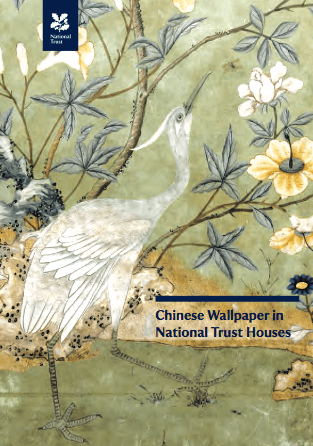 On the evening of 20 March Emile de Bruijn, Andrew Bush and Helen Clifford were delighted to celebrate the publication of Chinese Wallpaper in National Trust Houses, at the China Tang Suite at the Dorchester Hotel, London, providing the opportunity to thank the contributing team of collaborators including curators, conservators, entrepreneurs and scholars. Special thanks go to the hosts who made this venue possible. Copies of the National Trust’s catalogue of a group of historic Chinese wallpapers based on the latest research and conservation can be bought from Shop.nationaltrust.org.uk. The 50-page booklet is entitled Chinese Wallpapers in National Trust Houses and includes nearly 50 colour pictures, introductory essay, location map of sites including non-NT examples and a bibliography.
The booklet is also available as a PDF file.
More information about the The East India Company at Home Project is available here»
Exhibition | Magna Carta: Cornerstone of Liberty
On the eve of the 800th anniversary of Magna Carta. . . From the MFA press release (7 March 2014). . .
Magna Carta: Cornerstone of Liberty
Museum of Fine Arts, Boston, 2 July — 1 September 2014
Sterling and Francine Clark Art Institute, Williamstown, Massachusetts, 6 September — 2 November 2014
Library of Congress, Washington, D.C., 6 November 2014 — 19 January 2015
British Library, London, 13 March — 1 September 2015
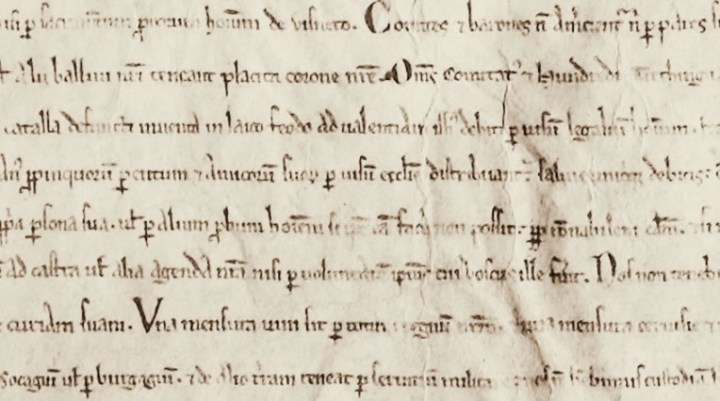
One of only four surviving copies of the original Magna Carta—a document written in 1215 that subsequently served as a symbol for liberty around the world—travels to the Museum of Fine Arts, Boston (MFA), this summer for a special exhibition of approximately 20 works in the Museum’s Art of the Americas Wing. An inspiration for the US Constitution and Bill of Rights, the exemplar owned by the UK’s Lincoln Cathedral and typically housed in Lincoln Castle will be on view in the exhibition, Magna Carta: Cornerstone of Liberty, from July 2–September 1, 2014. In partnership with the Massachusetts Historical Society (MHS) and the Massachusetts House of Representatives, Magna Carta will join historical loans as well as portraits and works of art from the Museum’s collection. The MFA’s Sons of Liberty Bowl (1768) by Paul Revere—which is engraved with the words “Magna/Charta” and “Bill of/Rights”—will be among the works that help tell the story of patriots and revolutionaries who fought for freedom in the face of tyranny across the centuries. Founding Fathers, presidents and abolitionists, inspired by the liberties enshrined in Magna Carta, will be represented in the exhibition through portraits, marble busts and historical documents that celebrate their commitment to civil rights and equal representation under the law.
“Our state’s rich history and preeminent cultural institutions provide a wonderful showcase for Magna Carta,” House Speaker Robert A. DeLeo said. “Massachusetts’ tourism industry is booming and the House of Representatives is proud to provide substantial support for the arts, travel and tourism. Last month we extended this commitment by allocating sizeable funding to bring Magna Carta to Massachusetts. Thank you to the Museum of Fine Arts and my colleagues in the Legislature for their work in securing this momentous historic treasure.”
State Representative Cory Atkins (D-Concord), House Chair of the Joint Committee on Tourism, Arts, and Cultural Development, and Alice Richmond, Deputy Chair of the Magna Carta 800th Anniversary 2015 Committee, worked with the MFA and Lincoln Cathedral to secure the loan of Magna Carta. After being shown in the MFA’s Edward and Nancy Roberts Family Gallery, Magna Carta travels to the Sterling and Francine Clark Art Institute in Williamstown, Massachusetts, and the Library of Congress in Washington, DC, before returning to London for an exhibition celebrating the charter’s 800th anniversary. All four of the original surviving 1215 Magna Carta manuscripts will be brought together for the first time in history at a three-day event at the British Library February 2–4, 2015.
“Massachusetts is a fitting place to learn about the founding of this great nation and the development of civil rights and liberties both here and abroad. I am incredibly proud to bring Magna Carta to Boston, where it inspired so many Sons of Liberty and Founding Fathers to action, and am grateful to the Lincoln Cathedral for this extraordinary loan,” said Malcolm Rogers, Ann and Graham Gund Director at the MFA. “This foundational document will hold a place of honor among American masterpieces and colonial treasures that bring some of the Commonwealth’s most famous patriots to life.”
For centuries, Magna Carta—Latin for “Great Charter”—has had symbolic influence on politicians, judges and revolutionaries who were inspired by its protections against tyranny and arbitrary rule. Written in Latin, the document laid the foundation for modern concepts of justice, due process, trial by jury and civil rights, and was reissued multiple times in the Middle Ages. In the 17th century, its influence was revived during the English Civil War. The concepts enshrined in the document also had a profound influence on the American Colonies, where it influenced the Declaration of Independence and later the US Constitution—particularly the Bill of Rights.
Massachusetts Historical Society President Dennis Fiori added, “This exhibition will be a terrific experience for anyone with an interest in the people and events that shaped our country. In partnering with the MFA, the MHS is pleased to loan a number of documents and artifacts that define our nation’s history. It will be quite something to see the nearly 800-year-old Magna Carta together with important US documents—such as handwritten drafts of the Declaration of Independence and an annotated copy of the Constitution—that were inspired by it. I am sure the Founding Fathers would be pleased.”
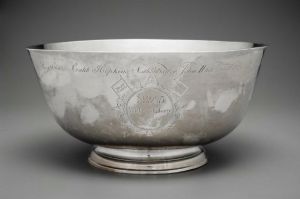
Paul Revere, Sons of Liberty Bowl, 1768 (Boston: MFA).
The exhibition at the MFA will focus on Massachusetts’ and America’s ongoing relationship with Magna Carta—highlighting early presidents, Founding Fathers and patriots whose ideals and philosophies have shaped our nation. Iconic works of art, loans and manuscript material from the MHS and other lenders will tell the story of these remarkable men and women, and the revolutionary acts inspired by Magna Carta. The MFA’s silver Sons of Liberty Bowl, a highlight of the Museum’s renowned collection of art and objects from Revolutionary Boston, honors 92 members of the Massachusetts House of Representatives who refused to rescind a letter protesting the Townshend Acts (1767), which taxed tea, paper, glass and other commodities. This act of civil disobedience by the ‘Glorious Ninety-Two’ was a major step leading to the American Revolution, and demonstrates the legacy and influence of Magna Carta more than 500 years after it was first issued.
“Since the 17th century, Magna Carta has served as a potent symbol for all Americans seeking protection against ‘the insolent menaces of villains in power,’ as the inscription on the Liberty Bowl states,” said Gerald W. R. Ward, New Hampshire State Representative (D-Portsmouth) and the MFA’s Senior Consulting Curator and Katharine Lane Weems Senior Curator of American Decorative Arts and Sculpture Emeritus. “This exhibition offers the rare opportunity, in this digital age, to see the nearly 800-year-old ‘real thing’ that is the ancient underpinning for so many freedoms and rights that we cherish today.”
A number of items from the Museum’s collection will be paired with loans from the MHS. Two manuscript copies of the Declaration of Independence, originally penned by John Adams and Thomas Jefferson, will be accompanied by the MFA’s marble busts of the two Founding Fathers. The MFA’s painting of lawyer Theodore Sedgwick (about 1808) by Gilbert Stuart complements a miniature portrait from the MHS of Elizabeth Freeman (“Mumbet”) (1811), a woman who was enslaved in Massachusetts and was represented by Sedgwick when she successfully sued for her freedom—a case which abolished slavery in the Commonwealth. Other loans from the MHS include a portrait of former Massachusetts Governor and US Vice President Elbridge Gerry and his annotated copy of the US Constitution, as well as two Paul Revere Sword in Hand Notes (currency)—one of which depicts the words “Magna Carta.” (more…)
New Book | Architecture, Art, and Identity in Venice
From Ashgate:
Nebahat Avcioglu and Emma Jones, eds., Architecture, Art, and Identity in Venice and its Territories, 1450–1750 (Aldershot: Ashgate, 2013), 326 pages, ISBN: 978-1472410825, £70.
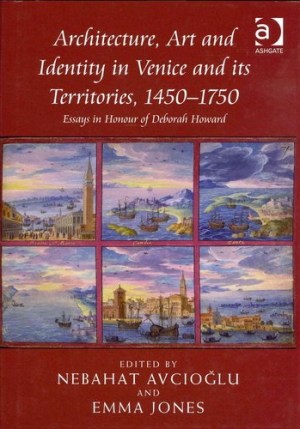 Cities are shaped as much by a repertoire of buildings, works and objects, as by cultural institutions, ideas and interactions between forms and practices entangled in identity formations. This is particularly true when seen through a city as forceful and splendid as Venice. The essays in this volume investigate these connections between art and identity, through discussions of patronage, space and the dissemination of architectural models and knowledge in Venice, its territories and beyond. They celebrate Professor Deborah Howard’s leading role in fostering a historically grounded and interdisciplinary approach to the art and architecture of Venice.
Based on an examination and re-interpretation of a wide range of archival material and primary sources, the contributing authors approach the notion of identity in its many guises: as self-representation, as strong sub-currents of spatial strategies, as visual and semantic discourses, and as political and imperial aspirations. Employing interdisciplinary modes of interpretation, these studies offer ground-breaking analyses of canonical sites and works of art, diverse groups of patrons, as well as the life and oeuvre of leading architects such as Jacopo Sansovino and Andrea Palladio. In so doing, they link together citizens and nobles, past and present, the real and the symbolic, space and sound, religion and power, the city and its parts, Venice and the Stato da Mar, the Serenissima and the Sublime Port.
Nebahat Avcioglu is Associate Professor of Art History at Hunter College, CUNY. Emma Jones is a PhD Candidate in the Department of History of Art at the University of Cambridge.
◊ ◊ ◊ ◊ ◊
C O N T E N T S
Introduction, Nebahat Avcioglu and Emma Jones
Section 1: Identity, Space and the City
1. ‘Soli deo honor et gloria’? Cittadino lay procurator patronage and the art of identity formation in Renaissance Venice, Allison Sherman
2. The Sisters Sagredo: Passion and patronage in eighteenth-century Venice, Esther Gabel
Section 2: Drawing, Mapping and Translating Venice
3. The early history of Jacopo Sansovino’s scheme for Piazza San Marco: A proposal, Paul Davies
4. Venice 1557: Sabbadino’s city plan, Elena Svalduz
5. Translatio Longhena Salute: Drawings and patrons in pilgrimage between Venice, Rome, and Gostyn, Andrew Hopkins
Section 3: Palladio’s Creations and Creating Palladio
6. The twin sacristy arrangement of Palladio’s Venice: origins and adaptations, Lydia Hamlett
7. Palladio’s patrons and music: Connections between cultural interests and architecture: The Villa Pisani at Bagnolo, Laura Moretti
8. How Palladio became famous: Paolo Gualdo and the Republic of Letters, Tracy E. Cooper
Section 4: The Production of Sacred Space
9. The seventeenth-century project for the church of San Nicolò del Lido in Venice: Liturgical problems and new architectural models in the counter-Reformation, Massimo Bisson
10. Innovation or afterthought? Dating the San Giobbe retrochoir, Joanne Allen
11. Venice’s cathedral of San Pietro di Castello, 1451–1630, Gianmario Guidarelli
Section 5: Time and Place in the Stato da Mar
12. The topography of antiquity in descriptions of Venetian Crete, Johanna D. Heinrichs
13. Jacopo Foscarini, Francesco Barozzi and the oracles of Leo the Wise, Blake de Maria
14. Becoming a man of empire: The construction of patrician identity in a republic of equals, Patricia Fortini Brown
Call for Papers | The Church of San Pietro di Castello
While this is primarily a Renaissance and seventeenth-century project, the organ of San Pietro di Castello is the mid-eighteenth-century work of Pietro Nachini. Surely ‘San Pietro in the Eighteenth Century’ would make a fine epilogue to the proceedings . . .
The Church of San Pietro di Castello and the Birth of the Patriarchate of Venice
Venice, 10–12 December 2015
Proposals due by 15 June 2014
The research project Chiese di Venezia. Nuove prospettive di ricerca (Churches of Venice. New Research Perspectives), promoted by the Studium Generale Marcianum and representing one of the activities of the ISSR San Lorenzo Giustiniani, consists in a long-term program of multidisciplinary conferences, each focused on a particular church of Venice. The project aims at promoting the combination of the different disciplines in order to understand the complex phenomena and dynamics of which Venetian churches, in their articulate reality and manifold meanings, have been catalyst elements for centuries. Besides facing in an innovative way the study of the churches of Venice, ‘releasing’ the potentialities of each discipline through their mutual comparison, the project takes up the challenge of reaching a wider public than just the specialist one, whose contributions, constituting a central aspect, are collected in a special series of volumes edited by Marcianum Press.
After the study of the churches of San Bartolomeo (2011), of the Scalzi (2012), of San Lazzaro dei Mendicanti (2013) and of San Zaccaria (scheduled for 2014), the conference of 10–12 December 2015 will be dedicated to the study of the church of San Pietro di Castello. In the context of the urban development of Venice, the Olivolo Island, set at the extreme peripheral area of the town, was appointed to be the see of the Bishop’s complex (including the cathedral, the bishop’s palace and the residences of the canons) since the 9th century. Since 1451, when the island was chosen to be the seat of the Patriarch of Venice, a series of urban and architectural renewals led to a complete restoration of the complex by Mauro Codussi, Andrea Palladio, Francesco Smeraldi, Gerolamo Grappiglia and Baldassarre Longhena.
The conference will concentrate on the transformation from the Episcopate of Castello to the Patriarchate of Venice, in the framework of Renaissance Venice, and will focus the attention on the early patriarchs, particularly on Lorenzo Giustiniani. The figure of the proto-patriarch of Venice, who played a fundamental role in the history of the local Church, will be studied not only in the context of the changing fortunes of the Venetian Church of the 15th century but also in the wider context of the changing fortunes of the whole town during 16th and 17th centuries, when the process of canonization and the following worship of the Saint represented the key to discover the relationship between Church and state. The conference intends to reconsider, from a multidisciplinary point of view, the role of the Patriarchate in the history of the town, starting from the church of San Pietro di Castello in its architectural consistency, passing on to the following decoration campaigns and getting to the 17th century rebuilding.
In particular, the following topics will be analysed:
• The area of the parish: social and pastoral aspects
• The curia: the patriarchal palace and the residences of the canons. Historical-architectural aspects, fortunes of the chancellery and life of the familia patriarchalis
• The Giustinianean Reform in the context of the Italian Church of 15th century
• Worship and music in San Pietro di Castello
• The church’s interior decoration between the 15th and 16th century
• The façade: sacred liturgy and urban ritual
• The worship of Saint Lorenzo Giustiniani: religious and civil rituals. The worship of the Saint in the area of the Republic: prayers, churches, place names and festivals dedicated to San Lorenzo Giustiniani outside Venice
• The iconography of Saint Lorenzo Giustiniani
• Seventeenth-century church: the chancel (architecture, painting, sculpture), the Vendramin Chapel and Luca Giordano. The interior decoration of the church.
Proposals, accompanied by a brief abstract (200 words, max 1200 characters) and by a one-page cv, will have to be submitted sending an e-mail to chiesedivenezia@marcianum.it by 15th June 2014. Successful applicants will be notified by 31st July 2014.










 Enfilade
leave a comment