Call for Papers | Faith, Politics, and the Arts
Faith, Politics, and the Arts: Early Modern Transfers between Catholic and Protestant Cultures
Philipps-Universität Marburg, Germany, 9–11 March 2015
Proposals due by 22 May 2014
The search for transcendental systems of belief that provide orientation in the confused realities of everyday life is an anthropological constant which characterizes contemporary multi-cultural communities just as much as the no less troubled societies of the past. Religion can inform political decisions, sustain certain forms of government, underpin or destabilize the social order. The conference Faith, Politics, and the Arts will explore the role of the arts as a means for shaping and interpreting the interrelation of religion and politics. Conference papers are intended to focus on Catholic and Protestant cultures in the Early Modern period (1517– ca. 1800). Central questions to be addressed are: How did Catholic and Protestant cultures visualize the relationship between God, ruler and subjects // spiritual and temporal power? In what ways and to what ends did the art production of Protestant cultures appropriate and modify visual formulae developed for Catholic societies (and vice versa)? To what extent did such transfers promote or undermine religious tolerance?
We invite proposals for papers from a wide range of disciplines engaging with the visual arts as well as architecture, drama, fashion, and material culture. Among others, topics may include: religious imagery in the palaces of political leaders; political elements in the pictorial programme, design and layout of churches and chapels; prints commenting on religiously motivated conflicts; diplomatic gifts between Catholic and Protestant powers; images promoting religious tolerance; theatre productions touching on confessional issues; the staging of the Eucharist and of religious processions; frontispieces to theological treatises; prints with satires on fashions associated with the ‘foreign’ religion etc.
Abstracts may be submitted in German, English, Italian, and French. Please send an abstract for a 30-minute paper plus a short CV to PD Dr. Christina Strunck (strunck@staff.uni-marburg.de) and Julia Bender-Helfenstein, M. A. (benderhelfenstein@googlemail.com) by May 22, 2014.
Call for Manuscripts | Brill Series: History of Collecting & Art Markets
From Brill’s latest Art and Architecture Catalog:
Brill’s Studies in the History of Collecting & Art Markets is a peer-reviewed book series dedicated to original scholarship on the social, cultural, and economic mechanisms underlying the circulation of art. Over the last two decades interest in the formation, display, and dissolution of art collections increased tremendously; art markets, trade routes, and dealer networks became a rich field of interdisciplinary inquiry. Scholarship brought forth a lot of information about the flamboyant personalities to whom the possession of art was a lifestyle; regarding the ‘social life of things’, i.e. the provenance of individual artworks, many research gaps could be closed.
This shift in scholarly attention from the production side to the consumption side of the art world is also reflected in the emergence of specialized post-graduate courses offered by a number of institutions internationally, as well as an ever-increasing stream of exhibitions, conferences, and publications devoted to the subject. Brill’s book series accommodates scholarly monographs, collections of essays, conference proceedings, and works of reference that engage in the broadly defined topic of art markets and collecting practices throughout history.
We invite scholars to submit their English language manuscript proposal for the new book series to Liesbeth Hugenholtz, Acquisitions Editor Art at Brill (hugenholtz@brill.com) or to the series editor Christian Huemer
(chuemer@getty.edu).
Editor-in-Chief
Christian Huemer, Getty Research Institute, Los Angeles
Editorial Board
Malcolm Baker (University of California, Riverside),
Ursula Frohne (University of Cologne), Hans van Miegroet (Duke
University, Durham), Inge Reist (Frick Collection, New York), Adriana
Turpin (Institut d’Études Supérieures des Arts, London), Filip Vermeylen
(Erasmus University, Rotterdam)
New Book | The Art of Professing in Bourbon Mexico
From the University of Texas Press:
James M. Córdova, The Art of Professing in Bourbon Mexico: Crowned-Nun Portraits and Reform in the Convent (Austin: University of Texas Press, 2014), 288 pages, ISBN: 978-0292753150, $55.
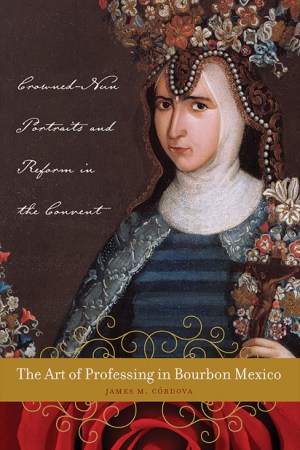 In the eighteenth century, New Spaniards (colonial Mexicans) so lauded their nuns that they developed a local tradition of visually opulent portraits, called monjas coronadas or ‘crowned nuns’, that picture their subjects in regal trappings at the moment of their religious profession and in death. This study identifies these portraits as markers of a vibrant and changing society that fused together indigenous and Euro-Christian traditions and ritual practices to construct a new and complex religious identity that was unique to New Spain.
To discover why crowned-nun portraits, and especially the profession portrait, were in such demand in New Spain, this book offers a pioneering interpretation of these works as significant visual contributions to a local counter-colonial discourse. James M. Córdova demonstrates that the portraits were a response to the Spanish crown’s project to modify and modernize colonial society—a series of reforms instituted by the Bourbon monarchs that threatened many nuns’ religious identities in New Spain. His analysis of the portraits’ rhetorical devices, which visually combined Euro-Christian and Mesoamerican notions of the sacred, shows how they promoted local religious and cultural values as well as client-patron relations, all of which were under scrutiny by the colonial Church. Combining visual evidence from images of the ‘crowned nun’ with a discussion of the nuns’ actual roles in society, Córdova reveals that nuns found their greatest agency as Christ’s brides, a title through which they could, and did, challenge the Church’s authority when they found it intolerable.
James M. Córdova is Assistant Professor of Art History at the University of Colorado at Boulder, where he teaches pre-Columbian and colonial Latin American art.
◊ ◊ ◊ ◊ ◊
C O N T E N T S
Introduction
1. Women’s Religious Pathways in New Spain
2. New Spanish Portraiture and Portraits of Nuns
3. Euro-Christian Precedents in the Crowned-Nun Image
4. Indigenous Contributions to Convent Arts and Culture
5. The Profession Portrait in a Time of Crisis
6. Colonial Identity Rhetorics
Epilogue
Notes
Glossary
Bibliography
Call for Papers | Travel and the Country House

From the Call for Papers:
Travel and the Country House: Places, Cultures, and Practices
University of Northampton, 15–16 September 2014
Proposals due by 19 May 2014
Keynote speakers include Roey Sweet (University of Leicester) and Margot Finn (UCL).
Travel has long played a vital role in shaping the country house, opening up horizons and exposing both house and owner to a variety of external influences. Travel impacted upon values, tastes, material culture and money, and helped to articulate the flow of ideas, information, goods and capital. The importance of the Grand Tour and Empire to the country house has long been recognised, but domestic tourism and travel for more mundane purposes—to visit family or friends, engage in political life or go to town—were also significant. In this conference, we wish to explore a wide range of travel experiences and consider how these impacted on the country house. How were travel choices made and how were impacts articulated? How did new influences mesh with existing tastes and goods? What impact did its status as a place to visit have upon the country house? And how do we communicate the importance of travel to those visiting country houses today?
We invite papers on all aspects of travel and the country house, but would especially welcome those which focus on:
• Geographies of travel: the Grand Tour, colonies and empire, and domestic and everyday travel
• The view from abroad: foreign visitors to British country houses
• Royal progresses and prodigy houses
• Travelling for business and pleasure: court and parliament; tours and spas
• Travel and material culture: how different places were brought into the country house through objects
• Travel and taste: the impact of travel on architecture, collecting, design and
• Visiting the country house: receiving guests and staying with friends or family
• The practicalities of travel: stables, coaches and horses; trains, ships and boats; servants and guides; accommodation, meals and sleeping
• Travel and publishing: journals, guidebooks and maps
• Travel as a theme in country house interpretation/presentation today
If you would like to present a paper, then please send a 300 word abstract to Prof Jon Stobart: jon.stobart@northampton.ac.uk by 19th May 2014.










 Enfilade
leave a comment