New Book | Oriental Interiors
From Bloomsbury:
John Potvin, ed., Oriental Interiors: Design, Identity, Space (London: Bloomsbury Academic, 2015), 296 pages, hardback ISBN: 978-1472596642, $115 / paperback ISBN: 978-1472596635, $30.
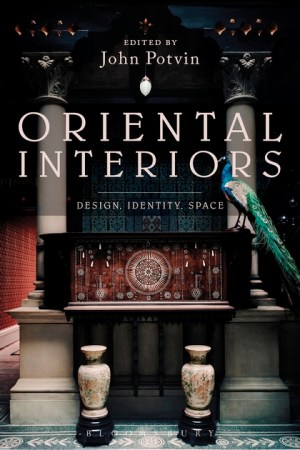 Since the publication of Edward Said’s groundbreaking work Orientalism 35 years ago, numerous studies have explored the West’s fraught and enduring fascination with the so-called Orient. Focusing their critical attention on the literary and pictorial arts, these studies have, to date, largely neglected the world of interior design. Oriental Interiors is the first book to fully explore the formation and perception of eastern-inspired interiors from an orientalist perspective.
Orientalist spaces in the West have taken numerous forms since the 18th century to the present day, and the fifteen chapters in this collection reflect that diversity, dealing with subjects as varied and engaging as harems, Turkish baths on RMS Titanic, Parisian bachelor quarters, potted palms, and contemporary yoga studios. It explores how furnishings, surface treatments, ornament and music, for example, are deployed to enhance the exoticism and pleasures of oriental spaces, looking across a range of international locations. Organized into three parts, each introduced by the editor, the essays are grouped by theme to highlight critical paths into the intersections between orientalist studies, spatial theory, design studies, visual culture and gender studies, making this essential reading for students and researchers alike.
John Potvin is Associate Professor in the Department of Art History at Concordia University, Montreal, where he teaches on the intersections of art, interior design and fashion. He is the author of Bachelors of a Different Sort: Queer Aesthetics, Material Culture and the Modern Interior in Britain (Manchester University Press, 2014), Giorgio Armani: Empire of the Senses (Ashgate, 2013), and Material and Visual Cultures Beyond Male Bonding (Ashgate, 2008). He is also editor of The Places and Spaces of Fashion (Routledge, 2009) and co-editor of Material Cultures, 1740–1920: The Meanings and Pleasures of Collecting (Ashgate, 2010) and Fashion, Interior Design and the Contours of Modern Identity (Ashgate, 2010).
◊ ◊ ◊ ◊ ◊
C O N T E N T S
Introduction: Inside Orientalism: Hybrid Spaces and Modern Interior Design, John Potvin
Section I: Modes of Display and Representation
Introduction to Section I
1 The Emptiness of Western Aesthetics Versus the Aesthetics of Eastern Intimacy: A Reading of Interior Spaces and (Colonial) Literary Impressionism in E. M. Forster’s A Passage to India, Victor Vargas (Cogswell Polytechnic)
2 The Exhibitionary Re-production of ‘Islamic’ Architecture, Solmaz Mohammadzadeh Kive (University of Colorado)
3 Promoting the Colonial Empire through French Interior Design, Laura Sextro (University of Dayton)
4 Orientalism and David Hockney’s Male-positive Imaginative Geographies, Dennis S. Gouws (Springfield College and the Australian Institute of Male Health and Studies)
5 The Excessive Trompe l’Oeil: The Saturated Interior in Tears of the Black Tiger, Mark Taylor (University of Newcastle) and Michael J. Ostwald (University of Newcastle)
Section II: Gendered and Sexual Identities
Introduction to Section II
6 On Oriental Interiors in Eighteenth-Century British Women Writers’ Novels, Marianna D’Ezio (Luspio University for International Studies of Rome)
7 Bachelor Quarters: The Spaces of Japonisme in Nineteenth-Century Paris, Christopher Reed (Pennsylvania State University)
8 Coming Out of the China Closet?: Performance, Identity and Sexuality in the House Beautiful, Anne Anderson (Exeter University and Kingston University)
9 Orientalism, Collecting and Shame: Inside Rolf de Maré’s Hildesborg Estate, John Potvin (Concordia University)
Section III: Spaces and Markets of Consumption
Introduction to Section III
10 Paradise in the Parlour: Potted Palms in Western Interiors, 1850–1914, Penny Sparke (Kingston University)
11 Traveling in Time and Space: The Cinematic Landscape of the Empress Theatre, Camille Bédard (McGill University)
12 Oriental Spaces at Sea: From the Titanic to the Empress of Britain, Anne Massey (Middlesex University)
13 Posturing for Authenticity: Embodying Otherness in Contemporary Interiors of Modern Yoga, Lauren Bird (Queen’s University)
Index
Oxford Art Journal, August 2016
In the latest issue of the Oxford Art Journal:
Oxford Art Journal 39 (August 2016)
 • Introduction | Katie Scott, David Bindman, and Tom Gretton, “Helen Weston ‘in three positions’”
• Denis Diderot, “Regrets on Parting with My Old Dressing Gown,” translated by Kate Tunstall and Katie Scott
• Katie Scott, “The Philosopher’s Room: Diderot’s Regrets on Parting with My Old Dressing Gown“
Regrets on Parting with My Old Dressing Gown recounts the story of Diderot’s internal struggles with affluence and comfort and his attempt to reconcile luxury with the philosopher’s life. This article analyses some of the ways he sought to do this is by attending closely to Regrets’ spatial and material forms. Not things, but relations to things, the article argues, characterised Diderot’s ethics of consumption. It further suggests that the politics of luxury was for Diderot linked to questions not only of property but also of access and that the ancient virtue of hospitality was crucial to his defence of his new ‘revered’ dressing gown and all that it connoted.
• Valerie Mainz, “The Inequalities of Infamy”
The contribution has for focus the etching by Isaak Cruikshank, entitled The Martyr of Equality: Behold the Progress of our System. The critical analysis of the satire conjoins the figurative forms of the visual imagery with its words investigating, in the process, several of the interdependent layers of meaning that can be imputed therefrom. Produced in the days after the execution of the French king Louis XVI, which had taken place on 21 January 1793, this satirical view of the beheading of the monarch shows off the mechanism of the guillotine as a bloody, equalising, killing machine. The central figure of Philippe Égalité, the king’s distant cousin who had voted for the death of the king, is in the guise of the executioner here, but he, too, would be sent to the guillotine on 6 November of the same year.
• David Bindman, “Lost Surfaces: Canova and Colour”
The unremitting whiteness of Canova’s sculptures makes the question of colour seem an odd one to raise in connection with his art, but in fact almost all of them were originally coated or tinted to give a mellowness and a certain realism to the surface of the marble. This raised fundamental questions to do with sculpture’s relationship to painting and to ancient Greece and made the sculptor a controversial figure. He was evidently influenced by his friend and biographer the French theorist Quatremère de Quincy, who published in 1814 a pioneering book demonstrating the use of colour on ancient Greek sculptures.
• Richard Taws, “Conté’s Machines: Drawing, Atmosphere, Erasure”
This article examines the graphic practice of Nicolas-Jacques Conté, an artist, chemist, engineer, and balloonist probably best known for his invention, in 1795, of the modern pencil, synthesising English ‘lead’ rendered unavailable by the naval blockade. Conté, a former pupil of Jean-Baptiste Greuze, subsequently became a key member of the Napoleonic expedition to Egypt. He participated in the production of its most extensive visual document, the monumental Description de l’Égypte, devising an ‘engraving machine’ that facilitated the production of uniform backgrounds for the Description’s plates. With this machine, the cloudless Egyptian skies that populated the large sheets of the Description could be reproduced at speed with minimal opportunity for artistic error, reducing complex atmospheric effects to a simple mechanical process. Tracing the reemergence of Conté’s numerous inventions in subsequent accounts of media change, particularly those that focused on photography, this article examines the ways in which Conté’s work often pivoted on the question of drawing and suggests that his practice asks broader questions of the relationship between technology, vision, and imperialism in the nineteenth century.
• Richard Wrigley, “Unreliable Witness: The Flâneur as Artist and Spectator of Art in Nineteenth-Century Paris”
One of the main reasons for the flâneur’s celebrity in studies of nineteenth-century Paris has been a connection with art and artists. The flâneur has been championed as a model for artists who depict the modern, urban world; this has been allied to assumptions that the flâneur embodies a process of aestheticisation which corresponds to capturing the essence of modernity (and thereby modern art). This article reconsiders such orthodoxy and suggests that a more historicised account of the figure’s origins and meaning. The canonical texts habitually called on to illustrate accounts of the flâneur’s identity (Le Physiologie du flaneur, Baudelaire’s ‘Le Peintre de la vie moderne’ etc.) are reconsidered critically. The article concludes by arguing that a more solidly based history of the flâneur should, firstly, reach back into the early nineteenth century, and secondly, also acknowledge the political character of such independent scrutiny of contemporary Paris, it spaces and social landscape.
• Tom Gretton, “ ‘Un Moyen Puissant de Vulgarisation Artistique’. Reproducing Salon Pictures in Parisian Illustrated Weekly Magazines c. 1860–1895: From Wood Engraving to the Half Tone Screen (and Back)”
L’Illustration and Le Monde illustré, Parisian up-market general-interest weekly illustrated magazines of the Illustrated London News genre published long Salon reviews every year there was a Salon. They also reproduced numbers of Salon pictures each year, in fluctuating (often very large) numbers, in a range of reproductive technologies, and accompanied by textual and presentational clues about what sorts of value the magazine was inviting its reader/viewers to attach to the reproduction: to the painting represented also but in the first instance to the reproduction.
Engaging with recent work by Stephen Bann, this article discusses the ways in which, in these magazines, reproductive wood engravings were aligned with the great tradition of French reproductive intaglio printmaking, and it looks at the impact of the introduction of photomechanical technologies (the line block and the half-tone screen) on the values that were attached to these pictures of Salon pictures. It demonstrates the persistence into the 1890s of the value system of reproductive engraving, and its eventual displacement by the more mechanical efficiencies of the half-tone screened photograph of a work of art. The essay calibrates this displacement with the increasingly compelling demands of the news cycle in relation to the visual reporting of the Salon, and it provides evidence that the half-tone screen, for a decade after its introduction, was a less-than-adequate technology for the reproduction of photographs of works of art, as the evidence of its uptake in the more technologically progressive of these two titles, L’Illustration, demonstrates.
The essay also engages with the debate over “the end of the Salon” (Mainardi). From the evidence of the resources that these magazines devoted not only to writing about but also to reproducing pictures from, the Salon through from the 1860s to the end of the 1890s, the essay argues that, at last for the national-bourgeois audience that was constituted by the wide readership of these two magazines, reports of the Salon’s death have been greatly exaggerated.
• Satish Padiyar, “Proust and Old Time: On ‘Chardin’ and ‘Watteau’”
Before Marcel Proust began working on his masterpiece À la Recherche du temps perdu, he had an idea to be an art critic. His youthful essay “Chardin” (1895) constitutes his first important piece of art criticism. Approaching Chardin’s work ‘philosophically’, Proust’s essay draws from the old painter’s work significant ideas about the affective life of objects, the pathos of interiors and interiority, and the shattering of the frame separating museum art from modern life. My essay argues that Chardin’s painting offered young Proust a significant new ‘way’ to begin to approach the ‘involuntary memory’ of Recherche, one that he delineates through his essay’s quasi-Platonic structure. Proust’s later incomplete essay on Watteau shifts his art writing into a more subjective mode; the early ‘art’ Proust becoming before our eyes the later genre-abolishing one.
Lecture Series | Philip Hardie on Celestial Aspirations
From H-ArtHist:
Philip Hardie | Celestial Aspirations: 17th- and 18th-Century
British Poetry and Painting and the Classical Tradition
The 2016 E. H. Gombrich Lecture Series on the Classical Tradition
London, Warburg Institute, 11–13 October 2016
Organised by the Warburg Institute and Princeton University Press
Philip Hardie, Honorary Professor of Latin and Senior Research Fellow at Trinity College, Cambridge, will deliver three lectures (each beginning at 17.30). They are free of charge, but pre-registration is required.
• Tuesday, 11 October: Visions of Apotheosis and Glory on Painted Ceilings: From Rubens’s Banqueting House, Whitehall to Thornhill’s Painted Hall, Greenwich
• Wednesday, 12 October: Poetic Ascents and Flights of the Mind: Neoplatonism to Romanticism
• Thursday, 13 October: ‘No Middle Flight’: Miltonic Ascents and Their Reception
Conference | European Portrait Miniatures
From the conference flyer:
European Portrait Miniatures: Artists, Functions, and Collections
The Tansey Miniatures Foundation, Bomann-Museum, Celle, 11–13 November 2016
 The conference is being held on the occasion of the opening of the sixth exhibition of the Tansey Miniatures Foundation and the publication of the accompanying catalogue Miniatures from the Baroque Period in the Tansey Collection.
Both conference venues are within walking distance (20 minutes) from the railway station. Trains from Hannover take approximately 25 to 45 minutes (Deutsche Bahn, Metronom, and S-Bahn).
For registration, please contact Juliane Schmieglitz-Otten, Head of the Residence Museum at Celle Castle, juliane.schmieglitz-otten@tansey-miniatures.com. For more information, please contact Bernd Pappe, Art Historian and Restorer, bernd.pappe@tansey-miniatures.com. Conception IT Coordination by Birgitt Schmedding, Photo Designer, birgitt.schmedding@tansey-miniatures.com.
◊ ◊ ◊ ◊ ◊
F R I D A Y , 1 1 N O V E M B E R 2 0 1 6
15:00 Registration
16:30 Welcome and opening of the exhibition Miniatures from the Baroque Period in the Tansey Collection
S A T U R D A Y , 1 2 N O V E M B E R 2 0 1 6
9:00 Objects, Agencies, and Social Practices
• Ulrike Kern (Frankfurt), The Limner’s Language: Words and Concepts Related to Miniature Painting in England
• Miranda L. Elston (Chapel Hill, North Carolina), Hilliard’s Miniatures: Enacted Desire within the Elizabethan Court
• Eloise Owens (New York), The Hand behind the Likeness: Women’s Practice as Portrait Miniaturists in Eighteenth-Century England
• Christoph Großpietsch (Salzburg), Portrait Miniatures of Mozart: Problems of Authenticity
• Violaine Joëssel (Geneva), A Quest for Legitimacy: The Practice of Miniature Painting in Colonial America
• Dimitri Gorchko (Moscow), ‘… et que tout ait un nom nouveau’: Portrait Miniatures of Napoleon’s Marshals, Generals, and Colonels: Analysis and Identification
13:00 Lunch
14:15 Politics and Representation
• Delia Schffer (Kassel), Power through Relations: Duke Louis of Württemberg‘s Family Ties in a Series of Miniature Portraits
• Sarah Grandin (Paris), Density in the ‘Boîte à Portrait’ under Louis XIV
• Stefanie Linsboth (Vienna), From Large-Scale Paintings to Precious Miniatures: Maria Theresa’s Portrait Miniatures
• Karin Schrader (Bad Nauheim), ‘Taking the Veil’: Miniatures of Royal Widows from the Sixteenth to the Nineteenth Centuries
16:30 Coffee
17:00 Special Techniques and Materials
• Tatjana Wischniowski (Dresden), Oil-Based Paint under a Layer of Water: Arnaud Vincent de Montpetit’s ‘Eludoric Painting’, a Rare Miniature Painting Technique
• Emma Rutherford, Alan Derbyshire, and Victoria Button (London), The Drawings of John Smart (1742–1811): Function, Purpose, and Line
S U N D A Y , 1 3 N O V E M B E R 2 0 1 6
9:00 Miniature Collections
• Lucy Davis (London), Famous Women in the Miniatures at The Wallace Collection
• Catherine Hess (San Marino, California), Up Close and Personal: Portrait Miniatures at The Huntington Art Collections
• Isabel M. Rodríguez-Marco (Madrid), The Collection of Portrait Miniatures and Small Portraits in the Museo Nacional de Artes Decorativas, Madrid
• Paul Caffrey (Dublin), European Enamels from the National Gallery of Ireland Collection
• Wladyslaw Maximowicz (Bergamo), The Portrait Miniature in Russian Provincial Collections
• Reetta Kuojärvi-Närhi (Helsinki), Small Treasures in Finland: Paul Sinebrycho as a Miniature Collector
13:00 Lunch
14:15 Miniature Painters
• Halgard Kuhn (Hannover), Peter Boy (c. 1650–1727): Medallions and Miniatures by the Frankfurt Baroque Goldsmith and Enamel Painter as Integrating Parts in Golden Jewellery
• Karen Hearn (London), The ‘Small Oil Colour Pictures’ of Cornelius Johnson (1593–1661)
• Marco Pupillo (Rome), Francesco Antonio Teriggi, a Miniaturist in the Service of Joseph Bonaparte
• Roger and Carmela Arturi Phillips (Ringwood), The True and Flawed Genius of John Engleheart
• Stephen Lloyd (Liverpool), Copying Portraits in Miniature in Regency England: The Work of William Derby (1786–1847) for the 13th Earl of Derby at Knowsley Hall
◊ ◊ ◊ ◊ ◊
The exhibition catalogue is distributed in North America and Japan by The University of Chicago Press (with information on the other five volumes published thus far from The Tansey Foundation). . .
Bernd Pappe and Juliane Schmieglitz-Otten, eds., Miniatures from the Baroque Period in the Tansey Collection / Miniaturen des Barock aus der Sammlung Tansey (Munich: Hirmer Publishers, 2016), 400 pages, ISBN: 978-3777426389, $64.
The Tansey miniatures, now held by the Bomann Museum in Celle, represent one of the most significant collections of European miniature paintings. This volume is the sixth in a series exploring the collection in key periods. Each volume presents new photographic reproductions of the miniatures at actual size and with close-up photographs that show important details. This volume covers portrait miniatures created throughout the Baroque period of the seventeenth-century, with more than one hundred representative works. Essays by specialists in the field offer insights into the artworks, their patrons, and the period. The resulting book is as informative as it is beautiful, a stunning testament to a bygone age and a once-popular form.
Conference | The Art Market, Collectors, and Agents
The first installment of the conference took place in July at the Warburg Institute in London. For the two days in Paris, I’ve included only the sessions most relevant to the eighteenth century. The full schedule is available from H-ArtHist:
The Art Market, Collectors, and Agents: Then and Now
Institut national d’histoire de l’art, Paris, 20–21 October 2016
The focus of the conference is to explore the changing and complex nature of the role of agent in the art market during the Early Modern Period. Papers will explore shifts in the dynamics of the market, the changing taste of collectors and the importance of writers, critics, museum curators and dealers in influencing these changes. The papers demonstrate how examining the role of agents through their correspondence with clients, day books or private records, bring new insights into the workings of the art world through the detailed evidence of how transactions were negotiated.
We would like to thank the speakers’ institutions and the Institut d’Etudes Supérieres des Arts for supporting the conference. The conference is free but to register for the lunches (20€ per day), please email a.turpin@iesa.edu.
Organised by the Collecting and Display Seminar Group London with the Centre André Chastel, INHA, Paris.
• Tamsin Foulkes (PhD Candidate, University of Nottingham), James Thornhill as an Agent-Collector in Early Eighteenth-Century Paris
• Corina Meyer (Institute of Art History, University of Stuttgart), ‘To See Once Again the Glorious Picture by Moretto before It Is Forever Lost for Rome’: Johann David Passavant’s (1787–1861) Recommendations and Selection of Paintings
• Tina Kosak (France Stele Institute of Art History, ZRC SAZU Ljubljana), Conquering New Art Markets: International Art Dealers and Local ‘Agents’ in Inner Austria in the Second Half of the Seventeenth Century
• Laura Popoviciu (PhD Candidate, Warburg Institute), Shaping the Taste of British Diplomats in Eighteenth-Century Venice
• Renata Schellenberg (Mount Allison University, Sackville, Canada), Commerce, Culture, and Connoisseurship: The Emergence of the Art Dealer in Eighteenth-Century Germany
NMAAHC Opens on Saturday

The Smithsonian National Museum of African American History and Culture
Wikimedia Commons (20 July 2016).
◊ ◊ ◊ ◊ ◊
As Lonnie Bunch, the MNAAHC’s director, repeatedly says, the museum aims, by addressing black experiences and contributions, to expand conceptions of what American history and identities are for all visitors. Part of that necessarily requires seventeenth- and eighteenth-century objects and interpretations. There are slave shackles, even an early nineteenth-century slave cabin, but there are also sources documenting service in the Revolutionary War, Freemasonry objects, and a portrait by Joshua Johnson, the earliest documented professional African American painter. Writing for The New York Times (15 September 2016), Holland Cotter calls it “more than just impressive. It’s a data-packed, engrossing, mood-swinging must-see.” Press release (2 February 2016) . . .
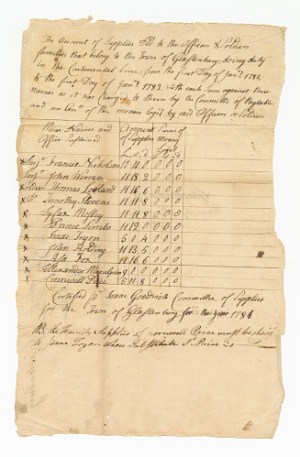
Ledger of supply costs for eleven Revolutionary War soldiers, 1782.
The Smithsonian today announced that the National Museum of African American History and Culture will open to the public Saturday, September 24. The opening will be the focus of a week-long celebration that begins with a dedication ceremony. The celebration continues with extended visiting hours and a three-day festival showcasing popular music, literature, dance and film. Also planned are events co-hosted by other museums around the country and in Africa.
“After 13 years of hard work and dedication on the part of so many, I am thrilled that we now have this good news to share with the nation and the world,” said Lonnie Bunch, the museum’s founding director. “In a few short months visitors will walk through the doors of the museum and see that it is a place for all people. We are prepared to offer exhibitions and programs to unite and capture the attention of millions of people worldwide. It will be a place for healing and reconciliation, a place where everyone can explore the story of America through the lens of the African American experience.”
“We look forward to the opening of this enormously important new museum,” said David Skorton, Smithsonian Secretary. “The National Museum of African American History and Culture furthers the Smithsonian’s commitment to telling America’s story in all its dimensions.”
President George W. Bush signed the legislation establishing the museum in 2003. In 2009, the museum’s architectural team of Freelon Adjaye Bond/SmithGroupJJR was selected, and in 2011 Clarke/Smoot/Russell was chosen as the construction firm. David Adjaye is the lead designer, and Phil Freelon is the lead architect. The landscape design is by the team of Gustafson Guthrie Nichol.
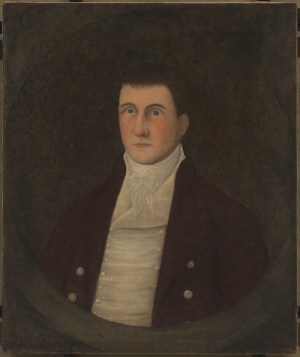
Joshua Johnson, Portrait of John Westwood, ca. 1807–08, oil on canvas (Washington, D.C.: Collection of the Smithsonian National Museum of African American History and Culture, 2010.25ab).
The Smithsonian broke ground for the museum 22 February 2012 on its five-acre site on Constitution Avenue between 14th and 15th streets N.W. The 400,000-square-foot building has five levels above ground and four below. The museum will have exhibition galleries, an education center, a theater, café, and store, as well as staff offices. Among the building’s signature spaces are the Contemplative Court, a water- and light-filled memorial area that offers visitors a quiet space for reflection; the Central Hall, the primary public space in the museum and the point of orientation to building; and a reflecting pool at the south entry of the museum, with calm waters meant to invite all to approach.
The museum also features a series of openings—’lenses’—throughout the exhibition spaces that frame views of the Washington Monument, the White House, and other Smithsonian museums on the National Mall. These framed perspectives remind visitors that the museum presents a view of American through the lens of the African American experience.
The museum will open with 11 inaugural exhibitions that will focus on broad themes of history, culture and community. The exhibitions have been designed by museum historians in collaboration with Ralph Appelbaum Associates. These exhibitions will feature some of the more that 34,000 artifacts the museum has collected since the legislation establishing it was signed in 2003. The museum’s collections are designed to illustrate the major periods of African American history. Highlights include: a segregation-era Southern Railway car (c. 1920), Nat Turner’s Bible (c. 1830s), Michael Jackson’s fedora (c. 1992), a slave cabin from Edisto Island, S.C. plantation (c. early 1800s), Harriet Tubman’s hymnal (c. 1876) and works of art by Charles Alston, Elizabeth Catlett, Romare Bearden, and Henry O. Tanner.
While under construction, the museum has had a gallery at the Smithsonian’s National Museum of American History. Since 2009, the museum has opened seven exhibitions in the space including Through the African American Lens: Selections from the Permanent Collection (on view now), The Scurlock Studio and Black Washington: Picturing the Promise, and Changing America: The Emancipation Proclamation, 1863 and The March on Washington, 1963. The museum’s first exhibition, Let Your Motto Be Resistance: African American Photographs, opened in 2007 at the International Center for Photography in New York and toured 15 cities.
In addition to exhibitions, the museum has also launched several education and research programs. Save Our African American Treasures was launched in Chicago in January 2008 and is one of the museum’s signature programs. Participants work with conservation specialists and historians to learn how to identify and preserve items of historical value, including photographs, jewelry, military uniforms, and textiles.
Call for Essays | Terra Foundation for American Art Essay Prize
Terra Foundation for American Art International Essay Prize
Submissions due by 15 January 2017
The Terra Foundation for American Art International Essay Prize recognizes excellent scholarship by a non-U.S. scholar in the field of historical American art. Manuscripts should advance the understanding of American art, demonstrating new findings and original perspectives. The prize winner will be given the opportunity to work toward publication in American Art, the Smithsonian American Art Museum’s scholarly journal. He or she will also receive a $1,000 cash award and a travel stipend of up to $3,000 to give a presentation in Washington, D.C., and meet with museum staff and fellows. This prize is supported by funding from the Terra Foundation for American Art.
Ph.D. candidates and above who have not published in American Art previously are eligible to participate in the competition. Essays may focus on any aspect of historical (pre-1980) American art and visual culture; however, architecture and film studies are not eligible. Preference will be given to submissions that address American art within a cross-cultural context and offer new ways of thinking about the material. A strong emphasis on visual analysis is encouraged.
Submissions for the 2017 prize must be sent to TerraEssayPrize@si.edu by January 15, 2017. For more information about eligibility and the format for submissions, please visit www.americanart.si.edu/research/awards/terra.
Exhibition | Drawings by William Stukeley
On view next month in Spalding:
Drawings by William Stukeley
Ayscoughfee Hall Museum, Spalding, 5–16 October 2016
Presented by the Spalding Gentlemen’s Society

John Stukeley, Stukeley’s House at Holbeach (Spalding Gentlemen’s Society).
These drawings by William Stukeley (1687–1765) have recently been cleaned, conserved, and mounted under a grant from the Heritage Lottery Fund. This is the first time they have ever been displayed in public. They are beautiful in their own right, examples of a drawing skill that used to be common before photography was invented in the nineteenth century.
Stukeley was born in Holbeach, a town he visited frequently as an adult. He was a founder member of the Spalding Gentlemen’s Society in 1710 and a noted antiquarian. The drawings on display are important for several reasons, not least for the light they shed on Stukeley’s role in shaping the evolution of garden design in Britain in the eighteenth century.
Display | ‘The Inspection of the Curious’: The Country-House Guidebook

Garden Front of Blenheim Palace, from Colen Campbell, Vitruvius Britannicus or the British Architect, the Plans, Elevations, and Sections of the Regular Buildings, both Publick and Private, in Great Britain . . . , 3 vols. (London: 1715–25), volume 1. For the display at The Mellon Centre, Campbell’s work is represented by a 1967 edition of the book; the image included above comes from Wikimedia Commons.
◊ ◊ ◊ ◊ ◊
Now on view at the Paul Mellon Centre:
‘The Inspection of the Curious’: The Country-House Guidebook, c. 1750–1990
Paul Mellon Centre for Studies in British Art, London, 5 September 2016 – 6 January 2017
Curated by Jessica Feather and Collections Staff
The fourth Drawing Room Display, curated by Jessica Feather (Brian Allen Fellow at the Paul Mellon Centre) and Collections staff, takes material from the Centre’s considerable holdings of Country House guidebooks to focus on three early adopters of the guidebook: Knole (Kent), Blenheim Palace (Oxfordshire), and Burghley (Lincolnshire/Northamptonshire).
The British country-house guidebook is a very specific genre of travel guide, with particular characteristics which have, arguably, remained relatively unchanged from beginnings in the mid-eighteenth century until the present day. Generally small in size, lightweight and inexpensive, they were intended to be portable in order to be carried round the house whilst visiting. The history of the country-house guidebook relates closely to the practice of visiting country houses.
It is a genre which only developed seriously in the later eighteenth century, some years after houses such as Chatsworth, Blenheim, and Burghley opened their doors. A subsequent rise in mass tourism by the mid-nineteenth century, and the appropriation of country houses as part of the national heritage, led to the production of an increased number of guidebooks before the decline in interest in visiting country houses from the 1880s onwards due to economic pressures and anti-aristocratic feeling. This saw a decline in visitor numbers and significant reduction in the number of new guidebooks produced and new editions of older ones. A revival in visiting country houses after the Second World War has been paralleled by the frequent publication of guidebooks in new editions at least up until the 1990s.
Examining the guidebooks of three great houses—Knole, Blenheim, and Burghley—not only allows us to consider the history of this genre, but also brings the historical narratives of these houses into the foreground.
The Paul Mellon Centre has been collecting country-house material and publications over a number of years both by purchase and donations, including material from the collections of Sir Howard Colvin and John Cornforth. For more information on the Library and Collections please click here.
The ‘Inspection of the Curious’ display coincides with the Art in the British Country House: Collecting and Display research project and the Art in the British Country House: Collecting and Display conference which takes place October 7.
Jessica Feather’s 21-page accompanying booklet is available digitally here»
Note (added 20 September 2016) — The original version of this posting mistakenly listed the opening date as 8 February 2017.
New Book | Technology in the Country House
Distributed by The University of Chicago Press:
Marilyn Palmer and Ian West, Technology in the Country House (London: Historic England Publishing, 2016), 272 pages, ISBN: 978-1848022805, $120.
 The country house has long been an important part of British cultural heritage, beloved not just for its beautiful architecture, furniture, and paintings, but also a means to reconnect with the past and the ways in which families and their households once lived. With Technology in the Country House, Marilyn Palmer and Ian West explore how new technologies began to change country houses and the lives of the families within them beginning in the nineteenth century. A wave of improvements promised better water supplies, flushing toilets, central heating, and communication by bells and then telephones. Country houses, however, were often too far from urban centers to take advantage of centralized resources and so were obliged to set up their own systems if they wanted any of these services to improve the comfort of daily living. Some landowners chose to do this, while others did not, and this book examines the motivations for their decisions.
Marilyn Palmer is emeritus professor of archaeology and president of the Association for Industrial Archaeology. She is the author or editor of many books, including, most recently, Industrial Archaeology: A Handbook. Ian West is an archaeologist and engineer.










 Enfilade
leave a comment