Call for Papers | Pictures of Exotic Animals
From H-ArtHist:
Bilder exotischer Tiere zwischen wissenschaftlicher
Erfassung und gesellschaftlicher Normierung, 1500–1800
Augsburg, 10–11 October 2017
Proposals due by 30 June 2017
Die Darstellung exotischer Tiere zählte zu den besonderen Herausforderungen an Künstler der Frühen Neuzeit. Ihr Innovationsbedarf war zweifach, da neben der textlichen Überlieferung der antiken Naturgeschichte die im Zuge der überseeischen Expansion rapide zunehmenden Kenntnisse außereuropäischer Fauna einer visuellen Fixierung bedurften: Im methodischen Spannungsfeld von humanistischer Textrevision und sammelnd-empirischer Erfassung avancierte das Bild zu einem primären Erkenntnisträger der vormodernen Zoologie. Epochale Forscher wie Ulisse Aldrovandi engagierten etwa Künstler, um ihr Wissen anhand der Visualisierung sowohl externer Bildvorlagen als auch lebender und präparierter Tiere aus den eigenen Sammlungen zu schärfen.
Ihre Erkenntnisse wurden jenseits der Naturkunde in zahlreichen Fällen in illustrierten Flugblättern popularisiert; umgekehrt konnten Flugblätter mit kommentierten Bilddarstellungen unbekannter Arten als Belege für die Forscher dienen. Analog dazu blieb auch die Betrachtung lebender oder präparierter Exoten nicht auf eine elitäre Sphäre begrenzt, sondern zählte zum Repertoire wandernder Schausteller in der frühneuzeitlichen Populärkultur. Zugleich wurden Motive exotischer Tiere im Bereich der repräsentativen Kunst adaptiert, indem sie in Embleme und Allegorien eingesetzt wurden. Neben dem weit verbreiteten Thema der vier Erdteile, für die Exoten zur Markierung insbesondere Afrikas und Amerikas dienten, sei etwa auf die Symbola et Emblemata des Joachim Camerarius verwiesen, die ausschließlich Motive der weltweiten Flora und Fauna beinhalten. Ihnen allen gemein war der Klassifikationsbedarf in einer von Mythen und Legenden geprägten Naturvorstellung sowie der Skala der Naturreiche.
Unter der Annahme, dass der Blick auf einen unbekannten Bereich der Natur mit der Prüfung des eigenen kulturellen Selbstverständnisses verbunden ist, stellt der projektierte Workshop die Frage nach Momenten sozialer und kultureller Normstiftungen in frühneuzeitlichen Bilddiskursen exotischer Fauna. Sie erweist sich dort als besonders triftig, wo Exoten in wertebestimmende Repräsentationssysteme aufgenommen und wo tradierte Ordnungsvorstellungen der Naturgeschichte und des Rangs des Menschen in der Natur durch die Zunahme neuer Erkenntnisse überlastet wurden.
Methodisch-theoretisch reagiert die Veranstaltung damit auf die Herausforderung der Human-Animal Studies: Das Verhältnis vom Menschen zum Tier (oder genauer: zu den anderen Tieren) ist in den vergangenen Jahren zu einem interdisziplinär diskutierten Thema geworden, zu dem die Kunstgeschichte Grundlagen einer historisierenden Perspektive beizutragen vermag. Auffällig ist allerdings, dass der Diskurs der Human-Animal-Studies bislang hauptsächlich domestizierte Tiere fokussiert, die als Nutz- und Haustiere in einer künstlich geprägten Sphäre zwischen natürlichem und vom Menschen bestimmtem Verhalten leben. In der Konzentration auf Exoten sollen nicht zuletzt besonders menschenferne und kaum zu domestizierende Tiere wie Haie, Schlangen und Krokodile thematisiert werden, deren Lebensraum gleichwohl infolge der europäischen Expansion beeinträchtigt wurde und die gerade in ihrer Fremdheit als besonderes Faszinosum auf die frühneuzeitliche Gesellschaft wirkten.
Als kunsthistorischer Workshop mit interdisziplinären Anschlussmöglichkeiten richtet sich die Veranstaltung an den wissenschaftlichen Nachwuchs (Doktorandinnen und Doktoranden sowie Post-Docs) der Kunstgeschichte und Bildwissenschaft ebenso wie benachbarter Disziplinen (Ethnologie, Literaturwissenschaft, Geschichte und insbesondere Wissenschaftsgeschichte sowie Philosophie). Beiträge sollten in Fallstudien auf die folgenden Fragestellungen reagieren:
• Wie begegneten Augenzeugen der außereuropäischen Fauna auf Reisen? Können an Bild- und Textdokumenten Stereotype und Projektionen bestimmt werden, die auf eine gesellschaftliche bzw. kulturelle Selbstverortung der Autoren schließen lassen?
• Welche Rolle kam Tierdarstellungen in der Rezeption außereuropäischer Kunst zu? Lieferten außereuropäische Tierdarstellungen einen Beitrag zur europäischen Fremdwahrnehmung?
• Welche Bildpraktiken waren signifikant für die wissenschaftliche Erfassung exotischer Tiere? In welchem Zusammenhang standen Bilder etwa mit den Sammlungsstücken von Kunstkammern und Naturalienkabinetten?
• Wie wurden neu entstehende Motive exotischer Fauna in die Muster der Ikonographie eingefügt? Vermochten Exoten abstrakte Begriffe und moralische Vorstellungen zu versinnbildlichen?
• Welchen Zwecken dienten Darstellungen außereuropäischer Fauna im repräsentativen Apparat der Höfe? Können aus Bildern exotischer Tiere Rückschlüsse auf Herrschaftsansprüche und Herrschaftspraxis gezogen werden? Gab es bürgerliche Strategien zur gesellschaftlichen Distinktion vermittels der Darstellung exotischer Tiere?
• Welche Deutungen erfuhren exotische Tiere im populären Bereich? Vermochten z.B. Sensationsnachrichten über exotische Tiere Ängste und Bedürfnisse einer breiten Gesellschaftsschicht zu reflektieren? Welche Rolle kam dem Bild im Bereich von Schaustellern und Wandermenagerien zu?
Die Konferenzsprachen sind Deutsch und Englisch. Beiträge sollen eine Vortragsdauer von 30 Minuten nicht überschreiten. Um aussagekräftige Abstracts von rund 300 Wörtern nebst einem kurzen Lebenslauf wird bis zum 30. Juni 2017 gebeten:
Dr. Robert Bauernfeind: robert.bauernfeind@philhist.uni-augsburg.de
Pia Rudolph: pia.rudolph@dlma.badw.de
Für Vortragende werden die Kosten für die Anreise bezuschusst, jene für die Übernachtung während des Workshops übernommen. Eine Publikation der Beiträge wird angestrebt.
Exhibition | Eyewitness Views: Making History
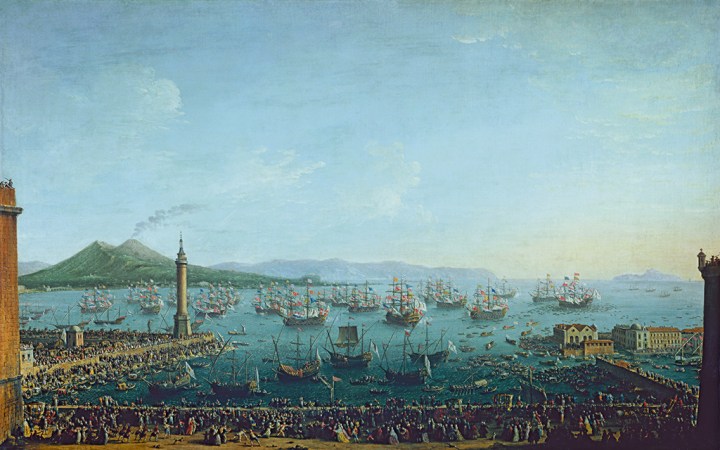
Antonio Joli, Departure of Charles III from Naples to Become King of Spain, 1759, oil on canvas
(Madrid: Museo Nacional del Prado)
◊ ◊ ◊ ◊ ◊
Opening tomorrow at The Getty:
Eyewitness Views: Making History in Eighteenth-Century Europe
The Getty Center, Los Angeles, 9 May — 30 July 2017
Minneapolis Institute of Art, 10 September — 31 December 2017
The Cleveland Museum of Art, 25 February — 20 May 2018
Curated by Peter Björn Kerber
From Paris to Venice to Rome, Europe’s most iconic cities have played host to magnificent ceremonies and dramatic events—and artists have been there to record them. During the eighteenth century, princes, popes, and ambassadors commissioned master painters such as Canaletto and Panini to record memorable moments, from the Venetian carnival to eruptions of Vesuvius, inspiring what became the golden age of view paintings.
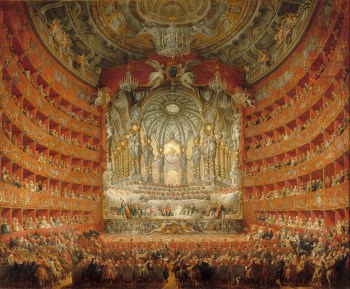
Giovanni Paolo Panini, The Musical Performance in the Teatro Argentina in Honor of the Marriage of the Dauphin, 1747, oil on canvas (Paris: Musée du Louvre)
This is the first exhibition to focus on view paintings as depictions of contemporary events. These reportorial works visually record occasions ranging from royal celebrations to state visits, religious ceremonies, sporting contests, and natural disasters. Their dates correspond to the golden age of European view painting from the beginning of the eighteenth century to the eve of the French Revolution. Through immersive compositions and a wealth of acutely observed detail, artists skillfully created the illusion that the viewer is present on the scene as history is made.
Memory & Manipulation
Members of the highest echelons of European society, from kings and popes to doges and ambassadors, commissioned view painters to commemorate the spectacular events staged at their command or for their benefit. In many cases, these noble patrons are themselves portrayed in the resulting canvases. While artists cultivated the impression that they were faithful chroniclers capturing an event on canvas just as they had witnessed it, they were in fact not above manipulating or ‘improving’ upon reality in order to meet the expectations of their status-conscious clientele.
Civic & Religious Ritual
In Europe’s major cities, the populace gathered throughout the year to commemorate local historic events, celebrate religious feast days, or participate in public rituals. Whether sacred or secular in character, these occasions were always imbued with civic pride. They were also among the few times when the different social classes interacted with each other and shared a common experience. Religious processions typically involved a revered object—such as the Blessed Sacrament, a relic, or a statue—that was carried through the streets with pomp and fanfare. A city’s deliverance from devastating epidemics of bubonic plague was commemorated with recurring festivals of thanksgiving and supplication, since the threat of a resurgence remained very real in the eighteenth century.
Festival & Spectacle
In eighteenth-century Europe, Venice was the undisputed capital of pageantry and entertainment. Undaunted by its political and economic decline, the Serene Republic and its aristocracy invested vast sums in maintaining its traditional ceremonies and dazzling its visitors—for example, by commissioning a new version of the Bucintoro, the lavishly gilded state barge used only on Ascension Day. Financial considerations were also brushed aside to provide extravagant entertainments for kings or princes staying in the city. The grandest of these special events was a ceremonial regatta. In Rome, a comparable level of opulence was seen in the French embassy’s celebrations of royal births and marriages.
Disaster & Destruction
Images of tragic events satisfied a desire for paintings that stimulated the imagination. Whether they showed devastation caused by warfare, fire, natural disaster, or political turmoil, these works offered viewers the thrill of witnessing a catastrophe. They stand apart from most other reportorial paintings in that they downplay the presence of rulers and nobility in favor of depicting the lower classes. Such figures were rarely intended to be recognizable likenesses of actual people. Instead, they serve as proxies through which viewers are able to funnel their own reactions to unfolding calamity.
From The Getty Store:
Peter Björn Kerber, Eyewitness Views: Making History in Eighteenth-Century Europe (Los Angeles: Getty Publications, 2017), 252 pages, ISBN: 978-160606 5259, $45.
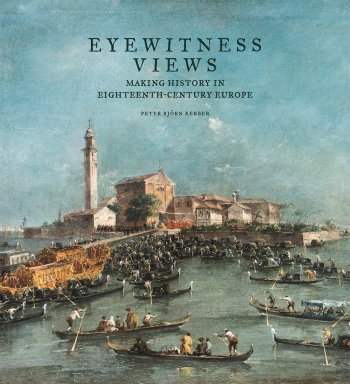 Canaletto, Bernardo Bellotto, Luca Carlevarijs, Giovanni Paolo Panini, Francesco Guardi, Hubert Robert—these renowned view painters are perhaps most famous for their expansive canvases depicting the ruins of Rome or the canals of Venice. Many of their most splendid paintings, however, feature important contemporary events. These occasions motivated some of the greatest artists of the era to produce their most exceptional work. Little explored by scholars, these paintings stand out by virtue of their extraordinary artistic quality, vibrant atmosphere, and historical interest. They are imbued with a sense of occasion, even drama, and were often commissioned by or for rulers, princes, and ambassadors as records of significant events in which they participated.
Lavishly illustrated and meticulously researched, this volume provides the first-ever comprehensive study—in any language—of this type of view painting. In examining these paintings alongside the historical events depicted in them, Peter Bjorn Kerber carefully reconstructs the meaning and context these paintings possessed for the artists who produced them and the patrons who commissioned them, as well as for their contemporary viewers.
Peter Björn Kerber is assistant curator of paintings at the J. Paul Getty Museum.
Symposium | The Splendour of the Dining Room
From Haughton International:
The Splendour of the Dining Room
Haughton International Ceramics Seminar
Christie’s, London, 28–29 June 2017
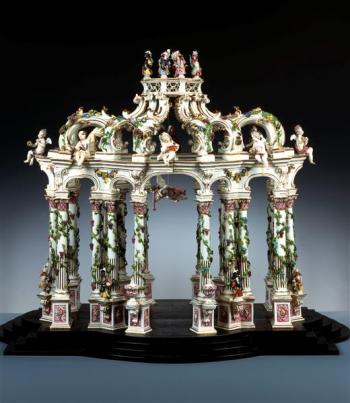
Temple of Honour (Ehrentempel), Meissen, hard-paste porcelain, ca. 1750 (Porzellansammlung, Staatliche Kunstsammlungen Dresden. Photo: Jürgen Karpinski).
Over the past 35 years, Brian & Anna Haughton have organised the International Ceramics Seminar as the nucleus of their annual art and antiques fair held in London each June. Every year the Seminar included the latest ceramic research, often ground-breaking, presented by an international rostrum of the leading scholars. The Haughtons’ contribution to ceramic scholarship has been immeasurable, providing opportunities for collectors, curators, independent researchers and enthusiasts to meet, network, exchange ideas, plan exhibitions and publications. In the absence of their annual fair and in order to keep the focus and continuity on ceramics in London in June, they have partnered with Christie’s to launch a two-day seminar with the support and encouragement from their academic colleagues. The seminar will, as always, cover a wide range of ceramic subjects and their relationships with other art forms such as silver and sculpture. Ceramics have always had a central place in the social background of the 18th century and were also important as diplomatic princely gifts, laid out on tables during state and important social occasions as highly political symbols of power and prestige.
Cost of two-day Seminar, held at Christie’s, 8 King Street, St James’s, London: £45 (inc VAT). Cost of two-day Seminar including dinner at The Athenaeum (Wednesday 28th June): £75 (inc VAT). Student Tickets for two-day Seminar only (on production of ID): £25 (inc VAT). Booking in advance through the website is essential due to limited numbers. The programme is subject to change without warning.
The speakers will include
• Kathryn Jones (Senior Curator of Decorative Arts, Royal Collection Trust, London), Very Massive and Handsome: George IV’s Grand Service and the Royal Table
• Timothy Wilson (Former Keeper of Western Art at the Ashmolean Museum, Oxford), Italian Maiolica Table Services: For Use or for Display?
• Claudia Lehner-Jobst (Art Historian and Curator, Vienna), Fasting and Feasting: Novelties at the Imperial Tables during the Reign of Maria Theresa
• Katharina Hantschmann (Keeper of Ceramics, Bayerisches Nationalmuseum, Munich, and Ernst Schneider Meissen porcelain Collection bequest at Lustheim Castle), Bustelli and the Impact of Meissen on the Nymphenburg Factory
• Ivan Day (Food Historian, Museums and Country House Consultant), Dining and Hospitality in 18th-Century English Provincial Towns and Cities
• Timothy Schroder (Silver Historian, Curator and former Prime Warden of the Goldsmiths Company), Magnificence: State Banquets in the Reign of Henry VIII
• Paul Crane (Ceramic Historian, London), Inspired by Marine Forms: Early English Porcelain Transforms the Dining Table
• Patricia Ferguson (Project Curator, Monument Trust, 18th Century Prints and Ceramics, British Museum, London, and Hon. Adviser on Ceramics, National Trust), Felbrigg’s Folly: Meissen Porcelain Temples for the Dessert Table
• Melitta Kunze-Koellensperger (Curator, independent researcher and Art Historian), The Dutch Village of Meissen Porcelain: Count Brühl’s Dessert de Luxe
• Rosalind Savill (Former Director of the Wallace Collection, London), From Salt Cellars to Sweetmeat Baskets: Dining with Sèvres Porcelain in the 18th Century
• Nicole Coolidge Rousmaniere (IFAC Handa Curator of the Japanese Arts, The British Museum, London, and founding Director of the Sainsbury Institute, Norwich), Celebration of Form and Function: Insights into Japanese Dining Traditions from the Jômon Period to the Present Day
• Rebecca Wallis (Curator, Ceramics & Glass, Victoria and Albert Museum, London), Dining in Style: 19th-Century Services in the Victoria and Albert Museum
• Suzanne Lambooy (Curator of Applied Arts, Gemeentemuseum, The Hague), Dutch Dining Culture in the Second Half of the 18th Century: The Diplomacy of the Table
• David Mitchell (Visiting Research Fellow, Centre for Metropolitan History, Institute of Historical Research, University of London), Linen Damask Napery, Henry VIII and the Northern Renaissance
MFA Reaches Agreement to Retain Seven Rare Pieces of Porcelain
Press release (4 May 2017) from Boston’s MFA:

Figure of Harlequine, Höchst Manufactory, ca. 1752; hard-paste porcelain (Boston: Museum of Fine Arts).
The Museum of Fine Arts, Boston (MFA), has reached an agreement with the Estate of Emma Budge, allowing the Museum to retain seven pieces of rare 18th-century German porcelain that were sold in Berlin in 1937. As the direct result of Nazi persecution, the proceeds from the sale were never realized by Budge’s heirs. The Italian comedy figures (commedia dell’arte), made by the porcelain manufactories Höchst, Fürstenburg, and Fulda, all belonged to Emma Lazarus Budge (1852–1937), who built a large collection of decorative arts in her home in Hamburg. These seven objects combine with works from the MFA collection to represent the only complete sets of these figures known to exist.
Upon Budge’s death in 1937, she left the disposition of her art collection to her estate executors. Emma Budge, who was Jewish, had specified that she did not wish her collection to be sold within National Socialist Germany. Nevertheless, on October 4–6, 1937, a large portion of her collection was sold by her estate at auction in Berlin. The proceeds from the sale were credited to the account of the Budge estate at M. M. Warburg Bank in Hamburg, but the ultimate settlement of the estate was delayed until 1939. In the meantime, Warburg Bank was Aryanized, or sold to non-Jewish owners, and several of Mrs. Budge’s estate executors, who were also Jewish, were dismissed from their roles. Many of her heirs fled Germany, and those who remained were subject to persecution. The estate funds that were ultimately disbursed were placed into tightly controlled, blocked accounts to which those heirs did not have free access.
Mel Urbach and Lothar Fremy, the lawyers representing the Budge Estate, thanked the MFA for efforts in reaching a “just and fair” solution. “The MFA has set another example of how provenance issues can be resolved through mutual cooperation, respect and recognition.”
The seven pieces of porcelain at the MFA were purchased at the 1937 auction by Otto and Magdalena Blohm, also porcelain collectors from Hamburg, and probably acquaintances of Emma Budge. Mrs. Blohm moved to New York after World War II, bringing the porcelain collection with her. Edward and Kiyi Pflueger acquired the figures from the Blohm collection and bequeathed them to the MFA in 2006. The series of Italian Comedy figures assembled by the Pfluegers formed part of their internationally known collection of European ceramics. Over the course of several years, the MFA acquired the Pflueger Collection, which offered a rare comprehensive survey of the art and technology of porcelain and pottery production in Europe from the late 15th to the 18th century.
The Budge figures belong to three distinct sets that were produced by German porcelain manufactories that flourished in the 1750s and ‘60s. The Höchst figures are unusual for standing on architectural plinths that were probably inspired by the ‘Comedy parterre’ garden at Schönborn Palace in Vienna. Their Fürstenberg counterparts, probably made a year or two later, stand on the ground. The single figure of Harlequin from the Fulda factory may be the rarest of all, since it was made a decade later at a much smaller, short-lived factory.
Objects included in the settlement:
• Harlequin, Höchst Manufactory, ca. 1752
• Harlequine, Höchst Manufactory, ca. 1752
• Il Capitano, Höchst Manufactory, ca. 1752
• Scaramouche, modeled by Simon Feilner, Fürstenberg Manufactory, ca. 1754
• Ragonda, modeled by Simon Feilner, Fürstenberg Manufactory, ca. 1754
• Columbine, modeled by Simon Feilner, Fürstenberg Manufactory, ca. 1754
• Harlequin, Fulda Manufactory, ca 1765
The MFA is a leader in the field of provenance research, employing a full-time Curator for Provenance, who works with curators throughout the Museum to research and document the MFA’s collection on an ongoing basis. Findings are included in the Museum’s online collections database. The MFA follows the highest standards of professional practice in regards to issues of ownership and in its response to claims for works in the collection. If research demonstrates that a work of art has been stolen, confiscated or unlawfully appropriated without subsequent restitution, then the Museum will notify potential claimants, and seek to resolve the matter in an equitable, appropriate and mutually agreeable manner. A list of ownership resolutions at the Museum since the late 1990s can be found here.
Symposium | Visualising Learning in France, 1500–1830
From the Centre for French History and Culture at St Andrews:
Visualising Learning in France, 1500–1830
St Andrews, 24–25 May 2017
 Generously supported by the British Society for Eighteenth-Century Studies, the Society for French Studies, The Centre for French History and Culture, School of Art History, and School of History, University of St Andrews
The event is free but places are limited. Please register by emailing ljg21@st-andrews.ac.uk (Linda Goddard) by 15 May, indicating day 1, 2, or both.
New Seminar Room, School of History, South Street, St Andrews
W E D N E S D A Y , 2 4 M A Y 2 0 1 7
9.30 Tea/coffee and welcome
10.00 Susanna Berger (University of Southern California / Villa I Tatti), Siegmund Jacob Apin on Visual Learning in Sixteenth- and Seventeenth-Century Europe
11.00 David Pullins (Massachusetts Institute of Technology / The Frick Collection), Visualizing Drawing: Cochin, the Encyclopédie and the livres à dessiner Tradition
12.00 Lunch
1.00 Katie Scott (The Courtauld Institute of Art) and Hannah Williams (Queen Mary University of London), Objects of Learning: Houdon’s Écorché and Oppenord’s Ripa
2.00 Stephanie O’Rourke (University of St Andrews), Histories of the Self in the Trioson Portrait Series
3.00 Coffee
3.30 Charles Kang (Columbia University), Trees of Blood: Injection and Representation
4.30 General discussion
5.00 Reception
T H U R S D A Y , 2 5 M A Y 20 1 7
9.30 Sarah Easterby-Smith (University of St Andrews), Cultivating Utility: Amateur Botany, Taste, and Floriculture in Late-Eighteenth-Century France
10.30 Richard Taws (University College London), The Echo Chamber of the French Revolution
11.30 Coffee
11.45 Mary Orr (University of St Andrews), Colouring the Science of the Past: The Arts of Learning for the Present?
Poster image: Jean-Baptiste Greuze, A Boy with a Lesson-Book (detail), exhibited 1757 (National Galleries Scotland).
Call for Papers | HECAA Session at UAAC, 2017
Thanks to Christina Smylitopoulos, who is again coordinating a HECAA session at this year’s UAAC Conference! Details and a full list of panels (57 in all) are available here»
◊ ◊ ◊ ◊ ◊
Universities Art Association of Canada / l’association d’art des universités du Canada
Banff Centre for Arts and Creativity, Banff, Alberta, 12–15 October 2017
Proposals due by 12 May 2017
 HECAA Open Session
The objective of this society is to stimulate, foster, and disseminate knowledge of all aspects of visual culture in the long eighteenth century. This HECAA open session welcomes papers that examine any aspect of art and visual culture from the 1680s to the 1830s. Special consideration will be given to proposals that demonstrate theoretical or methodological innovations. Please email proposals for 20-minute papers to Dr. Christina Smylitopoulos (University of Guelph), csmylito@uoguelph.ca.
Study Day Results | Fonder les institutions artistiques

PDF files for each presentation are available at the ACA-RES website:
Fonder les institutions artistiques : l’individu, la communauté et leurs réseaux en question
Centre Allemand d’Histoire de l’Art, Paris, 8–9 December 2016
Les premières journées d’étude du programme ACA-RES (Les académies d’art et leurs réseaux dans la France préindustrielle) se sont tenues les 8–9 décembre 2016 au Centre allemand d’histoire de l’art Paris, autour du thème : Fonder les institutions artistiques : l’individu, la communauté et leurs réseaux en question.
L’objectif de la rencontre était d’interroger la genèse des institutions académiques au XVIIIe siècle, en mettant l’accent sur l’articulation entre actions individuelles et logiques collectives; initiatives personnelles et cadres structurels; histoire locale, régionale, et mouvement d’entraînement à l’échelle française. Il s’agissait de revenir aux sources du phénomène de fondation d’écoles de dessin et d’académies d’art, qui pointe à partir des années 1740 à Rouen et à Toulouse et s’étend ensuite sur tout le territoire du royaume.
Première rencontre d’une série de trois préparant la tenue d’un colloque de synthèse en 2019, les discussions font aujourd’hui l’objet d’une diffusion sur la page Hypothèses du programme de recherche, dans la rubrique Les papiers d’ACA-RES. Ces actes sont un point d’étape dans la réflexion : ils rendent compte des questionnements soulevés et offrent un matériel documentaire qui pourra être complété et réinterrogé par la suite. Au présent compte-rendu s’adjoignent donc les « Brefs historiques » des écoles de chaque ville traitée, et les articles issus des communications. Laissés volontairement in progress, ils sont une invitation à rejoindre et prolonger la discussion.
◊ ◊ ◊ ◊ ◊
Anne Perrin Khelissa et Émilie Roffidal, Fonder les institutions artistiques : l’individu, la communauté et leurs réseaux en question
Séance de travail 1 : Les hommes et leurs réseaux
• Mikaël Bougenieres, L’École de dessin de Cambrai : les hommes et leurs réseaux
• Marjorie Guillin, L’Académie royale de peinture, sculpture et architecture de Toulouse : les hommes et leurs réseaux
• Ariane James-Sarazin, Les écoles de dessin à Angers : les hommes et leurs réseaux
• Gaëtane Maës, L’École de dessin de Lille : les hommes et leurs réseaux
• Gaëtane Maës, L’Académie de peinture et de sculpture de Valenciennes : les hommes et leurs réseaux
• Elsa Trani, De la Société des beaux-arts à l’École centrale de Montpellier : les hommes et leurs réseaux
• Nelly Vi-Tong, L’École de dessin de Dijon : les hommes et leurs réseaux
Séance de travail 2 : Les statuts et règlements
• Mikaël Bougenieres, L’École de dessin de Cambrai : les statuts et règlements
• Marjorie Guillin, L’Académie royale de peinture, sculpture et architecture de Toulouse : les statuts et règlements
• Ariane James-Sarazin, Les écoles de dessin à Angers : les statuts et règlements
• Gaëtane Maës, L’École de dessin de Lille : les statuts et règlements
• Gaëtane Maës, L’Académie de peinture et de sculpture de Valenciennes : les statuts et règlements
• Elsa Trani, De la Société des beaux-arts à l’École centrale de Montpellier : les statuts et règlements
• Nelly Vi-Tong, L’École de dessin de Dijon : les statuts et règlements
Workshop | Printed Stone: Sculpture and Its Images
From the workshop registration page:
Printed Stone: Sculpture and Its Images
Institute of Advanced Studies, University College London, 12 June 2017
Organized by by Brigid von Preussen and Cora Gilroy-Ware
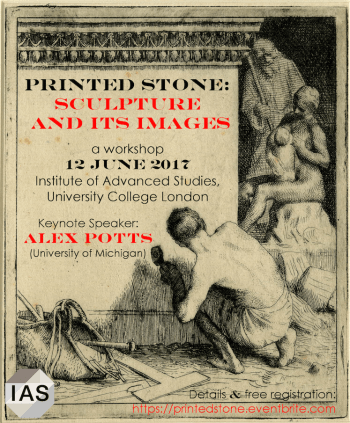 This interdisciplinary workshop will explore the relationship between sculpture and its printed images, whether produced for reasons of commerce or conservation, public edification or private gain. Our participants will interrogate the process of translation and mediation between two and three dimensions, asking how the materiality of different forms of sculpture has been rendered using various technologies of print-making, from the creation of an intaglio plate to advanced digital mapping techniques and 3D printing. We welcome the attendance and contribution of anyone interested in larger questions of representation, reproduction, materiality, media, technology, and process. Monday, 12 June 2017, 9:30–3:30; Common Ground, South Wing, Wilkins Building, Institute of Advanced Studies, University College London.
Keynote Speaker: Alex Potts (University of Michigan).
Participants include: Malcolm Baker (University of California, Riverside), Allison Stielau (University College London), Richard Taws (University College London), Danielle Thom (Museum of London), Emma Payne (University College London), and Cora Gilroy-Ware (Institute of Advanced Studies).
Organised by Cora Gilroy-Ware (Institute of Advanced Studies) and Brigid von Preussen (Columbia University) with the generous support of the Institute of Advanced Studies, University of London.
For further information, please contact Cora or Brigid: c.gilroy-ware@ucl.ac.uk and bev2105@columbia.edu. For free registration, please see printedstone.eventbrite.com.
PhD Studentship | 18th-Century British Women Printmakers
From Birkbeck College:
PhD Studentship | Making an Impression: British Women Printmakers in the Eighteenth Century
V&A / Birkbeck College, University of London, starting October 2017
Applications due by 23 May 2017
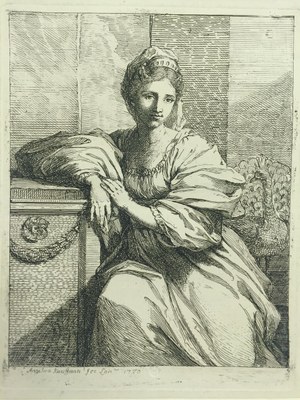
Angelica Kauffman, Juno, etching, London, 1770 (London: V&A, E.350-1890).
Applications are invited for an AHRC-funded PhD studentship researching the role, status and output of amateur and professional women printmakers in Britain during the long eighteenth century, drawing on the Victoria & Albert Museum’s strong collections of work by women printmakers of this period. The project will reconstruct and investigate the work of a number of women artists who have long been overlooked, thereby making a significant contribution to the history of art, design and the print.
This project will be supervised by Dr Kate Retford, Senior Lecturer in History of Art (Birkbeck College, University of London), who specialises in eighteenth-century British art, particularly gender and portraiture, and Dr Sarah Grant, Curator of Prints at the V&A, whose research interests encompass eighteenth-century prints, women artists, and female patronage.
Deadline: 5pm, Tuesday, 23 May 2017
More information is available here»
The British Library Launches ‘Picturing Places’
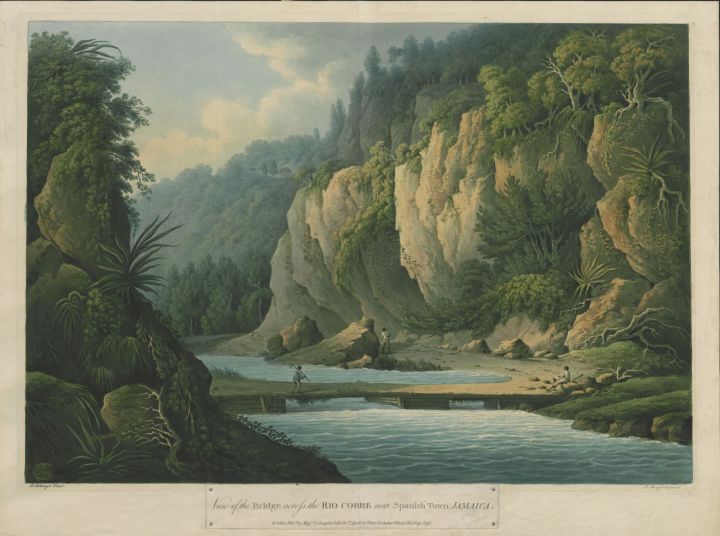
J. Mérigot after Louis Bélanger, View of the Bridge across the Rio Cobre near Spanish Town, Jamaica; etching, aquatint, hand colouring; published in London, 20 April 1800 (London: British Library, Maps K.Top.123.55.b). This sublime aquatint of the River Cobre in Jamaica is after a design by Louis Bélanger. It is part of a series of six. There is no record of Bélanger ever visiting Jamaica. It appears that he adapted his designs for this work and another view in the series from George Robertson’s paintings of the island, available in print from the 1770s (see BL Maps K.Top.123.54.f.). The image is included in Miles Ogborn’s article for Picturing Places: “Slavery, Freedom and the Jamaican Landscape.”
◊ ◊ ◊ ◊ ◊
Felicity Myrone of the British Library shares this exciting news:
The British Library is delighted to announce the launch of Picturing Places, a new free online resource which explores the Library’s extensive holdings of landscape imagery. The British Library’s huge collection of historic prints and drawings is a treasure trove waiting to be discovered. Picturing Places showcases works of art by well-known artists such as Thomas Gainsborough and J.M.W. Turner alongside images by a multitude of lesser-known figures. Only a few have ever been seen or published before.
Historically, the British Library’s prints and drawings have been overlooked by scholars. This is the first time that a large and important body of such materials from the Library are being brought to light. While landscape images have often been treated as accurate records of place, this website reveals the many different stories involved—about travel and empire, science and exploration, the imagination, history, and observation.
As well as over 500 newly-digitised works of art from the collection, this growing site will feature over 100 articles by both emerging and established scholars from many disciplines. Part of the British Library’s ongoing Transforming Topography research project, films from the Library’s 2016 conference exploring the depiction of place are also accessible, providing revelatory insights about the history of landscape imagery.
Additional information is available here»










 Enfilade
leave a comment