Exhibition | Honey from Many Flowers
Now on view at The Fitzwilliam:
Honey from Many Flowers: Carl Wilhelm Kolbe and Salomon Gessner’s Idylls
The Fitzwilliam Museum, Cambridge, 4 March — 10 September 2017
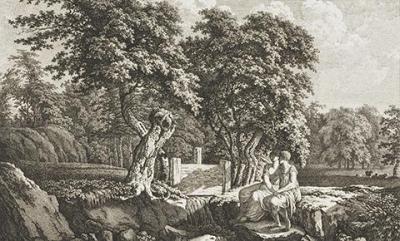
Carl Wilhelm Kolbe, after Salomon Gessner, Damon (Demophon) en Phillis (Phyllis), 1811 (Cambridge: The Fitzwilliam Museum).
Salomon Gessner (1730–88) was a Swiss artist and writer whose idyllic poetry and prose made him a household name in his lifetime. After his death, his family invited the German printmaker Carl Wilhelm Kolbe (1759–1835) to produce prints after a set of Gessner’s landscape drawings, which capture the Romantic period’s preoccupation with the pastoral idyll and delight in the natural world. This exhibition showcases a recently acquired complete set of Kolbe’s twenty-five etchings, issued in five parts from 1805 to 1811, together with a selection of works by eminent masters from whom Gessner drew inspiration, including Anthonie Waterloo, Allart van Everdingen, and Claude Lorrain.
Workshop | Translation Phenomena: Texts as Artistic Intermediaries
From H-ArtHist:
Translation Phenomena: Texts as Artistic Intermediaries
Übersetzungsphänomene: Texte als künstlerische Vermittlungsinstanzen
Friedrich-Alexander-Universität Erlangen-Nürnberg, Erlangen, 17–18 July 2017
In der Epoche der Frühen Neuzeit war Kunstproduktion in hohem Maße konditioniert durch die zentrale und ubiquitäre Kulturtechnik des Übersetzens. Die Übersetzung und Relektüre antiker Texte befeuerte das humanistische imitatio-Denken und inspirierte vielfältige Adaptionen theoretischer Konzepte, vorbildhafter Werke und motivischer Konstellationen. Der Workshop wird sich jedoch nicht primär auf die verhältnismäßig gut erforschte Antikenrezeption konzentrieren, sondern die konsekutiven Übersetzungswellen in den Blick nehmen, die bislang wenig Aufmerksamkeit gefunden haben. Die Veranstaltung thematisiert Konzepte und Praktiken des Übersetzens in ihrer Relation zu Bildender Kunst und Architektur im Zeitraum ca. 1550–1800. Vorrangig sind dabei zwei Prozesse zu untersuchen, die transnationale kulturelle Transfers betreffen: Zum einen geht es um die frühneuzeitlichen innereuropäischen Übersetzungsdynamiken (die Übertragung von Kunst- und Architekturtraktaten z. B. aus dem Italienischen ins Deutsche und Englische und die dabei vorgenommene Kommentierung bzw. Neu-Interpretation plurivalenter Passagen), zum anderen gilt es, die künstlerische Transformation der in solchen Traktaten kodifizierten Vorbilder und Normen sowohl innerhalb als auch außerhalb Europas zu analysieren.
Ort: Haus „kreuz + quer“, Bohlenplatz 1, 91054 Erlangen. Der Eintritt ist frei; eine Anmeldung ist nicht erforderlich.
Konzeption und Kontakt: Prof. Dr. Christina Strunck (Friedrich-Alexander-Universität Erlangen-Nürnberg), christina.strunck@fau.de
M O N D A Y , 1 7 J U L Y 2 0 1 7
14.15 Christina Strunck (Friedrich-Alexander-Universität Erlangen-Nürnberg), Begrüßung und Einführung
14.30 Ulrike Kern (Goethe-Universität Frankfurt am Main), Vom Festland zur Insel: Kunsttheoretische Übersetzung im frühneuzeitlichen England
15.30 Kaffeepause
16.00 Constanze Keilholz (Georg-August-Universität Göttingen), Vignolas Regola in Europa: Zur Transformation der Titelillustration eines frühneuzeitlichen Bestsellers
17.00 Paolo Sanvito (Università degli Studi di Napoli Federico II), Übersetzung und Interpretation von Textquellen zum antiken Theaterbau: Debatten an der Accademia Olimpica in Vicenza, von Daniele Barbaro (1567) bis Enea Arnaldi (1762)
T U E S D A Y , 1 8 J U L Y 2 0 1 7
9.00 Kristoffer Neville (University of California, Riverside), Leonhard Christoph Sturm as Reader and Critic: Architectural Translation and Synthesis in Germany in the Early Eighteenth Century
10.00 Carolin Scheidel (Friedrich-Alexander-Universität Erlangen-Nürnberg), Palladios I Quattro Libri in England: Transformation und Rezeption der illustrativen Elemente
11.00 Kaffeepause
11.30 Daniela Lunger-Šterbová (Univerzita Karlova, Prag), Johann Ferdinand Schor und seine Architekturmanuskripte: Erforschung der theoretischen Quellen seiner Vorlesungen
12.30 Abschlussdiskussion
Call for Papers | CAA in Los Angeles, 2018
106th Annual Conference of the College Art Association
Los Angeles Convention Center, 21–24 February 2018
Proposals due by 14 August 2017
The 2018 Call for Participation for the 106th Annual Conference—taking place February 21–24 in Los Angeles—describes many of next year’s sessions. CAA and the session chairs invite your participation: please follow the instructions in the booklet to submit a proposal for a paper or presentation. This publication also includes a call for Poster Session proposals. In addition, bear in mind that some sessions have already been fully formed at the time of acceptance.
Below are some of the sessions that could include eighteenth-century submissions, including HECAA’s panel on ‘Imitation, Influence, and Invention in the Enlightenment’, chaired by Heidi Strobel and Amber Ludwig.
◊ ◊ ◊ ◊ ◊
Historians of Netherlandish Art (HNA)
All in the Family: Northern European Artistic Dynasties, 1350–1750
Chair: Catharine Ingersoll (Virginia Military Institute), ingersollcc@vmi.edu
In early modern northern Europe, many artists followed fathers, uncles, brothers, sisters, and spouses into the family business of art-making. From the Netherlandish brothers Herman, Pol, and Jean de Limbourg, to the Vischer family of sculptors in Nuremberg, to the Teniers dynasty of Flemish painters, artists all over the North learned from and collaborated with family members over the course of their careers. For a young artist, family associations helped ease entry into the profession and art market and provided a built-in network of contacts and commissions. However, these connections could also constrict innovation when artists were expected to conform to models set by preceding generations. This session welcomes papers that deal with questions of artists’ familial relationships, in all their rich variety of forms. Some issues that may be explored in the panel include: Did artists seek to differentiate themselves from their pasts, or integrate themselves into a dynastic narrative? What kinds of dynamics were at play when family members collaborated on projects or commissions? How did familial ateliers organize themselves? In what ways were family traditions valued in the marketplace? To what extent did working in a family ‘style’ (evident for example in the work of Pieter Brueghel the Younger) benefit or hinder artists? Where in specific artworks do we see artistic debts to previous generations or deliberate breaks with the past?
◊ ◊ ◊ ◊ ◊
Ariadne’s Thread: Understanding Eurasia through Textiles
Chair: Mariachiara Gasparini (Santa Clara University), chiaragasparinistudio@gmail.com
Textile can be perceived as an indecipherable code included in the field of material and visual culture. It is not only a two-dimensional screen that reflects a known common imagery ‘indigenized’ in different geographic areas, but it has also a three-dimensional surface—created by the fibers interwoven in its structure—which follows an acquired technical grammar in the weaving process, and which could sometimes affect the ‘two-dimensional’ pattern register. Especially during the Middle Ages, the material and visual nature of textile enabled its transcultural circulation among Eurasian societies. Today, polychrome and monochrome fragments can disclose cultural and artistic similarities between centralized and provincial areas. A technical and stylistic analysis can indeed lead us through the comprehension of the universal aspect of this medium which can be easily and generally perceived as functional or as aesthetic, but rarely as a medium of human interaction and sharing. The universal aspect of textile challenges the idea of stable and fixed cultural boundaries especially arose with the concept of the modern nation-states. This panel aims to clarify similar or identical artistic developments among ancient societies of Asia and Europe. Ariadne’s thread would investigate transcultural entanglements of a maze currently recognized in the academic world as an ancient form of ‘globalization’, which might rather be reconsidered as a universal form of kinship. Papers may investigate case studies in specific visual art and material culture topics and archeological sites or take a broader, comparative approach. Particularly welcome are papers from the digital humanities.
◊ ◊ ◊ ◊ ◊
Art History as Anti-Oppression Work
Chair: Christine Y. Hahn (Kalamazoo College), chahn@kzoo.edu
What would an anti-racist, anti-oppression art history curriculum in higher education look like and how might it be taught and implemented? Working from Iris Young’s five categories of oppression—exploitation, powerlessness, marginalization, cultural imperialism, and violence—how might art history be used as a liberatory methodology for dismantling these categories? More specifically, how can we use art history’s methodologies to address those “structural phenomena that immobilize or diminish a group”? This panel seeks papers from practitioners of art history who have used innovative approaches in the discipline as tools for addressing and dismantling structural oppression. Particularly of interest are examples of successful introductory survey courses in this regard, department-wide commitments to anti-oppression work that have driven curricular decisions, student activism through art history, and effective community collaborations.
◊ ◊ ◊ ◊ ◊
Art, Agency, and the Making of Identities at a Global Level, 1600–2000
Chairs: Noémie Etienne (Bern University), noemie.etienne@ikg.unibe.ch; and Yaelle Biro (The Metropolitan Museum of Art), yaelle.biro@metmuseum.org
Circulation and imitation of cultural products are key factors in shaping the material world — as well as imagined identities. Many objects or techniques that came to be seen as local, authentic, and typical are in fact entangled in complex transnational narratives tied to a history of appropriation, imperialism, and the commercial phenomenon of supply and demand. In the seventeenth century, artists and craftspeople in Europe appropriated foreign techniques in the creation of porcelain, textiles, or lacquers that eventually shaped local European identities. During the nineteenth century, Western consumers looked for genuine goods produced outside of industry, and the demand of bourgeois tourism created a new market of authentic souvenirs and forgeries alike. Furthermore, the twentieth century saw the (re)emergence of local ‘schools’ of art and crafts as responses to political changes, anthropological research, and/or tourist demand. This panel will explore how technical knowledge, immaterial desires, and political agendas impacted the production and consumption of visual and material culture in different times and places. A new scrutiny of this back and forth between demanders and suppliers will allow us to map anew a multidirectional market for cultural goods in which the source countries could be positioned at the center. Papers could investigate transnational imitation and the definition of national identities; tourist art; the role of foreign investment in solidifying local identities; reproduction and authenticity in a commercial or institutional context; local responses to transnational demand; as well as the central role of the makers’ agency from the seventeenth to the twentieth century.
◊ ◊ ◊ ◊ ◊
Circumventing Censorship in Global Eighteenth-Century Visual Culture
Chairs: Lauren Kilroy-Ewbank (Pepperdine University), lauren.kilroy@pepperdine.edu; and Kristen Chiem (Pepperdine University), kristen.chiem@pepperdine.edu
Today, we recognize many pervasive subjects and decorative motifs from the eighteenth century as lacking radicalized or subversive content. However, many of them emerged within inquisitorial atmospheres that accompanied political revolutions, colonial projects, the enlightenment, and religious transformations. Censorship of artists and images occurred in many instances to maintain or advance dominant ideologies, yet there are also cases where it proved ineffectual. We seek papers that highlight these less successful or futile cases of censorship in global eighteenth-century visual culture, especially of Asia, Africa, and the Americas. Specifically, we are interested in how artists resisted or subverted authoritative ideologies by crafting images that were thoroughly interwoven into the visual and social fabric so as to seem commonplace and unobjectionable. How did artists use innocuous images to implicitly critique power structures or subvert authority? In what ways did censorship that targeted texts or social practices shape visual culture more broadly? How did inquisitorial attempts unintentionally draw attention to the very ideas they aimed to suppress? This panel encourages a rethinking of imagery perceived as decorative, trivial, or benign and the impact of censorship in the eighteenth century.
◊ ◊ ◊ ◊ ◊
Museum Committee
Decolonizing Art Museums?
Chairs: Risham Majeed (Ithaca College), rmajeed@ithaca.edu; Elizabeth Rodini (Johns Hopkins University), erodini@jhu.edu; and Celka Straughn (Spencer Museum of Art), straughn@ku.edu
The colonial history of museums is by now familiar, and institutional critiques of and within ethnographic and anthropological collections are fairly widespread. Indeed, many of the objects in these collections have migrated to art museums as a result of postcolonial thinking. But what about art museums? How do these institutions, their collections, and their practices continue to extend colonial outlooks for Western and non-Western art, perhaps silently, and what tools are being used to disrupt these perceptions both in the United States and abroad? This panel explores what decolonization means for art museum practices and the ways decolonizing approaches can move the museum field toward greater inclusion, broader scholarly perspectives, and opportunities to redress structural inequities. Topics to address might include: detangling collection objects from colonial collecting practices; decentering the status quo across museum operations; reconsidering the relationship between contemporaneity and historicism; alternative modes of presentation (breaking received hierarchies and narratives); embracing varied understandings of objects, materials, catalogues, and archives; polyphony and pluralism in museum rhetoric; and an understanding of ‘colonialism’ that steps outside conventional definitions of this term. We invite papers that combine scholarship, practice, and activism, bringing together case studies with critical reflection on art museums to demonstrate what decolonized practices can and might look like and o er models for institutional change. Papers that explore diverse modes of practice within and outside the United States, that provide intersectional and interdisciplinary approaches, and/or that present alternative ways for people to use and reimagine art museums are especially welcome.
◊ ◊ ◊ ◊ ◊
Digital Surrogates: The Reproduction and (re)Presentation of Art and Cultural Heritage
Chairs: Sarah Victoria Turner (Paul Mellon Centre for Studies in British Art), svturner@paul-mellon-centre.ac.uk; and Thomas Scutt (Paul Mellon Centre for Studies in British Art), tscutt@paul-mellon-centre. ac.uk
What new art historical perspectives and kinds of knowledge do three-dimensional visualizations of objects and spaces afford? What are the key possibilities or potential pitfalls to be aware of when generating new visualizations? How can visualizations extend and enhance the public function of museums by increasing accessibility and engagement? How do we connect these visualizations with new methodological insights about objects and their reproductions? Does the creation of digital surrogates result in a democratization of cultural history, or does it further distance researchers and the public from original objects? How does the production of these resources navigate the ‘threshold of originality,’ and to what extent can they be distinguished as original works? What are the most effective ways to share, publish, and circulate these visualizations? This panel seeks presentations and provocations exploring issues relating to the process of creating, collaborating on, publishing, and using 3D visualizations of art works, cultural heritage objects, and architectural spaces. It is chaired by members of the editorial team of British Art Studies (BAS), an online-only peer-reviewed journal that publishes new research on art and architecture. Approaching these issues from the perspective of art history, digital humanities, and cultural heritage, this panel will explore best practices in a growing area of digital art historical research from a range of perspectives.
◊ ◊ ◊ ◊ ◊
Eccentric Images in the Early Modern World
Chairs: Mark A. Meadow (University of California, Santa Barbara), meadow@arthistory.ucsb.edu; and Marta Faust (University of California, Santa Barbara), marta_faust@umail.ucsb.edu
Trompe l’oeil paintings, anamorphic portraits, anthropomorphic landscapes, pictorial stones, reversible heads, and composite figures are doubly eccentric. Often dismissed as curiosities and aberrations, they have been marginalized and de-centered within art history. Frequently, they demand that the viewer take unorthodox positions, looking at them from extreme angles from more than one physical location or shifting from one perceptual mode to another. Rather than trivializing such pictures as mere games, virtuosic trivia, and forms of entertainment, this session invites papers that explore how such eccentric images explore issues concerning perception, artifice, and both human and natural creativity. What different modes of artistic production and perception do they require? What questions do they pose about cognition, viewing experiences, and alternate subject positions? What questions do they raise about the role of viewers in constituting the work of art? How do images that seem to change before one’s eyes engage with period notions of paradox, volatility, and mutable forms? How do they establish conditions for a more self-aware beholder? We welcome submissions addressing any aspect of eccentric imagery, from any cultural perspective, in the long early modern period (ca. 1400–1800).
◊ ◊ ◊ ◊ ◊
Historicizing Loss in Early Modern Europe
Chair: Julia Vazquez (Columbia University), jmv2153@columbia.edu
The history of art and architecture in Baroque Madrid is bookended by two major events: the fire that burned down the Pardo Palace in 1604 and the fire that burned down the Alcázar Palace in 1734. Resulting in the loss of dozens of paintings by Titian, Antonis Mor, and Velázquez, in addition to the buildings themselves, these events represented unprecedented moments
of loss to the historical record of this period. Scholars that work in this field usually lament losses like these for their historiographic repercussions. This panel aims, instead, to resituate loss in its historical context. How can the loss of any one object transform the reception of others in their own historical period? How do patrons and artists respond to the destruction of objects? How are losses narrativized, and how do they transform existing narratives? When and under what circumstances does the destruction of existing artworks stimulate the production of new ones? Are objects ever recuperated or reconstituted, and if so, how? Although organized by a scholar of the Spanish Baroque, I invite scholars working in any period of early modern Europe to propose papers dealing with these or related questions.
◊ ◊ ◊ ◊ ◊
Hucksters or Connoisseurs?: The Role of Intermediary Agents in Art Economies
Chairs: Titial Hulst (Purchase College, The State University of New York), titiahulst@gmail.com; and Anne Helmreich (Texas Christian University), alhelmreich@gmail.com
The roles of art dealers in the creation of art economies and the circulatory exchange of goods have come to increasing attention of late. However, much work remains to be done to counter the long history of the hagiographic treatment of dealers, which owes a great deal to the fact that histories of dealers were largely authored by dealers themselves, eager to write themselves into the history of art. For this session, we seek to bring a critical and historical perspective to the role of intermediary agents in the primary and secondary markets. We seek papers that will examine dealers who mediated between the artist as producer and the consumer, whether conceived as an individual patron or broadly configured audiences. We also seek papers that identify strategies developed by these intermediary figures in response to changing social-historical as well as geographical conditions. Relatedly, what role did dealers play in the emergence of art history as a discipline and the construction of its narratives given the vested interest of these agents in knowledge formation and collection building? Since histories of art dealers have long been dominated by narratives drawn from the Western market, we are particularly interested in papers that examine the role of this figure in non-western art economies as well as topics that help us test and question standard models derived from the early modern and modern Western context. We encourage analysis of historically grounded strategies and practices, as opposed to anecdotal heroic narratives.
◊ ◊ ◊ ◊ ◊
Historians of Eighteenth-Century Art and Architecture (HECAA)
Imitation, Influence, and Invention in the Enlightenment
Chairs: Heidi A. Strobel (University of Evansville), hs40@evansville.edu; and Amber Ludwig, (Independent Scholar), amberludwigotero@gmail.com
Much eighteenth-century artistic training and practice centered on the idea of copying. Sir Joshua Reynolds encouraged Royal Academy students to contemplate and quote the old masters to elevate their works; the Académie des Beaux-Arts sponsored the Prix de Rome to allow French painters and sculptors uninterrupted study of antiquity and Renaissance art and architecture. Exhibitions like John Boydell’s Shakespeare Gallery relied, in part, on revenue from print sales to turn a pro t, while artists like sculptor Anne Damer used prints to broaden the audience of her works. The purpose of this session is to interrogate the complicated relationship between imitation, in uence, and invention and the ways in which value—educational, monetary, cultural, etc.—is assigned to artwork created after or influenced by another.
◊ ◊ ◊ ◊ ◊
Association of Research Institutes in Art History (ARIAH)
Material Culture and Art History: A State of the Field(s) Panel Discussion
Chair: Catharine Dann Roeber (Winterthur Museum), croeber@winterthur.org
Over the past generation, art history has become increasingly more inclusive in the objects it takes as its focus of study. In tandem, some practitioners have turned to the term ‘material culture studies’ to describe their work. We are looking for short presentations (ten minutes) that can open out into a larger discussion among panelists, organizers, and attendees about conceptual frameworks and methodological approaches emerging from this ongoing nexus. Proposals are welcomed from educators, curators, designers, and artists. Rather than case studies, we would value more reflective perspectives.
◊ ◊ ◊ ◊ ◊
Materiality and Metaphor: The Uses of Gold in Asian Art
Chairs: Michelle C. Wang (Georgetown University), mcw57@ georgetown.edu; and Donna K. Strahan (Freer Gallery of Art and Sackler M. Gallery, Smithsonian Institution), StrahanD@si.edu
Unique among Asian art materials, gold is both a color and an artistic medium. Embodying a host of contradictions, gold functioned as a marker of wealth and prestige and was minted into coins and cast into jewelry, yet it was also commonly used to embellish repairs made to utilitarian objects such as ceramics. Malleable and lustrous, gold furthermore was used as frequently on its own as it was in conjunction with other materials, including bronze, lacquer, and textile, and applied to paper as surface decoration. The conceptual associations of gold are equally varied. In Daoism, alchemists experimented with a range of substances in order to produce life-prolonging elixirs of gold. Within Buddhism, the body of the Buddha is believed to be golden in hue and emit light. Despite its omnipresence within a broad range of artistic and cultural traditions in Asia, however, the study of gold is still in its infancy. Only in the past twenty-five years have scholars of Asian art turned their attention to the serious study of gold artifacts. This panel seeks to bring together art historians and conservators from museums and universities in a conversation about gold as material and metaphor in Asian art. Creating a cross-cultural and comparative platform, we seek papers that simultaneously pay attention to the materiality of gold and place it into dialogue with larger theoretical and conceptual concerns in Asian art and culture.
◊ ◊ ◊ ◊ ◊
Association of Art Museum Curators (AAMC)
Mobilizing the Collection
Chairs: Kristen Collins (The J. Paul Getty Museum), KCollins@getty.edu
With the decentering of the discipline of art history, museums in this century are working as never before to transcend the paradigms that shaped their collections. The proposed panel explores how a primarily Western-centric collection can engage contemporary audiences in a multicultural society. The proposed panel discussion and conversation will include four ten-minute presentations by curators and directors who will outline projects that have attempted to address this issue through loans, exhibitions, and programming. Questions to be addressed include: How are we to mobilize our collections, using our works of art as a starting point for conversations that promote inclusiveness and connection to our audiences? What are the potential challenges that face museum professionals who move outside their areas of specialty in order to speak with, rather than at, intended audiences? Issues to be dealt with include how museums can work across boundaries established by institutions, established canons, and audiences. We will problematize periodization and traditional ideas regarding East-West exchange. We will also address the inherent challenges of decentering the history of art from collections that essentially work to a rm the Western European canon. Alternately, we welcome panelists who can speak from the perspective of specialist museums who seek to appropriate and transform the canon. The panel will also explore the negative tropes associated with race, gender, and class that are reflected in our collections and will discuss how museums can tell the truth about these difficult and ugly aspects of our shared history.
◊ ◊ ◊ ◊ ◊
Objects of Change? Art, Liberalism, and Reform across the Eighteenth and Nineteenth Centuries
Chairs: Caitlin Beach (Columbia University), cmb2226@columbia.edu; and Emily Casey (St. Mary’s College of Maryland), eccasey@smcm.edu
This panel seeks to consider the dynamics of producing, mobilizing, and consuming images in the pursuit of social justice and reform. The eighteenth and nineteenth centuries saw a proliferation of such campaigns, with movements to abolish slavery, extend suffrage rights, and transform labor laws numbering amongst the many efforts to effect large-scale societal changes in Europe and the Americas. From Josiah Wedgwood’s oft-reproduced antislavery medallion of 1793 to the imagery and highly visible pageantry of women’s suffrage movements towards the turn of the twentieth century, visual and material culture has long been seen to play a vital role in shaping and articulating rhetorics of liberal political reform. However, recent scholarship on the entangled—and oftentimes parallel—historical trajectories of liberalism, capitalism, and empire complicates a straightforward understanding of the relationship between images and reform. As Lisa Lowe, Marcus Wood, and others have suggested, ideologies of liberal governance and reform often did as much to scaffold the status quo as to incite radical societal change. How did art objects—broadly defined—manifest, transform, obscure, or interrupt relationships between liberal reform campaigns and the forms of power they supported? How did markets for fine and decorative arts participate in or overlap with capitalist networks? How might our understanding of objects of reform shift if we see them operating with—rather than in opposition to—the imperial nation-state? Finally, what are the stakes of mobilizing such historical objects today, particularly in museums, scholarship, pedagogy, and contemporary activism?
◊ ◊ ◊ ◊ ◊
Association for Latin American Art (ALAA)
Open Session for Emerging Scholars of Latin American Art
Chairs: Lisa Trever (University of California, Berkeley), Ltrever@berkeley.edu; and Elena FitzPatrick Sifford (Louisiana State University), efitzsifford@gmail.com
Each year increasing numbers of scholars are awarded doctoral degrees in Latin American art history. This session seeks to highlight the scholarship of advanced graduate and recent PhD scholars. Papers may address any geographic region, theme, or temporal period related to the study of Latin American art or art history, including Caribbean and Latinx topics. Please note, Association for Latin American Art (ALAA) membership is not required at the time of paper proposal, but all speakers will be required to be active members of CAA and ALAA at the time of the annual meeting. ALAA membership details are available through the session chairs.
◊ ◊ ◊ ◊ ◊
Provenance Research as a Method of Connoisseurship?
Chairs: Valentina Locatelli (Kunstmuseum Bern), valentina.locatelli@gmail.com; Christian Huemer (The Getty Research Institute), CHuemer@getty.edu; and Valérie Kobi (Universität Bielefeld), valerie.kobi@uni-bielefeld.de
This session will explore the intersections between provenance research and connoisseurship with regard to the early modern period. In order to go beyond today’s dominant understanding of provenance research as a practice almost exclusively related to Nazi-looted art and questions of restitutions, the panel will deliberately focus on topics from the late fifteenth to the eighteenth centuries. By setting this alternative chronological limit, we will delve into the historical role of provenance research, its tools and significations, and its relation to connoisseurship and collecting practices. What influence did the biography of an artwork exert on the opinion of some of the greatest connoisseurs of the past? How did the documented (or suspected) provenance of a work of art impact its attribution and authentication process? Which strategies were employed in the mentioning of provenance information in sale catalogues or, sometimes, directly on the artworks themselves? Did the development of art historical knowledge change the practice of provenance research over time? And finally, how can we call attention to these questions in contemporary museum practice and reassess provenance research as a tool of connoisseurship? In addition to addressing the history as well as the strategies of provenance research, this session will be an opportunity to question its relationship to other domains as well as to bring it closer to core problems of art history and museology. We invite contributions that introduce new historical and methodological approaches. Proposals which go beyond the case study are especially encouraged.
◊ ◊ ◊ ◊ ◊
Race, Ethnicity, and Cultural Appropriation in the History of Design
Chairs: Karen Carter (Kendall College of Art and Design of Ferris State University), karencarter@ferris.edu; and Victoria Rose Pass (Maryland Institute College of Art), vpass81@gmail.com
Design history has often ignored the thorny issues of race and ethnicity, although design is deeply intertwined with global trade, slavery, colonial encounters, and ethnic and racial stereotypes. Examples of cultural appropriations might include blue and white porcelain export ware from China or paisley cashmere shawls from India that were manufactured for Western markets and subsequently copied by European designers in order to capitalize on the taste for global goods. Additional examples are the use of ‘blackamoor’ figures in interior design or American housewares with depictions of Mammies in which blackness is constructed in opposition to whiteness. This panel seeks to critically interrogate the practice of cultural appropriation by exploring the economic and cultural foundations of design in the past and present (in architecture, industrial design, craft, fashion, graphics, furniture, interiors, and systems). Papers should address some of the following questions: How does cultural appropriation move in multiple directions throughout a globalized history of design? How do designers and/or consumers use cultural appropriation to express their own identities? What role does the concept of ‘authenticity’ play in cultural appropriation? Does cultural appropriation, which often relies on racial and ethnic stereotypes and helps to reify them, also have the potential to undermine stereotypes? How do questions of gender, sexuality, and class intersect with those of race and ethnicity within cultural appropriations? Papers that employ methods from postcolonial and critical race studies and/or case studies of ordinary artifacts that have been eliminated from the traditional canon of design history are especially welcome.
◊ ◊ ◊ ◊ ◊
State of the Art (History): Re-Examining the Exam
Chairs: Karen D. Shelby (Baruch College, The City University of New York), karen.shelby@gmail.com; and Virginia B. Spivey (Independent Scholar, Art History Teaching Resources), virginia.spivey@gmail.com
This session invites proposals for seven-minute lightning talks exploring the pedagogy and philosophy of formal assessments in art history. While we are interested in exam-related practices, we welcome submissions that substitute innovative and non-traditional models as a primary mode of formal assessment of specific skills and art historical content. What are critical and compelling components to formal assessment methods? How do you administer exams? How do you support students’ exam preparation? What exam formats do you find most effective to measure student learning, to provide formative feedback, or to achieve other goals of assessment? What is the relationship between formal assessment and student grades? What strategies have you employed to ensure transparency in evaluation and grades? What types of assessments are pedagogically sound for art history majors? Non-art history majors? Students taking art history as a general education requirement? The session will be facilitated by ArtHistoryTeachingResources.org (AHTR), founded in 2011 as a collectively authored discussion around new ways of teaching and learning in the art history classroom. Modeled on the AHTR Weekly, a peer-populated blog where art historians from international institutions share assignments, reactions, and teaching tools, this session will o er a dynamic ‘curriculum slam’ in which speakers, respondents, and attendees will engage in dialogue and reflection on successes/failures regarding issues of undergraduate assessment in art history. The session is dedicated to scholarly discourse that articulates research and practice in art history pedagogy and seeks to raise the profile and value of those who identify as educators.
◊ ◊ ◊ ◊ ◊
American Society for Eighteenth-Century Studies (ASECS)
The 1790s
Chair: Julia Sienkewicz (Duquesne University), julia.a.sienkewicz@gmail.com
An eventful decade in the ‘Age of Revolutions,’ the 1790s were a time of ‘commotion’ (so-characterized by Benjamin Henry Latrobe) that shifted national boundaries, transformed structures of power, and cast individuals of all ranks from one end of the globe to the other. Many travelers sought to escape misfortune, others voyaged in the service of their political ideals, and still others merely hoped to peacefully continue with routine trade and other activities. As a transitional decade, the culture of the 1790s is rich with both ideas that do not survive the eighteenth century and those that flourish in the nineteenth. In the production and consumption of art and architecture, these years brought pronounced changes. Neoclassicism flourished in a variety of forms and in the service of (sometimes subtly) differing ideologies or ideals. The medium of transparent watercolor rose to new heights, particularly in Britain, where it also began to take on a patriotic valence. In both France and the United States, artists and their publics struggled to give visual form to the idea of the ‘Republic,’ in light of the long tradition of art in the service of monarchy. This panel seeks to bring together new perspectives on the art and architecture of the 1790s. Scholarship that traces the chaos, innovation, and creative aspirations of this period, in lieu of pursuing long-established artistic canons or national schools is particularly desirable. Papers may consider artists from, or working in, any geographic location, and in any medium.
◊ ◊ ◊ ◊ ◊
The French Fragment, 1789–1914
Chairs: Emily Eastgate Brink (University of Western Australia), emily.brink@uwa.edu.au; and Marika Knowles (Harvard University), knowles@fas.harvard.edu
In 1979, Henri Zerner and Charles Rosen launched their influential analysis of Romantic aesthetics with a description of the Romantic fragment as “both metaphor and metonymy.” In France, post-Revolutionary artists gravitated towards visions of ruins, butchered bodies, papery sketches, and other manifestations of human transience. Evolving out of this love of pieces, fragments took on a variety of forms throughout the nineteenth century. Romantic artists responded to the spectacle of ‘bric-a-brac’ salvaged from aristocratic interiors, medieval sculptures loosed from cult settings, and collections of ethnographic curiosities comprised of objects from ‘elsewhere.’ Eventually, as artists turned to the spectacle of modern life, the fragment as an object, figure, or ‘other,’ ceded to forms of fragmentary vision. The late nineteenth-century artistic proclivity for cropped bodies, blurred outlines, and decorative vignettes trafficked in fragments, amplifying what Michael Fried has identified as the modern tension between the morceau and tableau. Nearly forty years after Zerner and Rosen’s publication, this panel seeks to reassess and reinvigorate approaches to the fragment in French art of the long nineteenth century. We welcome multiple approaches to the fragment, including critical definitions of the term. How did the fragment change, or remain the same, over the course of the long nineteenth century? What is the relationship between the fragment and its presumed ‘whole’? How did the fragment represent and articulate relationships within France’s ongoing colonial enterprise? How did new visual technologies, such as lithography, photography, and the cinema, affect the status of the fragment in France?
◊ ◊ ◊ ◊ ◊
Travel, Diplomacy, and Networks of Global Exchange in the Early Modern Period
Chair: Justina Spencer (Carleton Univeristy), justinahspencer@gmail.com
Early modern artists were known to travel alongside ambassadors on diplomatic missions, in accompaniment of explorers, or as entrepreneurial merchants on solo expeditions. Works of art likewise toured en route with artists, were produced amid voyages, or at times illustrated the arrival of foreigners in new lands. This panel seeks to explore the role visual culture played vis-à-vis travel, trade, diplomacy, and transcultural encounters in the early modern period. In what ways did the movement of artists contribute to the construction of aesthetic hybridism and early cosmopolitanism? If art forms such as Japanese Namban screens and Ottoman costume albums divulge a cultural encounter, do they presuppose a burgeoning ‘global public’? Taking into account that global art history is not, to use the words of Thomas DaCosta Kaufmann, “the reverse side of Western art history,” but instead contrary to national art and its incumbent limitations, this panel seeks contributions from scholars interested in a horizontal approach to artistic exchange where emphasis is placed on the interconnectedness of visual cultures, styles, and techniques. Contributors to this panel may deal with any aspect of global travel and exchange in the early modern period (1450–1800). Papers might address the visual manifestations of political diplomacy, art as foreign reportage, the adaption of foreign artistic techniques, or the role of the court as a contact zone for cross-cultural exchange. Topics may include a discussion of an individual work of art or artist, or can consist of more theoretical discussions of travel in the early modern world.
◊ ◊ ◊ ◊ ◊
Society for the Study of Early Modern Women (SSEMW)
Unruly Women in Early Modern Art and Material Culture
Chair: Maria F. Maurer (The University of Tulsa), maria-maurer@utulsa.edu
From Caterina Sforza’s defense of Forlì or Sor Juana de la Cruz’s questioning of the misogynist literary tradition to images of slovenly Dutch housewives and objects which facilitated active female participation in and enjoyment of sex, early modern art history abounds with images and stories of misbehaving women. Art and material culture produced during the early modern period allows us to consider ways in which women negotiated and even transgressed social strictures. What did it mean for an early modern woman to be unruly? How was gendered transgression pictured and performed through objects and artworks? Conversely, how might art have been used to normalize problematic female figures? Finally, how have modern art historians treated disruptive female agency? This panel aims to study examples of troublesome or disobedient women and their involvement in early modern art. We seek papers that explore artists, patrons, subjects, and beholders who do not t into expected frameworks or who disrupt traditional narratives about women’s roles in early modern art and society. Paper topics might include, but are not limited to: female artists or patrons who contravened established artistic practices; representations of unusual and/or misbehaving women; examples of female beholders who engaged in alternative interpretations of, or interactions with, art; and female artists, patrons, or subjects who have proved unmanageable for later art historians. We welcome papers from any area of the globe concerning the years ca. 1400–1800, and invite scholars of all ranks to apply.
◊ ◊ ◊ ◊ ◊
American Council for Southern Asian Art (ACSAA)
Viral Media and South Asia
Chairs: Holly Shaffer (Brown University), holly_shaffer@brown.edu; and Debra Diamond (Freer Gallery of Art and Sackler M. Gallery, Smithsonian Institution), diamode@si.edu
From the sixteenth century, European publications about South Asia ranged from travelers’ accounts, military memoirs, and missionary manuals to text and image compilations. The technology of print allowed for compositions to replicate and disperse over hundreds of years, which expanded knowledge—and established stereotypes—about South Asian culture. The role of the visual in establishing, justifying, and corroborating the parameters of European inquiries about South Asian subjects and peoples has urgent contemporary implications as the circulation of true or false images only increases the links between knowledge, politics, and aesthetics. This panel invites papers to address themes related to printed imagery produced about South Asia, or produced by South Asians about other locales, from 1500 to now. The first theme asks how the print medium accelerated the movement of information and stultified it through replication. We are interested in studies about images that ‘go viral’ or circulated ‘fake news.’The second question concerns the use of artworks as a source for printed images about culture. What were the processes of translating artworks into print? How does the artwork as model alter how information was perceived by makers and received by audiences? The third theme is about theories of reproducibility. How might a study of the conveyance of information about South Asia—by witnessing, hearsay, or objects—disrupt and nuance scholarship on the print medium? Papers can focus on artists, publishers, or publications from anywhere, the only qualifier is that they be about South Asia or produced by South Asians.
◊ ◊ ◊ ◊ ◊
Working Out of Medium
Chair: David Pullins (The Frick Collection), dpullins@gmail.com
What happens when an artist steps outside of their preferred medium, or outside the medium that their public has come to expect from them? What leads to such a decision, at what stage in an artist’s career might it occur, and with what results? How do such moments fit into an artist’s historiography (and the concept of a singular, consistent artistic personality and œuvre), or the collecting and display of their work (even the literal market value of one object over another)? Inspired by early modern European examples (the pastelist Perronneau working in oil, Chardin in pastel, Oudry in watercolor, Prud’hon in ink), this call for papers is open to a wider geographic and chronological range with the aim of starting from a diversity of particulars in order to address larger, more conceptual questions. This said, ideal proposals will be those that look with nuance at the material properties of the objects produced by one or two makers in order to set them into dialogue the themes of a panel that aims to speak across artistic practice and the construction of artistic identity as it relates to medium.
◊ ◊ ◊ ◊ ◊
Woven Spaces: Building with Textile in Islamic Architecture
Chair: Patricia Blessing (Pomona College), pdblessing@gmail.com
This session invites papers that examine the relationship between textiles and architecture within the Islamic world, prior to ca. 1850. Questions of textile as architecture (such as tents) but also textiles in architecture (such as textile furnishings or the use of textile motifs) are relevant to the panel. A larger discussion will develop surrounding the concept of a textile aesthetic in Islamic architecture, and the panel invites speakers to broadly engage theoretical perspectives in this regard. When considered in this framework, multiple relationships between fabric and monument emerge. Issues of materiality, sensory perception, and intermediality are at stake within the larger question of how fabrics are an integral part of the built environment in the medieval and early modern Islamic world. Textile structures such as tents or canopies were built of fabric; portable architecture that could be folded and stored for transportation, and then reconstructed. Textiles were also central parts of the ways in which spaces were furnished and transformed with changes in wall hangings, curtains, and floor coverings. Textile motifs were frequently integrated into architectural decoration, rendered in a range of materials such as stucco and tile. Overall, the understanding of space is thoroughly transformed once the presence of textiles in these often overlapping modes is acknowledged in considerations of textile spatiality. Contributions will engage with questions related to the multiple uses of textiles as they are integrated into Islamic architecture from late antiquity to the nineteenth century in the various ways outlined.
◊ ◊ ◊ ◊ ◊
Note (added 7 July 2017) — With the original posting, I inadvertently omitted the session on ‘Viral Media and South Asia’, chaired by Holly Shaffer and Debra Diamond. –CH
Note (added 13 July 2017) — The original posting did not include the ASECS-affiliated session on ‘The 1790s’.
New Book | Dans l’œil du connaisseur: Pierre-Jean Mariette
From PUR:
Valérie Kobi, Dans l’œil du connaisseur: Pierre-Jean Mariette (1694–1774) et la construction des savoirs en histoire de l’art (Rennes: Presses Universitaires de Rennes, 2017), 322 pages, ISBN: 978 27535 53149, 28€.
 En partant du cas singulier du collectionneur Pierre-Jean Mariette (1694–1774), cet ouvrage vise à mieux définir les étapes qui jalonnent la formation des connaissances en histoire de l’art au xviiie siècle et, plus largement, à questionner le rôle joué par la figure du connaisseur dans cette dynamique. En somme, il s’agit de répondre aux interrogations suivantes : sur quels éléments repose la réputation de l’amateur et comment s’organise la reconnaissance de son autorité par ses pairs ? Quels sont les instruments, matériels ou intellectuels, déployés par l’expert ? Et, finalement, sous quelles formes se présente son savoir lorsqu’il se matérialise par l’écrit ?
Dans ce but, l’identité et l’activité de Mariette se trouvent ici interrogées à travers six chapitres thématiques scindés en deux parties. La première, intitulée La naissance d’un amateur, analyse l’émergence de la figure de l’amateur à travers trois moments-clés : la constitution d’une identité, le voyage d’Italie et l’insertion de l’érudit dans la République des Lettres. La seconde, dévouée aux Savoirs mis en œuvre, examine les modalités de la divulgation scientifique, de ses modèles théoriques à ses représentations visuelles.
Plus qu’un panorama exhaustif d’une pensée savante, le développement suivi enquête sur la façon dont le livre devient, au cours du xviiie siècle, un véritable laboratoire des savoirs ; un espace privilégié où se déroule, entre amateurs, le débat qui participe à l’élaboration d’une connaissance empirique dans le domaine de l’histoire de l’art. À cet égard, la présente étude pose non seulement un regard nouveau sur l’apport de Pierre-Jean Mariette au champ historique mais elle réfléchit aussi de manière originale aux pratiques socio-culturelles et aux enjeux esthétiques qui façonnent la discipline à l’époque des Lumières.
Valérie Kobi a reçu son doctorat en histoire de l’art de l’université de Neuchâtel (Suisse). Elle a été boursière à l’Institut suisse de Rome, au Getty Research Institute et à la Ludwig-Maximilians-Universität München. Depuis mai 2015, elle mène ses recherches postdoctorales entre Bielefeld et Weimar dans le cadre du projet Parergonale Rahmungen. Zur Ästhetik wissenschaftlicher Dinge bei Goethe.
T A B L E D E S M A T I È R E S
Remerciements
Préface de Pascal Griener
Introduction
Première partie: La naissance d’un amateur
Destinée historiographique
Un œil poli: La formation d’un amateur entre préjugés et émancipation
Cultiver les muses: Transactions érudites et collaborations scientifiques au sein de la République des Lettres
Conclusion
Seconde partie: Les savoirs mis en œuvre
Le catalogue comme modèle de connaissance
L’esprit de l’original et les protocoles de la reproduction
Mariette et Bouchardon : la rhétorique d’une amitié
Conclusion
Conclusion générale
Annexes
Bibliographie
Index
Table des illustrations
A Visual History of Rome: The Rodolfo Lanciani Digital Archive

Francis Towne, The Colosseum from the Palatino, 1740; watercolor, 53.4 × 37.5 cm (Rome: Istituto Nazionale di Archeologia e Storia dell’Arte, Rodolfo Lanciani Collection, 16649 and Roma XI.1.I.15).
◊ ◊ ◊ ◊ ◊
Press release from Stanford, via Art Daily:
A team, which includes Stanford researchers, has created a new digital archive to study Rome’s transformation over the centuries. Images of Rome: The Rodolfo Lanciani Digital Archive, which went online in the spring, consists of almost 4,000 digitized drawings, prints, photographs, and sketches of Rome from the 16th to 20th centuries [with over 1,000 from the 18th century]. The pieces were collected by renowned Roman archaeologist Rodolfo Lanciani (1845–1929), who sought to document the entire history of Rome’s archeology up to the end of the 19th century.
“Rome is a layered city,” said Erik Steiner, co-director of the Spatial History Project at Stanford’s Center for Spatial and Textual Analysis (CESTA). “To be able to see that history you need to look through those layers, and this collection helps that process.”
The archive is a culmination of a two-year collaboration among CESTA, the Stanford University Libraries, University of Oregon, Dartmouth College, and the Italian government.
“This is part of our long-term ambition to bring one of the most documented cities in the world to the digital age,” Steiner said. “The project marries intense scholarly interest in Rome with best practices and tools built by the Stanford Libraries.”

Francesco Panini, Museo Vaticano, Museo Pio Clementino, 1775; watercolored pen and ink drawing, 72 × 51.2 cm (Rome: Istituto Nazionale di Archeologia e Storia dell’Arte, Rodolfo Lanciani Collection, Roma XI.61.II.69).
After Lanciani’s death in 1929, his library, which contains more than 21,000 items, was sold to the Istituto Nazionale di Archeologia e Storia dell’Arte (Italy’s National Institute of Archaeology and Art History) in Rome. Archaeologists, historians, architects, and other researchers who study ancient cities have used the collection to glean valuable information about Rome’s history and structure.
“These materials are very important and have been used by many different scholars, but access to them is quite limited,” said Roman archaeologist Giovanni Svevo, who also worked on the digital archive.
Viewing the archive requires a visit to the historic 15th-century Palazzo Venezia in central Rome. Lanciani’s collection is on the fourth floor and in its own dedicated room, which is open for only a few hours during weekdays. Only one folder from the collection can be viewed at a time. So the team—Steiner, Svevo, James Tice, a principal investigator on the project and an architecture professor at the University of Oregon, and Nicola Camerlenghi, an assistant professor of art history at Dartmouth College—set out to bring some of the collection onto the internet. Supported by a 2015 grant from the Samuel H. Kress Foundation, they partnered with Italy’s Ministry of Cultural Heritage and Activities and Tourism, and the National Institute to scan and create high-resolution images of each of the thousands of materials in the collection.
“Our collaboration with the Italian government on this project was very important,” Camerlenghi said. “It’s such a big help to scholars across the world when such teamwork can occur.”
Each digital object was categorized and tied to a descriptive set of data, so it could be properly stored and searched online. This part of the project demanded the most effort and care, the researchers said. The digital images and all associated descriptions are now permanently preserved in the Stanford Digital Repository.
“We believe this project is important for two reasons: it provides accessibility to a precious archival collection and, more broadly, it demonstrates a method whereby similar materials can be made available to scholars, students and the general public through the digital humanities,” Tice said.
Digitizing Lanciani’s collection is part of a larger effort to recreate the spatial history of Rome, a project named Mapping Rome, which Steiner and Tice began around 2004. As part of that effort, the team digitized the work of two 18th-century Italian architects, Giambattista Nolli and Giuseppe Vasi. They are also still working on completing the digitization of Lanciani’s famous Forma Urbis Romae, a cartographic map that traces Rome’s ancient ruins and its later developments. The map is 17 feet by 24 feet and is considered to have the most detailed information about Rome’s historical topography. The team envisions the end product to be an interactive map of Rome that links to the digitized archival materials.
“This is about telling a story of a place and reconstructing its past,” Steiner said. Beside allowing access to any scholar in the world, digitizing the archives also ensures their future preservation, Steiner emphasized. He said he hopes that more libraries and institutions around the world will devote time and funding to digitizing the humanities’ enormous body of historical documents.
“Nothing in the end would substitute holding primary documents in your hands, but you can answer a lot of scholarly questions by looking at them online in high resolution,” Camerlenghi said.
New Book | Settecento romano: Reti del Classicismo arcadico
From Viella and available from ArtBooks.com:
Beatrice Alfonzetti, ed., Settecento romano: Reti del Classicismo arcadico (Rome: Viella, 2017), 532 pages, ISBN: 978 88672 88571, 50€ / $75.
 Questo libro—nato da una ricerca d’équipe composta da letterati, storici dell’architettura, dell’arte e della musica—propone per la prima volta di unificare sotto la categoria di Classicismo arcadico tutto ciò che si crea ed elabora a Roma dalla fondazione dell’Arcadia in avanti. Non valida, ad esempio, per Torino, questa estensione permette di superare le viete periodizzazioni come la divisone per secoli fra Sei e Settecento o fra il primo e il secondo Settecento; e ci consente finalmente di intravedere la continuità, tutta romana, fra l’idea del bello di Bellori, la ragione poetica di Gravina, il recupero del tragico di Alfieri e Monti, tutti attivi, dall’inizio alla fine del secolo, proprio a Roma, accanto a Mengs, Füssli, Winckelmann, David. Al centro l’Arcadia che, con le acclamazioni o iscrizioni di cardinali, principi, sovrani, letterati, artisti di passaggio o residenti a Roma, era riuscita nell’impresa di fondare una repubblica letteraria sovranazionale che guardava persino a Voltaire. Era all’avanguardia, allora, Roma nelle arti, nelle accademie, nelle biblioteche, nei teatri e nella letteratura sinora chiamata neoclassica.
C O N T E N T S
Beatrice Alfonzetti, Introduzione
Parte prima
I. Il Classicismo restaurato
• Amedeo Quondam, Roma 1672: il Classicismo restaurato. L’idea del bello e il canone delle arti secondo Bellori
Parte seconda
I. L’Arcadia e la Roma di Clemente XI
• Valentina Gallo, La Basilissa: Cristina di Svezia in Arcadia
• Javier Gutiérrez Carou, Endimione fra Alessandro Guidi e Francesco de Lemene: drammaturgia, spettacolo, struttura dei finali
• Marina Formica, Dominare il tempo. Clemente XI e i tentativi di riforma del calendario
• Simone Caputo, Il ‘teatro della festa’ nella Roma di Clemente XI
II. Il Classicismo arcadico
• Franco Piperno, Architettura e musica nella Roma del Classicismo arcadico
• Angela Cipriani, Un secolo di premiazioni in Campidoglio (1696–1795). Le quattro arti liberali in mutuo soccorso
• Nicola Badolato, Il Ciro di Pietro Ottoboni e Alessandro Scarlatti e gli allestimenti operistici romani di Filippo Juvarra
• Massimo Zammerini, Architettura e scenografia nella Roma del Settecento
• Ilaria Delsere, L’Arcadia alla corte pontificia: la collaborazione tra Ludovico Sergardi e Antonio Valeri alla Fabbrica di San Pietro (1713–1726)
• Valter Curzi, Memoria dell’antico nella pittura di storia a Roma tra Seicento e Settecento: un contributo per la revisione storico-critica del Neoclassicismo
• Silvia Tatti, L’Arcadia di Crescimbeni e il trionfo della poesia: l’incoronazione in Campidoglio del 1725
• Alviera Bussotti, La recita del Temistocle di Michele Giuseppe Morei: tra Zeno e Metastasio
• Roberto Gigliucci, Il cardinale Pietro Ottoboni tra San Filippo Neri e San Casimiro
III. L’Arcadia: una rete transnazionale
• Maurizio Campanelli, I Sermones di Giovan Battista Casti (1762–1764)
• Elodie Oriol, Mecenatismo e sviluppo delle carriere musicali: il ruolo delle famiglie Acquaviva, Stuart e Albani nella Roma settecentesca
• Piermario Vescovo, Goldoni: vacanze romane
• Rosanna Cioffi, Tra Arcadia e Neoclassicismo. Da Maratti a Mengs nel segno di Shaftesbury e Winckelmann
• Marina Caffiero, Dal monastero al salotto alla tribuna. La mediazione culturale femminile nella Roma di metà Settecento
• Beatrice Alfonzetti, Poeti italiani e stranieri nelle adunanze arcadiche
• Andrea Fabiano, Astacide Tespio ovvero Poinsinet le Noyé (le Mystifié): un librettista comico francese in Arcadia
• Franca Sinopoli, Giovanni Battista Audiffredi e la realizzazione del modello di biblioteca universale
• Antonio Rostagno, Il ‘nuovo Dante’ nella musica. Dante e Petrarca in due manoscritti romani di Nicolò Antonio Zingarelli
• Orietta Rossi Pinelli, Gli artisti stranieri a Roma nel XVIII secolo
Indice dei nomi
New Book | Empire of the Senses
Scheduled for publication this fall from Brill:
Daniela Hacke and Paul Musselwhite, eds., Empire of the Senses: Sensory Practices of Colonialism in Early America (Leiden: Brill, 2017), ISBN: 978 90043 40633, 135€ / $156.
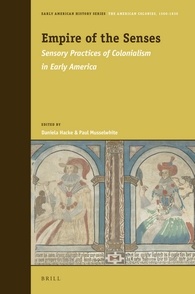 Empire of the Senses brings together pathbreaking scholarship on the role the five senses played in early America. With perspectives from across the hemisphere, exploring individual senses and multi-sensory frameworks, the volume explores how sensory perception helped frame cultural encounters, colonial knowledge, and political relationships. From early French interpretations of intercultural touch, to English plans to restructure the scent of Jamaica, these essays elucidate different ways the expansion of rival European empires across the Americas involved a vast interconnected range of sensory experiences and practices. Empire of the Senses offers a new comparative perspective on the way European imperialism was constructed, operated, implemented and, sometimes, counteracted by rich and complex new sensory frameworks in the diverse contexts of early America.
Daniela Hacke is Professor of Early Modern History at the Free University of Berlin. She has published monographs, translations and many articles on European Gender and Cultural History and is currently researching a History of the Senses in Venice.
Paul Musselwhite is Assistant Professor of History at Dartmouth College. He researches and publishes on early British America and the development of plantation society.
◊ ◊ ◊ ◊ ◊
C O N T E N T S
List of Illustrations
Notes on Contributors
Introduction: Making Sense of Colonial Encounters and New Worlds, Daniela Hacke and Paul Musselwhite
I | Cultural Encounters
1 Touching on Communication: Visual and Textual Representations of Touch as Friendship in Early Colonial Encounters, Céline Carayon
2 Mission Soundscapes: Demons, Jesuits, and Sounds in Antonio Ruiz de Montoya’s Conquista Espiritual (1639), Jutta Toelle
3 Singing with Strangers in Early Seventeenth-century New France, Michaela Ann Cameron
II | Colonial Subjectivity
4 The Pain of Senses Escaping: Eighteenth-century Europeans and the Sensory Challenges of the Caribbean, Annika Raapke
5 Color Visions: Perceiving Nature in the Portuguese Atlantic World, Marília dos Santos Lopes
III | Structures of Knowledge
6 Colonial Sensescapes: Thomas Harriot and the Production of Knowledge, Daniela Hacke
7 Merian and the Pineapple: Visual Representation of the Senses, Megan Baumhammer and Claire Kennedy
8 ‘Delightful a Fragrance’: Native American Olfactory Aesthetics within the Eighteenth-Century Anglo-American Botanical Community, Andrew Kettler
IV | Colonial Projects
9 The Aromas of Flora’s Wide Domains: Cultivating Gardens, Aromas, and Political Subjects in the Late Seventeenth-Century English Atlantic, Kate Mulry
10 Exploring Underwater Worlds: Diving in the Late Seventeenth-/Early Eighteenth-Century British Empire, Rebekka von Mallinckrodt
Index
V&A Opens New Courtyard and Entrance

The V&A’s Aston Webb screen from 1909, modified with five new openings on either side of the central arch, now connects the courtyard to Exhibition Road. Photograph: Hufton+Crow.
◊ ◊ ◊ ◊ ◊
Press release from the Victoria & Albert Museum:
The V&A Exhibition Road Quarter opened to the public on the evening of Friday 30 June 2017, creating a beautiful and unique new civic space for London and a world-class gallery space for the V&A’s internationally acclaimed exhibition programme. The project is designed by Stirling Prize-winning architect Amanda Levete and her practice, AL_A. The launch of the V&A Exhibition Road Quarter marks the beginning of a new era for the Museum as it prepares to expand its UK and international presence. The project is the Museum’s largest architectural intervention in over 100 years and offers a 21st-century interpretation of the V&A’s founding principles: to make works of art and design available to all, to educate, and to inspire designers and manufacturers today and in the future.
 The V&A Exhibition Road Quarter took six years to realise and transforms the V&A’s former boilerhouse yard on London’s great cultural artery, Exhibition Road. This new entrance connects the Museum with its neighbours, reinforcing the Albertopolis vision of intellectual ambition and innovation and creates a sequence of major new spaces:
• The Sainsbury Gallery: a flexible, 1,100sq m column-free exhibition gallery that provides the V&A with a purpose-built space for its world-leading programme of temporary exhibitions
• The Sackler Courtyard: the world’s first porcelain public courtyard, paved in 11,000 handmade tiles that were inspired by the rich tradition of ceramics at the V&A
• The Blavatnik Hall: a new entrance into the V&A from Exhibition Road, which transforms how visitors experience and discover the Museum and its collections
• The Aston Webb Screen: visitors will now enter the V&A from the street through the 11 openings of newly created colonnade formed from the 1909 Aston Webb Screen.
REVEAL, a free, week-long public festival (30 June–7 July) celebrates the opening of the V&A Exhibition Road Quarter and offers a unique opportunity for the public to explore the Museum’s newly designed spaces before exhibition programming begins in the autumn. Art, performance, fashion, and family activities will bring the architecture and collections to life, reflecting on the V&A’s unique combination of heritage, modernity, and technology.
Tristram Hunt, Director of the V&A said: “This is a landmark moment in our history. The V&A Exhibition Road Quarter is both the Museum’s largest architectural intervention in over one hundred years and the start of a new chapter of expansion, returning to our original mission at the same time as opening up the V&A for the future. With its mix of ingenuity and imagination, the V&A has always been a meeting point for historicism and modernity. The V&A Exhibition Road Quarter bridges the two by offering fresh insights into our historic building with pioneering new architecture, creating London’s leading exhibition space.”
The Sackler Courtyard is the world’s first all-porcelain public courtyard and comprises over 11,000 handmade porcelain tiles, inspired by the rich tradition of ceramics at the V&A. This new public space for London also houses a café with furniture designed for the space by AL_A and manufactured by Moroso. The Sackler Courtyard reveals architecturally significant façades and details that have never previously been seen by the public. These include sgraffito decoration on the side of the Henry Cole Wing—a decorative Renaissance technique using multiple layers of coloured plaster created by the first art students at the Museum in the late 19th century. The stonework of the Aston Webb Screen retains the damage that World War II inflicted on the Museum, which is reflected in 11 sets of new metal gates, designed by AL_A. The gates have been manufactured with a pattern of perforations tracing the imprint of the shrapnel damage on the stonework as well as the Royal Crest in the central gate.
The Blavatnik Hall is a new space that will transform how visitors experience and discover the Museum and collections. Connecting the newly displayed Robert H. N. Ho Family Foundation Galleries of Buddhist Art and the Dorothy and Michael Hintze Sculpture Galleries, The Blavatnik Hall gives views through to The John Madejski Garden, leads to a new shop, and connects to the historic Ceramic Staircase as well as the Sackler Centre for arts education, which reopens featuring the new John Lyon’s Charity Community Gallery.
The versatile, 1,100m sq column-free Sainsbury Gallery is one of the largest temporary exhibition galleries in the UK. This flexible exhibition space sits above a floor dedicated to art handling, conservation and preparation space. The new spaces reach as far as 18 metres below ground, directly beneath the Western Range of the V&A’s Grade I listed buildings: a daring engineering and construction challenge that is made visible to the public by steel columns and a beam painted in vivid international orange that are literally holding the weight of history and the Museum’s priceless collections above.
Amanda Levete said: “The V&A Exhibition Road Quarter is a reflection of the pioneering identity of the V&A and continues its mission of innovation into the twenty-first century. The Quarter reimagines the museum as an urban project, creating an exceptional place for London that will redefine the V&A’s relationship with the street and the public.”
Celebrating its 165th anniversary this summer, the V&A is the world’s leading museum of art, design and performance. The completion of this major project marks an exciting moment of evolution for the V&A, a year after winning the Art Fund Museum of the Year 2016, and looking ahead to the opening of the V&A Gallery, Shekou as part of Design Society, in China this autumn and the V&A Museum of Design, Dundee next year.
The V&A Exhibition Road Quarter is the largest construction project undertaken by the V&A since its main buildings in South Kensington were completed in 1909. 22,500 cubic metres of earth were removed from the site and clay from the deepest excavations was carbon-dated to 50 million years old. At the height of construction, up to 60 truckloads of earth were removed from site per day, 99% of which was recycled. The new spaces have created more than 6,000sq m out of 2,200sq m of underused space. AL_A was commissioned to design the V&A Exhibition Road Quarter in 2011 following an international competition. Wates are the lead contractors delivering the project and Arup are the Structural and Building Services engineers.
Over £48 million has been raised for the V&A Exhibition Road Quarter thanks to the generosity of The Monument Trust, The Dr Mortimer and Theresa Sackler Foundation, The Headley Trust, The Blavatnik Family Foundation, the Garfield Weston Foundation, the Heritage Lottery Fund and other donors including Peter Williams and Heather Acton and the Friends of the V&A.
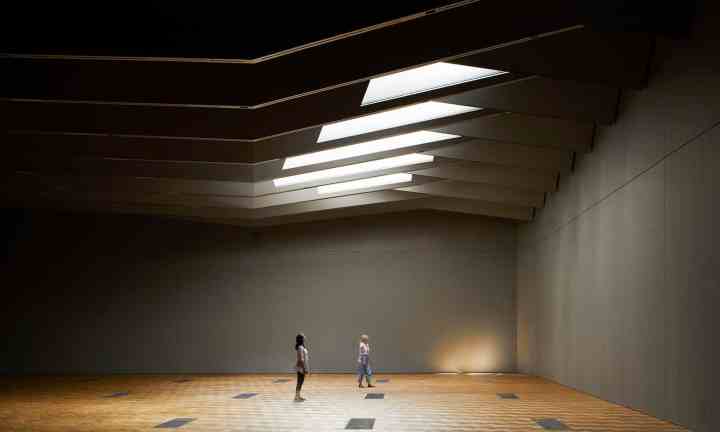
The V&A’s new Sainsbury Gallery, a flexible, 1100sq m column-free gallery for temporary exhibitions. The inaugural exhibition Opera: Passion, Power and Politics opens September 30. Photograph: Hufton+Crow.
◊ ◊ ◊ ◊ ◊
Writing in The Guardian, Oliver Wainwright provides a review of the new space along with context for the expansion, including description of the 1997 proposal by Daniel Liebeskind to build a tower (Spiral) on the site—an idea which, failing to secure funding, was abandoned in 2004. In Wainwright’s words, “Having been drawn, Icarus-like, to the shining promise of starchitecture, and had its wings thoroughly scorched, the V&A decided to opt for the more modest option of going underground.”










 Enfilade
leave a comment