Exhibition | Angelica Kauffman
Now on view at the Kunstpalast and coming to London’s RA in June:
Angelica Kauffman: Artist, Superwoman, Influencer
Kunstpalast, Düsseldorf, 30 January — 24 May 2020
Royal Academy of Arts, London, 28 June — 20 September 2020
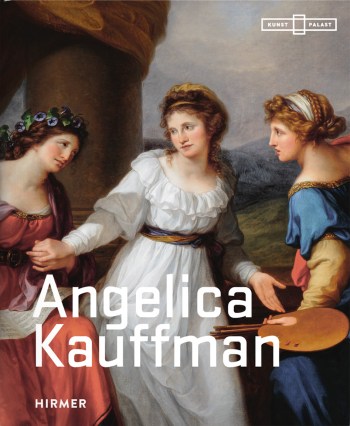 Angelica Kauffman was a founding member of the Royal Academy and an artist who defied convention. In this major exhibition we trace her trajectory from child prodigy to one of the most sought-after painters of her time. Born in Switzerland in 1741, Angelica Kauffman (1741–1807) was quickly recognised as a child prodigy, before receiving further artistic training in Italy. Arriving in London in 1766, she enjoyed an unprecedented career as a history painter and portraitist before moving to Rome in 1782, where her studio became a hub of the city’s cultural life. Kauffman’s career was unusual for a female artist in the late 18th and early 19th century. A highly acclaimed portraitist, she identified herself primarily as a history painter, working for patrons across Britain and the continent, including Catherine the Great amongst others. This exhibition will focus on Kauffman’s work at the height of her career, tracing the life and work of this celebrated artist.
The catalogue is published by Hirmer and distributed in North America by The University of Chicago Press:
Bettina Baumgärtel, ed., with contributions by B. Baumgärtel, I. M. Holubec, J. Myssok, and H. Valentine, Angelica Kauffman (Munich: Hirmer Publishers, 2020), 208 pages, ISBN: 978-3777434629, £35 / $45.
Call for Papers | Angelica Kauffman Study Day
From ArtHist.net:
Angelica Kauffman Study Day
Royal Academy of Arts, London, 16 September 2020
Proposals due by 15 April 2020
On the occasion of the retrospective dedicated to Angelica Kauffman taking place in Düsseldorf and London in 2020, the Royal Academy of Arts is organising a study day on the artist on Wednesday, 16 September 2020.
A child prodigy and a respected painter famous all over Europe in her own lifetime, Angelica Kauffman (1741–1807) transcended many boundaries and conventions linked to eighteenth-century social norms. She embraced many facets of the Enlightenment beliefs, pursued a career to become a history painter following the neoclassical ideals, and worked for some of the most prominent patrons of the time. She was also one of the two female founding members of the Royal Academy of Arts in London in 1768. At her death, her sculpted bust was placed next to Raphael’s in the Pantheon in Rome thereby underlining her place in the artistic canon.
We welcome papers exploring the rich and versatile career of Angelica Kauffman with a fresh contextualisation in the broader artistic, cultural, social, and economic fabric of the eighteenth century. Topics should draw on Kauffman’s production and career and may include, but are not necessarily limited to:
• Fashion and costume
• The business of art (showroom, records, book-keeping, and clientele)
• Cosmopolitan networks
• International career
• Women patrons
• Royal patrons
• Women artists and their careers
• Artistic/Intellectual friendships and their impact on creativity
• Multiples (prints, designs for decorative arts)
• Female self-portrait and self-representation
• Display in 18th-century European art
Please send an abstract of 300 words and a short biography of 200 words to: Marie.Tavinor@royalacademy.org.uk and Will.Iron@royalacademy.org.uk. We are sorry that we cannot offer any travel bursaries on this occasion.
Call for Papers | Revivals in the Decorative Arts
From ArtHist.net:
Revivals in the Decorative Arts — Annual ICOM / ICDAD Conference
National Palace of Ajuda, Lisbon, 14–16 October 2020
Proposals due by 15 April 2020
The 2020 Annual Conference and General Assembly of ICOM International Committee for Museums and Collections of Decorative Arts and Design will take place at the National Palace of Ajuda in Lisbon, Portugal, from October 14 to 16—plus two days (17–18 October) for the post conference tour to Coimbra and Porto.
Revivals—as a socio-cultural phenomenon recurrent throughout history—seek to rescue principles and traditions of times gone by. In this conference we approach revivals with regard to decorative arts and design. Decorative arts and design are to be interpreted as any domestic or public furnishings including but not limited to textiles, silverware, furniture, wallpaper, tableware, interior decoration as a whole, graphic design, as well as personal accessories (excluding fashion). We also welcome presentations on revivals within decorative and applied art traditions (ceramics, lacquer, metalwork, textiles, woodwork, etc.) made for utilitarian or connoisseurial purposes. Hence we encourage papers proposals on a wide variety of topics including a broad array of Asian, European, or North and South American revival styles. We also include the retro design styles of the 20th and 21st centuries, referring to the resurgence of old yet relatively recent styles.
It is fascinating how heritage is being used and valued, reconsidered both from the positions of a curator, artist, or a designer. We are interested in the examples, phenomena, and notions that reflect upon the relation to the past, treating it with both unsentimental and sentimental nostalgia, introducing ways of dealing with the recent past from different periods in history.
15-minute presentations (in English) will comprise the conference sessions. Please send an abstract of 250–300 words, including your name, title, institution, and ICOM membership number to Maria José Gaivão Tavares, Curator of the Furniture Collection at National Palace of Ajuda and ICDAD Secretary, icdad.secretariat@gmail.com. Additional information is available here.
AGO Acquires Portrait of a Lady Holding an Orange Blossom
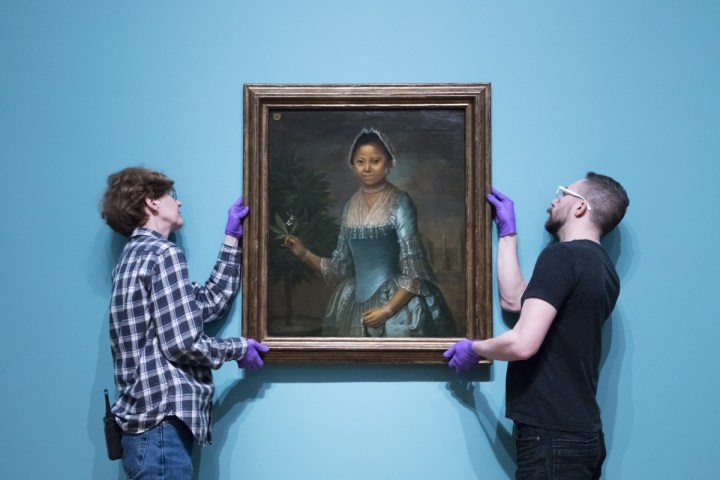
Unknown artist, Portrait of a Lady, Three Quarter Length, Holding an Orange Tree Flower, mid-18th century, oil on canvas, 80 × 56 cm
(Toronto: Art Gallery of Ontario, purchase, 2020, 2019/2437)
◊ ◊ ◊ ◊ ◊
Press release (25 February), from Toronto’s Art Gallery of Ontario:
If you’ve read about the AGO’s recent acquisitions, then you know it’s a top priority of ours to acquire dynamic and captivating works that will both strengthen and diversify our collection. With this in mind, we jumped at the opportunity to purchase the beauty you see pictured above. And what’s even more exciting is that it comes to us with a fascinating mystery to uncover.
Portrait of a Lady Holding an Orange Blossom is a striking and mysterious portrait that commands your attention. Its central figure is a young woman wearing a luxurious blue silk gown, woven with intricate lace trim. Around her neck and wrists are elegant pearls, which complement her bejewelled drop earrings. She is aware of her own radiance, smizing with piercing brown eyes and regal posture, clasping the front of her gown while presenting an orange tree blossom.
Though the subject’s presence is arresting and undeniable, her identity, as well as that of the artist who painted her, are currently unknown. Scholars agree that Portrait of a Lady is from the mid-1700s, painted by a male artist who was born and trained in Europe. With so many unanswered questions, we are left wondering: Who was this painter? What is the location of this painting and what brought him there? Who was his stunning subject?
Very few portraits of Black people by European artists survive from this time period. The painting raises important questions about the subject’s status within the transatlantic slave trade. While her opulent clothing and the mere existence of the portrait suggest that she was a free woman, her ancestors and even one of her parents may have been enslaved.
We continue to do research to find out more about her story. In the meantime, the presence of this figure in the European galleries reminds us that history is complex and diverse, composed of countless stories told from many perspectives. For the AGO, this acquisition is an important step toward acknowledging the rich and vital presence of people of colour in the history of Europe and its art. Portrait of a Lady Holding an Orange Blossom is currently on view on Level 1 in Frank P. Wood Gallery (Gallery 123).
New Book | Collecting and Empires
From Brepols:
Maia Wellington Gahtan and Eva-Maria Troelenberg, eds., Collecting and Empires: An Historical and Global Perspective (Turnhout: Harvey Miller Publishers, 2019), 404 pages, ISBN: 978-1909400634, 125€ / $156.
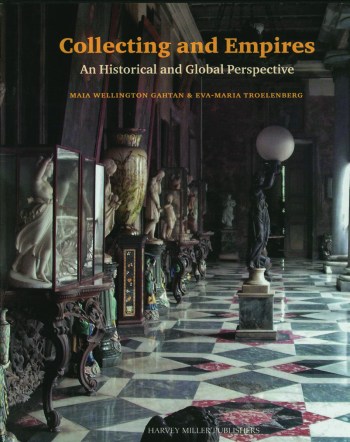 The comparative historical investigation of imperialism through the lens of collecting practices, museum archetypes, and museums proper helps shape our understanding of contemporary aesthetics and diversity management as well as helps identify what is imperial about our own approaches to material culture.
The creation and dissolution of empires has been a constant feature of human history from ancient times through the present day. Establishing new identities and new power relationships, empires also irrevocably altered social structures and the material culture on which those social structures were partly based. The political activities of empires are materially reflected in the movement of objects from periphery to center (and vice versa) and in the formation and display of collections which represent the potential for the production and the dissemination of knowledge. Imperial collecting practices tell stories that are complementary to and go beyond the classical sources of official history, the statistics of social history and even the narratives of collective or individual oral history. Building on previous work on European and Colonial object histories, this collection of essays—for the first time—approaches the subject of collecting and empires from a global and inclusive comparative perspective by addressing selection of the greatest empires the world has known from Han China to Hellenistic Greece to Aztec Mexico to the Third Reich.
C O N T E N T S
• Collection and Power in the Near Eastern World — Alain Schnapp
• The Biopolitics of Collecting: Empires of Mesopotamia — Zainab Bahrani
• Princely Treasures and Imperial Expansion in Western Han China (second/first century BC) — Michèle Pirazzoli-t’Serstevens
• Collecting like Caesar: The Pornography and Paideia of Amassing Artefacts in and after the Roman Empire — Caroline Vout
• From a Culture of the Intimate to a Culture of the Remote. A Latin Epigram Collection between Two Universal Powers: Papal Rome and the Holy Roman Empire — Nadia Cannata and Maia Wellington Gahtan
• The Mexica Empire: Memory, Identity, and Collectionism — Enrique Florescano
• Jahangir’s Hazelnut and Shah Jahan’s Chini Khana: The Collections of the Mughal Emperors — Ebba Koch
• Global Aspects of Habsburg Imperial Collecting — Thomas Da Costa Kaufmann
• Collecting in the Dutch Colonial Empire, Seventeenth and Eighteenth Centuries — Michael North
• The Musée Napoléon as an Imperial Louvre — Dominique Poulot
• The Object Flows of Empire: Cross-Cultural Collecting in Early Colonial India — Tapati Guha-Thakurta
• The Other Victoria and Albert Museum: Royal Souvenirs, Victorian Science and the Itineraries of Empire at the Swiss Cottage Museum, Osborne House — Ruth B. Phillips
• The (Still)Birth of the Ottoman ‘Museum’: A Critical Reassessment — Edhem Eldem
• The Ruin and Restoration of the Russian Art Empire — Katia Dianina
• Collecting and the ‘Visual Evidence of Events’: Exemplary Reflections on Berlin between the Imperial and Post-Imperial Age — Eva Maria Troelenberg
• Looted Art, Booty Art, ‘Degenerate Art’: Aspects of Art Collecting in the Third Reich — Christoph Zuschlag
• The (De)Colonized Object: Museums and the Other in France since 1960 — Daniel J. Sherman
• Signs of Empire: Islamic Art Museums from European Imperialism to the Global Empire of Capital — Wendy Shaw
• Afterword: The Imperial Style of Collecting — Krzysztof Pomian
Colloquium | Les réseaux des académies d’art provinciales
This month at INHA, from the conference programme:
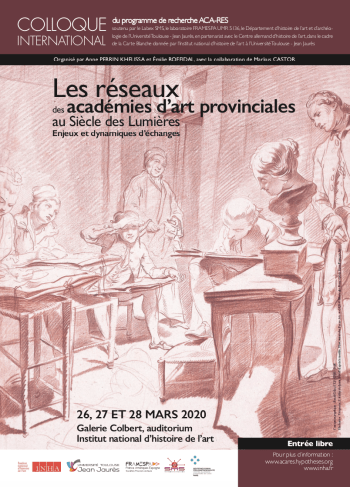
Les réseaux des académies d’art provinciales au Siècle des Lumières: Enjeux et dynamiques d’échanges
Institut national d’histoire de l’art, Paris, 26–28 March 2020
 Colloque international du programme ACA-RES
Université Toulouse-Jean Jaurès, FRAMESPA UMR 5136, Labex SMS, en partenariat avec le Centre allemand d’histoire de l’art et l’Institut national d’histoire de l’art dans le cadre de la Carte Blanche 2019
J E U D I , 2 6 M A R S 2 0 2 0
9.30 Mots d’ouverture du colloque
France Nerlich (INHA) et Thomas Kirchner (Centre allemand d’histoire de l’art – Paris)
Conférences introductives
• Pierre-Yves Beaurepaire, (Université Côte d’Azur), Sociabilités, réseaux et échanges des savoirs au siècle des Lumières
• Anne Perrin Khelissa et Émilie Roffidal (Université Toulouse-Jean Jaurès, FRAMESPA UMR 5136), Le programme ACA-RES, résultats et perspectives de recherche
Session 1 : Un levier pour les carrières artistiques ?
Sous la présidence de Charlotte Guichard (ENS, IHMC)
• Catherine Voiriot (Musée du Louvre), Les femmes et les académies des arts, sciences et belles lettres, 1740–1791 : début de recherche
• Gabriel Batalla-Lagleyre (Université de Bourgogne, Centre Georges Chevrier), Exposer en amateur dans les académies : réseaux et identités
12.30 Pause déjeuner
14.00 Reprise de la session 1
• Maël Tauziède Espariat (Université de Bourgogne, Centre Georges Chevrier), Les peintres parisiens et les écoles de dessin provinciales : des connexions inégales
• Hélène Rousteau-Chambon (Université de Nantes), L’école de dessin de Nantes, un creuset pour les architectes
• Stéphanie Trouvé (musée des beaux-arts de Bordeaux), Les cercles académiques bordelais dans la trajectoire du peintre Pierre Lacour (1745–1814)
• Joëlle Raineau (Petit Palais, Paris), Les cercles et établissements académiques : un levier de diffusion et de postérité d’une carrière. L’exemple des affiliations multiples du graveur Nicolas Ponce (1746–1831)
• Marlen Schneider (Université Grenoble Alpes, LARHRA), Les académies d’art allemandes au XVIIIe siècle – un tremplin pour les artistes français ?
V E N D R E D I , 2 7 M A R S 2 0 2 0
9.00 Session 2 : Quelle utilité pour les territoires ?
Sous la présidence de Pascal Julien (Université Toulouse-Jean Jaurès, FRAMESPA UMR 5136)
• Lesley Miller (Victoria & Albert Museum – University of Glasgow), L’école de dessin de Lyon et la production de tissus
• Fabienne Sartre (Université Paul-Valery Montpellier 3), Le statut de la sculpture académique à l’épreuve du terrain : les cas de Toulouse, Montpellier et Marseille
• Catherine Isaac (Université Toulouse-Jean Jaurès, FRAMESPA UMR 5136 – EPHE), Le rôle des académies des sciences et des arts dans la création et l’essor du corps des ingénieurs du Languedoc au XVIIIe siècle
• Aude Gobet (Musée du Louvre), École de dessin et patrimoine : l’enjeu des inventaires révolutionnaires
• Adrián Almoguera (Sorbonne Université, École française de Rome), L’Espagne académique du Siècle des Lumières: Construire un système pour définir un style architectural entre Madrid et Valence (1768-1808)
12.30 Pause déjeuner
14.00 Session 3 : Collections et supports d’apprentissage
Sous la présidence d’Olivier Bonfait (Université de Bourgogne, Centre Georges Chevrier)
• Morwena Joly (Centre des Monuments nationaux), Les modèles morphologiques et anatomiques des académies d’art : des migrations européennes complexes
• Nelly Vi-Tong (Université de Bourgogne, Centre Georges Chevrier), Enseignement artistique et supports d’apprentissage : les exemples de Dijon, Reims et Valenciennes
• Tara Cruzol (Université Toulouse-Jean Jaurès, FRAMESPA UMR 5136), Enseigner la sculpture à l’Académie de Lyon : le traité inédit d’Antoine-Michel Perrache
• Gérard Fabre (musée des beaux-arts de Marseille), Les collections dispersées de l’Académie de peinture et de sculpture de Marseille
• Flore César (Université Paul-Valery Montpellier 3), Le rôle des collections lors de l’instauration des écoles de dessin en province au XVIIIe siècle
• Miguel Faria (Université autonome de Lisbonne), Les modèles pédagogiques des écoles d’art (aulas) portugaises
Conférence conclusive de la journée
• Christian Michel (Université de Lausanne), Complémentarité ou subordination : L’Académie royale de Peinture et de Sculpture et les académies de province
S A M E D I , 2 8 M A R S 2 0 2 0
9.00 Session 4 : Échos internationaux en Europe et outre-Atlantique
Sous la présidence de Gaëtane Maës (Université de Lille, IRHIS)
• Markus Castor (Centre allemand d’histoire de l’art), L’académie des beaux-arts comme histoire institutionnelle : prolégomènes d’une analyse structurelle
• Maria Pia Donato (CNRS, IHMC-Paris), Émulation et propagande : remarques sur les académies italiennes au XVIIIe siècle
• Hugo Tardy (Université Toulouse-Jean Jaurès, FRAMESPA UMR 5136), Le système académique russe construit par ses échanges les ambitions d’un empire face à l’Europe
• Marion Amblard (Université Grenoble Alpes), Des arts manufacturés aux beaux-arts : l’influence des modèles romains et français dans le développement des académies écossaises au XVIIIe siècle
• Reed Benhamou (Indiana University, Bloomington), The Last Provincial Academy: ‘L’Académie des sciences et beaux arts des États-Unis de l’Amérique’
• Ana Maria Tavares Cavalcanti et Sonia Gomes Pereira (Universidade Federal do Rio de Janeiro), L’Académie des Beaux-Arts à Rio de Janeiro, Brésil
Trinity Fine Art Offers Ricci’s Lapiths and Centaurs at TEFAF
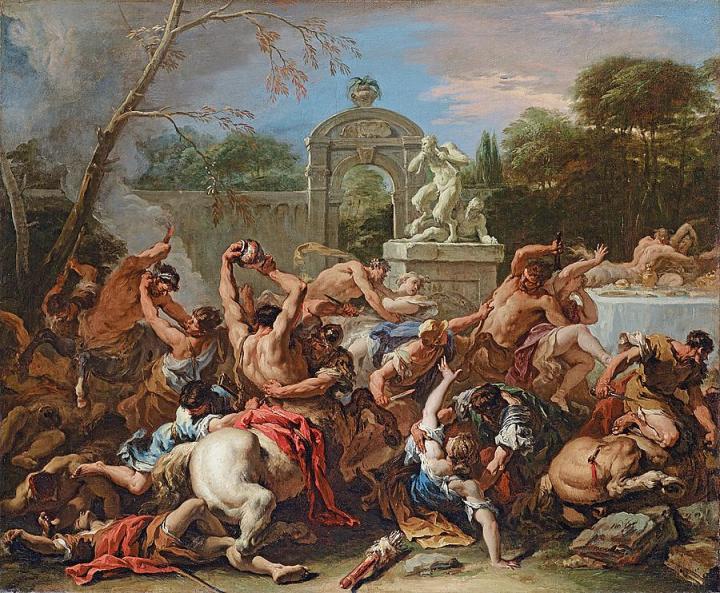
Sebastiano Ricci, The Battle of the Lapiths and the Centaurs, early eighteenth century, oil on canvas, 63 × 76 cm (Offered at TEFAF Maastricht 2020 by Trinity Fine Art for approximately one million euros).
◊ ◊ ◊ ◊ ◊
From the press release, via Art Daily (28 February 2020). . .
One of the highlights of TEFAF Maastricht 2020 (7–15 March) will be an extremely rare work by Sebastiano Ricci: The Battle of the Lapiths and the Centaurs, which has been rediscovered after being lost for 60 years. Sebastiano Ricci (1659–1734) revitalised Venetian painting at the beginning of the eighteenth century, and his work marked the transition between the Baroque and Rococo styles. He took the rich colours and luminosity of Veronese and further transformed it by his looser, more airy and spontaneously decorative style always shot through with a clear Venetian light, all traits he passed down in turn to Tiepolo. Ricci was widely travelled, since as one of the main exponents of the Rococo style he was called to many European courts that wished to draw on his talents. He was in France—where he became a close friend of Watteau—in Austria—where he was summoned by Emperor Joseph I to decorate the palace of Schönbrunn, and in England—where he executed a series of large canvases for the newly constructed Burlington House and also sold works to King George III.
Ricci’s work is exceptionally rare on the art market, since his best paintings—allegorical and biblical paintings and frescos of significant dimensions—are already contained in public collections, many of them since the eighteenth century. The works he made for Lord Burlington are now in the Royal Academy, London, and those acquired by King George III are at the Royal Collection, London. Those in the Hermitage have been there since the eighteenth century as have those in the Liechtenstein collection, acquired in 1819; and then there are the many frescos and ceilings in Italian palazzi and churches.
The present monumental work can be dated to the early eighteenth century at which time Ricci’s work displayed a close affinity with that of the Genoese painter, Alessandro Magnasco. It shows Ricci at the height of his powers of composition and as a colourist in this depiction of the story of the Lapiths and Centaurs taken from Ovid’s Metamorphoses, which was a popular choice from the Renaissance onwards for both artists and their humanist patrons since it symbolised both the victory of civilisation over barbarity and intellect triumphing over lust. It also has the added interest of being a collaborative work between Sebastiano and Marco Ricci, the former’s nephew, who is credited with executing many of the background details such as architectural elements and trees.
This work is to be offered by Trinity Fine Art at TEFAF Maastricht 2020, with an asking price of around one million euros. Established in 1984, Trinity Fine Art has earned a reputation as a leading dealer and consultant, offering exceptional works of art and specialising in master paintings, sculpture, and works of art from the Renaissance to the nineteenth century. Its clients include many of the world’s major museums as well as most leading private collections.
New Book | Les foyers artistiques à la fin du règne de Louis XIV
From Brepols:
Anne-Madeleine Goulet, Rémy Campos, Mathieu da Vinha, and Jean Duron, eds., Les foyers artistiques à la fin du règne de Louis XIV (1682–1715): Musique et spectacles (Turnhout: Brepols, 2019), 446 pages, ISBN: 978-2503586199, 65€.
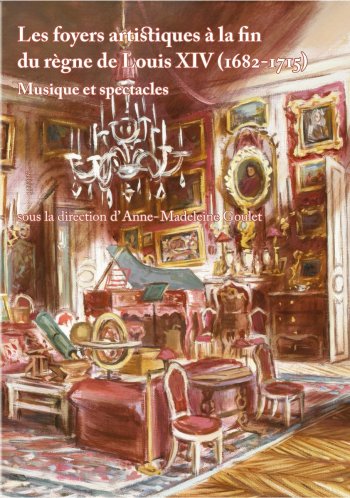 Grâce à la notion de «foyer», une série d’études pluridisciplinaires porte un regard nouveau sur les productions musicales et théâtrales en dehors de la cour de Versailles à la fin du règne de Louis XIV.
Les demeures aristocratiques de Paris et d’Île-de-France ont généralement été perçues comme des lieux périphériques, pâles reflets de la cour de Versailles. En réalité, les hôtels particuliers du Marais, où dominaient les sociabilités féminines, la résidence de Philippe d’Orléans au Palais-Royal, celle de la princesse de Conti à Versailles, les pavillons de plaisance bâtis entre Versailles et Paris, les demeures du duc et de la duchesse du Maine à Sceaux ou encore du roi d’Angleterre en exil à Saint-Germain-en-Laye, s’imposaient comme autant de foyers artistiques fort dynamiques, ouverts au théâtre et à la musique.
Le présent ouvrage, qui prend en considération ces différents lieux d’activité artistique comme un ensemble à la fois complémentaire et concurrent, enquête sur leur hiérarchie, leur fonctionnement concret ainsi que sur les relations qu’ils entretenaient avec la cour. Il met en lumière la tension entre le modèle versaillais, toujours prompt à imposer une norme artistique, et le développement d’autres espaces de création entre 1682 et 1715.
En illustrant la faculté des musiciens provinciaux à s’insérer dans les milieux artistiques de la capitale, en cernant l’identité de ceux qui façonnaient les goûts de leur époque et en considérant aussi les stratégies discursives et politiques qui visaient à constituer en foyers certains lieux de production et de performance alternatifs à la Cour, il propose une image plus complète de la vie musicale et spectaculaire de la France à la fin du règne de Louis XIV.
Direction de l’ouvrage
Anne-Madeleine Goulet, chercheuse en Arts du spectacle au CNRS (CESR).
En collaboration avec
Rémy Campos, professeur d’histoire de la musique au Conservatoire de Paris et responsable de la recherche de la Haute école de musique de Genève.
Mathieu da Vinha, directeur scientifique du Centre de recherche du château de Versailles et spécialiste de la cour de France aux XVIIe et XVIIIe siècles.
Jean Duron, fondateur et directeur (1989–2007) de l’Atelier d’études sur la musique française des XVIIe & XVIIIe siècles du CMBV, et spécialiste de la musique à l’époque de Louis XIV.
C O N T E N T S
• Rémy Campos et Anne-Madeleine Goulet — De la pertinence de la notion de foyer pour l’étude de la musique et des formes spectaculaires à Paris et à Versailles, 1682–1715
La Cour, les cours
• David Hennebelle — « La grande dépense et le fracas ». Recherches sur l’économie matérielle des patronages artistiques de l’aristocratie au tournant des XVIIe et XVIIIe siècles
• Don Fader — Monsieur and Philippe II d’Orléans: A Cultural Influence Beyond their Residences
• Tarek Berrada — La musique dans les appartements : Mlle de Guise, le roi et les princes de Condé
• Thomas Vernet — Musique et théâtre dans la « maison de ville » de Marie-Anne de Bourbon Conti à Versailles
• Catherine Cessac — Les Nuits de Sceaux : derniers feux du Grand Siècle ?
• Laurent Lemarchand — Les arts entre Paris et Versailles: le Palais-Royal de Philippe II d’Orléans ou l’absolutisme rénové
Des musiciens en partage
• Jean Duron — Composer pour les nouveaux foyers : la « fureur » des musiciens d’église au crépuscule du Grand Siècle
• Marie Demeilliez — Les collèges, des foyers pour la musique et la danse de théâtre
• Thomas Leconte — De la cour à la ville : les musiciens du roi face à l’émergence de nouveaux foyers cuturels
• Catherine Massip — Amateurs, professionnels : foyers et professionnalisation progressive des artistes, 1680–1715
Un esprit nouveau
• Christian Biet — Foyers, chaufooirs, chaleur et hétérogénéité des publics au theatre. La séance comme contre-pouvoir ?
• Thierry Favier — Foyers et dynamique des genres musicaux à la fin du règne de Louis XIV
• Nathalie Berton — Le Mercure galant, un révélateur et un passeur de répertoire : l’exemple du petit opéra
• Guy Spielmann — Le « théâtre de société », foyer de création ( ?)
• Louis Delpech — « Abends zu einer Concert de Musique eingeladen » : aspects musicaux du séjour parisien de Friedrich August II de Saxe, 1714–1715
Foyers réels, foyers imaginaires
• Mathieu da Vinha — Fêtes privées entre Versailles et Paris : éléments pour une typologie
• Anne Piéjus — Une galanterie très politique : l’image des foyers artistiques dans le Mercure galant
• Laura Naudeix — Foyers et territoire: l’espace de la musique dans la Comparaison de la musique italienne et de la musique française de Le Cerf de la Viéville
• Barbara Nestola — L’art d’assembler, le choix de partager : la collection de musique italienne des Stuart en France, 1689–1718
• Tatiana Senkevitch — The Making of Taste: Rembrandt and French Painting in the End of the Reign of Louis XIV
• Rebekah Ahrendt — L’activité des foyers musicaux et théâtraux en Europe vers 1700. Une enquête en coulisses
Perspectives
• Jean Boutier — Pour continuer l’enquête
Index des noms propres
Call for Papers | Georgian London Revisited
From The Georgian Group:
2020 Georgian Group Symposium: Georgian London Revisited
Society of Antiquaries, Burlington House, London, 7 November 2020
Proposals due by 20 March 2020
The Georgian Group is organising a day-long symposium on ‘Georgian London Revisited’, to be held at the Society of Antiquaries at Burlington House, London, on Saturday, 7 November 2020. Following the successful conferences run by the Group in previous years on Women and Architecture, and on the architecture of James Gibbs and the Adam brothers, the symposium will highlight changing perspectives and new research on the architecture of London during the ‘long 18th century’ (c.1660–1830) undertaken since the publication of the 1988 edition of Sir John Summerson’s seminal Georgian London (reissued with amendments by Sir Howard Colvin, 2003). Topics may include, but are not limited to, the following:
• Housing and estate development
• Public and commercial buildings
• ‘Improvement’: infrastructure, streets, open spaces, bridges, etc
• Places of entertainment
With this in mind, proposals are invited for 15-minute papers based on original research. Please send abstracts of no more than 200 words and a copy of your CV to Dr Geoffrey Tyack (education@georgiangroup.org.uk) by 20 March 2020. Any questions regarding the symposium should be sent to the same address. Further details will be made available, and tickets will go on sale, in the Spring.
Call for Papers | Cultural Dimensions of Dutch Overseas Expansion
From ArtHist.net:
The Cultural Dimension of Dutch Overseas Expansion
Utrecht University, 28 August 2020
Proposals due by 15 March 2020
“It is only money and not knowledge that our people are seeking [in the East Indies], which is to be lamented”, complained the Amsterdam mayor and VOC governor, Nicolaes Witsen, in 1712. The Dutch trading companies may have been associated with various qualities, but an interest in culture was not one of them. None of the VOC officials even noted the presence of the world’s biggest Buddhist temple, the Borobudur, on the island of Java, leaving its re-discovery to the British in 1814. No Dutch writer tried to emulate the epic celebration of the Portuguese maritime empire by Luís de Camões. Dutch expansion had an obvious impact on the sciences and medicine, as demonstrated in Harold Cook’s Matters of Exchange: Commerce, Medicine, and Science in the Dutch Golden Age (2007). But what, if any, was its impact on culture and the humanities?
Here there is, in fact, a fruitful scholarly field that largely remains to be explored. For example, Dutch lust for money set in motion the first transfer of culture on a truly global scale, when 40 million pieces of Chinese porcelain were shipped from East Asia to Europe and the Americas. ‘Indies shops’ in different Dutch cities sold curiosities from six continents. Travelogues—even when ordered by the VOC and predominantly mercantile in outlook—offered a wealth of ethnographic knowledge for the attentive reader. Scholarly-minded individuals could break the commercial pattern, resulting in the first Western translations of a work in Sanskrit (by Abraham Rogerius, 1651), a work of Hindu iconography (by Philips Angel, 1657), and the main work of Confucius (by Pieter van Hoorn, 1675). They must have relied on the expertise of local native speakers; non-Western perspectives come into even clearer focus with at least three Chinese men who visited the Netherlands and with the Africans who sat for Amsterdam painters.
This conference brings together historians of culture, art, literature, language, philosophy, science, and religion to arrive at a fuller picture of the cultural dimensions of Dutch overseas expansion. The keynote lectures will be given by Dr. Roelof van Gelder and Dr. Mariana Françozo (Leiden University).
Possible themes include:
• Cultural topics (art, literature, language, music, mythology, religion) addressed in travelogues
• Non-Western themes in Dutch literature and drama (from ‘Moortje’ to ‘Zungchin’)
• Representations of the world’s peoples, including enslaved persons and non-Western visitors to the Low Countries
• Trade, consumption, interpretation, and imitation of non-Western material culture
• Translations, dictionaries, and grammars
• Cultural industries (print shops, painting studios, artisan’s workshops) established overseas
• Cultural education in the context of the VOC and WIC
• The impact on culture of cross-cultural encounters, slavery, servitude, and colonialism
• Challenges posed by historiographies, religions, and philosophies from beyond Europe
Working group De Zeventiende Eeuw invites all interested in this topic to send in an abstract (max. 300 words) and curriculum (max. 100 words) for a paper (in English or Dutch) of 20 minutes. Proposals for sessions, consisting of three papers, are also welcome. Deadline for abstracts: 15 March 2020, to Jaap de Haan (j.dehaan@uu.nl).
Organizing Committee: Marjolijn Bol, Surekha Davis, Jaap de Haan, Cora van de Poppe, and Thijs Weststeijn










 Enfilade
leave a comment