New Book | Nicholas Barbon: Developing London, 1667–1698
From the London Topographical Society:
Frank Kelsall and Timothy Walker, Nicholas Barbon: Developing London, 1667–1698 (London: London Topographical Society, 2022), 240 pages, £35.
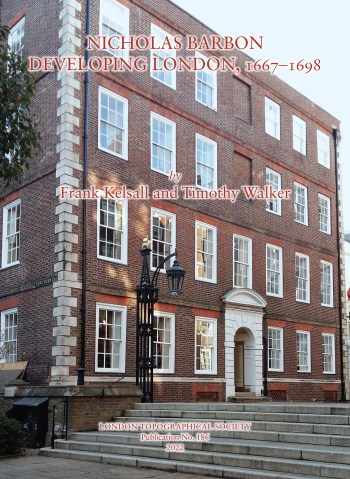 London grew rapidly in the last quarter of the seventeenth century, and Nicholas Barbon (c.1640–1698) was central to its physical transformation. This first complete biography analyses how Barbon’s property development was closely connected to financial innovations. As a young doctor during the Plague year of 1665 Nicholas Barbon stayed in London to help victims, but thereafter his attention turned to building, to finance, and to economics. His first developments were in the City after the Great Fire. He then took advantage of the westward move of aristocratic houses to lay out streets in what had been their grounds, before building in the Temple, moving to sites in Soho and Westminster, eastwards beyond the City walls and north to Holborn. His development of Red Lion Fields (to the fury of neighbouring lawyers in Gray’s Inn) and Lamb’s Conduit Fields is discussed in detail, revealing the sophisticated—some might say ruthless—methods he used to raise funding. His speculative activity created rows of terrace houses and squares that became the norm for the city’s future development. At the same time he set up the first fire insurance company, the second bank, became an MP, and published on economic matters such as free trade and recoinage. He was in the parlance of the day a ‘projector’, and his story reveals a great deal about the way London, and Britain as a whole, was changing topographically, politically and socially in these crucial years.
2022 Berger Prize for British Art History
From The British Art Journal, with the full long list available here:
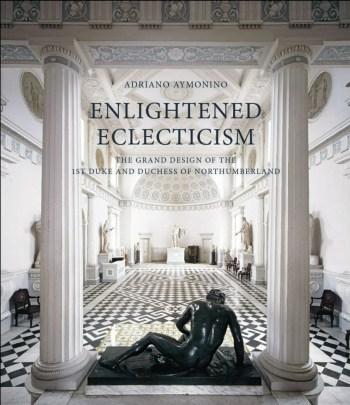 Adriano Aymonino’s Enlightened Eclecticism: The Grand Design of the 1st Duke and Duchess of Northumberland is the winner of the 2022 William MB Berger Prize for British Art History.
The annual prize was created in 2001 to recognize excellence in the field of British art history by the Berger Collection Educational Trust and The British Art Journal in honor of the late American collector and patron William M. B. Berger (1925–1999), who amassed a serious collection of British paintings, which was gifted to the Denver Art Museum in 2019.
S H O R T L I S T
• David Alexander, A Biographical Dictionary of British and Irish Engravers, 1714–1820 (London: Paul Mellon Centre for Studies in British Art, 2022), 1120 pages, ISBN: 978-1913107215, £75.
• Adriano Aymonino, Enlightened Eclecticism: The Grand Design of the 1st Duke and Duchess of Northumberland (London: Paul Mellon Centre for Studies in British Art, 2021), 400 pages, ISBN: 978-1913107178, £50.
• Manolo Guerci, London’s ‘Golden Mile’: The Great Houses of the Strand, 1550–1650 (London: Paul Mellon Centre, 2021), 336 pages, ISBN: 978-1913107239, £50.
• Kenneth McConkey, Towards the Sun: The Artist-Traveller at the Turn of the Twentieth Century (London: Paul Holberton Publishing, 2021), 260 pages, ISBN: 978-1913645083, £50.
• Cicely Robinson, ed, Henry Scott Tuke (New Haven: Yale University Press, 2022), 160 pages, ISBN: 978-0300265842, £20 / £30.
1 8 t h – C E N T U R Y O F F E R I N G S O N T H E L O N G L I S T
• David Alexander, A Biographical Dictionary of British and Irish Engravers, 1714–1820 (London: Paul Mellon Centre for Studies in British Art, 2022), 1120 pages, ISBN: 978-1913107215, £75.
• Malcolm Andrews, A Sweet View: The Making of an English Idyll (London: Reaktion Books, 2022), 352 pages, ISBN: 978-1789144987, £35.
• Adriano Aymonino, Enlightened Eclecticism: The Grand Design of the 1st Duke and Duchess of Northumberland (London: Paul Mellon Centre for Studies in British Art, 2021), 400 pages, ISBN: 978-1913107178, £50.
• Rosemary Baird Andreae, Huguenots, Apothecaries, Gardeners and Squires: The Garniers of Rookesbury, Hampshire (Exeter: Short Run Press, 2021), 52 pages, ISBN: 978-0907473237, £10.
• Tristram Hunt, The Radical Potter: The Life and Times of Josiah Wedgwood (Metropolitan Books, 2021), 352 pages, ISBN: 978-1250128348, £25.
• François Marandet, with prefaces by Emmanuelle Delapierre and Robin Simon, Louis Chéron (1655–1725): L’ambition du dessin parfait (Ballan-Miré: Illustria Librairie des Musées, 2022), 288 pages, ISBN: 978-2354040956, 30€.
• Simon Martin, Drawn to Nature: Gilbert White and the Artists (Chichester: Pallant House Gallery, distributed by Yale University Press, 2022), 192 pages, ISBN: 978-1869827755, £25.
• Susan Sloman, Gainsborough in London (London: Modern Art Press, 2021), 412 pages, ISBN: 978-0956800787, £35.
• Cathryn Spence, Nature’s Favourite Child: Thomas Robins and the Art of the Georgian Garden (Bradford-on-Avon: Stephen Morris, 2021), 312 pages, ISBN: 978-1838472634, £40.
• David Stacey, Art and Industry: Seven Artists in Search of an Industrial Revolution in Britain (London: Unicorn Publishing Group, 2021), 176 pages, ISBN: 978-1913491291, £25.
• Allen Staley, Copley and West in England, 1775–1815 (London: Burlington Press, 2021), 176 pages, ISBN: 978-1916237803, £35.
• Christina Strunck, Britain and the Continent, 1660–1727: Political Crisis and Conflict Resolution in Mural Paintings at Windsor, Chelsea, Chatsworth, Hampton Court and Greenwich (Berlin: De Gruyter, 2021), 528 pages, ISBN: 978-3110729610, £29.
• Adrian Tinniswood, Noble Ambitions: The Fall and Rise of the Post-War Country House (New York: Vintage Publishing, 2021), 416 pages, ISBN: 978-1787331785, £30.
• Joseph Viscomi, William Blake’s Printed Paintings: Methods, Origins, Meanings (London: Paul Mellon Centre for Studies in British Art, 2021), 256 pages, ISBN: 978-1913107208, £40.
Decorative Arts Trust Announces Failey Grant Recipients for 2023

The British and Irish Furniture Makers Online (BIFMO) project researches makers such as Giles Grendey, whose 1735–40 card table is in The Metropolitan Museum of Art’s collection; lacquered and gilded beech, lined with felt (New York: The Met, Gift of Louis J. Boury, 1937, 37.114).
◊ ◊ ◊ ◊ ◊
From the press release:
The Decorative Arts Trust announced that the 2023 Dean F. Failey Grant recipients will be British and Irish Furniture Makers Online (BIFMO) in London, England; The Center for Painted Wall Preservation (CPWP) in Hallowell, Maine; Preservation Long Island (PLI) in Cold Spring Harbor, New York; and Stenton in Philadelphia, Pennsylvania. The Failey Grant program provides support for noteworthy research, exhibition, publication, and conservation projects through the Dean F. Failey Fund, named in honor of the Trust’s late Governor. Preference is given to projects that employ or are led by emerging professionals in the museum field. Failey Grant applications are due October 31 annually.

Anne Reckless Emlen, Shellwork grotto, 1757, Philadelphia (Stenton, The National Society of The Colonial Dames of America in the Commonwealth of Pennsylvania).
• BIFMO will hire interns to research immigrant tradespeople in New York City, Philadelphia, Annapolis, and Baltimore under the guidance of BIFMO managing editor Laurie Lindey, digital editor Jonathan Blaney, and BIFMO project manager Adriana Turpin.
• CPWP will develop a virtual museum of historic painted interiors under the direction of project coordinators Margaret Gaertner and Linda Carter Lefko.
• PLI will produce the book Promoting Long Island: The Art of Edward Lange, 1870–1889, edited by PLI curator Lauren Brincat and PLI curatorial fellow Peter Fedoryk with essays from these editors as well as from Jennifer L. Anderson, Thomas Busciglio-Ritter, Sarah Kautz, and Joshua Ruff.
• Stenton, a historic house museum administered by The National Society of the Colonial Dames of America in the Commonwealth of Pennsylvania, will conserve a 1757 shellwork grotto by Anne Reckless Emlen, led by Stenton curator Laura Keim, Stenton curatorial assistant Kaila Temple, and conservator Lara Kaplan.
More information is available here»
Call for Papers | Soundscapes of Naples
From ArtHist.net:
Soundscapes of Naples: From the Medieval to the Early Modern
Naples, 8–9 June 2023
Proposals due by 31 January 2023
Musical practices are inherently woven into a city’s urban fabric: as marker of identity, expression of religious devotion, sonic manifestation of power, or form of entertainment, musicking punctuates the salient moments of a city’s culture. In Naples, for centuries a cultural and political capital and among the most densely populated cities in Europe, music making has always occupied a prominent position in the soundscape of public and private, sacred and secular spaces.
The interdisciplinary conference, Soundscapes of Naples: From the Medieval to the Early Modern, aims to map intersections between the performative dimension of music making and the city’s spaces and places. The organizing committee invites proposals that focus on physical venues (churches, monasteries, theaters, aristocratic palaces, schools, the public piazza, and so on, including their visual programs) as they interface with music performance and production. We welcome proposals on musicking as a cultural practice from musicologists as well as scholars from sister disciplines, including art and architectural history, archaeology, history, literary studies, and anthropology, on themes and approaches such as manuscript and print production, archival studies, music and gender, patronage/matronage, performance practice, history of the senses, acoustics, history of pedagogy, relationships between music and specific works of art, notions of ability/disability, and instrument making.
Proposals should include a curriculum vitae, a brief narrative biography (max. 150 words), and an abstract (max. 350 words), and may be in either Italian or English. The abstract should also indicate the topic’s relevance to the themes outlined above, and whether the proposed contribution could take the form of a presentation on-site at the monument under discussion. Final presentations (20 minutes) may be made in Italian or English. Please combine these materials in a single Word or PDF document with Lastname_Firstname as the title, and send to lacapraia@gmail.com by 31 January 2023. Selected participants will be notified in mid-February 2023.
Soundscapes of Naples: From the Medieval to the Early Modern is coorganized by the Center for the Art and Architectural History of Port Cities ‘La Capraia’ (a partnership between the Edith O’Donnell Institute of Art History at the University of Texas at Dallas and the Museo e Real Bosco di Capodimonte) and the Butler School of Music at the University of Texas at Austin.
Call for Papers | Ledoux’s Lectures de L’architecture
The Call for Papers from Fabula:
Claude-Nicolas Ledoux dans le texte: Lectures de L’architecture considérée sous le rapport de l’art, des moeurs et de la législation (1804)
Saline royale d’Arc-et-Senans, 1–3 June 2023
Proposals due by 31 December 2022
Colloque de clôture du projet Ledoux 2020–2023
Architecture, littérature, philosophie et société au tournant des Lumières : L’Architecture considérée sous le rapport de l’Art des mœurs et de la législation de Claude-Nicolas Ledoux, une édition numérique
(Labex Les Passés dans le Présent, Université Paris-Nanterre)
L’Architecture considérée sous le rapport de l’Art, des mœurs et de la législation, que l’architecte Claude-Nicolas Ledoux fait paraître en 1804, deux ans avant sa mort, est l’ouvrage le plus célèbre et le texte plus fascinant de toute l’architecture moderne européenne. Premier tome d’une oeuvre monument qui devait en compter cinq, cet ouvrage testamentaire au “style magique et poétique” (Cellerier) fait figure de véritable OVNI dans la production architecturale de l’époque. Ledoux y travaille pendant trente années pour l’élaboration de l’illustration (près de 500 planches, dont 125 publiées en 1804), et pendant près de dix ans pour établir un texte de 240 pages. Il conçoit ainsi une œuvre à la mesure de son ambition artistique totale. Or, parmi l’immense bibliographie et historiographie sur Ledoux, essentiellement consacrée à l’œuvre bâti et projeté, le livre lui-même et le texte de L’Architecture… n’ont que rarement fait l’objet d’études approfondies et a fortiori exclusives. Quant aux études littéraires, pourtant en pleine réévaluation de cette période du tournant des Lumières, elles l’ont plutôt négligé.
Dans la lignée des travaux pionniers de Béatrice Didier (qui avait tenté, la première, de situer la plume de Ledoux dans le contexte littéraire du tournant des Lumières), de Mona Ozouf (qui s’intéressa à la représentation livresque de Chaux) et des grandes analyses de Daniel Rabreau (qui a replacé l’écriture mythologique et poétique dans le projet esthétique global de Ledoux), ce colloque se propose de jeter toute la lumière possible sur le livre, la représentation de l’architecture, le texte et l’écriture de Ledoux, dans une approche et un esprit résolument interdisciplinaire, seule démarche à même, par le croisement des regards d’historiens, d’historiens de l’art, d’historiens des idées, de spécialistes de littérature ou de rhétorique…, de percer la densité et l’épaisseur des strates de sens de ce livre hiéroglyphe.
Cette rencontre plurielle, autour du texte de Ledoux, est le point d’aboutissement d’une démarche collective qui a engagé une quinzaine de chercheurs au sein du projet LEDOUX 2020–2023 du Labex Les Passés dans le Présent (université de Paris-Nanterre) dans la réalisation d’une édition scientifique et collaborative de l’Architecture, comportant un double volet, papier et numérique.
Accueilli par la Saline d’Arc-et-Senans, institution partenaire du projet LEDOUX, le colloque sera donc l’occasion de partager les acquis de ce travail collectif et de l’enrichir en l’ouvrant aux apports de chercheurs extérieurs.
Ces lectures de Ledoux, pourront, sans exclusive, explorer les dimensions suivantes :
La fabrique du texte de L’Architecture
Au-delà de la chronologie globale proposée par Gallet et Vidler, qui situe la rédaction entre son emprisonnement à la Force pendant la Terreur et le début du XIXe siècle, comment retracer une généalogie du texte de Ledoux ? Comment L’Architecture trouve-t-elle à s’inscrire dans un réseau d’autres textes connus de Ledoux (le Manuscrit Calonne, les extraits de la correspondance ou encore le Prospectus de 1803) qui pourraient en éclairer la genèse et la singularité ?
Quels éclairages peut apporter l’analyse du vaste réseau d’intertextes qui travaille L’Architecture et qui attend encore de véritables enquêtes d’archéologie textuelle et culturelle ? Entre Anciens (Homère, Ovide, Virgile, Plutarque, Lucien, Cicéron, César, Tacite…) et Modernes (La Fontaine, Fénelon, Diderot, Voltaire, mais aussi Shakespeare, Milton, Thomson, ou encore Gresset ou Gluck…), entre influences (d’une forme, d’un genre..), réécritures (d’un topos, d’un motif) voire reprises et citations (d’un extrait, d’un passage…), quelles formes prennent ces réappropriations littéraires multiples ? Comment participent-elles concrètement de la fabrique de l’imaginaire esthétique et historique ? Sous l’empreinte fièrement revendiquée que l’architecte laisse dans la pierre, quelle figure de l’écrivain ces emprunts, plutôt souterrains, dessinent-ils ? Et pour quels lecteurs ? Des “enfants chéris d’Apollon”, auxquels Ledoux s’adresse explicitement, jusqu’aux lecteurs d’aujourd’hui, comment a-t-on lu et lit-on encore Ledoux ? Avec quelle culture ? Pour quelle expérience ?
La fabrique des idées : Ledoux, penseur des Lumières ?
L’Architecture peut bel et bien être envisagée comme une formidable chambre d’échos, au crépuscule du siècle, de la pensée des Lumières. On pourra dès lors s’interroger sur les façons dont se diffusent et se cristallisent, dans le texte, ces grands courants de pensée qui traversent le demi-siècle : le sensualisme, auquel sont acquis de nombreux architectes, l’héritage encyclopédiste, la sensibilité rousseauiste, la pensée économique et physiocratique, la religion comme morale…
Dans quelle mesure Ledoux fait-il siennes ces idées partagées par le siècle ? Avec quelle singularité et quelle solidité ? Quel type de philosophe est-il ?
La fabrique des images : fiction et figurations
Les réflexions pourront aussi se réunir autour de la notion centrale d’image, au carrefour des enjeux propre à l’écriture, à l’illustration et à la théorie de la création artistique.
De quelle manière l’image travaille-t-elle en profondeur l’écriture et la langue de Ledoux ? Avec quels héritages rhétoriques ? Quels usages de l’univers mythologique ? Selon quelles modalités stylistiques (innovations lexicales, constructions syntaxiques) ? Pour quels réseaux de sens, entre unité et dissémination ?
Comment l’imagination (celle de l’architecte comme celle du lecteur) s’invite-t-elle au cœur du pacte de fiction qui commande le récit (avec le périple romanesque du voyageur) ou encore la description (avec le recours incessant à une esthétique du tableau, qu’on pourra interroger) ?
Enfin, quels types de relations les images textuelles entretiennent-elles avec les images gravées ?
L’histoire et la théorie des arts et de l’architecture
Comment situer l’entreprise éditoriale de Ledoux dans l’histoire du livre et de la théorie d’architecture, tant à l’époque moderne (une histoire qui reste d’ailleurs à écrire, malgré des travaux consacrés à l’Italie ou encore l’Angleterre) qu’au début du XIXe siècle, (période charnière pour l’édition en général et le livre d’architecture en particulier) ? Que représente L’Architecture, entre le Livre d’architecture de Boffrand (1745), les grandes monographies de la fin du XVIIIe siècle, comme la Description des écoles de chirurgie de Gondouin (1780), et les recueils de modèles du début du siècle suivant, comme l’Architecture civile de Dubut (1803) ou les recueils de Krafft, et les ouvrages pédagogiques, comme le Précis des leçons d’architecture de Durand (1802–1805) ? Quels liens le projet de Ledoux entretient-il avec d’autres écrits théoriques, aux ambitions parfois littéraires, comme les textes de Boullée et les Lettres sur l’architecture de Viel de Saint-Maux (1779), par exemple ?
Mais c’est aussi le rapport que l’architecte entretient avec l’Antiquité et les œuvres modernes, la Renaissance italienne et la création française des XVIIe et XVIIIe siècles, qu’il est possible d’examiner plus précisément à la lecture fine du texte de L’Architecture. Quelle est donc la culture architecturale de Ledoux ? Est-elle simplement livresque pour ce qui regarde les sites et édifices lointains ? N’a-t-il jamais vraiment fait l’expérience des sites antiques et des monuments modernes qu’il décrit à l’appui d’une démonstration ? Enfin, comment s’exprime, dans son texte, l’admiration inspiratrice qu’il porte aux peintres, aux sculpteurs, mais aussi l’intérêt qu’il montre pour l’art des jardins ?
Les propositions de communications (3000 signes maximum) sont à envoyer avant le 31 décembre 2022.
à : fabrice.moulin@parisnanterre.fr, dominiquemassounie@gmail.com
Comité d’organisation
• Fabrice Moulin, Paris-Nanterre, CSLF (litt&phi / ILHAM)
• Dominique Massounie, Paris-Nanterre, H-Mod/HAR
• Isabelle Sallé, Saline royale d’Arc-et-Senans
Comité scientifique
• Emmanuel Chateau-Dutier, professeur agrégé, université de Montréal
• Marianne Cojannot-Le Blanc, professeure, université Paris-Nanterre
• Michel Delon, professeur émérite, université Paris-Sorbonne
• Colas Duflo, professeur, Paris-Nanterre, IUF
• Hugues Marchal, professeur-assistant, université de Bâle, IUF
• Elise Pavy-Guilbert, maîtresse de conférences, université Bordeaux-Montaigne, IUF
Sweden Nationalmuseum Acquires Portrait of Marie-Gabrielle Capet
From the press release:
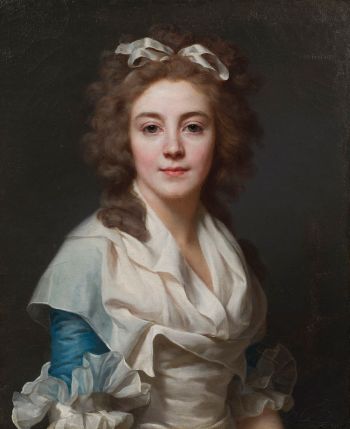
Unknown French artist, Portrait of Marie-Gabrielle-Capet, 1780s, oil on canvas (Stockholm: Nationalmuseum, 7658).
Nationalmuseum has acquired a portrait of Marie-Gabrielle Capet, a French painter of pastels and miniatures. The portrait depicts the artist in the 1780s, when she was a close associate of Adélaïde Labille-Guiard, one of the most celebrated portrait painters of the day, and her future husband François-André Vincent. There is ample evidence to suggest that it was Vincent who painted this portrait of the young Capet.
Marie-Gabrielle Capet (1761–1818) was born in Lyon in humble circumstances. Thanks to well-connected acquaintances, in her twenties she became a pupil of the portrait painter Adélaïde Labille-Guiard, who was known for taking on female pupils only. Evidence of their close relationship can be seen in Labille-Guiard’s large self-portrait from 1785, now in the Metropolitan Museum of Art in New York. Capet appears beside her teacher, along with another pupil, Marie Marguerite Carreaux de Rosemond. Labille-Guiard was one of the few female members of the French academy of fine arts, where she was a tireless advocate for women’s rights. In her personal life, she had a long-term relationship with her colleague François-André Vincent. In 1792 they bought a house together, where Capet also moved in.
The recently acquired portrait was likely painted a few years earlier. Labille-Guiard and Vincent both used their protégée Capet as a model, and there are several sketches of her as such, although none can be directly tied to the painting acquired by Nationalmuseum. The portrait shows her in a near-frontal pose, turning slightly to meet the onlooker with a piercing but gentle gaze, which betrays the close relationship between model and artist. The saturated colours and cohesive, symmetrical composition point to Vincent as the likely creator; these stylistic features had long made him Jacques-Louis David’s main rival in neoclassical painting.
In many respects, this portrait of Marie-Gabrielle Capet is a representation of a remarkable home, where artistic coworking and domestic roles were commingled. In an artistic sense, Capet seems to have been wholly dependent on her teacher Labille-Guiard. After the latter’s death in 1808, Capet continued looking after Vincent, whom she called ‘father’, until he died in 1816. Capet herself died only two years later, at the age of just 57, apparently from a broken heart and incapable of continuing her painting career.
“This portrait of Marie-Gabrielle Capet is notable for its unusually strong sense of presence. We really get the feeling of standing eye to eye with the model,” said Magnus Olausson, head of collections at Nationalmuseum. “With this acquisition, we can add another piece of the puzzle to the others in our collection spotlighting the great French female artists of the 18th century. So we are delighted that this significant work will shortly go on display at Nationalmuseum.”
The portrait of Marie-Gabrielle Capet will be on display in the 18th-century painting gallery from 1 February 2023.
Nationalmuseum receives no state funds with which to acquire design, applied art and artwork; instead the collections are enriched through donations and gifts from private foundations and trusts. This acquisition has been funded by a generous donation from the Sophia Giesecke bequest.
Exhibition | Women on Paper
From the press release for the exhibition:
Women on Paper
Rijksmuseum, Amsterdam, 3 December 2022 — 5 June 2023
The Rijksmuseum presents Women on Paper, an exhibition about women who have made their mark on art history. Work by a selection of women artists from the Rijksmuseum collection has been brought together in five rooms in different parts of the museum. Included are drawings, prints, and photographs by Gesina ter Borch, Berthe Morisot, Käthe Kollwitz, and Julia Margaret Cameron, as well as recent acquisitions by Cornelia de Rijck and Thérèse Schwartze. Women on Paper is the result of a long-term study to take stock of work by women artists in the Rijksmuseum collection and create a more balanced representation in the collection and exhibition.

Cornelia de Rijck, Butterflies: A Small Tortoiseshell, a Dryas Lulia, a Heliconius Sara, a Large Tortoiseshell, a Heliconius Melpomene, a Comma, and Others, ca. 1700, watercolor and bodycolor, watermark posthorn within a shield surmounted by a crown, 28 × 20 cm (Amsterdam: Rijksmuseum, purchased with the support of I.Q van Regteren Altena Fonds/Rijksmuseum Fonds). The work sold at Christie’s in New York on 28 January 2021 (online sale #19290, lot 71) for $30,000, ten times its high estimate.
Women were commonly educated within the family, and as with other professions, the production and publishing of prints was often a family business. Printmakers Diana Mantuana and Barbara van den Broeck developed into independent and enterprising engravers, and the 15th- and 16th-century print cabinet is dedicated to their work. The display in the 17th-century cabinets centres on the work of Magdalena de Passe and Gesina ter Borch. De Passe, like her three brothers, was trained as an engraver, and her work was highly regarded. Ter Borch came from an artistic family and devoted her life to art. On display are watercolours characterised by originality, humour, and beauty, alongside highly personal poems, writing, and drawings by Ter Borch and her family. The display in the 18th-century print cabinet focuses on flora and fauna, with watercolours by artists including Dorothea Maria Graff and Alida Withoos, whose precise and colourful work was an important contribution to the developing natural sciences. Their travels took them to a wide range of destinations, as far afield as Suriname.
The final print room focuses on the 19th century, with work by artists including Thérèse Schwartze, Lizzy Ansingh, Julia Margaret Cameron, and Eva Watson-Schütze. In the early 19th century, an exhibition circuit arose for drawings and pastels, through which many women artists achieved recognition and commercial success. The advent of photography brought another art form that was embraced by women for its many artistic possibilities.
Women on Paper and the research project have been made possible in part by the Women of the Rijksmuseum Fund. The exhibition in the print cabinets is on display from 3 December 2022 to 5 June 2023.
At Bonhams | New Auction Record for Pair of Meissen Vases

Lot 89: An extremely rare pair of Meissen red-ground bottle vases, from around 1735, sold at Bonhams for £831,900, more than four times their high estimate, and a new world record for a pair of Meissen vases.
◊ ◊ ◊ ◊ ◊
Press release from Bonhams, announcing the results of the sale:
500 Years of European Ceramics
Bonhams, London, 7 December 2022
On Wednesday, 7 December 2022, at Bonhams 500 Years of European Ceramics sale in London an extremely rare pair of Meissen red-ground vases from around 1735 achieved £831,900, a new world record for a pair of Meissen vases. The vases more than quadrupled their pre-sale estimate of £120,000–180,000. The 219-lot sale made a total £1,625,280.
Nette Megens, Bonhams Director, Decorative Arts, U.K. and Europe, said: “This is an exceptional result for an important and hitherto unrecorded pair of vases. Bottle vases of this kind were made by the Meissen factory exclusively for the Dresden court, and these are the largest size and only known examples with this rare ground colour. These qualities, and the fact that these vases were fresh to the market, led to fierce competition in the saleroom. The price they achieved is also a testament to the taste of one of the greatest collectors of the 20th century, Catalina von Pannwitz (1876–1959), to whom they once belonged.”
Another top lot was the very rare pair of Nymphenburg large circular dishes from the ‘Hofservice’, ca. 1760–1735, which sold for £164,000, soaring past an estimate of £20,000–30,000.
Other sale highlights included:
• A pair of Meissen models of hares, ca. 1750, sold for £36,840 (estimate: £8,000–12,000).
• A rare Meissen footed stand from the Sulkowski service sold for £35,580 (estimate: £15,000–20,000).
• A Meissen basket centrepiece from Podewils service, ca. 1741–42, sold for £25,500 (estimate: £6,000–8,000).
• A large Vincennes/Sèvres oval green-ground dish (plat à groseilles) from the Frederick V of Denmark service, dated 1735–38, sold for £25,500 (estimate: £20,000–30,000).
• A Sèvres plate from the ‘service de dessert marly rouge’ for Emperor Napoleon I, dated 1809, sold for £20,400 (estimate: £8,000–12,000).
• A Meissen waste bowl from the Sulkowski service, ca. 1735–38, sold for £16,575 (estimate: £6,000–8,000).
• A rare Meissen large dish from the Sulkowski service, ca. 1735–38, sold for £14,025 (estimate: £12,000–18,000).
Exhibition | The Secret of Colours: Ceramics in China and Europe
Now on view at the Baur Foundation, Museum of Far Eastern Art:
The Secret of Colours: Ceramics in China and Europe from the 18th Century to the Present
Le secret des couleurs: Céramiques de Chine et d’Europe du XVIIIe siècle à nos jours
Fondation Baur, Musée des arts d’Extrême-Orient, Geneva, 14 September 2022 — 12 February 2023
 This exhibition tells the often turbulent story of the quest for colour on porcelain in China and France. It contrasts two crucial moments in the history of porcelain driven by the desire to extend the range of enamels. They occurred at the turn of the 18th century in China and during the 19th century in France, two periods during which the interactions between Europe and China, whether cultural or belligerent, were particularly intense.
The first room in the exhibition introduces visitors to enamelling techniques, the notions of translucent and opaque enamels, and to the famille verte and famille rose. This is followed by a presentation of Chinese enamelled porcelain, principally from the reigns of Kangxi (1662–1722), Yongzheng (1723–35), and Qianlong (1736–95), which are among the jewels of Alfred Baur’s collection and which exemplify the use of colour on porcelain over a period of more than a century. The new palette developed in the imperial workshops was soon exported from the port of Canton on porcelain and copper-enamel wares on that had been specially designed for the Western market.
The second section of the exhibition takes place a century later in France, at the Sèvres manufactory, where Chinese colors, long coveted for their brilliance, were keenly researched. Missionaries, chemists, and French consuls in China all contributed to bringing back samples to France where the mysteries of Chinese manufacturing techniques could be fathomed.
The last part of the exhibition introduces more contemporary research on the use of color, first of all by Fance Franck (1927–2008), who from the late 1960s worked with the Sèvres factory to recreate the famous ‘fresh red’ (‘rouge frais‘) or ‘sacrificial red’ (‘rouge sacrificiel‘) that had been mastered by the potters in Jingdezhen several centuries earlier. The exhibition’s investigation into this endless chromatic quest is brought to a close by the pure and gleamingly colourful works of Thomas Bohle (b. 1958).
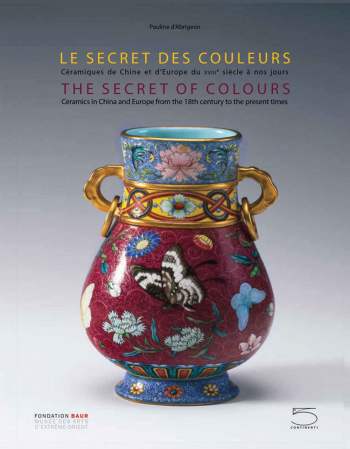
Pauline d’Abrigeon, Le secret des couleurs: Céramiques de Chine et d’Europe du XVIIIe siècle à nos jours (Milan: 5 Continents Editions, 2022), 170 pages, ISBN: 979-1254600054, €45. Bilingual edition (French and English).
Cover image: Vase with handles, porcelain and polychrome enamels on glaze, China, Jingdezhen, Qing Dynasty, mark and reign of Qianlong (1736–1795) (Geneva: Fondation Baur).
New Book | Global Objects
From Princeton UP:
Edward Cooke, Global Objects: Toward a Connected Art History (Princeton: Princeton University Press, 2022), 336 pages, ISBN: 978-0691184739, £28 / $35.
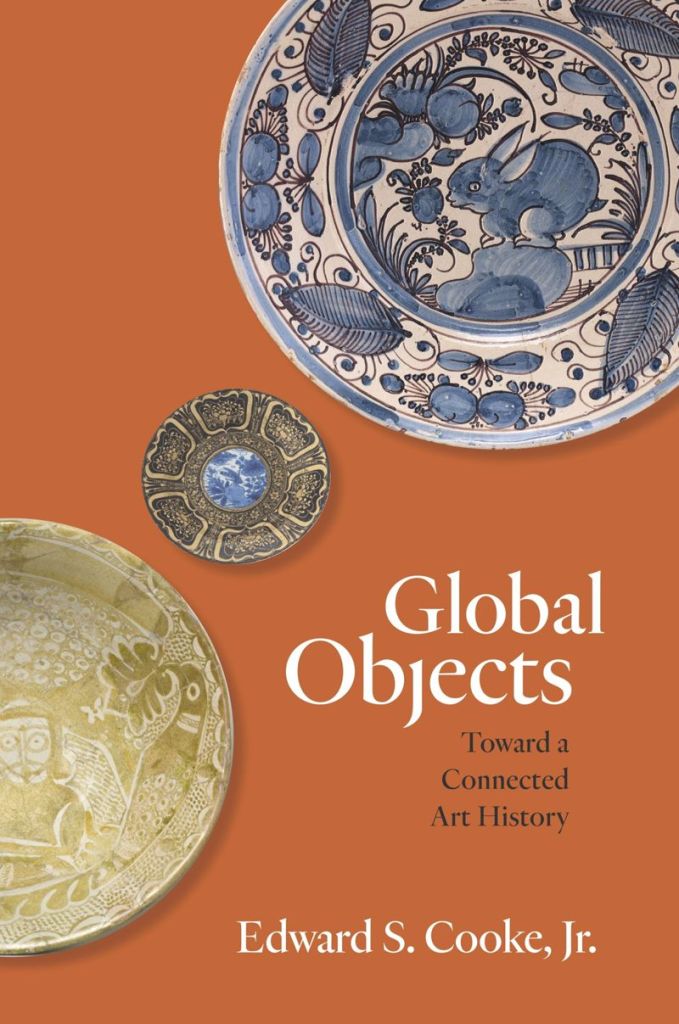 Art history is often viewed through cultural or national lenses that define some works as fine art while relegating others to the category of craft. Global Objects points the way to an interconnected history of art, examining a broad array of functional aesthetic objects that transcend geographic and temporal boundaries and challenging preconceived ideas about what is and is not art. Avoiding traditional binaries such as East versus West and fine art versus decorative art, Edward Cooke looks at the production, consumption, and circulation of objects made from clay, fiber, wood, and nonferrous base metals. Carefully considering the materials and process of making, and connecting process to product and people, he demonstrates how objects act on those who look at, use, and acquire them. He reveals how objects retain aspects of their local fabrication while absorbing additional meanings in subtle and unexpected ways as they move through space and time. In emphasizing multiple centers of art production amid constantly changing contexts, Cooke moves beyond regional histories driven by geography, nation-state, time period, or medium.
Beautifully illustrated, Global Objects traces the social lives of objects from creation to purchase, and from use to experienced meaning, charting exciting new directions in art history.
Edward S. Cooke, Jr. is the Charles F. Montgomery Professor of American Decorative Arts at Yale University. His books include Inventing Boston: Design, Production, and Consumption, 1680–1720 and Making Furniture in Preindustrial America: The Social Economy of Newtown and Woodbury, Connecticut.
C O N T E N T S
Introduction
I. Making
1 Materials
2 Realization
II. Movement
3 Circulation and Interchange
4 Function
III. Meaning
5 Memory and Gift
6 Appearance
7 Touch
Conclusion
Acknowledgments
Glossary
Notes
Index
Photo Credits










 Enfilade
leave a comment