New Book | ‘Het Pryeel van Zeeland’
From Uitgeverij Verloren:
Martin van den Broeke, ‘Het Pryeel van Zeeland’: Buitenplaatsen op Walcheren 1600–1820 (Hilversum: Uitgeverij Verloren, 2016), 516 pages, ISBN: 978 90870 45920, 49€.
 Buitenplaatsen bepaalden vroeger in sterke mate het landschap van Walcheren. Wat bewoog stedelingen in de zeventiende en achttiende eeuw om een deel van het jaar buiten de stad te gaan wonen? Een belangrijke reden was vermaak, maar welke rol speelde het economische aspect? En hoe toonden eigenaren van buitenplaatsen hun aanzien, macht en smaak? Martin van den Broeke laat zien dat al deze factoren in wisselende mate een rol speelden in het buitenleven en hoe dit door de eeuwen heen veranderde. Van den Broeke onderscheidt drie zones rond de steden waar verschillende typen buitenhuizen voorkomen. Nooit eerder zijn buitenplaatsen zo uitgebreid in hun landschappelijke en sociale omgeving beschreven. Dit boek geeft een rijk geschakeerd beeld van twee eeuwen buitenplaatscultuur in het ‘Het pryeel van Zeeland’, waarvan we de sporen nog zien in het landschap, in de archieven en op talrijke fraaie illustraties.
Met dit boek heeft Martin van den Broeke de Cultuurfondsprijs van de Historische Kring Walcheren gewonnen en de Ithakaprijs 2016 gewonnen. De Ithakaprijs is bedoeld ter stimulering van interdisciplinair (wetenschappelijk) onderzoek over Nederlandse kastelen, historische buitenplaatsen en landgoederen. Ook was zijn boek genomineerd voor de Zeeuwse Boekenprijs 2016.
C O N T E N T S
Woord vooraf
1 Inleiding
Buitenplaatsen als cultuurverschijnsel
Stand van het onderzoek
Begrippenkader
Afbakening van het onderzoek
Probleemstelling en onderzoeksvragen
Methoden en bronnen
2 Ontstaan, 1600–1670
Inleiding
Landschap
Functies
Macht
Aanzien
Architectuur
Conclusie
3 Expansie, 1670–1720
Inleiding
Landschap
Functies
Macht
Aanzien
Architectuur
Conclusie
4 Verfraaiing, 1720–1770
Inleiding
Landschap
Functies
Macht
Aanzien
Architectuur
Conclusie
5 Neergang, 1770–1820
Inleiding
Landschap
Functies
Macht
Aanzien
Architectuur
Conclusie
6 Slotbeschouwing
Het buitenplaatsenlandschap van Walcheren: langetermijn-ontwikkeling
Profijt en vermaak in drie zones
Macht
Aanzien
Vormgeving
Buitenplaatscultuur
Bijlagen
Afkortingen
Gebruikte bronnen en literatuur
Summary
Herkomst afbeeldingen
Register van buitenplaatsen
Register van namen en plaatsen
Curriculum vitae
New Book | Oxford Botanic Garden and Arboretum
Happy National Arbor Day!
Distributed for the Bodleian Library by The University of Chicago Press:
Stephen Harris, Oxford Botanic Garden and Arboretum: A Brief History (Oxford: Bodleian Library, 2017), 144 pages, ISBN: 978 18512 44652, £15 / $25.
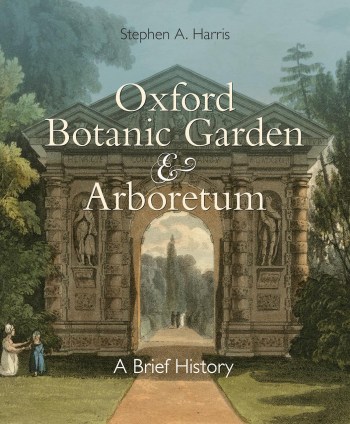 The Oxford Botanic Garden is the oldest surviving botanic garden in Britain, occupying the same location in central Oxford since 1621. Designed as a nursery for growing medicinal plants amid the turmoil of the civil war, and nurtured through the restoration of the monarchy, it has, perhaps unsurprisingly, a curious past.
This book tells the story of the garden through accounts of each of its keepers, tracing their work and priorities, from its founding keeper, Jacob Bobart, through to the early nineteenth-century partnership of gardener William Baxter and academic Charles Daubeny, who together gave the garden its greenhouse and ponds and helped ensure its survival to the present. Richly illustrated, this book offers a wonderful introduction to a celebrated Oxford site.
Stephen A. Harris is the Druce Curator of the Oxford University Herbaria and a University Research Lecturer. He is the author, most recently, of What Have Plants Ever Done for Us?, also published by the Bodleian Library, University of Oxford.
New Book | Late Eighteenth-Century Music and Visual Culture
From Brepols:
Cliff Eisen and Alan Davison, eds., Late Eighteenth-Century Music and Visual Culture (Turnhout: Brepols Publishers, 2017), 225 pages, ISBN: 978 2503 546292, $106.
 The late eighteenth century witnessed a flourishing exchange between music and visual art which was expressed in the creative as well as commercial cultures of the time. Nevertheless, there has been relatively little research to actively consider and thoroughly examine the symbiotic relationship between looking and listening during the period.
In this volume, nine prominent scholars employ a set of interdisciplinary methodological tools in order to come to a comprehensive understanding of the rich tapestry of eighteenth-century musical taste, performance, consumption and aesthetics. While the link between visual material and musicological study lies at the heart of the research presented in this collection of essays, the importance of the textual element, as it denoted the process of thinking about music and the various ways in which that was symbolically and often literally visualized in writing and print culture, is also closely examined.
Through a critical analysis of a number of important contemporary sources as well as current scholarship and research, the authors draw conclusions that extend well beyond the scope of their immediate material and closely-formulated questions. The conversation opened up in the chapters of this volume will hopefully break new ground on which the interrelationship between art and music, and more broadly between visual art and other forms of creative practice, may be studied and debated.
C O N T E N T S
Introduction — Cliff Eisen and Alan Davison
Charles Burney’s Wunderkammer of Ancient Instruments in his General History of Music — Zdravko Blažeković
John Brown’s Dissertation (1763) on Poetry and Music: An Eighteenth-Century View on Music’s Role in the Rise and Fall of Civilization — Alan Davison
Developing an Eye for Harmony: Rubens in Mozart’s Education — Thomas Tolley
Gothic Musical Scenes and the Image of Performance — Annette Richards
The Visual Traces of a Discourse of Ineffability: Late Eighteenth-Century German Published Writings on Music — Keith Chapin
Marketing Ploys, Monuments, and Music Paratexts: Reading the Title Pages of Early Mozart Editions —Nancy November
Musical Allegories in the Printed Edition of the Máscara Real: New Iconographic Models in Catalonian Engravings of the Second Half of the Eighteenth Century — Vanessa Esteve Marull
Authenticity and Likeness in Mozart Portraiture — Cliff Eisen
Imaging Beethoven — Simon Shaw-Miller
New Book | Blake, Myth, and Enlightenment
From Palgrave Macmillan:
David Fallon, Blake, Myth, and Enlightenment: The Politics of Apotheosis (London: Palgrave Macmillan, 2017), 343 pages, ISBN: 978 11373 90349, $100.
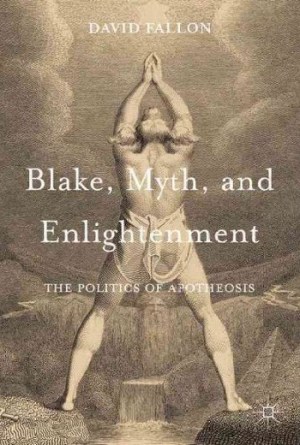 This book provides compelling new readings of William Blake’s poetry and art, including the first sustained account of his visionary paintings of Pitt and Nelson. It focuses on the recurrent motif of apotheosis, both as a figure of political authority to be demystified but also as an image of utopian possibility. It reevaluates Blake’s relationship to Enlightenment thought, myth, religion, and politics, from The French Revolution to Jerusalem and The Laocoön. The book combines careful attention to cultural and historical contexts with close readings of the texts and designs, providing an innovative account of Blake’s creative transformations of Enlightenment, classical, and Christian thought.
David Fallon is Senior Lecturer in English at the University of Sunderland, UK. From 2009 to 2012 he was a British Academy Postdoctoral Fellow at the University of Oxford. He has published on Blake and on eighteenth-century and Romantic-period booksellers and co-edited Romanticism and Revolution: A Reader (2011) with Jon Mee.
C O N T E N T S
1 Introduction: ‘A Saint Amongst the Infidels & a Heretic with the Orthodox’
2 ‘The Deep Indelible Stain’: Apotheosis in the Eighteenth Century
3 ‘Spirits of Fire’: Ambiguous Figures in The French Revolution
4 ‘Breathing! Awakening!’: Contesting and Transforming Apotheosis in America a Prophecy
5 ‘The Night of Holy Shadows’: Europe and Loyalist Reaction
6 ‘Serpentine Dissimulation’: Apotheosis in Urizen, Ahania, and The Song of Los
7 ‘The Name of the Wicked Shall Rot’: Blake’s Oriental Apotheoses of Nelson and Pitt
8 Transforming Apotheosis in The Four Zoas and Milton
9 ‘Ever Expanding in the Bosom of God’: Deification and Apotheosis in Jerusalem
10 Conclusion
Bibliography
Index
List of Figures
New Book | Eighteenth-Century Women Artists
Distributed in the USA and Canada by The University of Chicago Press:
Caroline Chapman, Eighteenth-Century Women Artists: Their Trials, Tribulations, and Triumphs (London: Unicorn Press, 2017), 176 pages, ISBN: 978 191078 7502, £20 / $35.
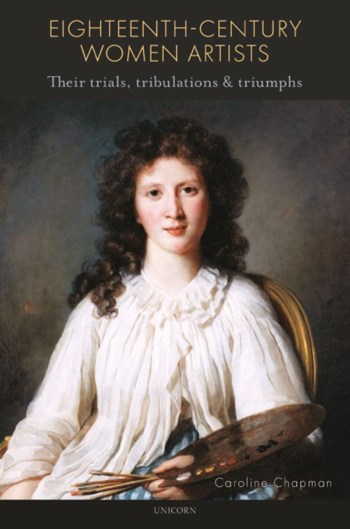 The eighteenth century was an age when not only the aristocracy, but a burgeoning middle class, had the opportunity to pursue their interest in the arts. But these opportunities were generally open only to men; any woman who wished to succeed as an artist still had to overcome numerous obstacles. In a society in which women were expected to marry, become mothers, and conform to rigid social conventions, becoming a professional artist was a controversial choice. Nevertheless, if a woman possessed charm and ambition, and united her talent with hard work, success was possible.
Eighteenth-Century Women Artists celebrates the work of women who had the tenacity and skill (and sometimes the necessary dash of luck) to succeed against the odds. Caroline Chapman examines the careers and working lives of celebrated artists like Angelica Kauffman and Elisabeth Vigée Le Brun as well as the equally interesting work of artists who have now mostly been forgotten. In addition to discussing their varied artworks, Chapman considers artists’ studios, the functioning of the print market, how art was sold, the role of patrons, and the rise of the lady amateur. It is enriched by over fifty color images, which offer a rich selection of art from the time.
Caroline Chapman is a writer, editor, and picture researcher. She has worked for both the Arthur Tooth and Son Art Gallery and the Crane Kalman Gallery as well as working as a freelance picture researcher for 30 years for Times Books, Dorling Kindersley, Phaidon, and Weidenfeld. She is the author of Elizabeth and Georgiana: The Duke of Devonshire and his Two Duchesses for John Murray and John and Joséphine: The Creation of The Bowes Museum for The Bowes Museum and has written an number of travel articles for the Times Education Supplement and Cosmopolitan.
Exhibition | The Luther Effect
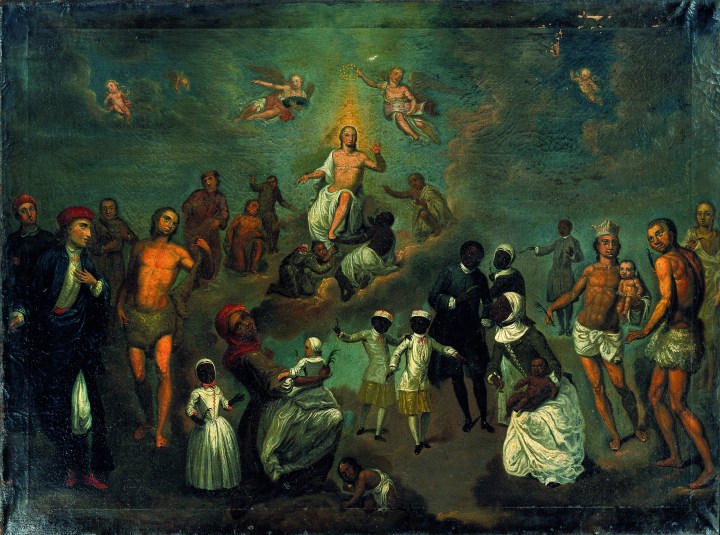
Johann Valentin Haidt, First Fruits (Erstlingsbild),1748
(Herrnhut: Unitätsarchiv der Evangelischen Brüder-Unität, GS 463)
◊ ◊ ◊ ◊ ◊
From the exhibition website:
The Luther Effect: Protestantism—500 Years in the World
Der Luthereffekt 500 Jahre Protestantismus in der Welt
Deutsches Historisches Museum at Martin-Gropius-Bau, Berlin, 12 April — 5 November 2017
The German Historical Museum (DHM) welcomes Martin-Gropius-Bau visitors on a trip through five centuries and across four continents. Marking the Reformation’s 500th anniversary, The Luther Effect shows the diversity and history, as well as the conflict potentials of Protestantism in the world. What impact has Protestantism had on other denominations and religions? How did Protestantism change through these encounters? And not least, how have people of different cultures adopted, shaped, and lived Protestant doctrine? Starting with Reformations in the 16th century, the exhibition highlights a global history of effect and counter-effect as seen in the examples of Sweden, the United States, South Korea, and Tanzania.
 An impressive display of around 500 original exhibits in an exhibition space measuring some 3,000 square meters (32,000 square feet), the exhibition includes exceptional artworks and compelling, meaningful everyday objects from the era. Many of these extraordinary exhibits are being shown in Germany for the first time, to mark the occasion of the 500th anniversary of the Reformation. Modern media is used to give background information, enriching the exhibition.
Reformations, 1450–1600
The Reformation was a European event. Since the 16th century, various paths of reform had been leading to a renewal of the Church and life in general. Martin Luther’s Reformation was one of these. However, from a global perspective, other paths such as the Reformed Church or the Anglican Church in England were more influential. The Catholic Church also underwent a process of reform.
Undisputed beliefs and centuries-old practices were called into question. Soon proponents and opponents of reform were fighting not only against each another but also among themselves. The more radical movements like the Anabaptists were persecuted and marginalised not only by Catholics, but by Lutherans and the Reformed as well. The competition forced Luther, the Reformed, Anabaptists, Anglicans, and Catholics to clarify their own positions and to set themselves apart from others. The different reform paths developed into denominations that continue to evolve dynamically to this day.
One Land, One Religion: Sweden as a Lutheran Great Power, 1500–1750
King Gustav Vasa of Sweden, influenced by the Lutheran Reformation, broke with the Pope in Rome in 1527. This contributed to the spread of various reformist ideas in the Swedish Empire. But it was the Synod and the Parliament of Uppsala in 1593 that first established the Lutheran Church as the binding confession of Sweden, resulting in a Lutheran State Church and a confessionally unified state in Sweden.
The Swedish State Church brought the evolution of a new religious culture. The community that emerged saw itself as the protective power of Lutheranism. Swedish rulers and their armies fought on Europe’s battlefields for Sweden’s great power status and Luther’s doctrines. At home in Sweden, the State Church became increasingly restrictive. Church discipline, and the conversion of the Sámi who lived in the north of the country, were intended to consolidate the Lutheran faith and foster a common identity.
The United States of America: The Promised Land?, 1600–1900
Protestantism was brought to the British colonies of North America, later the United States, through the immigration of various groups, churches, and confessions, which accounts for the diversity of American Protestantism. A state church does not exist in the United States; instead, there is a vast landscape of independent churches. Protestantism in the USA developed its unique profile under the influence of charismatic revivalist preachers beginning in the 18th century. This gave rise to new confessions and numerous social reform movements. The so-called Black Churches of African Americans also emerged in the course of this development. Protestantism contributed significantly to the creation of the American nation and the formation of its self-understanding. It shaped the notion of America as the Promised Land, and of Americans as the Chosen People. These concepts gave rise to ideas that continue to influence American society to the present day.
Korea: Boom Land of Protestantism, 1850–2000
In the Republic of Korea (South Korea), numerous religions lead a relatively peaceful coexistence. Almost 30 percent of South Koreans consider themselves Christian, and slightly fewer than two-thirds of them are Protestant. This makes South Korea the only East Asian country where a significant proportion of the population is Protestant.
Protestant missionaries could not settle permanently in Korea until the mid-1880s. At this time, the first Protestant communities, founded by Korean laypeople, already existed. Using the Korean alphabetic script Han’gul to translate the Bible proved to be an important instrument for the missions. After the division of the land and the Korean War 1950–53, most Christians fled the Democratic People’s Republic of Korea (North Korea) to the South. Since the 1960s, South Korea has developed rapidly into an industrialised state. At the same time, the religious landscape has changed drastically: in 1950, three percent of South Koreans were Protestant, and by 1995 the number had already risen to around 20 percent. The relation to North Korea, including the possible reunification of the country, is a key issue in South Korea, and for the Protestant churches as well. On such questions the churches take very diverse positions.
Tanzania: Mission and Self-Reliance Today
The country of Tanzania has been shaped by migration and by the more than 130 ethnic groups who coexist there in a largely peaceful atmosphere. Among the many forms of Tanzanian Protestantism, the Evangelical Lutheran Church in Tanzania (ELCT) plays a major role. With more than 6 million members in 24 dioceses, the ELCT is now the largest Lutheran Church in Africa and the second largest in the world. It traces its origins back to German, Scandinavian, and American missionary societies that were active in the region which had become the colony known as German East Africa (then encompassing today’s Tanzania, Burundi, Rwanda, and part of Mozambique). In addition, the Moravian Brethren, the Anglican Church, and charismatic movements were instrumental in the spread of Protestant faith communities.
A variety of Protestant churches rapidly developed, driven forward by devout Tanzanians. From the outset, the missions aimed to establish financially independent churches and parishes. Today, their influence extends beyond Tanzania’s borders. Missionaries from Tanzania work throughout the continent. With a heedful view of the European churches, they see themselves as preserving the original Lutheran ideals.
Transformation and Schism: Installation by Hans Peter Kuhn
Exclusively for the exhibition, the Berlin artist Hans Peter Kuhn transforms the atrium of the Martin-Gropius-Bau into a gigantic artwork out of aluminum tubing, light, and sound. The installation Transition approaches the worldwide effects of the Reformation from an artistic perspective and makes the processes of the transformation of the relationship of Man to God and the schism of the Church doctrines triggered by the Reformation palpable and perceptible.
◊ ◊ ◊ ◊ ◊
Published by Hirmer, the catalogue is distributed in North America and Japan by The University of Chicago Press:
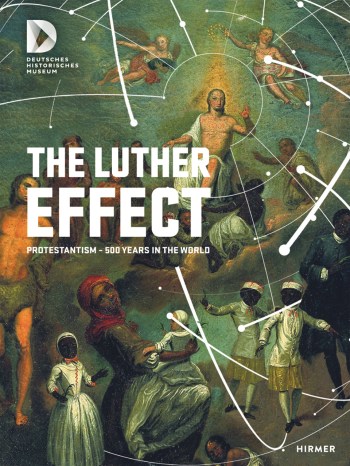
The Luther Effect: Protestantism—500 Years in the World (Munich: Hirmer Verlag, 2017), 400 pages, ISBN: 978 37774 27225, $54.
To mark the occasion of the five-hundredth anniversary of the Protestant Reformation in 2017, The Luther Effect offers a vivid and rich journey across five centuries and four continents, detailing the visual history of the growth of Protestantism around the world. The book examines how Protestantism has affected—and been affected by—encounters with diverse denominations, cultures, and lifestyles throughout the centuries. It explores how Protestantism has adapted and transformed and how different people around the world have adopted, modified, and followed its doctrine. Including two hundred and fifty stunning color plates and looking specifically at the art and cultural objects created in response to and in celebration of the religious movement, The Luther Effect presents the first comprehensive global history of Protestantism’s influence, reverberations, and reception.
2017 Charles Eldredge Prize | Transporting Visions
Press release (13 April 2017) from the Smithsonian:
Jennifer L. Roberts, Transporting Visions: The Movement of Images in Early America (Los Angeles: University of California Press, 2014), 240 pages, ISBN: 978-0520251847, $60 / £42.
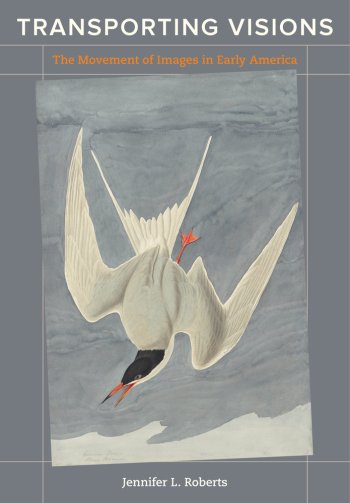 The Smithsonian American Art Museum has awarded the 2017 Charles C. Eldredge Prize for Distinguished Scholarship in American Art to Jennifer L. Roberts, the Elizabeth Cary Agassiz Professor of the Humanities at Harvard University, for her book Transporting Visions: The Movement of Images in Early America (University of California Press, 2014). The jurors wrote in a joint statement: “Roberts’s adventurous account provides an exciting indication of where the field of American art is going as it pushes analysis of visual material into new terrain.”
The three jurors who awarded the $3,000 prize were Jennifer Greenhill, associate professor of art history at the University of Southern California; Jessica May, deputy director and Robert and Elizabeth Nanovic Chief Curator at the Portland Museum of Art, Maine; and Akela Reason, associate professor of history at the University of Georgia.
The jurors continued: “Transporting Visions: The Movement of Images in Early America [is] a book of rare ambition whose impact on the field is undeniable. Methodologically sophisticated in its treatment of the material properties of objects on the move—the literal ‘weight and heft’ of things in the physical world—Roberts demonstrates just how much art historians have to contribute to contemporary, cross-disciplinary debates about the complex meanings of matter. The arguments about John Singleton Copley, John James Audubon, and Asher B. Durand are elegantly conceived and tightly crafted, making the book truly a pleasure to read. Rarely does such a field-shaping book come along.”
Roberts is the Elizabeth Cary Agassiz Professor of the Humanities at Harvard University. She teaches American art from the colonial period to the present, with particular focus on issues of landscape, expedition, material culture theory, and the history and philosophy of science. Roberts is the author of Mirror-Travels: Robert Smithson and History (2004) and Jasper Johns/In Press: The Crosshatch Works and the Logic of Print (2012). She is the co-author of the forthcoming catalog raisonné of Jasper Johns’ monotypes and is working on a book, The Matrix, about the broad cultural and philosophical implications of the physical operations of printing. She received a bachelor’s degree from Stanford University (1992) and earned her doctorate in art history from Yale University (2000). Roberts currently holds a Harvard College Professorship that was awarded for distinguished research and undergraduate teaching. She will occupy the Slade Professorship in Fine Arts at Cambridge University in 2019.
Roberts will give the annual Eldredge Prize lecture at the Smithsonian American Art Museum in the spring of 2018. More information about the prize, along with a list of past winners, is available here.
Exhibition | Treasures of the Hispanic Society of America
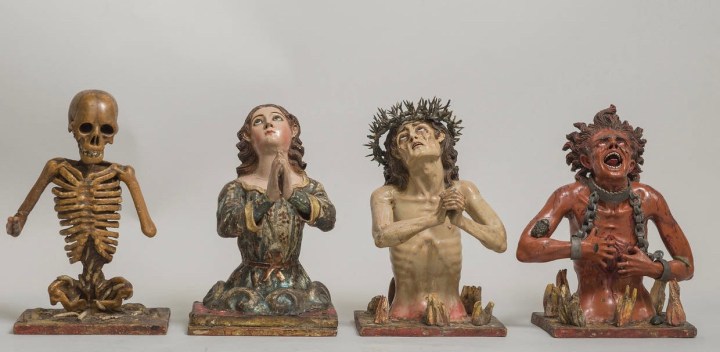
Manuel Chili, known as Caspicara, Four Fates of the Soul: Death, Soul in Heaven, Soul in Purgatory, and Soul in Hell, ca. 1775 (New York: The Hispanic Society of America).
◊ ◊ ◊ ◊ ◊
Press release (31 March 2017) for the exhibition:
Treasures of the Hispanic Society of America: Visions of the Hispanic World
Museo Nacional del Prado, Madrid, 4 April — 10 September 2017
Curated by Mitchell Codding
Through September 10, the Museo del Prado will present the treasures of the museum and library of the Hispanic Society, an institution located in Upper Manhattan in New York, founded in 1904 by Archer Milton Huntington (1870–1955), one of America’s greatest philanthropists. Huntington created an institution that reflected an appreciation of Spanish culture and the study of the literature and art of Spain, Portugal, and Latin America. Treasures of the Hispanic Society of America: Visions of the Hispanic World brings together more than two hundred works of art including paintings, drawings, and sculpture, archaeological artifacts, liturgical vestments, furniture, and books and manuscripts from the library, creating a fascinating chronological and thematic experience of the highlights of the Hispanic Society’s vast collections.
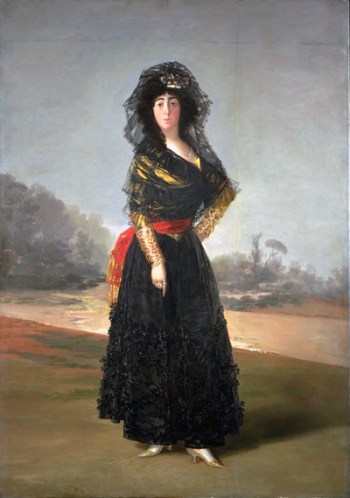
Francisco de Goya y Lucientes, The Duchess of Alba, 1796–97, oil on canvas, 210 × 149 cm (New York: The Hispanic Society of America).
With this exhibition—which occupies all of the temporary exhibition galleries in the new extension—the Museo del Prado offers its visitors the privilege of enjoying one museum within another, as it did in 2012 with the exhibition The Hermitage in the Prado. In this case, the renovation of the Hispanic Society’s galleries has allowed the treasures of their collections of Spanish and Latin American art, along with rare books and manuscripts, to travel to Spain. Many of the works of art that will be shown have not previously been exhibited or were unknown, including the reliquary busts of Santa Marta and Santa María Magdalena by Juan de Juni and the Fates of Man by Manuel Chili, known as Caspicara. Others have recently been identified, such as the Map of Tequaltiche, which was thought to be lost. Besides the individual value of each work of art, this exceptional grouping gives context to the magnitude of the rich history of Hispanic culture in the Iberian Peninsula, America, and Philippines. Spanning more than 3,000 years, the collection shows a quality of art works that no museum outside of Spain can compete with, demonstrating the passion of a unique collector who put his resources and knowledge towards creating a Spanish museum in America.
The extraordinary selection of paintings includes master works such as Portrait of a Little Girl, Camillo Astalli and Gaspar de Guzmán, Conde-Duque de Olivares by Velázquez, Pieta by El Greco, The Prodigal Son by Murillo, Santa Emerenciana by Zurbarán, and the emblematic Duchess of Alba by Goya, especially conserved for this occasion at the Museo del Prado with the collaboration of Fundación Iberdrola. Also represented are paintings by Post-Impressionists and modern artists, such as Zuloaga, Sorolla, and Santiago Rusiñol. The selection of sculpture includes, among others: the Efigie of Mencía Enríquez de Toledo from the Workshop of Gil de Siloé, the terracotta The Mystical Marriage of Saint Catherine by Luisa Roldán, and Fates of Man, a group of polychromed wood sculptures by Manuel Chili, known as Caspicara.
The exhibition also includes a selection of important archaeological artifacts, among them Celtiberian jewelry, Bell-Beaker vessels, and a Visigothic belt buckle. Completing the survey is a significant selection of decorative arts, with Renaissance and Baroque metalwork, ceramics from Manises, Talavera and Alcora, and an exquisite Pyxis made of ivory with gold plated hinges. Alongside these objects are textiles including a Fragment of the tunic of Prince Felipe de Castilla and a Nazrid silk textile.
An innovative mounting technique will allow the important holdings of the library of the Hispanic Society to be appreciated in all their splendor; works include A grant (Privilegio) issued by Alfonso VII, king of Castile and León, Biblia sacra iuxta versionem vulgata. Bible in Latin; unique letters such as Holograph instructions for his son Philip, the Letter to Phillip II of Spain from Elizabeth I, Queen of England, and the Holograph letter, signed “Diego de Silva Velazquez” to Damián Gotiens; and various maps including Portolan Atlas by Battista Agnese and the Mapamundi by Juan Vespucci.
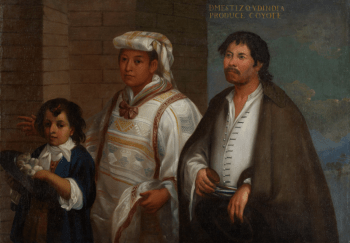
Juan Rodríguez Juárez, De Mestizo y de India produce Coyote, ca. 1716–20; Mexico, oil on canvas, 104 × 146 cm (New York: The Hispanic Society of America).
The first part of the exhibition (Galleries A and B) is organized chronologically and thematically by period in Spain and Latin America and comprises archaeological artifacts from sites on the Iberian Peninsula, Roman sculpture, magnificent ceramics, glass, furniture, textiles, silverworks, and Islamic and Medieval treasures as well as those from the Golden Age. Of particular relevance are Spanish paintings, in dialogue with the collections of the Prado, and colonial art closely related to the peninsula’s artistic legacy. Also included is a section dedicated to the library at the Hispanic Society, one of the most important in the world.
Gallery C offers a broad selection of the best Spanish painting from the 19th century through the early 20th century, including an exceptional collection of portraits of the leading Spanish scholars of that period, who worked closely with Huntington. After the First World War, Archer Huntington halted acquisitions, but maintained a close relationship with Spanish art and culture through his friendship with various painters, principally Joaquín Sorolla, who was commissioned to paint the famous series of large scale canvases depicting the regions of Spain for the Hispanic Society.
Accompanying the exhibition is a documentary projected in Gallery D, directed by Francesco Jodice, that transports the visitor to New York in the beginning of the twentieth century and narrates the history of the Hispanic Society and the passion of its founder, the philanthropist Archer Milton Huntington. The film contextualizes the origins of the early collecting practices of Huntington; the construction and inauguration of the headquarters of the Hispanic Society; Huntington’s collections and the fantastic holdings of the library; his relationship with Spain through Alfonso XII and the great Spanish intellectuals of the era; his friendship with Sorolla in New York; and the philanthropy of this great patron who wanted to remain anonymous during his entire life. The story is told by the director, Mitchell Codding, Chairman of the Board of Trustees, Philippe de Montebello, and the curators. The film, which runs for approximately 20 minutes, was filmed in New York and at the Prado Museum and is in English with Spanish subtitles.
Visions of the Hispanic World is the latest chapter in the decade-long collaboration between the Museo del Prado and the BBVA Foundation, involving the annual organization of a major exhibition event. This partnership has made possible such celebrated exhibitions as Passion for Renoir, The Hermitage in the Prado, El Greco and Modern Painting, and Bosch: The 5th Centenary Exhibition. Thanks to the Prado’s select network of relations with public and private lenders, these shows are the opportunity for an international public to view works that might otherwise never be seen under one roof. The exhibitions presented by the Prado and BBVA Foundation have met with an extraordinary response. In particular, those devoted to the Hermitage and Bosch successively broke the record of visits to the Madrid museum’s temporary exhibits, with over 580,000 spectators each.
Archer Milton Huntington, only son of one of the wealthiest families in The United States, from a young age possessed a profound interest in the Hispanic world. His education and numerous trips to Europe inspired an interest in collecting, always with the idea of creating a museum. In less than forty years, Huntington created a library and museum designed to elevate the study of Hispanic art through unparalleled collections in both scope and quality. At the same time, he published various facsimiles of important rare books and manuscripts. Huntington, in an effort to not deprive Spain of its artistic treasures, acquired most of his collection outside of the country. One can confirm, as did Jonathan Brown, that Huntington saw the Hispanic Society as an encyclopedic depository of Spanish art and literature. Huntington was one of the first Hispanists in the United States in the first half of the 20th century. For this reason he was awarded by numerous American universities. He was an active member of various Spanish museums and was invested as member of the Spanish Royal Academies. This exhibition pays homage to Huntington’s lifelong work for The Hispanic Society Museum & Library in the diffusion and study of Spanish culture in the United States of America.
Tesoros de la Hispanic Society of America (Madrid: Museo Nacional del Prado, 2017), 448 pages, ISBN: 978 84848 04079, 35€.
ASECS Awards, 2016–17
Recent awards from ASECS (with a full list available here) . . .
The Biennial Annibel Jenkins Biography Prize
Jane Kamensky (Professor of History and Pforzheimer Foundation Director of the Schlesinger Library, Harvard University), A Revolution in Color: The World of John Singleton Copley (New York: W. W. Norton and Company, 2016).
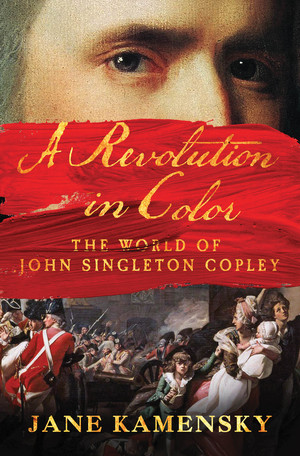 Committee’s evaluation: Kamensky’s “brilliantly written study of an ambitious painter in colonial Boston and then England is a joy to read from beginning to end. Kamensky is a deft storyteller with a keen eye for irony and paradox, and she draws upon a transatlantic archive that includes printed, manuscript, and visual sources. She cross fertilizes between history and art history in dazzling ways, and readers are sure to learn a great deal about the craft, politics, and finances of painting in colonial America and on the Continent as well. In making visible the complexities of cultural identity in a time of vexed allegiances, the author brings texture and depth to our understanding of Copley’s world before, during, and after the American Revolution.”
The Biennial Annibel Jenkins Biography Prize is given to the author of the best book-length biography of a late seventeenth-century or eighteenth-century subject. The prize is named in honor of Annibel Jenkins, Professor of English (Emerita) at the Georgia Institute of Technology. A founding member of the Southeastern American Society for Eighteenth-Century Studies, she was an outstanding teacher and scholar who has been for many years one of the most active and encouraging members of the academic community in America.
Robert R. Palmer Research Travel Fellowship
Margo Bernstein (Art History and Archaeology, Columbia University) “Carmontelle’s Profile Pictures and the Things that Made Them Modern.”
New Book | Jean-Baptiste Descamps
From Brepols:
Gaëtane Maës, De l’expertise artistique à la vulgarisation au siècle des Lumières: Jean-Baptiste Descamps (1715–1791) et la peinture flamande, hollandaise et allemande (Turnhout: Brepols Publishers, 2016), 608 pages, ISBN: 978 2503 567709, 125€.
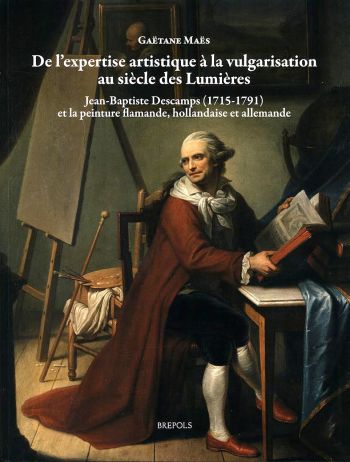 Peintre flamand peu connu aujourd’hui, Jean-Baptiste Descamps (1715–1791) demeure important par les livres qu’il a publiés de son vivant. Entre 1753 et 1763, paraissent ainsi les quatre volumes de son recueil intitulé La vie des peintres flamands, allemands et hollandois, suivis en 1769 de la publication d’un Voyage pittoresque de la Flandre et du Brabant. Ces textes ont longtemps été négligés car, contrairement aux modèles représentés par Giorgio Vasari et Karel van Mander, ils sont considérés comme de simples compilations. Consacrer une étude aux ouvrages de Descamps vise, par conséquent, à remettre en question ce postulat en soulignant les réels enjeux intellectuels que revêt l’écriture de ce polygraphe. Par ses livres, Descamps a, en effet, su se construire une visibilité et une légitimité d’expert de la peinture septentrionale, qui lui ont ouvert les portes de l’Académie royale de Peinture et de Sculpture à Paris en 1764.
Dans ce contexte, l’enquête monographique sert ici de simple fil conducteur à des questionnements variés sur la France des Lumières, et plus particulièrement sur le rapport entre Paris et la province, entre les grands et petits maîtres, entre la littérature érudite et les écrits de vulgarisation. L’étude s’attache aussi à définir la place des Arts dans l’espace public ouvert par le développement des expositions, du marché de l’art et du tourisme culturel. Elle met enfin l’accent sur l’attraction puissante qu’ont exercée les œuvres flamandes, hollandaises et allemandes sur les collectionneurs du XVIIIe siècle.
Cette synthèse sera prochainement suivie de la réédition critique du Voyage pittoresque de la Flandre et du Brabant, qui a été le premier guide publié en France avec l’intention explicite de proposer aux artistes et amateurs d’art une autre destination que l’Italie.
Gaetane Maes est Maître de conférences habilitée à diriger des recherches, et elle enseigne l’Histoire de l’Art des Temps modernes à l’université de Lille. Ses recherches s’attachent autant à l’art des anciens Pays-Bas (Flandre et Hollande) qu’à l’art français, afin de les envisager dans un esprit de décloisonnement. Avec Jan Blanc, elle a notamment publié Les échanges artistiques entre la France et les anciens Pays-Bas. 1482–1814 (Brepols, 2010). Elle est également l’auteur de nombreux articles sur l’historiographie des peintres et les fonctions sociales de l’art.
T A B L E D E S M A T I E R E S
Introduction
1ère partie. La vie et la carrière d’un peintre flamand en France
1 Entre vie mythique et vie réelle
2 Du peintre à l’entrepreneur : une stratégie de carrière réfléchie
3 La gloire ou l’argent ?
Conclusion de la 1ère partie
2e partie. L’entreprise éditoriale de La vie des peintres
4 Le peintre-écrivain au XVIIIe siècle: entre mythe et concurrence
5 Le livre comme objet social
6 Méthode de travail et documentation
Conclusion de la 2e partie
3e partie. Le sens de La vie des peintres : une théorie implicite ?
7 Un manuel pour connaisseurs
8 Le commerce contre l’histoire ou l’impossible union
9 La pensée esthétique de Descamps
10 Les goûts artistiques de Descamps
Conclusion de la 3e partie
4e partie. Le Voyage pittoresque de la Flandre et du Brabant
11 L’élaboration d’un best-seller
12 Le contenu du Voyage pittoresque
13 L’art et son public ou le Voyage pittoresque comme préfiguration de la notion de patrimoine
Conclusion de la 4e partie
Conclusion générale
Annexes
Bibliographie
Liste des illustrations
Crédits photographiques
Index des noms propres
Planches en couleurs










 Enfilade
leave a comment