New Book | The Russian Canvas: Painting in Imperial Russia
From Yale UP:
Rosalind P. Blakesley, The Russian Canvas: Painting in Imperial Russia, 1757–1881 (New Haven: Yale University Press, 2016), 380 pages, ISBN: 978-0300184372, $75.
 The Russian Canvas charts the remarkable rise of Russian painting in the 18th and 19th centuries, and the nature of its relationship with other European schools. Starting with the foundation of the Imperial Academy of the Arts in 1757 and culminating with the assassination of Tsar Alexander II in 1881, it details the professionalization and wide-ranging activities of painters against a backdrop of dramatic social and political change. The Imperial Academy formalized artistic training but later became a foil for dissent, as successive generations of painters negotiated their own positions between pan-European engagement and local and national identities. Drawing on original archival research, this groundbreaking book recontextualizes the work of major artists, revives the reputations of others, and explores the complex developments that took Russian painters from provincial anonymity to international acclaim.
Rosalind P. Blakesley is reader in Russian and European art at the University of Cambridge.
Blakesley is also the curator of the exhibition now on view at London’s National Portrait Gallery Russia and the Arts: The Age of Tolstoy and Tchaikovsky (17 March — 26 June), which addresses the period from 1867 to 1914.
Exhibition | Three Centuries of American Prints
From the press release (3 February 2016) for the exhibition:
Three Centuries of American Prints from the National Gallery of Art
National Gallery of Art, Washington, D.C., 3 April 3 — 24 July 2016
National Gallery, Prague, 4 October 2016 — 5 January 2017
Antiguo Colegio de San Ildefonso, Mexico City, 7 February — 30 April 2017
Curated by Amy Johnston and Judith Brodie

John Simon after John Verelst, Sa Ga Yeath Qua Pieth Tow, King of the Maquas, after 1710 (Washington, D.C.: National Gallery of Art, Paul Mellon Fund)
A new international traveling exhibition will explore major events and movements in American art through some 150 outstanding prints from the Colonial era to the present. Three Centuries of American Prints from the National Gallery of Art is the first major museum survey of American prints in more than 30 years. Timed to coincide with the National Gallery of Art’s 75th anniversary, the exhibition is drawn from the Gallery’s renowned holdings of works on paper, and features more than 100 artists such as Paul Revere, James McNeill Whistler, Mary Cassatt, Winslow Homer, George Bellows, John Marin, Jackson Pollock, Louise Nevelson, Romare Bearden, Andy Warhol, Robert Rauschenberg, Chuck Close, Jenny Holzer, and Kara Walker.
Organized chronologically and thematically through nine galleries, Three Centuries of American Prints reveals the breadth and excellence of the Gallery’s collection while showcasing some of the standouts: exquisite, rare impressions of James McNeill Whistler’s Nocturne (1879/1880), captivating prints by Mary Cassatt, a singularly stunning impression of John Marin’s Woolworth Building, No. 1 (1913), and Robert Rauschenberg’s pioneering Booster (1967).
The exhibition is bracketed by John Simon’s Four Indian Kings (1710)—stately portraits of four Native American leaders who traveled to London to meet Queen Anne—and Kara Walker’s no world (2010), which recalls the disastrous impact of European settlement in the New World. Both prints address the subject of transnational contact, a theme that runs through the history of American art.

Paul Revere, The Boston Massacre, 1770, hand-colored engraving (Washington, D.C.: National Gallery of Art, Rosenwald Collection)
Three Centuries of American Prints features works intended to provoke action, such as Paul Revere’s call for moral outrage in The Bloody Massacre (1770) and Jenny Holzer’s appeal to “Raise Boys and Girls the Same Way” in her Truisms (1977). Others lean more strongly toward visual concerns, such as Stuart Davis’s striking black-and-white lithograph, Barber Shop Chord (1931), and Richard Diebenkorn’s resplendent Green (1986). This duality between prints designed to exhort or teach and ones more weighted to artistic matters is an undercurrent of both the exhibition and the history of American prints.
Since its opening in 1941, the National Gallery of Art has assiduously collected American prints with the help of many generous donors. The Gallery’s American print collection has grown from nearly 1,900 prints in 1950 to some 22,500 prints in 2015. The collection was transformed in recent years by the acquisition of the Reba and Dave Williams Collection, the personal print archive of Jasper Johns, and some 2,300 American prints from the Corcoran Gallery of Art, along with a gift and pledge of 18th- and early 19th-century prints from Harry W. Havemeyer.
“In the past few decades the American collections at the National Gallery of Art have grown vastly in quality and scale. From 2000 until today—thanks to generous donors and acquisitions from the Corcoran Gallery of Art—the collection of American prints has almost doubled and now numbers some 22,500 works,” said Earl A. Powell III, Director, National Gallery of Art. “We are tremendously grateful to hundreds of donors, foremost among them Lessing J. Rosenwald and Reba and Dave Williams, as well as grateful to Altria Group, the Terra Foundation for American Art, and The Exhibition Circle of the National Gallery of Art for their vital support.”
The exhibition is made possible by Altria Group in celebration of the 75th Anniversary of the National Gallery of Art. This is the twelfth exhibition sponsorship by Altria Group at the Gallery. “For more than 50 years, Altria and its companies have supported visual and performing arts. Our partnership with the National Gallery of Art to share Three Centuries of American Prints is an important way that we’re bringing world-class cultural experiences to our communities,” said Bruce Gates, Senior Vice President of External Affairs for Altria Client Services. The international tour of the exhibition is sponsored by the Terra Foundation for American Art. Additional support is provided by The Exhibition Circle of the National Gallery of Art.
The curators of the exhibition are Amy Johnston, assistant curator of prints and drawings, and Judith Brodie, curator and head of the department of modern prints and drawings, both at the National Gallery of Art. The exhibition catalog is conceived and edited by Judith Brodie, with coauthors Amy Johnston and Michael J. Lewis, the Faison-Pierson-Stoddard Professor of Art History at Williams College. The Terra Foundation for American Art provided additional funding for the exhibition catalog.
Judith Brodie, Amy Johnston, and Michael J. Lewis, Three Centuries of American Prints (New York: Thames & Hudson, 2016), 306 pages, ISBN: 978-0500239520, $60.
New Book | The Mind Is a Collection
From Penn Press:
Sean Silver, The Mind Is a Collection: Case Studies in Eighteenth-Century Thought (Philadelphia: University of Pennsylvania Press, 2015), 384 pages, ISBN: 978-0812247268, $65 / £42.
 John Locke described the mind as a cabinet; Robert Hooke called it a repository; Joseph Addison imagined a drawer of medals. Each of these philosophers was an avid collector and curator of books, coins, and cultural artifacts. It is therefore no coincidence that when they wrote about the mental work of reason and imagination, they modeled their powers of intellect in terms of collecting, cataloging, and classification.
The Mind Is a Collection approaches seventeenth- and eighteenth-century metaphors of the mind from a material point of view. Each of the book’s six chapters is organized as a series of linked exhibits that speak to a single aspect of Enlightenment philosophies of mind. From his first chapter, on metaphor, to the last one, on dispossession, Sean Silver looks at ways that abstract theories referred to cognitive ecologies—systems crafted to enable certain kinds of thinking, such as libraries, workshops, notebooks, collections, and gardens. In doing so, he demonstrates the crossings-over of material into ideal, ideal into material, and the ways in which an idea might repeatedly turn up in an object, or a range of objects might repeatedly stand for an idea. A brief conclusion examines the afterlife of the metaphor of mind as collection, as it turns up in present-day cognitive studies. Modern cognitive theory has been applied to the microcomputer, and while the object is new, the habit is as old as the Enlightenment.
By examining lived environments and embodied habits from 1660 to 1800, Silver demonstrates that the philosophical dualism that separated mind from body and idea from thing was inextricably established through active engagement with crafted ecologies.
Sean Silver teaches literature at the University of Michigan. Sean Silver’s The Mind is a Collection is a two-part intellectual project featuring a virtual museum (about museums) along with his book, The Mind is a Collection, which serves as both scholarly study and an exhibit catalogue.
◊ ◊ ◊ ◊ ◊
C O N T E N T S
Preface: Welcome to the Museum
Introduction
Case 1. Metaphor
1 John Locke’s Commonplace Book
2 John Milton’s Bed
3 Mark Akenside’s Museum
Case 2. Design
4 Robert Hooke’s Camera Obscura
5 Raphael’s Judgment of Paris
6 A Gritty Pebble
7 An Oval Portrait of John Woodward
8 A Stone from the Grotto of Egeria
9 Venus at Her Toilet
Case 3. Digression
10 The Iliad in a Nutshell
11 A Full Stop
12 A Conical Roman Tumulus
13 The Reception of Claudius
14 Addison’s Walk
Case 4. Inwardness
15 William Hay’s Stone
16 Two Calculi Cut and Mounted in a Small Showcase
17 An Ampulla of the Blood of Thomas Becket
18 A Blue-Bound Copy of The Mysterious Mother
Case 5. Conception
19 A Blank Sheet of Paper (1)
20 A Folio Sheet with Two Sketches of a Single Conception
21 A Triumph of Galatea
22 Joshua Reynolds, William Hunter
Case 6. Dispossession
23 A Shilling
24 A Book of Accounts
25 A Blank Sheet of Paper (2)
26 A Ring Containing a Lock of Hair
27 The Lost Property Office
28 The Skeleton of Jonathan Wild
Conclusion
Notes
Index
Acknowledgments
Exhibition | I Am Here! Self-Portraits
Now on view at the Musée des Beaux-Arts de Lyon:
I Am Here! / Autoportraits: De Rembrandt du Selfie / Facing the World
Staatliche Kunsthalle Karlsruhe, 31 October 2015 — 31 January 2016
Musée des Beaux-Arts de Lyon, 26 March — 26 June 2016
Scottish National Portrait Gallery, Edinburgh, 16 July — 16 October 2016
Curated by Dorit Schäfer, Stéphane Paccoud, and Imogen Gibbon

Joseph Vivien, Self-portrait with Palette, 1715–20
The Staatliche Kunsthalle of Karlsruhe, the National Galleries of Scotland in Edinburgh, and the Museum of Fine Arts of Lyon established a partnership in 2011. The first exhibition to be created within this frame is on the theme of self-portraits and it will open in Lyon in spring of 2016.
The exhibition contains over 130 works from three major European museums, from the Renaissance period up to the 21st century, including paintings, drawings, prints, sculptures, photographs and videos. A specific genre in itself, self-portraits contain much information about their creators as well as their historical and social environment. At a time when selfies have become a true societal phenomenon, one that characterizes the digital era, the study of the traditions and usage of self portraits is more pertinent than it has ever been.
The exhibition offers a major chance to study the practice of self-portraits by artists in various forms that will be exhibited in seven sections
• The artist’s gaze
• the artist as a nobleman
• the artist at work
• the artist and his circle
• role-play
• the artist in his time
• the artist’s body
 Ich Bien Hier! Von Rembrandt zum Selfie (Cologne: Snoeck, 2016), 284 pages, ISBN: 978-3864421389. French and English editions will also be available.
Staatliche Kunsthalle de Karlsruhe
Pia Müller-Tamm, Director
Alexander Eiling, Curator
Dorit Schäfer, Curator, Drawings and Prints
Musée des Beaux-Arts de Lyon
Stéphane Paccoud, Chief Curator, Nineteenth-Century Paintings and Sculptures
Ludmila Virassamynaïken, Curator, Old Masters Paintings and Sculptures
National Galleries of Scotland
Michael Clarke, Director General
Imogen Gibbon, Curator
New Book | Framing Majismo: Art and Royal Identity in Spain
From Penn State UP:
Tara Zanardi, Framing Majismo: Art and Royal Identity in Eighteenth-Century Spain (University Park: Penn State University Press, 2016), 264 pages, ISBN: 978-0271067247, $95.
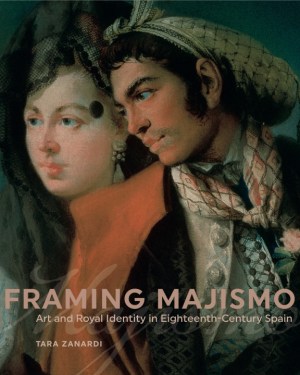 Majismo, a cultural phenomenon that embodied the popular aesthetic in Spain from the second half of the eighteenth century, served as a vehicle to ‘regain’ Spanish heritage. As expressed in visual representations of popular types participating in traditional customs and wearing garments viewed as historically Spanish, majismo conferred on Spanish ‘citizens’ the pictorial ideal of a shared national character.
In Framing Majismo, Tara Zanardi explores nobles’ fascination with and appropriation of the practices and types associated with majismo, as well as how this connection cultivated the formation of an elite Spanish identity in the late 1700s and aided the Bourbons’ objective to fashion themselves as the legitimate rulers of Spain. In particular, the book considers artistic and literary representations of the majo and the maja, purportedly native types who embodied and performed uniquely Spanish characteristics. Such visual examples of majismo emerge as critical and contentious sites for navigating eighteenth-century conceptions of gender, national character, and noble identity. Zanardi also examines how these bodies were contrasted with those regarded as ‘foreign’, finding that ‘foreign’ and ‘national’ bodies were frequently described and depicted in similar ways. She isolates and uncovers the nuances of bodily representation, ultimately showing how the body and the emergent nation were mutually constructed at a critical historical moment for both.
Tara Zanardi is Assistant Professor of Art History at Hunter College.
◊ ◊ ◊ ◊ ◊
C O N T E N T S
List of Illustrations
Acknowledgments
Introduction
1 Majismo, the Spanish National Character, and the Elite Cultivation of Cultural Patrimony
2 Swaggering Majos: Performing the Masculine Ideal
3 Performing the Bullfight: Spanish Bodies as Noble Spectacle
4 Majas, Elites, and Female Agency
5 Majismo and Elite Identity
Conclusion
Notes
Bibliography
Index
New Book | Thirty-Six Views: The Kangxi Emperor’s Mountain Estate
From Dumbarton Oaks Research Library:
Kangxi Emperor, translated by Richard Strassberg, with an introduction by Stephen Whiteman, Thirty-Six Views: The Kangxi Emperor’s Mountain Estate in Poetry and Prints (Washington, D.C.: Dumbarton Oaks Research Library, 2016), 316 pages, ISBN: 978-0884024095, $50.

In 1712, the Kangxi emperor published Imperial Poems on the Mountain Estate for Escaping the Heat (Yuzhi Bishu shanzhuang shi) to commemorate his recently completed summer palace. Through his perceptions of thirty-six of its most scenic views, his poems and descriptions present an unusually intimate self-portrait of the emperor at the age of sixty that reflected the pleasures of his life there as well as his ideals as the ruler of the Qing Empire. Kangxi was closely involved in the production of the book and ordered several of his outstanding court artists—the painter Shen Yu and the engravers Zhu Gui and Mei Yufeng—to produce woodblock prints of the thirty-six views, which set a new standard for topographical illustration. He also ordered Matteo Ripa, an Italian missionary serving as a court-artist, to translate these images into the medium of copperplate engraving, which introduced this technique to China. Ripa’s hybridized interpretations soon began to circulate in Europe and influenced contemporary aesthetic debates about the nature and virtues of the Chinese garden. This artistic collaboration between a Chinese emperor and a western missionary-artist thus marked a significant moment in intercultural imagination, production, and transmission during an earlier phase of globalization.
New Book | Frederick the Great: King of Prussia
From Random House:
Tim Blanning, Frederick the Great: King of Prussia (London: Allen Lane, 2015), 688 pages, ISBN: 978-1400068128, $35.
 Few figures loom as large in European history as Frederick the Great. When he inherited the Prussian crown in 1740, he ruled over a kingdom of scattered territories, a minor Germanic backwater. By the end of his reign, the much larger and consolidated Prussia ranked among the continent’s great powers. In this magisterial biography, award-winning historian Tim Blanning gives us an intimate, in-depth portrait of a king who dominated the political, military, and cultural life of Europe half a century before Napoleon.
A brilliant, ambitious, sometimes ruthless monarch, Frederick was a man of immense contradictions. This consummate conqueror was also an ardent patron of the arts who attracted painters, architects, musicians, playwrights, and intellectuals to his court. Like his fellow autocrat Catherine the Great of Russia, Frederick was captivated by the ideals of the Enlightenment—for many years he kept up lively correspondence with Voltaire and other leading thinkers of the age. Yet, like Catherine, Frederick drew the line when it came to implementing Enlightenment principles that might curtail his royal authority.
Frederick’s terrifying father instilled in him a stern military discipline that would make the future king one of the most fearsome battlefield commanders of his day, while deriding as effeminate his son’s passion for modern ideas and fine art. Frederick, driven to surpass his father’s legacy, challenged the dominant German-speaking powers, including Saxony, Bavaria, and the Habsburg Monarchy. It was an audacious foreign policy gambit, one at which Frederick, against the expectations of his rivals, succeeded.
In examining Frederick’s private life, Blanning also carefully considers the long-debated question of Frederick’s sexuality, finding evidence that Frederick lavished gifts on his male friends and maintained homosexual relationships throughout his life, while limiting contact with his estranged, unloved queen to visits that were few and far between.
The story of one man’s life and the complete political and cultural transformation of a nation, Tim Blanning’s sweeping biography takes readers inside the mind of the monarch, giving us a fresh understanding of Frederick the Great’s remarkable reign.
Until his retirement in 2009, Tim Blanning was a professor of modern European history at the University of Cambridge, and he remains a fellow of Sidney Sussex College and of the British Academy. He is the general editor of The Oxford History of Modern Europe and The Short Oxford History of Europe. He is also the author of The Culture of Power and the Power of Culture, which won a prestigious German prize and was short-listed for the British Academy Book Prize; The New York Times bestseller The Pursuit of Glory; The Triumph of Music; and The Romantic Revolution. In 2000 he was awarded a Pilkington Prize for teaching by the University of Cambridge.
New Book | The Philadelphia Country House
From Johns Hopkins UP:
Mark Reinberger and Elizabeth McLean, The Philadelphia Country House: Architecture and Landscape in Colonial America (Baltimore: Johns Hopkins University Press, 2015), 464 pages, ISBN: 9781421411637, $70.
 Colonial Americans, if they could afford it, liked to emulate the fashions of London and the style and manners of English country society while at the same time thinking of themselves as distinctly American. The houses they built reflected this ongoing cultural tension. By the mid-eighteenth century, Americans had developed their own version of the bourgeois English countryseat, a class of estate equally distinct in social function and form from townhouses, rural plantations, and farms. The metropolis of Philadelphia was surrounded by a particularly extraordinary collection of country houses and landscapes. Taken together, these estates make up one of the most significant groups of homes in colonial America.
In this masterly volume, Mark Reinberger, a senior architectural historian, and Elizabeth McLean, an accomplished scholar of landscape history, examine the country houses that the urban gentry built on the outskirts of Philadelphia in response to both local and international economic forces, social imperatives, and fashion. What do these structures and their gardens say about the taste of the people who conceived and executed them? How did their evolving forms demonstrate the persistence of European templates while embodying the spirit of American adaptation?
The Philadelphia Country House explores the myriad ways in which these estates—which were located in the country but responded to the ideas and manners of the city—straddled the cultural divide between urban and rural. Moving from general trends and building principles to architectural interiors and landscape design, Reinberger and McLean take readers on an intimate tour of the fine, fashionable elements found in upstairs parlors and formal gardens. They also reveal the intricate working world of servants, cellars, and kitchen gardens. Highlighting an important aspect of American historic architecture, this handsome volume is illustrated with nearly 150 photographs, more than 60 line drawings, and two color galleries.
Mark Reinberger is a professor of architecture at the University of Georgia. He is the author of Utility and Beauty: Robert Wellford and Composition Ornament in America. Elizabeth McLean is a research associate in botany at the Academy of Natural Sciences of Drexel University. She is the coauthor of Peter Collinson and the Eighteenth-Century Natural History Exchange.
Exhibition | Princely Splendour: The Power of Pomp
From the Belvedere:
Princely Splendour: The Power of Pomp / Fürstenglanz: Die Macht der Pracht
Winter Palace, Vienna, 18 March — 26 June 2016

Anton von Maron, Emperor Joseph II with the Statue of Mars, 1775 (Vienna: KHM-Museumsverband)
The exhibition Princely Splendour: The Power of Pomp explores collecting in the Baroque period and uses the transformation of Prince Eugene’s Winter Palace into a modern museum as an opportunity to look back to princely splendor, Baroque galleries, and the art of order. At the heart of the exhibition are the lavish catalogues of the major European Baroque galleries, proclaiming the prestige of their creators and also marking the origins of modern exhibition and art catalogues. They document princely ideals of beautiful interiors, provide glimpses behind concepts of Baroque (re)presentation and reflect classification systems, ‘public’ accessibility, and display practices typical of the period. These original collection catalogues are combined with portraits of the princes and a selection of paintings from their collections. The exhibition is the first to explore this phenomenon from a pan-European perspective and compare the most important princely collectors from the Baroque period.
Princely Splendour demonstrates the importance that Europe’s former ruling dynasties attached to their art collections. For centuries, owning art was used as a way of flaunting power. This development was accompanied by the increasing status of artists, particularly painters, in the emerging Baroque period. Talented artists became the favourites of princes and securing their services for the court, and the exclusive rights to their work this entailed, were further ‘puzzle pieces’ in the power structure. At the height of the Baroque period outstanding talents, such as Peter Paul Rubens, could even be promoted to diplomats and enjoyed the status of ‘painter princes’.
The exhibits include Theatrum Pictorium (Theatre of Painting), published by court painter David Teniers the Younger in 1660. This lavishly illustrated work is a testimony to the Habsburg Archduke Leopold Wilhelm’s passion for collecting and represents the birth of these elaborately designed books with printed reproductions of the artworks. Also featuring in the exhibition are Jean-Baptiste Colbert’s Tableaux du Cabinet du Roi created under France’s King Louis XIV; the Dresden Galeriewerk under August III, elector of Saxony and king of Poland; as well as a Prodromus, a type of preview compiled under the Austrian Emperor Charles VI in Baroque Vienna around 1720–30 with over one thousand planned painting reproductions grouped into miniature tableaus. This pan-European show features outstanding loans from the Louvre and other museums, with the state portrait of the French Sun King from the Palace of Versailles as the exhibition’s highlight.
The Imperial Picture Gallery’s move from Vienna’s Stallburg to the Upper Belvedere presented an ideal opportunity to compile a new guide to the collection. This small-scale publication provides an insight into the concept and organization of the new hanging which, when compared with other European galleries, reveals a completely new, rationalized order. Increasingly, large albums were being replaced by more reasonably priced shorter catalogues, reflecting the public’s wishes to enjoy the collection in the form of handy guides. In the spirit of the Enlightenment, the opening of aristocratic collections to a new, wider public went hand in hand with the evolution of these gallery catalogues.
Agnes Husslein-Arco and Tobias G. Natter, ed., Fürstenglanz: Die Macht der Pracht (2016), 224 pages, ISBN: 978-3902805973, 39€.
New Harley Gallery Showcases The Portland Collection
A new building at The Harley Gallery (Welbeck, Nottinghamshire) opens on Sunday to showcase The Portland Collection. . .
The Harley Gallery and Foundation is delighted to announce a new building which will display historic works from The Portland Collection, the historic fine and decorative arts collections of the Cavendish-Bentinck family. The family, currently headed by William Parente, grandson of the 7th Duke of Portland, have lived at Welbeck for over 400 years and through the generations have developed a beautiful and intriguing collection. The Portland Collection includes examples from some of the most highly regarded artists of each era.

George Stubbs, 3rd Duke of Portland, Welbeck Abbey, 1766 (The Portland Collection)
Hugh Broughton Architects were appointed to design the new building after a tightly fought architectural competition. The new building will consist of a glazed entrance pavilion and two gallery spaces, with a fresh new look for the courtyard itself. The main gallery spaces will be housed in a new structure, nestled between the Victorian walls. A top lit, barrel vaulted roof will filter light into the long gallery. A broad variety of pieces from the beautiful Portland Collection will be on show in a large gallery space.
The new building will be situated next to the existing Harley Gallery, within the walls of the Victorian Tan Gallop. Recently, this area has been used for storage. It was originally built as a covered area where the Welbeck Estate’s race horses could be trained in winter or poor weather. The name ‘Tan Gallop’ comes from the oak chippings that were used to cover the floor. By-products of the tanning process, these chippings were soft and provided a good surface for the horses to run on. A portion of the Tan Gallop, further away from The Harley Gallery, was converted into artists studios by the Harley Foundation in 1980.
Curatorial Advisory Panel
Karen Hearn, Honorary Professor, UCL
Alex Farquharson, Director, Nottingham Contemporary
Tim Knox, Director, The Fitzwilliam Museum
Hannah Obee, Curator, Chatsworth House Trust
Michael Hall, Architectural Historian and Journalist










 Enfilade
leave a comment