New Book | Poetical Dust: Poets’ Corner and the Making of Britain
Happy Bard Day!—on the 400th anniversary of the death of William Shakespeare (died on 23 April 1616). Global programming details are available at Shakespeare400. From Penn Press:
Thomas A. Prendergast, Poetical Dust: Poets’ Corner and the Making of Britain (Philadelphia: University of Pennsylvania Press, 2015), 256 pages, ISBN: 978-0812247503 (cloth), ISBN: 978-0812291902 (ebook), $60 / £39.
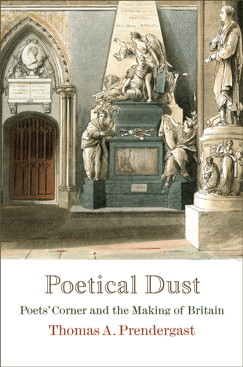 In the South Transept of Westminster Abbey in London, the bodies of more than seventy men and women, primarily writers, poets, and playwrights, are interred, with many more memorialized. From the time of the reburial of Geoffrey Chaucer in 1556, the space has become a sanctuary where some of the most revered figures of English letters are celebrated and remembered. Poets’ Corner is now an attraction visited by thousands of tourists each year, but for much of its history it was also the staging ground for an ongoing debate on the nature of British cultural identity and the place of poetry in the larger political landscape.
Thomas Prendergast’s Poetical Dust offers a provocative, far-reaching, and witty analysis of Poets’ Corner. Covering nearly a thousand years of political and literary history, the book examines the chaotic, sometimes fitful process through which Britain has consecrated its poetry and poets. Whether exploring the several burials of Chaucer, the politicking of Alexander Pope, or the absence of William Shakespeare, Prendergast asks us to consider how these relics attest to the vexed, melancholy ties between the literary corpse and corpus. His thoughtful, sophisticated discussion reveals Poets’ Corner to be not simply a centuries-old destination for pilgrims and tourists alike but a monument to literary fame and the inevitable decay of the bodies it has both rejected and celebrated.
Thomas Prendergast is Professor of English at The College of Wooster and author of Chaucer’s Dead Body: From Corpse to Corpus.
C O N T E N T S
Preface
Introduction
1 Westminster Abbey and the Incorporation of Poets’ Corner
2 Melancholia, Monumental Resistance, and the Invention of Poets’ Corner
3 Love, Literary Publicity, and the Naming of Poets’ Corner
4 Absence and the Public Poetics of Regret
5 Poetic Exhumation and the Anxiety of Absence
Coda: Necromancy and the American Poets’ Corner
Poets’ Corner Graveplan
Poets’ Corner Alphabetical Burial and Monument List
Chronological List of Stones and Monuments in the South Transept
Notes
Bibliography
Index
Acknowledgments
New Book | Ideas of Chinese Gardens: Western Accounts, 1300–1860
From Penn Press:
Bianca Maria Rinaldi, ed, Ideas of Chinese Gardens: Western Accounts, 1300–1860 (Philadelphia: University of Pennsylvania Press, 2015), 400 pages, ISBN: 978-0812247633 (cloth), ISBN: 978-0812292084 (ebook), $90 / £58.50.
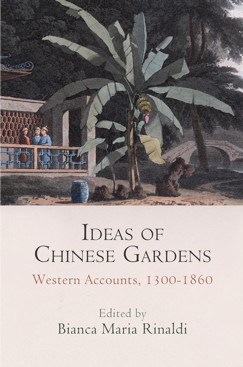 Europeans may be said to have first encountered the Chinese garden in Marco Polo’s narrative of his travels through the Mongol Empire and his years at the court of Kublai Khan. His account of a man-made lake abundant with fish, a verdant green hill lush with trees, raised walkways, and a plethora of beasts and birds took root in the European imagination as the description of a kind of Eden. Beginning in the sixteenth century, permanent interaction between Europe and China took form, and Jesuit missionaries and travelers recorded in letters and memoirs their admiration of Chinese gardens for their seeming naturalness. In the eighteenth century, European taste for chinoiserie reached its height, and informed observers of the Far East discovered that sophisticated and codified design principles lay behind the apparent simplicity of the Chinese garden. The widespread appreciation of the eighteenth century gave way to rejection in the nineteenth, a result of tensions over practical concerns such as trade imbalances and symbolized by the destruction of the imperial park of Yuanming yuan by a joint Anglo-French military expedition.
In Ideas of Chinese Gardens, Bianca Maria Rinaldi has gathered an unparalleled collection of westerners’ accounts, many freshly translated and all expertly annotated, as well as images that would have accompanied the texts as they circulated in Europe. Representing a great diversity of materials and literary genres, Rinaldi’s book includes more than thirty-five sources that span centuries, countries, languages, occupational biases, and political aims. By providing unmediated firsthand accounts of the testimony of these travelers and expatriates, Rinaldi illustrates how the Chinese garden was progressively lifted out of the realm of fantasy into something that could be compared with, and have an impact on, European traditions.
Bianca Maria Rinaldi is Associate Professor of landscape architecture at the Polytechnic University of Turin.
New Book | Thomas Whately’s Observations on Modern Gardening
From Boydell & Brewer:
Michael Symes, Observations on Modern Gardening by Thomas Whately: An Eighteenth-Century Study of the English Landscape Garden (Martlesham, Suffolk: Boydell Press, 2016), 261 pages, ISBN: 978-1783271023, $56.
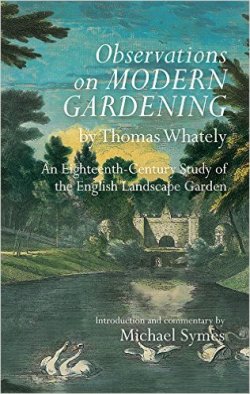 Thomas Whately’s Observations on Modern Gardening (1770) is the first and most comprehensive study of what has come to be known as the English landscape garden, often claimed to be this country’s greatest original contribution to the fine arts. It became the standard text on the subject; its authority was accepted at home and abroad, and the book was read widely across Europe, mainly in a French translation. It influenced taste and design; taught visitors how to respond to gardens; analysed natural and built elements of the garden; suggested principles of design; and provided descriptions of major gardens of the day, such as those at Blenheim and Piercefield (Monmouthshire), together with the author’s responses, aesthetic, mental and emotional. It indicates a taste for the natural and the ‘picturesque’, foreshadowing romanticism. This first modern edition of the text is accompanied by an introduction and full commentary, covering both general considerations and specific points and topics. Contemporary illustrations have been chosen to illuminate further the gardens and places discussed.
Michael Symes is an author, lecturer and garden historian. He founded the MA in Garden History at Birkbeck, University of London, and specialises in eighteenth-century gardens in Britain and on the continent.
C O N T E N T S
1 Introduction
2 Observations on Modern Gardening by Thomas Whately
3 Latapie and Whately
4 Commentary
Further Reading
Index of Place Names
New Book | Jacobites: A New History of the ’45 Rebellion
From Bloomsbury:
Jacqueline Riding, Jacobites: A New History of the ’45 Rebellion (London: Bloomsbury, 2016), 608 pages, ISBN: 978-1608198047, £25.
 The Jacobite Rebellion of 1745–46 is one of the most important turning points in British history–in terms of national crisis every bit the equal of 1066 and 1940. The tale of Charles Edward Stuart, ‘Bonnie Prince Charlie’, and his heroic attempt to regain his grandfather’s (James II) crown remains the stuff of legend: the hunted fugitive, Flora MacDonald, and the dramatic escape over the sea to the Isle of Skye. But the full story—the real history—is even more dramatic, captivating, and revelatory.
Much more than a single rebellion, the events of 1745 were part of an ongoing civil war that threatened to destabilize the British nation and its empire. The Bonnie Prince and his army alone, which included a large contingent of Scottish highlanders, could not have posed a great threat. But with the involvement of Britain’s perennial enemy, Catholic France, it was a far more dangerous and potentially catastrophic situation for the British crown. With encouragement and support from Louis XV, Charles’s triumphant Jacobite army advanced all the way to Derby, a mere 120 miles from London, before a series of missteps ultimately doomed the rebellion to crushing defeat and annihilation at Culloden in April 1746—the last battle ever fought on British soil. Jacqueline Riding conveys the full weight of these monumental years of English and Scottish history as the future course of Great Britain as a united nation was irreversibly altered.
Dr Jacqueline Riding specialises in eighteenth- and early nineteenth-century British history and art. She read History and Art History at the universities of Leicester, London and York, and has over twenty-five years’ experience working as a curator and consultant within a broad range of museums, galleries and historic buildings, including the Guards Museum, Tate Britain and Historic Royal Palaces. From 1993 to 1999 she was Assistant Curator at the Palace of Westminster and later founding Director of the Handel House Museum, London. Her publications include Houses of Parliament: History, Art, Architecture (2000). She was the consultant historian and art historian on Mike Leigh’s award-winning Mr. Turner (2014) and is the consultant historian on his next feature film, Peterloo. Jacqueline Riding is an Associate Research Fellow in the School of Arts, Birkbeck College, University of London and lives in South London.
Call for Nominations | Top 100 British Art Books, 1600–1850

John Carter, View of the Library at Strawberry Hill, watercolour, 23.7 × 28.8 cm, from Horace Walpole, A Description of the Villa … at Strawberry-Hill (Strawberry Hill, 1784). The Lewis Walpole Library, Yale University.
◊ ◊ ◊ ◊ ◊
The 100 Most Important Books for Understanding British Art, 1600–1850
Nominations due by 1 June 2016
As a cooperative initiative with Choice Magazine, the Historians of British Art (HBA) is working to assemble a list of the most important books for understanding British art produced between 1600 and 1850. The project, which will result in a bibliographic review essay for Choice, is particularly aimed at strengthening library holdings, and so nominations of studies broad in scope or significance are especially encouraged. In addition to studies of paintings, sculpture, and print culture, scholarship addressing country houses, gardens, decorative arts, patronage, and the history of exhibitions and collections for the period are welcome. Exhibition catalogues, historiographical studies, and works that situate British art within international contexts are also welcome. Books published within the past 10–20 years will anchor the final list, but nominations of titles from any period are eligible. Self-nominations are entirely appropriate. Don’t be shy. Nominate early and often!
Nominations may be submitted at the HBA website or emailed directly to HBA president, Craig Hanson, Top100BritishArtBooks@gmail.com. Nominations due by June 1.
New Book | Órdenes y espacio: sistemas de expresion
From Artbooks.com:
Esther Alegre Carvajal and Consuelo Gómez López, Ordenes y espacio: sistemas de expresion de la arquitectura moderna, siglos XV–XVIII (Madrid: UNED, 2016), 311 pages, ISBN: 978-8436269970, 30€ / $58.
 Un recorrido por la arquitectura y el urbanismo europeos de la Edad Moderna nos muestra un lenguaje arquitectónico vinculado al Clasicismo, que con la articulación de los órdenes clásicos, sus normas y sus proporciones crea espacios arquitectónicos y urbanos para los usos culturales, ideológicos y políticos del momento. Con este encuadre es necesario centrarse en el estudio del lenguaje de los órdenes arquitectónicos y los debates teóricos que surgieron durante los siglos XV al XVIII; el proceso de configuración formal y simbólico del espacio arquitectónico y su interpretación historiográfica; la creación de tipologías arquitectónicas, la relación entre el edificio y su espacio urbano; cómo influyeron las fuentes impresas y su circulación en la configuración de tipologías y modelos espaciales, o la recepción y aplicación que tuvo el Clasicismo como un sistema arquitectónico válido en los diferentes territorios europeos.
Exhibition | Freemasonry
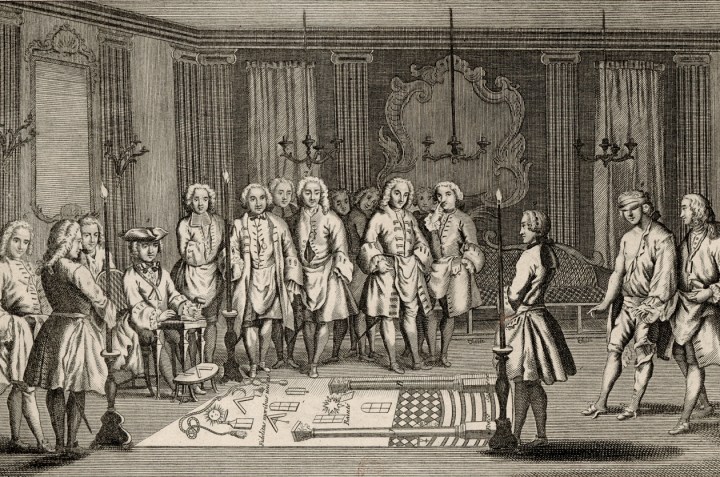
Assemblée de Francs-Maçons pour la réception des Maîtres, 1745
◊ ◊ ◊ ◊ ◊
Now on view at the BnF:
Freemasonry
Bibliothèque Nationale de France, Paris, 12 April — 24 July 2016
Curated by Pierre Mollier, Sylvie Bourel, and Laurent Portes
The Bibliothèque nationale de France, which houses one of the most important Masonic collections in the world, organizes a major exhibition dedicated to French freemasonry, in partnership with the Musée de la franc-maçonnerie. Over 450 pieces are presented, some of them for the first time ever. Some of these pieces belong either to the library’s collections or to major French obediences. Others were exceptionally lent by foreign owners. The exhibition focuses on the following issues: the origins of freemasonry, how it was founded in France, its symbols and rituals, its involvement in the political, religious, artistic and philosophical fields, the variety of associated legends… Its aim is to present freemasonry as an accessible issue.
The exhibition website is available here»
◊ ◊ ◊ ◊ ◊
Pierre Mollier, Sylvie Bourel, et Laurent Portes, La franc-maçonnerie (Paris: Bibliothèque Nationale de France, 2016), 344 pages, ISBN: 978-2717726992, 45€.
 À partir du XVIIIe siècle, la franc-maçonnerie s’implante aussi profondément que durablement dans la société française. Si, de nos jours, celle-ci fait régulièrement la une des journaux, elle n’en demeure pas moins mal connue—quand elle ne nourrit pas encore d’obscurs soupçons de trafic d’influence, de complot ou d’occultisme. Publié à l’occasion de l’exposition d’une envergure sans précédent que la Bibliothèque nationale de France consacre à la franc‑maçonnerie, cet ouvrage est appelé à devenir l’une des références incontournables du domaine. Réunissant les contributions des plus grands spécialistes, il répond à la légitime curiosité dont la maçonnerie fait l’objet.
Des origines légendaires à la franc-maçonnerie moderne, dite spéculative, il retrace l’histoire de la franc-maçonnerie en faisant la part du fantasme et de la réalité. Il présente le corpus symbolique et les rites maçonniques associés à la notion, ici centrale, d’initiation. Excluant tout esprit polémique, il répertorie les réalisations politiques et sociétales de l’histoire moderne qui puisent leurs sources dans l’engagement philanthropique des maçons : les lois sur la liberté de la presse, la liberté d’association, la laïcité, l’école gratuite et obligatoire ou encore les premières bases de la protection sociale. Il relève également les inspirations maçonniques variées qui, depuis trois siècles, irriguent les arts et les lettres, de La Flûte enchantée de Mozart à Léon Tolstoï ou Rudyard Kipling, en passant, aujourd’hui, par la bande dessinée ou le roman policier. Riche par la diversité des thèmes abordés, cet ouvrage l’est enfin par son iconographie. La Bibliothèque nationale de France abrite l’un des plus importants dépôts de documents maçonniques au monde : manuscrits, estampes, livres rares y sont à la fois nombreux et d’une qualité remarquable. Ces collections exceptionnelles méritaient d’être connues et admirées au-delà du monde des chercheurs et des spécialistes ; reproduites ici, parfois pour la toute première fois, elles contribueront désormais, de manière aussi spectaculaire que documentée, à la meilleure compréhension d’une société dont les adeptes eux-mêmes reconnaissent la complexité.
Cet ouvrage est publié à l’occasion de l’exposition «La franc-maçonnerie», organisée par la Bibliothèque nationale de France et présentée sur le site François-Mitterrand, du 12 avril au 24 juillet 2016.
New Book | Elegantiores statuae antiquae: Parole e immagini
From Artbooks.com:
Leonarda Di Cosmo and Lorenzo Fatticcioni, Elegantiores statuae antiquae: Parole e immagini per una fruizione ‘turistica’ dell’Antico nella Roma del Settecento (Rome: Bentivoglio, 2016), 350 pages, ISBN: 978-8898158553, 40€ / $70.
 Legato al genere degli ‘atlanti’ statuari, il volumetto Elegantiores statuae antiquae in variis romanorum palatiis asservatae di Dominique Magnan (1731–1796), offrendo una selezione aggiornata delle più apprezzate statue antiche, si connota come uno dei numerosi canali di divulgazione della cultura antiquaria operativi nel secondo Settecento. Organizzando il testo secondo strategie comunicative mutuate dalle più aggiornate ‘guide di Roma’ e coniugando nell’apparato iconografico le immagini di consolidate e nuovissime eccellenze statuarie, Magnan realizza un prodotto editoriale nuovo e di sicuro impatto commerciale. Configurate dunque come un’antologia del ‘più bello’ delle collezioni romane di antichità e quasi anticipando le rubriche ‘da non perdere’ o ‘vale il viaggio’ delle guide turistiche a noi contemporanee, le Elegantiores si proponevano come un agile prontuario che poteva essere acquistato ad accompagnamento di altri prodotti dell’ ‘industria’ culturale basata sull’Antico.
Leonarda Di Cosmo e Lorenzo Fatticcioni, studiosi di Storia dell’Archeologia Classica, svolgono la loro attività di ricerca presso la Scuola Normale Superiore di Pisa. Si occupano in particolare di antiquaria e di ‘fortuna dell’Antico’, di Storia del Collezionismo e, in parallelo, di Metodologie Informatiche applicate ai Beni Culturali. In quest’ultimo settore si dedicano alla progettazione di banche dati per la gestione di fonti storico-artistiche e documentarie e di siti web per la Museologia e la Comunicazione del Patrimonio Culturale. Hanno coordinato, tra l’altro, i progetti Monumenta Rariora. Metamorfosi dell’Antico, sulla fortuna della statuaria antica in età moderna e Arretinum Museum, sulla storia del collezionismo di antichità in territorio aretino. Tra le loro pubblicazioni più recenti si segnalano i volumi Le componenti del classicismo secentesco: Lo statuto della scultura antica e Le regole della bellezza: Saperi antiquari e teorie dell’arte nei ‘Segmenta nobilium signorum et statuarum’ di François Perrier.
New Book | The Mansion House, Dublin
Published by Four Courts Press:
Mary Clark, ed., The Mansion House, Dublin: 300 Years of History and Hospitality (Dublin: Four Courts Press, 2015), 180 pages, ISBN: 978-1907002199, €25 / $65.
 Dublin’s Mansion House is the only mayoral residence in Ireland and is older than any surviving in Great Britain. Originally the town house of merchant and property developer Joshua Dawson, it was purchased by the Dublin City Assembly in April 1715 and since then has been the home of each lord mayor during their term of office. This is the first major work on the Mansion House and includes essays on its history, architecture, and antique furnishings, along with an account of one year in the residence, which gives a vivid picture of how the building is used.
Mary Clark is the Dublin City Archivist and is curator of the Dublin Civic Portrait Collection. Fanchea Gibson is the Administrator of the Mansion House and oversees the day-to-day running of the mayoral residence. Nicola Matthews is architectural Conservation Officer with Dublin City Council and her research interests include the historic fabric of Merrion Square. Susan Roundtree was Senior Executive Architect with Dublin City Council and was responsible for the care and conservation of the Mansion House. Patricia Wrafter is Senior Executive Council and is responsible for the historic furnishings of the Mansion House.
New Book | Frederick de Wit and the First Concise Reference Atlas
From Brill:
George Carhart, Frederick de Wit and the First Concise Reference Atlas (Leiden: Brill, 2016), 600 pages, ISBN: 978-9004299030, 125€ / $162.
 This book is about the life and work of Frederick de Wit (1629–1706), one of the most famous dealers of maps, prints and art during the Dutch Golden Age, and his contribution to the dissemination of the knowledge of cartography. The Amsterdam firm of Frederick de Wit operated under the name ‘De Witte Pascaert’ (‘The White Chart’) from 1654 to 1710. It offered all kinds of printing and was one of the most successful publishers of maps and prints in the second half of the seventeenth century. The description of De Wit’s life and work is followed by an in-depth analysis and dating of the atlases and maps issued under his name.
After a career in yacht, boat, and historic building restoration and a stint in the army, George Carhart began his second career in academia with a BA in history from the University of Southern Maine. The history of cartography has been a central point of his interests. After receiving his BA in 1998 he joined the staff at the Osher Map Library and Smith Center for Cartographic Education, working there as the assistant curator. After leaving the Osher Map Library in 2006 to complete his doctoral work, he has continued to research, publish, and teach in the field of cartographic history. Since receiving his PhD from the University of Passau in 2011, he has worked on projects at several universities including Dresden University of Technology and Trinity College Dublin.
C O N T E N T S
Acknowledgments
Introduction
1 Frederick de Wit’s Biography and His Business
2 The First Modern World Atlas
3 Frederick de Wit’s New Concise Reference Atlas
4 Today’s Bibliographic Methods Collide with Printing and Publishing Methods of the Early Modern World, 1577–1800
5 Dating De Wit’s Maps and Atlases
6 De Wit’s Legacy
7 The Cartographic Origins of De Wit’s Maps
8 Conclusion
Overview of the atlases published by De Wit
Cartobibliography of maps in De Wit’s atlases
List of consulted libraries
Acknowledgement of the illustrations
A fully detailed table of contents is available here»










 Enfilade
leave a comment