New Book | Swedish Desire: Centuries of Luxury Consumption
From the Centre for Fashion Studies at Stockholm University:
Paula von Wachenfeldt and Klas Nyberg, eds., Det svenska begäret: sekler av lyxkonsumtion (Stockholm: Carlsson Bokförlag, 2015), 315 pages, ISBN: 978-9173316712, 255kr.
 With essays by Paula von Wachenfledt, Klas Nyberg, Marjatta Rahikainen, Kirsi Vainio-Korhonen, Håkan Jakobsson, Carolina Brown, Leif Runelfelt, Helena Kåberg, Louise Wallenberg, and Ulrika Berglund, this collection of essays The Swedish Desire: Centuries of Luxury Consumption is the first academic Swedish book on luxury history and development between the seventeenth and the first half of the twentieth century. There are few things that can create so much debate and resentment as the topic of luxury. As much as it creates well-being and comfort for its owner, luxury can also be a needle in the eye of the viewer. And as much as it can be an aesthetic expression, it remains a bitter reminder of social ills. As in most Western societies, Sweden has been an interesting arena for all kind of luxury parades and consumption and, not least, resistance. This book illustrates different historical examples of luxury use, human desire, and bitterness.
The editors of the book are senior lecturer Paula von Wachenfeldt and Professor Klas Nyberg at the Centre for Fashion Studies, Stockholm University.
◊ ◊ ◊ ◊ ◊
Beteckningen Det svenska begäret avser att visa att fenomenet lyx vinner på att betraktas som ett dynamiskt element i sitt historiska, kulturella och samhälleliga sammanhang. 1600-, 1700- resp. 1800-talen har haft olika välbeställda grupperingar som skilt ut sig genom olika typer av lyx: slottsbyggen, lyxig klädsel och heminredning; stora egendomar och nybyggnation. I boken utforskas lyxens svenska historia från nya infallsvinklar med utgångspunkt i aktuell forskning av historiker, konst- och modevetare. Här skrivs om manlig resp. kvinnlig lyx i förordningar och modeartiklar; hur svensk aristokrati beställde lyxartiklar som kalescher och karosser; hur spetsar – den vita lyxen – demonstrerade välstånd; hur indigoblått markerade god ekonomi; hur borgerliga värderingar och ideal tar sig uttryck i lyxens tjänst. Hur lyx och begär demonstrerades i svensk film på 1910–1940-talen; hur medelvägens lyx i form av franska hantverkstraditioner passade in i det svenska folkhemmet etc.
Paula von Wachenfeldt, docent, modevetare, litteraturvetare universitetslektor vid Centrum för modevetenskap, Stockholms universitet, redaktör och författare i boken.
Klas Nyberg, modevetare och professor i nationalekonomi vid Södertörns Högskola. Professor i ekonomisk historia vid Uppsala universitet och professor vid Centrum för modevetenskap, Stockholms universitet. redaktör och författare i boken.
Exhibition | The Empress and the Gardener
Press release from Hampton Court:
The Empress and the Gardener
Hampton Court Palace, London, 28 April — 4 September 2016
Curated by Sebastian Edwards
 A remarkable collection of watercolour paintings and drawings once owned by the Empress Catherine the Great of Russia will go on show at Hampton Court Palace this spring, as part of the nationwide commemorations marking the 300th anniversary of Lancelot ‘Capability’ Brown’s birth. Never displayed before, the exhibition of almost 60 intricately detailed views of the palace, park and gardens vividly captures Hampton Court during the time when Capability Brown served there as Chief Gardener to King George III. The intriguing history of this collection, which lay forgotten in the stores of the State Hermitage Museum in St Petersburg, Russia for over two centuries, will be explored in The Empress and the Gardener.
Arguably Britain’s most famous landscape gardener, Capability Brown served as Chief Gardener to King George III at Hampton Court Palace from 1764 to 1783. The job came with a handsome salary and residence at the palace, but Brown, who famously transformed landscapes across the country, actually did very little to change the palace’s Baroque formal gardens, choosing instead to preserve them out of respect for his predecessors. Nevertheless, by the time he moved into royal service, he was already operating a busy landscaping business, and winning international acclaim as one of the most famous proponents of the ‘English Style’ of landscape design.
Famously a voracious consumer of foreign culture, Catherine the Great was a great admirer of all things English, declaring to the philosopher Voltaire that “Anglo-mania rules my plantmania.” She built herself an ‘English Palace’ and ‘English Park’ at her palace at Peterhof, with the help of British designers but was unable to find a Capability Brown of her own. Seizing a lucrative opportunity, a figure in the shadows, John Spyers, assistant to Brown, sold two albums of his detailed drawings from Brown’s home and workplace, Hampton Court Palace, to the Empress for the huge sum of 1,000 roubles.
Quite how Spyers managed to achieve this extraordinary coup remains a mystery, but ironically the Empress found herself the possessor of an album of drawings of a palace landscape which Brown himself had barely touched. The albums, which alone had cost Catherine a tenth the price of creating her new gardens, disappeared in her collection at the Hermitage (now the State Hermitage Museum) and lay forgotten for over two centuries before being rediscovered by Hermitage curator Mikhail Dedinkin in 2002.
Today, the Spyers views are a unique survival: the richest and most revealing record of how Hampton Court gardens looked when Brown was in charge. Together they are considered one of the most complete visual records of any historic landscape ever captured before the dawn of photography. From rare glimpses of the ordinary people who lived in or visited the palace and its gardens, to evocative details of Hampton Court’s celebrated courtyards, passageways and picturesque corners, they explore an almost-forgotten period in the palace’s history in vivid detail.
The Empress and the Gardener will see these rare works go on public display for the first time, in the very setting that inspired their creation. The exhibition will also feature contemporary portraits of Capability Brown and the Empress Catherine, previously unseen drawings of Catherine’s ‘English Palace’ in the grounds of Peterhof near St. Petersburg and several pieces of the famous ‘Green Frog’ dinner service, a triumph of British design created for the Empress by Wedgwood, featuring images of some of the celebrated landscapes where Brown worked across England.
Sebastian Edwards, exhibition curator, said, “We are thrilled to be able to present this remarkable window into a forgotten Georgian era in the palace’s past, in the year when garden lovers up and down the country are celebrating the 300th anniversary of Capability Brown’s birth. We hope that after enjoying The Empress and the Gardener our visitors will follow in John Spyers’s footsteps, out into Hampton Court’s magnificent gardens and discover how they have changed over the centuries.”
◊ ◊ ◊ ◊ ◊
From Artbooks.com:
Mikhail Dedinkin and David Jacques, The Hampton Court Albums of Catherine the Great, (London: Fontanka 2016), 160 pages, ISBN: 978-1906257224, £32 / $45.
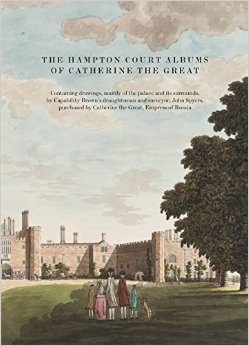
This album publishes, for the very first time, 100 hitherto unknown watercolours/drawings of Capability Brown’s designs for Hampton Court Palace gardens. These were purchased by Empress Catherine the Great of Russia through her own gardener James Meader, a disciple of Capability Brown, and then forgotten in the Hermitage stores. John Spyers, the artist to whom the albums have been attributed by Hermitage curator Mikhail Dedinkin, was Brown’s surveyor. Catherine the Great paid the huge sum of 1,000 roubles for them in the early 1780s and they were clearly bought as Capability Brown drawings. Almost no other visual material about Hampton Court and its gardens and park at the period when Lancelot ‘Capability’ Brown was the resident Royal Gardener has survived, so the importance of these views, which have never been published or on exhibition before, cannot be overstated.
New Book | The Philip Johnson Glass House: An Architect in the Garden
From Rizzoli (for anyone thinking about where Capability Brown’s ideas lead in the twentieth century) . . .
Maureen Cassidy-Geiger, with a foreword by Charles A. Birnbaum and photography by Peter Aaron, The Philip Johnson Glass House: An Architect in the Garden (New York: Skira Rizzoli, 2016), 224 pages, ISBN: 978-0847848362, $55.
 The first authoritative book on the history of the Glass House property—Philip Johnson’s fifty-year project of iconic modernist design, encompassing the remarkable buildings, landscape, and follies. From its completion in 1949 to the present day, Philip Johnson’s Glass House has drawn cognoscenti and the curious from around the world to New Canaan, Connecticut, to experience what might be the most photographed modernist residence in America. The property—an architectural playground on forty-seven acres with eleven Johnsonian follies dating from 1949 to 1995—is an icon of twentieth-century architectural and landscape design. The book chronicles how Philip Johnson and David Whitney, the architect and the plantsman, lived on the property for decades and used the landscape as an ever-changing canvas for their designs—the result of a unique synthesis of influences and ideas from across history and geography. New research reveals Johnson’s and Whitney’s interaction with the landscape and the evolution of the site from a five-acre parcel to a world-renowned gentlemanly estate for modern times. The Philip Johnson Glass House—beautifully illustrated with vintage and commissioned photography—will be a must-have for connoisseurs of architecture, landscape design, photography, and social history.
Maureen Cassidy-Geiger is an internationally recognized curator, scholar, and educator with expertise in European decorative arts, gardens, photography, and the history of architecture.
Charles A. Birnbaum, FASLA FAAR, is president and CEO of the Cultural Landscape Foundation in Washington, D.C.
New Book | The Secret Life of the Georgian Garden
Forthcoming from I. B. Tauris:
Kate Felus, with a foreword by Roy Strong, The Secret Life of the Georgian Garden: Beautiful Objects and Agreeable Retreats (London: I. B. Tauris, 2016), 240 pages, ISBN: 978-1784535728, $28 / £18.
 Georgian landscape gardens are among the most visited and enjoyed of the UK’s historical treasures. The Georgian garden has also been hailed as the greatest British contribution to European Art, seen as a beautiful composition created from grass, trees and water—a landscape for contemplation. But scratch below the surface and history reveals these gardens were a lot less serene and, in places, a great deal more scandalous. Beautifully illustrated in colour and black and white, this book is about the daily life of the Georgian garden. It reveals its previously untold secrets from early morning rides through to evening amorous liaisons. It explains how by the eighteenth century there was a desire to escape the busy country house where privacy was at a premium and how these gardens evolved aesthetically, with modestly-sized, far-flung temples and other eye-catchers, to cater for escape and solitude as well as food, drink, music and fireworks. Its publication coincides with the 2016 tercentenary of the birth of Lancelot ‘Capability’ Brown, arguably Britain’s greatest ever landscape gardener, and the book is uniquely positioned to put Brown’s work into its social context.
Kate Felus is a garden historian and historic landscape consultant. She researches designed landscapes of all periods, specializing particularly in eighteenth- and early nineteenth-century parks and gardens.
Exhibition | Jannis Kounellis at Monnaie de Paris
From the Monnaie de Paris:
Jannis Kounellis
Monnaie de Paris, 11 March — 30 April 2016
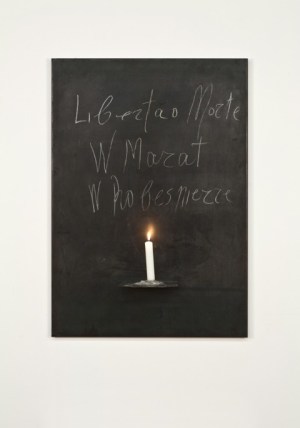
Jannis Kounellis, Libertà o Morte. W Marat W Robespierre, 1969.
At Monnaie de Paris (the Paris Mint), Jannis Kounellis has composed a dramatic sculpture throughout the thousand square metres of the 18th-century exhibition rooms of this Palace beside the Seine. Eminently present, concrete, irreducible, the new exhibition by Kounellis imposes a direct experience on visitors, without intermediaries.
“I come to Paris empty-handed, like an old painter.” This is what Kounellis said a few months ago in response to the invitation by Monnaie de Paris, which hosts this figure of contemporary art, at the origin of the Arte povera movement. As a painter, Kounellis designed his exhibition at Monnaie de Paris as a fresco. He had already, in 1972, crossed the boundaries of painting with Da inventare sul posto, a work accompanied by a dancer and a violinist.
In the 18th-century Monnaie de Paris salons, the paintings are staged through an installation of metal trestles. This army of cold metal will captivate visitors with its size and the contrast with the architecture and décor of the Palace: columns, marble, ornaments, gilt…
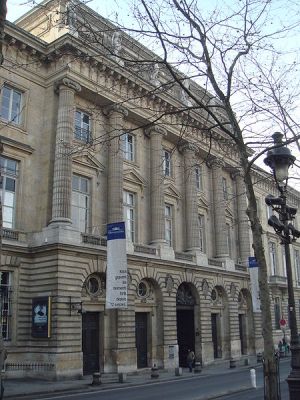
Jacques-Denis Antoine, Hôtel de la Monnaie, 1767–75
(Photo: Wikimedia Commons)
Jannis Kounellis offers a true experience to visitors. He had already positioned living energy alive, animal or human, at the centre of his work with the incomparable 12 live horses in 1969. But also in Nabucco in 1970 or quarters of hanging meat, or the Stommeln Pullheim Synagogue exhibition where fish evolved into a plate threatened with a knife in 1991.
Kounellis is inspired by Monnaie de Paris, the oldest company in the world and part of the heart of the last factory in Paris where know-how and industry intermingle to create his ‘new project’. The artist appeals to the visitor and raises the question of how a work is produced. It is in the technique, in the craft of the workshops, in the intuitive use of shapes and at the modelling stage that the artist’s project for Monnaie de Paris is born. The work Libertà o Morte. W Marat W Robespierre, 1969 will be presented in the exhibition as well as Da inventare sul posto which will echo the beating heart of the coin presses of Monnaie de Paris, embodying the strength, the rhythm, the orchestration.
A special public program will be performed by Etel Adnan with poetry and musical sessions on 17 March and 28 April at 7pm. Transmitted live on RAM Radioartemobile and broadcast on the Monnaie de Paris website, these rendez-vous will form part of a unique selection of radio archives.
Christophe Beaux, Jannis Kounellis, and Chiara Parisi, Jannis Kounellis (Berlin: Hatje Cantz, 2016), 64 pages, ISBN 978-3775741590, 30€. In French and English.
New Book | The Empress of Art: Catherine the Great
From Pegasus Books:
Susan Jaques, The Empress of Art: Catherine the Great and the Transformation of Russia (New York: Pegasus Books, 2016), 384 pages, ISBN: 978-1605989723, $21.
 Ruthless and passionate, Catherine the Great is singularly responsible for amassing one of the most awe-inspiring collections of art in the world and turning St. Petersburg in to a world wonder. The Empress of Art brings to life the creation of this captivating woman’s greatest legacy.
An art-oriented biography of the mighty Catherine the Great, who rose from seemingly innocuous beginnings to become one of the most powerful people in the world. A German princess who married a decadent and lazy Russian prince, Catherine mobilized support amongst the Russian nobles, playing off of her husband’s increasing corruption and abuse of power. She then staged a coup that ended with him being strangled with his own scarf in the halls of the palace, and she being crowned the Empress of Russia.
Intelligent and determined, Catherine modeled herself off of her grandfather in-law, Peter the Great, and sought to further modernize and westernize Russia. She believed that the best way to do this was through a ravenous acquisition of art, which Catherine often used as a form of diplomacy with other powers throughout Europe. She was a self-proclaimed “glutton for art” and she would be responsible for the creation of the Hermitage, one of the largest museums in the world, second only to the Louvre. Catherine also spearheaded the further expansion of St. Petersburg, and the magnificent architectural wonder the city became is largely her doing. There are few women in history more fascinating than Catherine the Great, and for the first time, Susan Jaques brings her to life through the prism of art.
Susan Jaques is a journalist specializing in art. She holds a BA in history from Stanford University and an MBA from UCLA. She is the author of A Love for the Beautiful: Discovering America’s Hidden Art Museums and lives in Los Angeles, where she’s a gallery docent at the J. Paul Getty Museum.
New Book | The Global Lives of Things
Published in December by Routledge:
Anne Gerritsen and Giorgio Riello, eds., The Global Lives of Things: The Material Culture of Connections in the Early Modern World (New York: Routledge, 2015), 266 pages, paperback ISBN: 978-1138776753, $50 / hardback ISBN: 978-1138776661, $160.
 The Global Lives of Things considers the ways in which ‘things’, ranging from commodities to works of art and precious materials, participated in the shaping of global connections in the period 1400–1800. By focusing on the material exchange between Asia, Europe, the Americas and Australia, this volume traces the movements of objects through human networks of commerce, colonialism and consumption. It argues that material objects mediated between the forces of global economic exchange and the constantly changing identities of individuals, as they were drawn into global circuits. It proposes a reconceptualization of early modern global history in the light of its material culture by asking the question: what can we learn about the early modern world by studying its objects?
This exciting new collection draws together the latest scholarship in the study of material culture and offers students a critique and explanation of the notion of commodity and a reinterpretation of the meaning of exchange. It engages with the concepts of ‘proto-globalization’, ‘the first global age’ and ‘commodities/consumption’. Divided into three parts, the volume considers in Part One, Objects of Global Knowledge, in Part Two, Objects of Global Connections, and finally, in Part Three, Objects of Global Consumption. The collection concludes with afterwords from three of the leading historians in the field, Maxine Berg, Suraiya Faroqhi and Paula Findlen, who offer their critical view of the methodologies and themes considered in the book and place its arguments within the wider field of scholarship. Extensively illustrated, and with chapters examining case studies from Northern Europe to China and Australia, this book will be essential reading for students of global history.
Anne Gerritsen is Associate Professor in the Department of History at the University of Warwick. Her previous publications include Ji’an Literati and the Local in Song-Yuan-Ming China (2007).
Giorgio Riello is Professor in the Department of History at the University of Warwick. In addition to several edited collections, he is the author of A Foot in the Past (2006) and Cotton: The Fabric that Made the Modern World (2013).
◊ ◊ ◊ ◊ ◊
C O N T E N T S
Introduction The Global Lives of Things: Material Culture in the First Global Age, Anne Gerritsen and Giorgio Riello
Part I: Objects of Global Knowledge
1 Itineraries of Matter and Knowledge in the Early Modern World, Pamela Smith
2 Towards a Global History of Shagreen, Christine Guth
3 The Coral Network: The Trade of Red Coral to the Qing Imperial Court in the Eighteenth Century, Pippa Lacey
Part II: Objects of Global Connections
4 Beyond the Kunstkammer: Brazilian Featherwork and the Northern European Court Festivals, Mariana Françozo
5 The Empire in the Duke’s Palace: Global Material Culture in Sixteenth-century Portugal, Nuno Senos
6 Dishes, Coins and Pipes: The Epistemological and Emotional Power of VOC Material Culture in Australia, Susan Broomhall
7 Encounters around the Material Object: French and Indian Consumers in Eighteenth-Century Pondicherry, Kévin Le Doudic
Part III: Objects of Global Consumption
8 Customs and Consumption: Russia’s Global Tobacco Habits in the Seventeenth and Eighteenth Centuries, Matthew P. Romaniello
9 Sugar Revisited: Sweetness and the Environment in the Early Modern World, Urmi Engineer
10 Coffee, Mind and Body: Global Material Culture and the Eighteenth-Century Hamburg Import Trade, Christine Fertig and Ulrich Pfister
Afterwords
Paula Findlen
Suraiya Faroqhi
Maxine Berg
Exhibition | Jefferson and Palladio: Constructing a New World
◊ ◊ ◊ ◊ ◊
From the Palladio Museum:
Jefferson and Palladio: Constructing a New World / Come costruire un mondo nuovo
Palladio Museum, Vicenza, 23 September 2015 — 28 March 2016
Curated by Guido Beltramini and Fulvio Lenzo
Visitors are introduced to the exhibition by a mirror reflecting the busts of Palladio and Thomas Jefferson. This raises the initial question in the show: how are forms and ideas ‘reflected’? Why, in this case, was an architect from a province in Northern Italy adopted as a model for the construction of the architecture of the New World?

Thomas Jefferson, Plan of the Rotunda of the University of Virginia (Charlottesville: Special Collections, University of Virginia Library)
The answer is linked to another fundamental question: what is Thomas Jefferson (1743–1826), the man who drafted the Declaration of Independence and was the third president of the United States, doing in a museum of architecture? The reason is that he more than any other American shaped the face of the new nation through art, architecture and regional planning. Visionary but also pragmatic, he was both a man of action and an intellectual who knew Latin and Greek. And he was convinced that the New World could only be built through reason and beauty.
Jefferson and Palladio: Constructing a New World is the first-ever exhibition dedicated to the great American Palladian in Europe. It will enable visitors to explore Jefferson’s world, his art collections, architectural designs, dreams, and also his contradictions, through drawings, sculptures, precious books, architectural models, films and multimedia. The exhibition also features 36 photographs by Filippo Romano, the result of a photographic survey specifically conducted in Virginia in Spring 2014. There are also three precious original bozzetti (models) by Antonio Canova for a statue of George Washington, commissioned by Thomas Jefferson. Visitors can enhance their experience of the exhibition by downloading a free smartphone app with descriptions by the curators and so move through the rooms accompanied by their words.
The exhibition is dedicated to the memory of Mario Valmarana, the still greatly cherished professor at the University of Virginia who devoted his life to creating bridges between Palladio’s Veneto and Jefferson’s Virginia. Sponsored by Roberto Coin, the exhibition has been made possible thanks to the support of the Regione del Veneto, the Fondazione Cariverona and Dainese, and is the result of collaboration with the Fondazione Canova di Possagno and the Stiftung Bibliothek Werner Oechslin, Einsiedeln, Switzerland. The exhibition is also part of a joint project developed with the Canadian Centre for Architecture, Montreal, which in October 2014 staged the photographic exhibition Found in Translation: Palladio-Jefferson, A narrative by Filippo Romano.
The exhibition has been curated by Guido Beltramini and Fulvio Lenzo, with the support of an Advisory Committee, chaired by Howard Burns (Scuola Normale Superiore, Pisa), and composed of James Ackerman (Harvard University), Bruce Boucher (University of Virginia), Travis C. McDonald (Corporation for Jefferson’s Poplar Forest), Damiana Paternò (IUAV, Venice), Mario Piana (IUAV, Venice), and Craig Reynolds (University of Virginia). The catalogue (available in English or Italian) is published by Officina Libraria. The exhibition layout has been designed by Alessandro Scandurra.
◊ ◊ ◊ ◊ ◊
◊ ◊ ◊ ◊ ◊
The catalogue is available from Artbooks.com:
Guido Beltramini and Fulvio Lenzo, eds., Jefferson and Palladio: Constructing a New World (Milan: Officina Libraria, 2016), 176 pages, ISBN: 9788897737780, $30.
 The catalogue offers an opportunity to acquire a deeper understanding of Jefferson’s architecture and, at the same time, leads to a clearer understanding of Palladio himself. Jefferson looked to Palladio because he was the architect of one of Europe’s few republics in which administrative power was in the hands of landed gentlemen who avoided the ostentation of princely manners and spent long periods of time in the countryside.
Thomas Jefferson (1743–1826), a cosmopolitan figure with rural roots, was a master of the knowledge of his time. He drafted The Declaration of Independence (1776), and thus founded a new view of the proper relation between governed and government. Jefferson was the architect of the new America, not just in a political sense, but in a literal sense as well. Architecture had an important place in his personal and public agenda. A self-taught architect, Jefferson buildings are among America’s most famous: Monticello, the Virginia State Capitol, and the University of Virginia are the starting points of American classical architecture. Jefferson was guided by his admiration for Palladio’s Four Books on Architecture, which provided him with key architectural forms and ideas. Palladio showed him how the admired building types of the ancient Romans could be adapted to modern purposes and provide a rational, harmonious framework for living and for building a new society.
Guido Beltramini is Director of the Centro Internazionale di Studi di Architettura Andrea Palladio, Vicenza. Fulvio Lenzo is Associate Professor in the history of architecture at the Universita IUAV di Venezia, Venice.
◊ ◊ ◊ ◊ ◊
C O N T E N T S
Palladio in America, James Ackerman
Jefferson and Palladio, Guido Beltramini
Jefferson: Architecture and Democracy, Fulvio Lenzo
Photographing Jefferson, Filippo Romano
Palladianism in America Before Jefferson, Bruce Boucher
The National Survey Grid and the American Democracy, Catherine Maumi
Jefferson’s Creation of American Classical Architecture, Richard Guy Wilson
Jefferson and the First Public Statues in the United States, Giovanna Capitelli
Canova and the Monument to George Washington, Mario Guderzo
Palladio: Materials and Building Techniques Damiana, Lucia Paterno
Jefferson Builder, Travis McDonald
Enrtries for Monticello, Virginia State Capitol, President’s House, Poplar Forest, Bremo, Barboursville, University of Virginia
Bibliography
Exhibition Checklist
New Appointment for Isabella Vitti
In January 2016, Isabella Vitti began her new position as Editor of Art History & Visual Studies at Routledge Taylor & Francis Group. She comes to the position after four years at Cambridge University Press, where she worked mainly on archaeology and Renaissance studies books—highly-illustrated projects that provided a lot of experience with image permissions, color plate sections, and high-resolution image files. Before Cambridge, Vitti worked at the Museum of Modern Art in the membership department—in her words, “an art historian’s dream!” She studied art history as an undergraduate at Wesleyan University.
Vitti stresses that most of Ashgate’s series covering the eighteenth century will continue. These include:
• The Histories of Material Culture and Collecting, 1700–1950
• Science and the Arts since 1750
• Visual Culture in Early Modernity
Routledge’s proposal guidelines are available here: Vitti’s email address is isabella.vitti@taylorandfrancis.com. She welcomes proposals for research monographs or edited collections.
New Book | Benjamin West and the Struggle to be Modern
From Merrell:
Loyd Grossman, Benjamin West and the Struggle to be Modern (London, Merrell, 2015), 256 pages, ISBN: 978-1858946412, £35 / $60.
 At the time of his death in 1820, Benjamin West was the most famous artist in the English-speaking world and celebrated throughout Europe. From humble beginnings in Pennsylvania, he had become the first American artist to study in Italy, and within a few short years of his arrival in London had been instrumental in the foundation of the Royal Academy of Arts and been appointed history painter to King George III. However, West’s posthumous reputation took a critical mauling, and today he remains one of the most neglected and misunderstood of Britain’s great 18th-century artists. As Loyd Grossman asserts in his new book, West was in the vanguard that created neoclassicism and romanticism, and among the first painters to represent the exciting and inspirational qualities of contemporary events, as opposed to events from the biblical, classical or mythological past. Most significantly, his best-known painting, The Death of General Wolfe, was a thrilling, revolutionary work that played a role in changing the course of art. In a lively, immersing text that situates West in the midst of Enlightenment thinking about history and progress, Grossman explores both why Wolfe has exercised such a magnetic grip on our imaginations for almost 250 years, and how, with this artwork, West helped to lay the foundations of a modern attitude that has affected the way we live and think ever since.
Loyd Grossman is a broadcaster, historian and journalist. He has presented a wide range of TV programmes, from Through the Keyhole and MasterChef to Loyd on Location and History of British Sculpture. Born in Massachusetts, Grossman has been based in the UK since 1975. He is involved with many charities supporting the arts, heritage and education in the UK. He is Chairman of the Heritage Alliance, Chairman of the Churches Conservation Trust and President of the National Association of Decorative and Fine Arts Societies (NADFAS). He was appointed OBE in 2003 and was awarded a Doctor of Letters degree in 2007 by the University of Chester in recognition of his heritage work. In January 2011 the University of Lincoln awarded him an honorary Doctor of Arts degree in recognition of his contribution to the cultural heritage sector. Grossman has a particular interest in eighteenth-century British art and architecture.










 Enfilade
leave a comment