Exhibition | Ships, Clocks & Stars: The Quest for Longitude

Working replicas of John Harrison’s three remarkable timekeepers (H1, H2, H3) are highlights of the Ships, Clocks & Stars exhibition at Mystic Seaport; pictured is a detail of H3. Photo by Andy Price/Mystic Seaport.
◊ ◊ ◊ ◊ ◊
Press release (20 August 2015) for the exhibition, which was earlier on display at the National Maritime Museum in Greenwich:
Ships, Clocks, and Stars: The Quest for Longitude
National Maritime Museum, Greenwich, 11 July 2014 — 4 January 2015
Mystic Seaport, Mystic, Connecticut, 19 September 2015 — 28 March 2016
Mystic Seaport proudly presents Ships, Clocks & Stars: The Quest for Longitude, on tour from England for a limited time only. The award-winning exhibition, produced by the National Maritime Museum in London and sponsored by United Technologies Corp., reveals the race to determine longitude at sea. Spurred on by the promise of rich rewards, astronomers, philosophers, and artisans—including John Harrison and his innovative timekeepers—finally solved one of the greatest technical challenges of the 18th century.
For centuries, longitude (east-west position) was a matter of life and death at sea. Ships that went off course had no way to rediscover their longitude. With no known location, they might smash into underwater obstacles or be forever lost at sea. For a maritime nation such as Britain, growing investment in long distance trade, outposts and settlements overseas made the ability to accurately determine a ship’s longitude increasingly important.
Ships, Clocks & Stars celebrates the 300th anniversary of the British Longitude Act of 1714, which offered a huge prize for any practical way to determine longitude at sea. The longitude problem was so difficult that—despite that incentive—it took five decades to solve it. Through the latest research and extraordinary, historic artifacts—many from the collection of the National Maritime Museum and never before displayed outside the UK—the exhibition tells the story of the clockmakers, astronomers, naval officers, and others who pursued the long ‘quest for longitude’ to ultimate success.
In recent years, John Harrison has been cast as the hero of the story, not least in Dava Sobel’s bestselling book Longitude: The True Story of a Lone Genius Who Solved the Greatest Scientific Problem of His Time. Ships, Clocks & Stars provides a new perspective on this famous tale. While John Harrison makes a good story and his marine sea-watch was vital to finally solving the problem of longitude, this was against a backdrop of almost unprecedented collaboration and investment. Famous names such as Galileo, Isaac Newton, James Cook, and William Bligh all feature in this fascinating and complex history. Crucially, it was Astronomer Royal Nevil Maskelyne’s observations and work on the Nautical Almanac at the Royal Observatory in Greenwich that demonstrated the complementary nature of astronomical and timekeeper methods. Combined, the two methods lead to the successful determination of longitude at sea and changed our understanding of the world.
“Mystic Seaport is very proud to bring Ships, Clocks & Stars to New England to tell this important story of scientific discovery, innovation, creativity, perseverance, and even adventure as different parties raced to find a solution,” said Steve White, president of Mystic Seaport. “This exhibit is more than the story of longitude: it is the story of human problem-solving, and it is as relevant today as it was in the eighteenth century.”
2015 Berger Prize for British Art History: James Barry’s Murals
Congratulations to Bill Pressly!
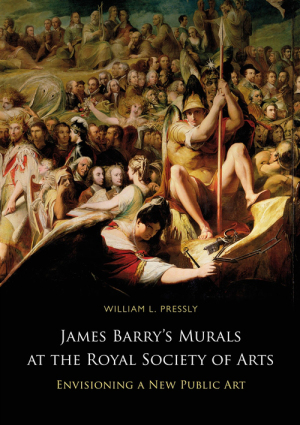 On December 7, William Pressly was awarded the 2015 William M. B. Berger Prize for British Art History for his book James Barry’s Murals at the Royal Society of Arts: Envisioning a New Public Art (Cork University Press). The book demonstrates that Barry’s RSA paintings contain a hidden meaning that has gone undetected for 230 years. The pictures offer in the heart of the London establishment a glorification of the Roman Catholic Church. The artist’s creation of a complex, mythic narrative establishes him as the mentor of William Blake, whose approach to art owes a profound debt to the Irishman’s example.
Other titles relevant to the eighteenth century on the short list included:
• Ruth Guilding, Owning the Past: Why the English collected Antique Sculpture, 1640–1840 (Yale University Press for the Paul Mellon Centre for Studies in British Art)
• Jane Munro, Silent Partners: Artist and Mannequin from Function to Fetish (Yale University Press in Association with the Fitzwilliam Museum, Cambridge)
• Malcolm Baker, The Marble Index: Roubiliac and Sculptural Portraiture in Eighteenth-Century Britain (Yale University Press for the Paul Mellon Centre for Studies in British Art)
The complete list, including the long list is available here»
Exhibition | Portals to the Past: British Ceramics, 1675–1825

William Greatbatch, Tea Canister, Soup Plate, Teapot; Fenton, Staffordshire, England, 1765–1770, cream-colored earthenware, lead glaze (Charlotte: The Mint Museum)
◊ ◊ ◊ ◊ ◊
From The Mint Museum:
Portals to the Past: British Ceramics, 1675–1825
The Mint Museum, Charlotte, North Carolina, opening 16 January 2015 (running for two years)
The Mint Museum’s collection of eighteenth-century British pottery and porcelain is widely respected for its scope and quality. The collection numbers over 2,000 objects and includes important examples of both salt-glazed and dry-bodied stoneware from Staffordshire; tin-glazed earthenware from Bristol, Liverpool, and London; and cream-colored earthenware from Derbyshire, Staffordshire, and Yorkshire. Notable eighteenth-century porcelain factories represented include Chelsea, Bow, and Vauxhall in London, Longton Hall in Staffordshire, Worcester, Bristol, and others. Individual works in the collection are exceptional because of their rarity, craftsmanship, provenance, or as representative examples of particular types or methods of production or decoration.

William Littler, Sweetmeat Stand; West Pans, East Lothian, Scotland, 1765–70, earthenware, lead glaze (Charlotte: The Mint Museum)
British Ceramics 1675–1825 presents more than 200 highlights of this collection in a new installation in the Alexander, Spangler, and Harris Galleries at Mint Museum Randolph. The objects are interpreted through a variety of thematic lenses—function, style, manufacturing technique, maker—to encourage visitors to engage with the objects in ways they find personally meaningful and interesting. The exhibition includes many objects that have never before been on view, as well as contemporaneous works of art in from the Mint’s holdings in other media, including paintings, furniture, fashion, and silver.
The exhibition’s opening follows the December release of a 270-page, illustrated catalogue, British Ceramics 1675–1825: The Mint Museum, produced by the museum in collaboration with D. Giles Limited, London. Both the catalogue and the exhibition honor the fiftieth anniversary of the museum’s purchase of the Delhom Collection of British and European ceramics.
Portals to the Past: British Ceramics 1675–1825 is presented by the Delhom Service League, ceramics affiliate of The Mint Museum, with additional support provided by Moore & Van Allen.
◊ ◊ ◊ ◊ ◊
From Giles:
Brian Gallagher, Barbara Stone Perry, Letitia Roberts, Diana Edwards, Pat Halfpenny, Maurice Hillis, and Margaret Ferris Zimmerman, British Ceramics 1675–1825: The Mint Museum (London: D. Giles Limited, 2015), 272 pages, ISBN: 978-1907804366, £50 / $80.
 British Ceramics 1675–1825 is an important and visually stunning new publication which highlights 200 of the best pieces from the The Mint Museum’s collection, selected on account of their rarity, craftsmanship, notable provenance, or as important examples of particular types, or methods of production, or decoration. Each object is illustrated in colour, and is accompanied by a catalogue entry including title, manufacturer, date, medium, marks, dimensions, description of other unique physical aspects (inscriptions or quote on the body of the vessel), provenance, previous publication history and exhibition history. Descriptive text for each piece covers unusual and pertinent aspects of its manufacture and history.
Brian Gallagher is the curator of Decorative Arts, The Mint Museum. Barbara Stone Perry is the former curator of Decorative Arts, The Mint Museum. Letitia Roberts is an independent scholar and consultant, and the former senior international specialist for European Ceramics and Chinese Export Porcelain at Sotheby’s, New York. Diana Edwards is a prolific writer and lecturer on seventeenth- and eighteenth-century British ceramics, and advises numerous ceramics organizations. Pat Halfpenny is a highly respected expert on Staffordshire pottery, and is curator emerita of Ceramics and Glass and retired Director of Museum Collections at Winterthur Museum, Delaware. Maurice Hillis has published extensively on eighteenth-century English pottery and porcelain, and is the former chairman and current president of the Northern Ceramic Society, United Kingdom. Margaret Ferris Zimmermann lectured on ceramics for the Delhom Service League’s orientation program at The Mint Museum for many years and is the former editor of the American Ceramic Circle Journal.
New Book | Furniture-Makers and Consumers in England, 1754–1851
From Ashgate:
Akiko Shimbo, Furniture-Makers and Consumers in England, 1754–1851: Design as Interaction (Farnham: Ashgate Publishings, 2015), 280 pages, ISBN: 978-0754669289, $125.
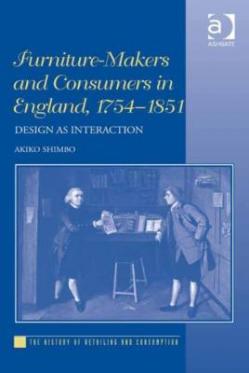 Covering the period from the publication of Thomas Chippendale’s The Gentleman and Cabinet-Makers’ Director (1754) to the Great Exhibition (1851), this book analyses the relationships between producer retailers and consumers of furniture and interior design, and explores what effect dialogues surrounding these transactions had on the standardisation of furniture production during this period. This was an era, before mass production, when domestic furniture was made both to order and from standard patterns and negotiations between producers and consumers formed a crucial part of the design and production process. This study narrows in on three main areas of this process: the role of pattern books and their readers; the construction of taste and style through negotiation; and daily interactions through showrooms and other services, to reveal the complexities of English material culture in a period of industrialisation.
Akiko Shimbo is Professor in the Department of Architecture and Environment Systems, School of Systems Engineering and Science,
Shibaura Institute of Technology, Japan.
◊ ◊ ◊ ◊ ◊
C O N T E N T S
List of Tables
List of Figures
List of Illustrations
General Editor’s Preface
Acknowledgments
1 Introduction
2 Furniture Design: Sharing Knowledge among Craftspeople
3 Pattern Books: Communicating between Producers and Consumers
4 Forming Taste and Style: Consumers’ Needs and Participation
5 The Showroom as Mediator
6 Furniture Repairs and Services: Building a Clientele
7 Taste, State and the Market: Changing Relationships between Producers and Consumers
8 Conclusion
Appendix: Pattern Books and Trade Guides (1750–1853) Consulted in this Study
Bibliography
Index
Exhibition | Light, Time, Legacy: Francis Towne’s Watercolours of Rome
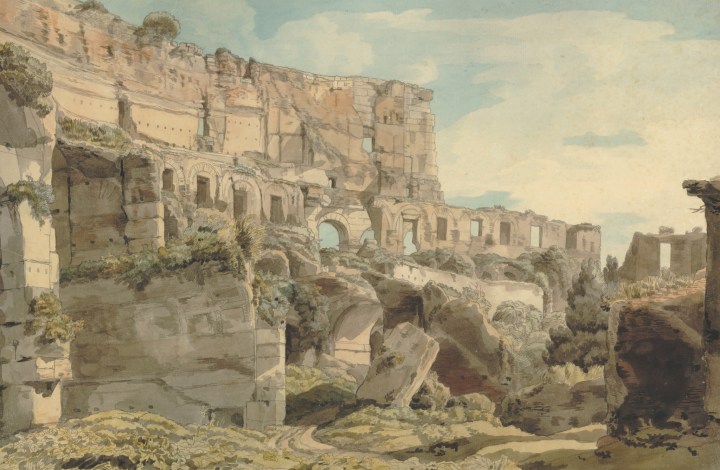
Francis Towne, Inside the Colosseum, 1780
(London: The British Museum)
◊ ◊ ◊ ◊ ◊
Press release for the upcoming exhibition:
Light, Time, Legacy: Francis Towne’s Watercolours of Rome
The British Museum, London, 21 January — 14 August 2016
Curated by Richard Stephens
2016 is the bicentenary of Francis Towne’s death and his historic bequest to the British Museum of 75 uniquely beautiful watercolours made on his visit to Italy in 1780–81. To celebrate this generous gift the watercolours are all on display here—at their heart are 52 views of Rome that have not been shown together since 1805. Towne’s decision to give the Museum such a major group of his drawings, so that they could be seen in the wider context of a collection that charted the history of the graphic arts from its Renaissance beginnings, was both strategic and pioneering as it set a pattern for artists to donate their work that endures to this day, as seen in the recent gift of 200 prints made by the American artist Jim Dine.

Francis Towne, Near the Arco Scuro, 1780, watercolour with pen and ink and some gum arabic, 320 x 467 mm (London: The British Museum)
Towne was born in London in 1739 where he later trained and then moved to Exeter. He tried unsuccessfully to gain recognition in the London art world, and failed to be elected to the Royal Academy on eleven separate occasions. Towne gained artistic recognition in his posthumous legacy at the British Museum. At the start of the 20th century, through these watercolours, Towne became the poster boy for the ‘new Georgian’ revival of interest in 18th-century art. The clarity and abstracted economy of Towne’s watercolours were not only admired by the public but also by early 20th-century modernists, and he is today recognised as one of Britain’s greatest watercolour artists.
Through Towne’s vision, the exhibition will explore Enlightenment Britain’s relationship with the classical past and Ancient Rome. Towne travelled to Rome in 1780–81 during a period of political crisis in England when America was in revolt, a French invasion of England was anticipated and a highly divisive general election had just concluded. Towne, and his social circle, viewed ancient Rome as a catastrophic precedent for what they perceived as a corrupt ruling power in England. The ruins that Towne depicted in his landscapes signified a warning to contemporary society not to suffer the same fate as the fallen Roman Empire.
Italy had a transformational effect on Towne’s work. When Towne first arrived in Rome he started making excursions north of city, making rural sketches instead of focusing on the ancient monuments. Towne’s delicate early studies were eventually replaced with large scale bolder work when Towne depicted such subjects as the Colosseum and other iconic Roman ruins. The experience of Rome was much different in the 18th century, few ruins had been excavated and tourists were free to explore them.
When Towne returned to England in 1781, these watercolours played a central role in his subsequent career. Although he was never accepted by the London art establishment, he organised an exhibition of his life’s work in 1805 with the Museum’s watercolours at its centre. Towne bequeathed the watercolours of Rome and others to the British Museum in 1816, with a further selection by his executors arriving in 1818.
A new open access catalogue raisonné of Francis Towne’s work by the guest curator of this exhibition, Dr Richard Stephens, will be published online in early 2016 by the Paul Mellon Centre for Studies in British Art.
The illustrated leaflet for the exhibition is available as a PDF file here»
◊ ◊ ◊ ◊ ◊
P R O G R A M M I N G
All events are free
Decline and Fall: Francis Towne and the Ruins of Rome
Tuesday, 26 January, 13.15–14.00, Room 90. Just drop in.
A gallery talk by exhibition curator Richard Stephens.
Light, Time, Legacy: Francis Towne’s Watercolours of Rome
Friday, 5 February, 13.30–14.15, BP Lecture Theatre. Booking essential.
Exhibition curator Richard Stephens gives a 45-minute illustrated introduction to the exhibition.
Theory and Practice in Towne’s Watercolours of Rome
Friday, 19 February, 13.15–14.00, Room 90. Just drop in.
A gallery talk by Timothy Wilcox, independent scholar.
The Selective Eye: Francis Towne’s Watercolours of Rome
Thursday, 21 April, 13.15–14.00, Room 90. Just drop in.
A gallery talk by art historian and curator Anne Lyles, independent speaker.
Magick Land? Francis Towne and His Response to Rome
Friday, 6 May, 13.15–14.00, Room 90. Just drop in.
A gallery talk by Jonny Yarker, Director of Lowell Libson Ltd.
Decline and Fall: Francis Towne and the Ruins of Rome
Wednesday, 15 June, 13.15–14.00, Room 90. Just drop in.
A gallery talk by exhibition curator Richard Stephens.
Exhibition | Turner in January
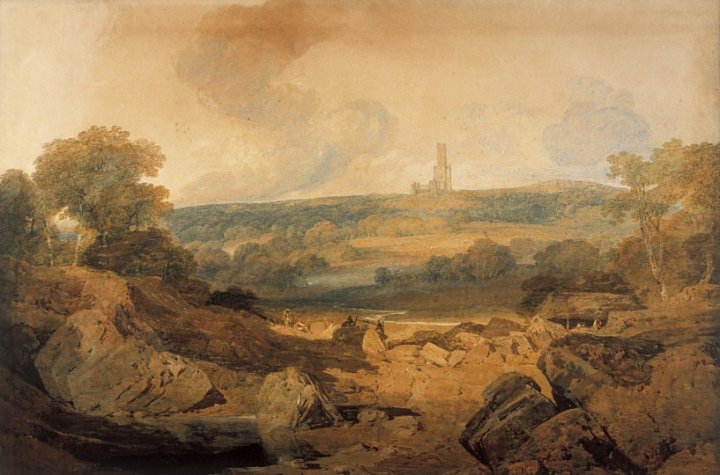
Joseph Mallord William Turner, East View of Fonthill Abbey, Noon, 1800, watercolour on paper
(Edinburgh: Scottish National Gallery)
◊ ◊ ◊ ◊ ◊
Press release for the exhibition:
Turner in January
Scottish National Gallery, Edinburgh, 1–31 January 2016
In keeping with a long-standing tradition now stretching over a century, New Year’s Day at the Scottish National Gallery will be marked by the opening of Turner in January: The Vaughan Bequest, an annual display of works by the artist Joseph Mallord William Turner (1775–1851).
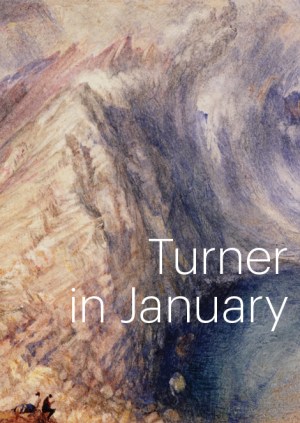 An outstanding collection by one of the great masters of British painting was bequeathed to the Gallery in 1900 by Henry Vaughan, a London art collector with a passion for Turner and a connoisseur’s eye for quality. Vaughan stipulated that the 38 exquisite works—which encapsulates the artist’s entire career—could not be subjected to permanent display, since continual exposure to light would result in their fading. Instead, these precious works were to be exhibited to the public “all at one time, free of charge, during the month of January,” when daylight in Edinburgh is at its lowest levels. Faithfully following Vaughan’s request, all of the works will be exhibited and Turner in January runs throughout the month, providing a welcome injection of light and colour during the darkest month of the year.
Clara Govier, Head of Charities at People’s Postcode Lottery (PPL), said: “This is the fourth year that players of PPL have supported Turner in January at the Scottish National Gallery, and we’re thrilled—even as relative newcomers in the grand scheme of things—to be involved in such an established tradition. It’s great for players to see that their valuable support is helping to provide thousands of visitors—some who come to see the exhibition every year, some for the very first time—with the opportunity to keep playing a part in this wonderful legacy.”
Recognised as perhaps the greatest of all British artists, Turner was born in London in 1775 and proved himself as an accomplished draughtsman while still a youth, exhibiting at the Royal Academy at the tender age of fifteen. He was a prolific and innovative artist who went on to exploit every possibility of the watercolour medium to create stunning land-and seascapes. Travelling widely, at first with sketching tours in England, Wales and Scotland and then later across Europe, Turner gathered material for masterful watercolours and oil paintings, discovering the awe-inspiring mountainous landscapes which became a major pre-occupation in his work.
Many of the works in the display reveal a youthful Turner’s artistic talents, such as the early wash drawings of the 1790s, while others show how this skill would come to be fused with the peripatetic lifestyle which dominated Turner’s life and career, resulting in colourful and atmospheric watercolour sketches of Continental Europe, such as Chatel Argent, in the Val d’Aosta, near Villeneuve (after 1836) and Falls of the Rhine at Schaffhausen, Side View (ca. 1841).
In his lifetime, Turner also managed three trips to Venice, first arriving there in 1819. The Vaughan Bequest features six of the artist’s stunning views of the city. In The Piazzetta, Venice (ca. 1835), one of Turner’s most spectacular Venetian studies, the Doge’s Palace and renowned St. Mark’s Basilica are dramatically illuminated by a bolt of lightning, an effect innovatively created by the artist by scratching away to reveal the paper once he had painted on it. Often, Turner would use his thumbnail and is reputed to have grown like an ‘eagle-claw’ for such a purpose. His third and final visit to the city in 1840 would see the artist produce a series of incredible works in which light itself appeared to have become the main subject, such as in The Grand Canal by the Salute, Venice (ca. 1840) and Venice from the Laguna (1840) where Turner’s consummate mastery of atmospheric lighting effects is clearly demonstrated.
As with many artists at the end of the 18th century, for Turner the vastness and tumultuous conditions of nature inspired senses of awe and terror. This life-long fascination—of the savageness of elemental forces—poured out of Turner’s art, namely in the form of avalanches, storms and mountainous seas. This can be seen in works from the bequest, such as Loch Coruisk, Skye (1831–34), with its miniature human figures set against a grand, stretching backdrop of painted swirls.
Turner’s Heidelberg (ca. 1846), a glowing, almost hallucinatory image of the ancient university town on the Rhine and one of his finest late works, will also be on display.
Also joining those from the bequest is the work East View of Fonthill Abbey, Noon (1800), a romantic view of the Gothic novelist William Beckford’s extraordinary cathedral-like mansion in rural Wiltshire, which was accepted by HM Government in lieu of inheritance tax in 1988 and loaned to National Trust for Scotland at Brodick Castle.
◊ ◊ ◊ ◊ ◊
Christopher Baker, J.M.W. Turner: The Vaughan Bequest (Edinburgh: National Galleries of Scotland, 2007), 120 pages, ISBN: 978-1903278895, £10.
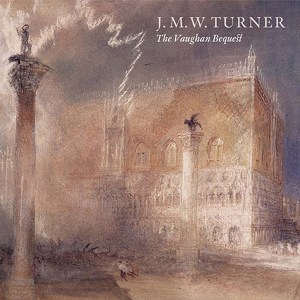 J.M.W. Turner (1775–1851) was perhaps the most prolific and innovative of all British artists. His outstanding watercolours in the collection of the National Gallery of Scotland are one of the most popular features of its collection. Bequeathed to the Gallery in 1899 by the distinguished collector Henry Vaughan, they have been exhibited, as he requested, every January for over 100 years at the National Galleries of Scotland. Renowned for their excellent state of preservation, they provide a remarkable overview of many of the most important aspects of Turner’s career.
This richly illustrated book, provides an authoritative commentary on the watercolours, taking account of recent research, and addressing questions of technique and function, as well as considering some of the numerous contacts Turner had with other artists, collectors and dealers. The introduction concentrates on Henry Vaughan, one of the greatest enthusiasts for British art in the late nineteenth century, whose diverse collections have not previously been fully studied and appreciated. The book accompanies the annual display every January of this bequest of Turner watercolours.
Exhibition | Reigning Men: Fashion in Menswear, 1715–2015
From LACMA:
Reigning Men: Fashion in Menswear, 1715–2015
Los Angeles County Museum of Art, 10 April — 21 August 2016
Powerhouse Museum, Sydney, 3 December 2016 — 12 March 2017
Saint Louis Art Museum, 25 May — 17 September 2017
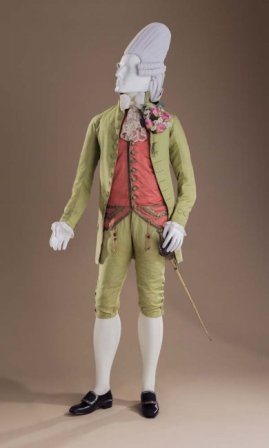
The Macaroni ensemble: Man’s Three-piece Suit, ca. 1770. Sword with Chatelaine, late 18th century. Men’s Pair of Shoe Buckles, late 18th century (LACMA)
Reigning Men: Fashion in Menswear, 1715–2015 explores the history of men’s fashionable dress from the eighteenth century to the present and re-examines the all-too-frequent equation of ‘fashion’ with ‘femininity’.
Beginning with the eighteenth century, the male aristocrat wore a three-piece suit conspicuous in make and style, and equally as lavish as the opulent dress of his female counterpart. The nineteenth-century ‘dandy’ made famous a more refined brand of expensive elegance which became the hallmark of Savile Row. The mid-twentieth-century ‘mod’ relished in the colorful and modern styles of Carnaby Street, and the twenty-first century man—in an ultra-chic ‘skinny suit’ by day and a flowered tuxedo by night—redefines today’s concept of masculinity.
Drawing primarily from LACMA’s renowned permanent collection, Reigning Men makes illuminating connections between history and high fashion. The exhibition traces cultural influences over the centuries, examines how elements of the uniform have profoundly shaped fashionable dress, and reveals how cinching and padding the body was, and is, not exclusive to women. The exhibition features 200 looks, and celebrates a rich history of restraint and resplendence.
This exhibition was organized by the Los Angeles County Museum of Art and made possible by Ellen A. Michelson. Additional support is provided by the Wallis Annenberg Director’s Endowment Fund.
◊ ◊ ◊ ◊ ◊
From Prestel:
Sharon Sadako Takeda, Kaye Durland Spilker, and Clarissa Esguerra, with contributions by Tim Blanks and Peter McNeil, Reigning Men: Fashion in Menswear, 1715–2015 (New York: Prestel, 2016), 272 page, ISBN: 978–3791355207, $55 / £35.
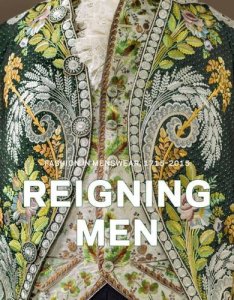
This fully illustrated book accompanies one of the most comprehensive exhibitions dedicated solely to three centuries of men’s fashion. The fashionable male may be making a comeback, but early fashion trends centered around what men—not women—were wearing. This intriguing book traces the history of men’s fashion since the 18th century, when young Englishmen imitated foreign dress and manners after touring the European continent. This phenomenon is only one of many explored in sections titled ‘Revolution/Evolution’, ‘East/West’, ‘Uniformity’, ‘Body Consciousness’, and ‘The Splendid Man’. In addition to numerous illustrations of extant menswear, the book captures the 19th-century dandy, a more restrained brand of expensive elegance which became the hallmark of Savile Row; the post-WWII mod, who relished the colorful styles of Carnaby Street; and the 21st-century man—ultra-chic in a sleek suit by day, wearing a flowered tuxedo by night. Reigning Men illuminates connections between history and high fashion, traces cultural influences over the centuries, examines how uniforms have profoundly shaped fashionable dress, and reveals that women aren’t the only ones who cinch and pad their bodies.
Sharon Sadako Takeda is Senior Curator and Head of the Costume and Textiles Department at the Los Angles County Museum of Art. Kaye Durland Spilker is Curator, and Clarissa Esguerra is Assistant Curator of the Costume and Textiles Department at the Los Angles County Museum of Art. They are the authors of Fashioning Fashion: European Culture in Detail, 1700–1915 (Prestel, 2010).
◊ ◊ ◊ ◊ ◊
Thomas John Bernard, . . . a theatrical costume designer, worked with the curators and conservators of the Costume and Textiles Department at LACMA to draw these patterns approximating the design of garments in the collection.
PDF documents with annotated patterns are available here»
New Book | Von der Kunst des sozialen Aufstiegs
From ArtBooks.com:
Almut Goldhahn, Von der Kunst des sozialen Aufstiegs: Statusstrategien und Kunstpatronage der venezianischen Papstfamilie Rezzonico (Vienna: Böhlau Verlag, 2016), 408 pages, ISBN: 978-3412503529, $135.
 Als Angehörige der ‘nobilità nuova’ hatten es die Rezzonico schwer, sich innerhalb des oligarchischen Systems der Adelsrepublik Venedig zu behaupten. Schon früh orientierten sie sich daher nach Rom, um parallel zur angestrebten Etablierung der Familie in Venedig eine familiäre Verankerung an der Kurie voranzutreiben. Dieses zweigleisige Modell sollte sich schließlich als tragfähig erweisen: 1758 wurde Clemens XIII. Rezzonico zum Papst gewählt. Über einen Zeitraum von 150 Jahren zeichnet das Buch den Aufstieg der Rezzonico von einer venezianischen Kaufmannsfamilie zu einer römischen Papstfamilie nach. Dabei werden die generationen- und systemübergreifenden Etablierungsstrategien der Familie offengelegt und mit ihrer Kunstpatronage abgeglichen, die gezielt zur visuellen Manifestierung ihres sozialen Status eingesetzt wurde. (Studien zur Kunst, 37).
Almut Goldhahn ist Wissenschaftliche Mitarbeiterin in der Photothek des Kunsthistorischen Instituts in Florenz – Max Planck Institut.
New Book | Louis XIV Outside In
From Ashgate:
Tony Claydon and Charles-Édouard Levillain eds., Louis XIV Outside In: Images of the Sun King Beyond France, 1661–1715, (Farnham: Ashgate), 231 pages, ISBN: 978-1472431264, $125.
 Louis XIV—the ‘Sun King’—casts a long shadow over the history of seventeenth- and eighteenth-century Europe. Yet while he has been the subject of numerous works, much of the scholarship remains firmly rooted within national frameworks and traditions. Thus in France Louis is still chiefly remembered for the splendid baroque culture his reign ushered in, and his political achievements in wielding together a strong centralised French state; whereas in England, the Netherlands and other protestant states, his memory is that of an aggressive military tyrant and persecutor of non-Catholics.
In order to try to break free of such parochial strictures, this volume builds upon the approach of scholars such as Ragnhild Hatton who have attempted to situate Louis’ legacy within broader, pan-European context. But where Hatton focused primarily on geo-political themes, Louis XIV Outside In introduces current interests in cultural history, integrating aspects of artistic, literary and musical themes. In particular it examines the formulation and use of images of Louis XIV abroad, concentrating on Louis’ neighbours in northwest Europe. This broad geographical coverage demonstrates how images of Louis XIV were moulded by the polemical needs of people far from Versailles and distorted from any French originals by the particular political and cultural circumstances of diverse nations. Because the French regime’s ability to control the public image of its leader was very limited, the collection highlights how—at least in the sphere of public presentation—his power was frequently denied, subverted, or appropriated to very different purposes, questioning the limits of his absolutism which has also been such a feature of recent work.
Tony Claydon is Professor of Early Modern History at Bangor University, Wales. He is author of several books including, William III and the Godly Revolution; (with Ian McBride) ed., Protestantism and National Identity: Britain and Ireland, c.1650–c.1850; William III: Profiles in Power; and Europe and the Making of England, 1660–1760.
Charles-Édouard Levillain is Professor of History at the Université Paris VII Denis Diderot, France. A historian of early modern Britain and Europe, he works primarily on Anglo-Dutch politics in the late seventeenth and early eighteenth centuries. He is author of Vaincre Louis XIV: Angleterre-Hollande-France: Histoire d’une relation tiangulaire (1665–1688) (Champ Vallon, 2010); and Un glaive pour un royaume: La querelle de la milice dans l’Angleterre du XVIIe siècle (Honoré Champion, 2014).
◊ ◊ ◊ ◊ ◊
C O N T E N T S
List of Illustrations
Notes on Contributors
Acknowledgments
Introduction: Louis XIV Upside Down? Interpreting the Sun King’s Image, Tony Claydon and Charles-Édouard Levillain
1 Image Battles under Louis XIV: Some Reflections, Hendrik Ziegler
2 Francophobia in Late-17th-Century England, Tim Harris
3 ‘We Have Better Materials for Clothes, They, Better Taylors’: The Influence of La Mode on the Clothes of Charles II and James II, Maria Hayward
4 The Court of Louis XIV and the English Public Sphere: Worlds Set Apart?, Stéphane Jettot
5 Popular English Perceptions of Louis XIV’s Way of War, Jamel Ostwald
6 Louis XIV, James II and Ireland, D.W. Hayton
7 Lampooning Louis XIV: Romeyn de Hooghe’s Harlequin Prints, 1688–89, Henk van Nierop
8 Foe and Fatherland: The Image of Louis XIV in Dutch Songs, Donald Haks
9 Amsterdam and the Ambassadors of Louis XIV 1674–85, Elizabeth Edwards
10 Millenarian Portraits of Louis XIV, Lionel Laborie
Index
New Book | The Forge of Vision: A Visual History of Modern Christianity
From the University of California Press:
David Morgan, The Forge of Vision: A Visual History of Modern Christianity (Los Angeles: University of California Press, 2015), 407 pages, ISBN: 978-0520286955, $40 / £28.
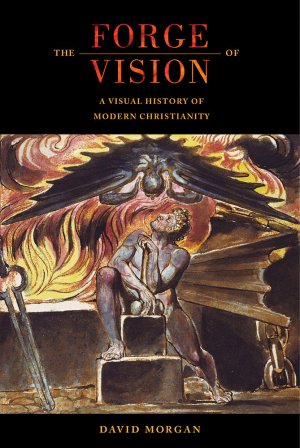 Religions teach their adherents how to see and feel at the same time; learning to see is not a disembodied process but one hammered from the forge of human need, social relations, and material practice. David Morgan argues that the history of religions may therefore be studied through the lens of their salient visual themes. The Forge of Vision tells the history of Christianity from the sixteenth century through the present by selecting the visual themes of faith that have profoundly influenced its development. After exploring how distinctive Catholic and Protestant visual cultures emerged in the early modern period, Morgan examines a variety of Christian visual practices, ranging from the imagination, visions of nationhood, the likeness of Jesus, the material life of words, and the role of modern art as a spiritual quest, to the importance of images for education, devotion, worship, and domestic life. An insightful, informed presentation of how Christianity has shaped and continues to shape the modern world, this work is a must-read for scholars and students across fields of religious studies, history, and art history.
David Morgan is Professor of Religious Studies at Duke University, with a secondary appointment in the Department of Art, Art History, and Visual Studies. He is the author of The Embodied Eye: Religious Visual Culture and the Social Life of Feeling and The Sacred Gaze: Religious Visual Culture in Theory and Practice, and coeditor of the journal Material Religion.
◊ ◊ ◊ ◊ ◊
C O N T E N T S
List of Illustrations
Acknowledgments
Introduction
I Word and Image
1 The Shape of the Holy
2 The Visible Word
II The Traffic of Images
3 Religion as Sacred Economy
4 The Agency of Words
5 Christianity and Nationhood
6 The Likeness of Jesus
7 Modern Art and Christianity
Conclusion
Notes
Selected Bibliography
Index










 Enfilade
leave a comment