New Book | Architecture at the End of the Earth
From Duke UP:
William Craft Brumfield, Architecture at the End of the Earth: Photographing the Russian North (Duke University Press, 2015), 256 pages, ISBN: 978-0822359067, $40.
 Carpeted in boreal forests, dotted with lakes, cut by rivers, and straddling the Arctic Circle, the region surrounding the White Sea, which is known as the Russian North, is sparsely populated and immensely isolated. It is also the home to architectural marvels, as many of the original wooden and brick churches and homes in the region’s ancient villages and towns still stand. Featuring nearly two hundred full color photographs of these beautiful centuries-old structures, Architecture at the End of the Earth is the most recent addition to William Craft Brumfield’s ongoing project to photographically document all aspects of Russian architecture.
The architectural masterpieces Brumfield photographed are diverse: they range from humble chapels to grand cathedrals, buildings that are either dilapidated or well cared for, and structures repurposed during the Soviet era. Included are onion-domed wooden churches such as the Church of the Dormition, built in 1674 in Varzuga; the massive walled Transfiguration Monastery on Great Solovetsky Island, which dates to the mid-1550s; the Ferapontov-Nativity Monastery’s frescoes, painted in 1502 by Dionisy, one of Russia’s greatest medieval painters; nineteenth-century log houses, both rustic and ornate; and the Cathedral of St. Sophia in Vologda, which was commissioned by Ivan the Terrible in the 1560s. The text that introduces the photographs outlines the region’s significance to Russian history and culture.
Brumfield is challenged by the immense difficulty of accessing the Russian North, and recounts traversing sketchy roads, crossing silt-clogged rivers on barges and ferries, improvising travel arrangements, being delayed by severe snowstorms, and seeing the region from the air aboard the small planes he needs to reach remote areas.
The buildings Brumfield photographed, some of which lie in near ruin, are at constant risk due to local indifference and vandalism, a lack of maintenance funds, clumsy restorations, or changes in local and national priorities. Brumfield is concerned with their futures and hopes that the region’s beautiful and vulnerable achievements of master Russian carpenters will be preserved. Architecture at the End of the Earth is at once an art book, a travel guide, and a personal document about the discovery of this bleak but beautiful region of Russia that most readers will see here for the first time.
William Craft Brumfield is Professor of Slavic Studies at Tulane University. Brumfield, who began photographing Russia in 1970, is the foremost authority in the West on Russian architecture. He is the author, editor, and photographer of numerous books, including Lost Russia: Photographing the Ruins of Russian Architecture, also published by Duke University Press. Brumfield is the recipient of a John Simon Guggenheim Memorial Fellowship and was a Fellow at the National Humanities Center. In 2002 he was elected to the State Russian Academy of Architecture and Construction Sciences, and in 2006 he was elected to the Russian Academy of Fine Arts. He is also the 2014 recipient of the D. S. Likhachev Prize for Outstanding Contributions to the Preservation of the Cultural Heritage of Russia. Brumfield’s photographs of Russian architecture have been exhibited at numerous galleries and museums and are part of the Image Collections at the National Gallery of Art in Washington, D.C.
Exhibition | The Power of Prints: The Legacy of Ivins and Mayor

Paul-César Helleu, Madame Helleu Looking at the Watteau Drawings in the Louvre, ca. 1896, drypoint, 38.8 × 51 cm (New York: The Metropolitan Museum of Art, The Elisha Whittelsey Collection, 59.599.19)
◊ ◊ ◊ ◊ ◊
Goya is the the important eighteenth-century offering here: Ivins was responsible for those acquisitions. Press release (21 January 2016) from The Met:
The Power of Prints: The Legacy of William M. Ivins and A. Hyatt Mayor
The Metropolitan Museum of Art, New York, 26 January 26 — 22 May 2016
Curated by Freyda Spira
The history of the Metropolitan Museum’s collection of works of art on paper—now one of the most important and most comprehensive in the world—began 100 years ago with the unlikely and astonishing story of its first two curators, neither of whom was trained as an art historian. Together, they challenged convention, engaged the public, and revolutionized the study of these works. Organized to commemorate the department’s centennial, the exhibition The Power of Prints: The Legacy of William M. Ivins and A. Hyatt Mayor sheds light on the fascinating careers of its founding curators and reveals how, from the very beginning, they artfully composed the print collection as a visual library: a corpus of works of art on paper—from the exceptional to the everyday. The story of this great American collection will be told through prints by Andrea Mantegna, Albrecht Dürer, Marcantonio Raimondi, Jacques Callot, Rembrandt van Rijn, Francisco de Goya y Lucientes, Honoré Daumier, James McNeill Whistler, Henri de Toulouse-Lautrec, Mary Cassatt, Edward Penfield, and Edward Hopper, among others.

Francisco de Goya y Lucientes, The Garroted Man (El agarrotado), ca. 1778–80, etching, 32.7 x 21.4 cm (New York: The Metropolitan Museum of Art, Rogers Fund, 1920, 20.22)
In 1916, William Mills Ivins (1881–1961) abandoned a successful law career to accept the job of founding curator of the Met’s Department of Prints. Although he was hired specifically to acquire the works of well-known 19th-century artists and old masters, Ivins set out instead to amass examples of technical, social, and historical interest as well. Notably, he championed the works of Goya, whose challenging and sometimes gruesome imagery was not appreciated in America at that time. Ivins first encountered these works as a student in Paris; the brutal images of war affected him profoundly and, in time, changed the course of his life. Almost all of the Met’s collection of nearly 300 Goya prints—one of the largest anywhere—was acquired by Ivins.
Before joining the Museum in 1932, Alpheus Hyatt Mayor (1901–1980) had studied modern languages, literature, and poetry, and worked as an arts critic, teacher, and occasional actor. Like Ivins, he was also an avid bibliophile with wide-ranging interests, a voracity for knowledge, and passion for social history. Brought on to assist Ivins and, eventually, to continue his legacy, Mayor expanded on Ivins’s foundational work by adding a new focus on lithography and popular prints. Pushing the boundaries of what had traditionally been collected as printed matter, he acquired for the Museum some of the most renowned American collections of popular prints. To Mayor, these items had value, because of the information they contained about all aspects of culture. He also recognized their future potential for research in diverse fields, from anthropology to urban planning.
As a result of Ivins’s and Mayor’s prescient collecting, the department now houses innumerable unique masterpieces, lauded for their exceptional artistry, as well as popular prints such as posters and trade cards that were printed in large numbers and never intended to last. By employing a conversational and colloquial tone in texts they drafted to describe these works, Ivins and Mayor transformed the way information about art objects was written. Excerpts from the writings of Ivins and Mayor will be included on labels throughout the exhibition.
To a certain extent, the history of the department is also the history of a series of extraordinary gifts and purchases of works of art. The gift of some 3,500 prints by paper manufacturer Harris Brisbane Dick led to the hiring of Ivins, to oversee them. An early gift of 10 prints by the artist Mary Cassatt came from Ivins’s friend Paul J. Sachs, assistant director at the Fogg Museum at Harvard University. (Sachs’s brother—also a friend of Ivins—gave an additional seven.) Engravings, woodcuts, and two woodblocks by Dürer entered the collection through gift and purchase from Junius Spencer Morgan, a noted collector of the artist’s works. Between 1949 and 1962, Mayor purchased more than 16,000 engravings, woodcuts, and mezzotints from Franz Joseph II, prince of Liechtenstein. The American sculptor Bessie Potter Vonnoh donated her entire collection of French and American posters of the 1890s. From Jefferson R. Burdick, the Museum received 300,000 examples of printed ephemera from the late 19th to the mid-20th century.
Just as Ivins and Mayor did, the exhibition will consider printed matter as the entrée to the information age, recognizing prints as functional objects that spread information to an ever-expanding audience and reflect a changing society. In the age of digital photography and the Internet, the power of prints, or the ability to disseminate images in identical form to a mass market, has special relevance to how we see, understand, and engage with works of art.
Arranged thematically and by technique, the exhibition has four parts. In the first section, the idea of taste is addressed in terms of Harris Brisbane Dick’s foundational gift of French, British, and American etchings and how it affected the collecting of etchings by the likes of Rembrandt and Goya. The second section considers engravings, amassed from the beginning with a focus on Renaissance artists such as Mantegna and Dürer. The third section shows the use of printed images in the spread of knowledge. Several rare early books, illustrated by woodcuts will be displayed. The books represent firsts of their kind on topics as diverse as costume, anatomy, and architecture. The final section features examples by Daumier, Toulouse-Lautrec, and other 19th-century artists whose works entered a truly mass market in the form of lithographs. Also in this section will be selected popular prints and ephemera from the late 19th and early 20th centuries.
The Power of Prints: The Legacy of William M. Ivins and A. Hyatt Mayor is organized by Freyda Spira, Associate Curator in the Metropolitan Museum’s Department of Drawings and Prints. Exhibition design is by Zoe Alexandra Florence, Exhibition Designer; graphics are by Ria Roberts, Graphic Designer; and lighting is by Clint Ross Coller and Richard Lichte, Lighting Design Managers, all of the Museum’s Design Department.
An illustrated checklist is available here»
◊ ◊ ◊ ◊ ◊
The catalogue is distributed by Yale UP:
Freyda Spira and Peter Parshall, The Power of Prints: The Legacy of William M. Ivins and A. Hyatt Mayor (New York: The Metropolitan Museum of Art, 2016), 192 pages, ISBN: 978-1588395856, $35 / £25.
 Metropolitan Museum curators William M. Ivins and his protégé A. Hyatt Mayor not only assembled a vast collection of prints, from Renaissance masterworks to ephemeral works, but also expanded the appreciation of prints as aesthetic objects, socio-historical documents, and tools of communication. More radically, by discussing these prints in accessible language, they changed our notions of how art reaches the wider public. Drawing on previously unpublished material, including personal letters and departmental records, this is the first comprehensive exploration of the lives, careers, theories, and influence of Ivins and Mayor. Also included are 120 exceptional prints that represent the breadth and depth of their acquisitions, including works by Dürer, Rembrandt, Callot, Goya, Whistler, Cassatt, and Toulouse-Lautrec.
Freyda Spira is associate curator in the Department of Drawings and Prints, The Metropolitan Museum of Art. Peter Parshall was formerly the Jane Neuberger Goodsell Professor of Art History and the Humanities at Reed College and curator and head of the Department of Old Master Prints at the National Gallery of Art, Washington, D.C.
New Book | Histories of Ornament: From Global to Local
From Princeton UP:
Gülru Necipoğlu & Alina Payne, eds., Histories of Ornament: From Global to Local (Princeton: Princeton University Press, 2016), 464 pages, ISBN: 978-0691167282, $60 / £42.
 This lavishly illustrated volume is the first major global history of ornament from the Middle Ages to today. Crossing historical and geographical boundaries in unprecedented ways and considering the role of ornament in both art and architecture, Histories of Ornament offers a nuanced examination that integrates medieval, Renaissance, baroque, and modern Euroamerican traditions with their Islamic, Indian, Chinese, and Mesoamerican counterparts. At a time when ornament has re-emerged in architectural practice and is a topic of growing interest to art and architectural historians, the book reveals how the long history of ornament illuminates its global resurgence today.
Organized by thematic sections on the significance, influence, and role of ornament, the book addresses ornament’s current revival in architecture, its historiography and theories, its transcontinental mobility in medieval and early modern Europe and the Middle East, and its place in the context of industrialization and modernism. Throughout, Histories of Ornament emphasizes the portability and politics of ornament, figuration versus abstraction, cross-cultural dialogues, and the constant negotiation of local and global traditions.
Featuring original essays by more than two dozen scholars from around the world, this authoritative and wide-ranging book provides an indispensable reference on the histories of ornament in a global context. Contributors include: Michele Bacci (Fribourg University); Anna Contadini (University of London); Thomas B. F. Cummins (Harvard); Chanchal Dadlani (Wake Forest); Daniela del Pesco (Universita degli Studi Roma Tre); Vittoria Di Palma (USC); Anne Dunlop (University of Melbourne); Marzia Faietti (University of Bologna); María Judith Feliciano (independent scholar); Finbarr Barry Flood (NYU); Jonathan Hay (NYU); Christopher P. Heuer (Clark Art); Rémi Labrusse (Université Paris Ouest Nanterre la Défense); Gülru Necipoğlu (Harvard); Marco Rosario Nobile (University of Palermo); Oya Pancaroğlu (Bosphorus University); Spyros Papapetros (Princeton); Alina Payne (Harvard); Antoine Picon (Harvard); David Pullins (Harvard); Jennifer L. Roberts (Harvard); David J. Roxburgh (Harvard); Hashim Sarkis (MIT); Robin Schuldenfrei (Courtauld); Avinoam Shalem (Columbia); and Gerhard Wolf (KHI, Florence).
Gülru Necipoglu is the Aga Khan Professor of Islamic Art and director of the Aga Khan Program for Islamic Architecture at Harvard University. She is the author of The Age of Sinan: Architectural Culture in the Ottoman Empire (Princeton) and The Topkapi Scroll: Geometry and Ornament in Islamic Architecture. Alina Payne is the Alexander P. Misheff Professor of History of Art and Architecture at Harvard University and Paul E. Geier Director of Villa I Tatti, The Harvard Center for Italian Renaissance Studies at Villa I Tatti in Florence. She is the author of The Architectural Treatise in the Italian Renaissance and From Ornament to Object: Genealogies of Architectural Modernism.
Exhibition | Hubert Robert, 1733–1808

◊ ◊ ◊ ◊ ◊
From the National Gallery of Art:
Hubert Robert (1733–1808), un peintre visionnaire
Musée du Louvre, Paris, 7 March — 30 May 2016
National Gallery of Art, Washington, D.C., 6 June — 2 October 2016
Known fondly as ‘Robert des ruines’ because of his penchant for painting ancient ruins, Hubert Robert was regarded during his lifetime as one of France’s most successful and prominent artists. In the first monographic exhibition showcasing Robert’s full achievement as a draftsman and painter, some 50 paintings and 50 drawings will chart his development in Rome and subsequent high level of accomplishment after his return to Paris. The exhibition will also focus on Robert’s lasting contribution to French visual culture and the fundamental role he played in promoting the architectural capriccio (caprice or fantasy), an art form in which famous monuments of antiquity and modernity were imaginatively combined to create striking and novel city scenes and landscapes.
◊ ◊ ◊ ◊ ◊
The English edition catalogue is published by Lund Humphries:
Margaret Morgan Grasselli with contributions from Yuriko Jackall, Guillaume Faroult and Catherine Voiriot, Hubert Robert (London: Lund Humphries, 2016), 288 pages, ISBN: 978-1848221918, £45.
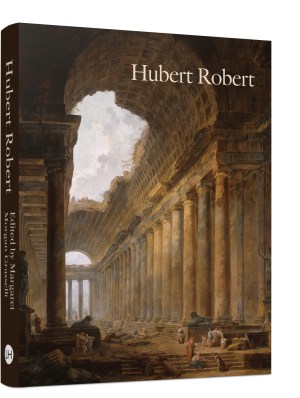 Known fondly as ‘Robert des ruines’ because of his penchant for painting ancient ruins, Hubert Robert (1733–1808) was one of France’s most successful and prominent artists during his lifetime. This outstanding publication, which accompanies the first monographic exhibition of his work, illuminates Robert’s remarkable artistic achievements and his lasting contributions to French visual culture.
Robert’s skills were manifold—he enjoyed great success as a painter, draftsman, interior decorator and garden architect. During his time in Rome, he fostered close professional bonds with artists such as Piranesi, Panini and Fragonard, while in Paris he flourished under the patronage of several wealthy French supporters including the Marquis de Marigny, brother of the famed Madame de Pompadour. Robert’s work later addressed the demise of this glittering society through both ominous scenes of disaster and representations of vandalized royalist monuments. Upon his own release from imprisonment following the French Revolution, Robert completed a series of meditative variations on the Grande Galerie of the Musée du Louvre, of which he had been appointed curator in 1784.
◊ ◊ ◊ ◊ ◊
The French edition catalogue is published by Somogy:
Guillaume Faroult, ed., Hubert Robert (1733–1808) : un peintre visionnaire (Paris: Somogy, 2016), 544 pages, ISBN: 978-2757210642, 49€.
 Hubert Robert fut l’un des créateurs les plus séduisants du siècle des Lumières. Artisan de cet art de vivre poli, galant et souriant qui paraît l’une des quintessences de l’esprit français au XVIIIe siècle, l’artiste attire d’emblée la sympathie. Il parvint à s’introduire dans les cercles les plus brillants de son temps, édifiant une carrière exemplaire dans la France de l’Ancien Régime jusqu’au règne de Napoléon.
Formé à Rome vers le milieu du siècle, en pleine fièvre antiquaire, Robert s’impose dès son retour à Paris comme « peintre d’architecture ». Le philosophe Denis Diderot célèbre aussitôt la «poétique des ruines » du jeune artiste. La production de Robert fait preuve au cours de sa carrière d’une exceptionnelle dynamique d’amplification: les œuvres, les projets, les charges y atteignent une dimension considérable. L’artiste devient très recherché pour la production de vastes ensembles de décors peints. Il se lance enfin avec succès dans une forme d’« art total » en tant que créateur de jardins, dont le parc de Méréville (de 1786 à 1793) fut sans doute le chef-d’œuvre.
Frappé par le bouleversement historique de la Révolution française, il en consigne les premières manifestations en représentant, dès l’été 1789, La Bastille dans les premiers jours de sa démolition. En 1795, il réintègre sa fonction de conservateur du «Muséum national », c’est-à-dire du musée du Louvre qui vient d’ouvrir ses portes, et dont il avait préparé activement la création. Sans aucun doute, l’œuvre de Robert est parcourue par un sens de l’écoulement inexorable du temps et, par-delà, par une conscience de la marche de l’histoire, tour à tour triomphante ou déplorable, qui en constitue l’impressionnante grandeur.
Exhibition | Mavericks: Breaking the Mould of British Architecture

William Hodges and William Pars, The Pantheon, Oxford Street, London, 1770–72, by James Wyatt, oil on canvas (Leeds Museums and Art Galleries / Temple Newsam House)
◊ ◊ ◊ ◊ ◊
Press release (8 December 2015) from the RA:
Mavericks: Breaking the Mould of British Architecture
Royal Academy of Arts, London, 26 January – 20 April 2016
Curated by Owen Hopkins
Mavericks: Breaking the Mould of British Architecture is an installation that will chart the course of British architecture from the sixteenth century to the present day through the work of twelve maverick architects: Robert Smythson, Sir John Vanbrugh, James Wyatt PRA, Sir John Soane RA, Charles Robert Cockerell RA, Charles Rennie Mackintosh, Charles Holden, H. S. Goodhart-Rendel, James Stirling RA, Cedric Price, FAT and Zaha Hadid RA.
Each of the twelve mavericks has charted his or her own course, often deliberately ignoring prevailing taste, fashion and ways of working. The installation comprises of images and photographs of these maverick architects’ work, situating their work within the broader context of architectural history, through an arresting colour-gradated design by Scott-Whitby Studio. Celebrating the original and the unorthodox, the installation will pose an intriguing alternative narrative to the history of British architecture.
◊ ◊ ◊ ◊ ◊
Owen Hopkins, Mavericks: Breaking the Mould of British Architecture (London: Royal Academy Publications, 2016), 128 pages, ISBN: 978-1910350393, £13 / $28.
The history of architecture is a story of continual innovation, and at certain points within that story come architects whose visions completely defy convention. Mavericks focuses on 12 such figures from the history of British architecture, including Sir John Soane, Charles Rennie Mackintosh, Cedric Price, and Zaha Hadid. From the stripped-back classicism of Soane’s Dulwich Picture Gallery to Hadid’s neofuturistic London Aquatics Centre for the 2012 Olympics, the architects’ work is bold, frequently controversial, and often radical. It is architecture that actively resists being pigeonholed into a particular style or period. What connects this naturally disparate group of free creative spirits is the way each has charted his or her own course, often deliberately evading conventions of taste, fashion, and ways of working. This book offers a fresh take on their creations, establishing new and sometimes surprising historical connections while proposing an intriguing alternative narrative to the history of British architecture.
Owen Hopkins is Architecture Programme Curator at the Royal Academy of Arts, London, and has written widely on architecture for The Burlington Magazine, The Architectural Review, Apollo, Dezeen, RA Magazine, C20 Magazine, The Oxonian Review, Architects’ Journal and Building Design. He is author of Reading Architecture: A Visual Lexicon (Laurence King, 2012), Architectural Styles: A Visual Guide (Laurence King, 2014) and From the Shadows: The Architecture and Afterlife of Nicholas Hawksmoor (Reaktion, 2015).
◊ ◊ ◊ ◊ ◊
E V E N T S
All events take place at the Geological Society, Piccadilly; £12 / reductions £6
Does Architecture Need Mavericks?
Thursday 4 February, 6.30–8pm
Owen Hopkins introduces the Mavericks book and installation and chairs a debate exploring the role of unorthodox approaches and original thinking in architecture.
Maverick Architects – A Thing of the Past?
Thursday 25 February, 6.30–8pm
Faced with the crushing weight of student debt and an increasingly risk-averse building industry, the panel explore if there is any future for mavericks in architecture.
After the Age of ‘Starchitects’
Monday, 7 March, 6.30–8pm
What might life be like after the signature-style, icon-obsessed—and male-dominated—age of the ‘starchitect’? The panel explores.
The Artist as Maverick Architect
Monday, 21 March, 6.30–8pm
Sean Griffiths, co-founder of FAT, one of the architects featured in Mavericks, chairs this discussion exploring the different perspectives artists can bring to the making of architecture.
Britain’s Greatest Maverick Building – The Debate
Monday, 18 April, 6.30–8pm
Do you have a favourite quirky or unusual building? Let us know on Twitter for a chance for it to be included in this debate looking for Britain’s greatest maverick building: @architecture_RA #Mavericks

New Book | Giambattista Bodoni: His Life and His World
On the occasion of the publication of Valerie Lester’s Giambattista Bodoni: His Life and His World, the first English biography of the great typographer, PRPH Rare Books and David R. Godine, Publisher invite you to an exhibit of selected Bodoni masterworks at our New York Gallery, a five-minute walk from The Grolier Club, Wednesday, January 27, 2016, 7.30–10.00pm. Light refreshments will be served. Please RSVP to news@prphbooks.com. PRPH Rare Books, 26 East 64th Street, 3rd Floor , New York, NY 10065.
A brief catalogue of nineteen items related to Bodoni is available as a PDF file here»
◊ ◊ ◊ ◊ ◊
From David R. Godine:
Valerie Lester, Giambattista Bodoni: His Life and His World (Boston: David R. Godine, 2015), 280 pages, ISBN: 978-1567925289, $40.
 A lively, lavishly illustrated biography of the great printer Bodoni, vividly describing his work, life, and times while justifying his reputation as the ‘prince of typographers’.
This is the first English-language biography of the relentlessly ambitious and incomparably talented printer Giambattista Bodoni (1740–1813). Born to a printing family in the small foothill town of Saluzzo, he left his comfortable life to travel to Rome in 1758 where he served as an apprentice of Cardinal Spinelli at the Propaganda Fide press. There, under the sponsorship of Ruggieri, his close friend, mentor, and protector, he learned all aspects of the printing craft. Even then, his real talent, indeed his genius, lay in type design and punchcutting, especially of the exotic foreign alphabets needed by the papal office to spread the faith.
His life changed when in 1768 at age 28 he was invited by the young Duke of Parma to abandon Rome for that very French city to establish and direct the ducal press. He remained in Parma, overseeing a vast variety of printing, some of it pedestrian, but much of it glorious. And all of it making use of the typefaces he personally designed and engraved.
This fine book goes beyond Bodoni’s capacity as a printer; it examines the life and times in which he lived, the turbulent and always fragile political climate, the fascinating cast of characters that enlivened the ducal court, the impressive list of visitors making the pilgrim- age to Parma, and the unique position Parma occupied, politically Italian but very much French in terms of taste and culture. Even the food gets its due (and in savory detail). The illustrations—of the city, of the press, of the types and matrices—are compelling enough, but most striking are the pages from the books he designed. And especially, pages from his typographic masterpiece, the Manuale Tipografico, painstakingly prepared by his wife Ghitta, posthumously published in two volumes, and displaying the myriad typefaces in multiple sizes that Bodoni had designed and engraved over a long and prolific career.
Intriguing, scholarly, visually arresting, and designed and printed to Bodoni’s standards, this title belongs on the shelf of any self-respecting bibliophile. It not only makes for compelling reading, it will be considered the biography of record of a great printer for years to come.
Valerie Browne Lester is an independent scholar, writer, and translator living in Boston. She is the author of Phiz: The Man Who Drew Dickens (2004), a biography of Hablot Knight Browne, Dickens’s principal illustrator who was also her great-great-grandfather. She translated Alain-Fournier’s Le Grand Meaulnes (The Magnificent Meaulnes, 2009), and has written poetry, plays, and articles.
New Book | Jacques-François Blondel
From Librairie Droz:
Aurélien Davrius, ed., Jacques-François Blondel, un architecte dans la « République des Arts » (Geneva: Librairie Droz, 2016), 752 pages, ISBN: 978-2600019514, 89€.
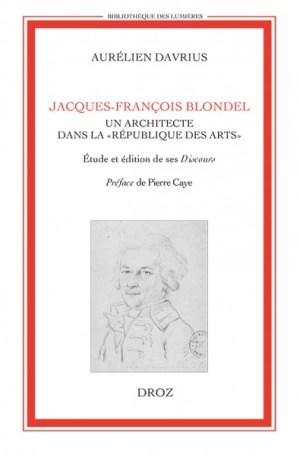 Au XVIIIe siècle, de nombreux architectes ont publié des traités ou des « Cours » sur leur art. L’un d’eux se distingue par la quantité et la qualité des livres qu’il publie : Jacques-François Blondel (1708/9–1774). Auteur majeur de la théorie architecturale, Blondel a su, au cœur des Lumières, redonner une actualité à l’architecture classique, en s’opposant à l’art rocaille qui domine alors. Pour Blondel, l’architecture possède une dimension encyclopédique – il mobilise à la fois les savoirs techniques et les différents arts –, mais aussi sociale – chacun est appelé à y participer. Les écrits de Blondel sont par ailleurs indissociables de son action pédagogique : avec la fondation de son Ecole des Arts, qui se propose de centraliser la diversité des compétences, il opère une véritable révolution pédagogique. Cet ouvrage rassemble les discours, mémoires, articles pour L’Encyclopédie et autres textes de Blondel, dans lesquels le professeur développe ses idées sur le « bon goût » en architecture. Pour la majeure partie inédits, ou jamais réédités depuis le XVIIIe siècle, ces documents renseignent sur les enjeux de l’art de bâtir au siècle des Lumières, ainsi que sur la transmission de la tradition nationale.
◊ ◊ ◊ ◊ ◊
Table des matières (more…)
New Book | The Country House: Material Culture and Consumption
Published by Historic England and distributed by The University of Chicago Press:
Jon Stobart and Andrew Hann, eds., The Country House: Material Culture and Consumption (Swindon: English Heritage, 2016), 224 pages, ISBN: 978-1848022331, £70 / $140.
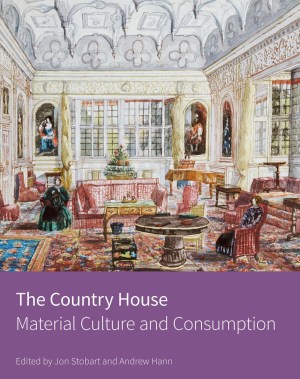 The country house has long been recognised as symbol of elite power—a showpiece demonstrating the wealth and ambition of its owner, but also their taste and discernment. Ownership of a country house distinguished the landed classes from the rest of society and signalled an individual’s arrival amongst a privileged elite. Yet, as the contributions to this book amply demonstrate, the country house in Britain and elsewhere in Europe was much more than this: it was a lived and living space, populated by family, visitors and servants. This formed the context in which decisions were made about what to buy, what to keep and what could be discarded; about what taste comprised and how it would be balanced against financial constraints or the imperatives of pedigree and heritance.
In this collection, consumption is thus explored as an active and ongoing process that involved the mundane as well as the magnificent. It drew the country house into complex and overlapping networks of supply that stretched from the local to the international. Material culture and elite identity were shaped by a cosmopolitan mixture of the everyday, the European and the exotic, thus food from the kitchen garden was served a la francaise from Chinese porcelain.
Jon Stobart is Professor of History at Manchester Metropolitan University.
Andrew Hann is Properties Historians’ Team Leader at English Heritage.
◊ ◊ ◊ ◊ ◊
C O N T E N T S
Introduction, Jon Stobart: The Country House and Cultures of Consumption
Section 1 | Elites, consumption and the country house
1. Yme Kuiper: The rise of the country house in the Dutch Republic: Beyond Johan Huizinga’s narrative of Dutch civilisation in the 17th century
2. Jane Whittle: The gentry as consumers in early 17th-century England
3. Johanna Ilmakunnas: To build according to one’s status: A country house in late 18th-century Sweden
4. Mark Rothery and Jon Stobart: Geographies of supply: Stoneleigh Abbey and Arbury Hall in the 18th century
5. Shelley Garland: The use of French architectural design books in De Grey’s choice of style at Wrest Park
Section 2 | Continuity, heritage and the country house
6. Hannah Chavasse: Fashion and ‘affectionate recollection’: Material culture at Audley End, 1762–1773
7. Hanneke Ronnes: A sense of heritage: Renewal versus preservation in the English and Dutch palaces of William III in the 18th century
8. Victor Hugo López Borges: An Anglo-Irish country house in Spain: The Palacio de Castrelos
Section 3 | Eastern connections, adoptions and imitations
9. Emile de Bruijn: Consuming East Asia: Continuity and change in the development of chinoiserie
10. Kate Smith: Imperial objects? Country house interiors in 18th-century Britain
11. Patricia F Ferguson: ‘Japan China’ taste and elite ceramic consumption in 18th-century England: Revising the narrative
12. Helen Clifford: ‘Conquests from North to South’: The Dundas property empire. New wealth, constructing status and the role of ‘India’ goods in the British country house.
Section 4 | Country house interiors as lived spaces
13. Rosie MacArthur: Settling into the country house: The Hanburys at Kelmarsh Hall
14. Susan Jenkins: Fashion and function: The decoration of the library at Kenwood in context
15. Karol Mullaney-Dignam: Useless and extravagant? The consumption of music in the Irish country house
16. Annie Gray: Broccoli, bunnies and beef: Supplying the edible wants of the Victorian country house
Section 5 | Presenting the country house
17. Nicola Pickering: Mayer Amschel de Rothschild and Mentmore Towers: Displaying ‘le goût Rothschild’
18. Anna McEvoy: Following in the footsteps of 18th-century tourists: The visitor experience at Stowe over 300 years
19. Karen Fielder: X marks the spot: Narratives of a lost country house
Exhibition | Meant to Be Shared: Prints from the Arthur Ross Collection

Giovanni Battista Piranesi, Veduta della Piazza di Monte Cavallo (View of the Piazza di Monte Cavallo [now the Piazza del Quirinale with the Quirinal Palace]), from Vedute di Roma (Views of Rome), 1750, etching (New Haven: Yale University Art Gallery, The Arthur Ross Collection).
◊ ◊ ◊ ◊ ◊
Press release (11 December 2015) from the Yale University Art Gallery:
Meant to Be Shared: Selections from the Arthur Ross
Collection of European Prints at the Yale University Art Gallery
Yale University Art Gallery, New Haven, 18 December 2015 — 24 April 2016
Samuel P. Harn Museum of Art, University of Florida, Gainesville, 29 January — 8 May 2017
Syracuse University Art Galleries, Syracuse University, 17 August — 19 November 2017
Curated by Suzanne Boorsch
The Yale University Art Gallery is delighted to announce Meant to Be Shared: Selections from the Arthur Ross Collection of European Prints at the Yale University Art Gallery, an exhibition presenting highlights of the more than 1,200 prints donated to the Gallery in 2012 by the Arthur Ross Foundation. Beginning in the late 1970s, philanthropist Arthur Ross (1910–2007) avidly collected works of art by some of the most renowned Italian, Spanish, and French printmakers of the last several centuries for his eponymous foundation. Highlights of the Arthur Ross Collection include works by Francisco Goya, the first artist whom Ross collected; Giovanni Battista Piranesi’s images of ancient and 18th-century Rome, which reflect Ross’s love of classicism and the Eternal City; and Édouard Manet’s illustrations for Edgar Allan Poe’s famous poem The Raven.
The Arthur Ross Collection comprises three major segments. The largest is a group of some 800 18th-century Italian works by Giovanni Battista Piranesi, Giovanni Antonio Canal (called Canaletto), Giovanni Battista Tiepolo and his sons, and others. A group of close to 200 prints by the Spaniard Francisco Goya includes the three intriguing and enigmatic series of etchings he made in the second decade of the 19th century, during which Spain suffered, first, Napoleon Bonaparte’s invasion, and then, with the restoration of the Bourbon monarchy, the repressive rule of King Ferdinand VII. The third segment consists of about 200 French prints by some of the greatest artists of the 19th and 20th centuries: Eugène Delacroix, Honoré Daumier, Camille Pissarro, Édouard Manet, Edgar Degas, Paul Gauguin, Henri Matisse, and Pablo Picasso.
This inaugural exhibition features 19 of Goya’s profoundly mysterious Disparates (Los proverbios) (Follies [Proverbs]) series, made around 1816 to 1819 but not published in Goya’s lifetime, for fear of the Inquisition. Ten images from the Tauromaquia (The Art of Bullfighting; 1815, published 1816) series and nine of the Desastres de la guerra (Disasters of War; ca. 1810–11, published 1863) are on display as well. The installation also highlights illustrations of great works of literature—one of the salient themes of the French work—including Delacroix’s 13 lithographs illustrating William Shakespeare’s Hamlet (1834–43) and some of his illustrations for Johann Wolfgang von Goethe’s Faust (1827, published 1828), and Manet’s truly revolutionary illustrations for Edgar Allan Poe’s The Raven (1875).
An entire gallery is devoted to views of places that might have been visited on the Italian segment of the Grand Tour, the cultural tour of Europe that was deemed an essential cap to the classical education of young gentlemen, especially those from Britain. Sparkling views of the Venetian region by Canaletto set the stage. The largest section is devoted to Rome; this part of the exhibition features a spectacular six-by-seven-foot map of the Eternal City, published in 1748, designed by the surveyor Giovanni Battista Nolli, and 20 of Piranesi’s Vedute (Views; ca. 1748–60) of Rome. The final area focuses on images of Pompeii and Paestum, in southern Italy, where in the mid-18th century rediscoveries of ancient sites excited the intelligentsia across Europe.
The title of the exhibition, Meant to Be Shared, reflects the raison d’être of the collection. Arthur Ross collected these prints for his foundation with the express purpose, in the words of his widow, Janet C. Ross, “to lend first-class prints … to educational institutions in the United States and abroad that would not otherwise have access to such objects for study and enjoyment.” In this spirit, the inaugural exhibition travels to the Samuel P. Harn Museum of Art at the University of Florida, Gainesville, in early 2017, and to the Syracuse University Art Galleries, New York, later that year. Gallery staff members have partnered with Harn Museum Director Rebecca M. Nagy and Syracuse University Art Galleries Director Domenic Iacono to plan ways to use the prints as teaching tools at each institution—including related university courses, public programs, and close-looking sessions—throughout the run of the exhibition. Suzanne Boorsch, the Gallery’s Robert L. Solley Curator of Prints and Drawings and curator of the exhibition, explains, “Far and away the most difficult aspect of preparing this exhibition was to make a selection from the abundance of riches that constitute this extraordinary donation. The possibilities that the Arthur Ross Collection offers for exhibition, research, and teaching are virtually endless, and, indeed, this inaugural exhibition and the collection catalogue are just the beginning of the rewards to be reaped by the study and enjoyment of this gift.”
The Gallery’s mission of sharing its collections broadly honors both the legacy of Arthur Ross and the value of the work he collected. Jock Reynolds, the Gallery’s Henry J. Heinz II Director, states, “We are grateful that the Arthur Ross Foundation has chosen the Gallery to be the steward of this remarkable collection, ensuring its proper care and always sharing it generously with active learners of all ages.”
◊ ◊ ◊ ◊ ◊
P R O G R A M M I N G
Gallery Talks
Wednesday, December 9, 12:30 pm
“Piranesi’s Rome: The Vision of an 18th-Century Architect and Printmaker,” Jakub Koguciuk, Ph.D. candidate in the History of Art and Renaissance Studies, Yale University
Wednesday, February 24, 12:30 pm
“Bullfighting: Audience and Perspective in Prints by Antonio Carnicero, Francisco Goya, and Pablo Picasso,” Ian Althouse, Ph.D. candidate in the Department of Spanish and Portuguese, Yale University
Wednesday, February 24, 1:30 pm
“Las corridas de toros: Audiencia y mirada en el arte de Antonio Carnicero, Francisco Goya y Pablo Picasso” (in Spanish), Ian Althouse
Wednesday, April 13, 12:30 pm
“Intensité, Obscurité, Frivolité: The Proliferation of Print Media in 19th-Century France,” Lisa Hodermarsky, the Sutphin Family Senior Associate Curator of Prints and Drawings, Yale University Art Gallery
Ryerson Lectures
Thursday, January 21, 5:30 pm
“Goya’s Prints in Context,” Janis A. Tomlinson, Director of University Museums, University of Delaware, Newark
Friday, February 5, 1:30 pm
“The Marriage of Venice and Rome, or What Makes Piranesi Great?,” Andrew Robison, the Andrew W. Mellon Senior Curator of Prints and Drawings, National Gallery of Art, Washington, D.C.
Friday, April 1, 1:30 pm
“From Paris to Tahiti: Paul Gauguin’s Innovative Prints,” Elizabeth C. Childs, the Etta and Mark Steinberg Professor of Art History and Chair of the Department of Art History and Archaeology, Washington University in Saint Louis
Performance
Thursday, March 31, 5:30 pm
Chamber Music of the 18th Century, Tiny Baroque Orchestra
Studio Programs
Friday, February 12, 1:30 and 3:00 pm
Printmaking Workshops
Inspired by the over 1,200 prints in the Arthur Ross Collection, Mauricio Cortes Ortega, M.F.A. candidate, and Caroline Sydney, SM ’16, both of Yale University, invite visitors to explore the art of printmaking. In this hands-on workshop, participants learn the basic techniques of intaglio printing and create a unique print of their own. Space is limited. Registration required; please call 203.432.9525.
◊ ◊ ◊ ◊ ◊
The catalogue is distributed by Yale UP:
Suzanne Boorsch, Douglas Cushing, Alexa Greist, Elisabeth Hodermarsky, Sinclaire Marber, John Moore, and Heather Nolin, with a foreword by Janet Ross, Meant to Be Shared: The Arthur Ross Collection of European Prints (New Haven: Yale University Press, 2016), 196 pages, ISBN: 978-0300214390, $60.
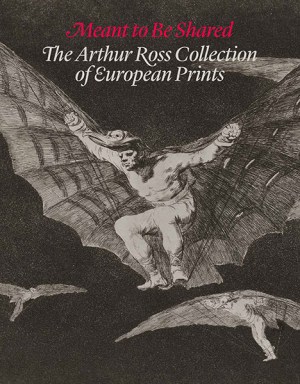 This important volume offers the first comprehensive look at the Arthur Ross Collection—more than 1,200 17th- to 20th-century Italian, French, and Spanish prints—and is published to mark the inaugural exhibition of the collection in its new home at the Yale University Art Gallery. Highlights include superb etchings by Canaletto and Tiepolo; the four volumes of Piranesi’s Antiquities of Rome, as well as his famous Vedute (Views) and Carceri (Prisons); Goya’s Tauromaquia in its first edition of 1816; an extremely rare etching by Edgar Degas; and numerous other 19th-century French prints, by Eugène Delacroix, Honoré Daumier, Édouard Manet, Paul Gauguin, Paul Cézanne, and others. The accompanying essays discuss the life of Arthur Ross, a significant philanthropist who funded several arts institutions; the formation of the collection and the art-historical significance of the works; and several thematic approaches to studying the collection, reinforcing its legacy as an important teaching resource.
New Book | An Anthology of Decorated Papers: A Sourcebook
From Thames & Hudson:
P. J. M. Marks, An Anthology of Decorated Papers: A Sourcebook for Designers (London: Thames & Hudson, 2016), 256 pages, ISBN: 978-0500518120, $60 / £38.
 Rich in ornamentation, decorated papers have been in use for centuries—as wrappers and endpapers for books, as the backing for playing cards, and even as linings for chests and cases. Yet despite the many contexts in which they can be found, they often go unnoticed. This remarkable new book not only showcases several hundred of the best and most exquisite examples of decorated paper but also provides a fascinating introduction to its history, traditions, and techniques. Drawing on the Olga Hirsch collection at the British Library, one of the largest and most diverse collections of decorated papers in the world, this beautifully produced anthology will both delight and inspire designers, bibliophiles, and anyone with a love of pattern and decoration.
P. J. M. Marks is curator of bookbindings at the British Library. Her previous books include The British Library Guide to Bookbinding, Treasures in Focus: Decorated Papers, and Beautiful Bookbindings. Her most recent publication is a chapter on selected European decorated bookbindings in The Arcadian Library: Bindings and Provenance.
◊ ◊ ◊ ◊ ◊
From the BL:
The Olga Hirsch collection of decorated papers, bequeathed in 1968, comprises over 3,500 sheets of paper and around 130 books in paper wrappers or with decorated end-leaves. There are hand-made papers from the 16th century onwards, and also later, machine-made papers. Various techniques of decorating paper are represented: there are brush-coated, sprinkled, sprayed, flock, marbled, block-printed, embossed, and metallic-varnish papers, as well as book jackets and 20th-century artists’ papers.
Mirjam Foot, “The Olga Hirsch Collection of Decorated Papers,” British Library Journal 7 (Spring 1981): 12–38, available as a PDF file here.










 Enfilade
leave a comment