New Book | Re-Interpreting Blackstone’s Commentaries
From Hart Publishing:
Wilfrid Prest, ed., Re-Interpreting Blackstone’s Commentaries: A Seminal Text in National and International Contexts (Oxford: Hart Publishing, 2014), 221 pages, ISBN: 978-1849465380, £50 / $100.
 This collection explores the remarkable impact and continuing influence of William Blackstone’s Commentaries on the Laws of England, from the work’s original publication in the 1760s down to the present. Contributions by cultural and literary scholars, and intellectual and legal historians trace the manner in which this truly seminal text has established its authority well beyond the author’s native shores or his own limited lifespan.
In the first section, ‘Words and Visions’, Kathryn Temple, Simon Stern, Cristina S. Martinez, and Michael Meehan discuss the Commentaries‘ aesthetic and literary qualities as factors contributing to the work’s unique status in Anglo-American legal culture. The second group of essays traces the nature and dimensions of Blackstone’s impact in various jurisdictions outside England, namely Quebec (Michel Morin), Louisiana, and the United States more generally (John W. Cairns and Stephen M. Sheppard), North Carolina (John V. Orth) and Australasia (Wilfrid Prest). Finally Horst Dippel, Paul Halliday, and Ruth Paley examine aspects of Blackstone’s influential constitutional and political ideas, while Jessie Allen concludes the volume with a personal account of ‘Reading Blackstone in the Twenty-First Century and the Twenty-First Century through Blackstone’. This volume is a sequel to the well-received collection Blackstone and his Commentaries: Biography, Law, History (Hart Publishing, 2009).
Wilfrid Prest is Professor Emeritus in Law and History at the University of Adelaide.
◊ ◊ ◊ ◊ ◊
C O N T E N T S
I. Words and Visions
1. Kathryn Temple, Blackstone’s ‘Stutter’: The (Anti)Performance of the Commentaries
2. Simon Stern, William Blackstone: Courtroom Dramatist?
3. Cristina S. Martinez, Blackstone as Draughtsman: Picturing the Law
4. Blackstone’s Commentaries: England’s Legal Georgic? Michael Meehan
II. Beyond England
5. John W. Cairns, Blackstone in the Bayous: Inscribing Slavery in the Louisiana Digest of 1808
6. Stephen M. Sheppard, Legal Jambalaya
7. Michel Morin, Blackstone and the Birth of Quebec’s Distinct Legal Culture, 1765–1867
8. John V. Orth, Blackstone’s Ghost: Law and Legal Education in North Carolina
9. Wilfrid Prest, Antipodean Blackstone
III. Law and Politics
10. Paul D. Halliday, Blackstone’s King
11. Ruth Paley, Modern Blackstone: The King’s Two Bodies, the Supreme Court and the President
12. Horst Dippel, Blackstone’s Commentaries and the Origins of Modern Constitutionalism
13. Jessie Allen, Reading Blackstone in the Twenty-First Century and the Twenty-First Century through Blackstone
New Book | Display of Art in the Roman Palace, 1550–1750
Just published by the Getty Research Institute (growing out of a 2010 conference) . . .
Gail Feigenbaum, ed., Display of Art in the Roman Palace, 1550–1750 (Los Angeles: Getty Publications, 2014), 384 pages, ISBN 978-1606062982, $75.
 This book explores the principles of the display of art in the magnificent Roman palaces of the early modern period, focusing attention on how the parts function to convey multiple artistic, social, and political messages, all within a splendid environment that provided a model for aristocratic residences throughout Europe. Many of the objects exhibited in museums today once graced the interior of a Roman Baroque palazzo or a setting inspired by one. In fact, the very convention of a paintings gallery—the mainstay of museums—traces its ancestry to prototypes in the palaces of Rome.
Inside Roman palaces, the display of art was calibrated to an increasingly accentuated dynamism of social and official life, activated by the moving bodies and the attention of residents and visitors. Display unfolded in space in a purposeful narrative that reflected rank, honor, privilege, and intimacy.
With a contextual approach that encompasses the full range of media, from textiles to stucco, this study traces the influential emerging concept of a unified interior. It argues that art history—even the emergence of the modern category of fine art—was worked out as much in the rooms of palaces as in the printed pages of Vasari and other early writers on art.
Gail Feigenbaum is associate director of the Getty Research Institute. She has published widely on early modern art and is coeditor of Provenance: An Alternate History of Art (Getty Publications, 2012) and Sacred Possessions: Collecting Italian Religious Art, 1500–1900 (Getty Publications, 2011).
The table of contents is available at Amazon.com
Exhibition | The Spanish Gesture: Drawings from Murillo to Goya

Francisco de Goya y Lucientes, Two Groups of Picadors Overrun Consecutively by a Single Bull, 1814–16. Red chalk and red-ink wash on laid paper
(Hamburger Kunsthalle, Kupferstichkabinett 38541; photo by Christoph Irrgang)
◊ ◊ ◊ ◊ ◊
From the Meadows Museum:
The Spanish Gesture: Drawings from Murillo to Goya in the Hamburger Kunsthalle
Dibujos españoles en la Hamburger Kunsthalle: Cano, Murillo y Goya
Meadows Museum, Dallas, 25 May — 31 August 2014
Museo Nacional del Prado, Madrid, 30 October 2014 — 8 February 2015
Curated by Jens Hoffmann-Samland
The Kupferstichkabinett (collection of prints and drawings) at the Kunsthalle of Hamburg holds, alongside Florence, Paris and London, one of the most significant collections of Spanish drawings to be found outside of Spain. This is perhaps surprising at first, given that the Hanseatic city of Hamburg has historically not been a stronghold of Catholicism. Indeed, the reason for this lies in a single, rather chance purchase by the first director of the Kunsthalle, Alfred Lichtwark (1852–1914); the motivation for this acquisition was as spontaneous as it was personal.

Francisco de Goya y Lucientes, Prince Balthasar Carlos as Hunter (after Velázquez), 1778–79. Red crayon over preliminary drawing in pencil. (Hamburger Kunsthalle, Kupferstichkabinett 38540; photo by Christoph Irrgang)
In 1891, the London art and antiques dealer Bernard Quaritch (1819–1899) offered for sale a mixed lot of Spanish and Italian drawings to the Berlin Museum. There, however, the budget had already been depleted by the purchase of a different collection. Lichtwark viewed the drawings in Berlin and, since they “pleased him greatly,” he immediately and successfully went about securing the necessary £180, thus acquiring them for Hamburg.
A few years later, however, the quality of the extraordinary collection, which today comprises over 200 drawings, had already faded from memory. When August L. Mayer (1885–1944) inquired as to whether there were any Spanish drawings in the Hamburg collection that he could include in his planned publication of 150 drawings by Spanish masters to be published by The Hispanic Society of America in 1915, he was told that “it contains almost nothing of significance.” As a result, the drawings went unheeded for a considerable length of time. There followed—at intervals of about thirty-five to forty years—a small in-house exhibition in 1931, a slightly larger exhibition in 1966 with additional items from the Museo Nacional del Prado and the Biblioteca Nacional in Madrid, and another smaller presentation in 2005 comprising forty-five works of art. To be certain, some important and, by now, famous works from the Hamburg collection have often traveled to different venues. The Spanish Gesture: Drawings from Murillo to Goya in the Kunsthalle, Hamburg is the first exhibition to present this exquisite collection on a larger scale, 123 years after it was first bought by the Kunsthalle of Hamburg.
A great part of the core of today’s Hamburg collection was assembled by Bartolomé Esteban Murillo (1617-1682) and was produced in and around the Academia de Murillo he established in Seville in 1660 with Francisco Herrera the Younger (1622-1685), Juan de Valdés Leal (1622–1690), Cornelis Schut (1629–1685) and others. Highlights from this period include Murillo’s Assumption of the Virgin (c. 1665); a pen-and-ink drawing, Nobleman in a Landscape (c. 1660), attributed to Herrera the Younger; Head of St. John the Baptist (1654–55) by Valdés Leal; and Alonso Cano’s (1601–1667) Sketch for the Altar of St. Catherine. The Hamburg Kupferstichkabinett holds the largest group of half-length holy figures, understood to represent the twelve apostles, by Francisco Herrera the Elder (c. 1590–1656), created around 1640–50, and this exhibition will display all twelve works together for the first time.
Representing the later end of the collection is a number of drawings by Francisco Goya (1746–1828). Together with his Tauromaquia prints and drawings from Goya’s “Album B,” the collection holds the majority of Goya’s drawings after Diego Velázquez (1599–1660) that he subsequently used (or intended to use) for his etchings. Among these are the two Greek literary figures Aesop and Moenippus. The collection also comprises full-length portraits of members of the royal family, dwarves and court jesters, Los Borrachos, Las Meninas, and one of Velázquez’s most important early works that leads us back to Seville, the Waterseller of Seville.
As part of the continued collaboration between the Meadows Museum and the Museo Nacional del Prado, the exhibition has been researched by Dr. Jens Hoffmann-Samland, an independent art historian. Approximately eighty drawings from the Kunsthalle of Hamburg will be on view in Dallas, and will be published in the accompanying catalogue, which is being collaboratively published by the Meadows Museum, the Museo Nacional del Prado, the Kunsthalle of Hamburg, and the Centro de Estudios Europa Hispánica (CEEH). The exhibition will travel to Madrid for display at the Museo Nacional del Prado October 2014–February 2015.
This exhibition has been organized by the Meadows Museum, SMU; the Museo Nacional del Prado; the Hamburger Kunsthalle; Centro de Estudios Europa Hispánica; Center for Spain in America; and is funded by a generous gift from The Meadows Foundation. Promotional support provided by The Dallas Morning News.
◊ ◊ ◊ ◊ ◊
◊ ◊ ◊ ◊ ◊
From the Centro de Estudios Europa Hispánica:
Jens Hoffmann-Samland, et al, The Spanish Gesture: Drawings from Murillo to Goya in the Hamburger Kunsthalle (Dallas: Meadows Museum, 2014), 294 pages, ISBN: 978-0692207864.
 Este catálogo publica por primera vez toda la colección de dibujos españoles de la Hamburger Kunsthalle. Algunas de sus obras eran ya conocidas por su singular importancia, habiéndose expuesto en varias ocasiones; faltaba un estudio completo del conjunto, su historia y los problemas atributivos que suscita. El fondo de este museo alemán contiene obras de los más destacados maestros españoles de los siglos XVI al XVIII, desde Juan de Juanes hasta Francisco de Goya pasando por los máximos representantes del Siglo de Oro, entre ellos Carducho, Francisco de Herrera el Viejo, Alonso Cano, Antonio del Castillo o Murillo.
La versión inglesa del libro acompaña la exposición de una selección de piezas en el Meadows Museum de Dallas (mayo–agosto 2014); la versión española corresponde a la segunda sede de esta muestra en el Museo Nacional del Prado (septiembre 2014–enero 2015).
Su autor principal, Jens Hoffmann-Samland, es historiador del arte independiente especializado en el arte español del Siglo de Oro.
J & A Beare and Amati Release Books on 18th-Century Violins
“With the closure of Sotheby’s and Christie’s music departments, Amati is leaping into the gap in the market with gusto and is changing the shape of the industry. Amati not only provides owners with a valuation service but allows dealers and makers around the world to upload their instruments, with full provenance and documentation for the valuable instruments.” More usefully for most of us, Amati’s online magazine includes reviews of concerts and recordings. –CH
From Art Daily (24 August 2014). . .

Antonio Stradivari ‘La Pucelle’ Violin, 1709
The Monograph Collection is a collaboration between J & A Beare and Amati, who will be releasing a series of books each dedicated to a single masterwork of the classical school of violin making. The Monograph Collection books are sold as an annual subscription and are available to pre-order, with the first three books due out in September and the fourth in December. Each volume includes a detailed history as well as descriptive text on the technical and aesthetic features of each instrument, alongside professional photos and measurements. Written by strings specialist John Dilworth, it is hoped that the books will become treasured collector’s items.
Extract from I – Antonio Stradivari ‘La Pucelle’ Violin 1709: “The soundholes are wonderfully elegant and beautifully finished, as one would expect. They sit with great poise and balance on the front, the edges still looking sharp enough to cut paper. Comparing these virtually perfect soundholes with those on other celebrated instruments by Stradivari brings home the great variation observable in position, inclination, widths, and even symmetry in the work as a whole. These particular soundholes on ‘La Pucelle’ are cut with a quite generous width in the arm, a feature going back to the 1680s. Amongst these and later examples there are soundhole pairs that lean inwardly at the upper hole, and later there appear soundholes cut with a slender arm, set sometimes very upright and parallel. Then, in the Golden Period and beyond, there appear mixtures of all these traits in pairs of soundholes on the same instrument. The explanations for all this apparently random treatment lie in the techniques Stradivari used to draw out the soundholes and the obvious fact that there were more than one pair of hands at work in the atelier.”
Amati, the marketplace for stringed instruments, was set up to offer free evaluations and to provide transparency in the sale and purchase of violins, cellos, violas and bows—from a child’s violin to mid-range instruments for young professionals and antique violins of the highest calibre. By taking the market online, it empowers buyers and sellers to become better informed about an industry often shrouded in mystique. For those with a violin gathering dust in an attic, Amati is the first port of call for finding out the value of an instrument and sourcing comparisons, to enable those with little knowledge to access accurate information in the public domain. Amati will also be providing access to illustrated, hardbound monographs written by John Dilworth on some of the most famous Stradivarius violins and cellos in existence. With the closure of Sotheby’s and Christie’s music departments, Amati is leaping into the gap in the market with gusto and is changing the shape of the industry. Amati not only provides owners with a valuation service but allows dealers and makers around the world to upload their instruments, with full provenance and documentation for the valuable instruments.
Amati was co-founded by husband and wife team James and Sarah Buchanan in July 2013. Sarah is the company Director, while James offers specialist expertise in valuations. He has gained expert knowledge of the industry, having co-founded a specialist auction house in 2006, after running the Music Department at Christie’s Auctioneers in London.
Exhibition | Mind’s Eye: Masterworks on Paper from David to Cézanne
From the DMA’s exhibition press release (26 June 2014). . .
Mind’s Eye: Masterworks on Paper from David to Cézanne
Dallas Museum of Art, 29 June — 26 October 2014
Curated by Olivier Meslay and William Jordan
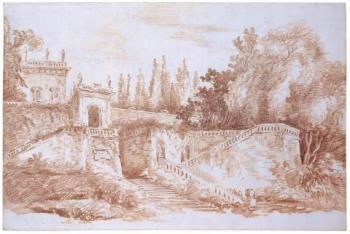
Hubert Robert, View of the Gardens at the Villa Mattei, 14 x 21 inches (34.93 x 52.39 cm), red chalk on paper, 1761 (Dallas Museum of Art, fractional gift of Charlene and Tom Marsh, 2006.17). The drawing sold in Paris at Christies (Lot 512, Sale 5075) in December 2003 for €17,625.
From quick sketches to watercolors and finished masterpieces, works by artists such as Eugène Delacroix, Jacques-Louis David, Edgar Degas, Edouard Manet, Paul Cézanne, Vincent van Gogh, Egon Schiele, Piet Mondrian and Pablo Picasso are brought together in Mind’s Eye: Masterworks on Paper from David to Cézanne. Organized by the Dallas Museum of Art, the exhibition features more than 120 works on paper—many of which have never been exhibited publicly—by 70 artists. Drawn in part from the DMA’s collection, but with significant loans from private collections in North Texas, Mind’s Eye, offers insights into the working methods of these artists, providing an intimate view of their approach to art making while also presenting the drawings and watercolors as finished works of art in their own right.
“One of the goals of the Dallas Museum of Art is to encourage collecting within the community. There is no better example of how to do this than to highlight the Museum’s graphic holdings together with those that have been assembled in private homes throughout our area,” said Maxwell L. Anderson, The Eugene McDermott Director of the DMA. “Mind’s Eye: Masterworks on Paper from David to Cézanne presents a rich and fascinating array of works in various media by artists from the Austro-Hungarian, Belgian, British, Dutch, French, German, Spanish and Swiss schools, spanning nearly 150 years—from the French Revolution to the dawn of modernism.”
The collecting and appreciation of drawings were for centuries activities associated with the privileged, the educated, or artists themselves, and the skills derived from these actions ultimately formed the basis of modern art history. Through museums, a wider audience has come to enjoy and value these most intimate of artists’ expressions. Collecting in this area has gone on throughout the DMA’s 111-year history, yet Mind’s Eye is the first exhibition to consider what has been achieved, while also serving as a tribute to the generations of collectors who have brought these drawings to Texas.
The works on view in Mind’s Eye focus on European art from the French Revolution in the late 18th century to the birth of modernism in the early 20th century. The Museum’s European works on paper collection, which has a strong holding of French art from the 19th and early 20th centuries, with an emphasis on impressionist and post-impressionist works, is complemented by loans from private collections that broaden the scope of the exhibition. Because of the different kinds of works on view, the varied roles that drawing plays for artists—as a learning exercise, as a form of note taking, as a tool for planning and development of larger works, and as an end in itself—are showcased, and the artistic process of the various artists revealed.
“Mind’s Eye is about the pleasures of collecting, but it is also about the rich history and diversity found in drawings created by artists throughout art history,” said Olivier Meslay, Associate Director of Curatorial Affairs and The Barbara Thomas Lemmon Curator of European Art. “The exhibition highlights many recognizable names along with lesser-known artists, examining overlooked works and reexamining those produced by famous artists to reveal the full effect of their contributions from a fresh, modern perspective.” Meslay is co-curator of the exhibition with Dr. William B. Jordan, formerly Director of the Meadows Museum and Deputy Director of the Kimbell Art Museum. Both are lifelong students of drawings. “This works on paper exhibition brings to light a part of the collection that is not often highlighted, despite its quality,” added Jordan.
In the exhibition, visitors will be able to learn about the care and conservation of works on paper, and how to properly frame a drawing through a video demonstration, as well as view a display of various materials represented in the works on view with examples of the different kinds of lines produced by these tools. The educational displays were created by DMA Chief Conservator Mark Leonard. In the late summer, visitors will be able to explore the exhibition with a smartphone tour featuring commentary by the exhibition co-curators, Olivier Meslay and William B. Jordan. DMA Friends will be able to earn the Mind’s Eye Special Exhibition Badge while the show is on view. For more information on the DMA Friends program, visit DMA.org/friends.
The exhibition is accompanied by a 240-page full-color publication, edited by Olivier Meslay and William B. Jordan, with contributions by Esther Bell, Richard R. Brettell, Alessandra Comini, Dakin Hart, William B. Jordan, Felix Krämer, Laurence Lhinares, Heather MacDonald, Olivier Meslay, Jed Morse, Steven Nash, Sylvie Patry, Louis-Antoine Prat, Richard Rand, George T. M. Shackelford, Richard Shiff, Kevin W. Tucker and Charles Wylie. The catalogue is distributed by Yale University Press.
◊ ◊ ◊ ◊ ◊
Distributed by Yale UP:
Olivier Meslay and William B. Jordan, eds., Mind’s Eye: Masterworks on Paper from David to Cézanne (Dallas: Dallas Museum of Art, 2014), 240 pages, ISBN: 978-0300207217, $60.
 An overview of European art from the French Revolution to the First World War, Mind’s Eye encompasses 116 works on paper in various media by seventy artists. These works range from quick sketches and working drawings to cartoons for large murals and highly finished masterpieces. Among the featured artists are such recognizable names as Pierre Bonnard, Paul Cézanne, Jacques-Louis David, Edgar Degas, Eugène Delacroix, Théodore Géricault, Fernand Léger, Pablo Picasso, Pierre-Auguste Renoir, and Georges Seurat. Also included are never-before-published works by accomplished yet lesser-known artists, such as Albert Anker, Henri Gaudier-Brzeska, Adolf Hirémy-Hirschl, Fernand Khnopff, František Kupka, and Simeon Solomon. Noted international specialists in the field address the working methods of these artists and the aesthetic beauty of their drawings and watercolors, and offer focused studies on artists, regions, schools, and themes. By simultaneously drawing attention to overlooked works and reexamining those produced by famous artists, this catalogue examines the overall effect of their cumulative contributions from a fresh, modern perspective.
Olivier Meslay is associate director of curatorial affairs at the Dallas Museum of Art, and William B. Jordan is an art historian and a trustee at the Dallas Museum of Art.
New Book | Built to Brew: The History and Heritage of the Brewery
From English Heritage:
Lynn Pearson, Built to Brew: The History and Heritage of the Brewery (Swindon: English Heritage, 2014), 264 pages, ISBN: 978-1848022386, £25.
 Beer has been brewed in England since Neolithic times, and this book combines a thoroughly enjoyable exploration of beer’s history and built heritage with new in-depth research into the nuts and bolts of its production. Based around England’s breweries, but occasionally ranging further afield, it tells the intriguing story of the growth of this significant industry. From Georgian brewing magnates who became household names—and their brewhouses notable tourist attractions—through magnificently ornate Victorian towers to the contemporary resurgence of microbreweries, the text throws new light on brewers and the distinctive architecture of their buildings.
Detailed chapters explain what makes a brewery work, revealing the functions of sometimes enormous brewing vessels, the astonishing skills of coppersmiths and engineers, the work of heroic mill horses and the innovative steam engines which replaced them. The wider context of the brewing industry is also investigated, bringing out the breadth of the ‘beerscape’, including those buildings put up with brewing profits such as the original Shakespeare Memorial Theatre in Stratford-upon-Avon.
Lynn Pearson is an independent architectural historian, writer and photographer specialising in the brewing industry, sporting architecture, postwar decorative arts and architectural ceramics. She has been based in Newcastle upon Tyne since 1984 and has published 20 books including pioneering works on seaside architecture, the architectural history of British breweries, and the architecture of cooperative living. More information is available at her website.
◊ ◊ ◊ ◊ ◊
C O N T E N T S
Preface
Acknowledgements
1. The Prologue: Beer
2. The Emergence of the Brewery
3. The Development of the Brewery
4. Designing and Planning the Brewery
5. Inside the Brewery
6. Powering the Brewery
7. Burton upon Trent – Beer Capital of Britain
8. Beyond the Brewery
9. The Buildings of the Brewing Industry Today
Notes
Bibliography
Glossary
Brewery Index
Geographical Index
General Index
New Book | Support for the Fleet

The former home for injured seamen established
at Greenwich by Queen Mary
◊ ◊ ◊ ◊ ◊
From English Heritage:
Jonathan Coad, Support for the Fleet: Architecture and Engineering of the Royal Navy’s Bases, 1700–1914 (Swindon: English Heritage, 2013), 464 pages, ISBN: 978-1848020559, £100.
Joint winner of the Association for Industrial Archaeology’s Peter Neaverson Award for Outstanding Scholarship in Industrial Archaeology (2014)
 This major new book traces for the first time the architectural and engineering works in the Royal Navy’s shore bases at home and overseas and the political imperatives and technologies that helped shape them up to the First World War. Based on detailed archival research, it concentrates on the remarkable legacy of surviving structures. The varied requirements of the sailing navy and its steam-driven successor are reflected in successive dockyard remodellings and expansions. The book reveals the close links that developed with a rapidly industrialising Britain at the end of the eighteenth century, showing contributions of figures such as Samuel Bentham, Thomas Telford, Henry Maudslay, the Rennies, the Jessops and James Watt.
The influence of the Royal Engineers is traced from early beginnings in the 1700s to their major role in the dockyard expansions from the late 1830s into the twentieth century. The architectural development of victualling and ordnance yards, naval hospitals, schools and coaling stations are all described, together with their key contributions to Great Britain’s long naval supremacy. Copiously illustrated with maps, plans and photographs, this important and lively work will appeal to naval historians, industrial archaeologists and students of British history.
Jonathan Coad is a former Inspector of Ancient Monuments. He is a Vice-President of the Society for Nautical Research and a former President of the Royal Archaeological Institute of Great Britain and Ireland.
◊ ◊ ◊ ◊ ◊
C O N T E N T S
1. The Royal Dockyards in Great Britain, 1700–1835
2. The Royal Dockyards in Great Britain, 1835–1914
3. Planning and Building the Royal Dockyards to 1795
4. Planning and Building the Royal Dockyards, 1795–1914
5. Engineering Works of the Sailing Navy, 1700–1835
6. Buildings of the Sailing Navy
7. Dockyard Housing, Offices and Chapels
8. Buildings and Engineering Works of the Steam Navy, 1835–1914
9. Growth of Empire: The Overseas Bases of the Sailing Navy, 1700–1835
10. Heyday of Empire: The Overseas Bases, 1835–1914
11. The Mediterranean Bases: Buildings and Engineering Works, 1700–1914
12. The West Indies and North American Bases: Buildings and Engineering Works, 1700–1914
13. South Atlantic and Australian Bases: Buildings and Engineering Works, 1700–1914
14. Feeding the Fleet: The Royal Victualling Yards
15. Naval Ordnance Yards
16. Care of the Sick and Wounded: Naval Hospitals
17. Barracks and Training Establishments
Exhibition | Caroline Watson and Female Printmaking
Opening next month at The Fitzwilliam:
Caroline Watson and Female Printmaking in Late Georgian England
The Fitzwilliam Museum, Cambridge, 23 September 2014 — 4 January 2015
Curated by David Alexander
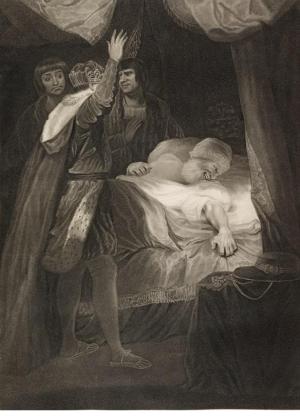
Caroline Watson, The Death of Cardinal Beaufort, stipple and etching after Sir Joshua Reynolds, 1792.
Caroline Watson (1760/61–1814) can be seen as the first British woman professional engraver. Many women in Britain had made prints before her day, but she was the first to make an extended career as an independent engraver. Nearly all those who had earlier made prints were either amateurs, making prints for amusement, or members of printmakers’ families, playing their part in family enterprises. The interest of her career is increased because she was working at a time when women were becoming more important as print buyers; some of her output reflected this change and the accompanying popularity of prints catering to feminine taste. She received support from other women, including recognition from Queen Charlotte, who appointed her ‘Engraver to the Queen’ in 1785, after she had been working for only five years. Later she was encouraged by the wealthy Bute family, particularly by the 4th Earl’s second wife, whose guest she was on several occasions at Luton Park, where Lord Bute, had one of the finest picture collections in England.
At the same time as finding support from other women Caroline Watson was encouraged by several influential men who saw advantage in using her skills; at the start of her career there were the painters Robert Edge Pine, Sir Joshua Reynolds and Ozias Humphry, as well as the printseller John Boydell, all of whom must have known her father; at the end of her career there was William Hayley, a poet and man of letters who befriended many artists. He both admired her as an ailing woman working on her own, and saw her as a reliable and talented collaborator. Having previously employed William Blake to engrave book illustrations he instead employed Caroline Watson on his Life of Romney, 1809. She did not owe her success to patronage, but to her great skill and dedication as an engraver; however the accidents of patronage were an important element in any artist’s career, especially for a woman who was of a retiring nature and not particularly robust in health.
The 200th anniversary of Watson’s death and the fact that the Fitzwilliam and the Folger Library own a number of unpublished letters by her to Hayley, which throw much light on her situation and way of life, provide a suitable opportunity not just to look at her career but to examine printmaking by women in the Britain of her time.
◊ ◊ ◊ ◊ ◊
Caroline Watson and Female Printmaking in Late Georgian England
The Fitzwilliam Museum, Cambridge, 24 September 2014
David Alexander, Honorary Keeper of British Prints and curator of the exhibition, will give a lunchtime talk at 1:15 on Wednesday, 24 September in the Seminar Room. Free admission is by token, 1 per person, available at the Courtyard Entrance desk from 12.45 on the day of the talk.
◊ ◊ ◊ ◊ ◊
Note (added 28 September 2014) — The catalogue is available from the Fitzwilliam:
David Alexander, Caroline Watson and Female Printmaking in Late Georgian England (Cambridge: Fitzwilliam Museum, 2014), 126 pages, ISBN 978-0957443464, £15.
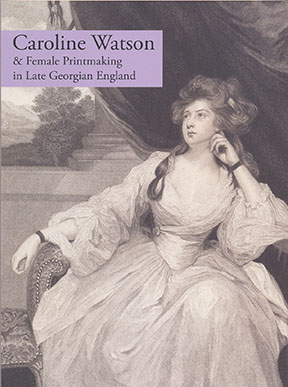 Caroline Watson, who died in 1814, can be seen as the first professional woman engraver, in the sense that she worked independently rather than as a member of a family of engravers. Over a career of thirty years she engraved more than a hundred very delicate prints in the stipple, or dotted manner, which was particularly suited for reproducing miniature portraits. The catalogue, which contains a chronological list of her prints, puts her in the context of the female printmaking of her time, and shows how exceptional was her achievement in working in a male dominated profession. The catalogue carries a transcription of sixteen letters written to her last major employer, William Hayley, which throw much light on the working methods of engravers in general.
Exhibition | Silent Partners: Artist and Mannequin
Press release (4 August) from The Fitzwilliam:
Silent Partners: Artist and Mannequin from Function to Fetish
The Fitzwilliam Museum, Cambridge, 14 October 2014 — 25 January 2015
Musée Bourdelle, Paris, 31 March — 12 July 2015
Curated by Jane Munro
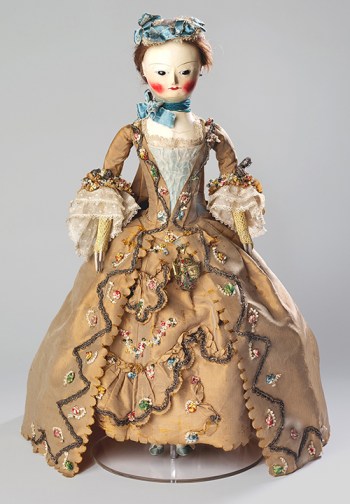
Fashion doll with costume and accessories, 1755–60; wood, gesso, paint, glass, human hair, knitted cotton, satin, silk, gilt braid, wire, silk gauze, linen, cotton, and silk satin, 60 x 42 x 43 cm (London: V&A Museum)
Every picture tells a story … but it does not always give away its secrets. For much of its existence, the artist’s mannequin, or lay figure, was one of art’s best-kept.
Now, for the first time, Silent Partners will unveil the mannequin’s secret life to show how, from being an inconspicuous studio tool, a piece of equipment as necessary as easel, pigments and brushes, the lay figure became the fetishised subject of the artist’s painting, and eventually, in the twentieth century, a work of art in its own right.
A common figure in the studios of painters and sculptors from the Renaissance onwards, this ‘artful implement’ was used to study perspective, arrange compositions, ‘rehearse’ the fall of light and shade and, especially, to paint drapery and clothing. But, while even the very greatest artists condoned its use, the mannequin best served its purpose by remaining ‘silent’: too present or visible in the finished picture, the mannequin could make figures appear stiff and unnatural, and so betray the tricks of the artist’s trade.
The nineteenth century was a turning point. Mannequin-making became a profession in its own right and Paris, especially, became a leading centre of production. Competition was fierce to create and perfect the ‘naturalistic’ mannequin, one that was life-size with an articulated skeleton that could move in realistic ways and an exterior finish that was painted and padded to look—sometimes eerily—human.
And as the mannequins became an increasingly sophisticated human replica, so they emerged from the anonymity of the studio to take their place, centre stage, on the canvas. At first the mannequin featured humorously, in witty visual games of ‘hide and seek’ and double entendre. However, throughout the course of the nineteenth century, painters such as Degas began to represent it in more troubling ways, playing on the unnerving psychological presence of a figure that was realistic, yet unreal, lifelike, yet lifeless. Others—photographers especially—explored in more voyeuristic terms how the relationship between male painter and female mannequin played out behind closed doors, revealing the studio as a place of potent erotic encounter.

Paul Huot, Female Mannequin, ca. 1816; wood, metal, horsehair, wax, silk, cotton and painted papier-mâché head, 163 x 65 cm, (Museumslandschaft Hessen Kassel, Sammlung Angewandte Kunst)
By the end of the century, innovations in the manufacture of mannequins shifted to the shop window dummy, the lay figure’s closest kin. Again, Paris led the way, and the fashion mannequin was transformed by firms such as Pierre Imans and Siégel from a schematic approximation of the human form into an uncannily realistic surrogate that inspired both consumerist longing and sexual fantasy.
This distinctively modern mannequin—one that reflected the life and elegance of its era—set a new challenge for twentieth-century painters and photographers. Featureless and expressionless, they haunted the paintings of the Italian metaphysical painters Giorgio de Chirico and Carlo Carrà, while the Surrealists celebrated the ‘modern’ mannequin as a manifestation of the ‘marvellous’, an object that could reveal the artist’s—and our—secret unconscious desires.
One of the most wide-ranging and ambitious shows ever hosted at the Fitzwilliam, the exhibition will feature over 180 paintings, drawings, books and photographs as well as fashion dolls, trade catalogues, a series of extraordinary patent documents and videos that will surprise and at times disturb. There will be paintings and drawings by Fra Bartolommeo, Cézanne, Poussin, Gainsborough, Millais, Ford Madox Brown, Courbet, Wilhelm Trübner, Kokoschka and Degas as well as photographs by and of Surrealist artists such as Bellmer, Raoul Ubac, Dalì and Man Ray; two works by Jake and Dinos Chapman will form a twenty-first-century coda. But among the most striking and fascinating exhibits will be the mannequins themselves: from beautifully carved sixteenth-century figures to haunting wooden effigies once belonging to Sickert (and maybe Hogarth) and painted dolls of full human height, top-of-the range models that were highly sought after by artists throughout Europe.
◊ ◊ ◊ ◊ ◊
From Yale UP:
Jane Munro, Silent Partners: Artist and Mannequin from Function to Fetish (New Haven: Yale University Press, 2014), 280 pages, ISBN: 978-0300208221, $65.
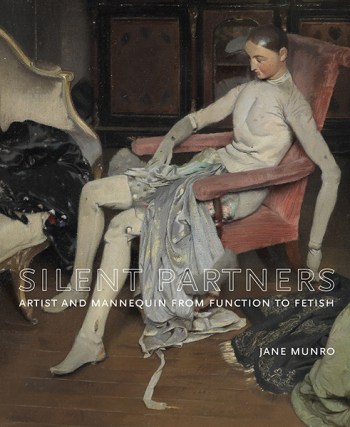 The articulated human figure made of wax or wood has been a common tool in artistic practice since the 16th century. Its mobile limbs enable the artist to study anatomical proportion, fix a pose at will, and perfect the depiction of drapery and clothing. Over the course of the 19th century, the mannequin gradually emerged from the studio to become the artist’s subject, at first humorously, then in more complicated ways, playing on the unnerving psychological presence of a figure that was realistic, yet unreal—lifelike, yet lifeless.
Silent Partners locates the artist’s mannequin within the context of an expanding universe of effigies, avatars, dolls, and shop window dummies. Generously illustrated, this book features works by such artists as Poussin, Gainsborough, Degas, Courbet, Cézanne, Kokoschka, Dalí, Man Ray, and others; the astute, perceptive text examines their range of responses to the uncanny and highly suggestive potential of the mannequin.
Jane Munro is a curator in the Department of Paintings, Drawings and Prints at the Fitzwilliam Museum and director of studies in history of art at Christ’s College at the University of Cambridge.
New Book | Art at the Origin
From the publisher:
Hans Christian Hönes, Kunst am Ursprung. Das Nachleben der Bilder und die Souveränität des Antiquars (Bielefeld: Transcript Verlag, 2014), 330 pages, ISBN 978-3837627503, 38€.
 The book provides a systematic study of the spectacular and often highly speculative art theories and art-historical narratives of such renowned antiquaries as Pierre d’Hancarville, Richard Payne Knight, and James Christie. Hans Christian Hönes analyses their theories on the origins of art and interprets the theory of history resulting from these hypotheses on the beginnings of art as a narrative of »survival«, bearing a surprisingly close resemblance to ideas culminating around 1900 in the writings of Aby Warburg.
Die spektakulären und höchst spekulativen Geschichtsentwürfe und Bildtheorien bedeutender Antiquare wie Pierre d’Hancarville und Richard Payne Knight stehen in diesem Buch erstmals im Fokus der Analyse. Hans Christian Hönes beleuchtet deren Theorien über den Ursprung der Kunst und das, so die These, daraus resultierende Narrativ eines bis in die eigene Gegenwart virulenten »Nachlebens« dieser Ursprünge. So offenbart sich ein Geschichtsentwurf, der überraschende Parallelen zu Theorien aufweist, wie sie um 1900 im Werk Aby Warburgs kulminieren. Die Studie zeigt: Das Anliegen der Protagonisten ist weniger die Suche nach historistischer Wahrheit—sondern vielmehr die
Konstruktion einer souverän entworfenen, polemischen und
romanhaften Kunstübung.
Hans Christian Hönes is Research Associate of the international research group Bilderfahrzeuge: Warburg’s Legacy and the Future of Iconology at the Warburg-Institute London.










 Enfilade
leave a comment