Exhibition Review | Versailles and the Antique
Reviewed for Enfilade by Hélène Bremer
Versailles et l’Antique
Château de Versailles, 13 November 2012 — 17 March 2013
Curated by Alexandre Maral, Geneviève Bresc-Bautier, Jean-Luc Martinez, and Nicolas Milovanovic, with scenography by Pier Luigi Pizzi

Galerie de Pierre basse (Room 1) Versailles et l’Antique
© EPV / Th. Garnier
The entrance through the Gallerie de Pierre Basse (Room 1) of the Palace of Versailles has been changed dramatically for the exhibition Versailles and Antiquity. The public is usually barred from this part of the palace, allowed only to peek down a rather dark hallway containing a collection of sculpture dedicated to heroes of French history. Instead, for now, these statues are discretely draped with white tissue, and the public enters alongside a selection of masterpieces from Louis XIVth’s sculpture garden. The finest marble sculpture from the collections of the French court, now in the collections of the Louvre and the Palace of Versailles, suggest a new Rome, created at Versailles by the Sun King and presently revived by the exhibition curators. This exceptionally ambitious show brings together not only marbles, but also bronzes, tapestries, paintings, drawings, decorative and ephemeral objects to explore the relationship between Versailles and Antiquity.
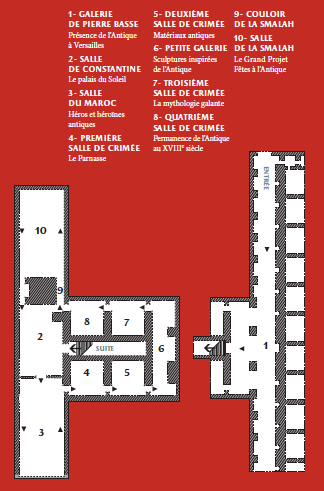 The renowned opera-stage-designer Pier Luigi Pizzi is responsible for the scenography of the installation. He has described the exhibition as a play in which the works of art are the characters and the stage breathes the spirit of the seventeenth-century French court. The subject of the play is the taste of the insatiable collector, Louis XIV. Within the spaces of the palace, Pizzi has managed to accommodate these ‘actors’, which here communicate with each other and invite visitors to follow along, from one spectacular scene to the next (though I imagine many may fail to appreciate the full production with not a single explanatory panel to be found in the whole exhibition).
In early modern Europe, all important courts collected antiquities in order to suggest their magnificence. Materials like porphyry, marble, alabaster, and bronze enhanced the prestige of such collections while tapestries and paintings comparing sovereigns with Classical gods and goddesses symbolized the court’s power.
In France this mode of collecting began with François I. After he failed to acquire the Laöcoon group in 1515 (and again in 1520) from Pope Leo X, his agent Francesco Primaticcio finally gained permission to make casts from the work, and a bronze copy was made for the Palace at Fontainebleau. The French collection of antiques grew only slowly under Henry II, who received the sculpture of Diane chasseresse from Pope Paul IV in 1556 (it serves as the emblem of the exhibition), and subsequent sovereigns largely lost interest altogether. In the seventeenth century, however, cardinals Richelieu and Mazarin assembled large collections of antiquities, most of which eventually entered the collection of Louis XIV. While the king had long been interested in collecting antiquities (under the guidance of Mazarin), his ambitions were fueled by a remark made by Bernini in 1665 during the sculptor’s visit to France. After Louis XIV showed him the royal collection, Bernini judged that it consisted of “ornaments for ladies.” Embarrassed, the king hurried to improve the collection, adding important, large, masculine (read powerful) sculpture. At the time it was not necessary to display genuine antique marbles; but instead, reassembled works and contemporary sculpture inspired by the antique could do as well. Within a short time, the collection at Versailles grew steadily, and the newly built Hall of Mirrors was adorned with gods and goddesses in marble, vases in porphyry as well as with classically-themed ceiling and wall paintings. References to antiquity intensified among all art forms, with Versailles celebrated as the new Rome.

Salle du Maroc (Room 3) Versailles et l’Antique
© EPV / Th. Garnier
This exhibition claims to reconstruct a Versailles not seen since the French Revolution. On offer is not, however, a display of antiquities as they appeared at the court of Louis XIV, but the creation of an ambiance. Walking from the sculpture garden in the Gallerie Basse up the stairs to the Salle de Constantine (Room 2) with its reconstructed Palais de Soleil would have been a rather different experience in the seventeenth century. The importance of antiquity is nonetheless clear from the enormous quantity of objects on display. Using the rooms of the palace instead of temporary exhibition spaces preserves the court’s atmosphere. One wanders from intimate cabinets (Rooms 4 and 5) filled with precious objects and paintings, into a light-filled sculpture gallery dedicated to the gardens of Marly (Room 6), to rooms containing mythological paintings (Rooms 7 and 8). The exhibition includes a historical sequence, and dixhuitièmists will be especially interested in the Quatrième Salle de Crimée (Room 8) dedicated to the persistence of antiquity in the eighteenth century. In particular, the room examines eighteenth-century taste through paintings by Nattier and Drouais of court ladies disguised as Diana or Flore, along with the changing relationship between politics and aesthetics.
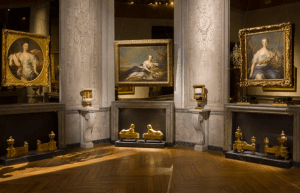
Quatrième salle de Crimée (Room 8) Versailles et l’Antique
© EPV / Th. Garnier
Near the show’s conclusion (Room 9), the presentation of the grand projet to reconstruct the palace during the eighteenth century is interesting for its references to the antique (especially to the monuments of Rome), but this architectural departure is probably a bit much for the average visitor at the close of such an extensive exhibition (180 of the 200 objects on display have already asked a lot of viewers’ attention). Showing this material in a separate venue may have helped insure it receives the attention it merits.
Finally, the Salle de la Smalah (Room 10), dedicated to the Fêtes à l’antique, displays an impressive table ornament in the form of a antique colonnade in front of a sculpture of Apollo, in turn flanked by an enormous barometer made for Louis XV and XVI. Rather, however, than providing a satisfying finale to the proposed play, this last installation left me feeling oddly alone on the middle of the stage, longing for a re-enactment.
◊ ◊ ◊ ◊ ◊
Alexandre Maral and Nicolas Milovanovic, eds., Versailles et l’Antique (Paris: Artlys, 2012), 336 pages, ISBN: 978-2854955125, 49€ / $95.
 Versailles was a new Rome in several ways: in its grandiose size, in its ambition to endure through the centuries, and in the many references to the great models of Antiquity. In the 17th century, Antiquity was an incomparable absolute, which the most ambitious sovereigns wished to rival: Louis XIV created Versailles as the seat of power to bring back the grandeur of Antiquity. The exhibition examines the presence of Antiquity in Versailles from two angles: the acquisition of antique fragments and commissions of copies by the kings, and the re-appropriation of antique models and figures by artists. It brings back to Versailles about fifty antiques that it possessed during the Ancien Régime. The interpretation of Antiquity and its mythology are evoked through about two hundred works from the principal French and foreign collections (the Louvre, Bibliothèque nationale de France, Musée des Beaux-Arts de Besançon, Uffizi Gallery of Florence, Archaeological Museum of Naples, etc.): sculptures, paintings, drawings, engravings,
tapestries, pieces of furniture, objets d’art.
Available from ArtBooks.com»
◊ ◊ ◊ ◊ ◊
The website of the Palace of Versailles provides additional information, including a series of videos. Full descriptions of each section of the exhibition are available as a PDF file here»
New Book | Encountering China
From Bucknell University Press:
Rachana Sachdev and Qingjun Li, eds., Encountering China: Early Modern and European Responses (Lewisburg, PA: Bucknell University Press, 2012), 230 pages, ISBN 978-1611484823, $35.
 Encountering China addresses the responses of early modern travelers to China who, awed by the wealth and sophistication of the society they encountered, attempted primarily to build bridges, to explore similarities, and to emulate the Chinese, though they were also critical of some local traditions and practices. Contributors engage critically with travelogues, treating them not just as occasional sources of historical information but as primary, literary texts deeply revelatory of the world they describe. Contributors reach back to the earliest European writings available on China in an effort to broaden and nuance our understanding of European contact with the Middle Kingdom in the early modern period. While the primary focus of these essays is the external gaze – European sources about China – contributors also tease out aspects of the Chinese world-view of the time, thus generating a conversation between Chinese literary and historical texts and European ones.
Rachana Sachdev is associate professor of English and coordinator of Asian studies at Susquehanna University. She has published several articles on early modern gynecological discourses; the most recent, “Of Paps and Drugs: Nursing Breasts in Shakespeare’s England,” appeared in English Language Notes 47, 2 (Fall/Winter 2009). Her current research project focuses on representations of infanticide and position of children in Asia in the European travel writing from the early modern era. A brief section of the chapter on Ming China, “Contextualizing Female Infanticide: Ming China in Early Modern European Travelogues” was recently published in ASIANetwork Exchange (Fall 2010).
Qingjun Li is Assistant Professor of Asian Studies and Chinese Language at Belmont University. She holds her Ph.D. in English from Middle Tennessee State University (MTSU). She is also Associate Professor of English at Zhengzhou University, Peoples Republic of China, where she has been twice recognized as the Teacher of Excellence. She is author of three books and numerous articles, including her recent essay, “Pound’s Poetic Mirror and the China Cantos: The Healing of the West,” Southeast Review of Asian Studies 30 (2008). Her research interests are in Chinese American literature, women’s literature, and comparative literature.
◊ ◊ ◊ ◊ ◊
C O N T E N T S
Rachana Sachdev — Introduction
Rachana Sachdev — European Responses to Child Abandonment, Sale of Children and Social Welfare Policies in Ming China
Qingjun Li — Of Golden Lilies and Gentlewomen: Constructions of Chinese Women in Early Modern European Travel Narratives
Daniel Dooghan — Earlier Moderns: The Novel Form as National Development in China and Europe
Ning Ma — “A Strong Resemblance”: Samuel Richardson, Chinese Talent-Beauty Novels, and a Secret Origin of “World Literature”
Ronnie Littlejohn — “Magicians, Enchanters, and Professional Crooks”: Early Modern Understandings of Daoism
Terry Logan Mazurak — Buddhism and Idolatry
Bibliography
Index
About the Contributors
New Book | Daniela Bleichmar’s ‘Visible Empire’
From The University of Chicago Press:
Daniela Bleichmar, Visible Empire: Botanical Expeditions and Visual Culture in the Hispanic Enlightenment (Chicago: University of Chicago Press, 2012), 288 pages, ISBN: 978-0226058535, $55.
 Between 1777 and 1816, botanical expeditions crisscrossed the vast Spanish empire in an ambitious project to survey the flora of much of the Americas, the Caribbean, and the Philippines. While these voyages produced written texts and compiled collections of specimens, they dedicated an overwhelming proportion of their resources and energy to the creation of visual materials. European and American naturalists and artists collaborated to manufacture a staggering total of more than 12,000 botanical illustrations. Yet these images have remained largely overlooked—until now.
In this lavishly illustrated volume, Daniela Bleichmar gives this archive its due, finding in these botanical images a window into the worlds of Enlightenment science, visual culture, and empire. Through innovative interdisciplinary scholarship that bridges the histories of science, visual culture, and the Hispanic world, Bleichmar uses these images to trace two related histories: the little-known history of scientific expeditions in the Hispanic Enlightenment and the history of visual evidence in both science and administration in the early modern Spanish empire. As Bleichmar shows, in the Spanish empire visual epistemology operated not only in scientific contexts but also as part of an imperial apparatus that had a long-established tradition of deploying visual evidence for administrative purposes.
Daniela Bleichmar holds a joint appointment in the Departments of Art History and History. She received her BA from Harvard University and her Ph.D. in History (History of Science) from Princeton University, where she trained as a cultural historian of early modern science, specializing in the history of visual culture and the natural sciences in Europe and the Spanish Americas in the period 1500-1800. Her research and teaching address the history of the Spanish empire, early modern Europe, visual and material culture in science, collecting and display, and the book, print, and prints.
◊ ◊ ◊ ◊ ◊
C O N T E N T S
Introduction: Natural History and Visual Culture in the Spanish Empire
1: A Botanical Reconquista
2: Natural History and Visual Epistemology
3: Painting as Exploration
4: Economic Botany and the Limits of the Visual
5: Visions of Imperial Nature: Global White Space, Local Color
Conclusion: The Empire as an Image Machine
Acknowledgments
Notes
Bibliography
Index
◊ ◊ ◊ ◊ ◊
“The history of late eighteenth-century Latin America is often told simply as the Creoles’ ever-increasing disenchantment with an unenlightened Mother Spain. Daniela Bleichmar’s remarkable book offers us a different history, one in which an Enlightenment study of natural history takes center stage. She casts before the reader passionate and dedicated men of learning and the arts who under Spanish royal sponsorship were entrusted to perform precise observation of the natural fruits of divine creation and render them into splendid and copious scientific illustrations; the results of ‘artful looking . . . a barometer of Enlightenment thought.’ Bleichmar provides more than just an account of these accomplishments; she wields an interdisciplinary brilliance that melds the best of the history of science, art history, and history and serves up a critical and fascinating examination of Linnean classification, scientific illustration, and their complex intersection, scientific and social, in recording the flora of South America.”—Thomas B. F. Cummins, Harvard University
Exhibition | Peru: Kingdoms of the Sun and Moon
Press release (26 October 2012) from the MMFA:
Peru: Kingdoms of the Sun and Moon: Identities and Conquest
in the Early, Colonial and Modern Periods
Montreal Museum of Fine Arts, 2 February — 16 June 2013
Seattle Art Museum, 17 October 2013 — 5 January 2014
Curated by Victor Pimentel

Mochica, North Coast, possibly La Mina, Forehead ornament with feline head and octopus tentacles ending in catfish heads (100 – 800 A.D.), Gold, chrysocolla, and shells. 28.5 x 41.4 x 4.5 cm (Museo de la Nación, Lima. Photo: Daniel Giannoni)
Organized by the Montreal Museum of Fine Arts, Peru: Kingdoms of the Sun and Moon will display an extensive collection of pre-Columbian treasures and masterpieces from the colonial era to Indigenism, including over 100 pieces that have never before been seen outside of Peru. With more than 350 works of art (paintings, sculptures, gold and silver ornaments, pottery, photograph, works on paper, and textiles) on loan from public and private collections in Peru, Canada, United States, France, and Germany, this exhibition covers roughly 3,000 years of history, including archaeological discoveries in recent decades.
“In conceiving this exhibition on the question of identity in Latin America following our exhibition Cuba! Art and History from 1868 to today presented in 2008, I was fascinated to discover the extent to which archaeology has revealed this birthplace of civilization – one of six such in the world – only recently in the course of the 20th century” explains Nathalie Bondil, Director and Chief Curator of the MMFA. “This exhibition demonstrates how the retrospective view of history shifted from a colonial interpretation to a new nationalist feeling in the course of the modern era. This complex project brings together numerous loans, both public and private, from Peru, some of which have not been exhibited before. Above all, the display features paintings of the era subsequent to the Spanish Conquest and, for the first time outside Peru, of the Indigenist period after independence. The constant elements of a civilization built up over millennia open up perspectives never before opened,” she added.
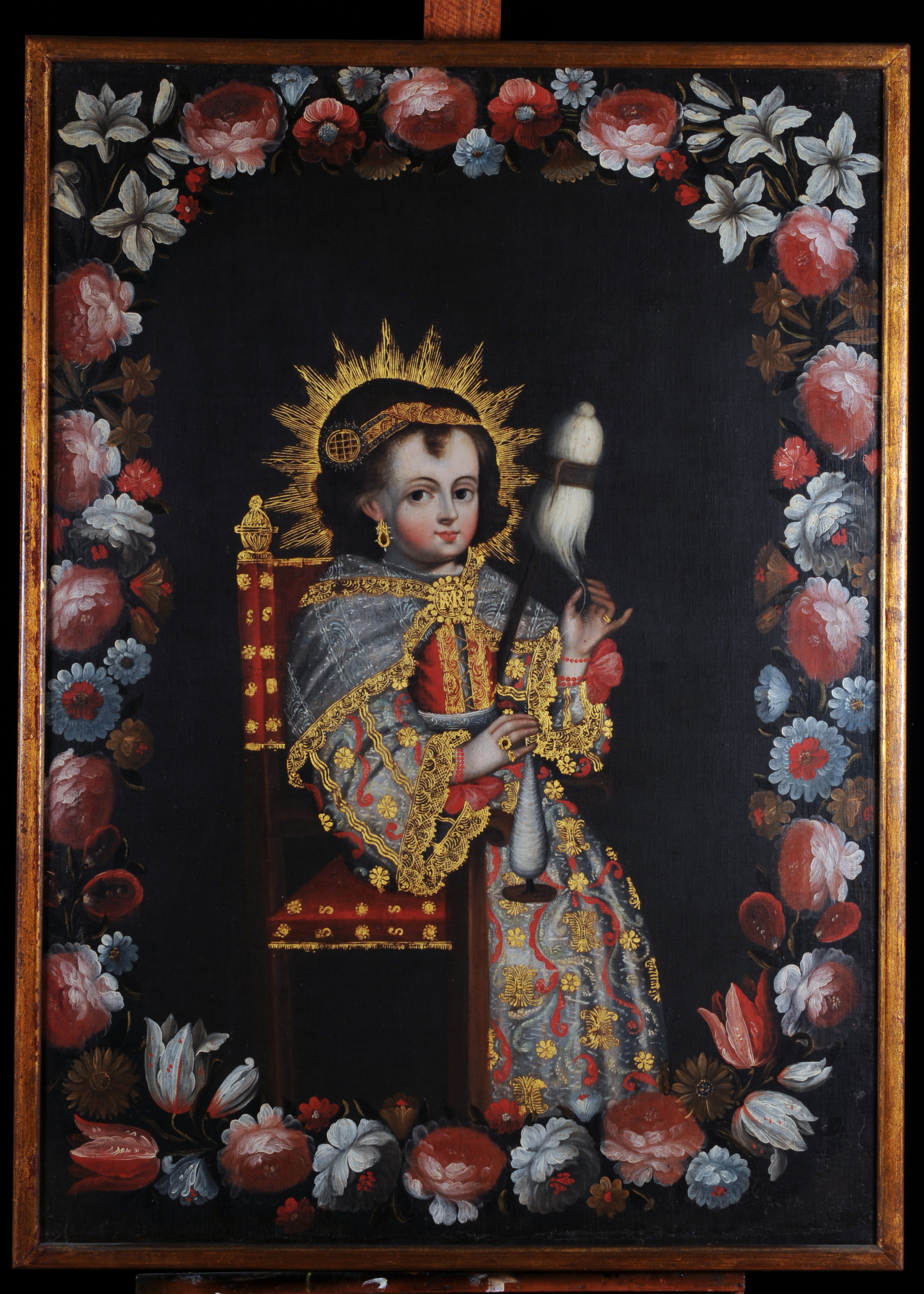
Anonymous, Cuzco School, Virgen Niña Hilando (Young Virgin Spinning), second third of the 18th century, oil on canvas, gold leaf. 112.5 x 80.5 cm
(Lima: Museo Pedro de Osma. Photo: Joaquín Rubio)
Mythical Peru, cradle of Andean civilization, and its pre-Hispanic, colonial and modern history will be examined in the four sections of the exhibition as follows:
• Section 1 (introduction) will explain how archaeology rewrote the national history beginning with the discovery, in 1911, of Machu Picchu to the recent restitution of artworks.
• Section 2 will focus on the myths and rituals of the early civilizations of the Andes, highlighting their role in forming and shaping Peruvian identity during the pre-Columbian era.
• Section 3 will illustrate the perpetuation, concealment, and hybridization of the indigenous culture during the colonial period.
• The last section will highlight the rediscovery of this culture in the 20th century and the revalorization of ancient symbols of identity in contemporary Peruvian iconography.
Adds Exhibition Curator Victor Pimentel, Curator of Pre-Columbian Art at the MMFA, “Through the representation and reinterpretation of myths, rituals and other primordial symbols of identity captured by different artistic traditions, the exhibition will illustrate how the evocative power of images have influenced the history of pre-Hispanic, colonial and modern Peru.”
Illustrating the beliefs and rituals of pre-Columbian societies
The relationship with death, particularly the constant dialogue between the world of the living and the world of the dead, is an essential component of Andean spirituality. Among the Mochicas, ceremonial sacrifices contributed to the perpetuation of the supernatural and social orders, while ancestor worship held significant importance to the Lambayeque and Chimú cultures.
In order to illustrate the beliefs and rituals that dominated the life of pre-Columbian societies, the exhibition will focus on objects associated with the sacrificial ceremony of the Mochica people (200 B.C. to 800 A.D.) and the funerary rites of the Chimú and Lambayeque cultures (11th to 15th century A.D.), by presenting some of the most complete depictions of these rituals. On display will be important objects in gold, silver, and turquoise from the royal tombs of Sipán, discovered in 1987 by archaeologist Walter Alva, constituting the most significant find made in Peru since that of Machu Picchu. They include:
• A gold ear disc depicting the Lord of the place, the Mochica governor
• A Mochica ornament in the shape of a half-feline, half-octopus recently repatriated and exhibited for the first time
outside of Peru
• Funerary jewelry (crown, ear discs, necklace, pectoral and shoulder-pieces) including a masterpiece of Chimú gold work
• A rare headboard of a Lambayeque litter depicting figures officiating at a ceremony, unique in the complexity of its ornamentation
Religion in Many Forms
The Spanish conquest of Peru in the 16th century led to the hybridization of the Peruvian culture expressed through reinterpretations of mostly religious European art. Paintings of the School of Cuzco – established by the Spanish as a means of converting the Incas to Catholicism – showing Christ, miraculous Virgins, archangels and defenders of the Catholic faith, testify to the powerful role played by images in the campaign to evangelize the Native peoples of the Andes. Included among the examples of paintings mainly by Native artists resulted from this hybridization are:
A Nativity Chest dating from the 18th century, painted with a number of Biblical stories including Adam and Eve, the Annunciation, the Nativity and the visit of the Magi. This three-dimensional illustrated catechism was used to spread Catholicism throughout the Andes.
Among the ceremonial objects on view illustrating the importance of imagery relating to the celebration of the Eucharist in the Andes is a silver Eucharistic urn in the shape of a Pelican, a bird traditionally associated with Christ’s sacrifice. It is widely considered a masterpiece of the liturgical metalwork from the Latin-American Baroque period.
A particularly popular image in art during the Viceroyal period is that of the Virgin. Symbolic representations of the virtuous life of the Virgin Mary on view, such as Young Virgin Spinning, recalls the acllas, the Virgins of the Sun in the Inca empire, whose principal occupation was making garments for the Inca and for religious rites.
Processions also played an important role in the elaboration of a Peruvian identity both as a collective expression of Christian faith and as a means of reinforcing the socio-political positions of the participants. An 18th-century depiction of a splendid Corpus Christi procession, one of the first Christian celebrations to be performed in the colony and still performed to this day, attests to the multi-ethnic nature of the city of Cuzco, the ancient capital of the Inca empire. Coinciding with the celebration of the Inti Raymi, an Inca festival dedicated to the Sun God, Corpus Christi was the most important feast day in the colonial liturgical calendar.
Peruvian art in the 19th and 20th centuries
By 1821, Peruvians had achieved their independence and had formed an indigenous collective memory that combined the idealisation of the pre-Hispanic past, particularly the Inca Empire, with an interest in local subjects. A typical work of Peruvian art of the mid-19th century, Habitante de las cordilleras del Perú (Inhabitant of the Peruvian Highlands) by Francisco Laso, portrays the indigenous peasant as a national symbol for the new Peruvian republic, and heralds the direction that Peruvian cultural nationalism was to take in the next century.
At the beginning of the 20th century, Indigenism flourished as an artistic and intellectual movement based on revalorising and reaffirming Peru’s indigenous heritage. Paintings depicting scenes of Native life and the idyllic landscapes of the Peruvian countryside and highlands such as Pastoras (Shepherdesses) by Leonor Vinatea Cantuarias were to transform the visual culture of Peru in the modern era. This movement is represented in the exhibition by a wide selection of works by José Sabogal, Camilo Blas, Julia Codesido, and Enrique Camino Brent. Widely praised for his documentation of indigenous culture, the only Amerindian included among the major artists associated with the movement is the photographer and portraitist Martín Chambi. Works by Chambi on view include Tristeza andina, La Raya (Andean sadness, La Raya).
An exhibition checklist (PDF) is available here»
◊ ◊ ◊ ◊ ◊
From Abrams:
Victor Pimentel, ed., Peru: Kingdoms of the Sun and the Moon (Milan: 5 Continents Editions, 2013), 384 pages, ISBN: 978-8874396290, $65.
 A new publication featuring essays by the foremost experts on the art of Peru The MMFA will produce an accompanying 384-page catalogue co-published in English and in French by the MMFA and 5 Continents Editions in Milan. This fully-illustrated volume (450 illustrations) comprises essays by eminent curators and specialists and interviews with leading figures and experts on Peruvian archaeology, art history, and literature such as the novelist Mario Vargas Llosa.
Victor Pimentel is curator of pre-Columbian art at the Montreal Museum of Fine Arts.
New Book | Modern Antiques: The Material Past in England
From Bucknell UP:
Barrett Kalter, Modern Antiques: The Material Past in England, 1660-1780 (Lewisburg, PA: Bucknell University Press, 2012), 249 pages, ISBN 978-1611483789, $80.
 The recovery and reinvention of the past were fundamental to the conception of the modern in England during the long eighteenth century. Scholars then forged connections between linear time and empirical evidence that transformed historical consciousness. Chronologers, textual critics, and antiquaries constructed the notion of a material past, which spread through the cultures of print and consumption to a broader public, offering powerful–and for that reason, contested–ways of perceiving temporality and change, the historicity of objects, and the relation between fact and the imagination. But even as these innovative ideas won acceptance, they also generated rival forms of historical meaning. The regular procession of chronological time accentuated the deviance of anachronism and ephemerality, while the opposition of unique artifacts to ubiquitous commodities exoticized things that straddled this divide.
Inspired by the authentic products as well as the anomalous by-products of contemporary scholarship, writers, craftsmen, and shoppers appropriated the past to create nostalgic and ironic alternatives to their own moment. Barrett Kalter explores the history of these “modern antiques,” including Dryden’s translation of Virgil, modernizations of The Canterbury Tales, Gray’s Gothic wallpaper, and Walpole’s Strawberry Hill. Though grounded in the ancient and medieval eras, these works uncannily addressed the controversies about monarchy, nationhood, commerce, and specialized knowledge that defined the present for the English eighteenth century. Bringing together literary criticism, historiography, material culture studies, and book history, Kalter argues that the proliferation of modern antiques in this period reveals modernity’s paradoxical emergence out of encounters with the past.
Introduction: The Time Bound and the Modern Antique
Chapter 1 The “Cobweb-Law” and the Fundamental Law: History, Chronology, and Poetic License
Chapter 2 Chaucer Ancient and Modern: Standardization, Modernization, and the Eighteenth-Century Reception of The Canterbury Tales
Chapter 3 DIY Gothic: Thomas Gray and the Medieval Revival
Chapter 4 Horace Walpole’s Fugitive Pieces: Collecting and Ephemerality
Conclusion
Barrett Kalter is Associate Professor of English at University of Wisconsin-Milwaukee.
New Book | Marlborough: Soldier and Diplomat
In the book’s final chapter, Richard Johns, curator of prints and drawings at the National Maritime Museum in Greenwich, addresses, “‘The British Caesar’: John Churchill, 1st Duke of Marlborough, and the Visual Arts.” From the publisher:
John Hattendorf, Augustus Veenendaal, and Rolof van Hövell tot Westerflier, eds., Marlborough: Soldier and Diplomat (Zutphen: Karwansaray Publishers, 2012), 408 pages, ISBN: 978-9490258047, € 75.
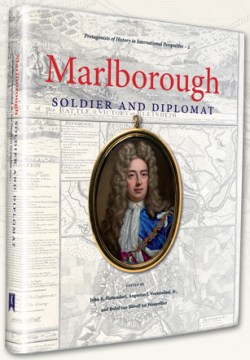
The subject of numerous books in English, Marlborough has typically been seen only in terms of British political and military history. In this book, twelve leading specialists of the period broaden the perspective by assessing Marlborough in the wider and more diverse contexts of the European situation, the common soldier in the British army, the complementary activities of navies, the differing perspectives of the Austrians, Dutch, French, and Germans as well as in the context of the British popular press and the visual arts.
John Churchill, the 1st Duke of Marlborough, is perhaps now best known for his role in the War of the Spanish Succesion. His victories at battles such as Blenheim, Ramillies, Oudenaarde, and Malplaquet have firmly established him as one of Britian’s greatest military heroes. His success also brought his family unprecedented wealth, power and influence. Physically handsome, he rose to power not only thanks to his military genius, but also his personal service as a very successful courtier. It was his interrelated personal, political, and family connections, combined with those his wife developed, that were the key elements in reaching and sustaining his positions of power. While the 1st Duke of Marlborough is firmly established in the British historical canon, far less has been said about him in a broader European context. Marlborough: Soldier and Diplomat attempts to address this disparity through a series of articles writen by noted international historians and experts. In this new book, the Duke is not only examined from the perspective of his enemies and allies, but also for his influence on social, military, and art history as a whole.
Edited by John B. Hattendorf, Augustus J. Veenendaal and Rolof van Hövell tot Westerflier, Marlborough: Soldier and Diplomat is lavishly illustrated with contemporary artwork and photographs of important places in Marlborough’s world. Each of its twelve chapters are dedicated to forming a complete but multi-faceted view of this important figure in European
Exhibition | Nicolas Colombel: L’Idéal et la grâce
Now on at the Musée des Beaux-Arts in Rouen:
Nicolas Colombel: L’Idéal et la grâce
Musée des Beaux-Arts, Rouen, 9 November 2012 — 24 February 2013
 This is the first monographic exhibition to be devoted to this figure long forgotten French painter of the Grand Siècle, Nicolas Colombel (ca. 1644-1717). The exhibition at the Museum of Fine Arts in Rouen brings us an important rediscovery. This artist born in Sotteville-lès-Rouen in approximately 1644 worked in Rome and Paris, developing a unique style which combines sensuality and idealism in the grand tradition of Poussin.
Bringing together over half of the artist’s known works today, dating from the 1680s until 1712, the exhibition offers a unique opportunity to discover Colombel’s unusual career. He was the only French painter of his generation to be successful in Rome before continuing a career in Paris at the Royal Academy of Painting and Sculpture during the reign of Louis XIV. The exhibition brings together exceptional loans from the most important collections in Europe and the United States.
◊ ◊ ◊ ◊ ◊
From the press materials:
Première exposition monographique consacrée à cette figure longtemps méconnue de la peinture française du Grand Siècle, l’exposition du musée des Beaux-Arts de Rouen consacre une redécouverte importante : celle d’un artiste né à Sotteville-lès-Rouen vers 1644, qui a fait carrière à Rome puis à Paris, concevant un style très singulier qui conjugue idéalisme et sensualité, dans la grande tradition de Poussin. Rassemblant plus de la moitié des oeuvres aujourd’hui connues, depuis les années 1680 jusqu’à 1712, l’exposition offre une occasion unique de découvrir le parcours atypique du seul peintre français de sa génération à rencontrer le succès à Rome, avant de faire carrière à Paris au sein de l’Académie royale de Peinture et de Sculpture, à la fin du règne de Louis XIV.
Nombre des tableaux de l’artiste n’ont été redécouverts que récemment : très recherchés des collectionneurs de peinture ancienne, ils sont aujourd’hui dispersés à travers le monde et la plupart sont conservés hors de France. L’exposition réunit des prêts exceptionnels venus des plus grandes collections d’Europe et des États-Unis. Elle marque également l’occasion de publier le catalogue raisonné de l’oeuvre de Nicolas Colombel.
Le parcours de l’exposition présente les principaux aspects de la carrière de Nicolas Colombel, articulés autour de deux axes : ses débuts à Rome, où il acquiert une notoriété auprès du public italien mais également français, puis sa carrière académique à Paris, lorsqu’il intègre l’Académie royale de Peinture et de Sculpture et développe, parallèlement à ses productions religieuses et à la peinture tirée de l’histoire ancienne, une peinture mythologique, aux tons éclaircis et accents de fable galante. Les débuts romains sont illustrés par la peinture religieuse marquée
par l’art de Nicolas Poussin ; Colombel est alors attaché à un classicisme rigoureux.
Les commandes réalisées à Rome pour les ordres religieux français démontrent qu’au-delà de l’exemple de Poussin, Colombel usa de références variées et retint les leçons de peintres tels que Philippe de Champaigne ou le Dominiquin. Les portraits de personnalités françaises peints à Rome révèlent que son activité de portraitiste
se développe suivant une ligne toute personnelle et qu’il développe en Italie un véritable réseau social français. L’italianisme dans la production de Colombel à Rome touche l’ensemble de sa production, les épisodes mythologiques, les scènes tirées de la littérature ou de l’histoire ancienne, comme celles issues de l’Ancien et du Nouveau Testament. Colombel tire ses modèles de Giacinto Gimignani, des Carrache, de Guido Reni.
Le retour à Paris est marqué par la réalisation de son morceau de réception à l’Académie royale qui dénote l’influence de Pierre Mignard, directeur de l’Académie royale, sur l’art de Colombel une fois qu’il intègre l’Académie. Les premières années de sa carrière parisienne doivent en effet beaucoup au modèle de Pierre Mignard, directeur de l’Académie royale, en particulier dans le genre du portrait mythologique dont Colombel fi t l’une de ses spécialités tout en continuant à offrir des compositions religieuses ou historiques. Sa compréhension de l’art bolonais, celui des élèves des Carrache, qu’il adapte aux attentes du public français dans des compositions mythologiques aux coloris clairs, à la ligne épurée et à la délicate sensualité font alors de lui l’un des artistes à la manière la plus séduisante au tournant du siècle.
◊ ◊ ◊ ◊ ◊
Catalogue: Karen Chastagnol, et al, Nicolas Colombel (vers 1644 – 1717): L’Idéal et la grâce (Paris: Éditions Nicolas Chaudun, 2012), 232 pages, ISBN: 978-2350391472, 39€ / $75. [available from ArtBooks.com]
 L’exposition réunit plus de la moitié des peintures de Colombel aujourd’hui conservées, ainsi que la plupart de ses dessins. Elle est l’occasion de publier un catalogue raisonné accompagné d’une biographie détaillée, rédigés par Karen Chastagnol, et complétés par plusieurs essais qui éclairent aussi bien les sources du peintre que le contexte romain des années 1680-1690.
Auteurs: Catalogue établi sous la direction de Karen Chastagnol avec des contributions de Pierre Rosenberg, Liliana Barroero et Diederik Bakhuÿs.
Exhibition | Johann Georg Pinsel: An 18th-Century Sculptor in Ukraine
From the Louvre:
Johann Georg Pinsel: Un Sculpteur Baroque en Ukraine au XVIIIe Siècle
Musée du Louvre, Paris, 22 November 2012 — 25 February 2013
Curated by Guilhem Scherf
 En étroite collaboration avec les institutions ukrainiennes, le musée du Louvre organise une exposition consacrée à Johann Georg Pinsel, un important sculpteur de l’époque baroque actif au milieu du XVIIIe siècle en Galicie, la partie occidentale du pays alors territoire polonais.
L’exposition s’appuie principalement sur les collections du musée Pinsel de Lviv, avec des emprunts venant d’autres musées de Galicie et aussi de Pologne (Wroclaw) et de Munich. Une trentaine de sculptures parmi les plus spectaculaires de l’artiste, majoritairement en bois (certaines avec polychromie ou dorure), seront présentées.
Le style de Pinsel, très brillant, proche de celui des grands sculpteurs de l’âge d’or du baroque germanique, témoigne d’une esthétique rarement montrée en France. L’artiste se distingue de ses contemporains par une personnalité propre : une gestuelle extravertie démonstrative, une expressivité prononcée, une caractérisation très personnelle des draperies.
◊ ◊ ◊ ◊ ◊
Jan K. Ostrowski and Guilhem Scherf, eds., Johann Georg Pinsel: Un sculpteur baroque en Ukraine au XVIIIe siècle (Paris: Coédition Louvre éditions/Snoeck éditions, 2012), 173 pages, ISBN: 978-9461610485, 32€.
Le catalogue, comprenant textes et notices d’oeuvres, est écrit par les spécialistes du sculpteur Jan Ostrowski, Boris Voznitsky, Oxana Kozyr-Fedotov avec également des essais de Claude Michaud et Guilhem Scherf. C’est le premier ouvrage sur Pinsel disponible en français.
◊ ◊ ◊ ◊ ◊
Didier Rykner reviewed the exhibition for La Tribune de l’Art (2 January 2013).
C’est à une vraie découverte que nous convie le département des sculptures du Musée du Louvre. Car qui, en France, pouvait se targuer d’avoir jamais entendu parler de Johann Georg Pinsel ? Ce sculpteur fut actif en Galicie, c’est-à-dire dans une région d’Europe de l’Est aux confins de la Pologne et de l’Ukraine, deux pays entre lesquels elle se partage aujourd’hui. Plus précisément, Pinsel exerça son art autour de Lviv (autrefois plutôt connue sous le nom de Lvov), un territoire faisant aujourd’hui partie de l’Ukraine, et aux populations mêlées, ainsi qu’aux religions diverses (catholiques romains, uniates – c’est-à-dire catholiques grecs, et orthodoxes). . . .
◊ ◊ ◊ ◊ ◊
New Book | The Fusion of Neo-Classical Principles
From Wordwell Books:
Lynda Mulvin, ed., The Fusion of Neo-Classical Principles (Dublin: Wordwell, 2012), 200 pages, ISBN: 978-1905569557, €35.
 Our understanding of Neo-Classicism is currently in an interesting phase of development, a progression to which this volume will make a significant contribution. As Kathleen James-Chakraborty’s keynote paper argues, scholarly attention is shifting from a focus on the production of works of art and buildings to a focus on consumption. The only chapter in the book that deals with painting, Brendan Cassidy’s on the reputation of Gavin Hamilton, neatly exemplifies the polarities of production and consumption. Hamilton painted his pictures in Rome where they were admired by travelling British patrons but, upon their arrival in England, they were consumed by the public with far less enthusiasm. Cassidy advances a very particular reason for this: that Grand Tourists tended to be very young men who took pleasure in identifying Hamilton’s historical subjects whilst on the sacred territory of Rome by reference to their schoolboy steeping in classical texts but, on their return to more distant northern Europe, were happy to conform with the predominant taste for landscape painting and portraiture.
Conor Lucey’s chapter, on the architectural pattern books that can be identified as having been in the hands of Dublin artisans, is a good contribution to the theme of diffusion of design ideas from one place to another, as is John Wilton-Ely’s on the design revolution of Robert Adam. As Wilton-Ely argues, the targeting and marketing of a ‘style’ is a sign of economic modernity. Another aspect of economic modernity in the eighteenth century is the quasi-professional organisation of the means of production, and Barbara Arciswewska’s essay on the reform of the English Office of Works instigated by the new Hanoverian dynasty is a very important contribution to scholarship in this respect.
In this volume the chapters of Michael McCarthy and Toby Barnard deal explicitly with the problem of when Neo-Classicism begins and ends. McCarthy argues that the fierceness of the nineteenth-century ‘battle of the styles’ has caused us to lose sight of the more gentlemanly basis on which the debate took place in the eighteenth century, but Barnard explores the religious disputes in Ireland that saw the Gothic commandeered by the Protestant community and the Catholics turning to classicism – and perhaps not unwillingly, given that their sense of civic duty was modelled on their classical educations like the young English aristocrats who, as we have seen, form the basis of Cassidy’s chapter.
The issue of the thoroughgoing Greek Revival, which would have hardly any place if this volume were circumscribed in chronological terms by the dates 1750-1800, is vigorously dealt with in this volume by three essays. Susan Pearce looks back to that first truly great phase of archaeological discovery in Greece that followed the Napoleonic Wars and in particular at the extraordinary understandings of Greek architecture and architectural sculpture of C.R. Cockerell. Lynda Mulvin’s own chapter on Cockerell’s work in Ireland pursues these ideas into built form are, while Patricia McCarthy deals with the much more extensive Irish projects of Richard and William Morrison. Also in this connection, Joe McDonnell through the works of the Irish sculptor Christopher Hewetson and Paul Caffrey with a collection of miniatures examine the emergence of Neo-Classicism in other media in Ireland.
A final strand to this rich volume can be found in the transference of design ideas between different artistic media. This is explored in the essays of Tracy Watts and Eddie McParland.
These essays will make a wide-ranging and stimulating contribution to current scholarly debates about the nature of Neo-Classicism, that critical cultural development that signals the arrival both of recognisable modernity and of internationalism in the western tradition. Moreover the essays have been written by some of the leading experts on the subject.
A Collaborative Reading of ‘Slavery and the Culture of Taste’
An invitation from Dave Mazella of The Long Eighteenth:
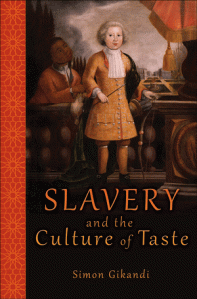 Simon Gikandi’s book Slavery and the Culture of Taste has just received a James Russell Lowell prize at MLA, and I thought that C18L, Long 18th, and other 18th-century scholars/readers might be interested in doing a collaborative reading of this book in the spring. Right now I’m trying to gauge the level of interest in the book, and seeing when might be a good time to do it.
We would probably do it over about a week or so, with one respondent per chapter posting a 500-800 word response every day or so, depending on the level of traffic. Then hopefully we can get Gikandi to respond to our posters at the end. For those interested in the process, we’ve done this with books by Joe Roach, Michael McKeon and Richard Sher in the past. Here’s the link to our announcement. If you’d like to participate, or better yet, help organize, please contact me at dmazella@uh.edu. It would also be helpful if you could give me an idea of the best week or weeks this spring for me to schedule.
Thanks,
Dave Mazella
The Long Eighteenth
◊ ◊ ◊ ◊ ◊
Recent postings at The Long Eighteenth offer numerous items of potential interest Enfilade readers including: 1) Soren Hammerschmidt‘s new course blog, Eighteenth-Century Media; 2) ‘Jeffersongate’ and the controversy surrounding Henry Wiencek’s treatment of Thomas Jefferson in Master of the Mountain; and 3) thoughts on synthesis. -CH










 Enfilade
leave a comment