Happy Arbor Day
I posted notice of this collection last September, but I’m reposting it in honor of National Arbor Day. From SVEC (formerly Studies on Voltaire and the Eighteenth Century), available from the Voltaire Foundation:
Laura Auricchio, Elizabeth Heckendorn Cook and Giulia Pacini, eds., Invaluable Trees: Cultures of Nature, 1660-1830 — SVEC 2012:08 (Oxford: Voltaire Foundation, 2012), 360 pages, ISBN 9780729410489, £65 / €95 / $110.
 Trees and tree products have long been central to human life and culture, taking on intensified significance during the long eighteenth century. In this interdisciplinary volume, contributors trace changes in early modern theories of resource management and ecology across European and North American landscapes, and show how different and sometimes contradictory practices were caught up in shifting conceptions of nature, social identity, physical health and moral wellbeing.
◊ ◊ ◊ ◊ ◊
C O N T E N T S
Introduction
• Laura Auricchio — Elizabeth Heckendorn Cook and Giulia Pacini, Invaluable trees
I. Arboreal Lives
• Hamish Graham — ‘Alone in the forest’? Trees, charcoal and charcoal burners in eighteenth-century France
• J. L. Caradonna — Conservationism avant la lettre,? Public essay competitions on forestry and deforestation in eighteenth-century France
• Paula Young Lee — Land, logs and liberty: the Revolutionary expansion of the Muséum d’histoire naturelle during the Terror
• Peter Mcphee — ‘Cette anarchie dévastatrice’: the légende noire of the French Revolution
• Paul Elliott — Erasmus Darwin’s trees
• Giulia Pacini — At home with their trees: arboreal beings in the eighteenth-century French imaginary
II. Strategic Trees
• Elizabeth Heckendorn Cook — The vocal stump: the politics of tree-felling in Swift’s ‘On cutting down the old thorn at Market Hill’
• Michael Guenther — Tapping nature’s bounty: science and sugar maples in the age of improvement
• Meredith Martin — Bourbon renewal at Rambouillet
• Susan Taylor-Leduc — Assessing the value of fruit trees in the marquis de Fontanes’s poem Le Verger
• Elizabeth Hyde — Arboreal negotiations, or William Livingston’s American perspective on the cultural politics of trees in the Atlantic world
• Lisa Ford — The ‘naturalisation’ of François André Michaux’s North American sylva: patriotism in early American natural history
III. Arboreal Enlightenments
• Tom Williamson — The management of trees and woods in eighteenth-century England
• Steven King — The healing tree
• Nicolle Jordan — ‘I writ these lines on the body of the tree’: Jane Barker’s arboreal poetics
• Waltraud Maierhofer — Goethe and forestry
• Paula R. Backscheider — Disputed value: women and the trees they loved
• Aaron S. Allen — ‘Fatto di Fiemme’: Stradivari’s violins and the musical trees of the Paneveggio
Summaries
Bibliography
Index
◊ ◊ ◊ ◊ ◊
Laura Auricchio is Associate Professor of Art History and Chair of Humanities at The New School in New York. Her current research addresses Franco-American cultural exchanges in the Age of Revolution.
Elizabeth Heckendorn Cook is Associate Professor of English at the University of California, Santa Barbara. She studies the history of environmental ethics and early modern representations of trees and forests.
Giulia Pacini is Associate Professor of French at The College of William & Mary. Her current research focuses on the political and material significance of trees in early modern France.
Book and Conference | The Chesapeake House
The following conference takes place next month at Williamsburg:
The Chesapeake House
Colonial Williamsburg, 19-21 May 2013
 To mark the publication of The Chesapeake House: Architectural Investigation by Colonial Williamsburg by the University of North Carolina Press, the Colonial Williamsburg Foundation will offer a three-day conference focusing on the methods used by architectural historians at Colonial Williamsburg to investigate buildings as well as review new discoveries in the field. The Chesapeake House is a major scholarly landmark that will set the standard for the analysis and history of early Virginia and Maryland architecture for the coming decades. The seventeen essays are based on the collective scholarship of nine authors who have been involved in research in this field for the past three decades. Participants in the conference will receive a copy of the book as part of their registration.
Through a series of lectures, conversations, and specialized tours of the Historic Area of Colonial Williamsburg, The Chesapeake House conference provides an insider’s view of how Colonial Williamsburg’s experts examine historic buildings. The program will appeal to teachers, students, preservationists, and other professionals in the field as well as friends of Colonial Williamsburg and members of the general public with interests in old houses, American history, restoration, and historic preservation. Presentations will explore the practice of architectural fieldwork, the nature of regionalism in building design, and the development of a distinctive framing system in the colonial period. Specialists will discuss the latest techniques of dendrochronoly and paint analysis.
There will be a special audience participation session entitled “How old is your house?” Often, it is one of the first questions homeowners ask and it is always essential for architectural historians to determine. Yet, such a basic query is often hard to answer. Assessing the age and alterations made to buildings is challenging since the process involves piecing together disparate kinds of evidence found in many different parts of a house, from the attic to the cellar. How was the frame constructed? What kind of bonding pattern does the chimney have? What sort of hinges are on the doors? Some details provide solid diagnostic clues while others are less helpful. However, when combined, they can provide plausible dates to within a few years or decades.
Curious about the age of your old house or one you know? Here is your chance to start the process of figuring it out. “Making Sense of the Evidence” will provide an interactive opportunity to review and analyze the material you submit with other participants. This session will demonstrate how the experts read the evidence from the field to make a reasonable estimate of the age of a house based on its form, construction, and style of various features.
◊ ◊ ◊ ◊ ◊
Cary Carson and Carl R. Lounsbury, eds., The Chesapeake House: Architectural Investigation by Colonial Williamsburg (Chapel Hill: University of North Carolina Press, 2013), 488 pages, ISBN: 978-0807835777, $60.
◊ ◊ ◊ ◊ ◊
S U N D A Y , 1 9 M A Y 20 1 3
4:00 Welcome, Colin G. Campbell, president and CEO, Colonial Williamsburg Foundation
4:15 “Publishing The Chesapeake House,” David Perry, editor-in-chief and assistant director, (retired), University of North Carolina Press, Chapel Hill
4:30 “Rendering The Chesapeake House,” Jeffrey Klee, architectural historian, Colonial Williamsburg
M O N D A Y , 2 0 M A Y 2 0 1 3
8:30 The Art Museums of Colonial Williamsburg open for conference participants
9:00 “Why Architectural Fieldwork?,” Edward Chappell, director, architectural and archaeological research department, Colonial Williamsburg
9:45 Coffee
10:15 “What makes Chesapeake Architecture Regional?,” Carl Lounsbury, senior architectural historian, Colonial Williamsburg
11:00 “Timber Framing: The DNA of Chesapeake Architecture,” Willie Graham, curator, architecture, Colonial Williamsburg
1:15 Revolutionary City programming. Looking at Architectural Details. Participants will be divided into four groups and will rotate around in order to participate in all four sessions:
• Timber Framing, Willie Graham, Booker Tenement
• Brickwork, Carl Lounsbury, Wythe House, Cole House, and Courthouse
• Hardware, Edward Chappell, Ken Schwarz, Armoury
• Architectural Elements, Jeffrey Klee, Hennage Auditorium
4:30 “Making Sense of the Evidence, or Stump the Chumps,” Cary Carson, Edward Chappell, Willie Graham, Jeffrey Klee, Carl Lounsbury, and members of the audience. Review of images of buildings and details submitted by members of the audience
6:30 Reception at the home of Margaret Pritchard
T U E S D A Y , 2 1 M A Y 2 0 1 3
8:30 The Art Museums of Colonial Williamsburg open for conference participants
9:00 “How Dendrochronology has Changed Architectural Research,” Michael Worthington, dendrochronologist, Oxford Tree-Ring Laboratory, Baltimore
9:45 “Paint Analysis in Architectural Investigations,” Susan Buck, conservator and paint analyst, Williamsburg
10:15 Coffee
10:45 “Off the Wall: Textile and Paper Hangings in the Chesapeake House,” Margaret Pritchard, curator, prints, maps, and wallpaper, Colonial Williamsburg
11:30 “Furnished Lives,” Cary Carson, vice president of research (retired), Colonial Williamsburg
New Book | Suffering and Sentiment in Romantic Military Art
Due out in June from Ashgate:
Philip Shaw, Suffering and Sentiment in Romantic Military Art (Aldershot: Ashgate, 2013), 260 pages, ISBN: 978-0754664925, $105.
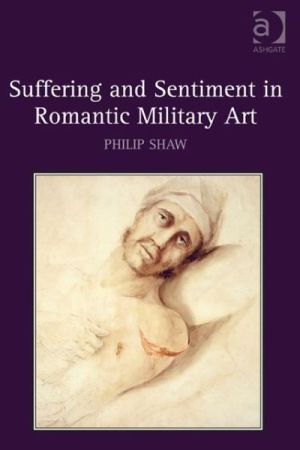 In a moving intervention into Romantic-era depictions of the dead and wounded, Philip Shaw’s timely study directs our gaze to the neglected figure of the common soldier. How suffering and sentiment were portrayed in a variety of visual and verbal media is Shaw’s particular concern, as he examines a wide range of print and visual media, from paintings to sketches to political prose and anti-war poetry, and from writings on culture and aesthetics to graphic satires and early photographs.
Whilst classical portraiture and history painting certainly conspired with official ideologies to deflect attention from the true costs of war, other works of art, literary as well as visual, proffered representations that countered the view that suffering on and off the battlefield is noble or heroic. Shaw uncovers a history of changing attitudes towards suffering, from mid-eighteenth century ambivalence to late eighteenth- and early nineteenth-century concepts of moral sentiment. Thus, Shaw’s story is one of how images of death and wounding facilitated and queried these shifts in the perception of war, qualifying as well as consolidating ideas of individual and national unanimity. Informed by readings of the letters and journals of serving soldiers, surgeons’ notebooks and sketches, and the writings of peace and war agitators, Shaw’s study shows how an attention to the depiction of suffering and the development of ‘liberal’ sentiment enables a reconfiguring of historical and theoretical notions of the body as a site of pain and as a locus of violent national imaginings.
Contents: Introduction; Seeing through tears I; Seeing through tears II; ‘Complicated woe’: British military art of the 1790s; All the news that’s fit to paint; Disgusting objects; images of wounding in the aftermath of war; Conclusion; Bibliography; Index.
Philip Shaw is Professor of Romantic Studies in the School of English at the University of Leicester, UK. His publications include Waterloo and the Romantic Imagination (2002) and, as editor, Romantic Wars: Studies in Culture and Conflict, 1793-1822 (2000).
Forthcoming Book | Roman Fever
Schedule for June release from Yale UP:
Richard Wrigley, Roman Fever: Influence, Infection, and the Image of Rome, 1700-1870 (New Haven: Yale University Press, 2013), 330 pages, ISBN: 978-0300190212, $75.
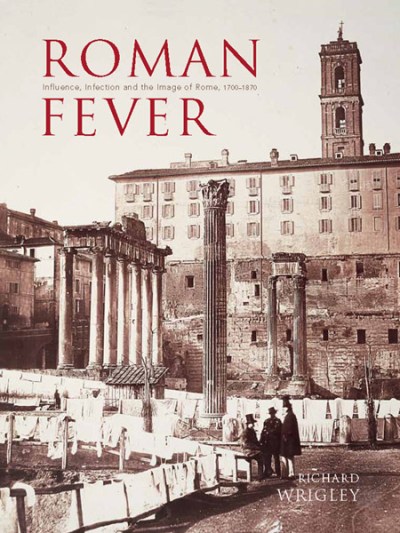 During the 18th and 19th centuries, artists and travellers were lured to Rome, the home of civilized values and artistic beauty. But the history of visiting Rome had a pathological side—not only crisis and disorientation but repulsion at its filth and stink. Rome’s air was considered to contain a chronic source of disease. This book argues that “bad air” (mal’aria) is a neglected aspect of thinking about the city’s history and as a destination for artists, visitors, and Romans both ancient and modern. These problems interfered with exploring Rome, its art and architecture, and representing its landscape. Atmospheric contamination made plein air painting and investigating antique ruins challenging activities.
Roman Fever invites an original and alternative perspective on the city and its countryside, revisiting the history of Rome in terms of ideas about climate and the role of the environment. Beautifully illustrated with unfamiliar images, it focuses on the interplay between enthusiasm and inspiration, and debilitation and mortality, all an integral part of discovering and engaging with the Eternal City’s landscape.
Richard Wrigley is professor of art history at the University of Nottingham.
New Title | The Oglethorpe Plan
From the University of Virginia Press:
Thomas D. Wilson, The Oglethorpe Plan: Enlightenment Design in Savannah and Beyond (Charlottesville: University of Virginia Press, 2012), 272 pages, ISBN 978-0813932903, $35.

ISBN 978-0813932903
The statesman and reformer James Oglethorpe was a significant figure in the philosophical and political landscape of eighteenth-century British America. His social contributions—all informed by Enlightenment ideals—included prison reform, the founding of the Georgia colony on behalf of the “worthy poor,” and stirring the founders of the abolitionist movement. He also developed the famous ward design for the city of Savannah, a design that became one of the most important planning innovations in American history. Multilayered and connecting the urban core to peripheral garden and farm lots, the Oglethorpe Plan was intended by its author to both exhibit and foster his utopian ideas of agrarian equality.
In his new book, the professional planner Thomas D. Wilson reconsiders the Oglethorpe Plan, revealing that Oglethorpe was a more dynamic force in urban planning than has generally been supposed. In essence, claims Wilson, the Oglethorpe Plan offers a portrait of the Enlightenment, and embodies all of the major themes of that era, including science, humanism, and secularism. The vibrancy of the ideas behind its conception invites an exploration of the plan’s enduring qualities. In addition to surveying historical context and intellectual origins, this book aims to rescue Oglethorpe’s work from its relegation to the status of a living museum in a revered historic district, and to demonstrate instead how modern-day town planners might employ its principles. Unique in its exclusive focus on the topic and written in a clear and readable style, The Oglethorpe Plan explores this design as a bridge between New Urbanism and other more naturally evolving and socially engaged modes of urban development.
New Book | Paris 1650-1900: Decorative Arts in the Rijksmuseum
With the Rijksmuseum open once again, this book is especially timely. It’s due out in May from Yale UP:
Reinier Baarsen, Paris 1650-1900: Decorative Arts in the Rijksmuseum (New Haven: Yale University Press, 2013), 608 pages, ISBN: 978-0300191295, $275.
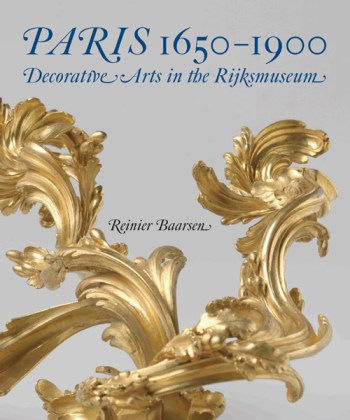 From 1650 to 1900 Paris was the undisputed center of fashion and taste in Europe. Home to a unique concentration of artists, designers, patrons, critics, and a keen buying public, Paris was the city where trends were made and where novel types of objects, devised for new ways of life, were invented. This book traces the wonderful story of Parisian decorative arts from the reign of Louis XIV to the triumph of art nouveau, through a selection of 150 breathtaking, and often little-known, masterpieces from the collection of the Rijksmuseum in Amsterdam. It features an exhilarating mixture of furniture, gilt bronze, tapestries, silver, watches, snuff-boxes, jewellery, Sèvres porcelain, and other ceramics, as well as some design drawings and engravings. Specially taken photographs reveal the daring design and beautiful execution of the work of some of the greatest artists and craftsmen of their time. Reinier Baarsen discusses the history and significance of each object, presenting the findings of much new research.
Reinier Baarsen is senior curator of furniture at the
Rijksmuseum.
New Title | Venetian Engravers of the Eighteenth Century
From Fondazione Giorgio Cini:
Rodolfo Pallacchini, Gli incisori veneti del Settecento: Venezia 1941 (Verona: Scripta Edizioni, 2012), 403 pages, ISBN: 9788896162514, $47.50. available from ArtBooks.com
 Il volume ripresenta, in edizione anastatica, il catalogo della mostra Gli incisori veneti del Settecento, organizzata da Rodolfo Pallucchini a Venezia, al teatro del “Ridotto” nel 1941. Solo 94 erano tuttavia le illustrazioni, a fronte di 613 opere esposte. Al fine di poter offrire uno strumento di lavoro adeguato sia per gli studiosi sia per i collezionisti dell’incisione veneta del Settecento, si è deciso di riprodurre qui integralmente tutte le incisioni presentate a quella mostra memorabile, incentrata su un aspetto eccezionale di creatività in ambito europeo, indagato da Pallucchini con l’abituale intelligenza critica in questo studio pionieristico.
Exhibition | Mexican Art at the Louvre
From The Louvre:
Le Mexique au Louvre: Chefs-d’oeuvre de la Nouvelle Espagne, XVIIe et XVIIIe siècles
Musée du Louvre, Paris, 7 March — 3 June 2013
Curated by Guillaume Kientz and Jonathan Brown
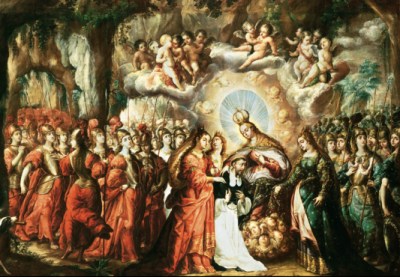
Cristobal de Villalpando, La Lactacion de Santo Domingo, © Rafael Doniz / Conaculta-INAHSinafo-Mex.
Mexican art, an area in which the Louvre’s Hispanic collection is intended to expand, will be showcased at the museum this spring. A selection of some ten of the finest works from this ‘sister’ school will be exhibited among the Spanish paintings. Among others, the monumental ‘Zurbaranesque’ work of José Juárez, the Baroque dynamism of Cristóbal Villalpando and the softness and delicacy of Rodríguez Juárez will introduce visitors to the many facets of New World art during this period and give them an understanding of its close yet independent relationship with Spanish art.
Although represented in national museums, Latin American art remains little known in France. The book that accompanies this exhibition, based on inventory work conducted by the Louvre and the French National Institute of Art History (the BAILA project), provides an overview of the major Latin American works in French museums, and explores the origins and evolution of this artistic school.
The Louvre’s press release (14 February 2013) is available here»
New Title | The Books That Shaped Art History
From Thames & Hudson:
Richard Shone and John-Paul Stonard, eds., The Books That Shaped Art History: From Gombrich and Greenberg to Alpers and Krauss (London: Thames & Hudson, 2013), 268 pages, ISBN: 978-0500238950, £25 /$35.
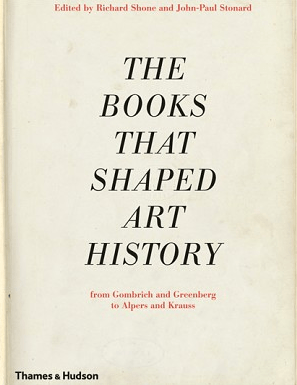 It provides an invaluable roadmap of the field by reassessing the impact of several of the most important works of art history. Each chapter, focusing on a single title, is written by a leading art historian, curator or one of the promising scholars of today, presenting a varied and invaluable overview
of the history of art, told through its seminal texts.
It provides an invaluable roadmap of the field by reassessing the impact of several of the most important works of art history. Each chapter, focusing on a single title, is written by a leading art historian, curator or one of the promising scholars of today, presenting a varied and invaluable overview
of the history of art, told through its seminal texts.
The sixteen books include Nikolaus Pevsner’s gospel of Modernism, Pioneers of the Modern Movement, Alfred Barr’s now legendary monograph on Matisse, E.H. Gombrich’s Art and Illusion, Clement Greenberg’s Art and Culture, which had a seismic impact when it was published in 1961, and Rosalind Krauss’s The Originality of the Avant-Garde and Other Modernist Myths, which introduced structuralist and poststructuralist thinking into art historical study.
Each chapter – with writers including John Elderfield, Boris Groys, Susie Nash and Richard Verdi – analyses a single major book, setting out its premises and argument and mapping the intellectual development of its author, discussing its position within the field of art history, and looking at its significance in the context both of its initial reception and its legacy. An introduction by John-Paul Stonard explores how art history has been forged by these outstanding contributions, as well as by the dialogues and ruptures between them. Supplementary documentation summarises the achievements of each art historian and provides a detailed publication history of their texts, with suggestions for further reading.
Richard Shone is Editor of The Burlington Magazine. He is the author of a number of books on French and British art, including Bloomsbury Portraits, The Post-Impressionists, Walter Sickert and Sisley. He contributed to the exhibition catalogue for ‘Sensation’ at London’s Royal Academy and organised ‘The Art of Bloomsbury’ for the Tate Gallery.
John-Paul Stonard is an art historian and former Contributing Editor of The Burlington Magazine. His book Fault Lines: Art in Germany 1945–55 was published in 2007. He has worked as a Visiting Lecturer at the Courtauld Institute of Art, and from 2010–11 was a Senior Fellow at the National Gallery of Art, Washington, DC. He has published widely on modern and contemporary German and British art, and is a regular contributor to The Burlington Magazine, the Times Literary Supplement and Artforum.
Exhibition | Napoleon and Europe
As noted at Art Daily:
Napoléon et l’Europe
Musée de l’Armée, Hôtel National des Invalides, Paris, 27 March — 14 July 2013
Curated by Émilie Robbe
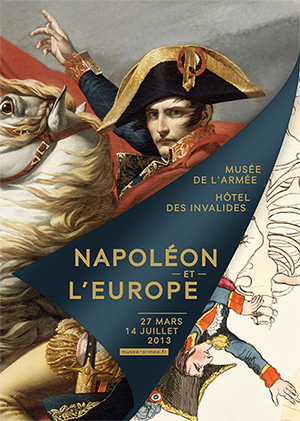 Napoleon Bonaparte (1769-1821) had a deep and lasting effect on the history of Europe, despite remaining in power for a mere fifteen years. The exhibition Napoléon et l’Europe [Napoleon and Europe], at the Musée de l’Armée from 27 March to the 14 July 2013, bears witness to Napoleon Bonaparte’s European ambitions between 1793 and 1815. The visit reveals his ambitious policies for expansion in Europe and the subsequent reactions by the various European countries, whether in support of, or against, such policies. The exhibition also highlights the consequences and the deep scars that such a conquest left on Europe.
Far removed from stereotype and biased opinion, this exhibition aims to present an influential episode in French and European history in a different manner; by combining the diverse, often-times opposing viewpoints of Napoleon’s contemporaries, on themes such as war, politics, diplomacy, the government, currency, propaganda and the arts… In order to recount or retrace this chapter of history, 250 artworks, objects and documents have been gathered together, on loan from fifty or so European museums and institutions, with more than half of these coming from outside France. Since the retrospective exhibition Napoléon held in 1969 at the Grand Palais, Paris, no other exhibition of this scope and ambition has been organized in France.
Conquest and Resistance
The entire exhibition is punctuated by or structured around two viewpoints that both question and mirror the other: the progressive and concrete creation of Napoleon’s Empire on the one hand, and the reactions of certain peoples and the main European powers to this direct quest for domination, on the other hand. From alliances to battles, from treaties to reform, this incredibly rapid succession of events is recounted in chronological fashion and explained in context. (more…)










leave a comment