Forthcoming Book | Stretch: America’s First Family of Clockmakers
From ACC Distribution:
Donald L. Fennimore & Frank L. Hohmann with Onie Rollins, Stretch: America’s First Family of Clockmakers (Winterthur Museum, 2013), 376 pages, ISBN: 978-0912724706, $75.
 This volume presents the definitive history of the UK-born Stretch family of clockmakers who emigrated to Philadelphia in 1703 and played an influential role in the city’s early clockmaking, civic, and Quaker communities. Initial essays discuss the family and the importance of their Quaker beliefs; time-telling and the clockmaking community in pre-1750 Philadelphia; innovative mechanical advances made by the Stretches; and their notable civic and cultural contributions to the city.
The catalog section of the book features 84 of the 133 Peter, Thomas, and William Stretch clocks discovered during the course of the project, illustrating and fully describing both the cases and the works. The majority of the clocks, passed down through the generations and still in private collections, are being published for the first time.
C O N T E N T S
Foreword, Acknowledgments, Introduction
Chapter 1 – Time and Telling Time in Early Philadelphia
Chapter 2 – Peter Stretch and Family
Chapter 3 – Stretch Clocks and the Philadelphia Clockmaking Community before 1750
Catalogue: Peter Stretch Clocks, Nos. 1 – 62; Thomas Stretch Clocks, Nos. 63 – 78; William Stretch Clocks, Nos. 79 – 84
Appendix 1 – Peter Stretch Will and Inventory
Appendix 2 – Thomas Stretch Will and Inventory
Appendix 3 – Samuel Stretch Will and Inventory
Appendix 4 – Clock Owners in Philadelphia, 1684 – 1750
Appendix 5 – Stretch Signature Plates: A Comparison
Appendix 6 – Stretch Clocks: A Comparison
Appendix 7 – Identified Stretch Clocks
Appendix 8 – Genealogy
Endnotes, Bibliography, Index
Donald L. Fennimore, Curator Emeritus, served as metalwork specialist at Winterthur Museum, Delaware, for 34 years. The list of his numerous publications includes Metalwork in Early America (Winterthur, 1996); Iron at Winterthur (Winterthur, 2004); and Silversmiths to the Nation: Thomas Fletcher and Sidney Gardiner (ACC, 2007).
Frank L. Hohmann III, a retired Wall Street executive, is a collector of 18th-century furniture, with a concentration on brass dial clocks. He co-authored and published the volume Timeless: Masterpiece American Brass Dial Clocks (2009). He is a Trustee of Winterthur Museum, Delaware and a Liveryman in the Worshipful Company of Clockmakers.
New Book | Le Ciseau et la Tiare: Les Sculpteurs dans la Rome des Papes
From Publications de l’École Française de Rome:
Anne-Lise Desmas, Le ciseau et la tiare : les sculpteurs dans la Rome de Benoît XIII, Clément XII et Benoît XIV, 1724-1758 (Rome: École Française de Rome, 2012), 471 pages, ISBN: 978-2728309405, 50€ / $95. [available from Artbooks.com]
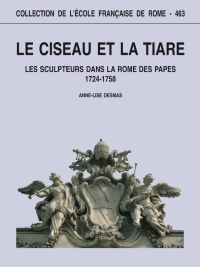 L’image monumentale de la Ville éternelle, des statues de la fontaine de Trevi ou de la façade du Latran à celles des fondateurs d’ordres dans la nef de Saint-Pierre, a été largement façonnée par les sculpteurs des pontificats de Benoît XIII, Clément XII et Benoît XIV. Pourtant, ces artistes, tels Maini, Bracci et Della Valle, restent méconnus.
C’est ce grand atelier et ses acteurs que cet ouvrage fait revivre, entrelaçant recherches monographiques et études sociales, reconstitutions de carrières, enquêtes sur les institutions artistiques et examen stylistique des œuvres.
Cette approche globale prend en compte tous les rouages de ce vaste chantier sculptural, du transport du marbre à la composition des décors éphémères, de la restauration d’antiques aux concours, des commandes privées de monuments funéraires à l’organisation des grands chantiers, souvent dominés par la figure de l’architecte. Elle examine aussi différents milieux, dont celui de l’Académie de France où brillent Adam et Bouchardon, et retrace le parcours romain de sculpteurs italiens, tels le Napolitain Benaglia, le Florentin Cornacchini ou le Vénitien Corradini.
Ces années, entre Rusconi et Canova, restent dominées par le poids de la tradition héritée du siècle de Bernin. Or c’est l’un des paradoxes que cherche à élucider cette étude : pourquoi la Rome des Lumières n’a-t-elle pas laissé émerger l’un de ces artistes qui, incontestablement talentueux, lui assurèrent une abondante et remarquable production sculpturale ?
The table of contents is available as a PDF here»
New Book | Architecture & Tradition Académique au Temps des Lumières
Basile Baudez, Architecture & tradition académique au temps des Lumières (Presses Universitaires de Rennes, 2013), 390 pages, ISBN: 978-2753521223, 24€.
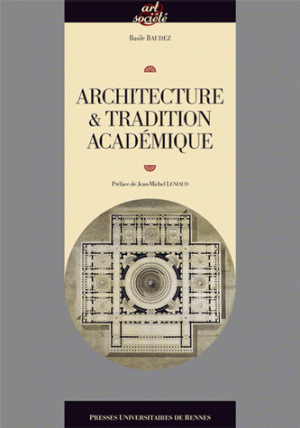 Dans le système des beaux-arts, l’architecture, en tant qu’art utile, a toujours occupé une place singulière. Issue des arts du dessin, elle côtoyait sur un pied d’égalité la peinture et la sculpture dans les premières académies fondées par les humanistes de la Renaissance. Ces institutions connurent leur âge d’or au siècle des Lumières dans le domaine des sciences, des lettres et des arts. Les académies artistiques d’Europe se définissaient comme des cercles professionnels, des organes de consultation pour le pouvoir politique et des écoles visant à transmettre un certain nombre de principes esthétiques.
Elles jouèrent un rôle crucial pour la structuration de la profession architecturale, l’établissement de normes théoriques et la diffusion de la pratique de l’expertise dans l’Europe classique. Cet ouvrage examine pour la première fois la manière dont ce modèle propre au monde occidental, si décrié à la fin du XIXe siècle, a donné naissance dans la seconde moitié du XVIIIe siècle à la profession moderne d’architecte et à une façon de concevoir l’art de bâtir qui est encore la nôtre.
Basile Baudez, archiviste paléographe, agrégé d’histoire, est maître de conférences en histoire du patrimoine moderne et contemporain à l’université Paris-Sorbonne. Ses recherches portent sur l’histoire de l’architecture européenne de l’époque classique.
A full description is available at Le Blog de L’ApAhAu.
Exhibition | Journeys to New Worlds: Spanish and Portuguese Art
Now on at the Philadelphia Museum of Art:
Journeys to New Worlds: Spanish and Portuguese
Colonial Art from the Roberta and Richard Huber Collection
Philadelphia Museum of Art, 16 February — 19 May 2013
Curated by Mark A. Castro and Joseph J. Rishel
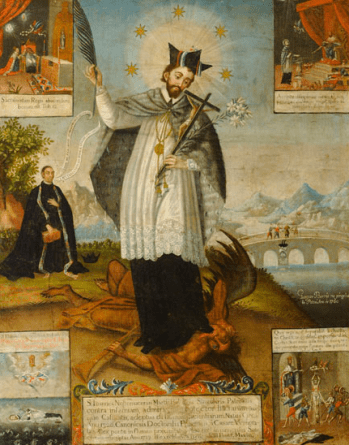
Gaspar Miguel de Berrío, Saint John of Nepomuk, 1760, oil on canvas, 40 x 32 inches (103 x 82 cm)
With a rare group of paintings, decorative arts, and sculptures from the collection of Roberta and Richard Huber, Journeys to New Worlds explores the artistic exchanges between Spain and Portugal and their colonies in the Americas and Asia during the seventeenth and eighteenth centuries. This unique combination of rich visual traditions offers viewers a glimpse into the fascinating history and global influence of Iberian colonial art.
The exhibition includes paintings by Melchor Pérez Holguín (c. 1665–after 1724) and Gaspar Miguel de Berrío (1706–after 1764), two prolific artists from the city of Potosí, Bolivia. Berrío’s Our Lady of Mount Carmel with Bishop Saints of 1764 displays the artist’s ability to present European imagery in a new regional style, emphasizing sumptuous textiles and lush colors. Other paintings on view feature objects of popular devotion, among them the anonymously painted Our Lady of Pomata, which depicts a dressed sculpture of the Virgin Mary housed in a sanctuary on the shores of Lake Titicaca, Peru.

Coquera (Coca Box), Bolivia, first half of the eighteenth century; silver, repoussé, chased and burnished, 9 x 11 x 10 inches (23 x 29 x 26 cm) Roberta and Richard Huber Collection
Potosí sits at the foot of the Cerro Rico (Rich Hill), known for its abundant silver mines, which funded the Spanish empire for many years. The mines also fueled a great metalworking tradition that produced decorative objects for church, public, and domestic use. Among the silver works included in this show are an eighteenth-century coquera (a box used for storing coca leaves) and an elaborately decorated altar plaque.
Sophisticated ivory sculptures created in the Iberian colonies in Asia (the Portuguese colonies of Goa, on the western shores of India, and Ceylon, the modern nation of Sri Lanka; as well as the Spanish-controlled Philippines) are another integral part of the Huber collection. These carved works depict Catholic themes, yet the refined, Asiatic features of the figures show the direct influence of native artistic traditions.
Roberta and Richard Huber began collecting in the 1970s, when the study of Iberian colonial art was in its infancy in the United States. They have purchased works over the years based on their own changing interests, enjoying the thrill of discovering new objects as much as the works themselves. Embodying the passionate interests of two individuals, their collection is one of a handful focused on this material in the country. Journeys to New Worlds celebrates their enthusiasm and reflects the Philadelphia Museum of Art’s continuing commitment to promoting the arts of Latin America.
The exhibition is generously supported by The Annenberg Foundation Fund for Exhibitions, the Arlin and Neysa Adams Endowment, Paul K. Kania, and Mr. and Mrs. Reinaldo Herrera. The catalogue is made possible by The Andrew W. Mellon Fund for Scholarly Publications at the Philadelphia Museum of Art and by Furthermore: a program of the J.M. Kaplan Fund.
Curated by Mark A. Castro, Exhibition Coordinator, and Joseph J. Rishel, The Gisela and Dennis Alter Senior Curator of European Painting before 1900, and Senior Curator of the John G. Johnson Collection and the Rodin Museum.
◊ ◊ ◊ ◊ ◊
From Yale UP:
Edited by Suzanne L. Stratton-Pruitt, with Mark A. Castro, Journeys to New Worlds: Spanish and Portuguese Colonial Art in the Roberta and Richard Huber Collection (New Haven: Yale University Press, 2013), 204 pages, ISBN: 978-0300191769, $60.
Contributions by Luisa Elena Alcalá, David L. Barquist, Mark A. Castro, Margarita M. Estella Marcos, Enrique Quispe Cueva, Joseph J. Rishel, Jorge F. Rivas P., and Suzanne L. Stratton-Pruitt
 This beautifully illustrated catalogue showcases 120 Spanish and Portuguese artworks from the seventeenth and eighteenth centuries, all highlights from the dazzling collection of Roberta and Richard Huber. Featuring works in a variety of mediums and from far-flung places, including paintings, silver, and furniture from South America and sculptures in ivory from the Spanish Philippines and from Portuguese territories in India. Distinguished experts shed light on these significant objects, many of which have not been previously published and which illustrate the unparalleled artistic exchanges between and within these colonial empires. The Andean painters Melchor Pérez Holguín and Gaspar Miguel de Berrío inventively interpreted European iconographies, while similar adaptations took place in Asia, where native craftsmen, carved Christian images in ivory. These works traveled along the trade routes connecting Europe to Asia and the Americas, thus influencing the development of a new visual culture.
Suzanne L. Stratton-Pruitt is an independent scholar specializing in Spanish and Spanish colonial art. Mark A. Castro is an Exhibition Coordinator at the Philadelphia Museum of Art.
Forthcoming | Rediscovering the Ancient World on the Bay of Naples
From Yale UP:
Carol C. Mattusch, ed., Rediscovering the Ancient World on the Bay of Naples, 1710-1890 (New Haven: Yale University Press, 2013), 292 pages, ISBN: 9780300189216, $70.
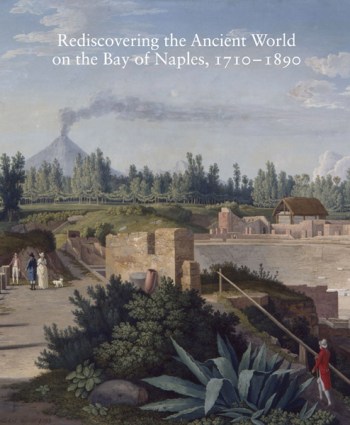 The ancient Roman cities of Pompeii and Herculaneum, buried by the eruption of Mount Vesuvius in 79 C.E., drew international attention when excavations commenced in the 1730s. As a result, the nearby city of Naples became a nexus of scholarship, cultural diplomacy, and tourism. This fascinating book examines responses to the excavations by 18th- and 19th-century monarchs, statesmen, scholars, and archaeologists, as well as by artists, architects, designers, writers, and tourists.
Essays by leading art historians and archaeologists chronicle the exploitation of the sites through excavation, publication, and museum display, and discuss the wider influence of the recovered objects and architectural remains on art and design in Italy, France, Germany, and Britain. Unlike other publications that focus on the archaeological artifacts and their documentation, this extensively illustrated book presents the discoveries from
the standpoint of how they were understood at the time.
Carol C. Mattusch is Mathy Professor of Art History in the Department of History and Art History at George Mason University.
◊ ◊ ◊ ◊ ◊
C O N T E N T S
Elizabeth Cropper, Preface
Carol C. Mattusch, Introduction
Alain Schnapp, The Antiquarian Culture of Eighteenth-Century Naples as a Laboratory of New Ideas
Jens Daehner, The Herculaneum Women in Eighteenth-Century Europe
Christopher Parslow, The Sacrarium of Isis in the Praedia of Julia Felix in Pompeii in Its Archaeological and Historical Contexts
Carlo Knight, Politics and Royal Patronage in the Neapolitan Regency: The Correspondence of Charles III and the Prince of San Nicandro, 1759–1767
John E. Moore, “To the Catholic King” and Others: Bernardo Tanucci’s Correspondence and the Herculaneum Project
Steffi Roettgen, German Painters in Naples and Their Contribution to the Revival of Antiquity, 1760–1799
Sophie Descamps-Lequime, The Ferdinand IV Donation to the First Consul and His Wife: Antiquities from the Bay of Naples at Malmaison
Nancy H. Ramage, Flying Maenads and Cupids: Pompeii, Herculaneum, and Eighteenth-Century Decorative Arts
Bruce Redford, Grecian Taste and Neapolitan Spirit: Grand Tour Portraits of the Society of Dilettanti
Eric M. Moormann, Literary Evocations of Herculaneum in the Nineteenth Century
Mary Beard, Taste and the Antique: Visiting Pompeii in the Nineteenth Century
John Pinto, “Speaking Ruins”: Piranesi and Desprez at Pompeii
Eugene J. Dwyer, Pompeii versus Herculaneum
Exhibition | Piranesi’s Paestum: Master Drawings Uncovered
Press release for the exhibition Piranesi’s Paestum, now on at the Soane Museum:
Piranesi’s Paestum: Master Drawings Uncovered
Sir John Soane’s Museum, London, 15 February — 18 May 2013
Tchoban Foundation, Museum for Architectural Drawing, Berlin, 1 June – 31 August 2013
The Morgan Library and Museum, New York, 23 January – 17 May 2015
Curated by Jerzy Kierkuć-Bieliński
 An exhibition of Giovanni Battista Piranesi’s last great graphic project, the highly finished Paestum drawings, is now on view at Sir John Soane’s Museum, London, deepening understanding of the graphic artist whose work has influenced designers from Escher to the makers of the Harry Potter films, and shedding new light on the considerable impact of his work on 18th-century architectural taste. For the very first time since Piranesi’s death, all seventeen drawings will be shown together, uniting the fifteen drawings from Sir John Soane’s Collection with those from the collections of the Bibliothèque nationale de France, Paris, and Amsterdam’s Rijksmuseum. The Paestum drawings were the preparatory work for Piranesi’s Différentes Vues de Pesto finished by his son Francesco and published posthumously in 1778. They depict views of the three great Doric temples in the former Greek colony of Poseidonia, colonised by the Romans and re-named Paestum.
Left abandoned, and later cut off by a malarial swamp, the ruins of the colony were rediscovered in 1746 during the construction of a new road. Its massive and well-preserved Doric temples dedicated to Poseidon, Hera and Athena sparked renewed interest among artists and architects including the celebrated Giovanni Battista Piranesi and inspired drawings, prints, paintings and models which revolutionised understanding of early Greek Classical architecture.
As well as exploring Piranesi’s complex perspectives, the Master Drawings Uncovered exhibition will examine Soane’s relationship with the artist, architect and antiquarian and the influence that visiting Paestum and experiencing Piranesi’s work had on his architecture and teaching. Those wishing to explore Piranesi’s techniques for themselves, will also be able to participate in an evening course and a range of Piranesi-inspired workshops, running alongside the exhibition.

The Paestum drawings are highly unusual in Piranesi’s portfolio. Although the artist usually made preparatory drawings for his famous etchings, much of the composition was often worked directly on to the copper plate at the engraving stage. These drawings contain a level of detail very close to the finished prints, and it is thought that perhaps, aware of his failing health, Piranesi included as much detail as possible for his son Francesco to finish the work he had begun. He uses the full repertoire of his draughtsmanship to create images that both accurately describe the architecture of the Paestum temples and bring out their evocative, rustic setting. Multi-layering of pencil, brown and grey washes and pen and ink, sometimes with the addition of red chalk or white chalk highlights, creates a layered effect which can be compared to the repeated bitings in the resulting etchings. The rough paper used by Piranesi is analogous with the travertine used to construct the temples – echoing its pitted and eroded texture. He also uses the scena per angolo – a feature of Ferdinando Bibiena’s theatrical scenery designs – to give a unique perspective to the drawings; replacing the traditional, central vanishing point with diagonal axes to heighten the three-dimensionality of the temples and add to their dramatic impact.
The Paestum drawings in the Soane collection were purchased by Sir John Soane at auction in March 1817 for £14.5.0, as part of a sale by antiquarian Charles Lambert. It is not known how they came to be in his collection. Dr Jerzy Kierkuć-Bieliński, curator of Master Drawings Uncovered, looks forward to welcoming visitors to a significant exhibition of Piranesi’s work: “We’re delighted to be able to present a focused exhibition which celebrates the impeccable quality and influence of a small selection of drawings. Although six of the Soane drawings have been exhibited in the Die Graber von Paestum exhibition (2007–08) in Hamburg and Berlin, they have never been viewed by the public un-framed, and no exhibition has ever been devoted to their display as a discrete grouping. The fifteen drawings in Soane’s collection have been displayed in the Picture Room of No.13 Lincoln’s Inn Fields, but their position, in Soane’s ingenious picture planes, has not allowed close scrutiny. We hope that the conservation and academic research resulting from the exposure of the drawings will throw considerable light on their history and the architectural legacy left by Giovanni Battista Piranesi.”
Images courtesy of the Trustees of Sir John Soane’s Museum
Top: Exterior of the Temple of Neptune from the North-East
Bottom: Interior of the Temple of Neptune from the West
◊ ◊ ◊ ◊ ◊
From the Soane Museum’s shop:
John Wilton-Ely, Piranesi, Paestum, & Soane (London: Prestel, 2013), 112 pages, ISBN: 978-3791348063, £25.
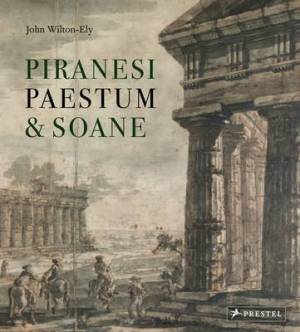 To celebrate the launch of our exhibition Piranesi’s Paestum: Master Drawings Uncovered, the Soane is proud to bring you the accompanying exhibition book, Piranesi Paestum & Soane, beautifully produced in hardback with full colour pictures and illustrations. This newly reprinted and updated book by John Wilton-Ely [the first edition of which appeared in 2002] examines Soane’s extensive collection of Piranesi’s work which Soane incorporated into his theatrical displays at his Lincoln’s Inn home, connecting Piranesi’s own dramatic visions of Paestum with his revivalist architectural practice.
Architect and printmaker, Giovanni Battista Piranesi was a lifelong champion of Rome, publishing more than 1000 etchings of the Eternal City and it’s ancient monuments. When Sir John Soane and Piranesi met they formed a profound and complex, creative and intellectual relationship that nurtured Soane’s later career. Among Soane’s greatest legacies are the preparatory drawings Piranesi developed for a publication on the Greek temples at Paestum.
Mantel on “Royal Bodies”
From the Editor
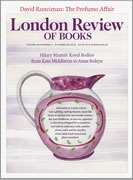 Hilary Mantel’s talk, “Undressing Anne Boleyn,” at the British Museum (4 February 2013), published as “Royal Bodies” in the London Review of Books (21 February 2013), has occasioned considerable discussion in the UK, thanks to the comments of the two-time Booker Prize recipient regarding the role of Kate Middleton, Duchess of Cambridge, and her body in British society. With no intentions of fanning the flames of the controversy, I thought it might nonetheless be of interest to Enfilade readers, particularly since Marie Antoinette serves as one source for the argument (whatever one makes of Mantel’s engagement with history, I’m repeatedly gobsmacked by her writing and the views offered into the past). From the LRB article:
Marie Antoinette was a woman eaten alive by her frocks. She was transfixed by appearances, stigmatised by her fashion choices. Politics were made personal in her. Her greed for self-gratification, her half-educated dabbling in public affairs, were adduced as a reason the French were bankrupt and miserable. It was ridiculous, of course. She was one individual with limited power and influence, who focused the rays of misogyny. She was a woman who couldn’t win. If she wore fine fabrics she was said to be extravagant. If she wore simple fabrics, she was accused of plotting to ruin the Lyon silk trade. . . .
 Mantel’s first novel, A Place of Greater Safety — finished in 1979 but not published until 1992 — addresses not Tudor England but Revolutionary France, imagining the lives of Georges-Jacques Danton, Maximilien Robespierre, and Camille Desmoulins. Larissa MacFarquhar brilliantly profiled Mantel in the fall in “The Dead Are Real,” for The New Yorker (15 October 2012). And in terms of the current controversy, Jenny Hendrix, writing for The Los Angeles Times Books (19 February 2013), offers a sampling of the response in the British media. Here, I give the last words to Mantel:
It may be that the whole phenomenon of monarchy is irrational, but that doesn’t mean that when we look at it we should behave like spectators at Bedlam. Cheerful curiosity can easily become cruelty. It can easily become fatal. We don’t cut off the heads of royal ladies these days, but we do sacrifice them, and we did memorably drive one to destruction a scant generation ago. History makes fools of us, makes puppets of us, often enough. But it doesn’t have to repeat itself. In the current case, much lies within our control. I’m not asking for censorship. I’m not asking for pious humbug and smarmy reverence. I’m asking us to back off and not be brutes. . .
New Book | Portraiture and British Gothic Fiction
From Johns Hopkins University Press:
Kamilla Elliott, Portraiture and British Gothic Fiction: The Rise of Picture Identification, 1764–1835 (Baltimore: Johns Hopkins University Press, 2012), 352 pages, ISBN: 978-1421407173, $60.
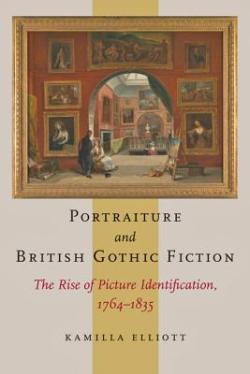 Traditionally, kings and rulers were featured on stamps and money,the titled and affluent commissioned busts and portraits, and criminals and missing persons appeared on wanted posters. British writers of the eighteenth and nineteenth centuries, however, reworked ideas about portraiture to promote the value and agendas of the ordinary middle classes. According to Kamilla Elliott, our current practices of “picture identification” (driver’s licenses, passports, and so on) are rooted in these late eighteenth- and early nineteenth-century debates.
Portraiture and British Gothic Fiction examines ways writers such as Horace Walpole, Ann Radcliffe, Mary Shelley, and C. R. Maturin as well as artists, historians, politicians, and periodical authors dealt with changes in how social identities were understood and valued in British culture—specifically, who was represented by portraits and how they were represented as they vied for social power.
Elliott investigates multiple aspects of picture identification: its politics, epistemologies, semiotics, and aesthetics, and the desires and phobias that it produces. Her extensive research not only covers Gothic literature’s best-known and most studied texts but also engages with more than 100 Gothic works in total, expanding knowledge of first-wave Gothic fiction as well as opening new windows into familiar work.
Kamilla Elliott is senior lecturer at Lancaster University and is author of Rethinking the Novel/Film Debate.
Exhibition | Beauty and Revolution: Neoclassicism 1770-1820

Press release from the Städel Museum:
Beauty and Revolution: Neoclassicism 1770-1820
Städel Museum, Frankfurt, 20 February — 26 May 2013
Curated by Eva Mongi-Vollmer and Maraike Bücklingy
A comprehensive special exhibition presented by Frankfurt’s Städel Museum from 20 February to 26 May 2013 will highlight the art of Neoclassicism and the impulses it provided for Romanticism. Developed in collaboration with the Liebieghaus Skulpturensammlung, the show Beauty and Revolution will assemble about one hundred works of the period from 1770 to 1820 by such artists as Anton Raphael Mengs, Thomas Banks, Antonio Canova, Jacques-Louis David, Bertel Thorvaldsen, Johann Gottfried Schadow, and Jean-August-Dominique Ingres. The major survey, whose range also comprises a number of impressive examples of ‘Romantic Neoclassicism’, will be the first in Germany to convey an idea of the variety of the different and sometimes even contradictory facets of this style.
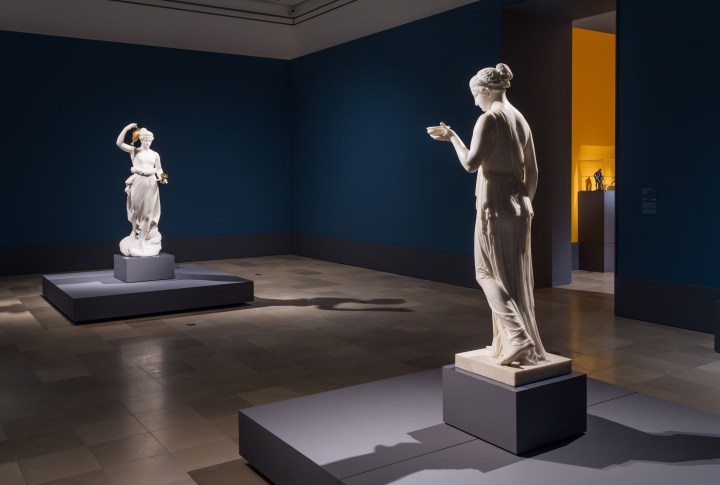 Based on significant sculptures, paintings, and prints from collections in many countries, the exhibition will explore the decisive influence of classical antiquity on the artists of the era. Struggling for a socially relevant art, the artists directed their attention to the aesthetics of Greek and Roman art as well as to their virtues and moral standards conveyed by history and mythology. It will become evident how the viewer could be addressed in many different ways. Two famous marble sculptures of the Greek goddess Hebe, for example, will be confronted with each other in Frankfurt for the first time: a variant by Antonio Canova (1796, The State Hermitage Museum, Saint Petersburg) and another by Bertel Thorvaldsen (designed in 1806, Thorvaldsens Museum, Copenhagen). The two masterpieces have again and again been compared and judged, yet never exhibited together since their creation.
Assembling a wide range of works from Gavin Hamilton’s and Henry Fuseli’s innovative solutions to central works by Antonio Canova and Jacques-Louis David as well as Bertel Thorvaldsen’s masterpieces of ‘Romantic Neoclassicism’, the Städel Museum’s major spring exhibition offers an extensive survey of Neoclassicist art and demonstrates the unexpected vitality of an era often classified as static.
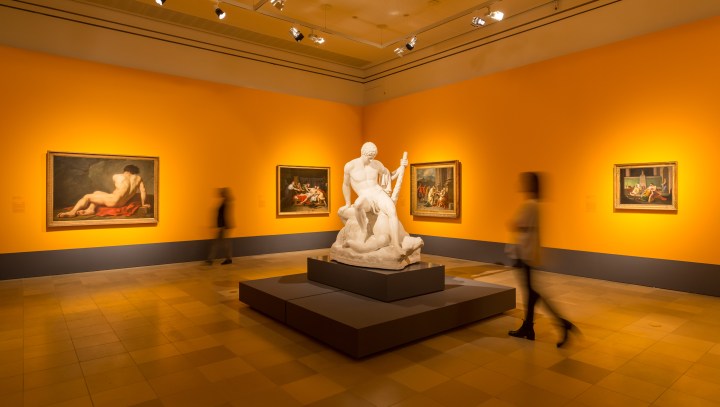 The various aspects of Neoclassicism will be explored along three lines in the Städel’s exhibition. Disregarding a few exceptions, the selection of numerous loans focuses on the production of art in the city of Rome that was considered the first address for studying the ancient world by many artists, writers, and theorists around 1800 and became a center of the art world of that time. The second emphasis of the show is on representations of historical and mythological scenes. In search of a model for moral standards of behavior, the artists fathomed the core of what features as human in the ancient world’s myths, which they read as poetry without religious implications. Jacques-Louis David’s painting The Oath of the Horatii, for example – of which an oil sketch from the holdings of the Louvre in Paris will be presented in the exhibition – upholds a timelessly valid moral code, yet also relates to current political events. The show exemplifies how contemporary motifs increasingly found their way into the range of themes dealt with by Neoclassicist art. The third chapter explores an issue connected with this development, namely how feelings and passions were depicted in Neoclassicist works of art. Artists like Canova or David rendered emotions and pathos in a way unfamiliar to their contemporaries, a way which manifested itself mainly in their figures’ body language. Contrary to the Baroque era, it was not the representation of affectations that artists were primarily concerned with any longer, but internalized emotions in which the viewer was to immerse himself. The artists also clearly detached themselves from the pathos of the ancient world in this way: Canova’s sculpture Theseus and the Minotaur (1783, Museo e Gipsoteca Antonio Canova, Possagno), for example, primarily deals with the aspect of reflection after Theseus’s victory and the hero’s moral consciousness.
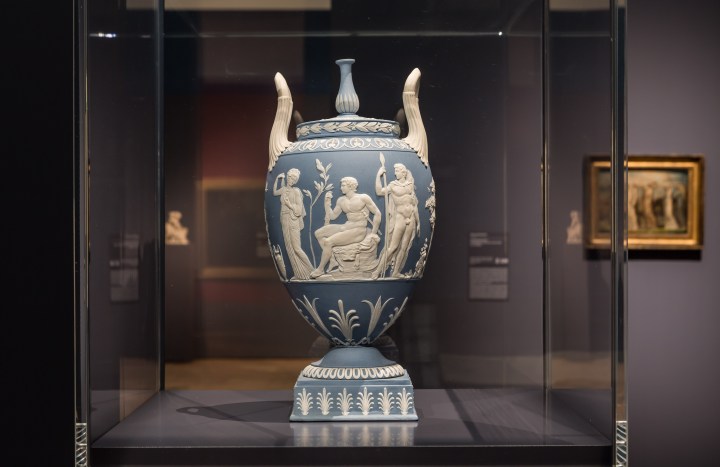
Extending across the Städel’s entire Exhibition House, the generously conceived special exhibition begins with the imposing confrontation of the two famous representations of the goddess Hebe by Antonio Canova (1800–05) and Bertel Thorvaldsen (1815–23) on the ground floor. The difference between Canova’s cupbearer hurrying near on a cloud and involved in what is going on and Thorvaldsen’s introverted musing female illustrates the whole stylistic range of Neoclassicist art at the very beginning. Picking up the thread of this confrontation, the presentation in the large ground floor hall impressively visualizes the turbulent development of Neoclassicism until about 1870. The tour starts with a selection of plaster cast and bronze reproductions of antique sculptures dating from the late eighteenth and early nineteenth centuries; these reproductions particularly illustrate the canon of classical antiquity emphasized by the archaeologist and art historian Johann Joachim Winckelmann (1717–68). Artists staying in Rome initially incorporated these famous reproductions into their works as directly as possible. In those years, the return to the ancient world frequently implied a criticism of contemporary systems of rule, especially of the courtly and ecclesiastical formal language of the Baroque age. Anton Raphael Mengs’s appropriation of classical antiquity was of such an extreme degree that the artist was even able to deceive Winckelmann who described Mengs’s fresco Jupiter Kissing Ganymede (1758–59, Galleria Nazionale d’Arte Antica, Palazzo Barberini, Rome) as an original of classical antiquity in one of his writings.
The following section comprises the rebellious works of a group of artists who also lived in Rome for some time, yet felt not inclined to follow Winckelmann’s credo of “noble simplicity and quiet grandeur” – though they too thoroughly studied the antique models. They aimed at capturing the viewer’s attention by dramatizing their subjects, even if this meant putting up with exaggeration and distortion. The English sculptor Thomas Banks (1735–1805) – see his The Falling Titan (1786, Royal Academy of Arts, London) – was one this group’s artists as was the Swiss-born Henry Fuseli (1741–1825), whose Achilles Sacrificing his Hair on the Funeral Pyre of Patroclus (1800–05) from the Kunsthaus in Zurich is included in the exhibition.
The shown works by Antonio Canova (1757–1822) and Jacques-Louis David (1748–1825) and his pupils then ushered in a definitely calmer approach to the motifs rendered. They are characterized by formal austerity and a deliberately pointed dramatic composition. However, both the sculptor Canova and the painter David relied on completely new pictorial and iconographic means for drawing on antique subjects and attitudes – means that were to inform subsequent generations of artists all over Europe.
The presentation on the second floor of the Exhibition House highlights how the new iconography developed not least in response to the political context of the time and particularly the French Revolution. Jacques-Louis David immortalized the dead Marat as the revolution’s first martyr, for example: the exhibition comprises a version by David and his workshop (Musée national des châteaux de Versailles et de Trianon, Versailles) as well as by Joseph Roques (1793, Musée des Augustins, Toulouse).
The works in the following room strikingly illustrate that the young art also held a revolutionary potential in terms of form: the sophisticatedly simplified scenes visualized by the sculptor John Flaxman (1755–1826) in his drawings and engravings, for example, are based on an astounding abstraction. Their reduction to mere contours was to create a furore all over Europe.
The adjacent room sheds light on the slow, yet far-reaching change in the artists’ attitude toward the ancient world that occurred around 1800. The unreachability of its ideal made itself felt with increasing weight. This implied a growing abandonment of its norms on the part of the artists, whereas the viewer was granted more leeway for interpretation. The protagonist’s internalization also came to play a more important role in what was going on in the picture. Consequently, masterpieces such as Bertel Thorvaldsen’s Ganymede (1819–21, Thorvaldsens Museum, Copenhagen) are categorized as works of ‘Romantic Neoclassicism’ today.
The various tendencies brought forth by Neoclassicism within the first decades after 1800 become increasingly clear in the last room of the exhibition. In spite of all discrepancies between the various artists’ decisions, they shared a common denominator in looking for new ways to leave Neoclassicism behind. The idea of the ancient world was regarded with increasing detachment, unconventionally transformed, and largely ignored by more and more nineteenth-century artists. All in all, the exhibition unfolds the age of Neoclassicism as a surprisingly manifold and lively stylistic epoch whose unconditional desire for renewal and improvement became a breeding ground for Romanticism in its return to classical antiquity.
Exhibition photos by Norbert Miguletz
◊ ◊ ◊ ◊ ◊

Maraike Bückling and Eva Mongi-Vollmer, eds., Schönheit & Revolution: Klassizismus 1770-1820 (Munich: Hirmer, 2013), 392 pages, ISBN: 978-3777470115, €40 / $85. — available from Artbooks.com.
A comprehensive catalogue edited by Maraike Bückling and Eva Mongi-Vollmer will be published by Hirmer to accompany the exhibition. It will include contributions by Sergej Androsov, David Bindman, Maraike Bückling, Werner Busch, Christian M. Geyer, Alexander Kaczmarczyk, Thomas Kirchner, Eva Mongi-Vollmer, Johannes Myssok, and Marjorie Trusted. German.
Forthcoming | European Painted Cloths, 1400-2000
While most of the papers from this June 2012 Courtauld conference addressed earlier material, there were some eighteenth-century offerings. The collection of essays is due out in June.
◊ ◊ ◊ ◊ ◊
From ACC Distribution:
Christina Young and Nicola Costaras, European Painted Cloths, 1400-2000: Pagentry, Ceremony, Theatre and Domestic (Archetype Publications, 2013), 196 pages, ISBN: 9781904982906, $140.
 The conference papers in this volume explore the use of painted cloths in religious ceremony, pageantry, domestic interiors and scenic art, focussing on their change of context and significance from the fourteenth to the twenty-first centuries and examining their different function, materials, and method of creation. The potential for large sizes, portability, and versatility for religious objects including banners, hangings, altarpieces, and palls was the impetus for the emergence of fabrics as a painting support in Western art in the Middle Ages. The functionality of the works explains the survival of relatively few examples. One of the most common forms of interior decoration for centuries, painted cloths have received less attention from art historians and historians than they deserve in part due to their poor survival. Scenic backcloths were once commissioned for court functions, part of an elaborate display of royal power and magnificence. The same methods and materials continued to be used for theatrical cloths.










leave a comment