The Burlington Magazine, March 2022
The eighteenth century in the March issue of The Burlington . . .
The Burlington Magazine 164 (March 2022)
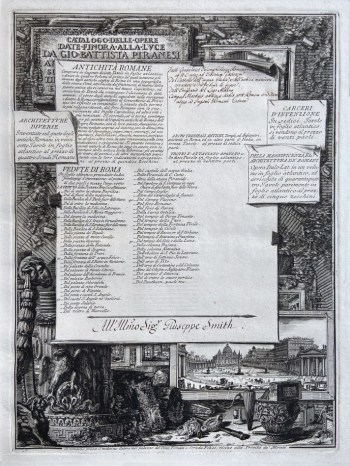
G. B. Piranesi, Catalogo delle Opere, State I, with manuscript additions, 1761, etching, 40 × 30 cm (Private collection).
A R T I C L E S
• Andrew Robison, “Piranesi’s Catalogo delle Opere,” pp. 230–45. When Piranesi moved to new quarters in Rome in 1761 he had space to store and sell his prints rather than entrust them to booksellers. This prompted him to publish an illustrated sales catalogue in the form of an etching and engraving, of which a number of copied inscribed to his friends and patrons survive. Revised twenty-nine times before Piranesi’s death in 1778, the catalogue provides important evidence about his understanding as well as the dating of his prints, series of prints and illustrated books.
• Giovan Battista Fidanza, “Carlo Maratti’s Additions to the Barberini Venus,” pp. 260–65. In 1999–2000 a restoration of the sixteenth-century mural in the Palazzo Barberini, Rome, known as the Barberini Venus, which was remodelled with additions by Carlo Maratti in 1693, removed tempera overpainting in the belief that it post-dated his changes. A newly discovered document in the Barberini archives both provides the fullest contemporary record of Maratti’s work on the mural and indicates that the tempera additions were painted by him.
R E V I E W S
• Isabelle Kent, Review of the Spanish Gallery, Bishop Auckland, pp. 276–83. In October 2021 the only museum in Britain devoted to Spanish art opened in Bishop Auckland, County Durham. Part of the Auckland Project, which uses art, faith and heritage to fuel long-term regeneration, the museum offers an impressive if idiosyncratic representation of Spain in the sixteenth and seventeenth century. [Paintings by Zurbarán were purchased by the Bishop of Durham, Richard Trevor in 1756.]
• Laura Moretti, Review of the newly opened galleries for the permanent collection at the Palazzo Maffei in Verona, pp. 290–92.
• Imogen Tedbury, Review of the exhibition Willem van de Velde and Son (Amsterdam: National Maritime Museum, 2021–22), pp. 293–95.
• Clare Hornsby, Review of the exhibition Grand Tour: Sogno d’Italia da Venezia a Pompei (Milan: Gallerie d’Italia, Piazza Scala, 2021–22), pp. 295-98.
• Carl-Johan Olsson, Review of the exhibition True to Nature: Open-Air Painting in Europe 1780–1870 (Paris: Fondation Custodia, 2021–22), pp. 298-300.
• María Cruz de Carlos Varona, Review of Beatriz Blasco Esquivias, Jonatan Jair López Muñoz, and Sergio Ramiro Ramírez, eds., Las mujeres y las artes: Mecenas, artistas, emprendedoras y coleccionistas (Abada Editores, 2021), pp. 316–17.
• Susanna Zanuso, Review of Aurora Laurenti, Intagli rococo: professionalità ed elaborazione del gusto negli interni del Palazzo Reale di Torino (Accademia University Press, Turin, 2020), pp. 318–20.
The Burlington Magazine, February 2022
The eighteenth century in February’s issue of The Burlington . . .
The Burlington Magazine 164 (February 2022) — Northern European Art
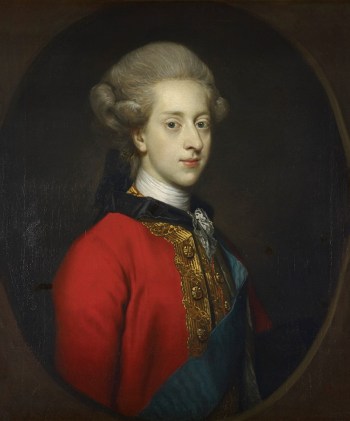
Nathaniel Dance Holland, Portrait of Christian VII, King of Denmark, 1768, oil on canvas, 77 × 63 cm (Royal Collection Trust).
A R T I C L E S
• Sara Ayres, “Christian VII of Denmark’s Lost British Portraits,” pp. 155–63. In 1768–69 the young Christian VII of Denmark visited London and Paris, where several portraits of him were painted. Three were by artists born or working in Britain—Angelica Kauffmann, Edward Cunningham, known as Calze, and Matthew Peters. All are now lost, but evidence about the comissions survives in copies and prints, contemporary descriptions and documents in the Danish State Archives.
• Lars Hendrikman, “The Finding of the Infant Bacchus,” pp. 180–83.
R E V I E W S
• Camilla Pietrabissa, Review of the exhibition Venetia 1600: Births and Rebirths (Venice: Palazza Ducale, 2021–22), pp. 190–92.
• Ivan Gaskell, Review of the new galleries of Dutch and Flemish art at the MFA Boston (open from November 2021), pp. 195–98.
• Richard Stemp, Review of the exhibition Hogarth and Europe (London: Tate Britain, 2021–22), pp. 198–200.
• Maryl Gensheimer, Review of Fabio Barry, Painting in Stone: Architecture and the Poetics of Marble from Antiquity to the Enlightenment (Yale UP, 2020), pp. 216–17.
• Clare Hornsby, Review of Ortwin Dally, Maria Gazzetti, and Arnold Nesselrath, eds., Johann Joachim Winckelmann (1717–1768): Ein Europ isches Rezeptionsph nomen / Fenomeno Europeo della Ricezione (Michael Imhof Verlag, 2021), pp. 217–18.
• Robert Skwirblies, Review of Lea Kuhn, Gemalte Kunstgeschichte: Bildgenealogien in der Malerei um 1800 (Wilhelm Fink Verlag, 2020), pp. 218–19.
• Thomas Stammers, Review of Stacey Boldrick, Iconoclasm and the Museum (Routledge, 2020), p. 222.
O B I T U A R I E S
• Marjorie Trusted, “Christian Theuerkauff (1936–2021),” pp. 223–24. For many years Deputy Director of the sculpture collection at the Bode Museum, Berlin, and honorary professor at the city’s Free University, Christian Theuerkauff was a leading scholar of Baroque ivories, whose expert connosseurship and archival research definitively shaped our understanding of many of the outstanding sculptors in the medium.
New Book | The Material World of Eyre Hall
From Giles, in association with the Maryland Center for History and Culture, Baltimore:
Carl Lounsbury, ed., The Material World of Eyre Hall: Four Centuries of Chesapeake History (London: Giles, 2021), 448 pages, ISBN: 978-1911282914, £75 / $90.
With an Introduction by Cary Carson, and contributions by Laura Pass Barry, Bennie Brown, Edward A. Chappell, Sam Florer, Erik Goldstein, Haley Hoffman, Neal T. Hurst, Angelika R. Kuettner, Mark B. Letzer, Carl R. Lounsbury, George W. McDaniel, Katie McKinney, Elizabeth Palms, Margaret Pritchard, Sumpter Priddy, Will Rieley, Alexandra Rosenberg, Gary Stanton, Robert Watkins, and John Watson
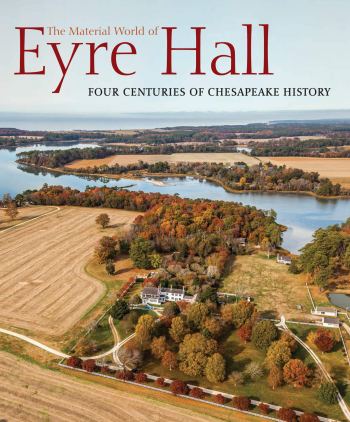 A microhistory of 400 years of southern USA history told in the study of one place, Eyre Hall on the eastern shore of Chesapeake Bay.
Erected in 1759 on the Eastern Shore of Virginia, Eyre Hall is still occupied by descendants of its builder. It retains a rich variety of objects from furniture and books to silver and paintings acquired by the family, reflecting the tastes and aspirations of its many different generations. Only a small handful of places in Virginia can claim such continuity. The material culture of Eyre Hall illustrates the ever-changing meanings of this place in American culture from the seventeenth through the twenty-first century. It represents the cultural endeavours of Southern society built on slavery and impacted by the tribulations of wars, emancipation, and economic depressions. This study explores the mutability of this inheritance in the wake of such transformative events. The book is divided into four sections. The first recounts the history of those who lived at Eyre Hall. The second examines the architecture of the house and its service buildings. The third explores the formal garden. The fourth section is a catalogue raisonné of its objects.
Carl R. Lounsbury was Senior Architectural Historian at Colonial Williamsburg Foundation (now retired) and Adjunct Associate Professor of History at the College of William and Mary. Cary Carson was Senior Vice President of Research at Colonial Williamsburg (now retired).
C O N T E N T S
Acknowledgments
Foreword by J. Thomas Savage
Eyreloom: An Introduction by Cary Carson
I. The Changing Fortunes of the Eyre Family through Four Centuries
Golden Quarter by Carl Lounsbury
Eyreville: Archaeology of the Late Seventeenth Century by Haley Hoffman
Eyre Hall: Power House by Carl Lounsbury
Working the Land by Sam Florer
The Bounty of Eyre Hall: From Working Plantation to Summer Retreat in the Long Nineteenth Century by Carl Lounsbury
Escaping Enslavement by Whaleboat, 1832 by Alexandra Rosenberg
Health Retreats and Pleasure Grounds by Robert Watkins
Hoofprints by Elizabeth Palms
Eyre Hall in the Twentieth Century: ‘I’m Home’ by George McDaniel
A Scrapbook of Recollections by Those Who Called Eyre Hall ‘Home’ by George McDanielII
II. Architecture
The Architecture of the House by Carl Lounsbury
Architectural Hardware by Edward Chappell
Wallpaper by Margaret Pritchard
Domestic Service Buildings by Carl Lounsbury
Home Farm: Overseer’s House by Carl Lounsbury
III. Landscape
Garden and Grounds by Will Rieley
Green-house by Will Rieley
Graveyard by Carl Lounsbury
IV. Catalogue
Furniture by Sumpter Priddy
Silver by Mark Letzer
Ceramics by Robert Hunter and Angelika Kuettner
Glass by Angelika Kuettner
Paintings by Laura Pass Barry
Maps by Katie McKinney
Prints by Katie McKinney
Books by Bennie Brown
Musical Instruments by John Watson
Sheet Music by Gary Stanton
Costume and Textiles by Neal Hurst
Ironwork and Arms by Erik Goldstein
Index
Photo Credits
New Book | Lover’s Eyes
This is an updated and expanded version of the 2012 exhibition catalogue. From Giles:
Elle Shushan, ed., with additional contributions by Graham Boettcher and Stephen Lloyd, Lover’s Eyes: Eye Miniatures from the Skier Collection (London: Giles, 2022), 280 pages, ISBN: 978-1911282938, £40 / $50.
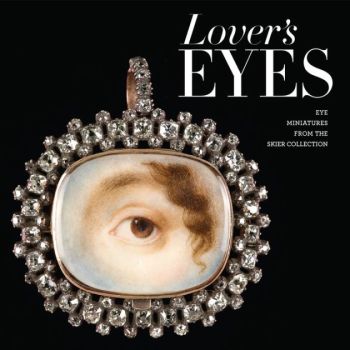 Until the early 2000s, little had been written about eye miniatures, or ‘Lover’s Eyes’, and their short-lived popularity at the end of the 18th and early 19th centuries, when hand-painted portraits of single human eyes were set in jewellery, or created to memorialize a deceased loved one. This new expanded and updated edition of the 2012 volume The Look of Love examines their role in the broader context of Georgian and early Victorian portrait miniatures; and looks in detail at the creation, and appeal, of these extraordinary objects.
Dr. and Mrs. David A. Skier’s collection of eye miniatures is one of the most complete such collections of this genre of miniature painting anywhere in existence. This volume features over 130 pieces from the Skier Collection, with 36 extraordinary newly acquired pieces, including two of the three known existing ‘lovers’ lips’, and six examples of a delightful sub-category known as ‘Flower Eyes’. There are four new illustrated essays: on forgeries and fakes of lovers’ eyes, on ‘Flower Eyes’, on the persistence of the eye image which continues the tradition of lovers’ eyes, and an essay on the eye miniatures created by Richard Cosway.
Elle Shushan is a specialist dealer, author, lecturer, and museum consultant. She is a member of the Antiques Dealers’ Association of America, the British Antique Dealers’ Association, CINOA, the Private Art Dealers Association, and the Association of Historians of American Art.
Stephen Lloyd is curator of the Derby Collection at Knowsley Hall, Merseyside. From 1993 to 2009 he was Assistant Keeper and then Senior Curator at the Scottish National Portrait Gallery, where he co-curated the exhibition The Intimate Portrait: Drawings, Miniatures, and Pastels from Ramsay to Lawrence.
Graham Corray Boettcher is the director of the Birmingham Museum of Art in Birmingham, Alabama.
C O N T E N T S
Collectors’ Preface
Acknowledgements
The Artist’s Eye by Elle Shushan
Eye Miniatures by Richard Cosway by Stephen Lloyd
Symbol & Sentiment: Lover’s Eyes and the Language of Gemstones by Graham Boettcher
Floriography by Elle Shushan
Fake of Fashion by Elle Shushan
Love Never Dies by Graham Boettcher
Catalogue of the Exhibition by Graham Boettcher, Nan Skier, and Elle Shushan, with the assistance of Laura Wallace and Maggie Keenan
Index
Author biographies
New Book | Worn: A People’s History of Clothing
From Penguin Random House:
Sofi Thanhauser, Worn: A People’s History of Clothing (New York: Pantheon, 2022), 400 pages, ISBN: 978-1524748395, $30.
 In this panoramic social history, Sofi Thanhauser brilliantly tells five stories—Linen, Cotton, Silk, Synthetics, Wool—about the clothes we wear and where they come from, illuminating our world in unexpected ways. She takes us from the opulent court of Louis XIV to the labor camps in modern-day Chinese-occupied Xinjiang. We see how textiles were once dyed with lichen, shells, bark, saffron, and beetles, displaying distinctive regional weaves and knits, and how the modern Western garment industry has refashioned our attire into the homogenous and disposable uniforms popularized by fast-fashion brands.
Thanhauser makes clear how the clothing industry has become one of the planet’s worst polluters and how it relies on chronically underpaid and exploited laborers. But she also shows us how micro-communities, textile companies, and clothing makers in every corner of the world are rediscovering ancestral and ethical methods for making what we wear. Drawn from years of intensive research and reporting from around the world, and brimming with fascinating stories, Worn reveals to us that our clothing comes not just from the countries listed on the tags or ready-made from our factories. It comes, as well, from deep in our histories.
Sofi Thanhauser teaches in the writing department at Pratt Institute. She has received fellowships from the Fulbright Program, MacDowell, and Ucross Foundation. Her writing has appeared in Vox, Essay Daily, and The Establishment, among other publications.
C O N T E N T S
Introduction
Linen
1 The Last Linen Shirt in New Hampshire
2 Underthings
Cotton
3 Texas Fields
4 The Fabric Revolution
5 Drought
Silk
6 Yangtze Silk
7 Costume Drama
8 The Rise of Mass Fashion
Synthetics
9 Rayon
10 Nylons
11 Export Processing Zones
Wool
12 Army of the Small
13 Woolfest
14 Weavers
Conclusion
Acknowledgments
Notes
Bibliography
Index
New Book | Chiswick House Gardens
From Liverpool UP:
David Jacques, Chiswick House Gardens: 300 Years of Creation and Re-creation (Liverpool: Liverpool University Press, 2022), 248 pages, ISBN: 978-1800856219, £40.
 The grounds at Chiswick House are amongst the most iconic of all the historic gardens of Europe. In the 1720s they reflected Lord Burlington’s innovative ideas on Palladianism and antique gardens, whilst the area transformed by William Kent to give a rustic appearance in the early 1730s has been recognised as one of, or perhaps the, birthplace of the landscape garden. The grounds were periodically brought to the forefront of taste, reaching another high point as the venue for spectacular garden parties under the 6th Duke of Devonshire. As a garden of many periods it has given rise to passionate national debates since World War II on the principles of restoration, and as a public park it has been an important project assisted by the National Lottery Heritage Fund. Its renewed high state of keeping and its tranquil beauty belies its ‘deep’ history of intellectual debate, social tensions and practical difficulties.
The book concentrates on the four main periods when Chiswick gardens were in the national spotlight, two when being in the forefront of taste and two concerning the restorations, the first being in the 1950s when the whole question of garden restoration was entirely new. The second restoration, on and off since 1988 intersects with the development of a philosophical stance and national policy on the restoration of parks and gardens. There is much of interest for art and architectural historians, garden historians, social historians and those local and international visitors who enjoy the finest public park in West London.
David Jacques is an independent scholar and part-time lecturer at the Institute for Historical Research.
C O N T E N T S
Foreword
Acknowledgements
Image Credits
About the Book
Abbreviations
1 ‘His Lordship’s Fine Genius’
2 ‘A Picture of Watteau’
3 English Palladianism
4 The Public Park Initiative
Appendix A: The Owners of Chiswick House Gardens
Appendix B: The Head Gardeners at Chiswick House
Appendix C: Chronology
Notes
Bibliography
Index
Print Quarterly, March 2022
The long eighteenth century in the latest issue of Print Quarterly:
Print Quarterly 39.1 (March 2022) . .
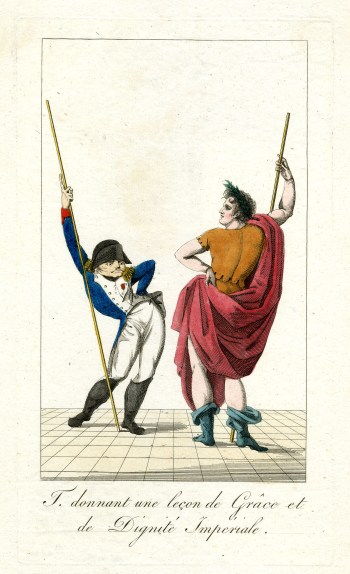
Charles Elie, T[alma] donnant une leçon de grâce et de dignité impériale (T[alma] giving a lesson in grace and imperial dignity), 1814, hand-coloured etching, 244 x 142 mm (London: British Museum).
A R T I C L E S
Antony Griffiths, “The Publication of Caricatures in Paris in 1814 and 1815, Part I: The Established Printsellers, Genty and Martinet,” pp. 31ff.
Two articles by Antony Griffiths on ‘The Publication of Caricatures in Paris in 1814 and 1815’—Part 1 in the March 2022 issue and Part 2 forthcoming—discuss the publication of caricatures in Paris during two years in which there were four regimes in power, and two occupations by foreign armies—a period which led to an unprecedented outpouring of social and political satire. Many works of great quality were produced, but most have only a title and do not reveal the names of the producers. The articles discuss how publishers and artists dealt with the political upheavals and identify some of the many participants who entered the field in these years. Part 1 deals with the caricatures published by members of the established print trade in Paris, and in particular Aaron Martinet and the newcomer Genty, who has previously been misidentified.
R E V I E W S
• Mark McDonald, Review of Juan Agustín Ceán Bermúdez, El Churriguerismo: discurso inédito (Alicante: Biblioteca Virtual Miguel de Cervantes, 2019), p. 79.
• Diana Greenwald, Review of Madeleine Viljoen, Nina Dubin and Meredith Martin, Meltdown! Picturing the World’s First Bubble Economy (Turnhout: Harvey Miller, 2020), p. 80.
• Ann V. Gunn, Review of John Bonehill, Anne Dulau Beveridge, and Nigel Leask, eds., Old Ways New Roads: Travels in Scotland 1720–1832 (Edinburgh: Birlinn, 2021), p. 81.
• Marcia Reed, Review of Troy Bickham, Eating the Empire: Food and Society in Eighteenth-Century Britain (London: Reaktion, 2020), p. 84.
• Nigel Tattersfield, Review of Graham Williams, Thomas Bewick Engraver & the Performance of Woodblocks (Kent: Florin Press, 2021), p. 86.
• Janis A. Tomlinson, Review of Mark McDonald et al., Goya’s Graphic Imagination (New York: The Metropolitan Museum of Art, 2021), p. 102.
Exhibition | A Shared Passion for Drawing
From:
Le partage d’une passion pour le dessin
Palais des Beaux-Arts, Paris, 22 March — 30 April 2022

Jean-Baptiste Greuze, Head of a Frightened Child, red chalk on beige paper (Beaux-Arts de Paris, acquired in 2013).
L’exposition dévoile un ensemble de 90 dessins, entrés dans les collections de l’École grâce à la générosité de l’association « Le Cabinet des amateurs de dessins des Beaux-Arts de Paris ». Le parcours, organisé à l’occasion des 15 ans de l’association, est présenté par écoles (italienne, nordique et française) à travers les siècles. Des œuvres d’Eugène Delacroix, Jean-Honoré Fragonard, Jean-Baptiste Greuze, Gerrit Van Honthorst, Giuseppe Penone ou encore Simone Peterzano sont ainsi à découvrir.
Les Beaux-Arts de Paris conservent la plus belle collection de dessins de France, après celle du musée du Louvre. Cette collection continue aujourd’hui encore de s’enrichir grâce à une politique d’acquisitions conçue à des fins pédagogiques ; ainsi que par des dons de professeurs, de jeunes artistes, et de l’association « Le Cabinet des amateurs de dessins des Beaux-Arts de Paris ».
Le partage d’une passion pour le dessin (ENSBA, 2017), 282 pages, ISBN: 978-2840565093, 39€.
New Book | Animating the Antique
From Penn State UP:
Sarah Betzer, Animating the Antique: Sculptural Encounter in the Age of Aesthetic Theory (University Park: Pennsylvania State University Press, 2022), 272 pages, ISBN: 978-0271088839, $125.
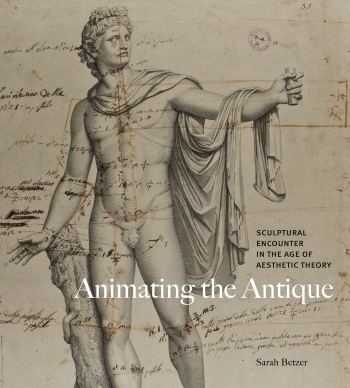 Framed by tensions between figural sculpture experienced in the round and its translation into two-dimensional representations, Animating the Antique explores enthralling episodes in a history of artistic and aesthetic encounters. Moving across varied locations—among them Rome, Florence, Naples, London, Dresden, and Paris—Sarah Betzer explores a history that has yet to be written: that of the Janus-faced nature of interactions with the antique by which sculptures and beholders alike were caught between the promise of animation and the threat of mortification.
Examining the traces of affective and transformative sculptural encounters, the book takes off from the decades marked by the archaeological, art-historical, and art-philosophical developments of the mid-eighteenth century and culminates in fin de siècle anthropological, psychological, and empathic frameworks. It turns on two fundamental and interconnected arguments: that an eighteenth-century ontology of ancient sculpture continued to inform encounters with the antique well into the nineteenth century, and that by attending to the enduring power of this model, we can newly appreciate the distinctively modern terms of antique sculpture’s allure. As Betzer shows, these eighteenth-century developments had far-reaching ramifications for the making and beholding of modern art, the articulations of art theory, the writing of art history, and a significantly queer Nachleben of the antique.
Bold and wide-ranging, Animating the Antique sheds light upon the work of myriad artists, in addition to that of writers ranging from Goethe and Winckelmann to Hegel, Walter Pater, and Vernon Lee. It will be especially welcomed by scholars and students working in eighteenth- and nineteenth-century art history, art writing, and art historiography.
Sarah Betzer is Professor of Art History at the University of Virginia and the author of Ingres and the Studio: Women, Painting, History, also published by Penn State University Press.
Exhibition | Antoine Coypel and the Theater of Troy
Now on view at the Musée des Beaux-Arts de Tours:
Le Théâtre de Troie: Antoine Coypel, d’Homère à Virgile
Musée des Beaux-Arts de Tours, 22 January — 17 April 2022
 L’exposition, présentée au musée des Beaux-Arts de Tours, en partenariat avec la Bibliothèque nationale de France, est une invitation à redécouvrir Antoine Coypel (1661–1722), peintre du roi Louis XIV et du régent Philippe d’Orléans. Aucune exposition monographique concernant Coypel n’a vu le jour jusqu’à présent, mais la connaissance de l’artiste a été récemment enrichie grâce à l’apparition sur le marché de l’art d’oeuvres inédites, à la redécouverte de tableaux que l’on croyait perdus et à la restauration de décors monumentaux, tel le plafond de l’hôtel d’Argenson, sur le point d’être révélé au public aux Archives Nationales. Sans prétendre à l’exhaustivité, l’exposition est une invitation à redécouvrir la personnalité attachante et la carrière prolifique d’Antoine Coypel, ainsi que les grands textes de l’Antiquité, d’Homère et de Virgile, ayant nourri son inspiration.
Autour de La Colère d’Achille et des Adieux d’Hector et Andromaque de Tours, une cinquantaine d’oeuvres des XVIIIᵉ et XIXᵉ siècles (tableaux, estampes, dessins, sculptures, objets d’art et planches gravées) sont réunies, grâce au prêt exceptionnel de la Bibliothèque nationale de France, du château de Versailles, des musées du Louvre, de Rennes, d’Angers, d’Arles, du Mobilier national et de l’École des Beaux-Arts de Paris.
Point d’orgue de l’exposition, la galerie d’Énée du Palais-Royal, chef-d’oeuvre d’Antoine Coypel aujourd’hui disparu, renaît au travers d’estampes spectaculaires de la Bibliothèque nationale de France. Les recherches approfondies menées pour reconstituer ce grand décor ont également permis de concevoir une maquette numérique de la galerie, en partenariat avec le musée Fabre de Montpellier, qui offre pour la première fois une proposition de reconstitution virtuelle en 3D très aboutie.
Une riche programmation culturelle (cycle de conférences, visites, spectacles de danse, musique, théâtre, cycle de péplums à la cinémathèque de Tours, cours d’histoire de l’art tout public, etc.) accompagnera toute la durée de cette exposition.
Le théâtre de Troie: Antoine Coypel, d’Homère à Virgile (Paris: Lienart éditions, 2022), 192 pages, ISBN: 978-2359063547, 23€.










 Enfilade
leave a comment