New Book | Capitalism and the Emergence of Civic Equality
From The University of Chicago Press:
William Sewell, Capitalism and the Emergence of Civic Equality in Eighteenth-Century France (Chicago: The University of Chicago Press, 2021), 416 pages, ISBN: 9780226770321 (cloth), $105 / ISBN: 9780226770468 (paper), $35.
 There is little doubt that the French Revolution of 1789 changed the course of Western history. But why did the idea of civic equality—a distinctive signature of that revolution—find such fertile ground in France? How might changing economic and social realities have affected political opinions? William H. Sewell Jr. argues that the flourishing of commercial capitalism in eighteenth-century France introduced a new independence, flexibility, and anonymity to French social life. By entering the interstices of this otherwise rigidly hierarchical society, expanded commodity exchange colored everyday experience in ways that made civic equality thinkable, possible, even desirable, when the crisis of the French Revolution arrived. Sewell ties together masterful analyses of a multitude of interrelated topics: the rise of commerce, the emergence of urban publics, the careers of the philosophes, commercial publishing, patronage, political economy, trade, and state finance. Capitalism and the Emergence of Civic Equality in Eighteenth-Century France offers an original interpretation of one of history’s pivotal moments.
William H. Sewell Jr. is the Frank P. Hixon Distinguished Service Professor Emeritus in Political Science and History at the University of Chicago. He is the author of several books, including, most recently, Logics of History: Social Theory and Social Transformation, published by the University of Chicago Press.
C O N T E N T S
Introduction: The French Revolution and the Shock of Civic Equality
1 Old Regime State and Society
2 The Eighteenth-Century Economy: Commerce and Capitalism
I. The Emergence of an Urban Public
3 The Commercial Public Sphere
4 The Empire of Fashion
5 The Parisian Promenade
II. The Philosophes and the Career Open to Talent
6 The Philosophe Career and the Impossible Example of Voltaire
7 Denis Diderot: Living by the Pen
8 The Abbé Morellet: Between Publishing and Patronage
9 Jean-Jacques Rousseau: Self-Deceived Clientage
III. Royal Administration and the Promise of Political Economy
10 Tocqueville’s Challenge: Royal Administration and the Rise of Civic Equality
11 Warfare, Taxes, and Administrative Centralization: The Double Bind of Royal Finance
12 Political Economy: A Solution to the Double Bind?
13 Navigating the Double Bind: Efforts at Reform
Conclusion: The Revolution and the Advent of Civic Equality
Epilogue: Civic Equality and the Continuing History of Capitalism
Acknowledgments
References
Index
Exhibition | Bestowing Beauty

Inkwell, Pakistan, Sindh, eighteenth century, steel, overlaid with gold (koftgari) (Houston: Hossein Afshar Collection at the MFAH). This inkwell is dedicated to Mir Fateh ‘Ali Sarkar-i Khan Talpur (r. 1783–1801/2), chief of the Talpurs, a tribe that conquered and ruled Sindh, in present-day Pakistan, from 1783 until 1843. The slit in the inkwell’s base, which makes it possible for a belt to pass through, suggests its portability and importance as part of courtly attire. The gold overlay, delicate decoration, and dedicatory inscription emphasize the power and prestige of the written word.
◊ ◊ ◊ ◊ ◊
From the Toledo Museum of Art’s press release for the exhibition:
Bestowing Beauty: Masterpieces from Persian Lands
The Museum of Fine Arts, Houston, 19 November 2017 — 11 February 2018
High Museum of Art, Atlanta, 12 December 2020 — 18 April 2021
Toledo Museum of Art, 23 April — 17 July 2022
Curated by Aimée Froom
This spring and summer the Toledo Museum of Art offers a spectacular exhibition of more than 100 objects drawn from one of the most significant private collections of Persian art. Bestowing Beauty: Masterpieces from Persian Lands showcases the artistic inventiveness of Persian culture across different media, featuring a broad array of textiles, ceramics, metalwork, lacquer, paintings, jewelry, and manuscripts from the Hossein Afshar Collection. Historically Persian lands—a wide swath of territory that at various times spanned from Cairo to Delhi, with its heart in what is now modern-day Iran—saw centuries of conquest and globalization. The art that resulted both reinforced Persian culture and assimilated these cross-cultural exchanges.
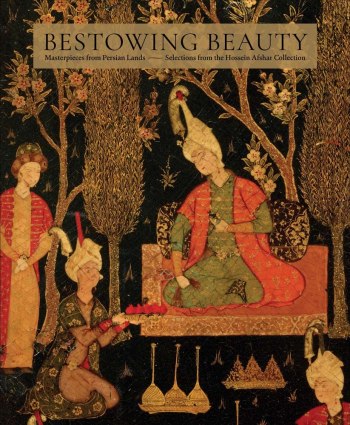 Woven throughout the stories of these extraordinary objects are experiences, ideas, and emotions shared by cultures across the globe. By evoking universal themes of love, loss, conflict, and spirituality the exhibition brings to life the rich heritage and enduring beauty of Persian art.
“Celebrating the cultural heritage of Iran at the Toledo Museum of Art with Bestowing Beauty represents a rare opportunity for our audiences to experience the grandeur and beauty of these objects in person,” said Diane Wright, the Museum’s senior curator of glass and contemporary craft. “An important area of trade and migration, Persian lands served as critical centers of artistic production and influence for centuries, which the exhibition brilliantly highlights through these extraordinary works of art.”
The visual and literary arts have held a privileged place in Iranian civilization for centuries. The Hossein Afshar Collection, which embraces a diverse range of treasures from the eve of Islam’s arrival in the seventh century to the end of the 19th century, was assembled to preserve and share Persian art and culture today and for future generations. The exceptional objects in Bestowing Beauty embody the history of trade and migration found in Persian art, as well as map the legacy of artistic and technological advancements across the region.
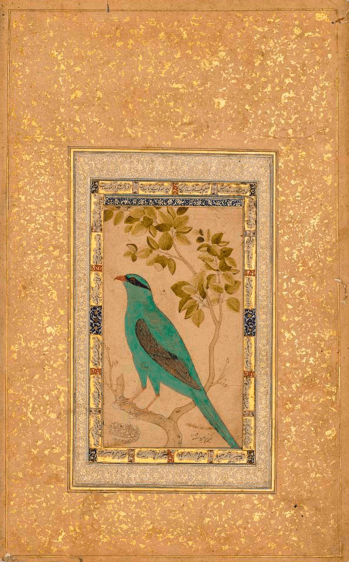
Signed ‘Ali-Quli’, Common Green Magpie, 1746–47, ink, opaque watercolor, and gold on paper (Hossein Afshar Collection at the MFAH).
The exhibition is divided into six sections:
Banquets and Battles features the exuberance of palace feasting and fighting, quintessential aspects of Persian kingship and perennially popular subjects in Persian art and literature. Feasts are portrayed across media, such as a 19th-century painting of a female juggler accompanied by a cat, and the exhibition also includes lavishly decorated serving vessels and utensils fashioned from metals and ceramic.
Faith and Piety explores how, after the advent of Islam, words from the Qur’an became paramount as a mode of expression. Exquisitely penned and sumptuously illuminated Qur’an manuscripts were produced across the Islamic world. Calligraphers also copied a variety of texts in addition to the Qur’an, such as sayings from the Hadith, Shi‘a invocations, literary manuscripts and poetry, all of which are included in the exhibition.
Art of the Word, the third section, delves into the different developments, styles and uses of calligraphy, enhancing the aesthetic form and rhythmic beauty of calligraphy. Words were woven into textiles, engraved onto metalwork, painted on ceramic objects and enamels, and carved into wood.
In Persian literature, love finds expression as a profound human connection and metaphor for a yearning for unity with the divine. Love and Longing traces how calligraphers and painters brought to life the rich corpus of Persian literature, from the exquisite miniature paintings from the Shahnama (Book of Kings), the Persian national epic, to couplets of lyric poetry and a pair of tightly embracing lovers on a slim lacquer pen case.
Kingship and Authority explores the kingly ideal, which figures prominently in Persian visual and literary culture. In addition to the Shahnama—the masterpiece that reflects the legends and virtues of Persian dynasties—court painters in the 19th century captured portraits of royalty and the ruling elite. This section also incorporates monumental silk carpets of the 16th and 17th centuries and an exquisite 19th-century pendant of gold, pearls, and gemstones.
The concluding section, Earth and Nature, examines the manifestations of flora and fauna that abound in the art of Iran. Its people were among the earliest civilizations to cultivate gardens. The garden’s symbolism—of paradise, of the promise of spring, of renewal—permeated Persian culture and can be seen in the exhibition through glorious depictions of lions, falcons, nightingales, roses, and fruit.
“The significance of Persian lands geographically, culturally and politically cannot be overstated,” said Sophie Ong, Hirsch curatorial fellow at the Toledo Museum of Art. “Bestowing Beauty draws attention to the splendor and complexity of Persian art, continuing TMA’s enrichment of the medieval world and beyond.”
Bestowing Beauty: Masterpieces from Persian Lands is organized by the Museum of Fine Arts, Houston.
Aimée Froom, ed., Bestowing Beauty: Masterpieces from Persian Lands—Selections from the Hossein Afshar Collection (New Haven: Yale University Press, with The Museum of Fine Arts, Houston, 2021), 304 pages, ISBN: 978-0300247022, $85. With contributions by Walter Denny, Melanie Gibson, David Roxburgh, Robert Hillenbrand, Mary McWilliams, Janet O’Brien, Marianna Shreve Simpson, Eleanor Sims, Margaret Squires, and Julie Timte.
Exhibition | Louis Chéron (1655–1725)
The exhibition closed last month, but the catalogue is still available:
Louis Chéron: L’ambition du dessin parfait
Musée des Beaux-Arts, Caen, 4 December 2021 — 6 March 2022
Curated by François Marandet
 Le musée des Beaux-Arts propose la première rétrospective consacrée à Louis Chéron, au travers d’une soixantaine d’œuvres issues de collections françaises et anglaises, couvrant une large période, de 1678 jusqu’aux années 1720.
Né à Paris en 1655, Louis Chéron quitte la France pour l’Angleterre en 1683. C’est à Londres qu’il vivra pendant trente ans, occupant là une place centrale au sein de la scène artistique. Les études académiques, les dessins d’invention, les projets d’illustration, les programmes pour de grands décors peints et les rares tableaux de chevalet conservés permettent de découvrir un artiste prolifique et précurseur. Contemporain de Louis Laguerre et de James Thornhill, à cheval sur deux siècles et deux nations, Cheron, souvent considéré comme un « suiveur de Charles Le Brun », reflète l’esprit classique français. Il annonce également, par ses dessins d’invention et sa peinture de chevalet proprement fantastiques, l’art de la génération suivante. En 1720, il crée sa propre école d’art à Londres, dont l’originalité est l’introduction de femmes nues comme modèles. Un peintre aussi célèbre que William Hogarth y suivra des cours.
The press packet is available as a PDF file here»
François Marandet, with prefaces by Emmanuelle Delapierre and Robin Simon, Louis Chéron (1655–1725): L’ambition du dessin parfait (Ballan-Miré: Illustria Librairie des Musées, 2022), 288 pages, ISBN: 978-2354040956, 30€.
New Book | Figures of the Enlightenment: Eighteenth-Century Meissen
Distributed by The University of Chicago Press:
Philip Kelleway and Tristan Sam Weller, Figures of the Enlightenment: A Catalogue of Eighteenth-Century Meissen from a Private Collection (London: Unicorn Publishing Group, 2022), 128 pages, ISBN: 978-1913491857, $45.
 A compelling record of eighteenth-century taste through pieces of Meissen porcelain.
This book presents more than one hundred specially commissioned photographs of eighteenth-century Meissen porcelain from a significant private collection, illuminating what elite consumers of that era valued, aspired to, and found entertaining. With an expert eye, each object is showcased in the round and up close, highlighting all important features. Detailed entries accompany each item and an introductory essay helps to place them in their proper historical context. Anyone with an interest in the decorative arts of the eighteenth century will find this book a feast for the eyes.
Philip Kelleway is an art historian who has written widely on eighteenth-century porcelain, illustration, and landscape painting. Tristan Sam Weller is a photographer based in the United Kingdom.
The Burlington Magazine, April 2022
The eighteenth century in the April issue of The Burlington . . .
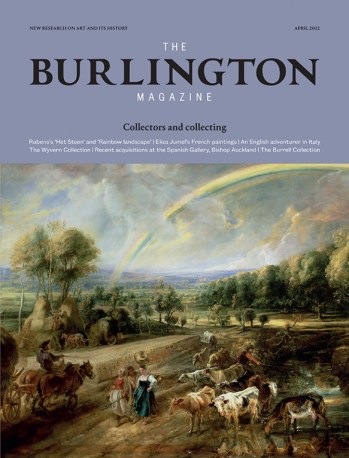
The Burlington Magazine 164 (April 2022)
 A R T I C L E S
• Lucy Davis and Natalia Muñoz-Rojas, “The Provenance of Het Steen and The Rainbow Landscape by Rubens,” pp. 333–41. New documentary evidence elucidates the hitherto uncertain history of these two celebrated landscapes painted by Peter Paul Rubens ca. 1636. Having remained with this family after his death, they were purchased by the Marquess of Caracena, Governor of the Spanish Netherlands, and taken to Madrid. By 1706 they were in Genoa, in the collections of successively Bartolomeo Saluzzo (1652–1705) and Costantino Balbi (d. 1740). This article assimilates a number of archival discoveries that shed light not only on the provenance of these two paintings but also on two important Genoese collections.
• Lucia Bonazzi, “Richard Vickris Pryor in the Art Market of Napoleonic Europe,” pp. 342–49. The son of a Quaker family of brewers and wine merchants, Richard Vickris Pryor (1780–1807) spent his brief adult life in pursuit of paintings. A characteristic example of the sort of entrepreneur who sought to exploit the release of works of art onto the market in the wake of Napoleon’s campaigns, he scored his greatest success with the purchase of the Lechi collection in Brescia in 1802.
• Margaret Oppenheimer, “From Paris to New York: French Paintings from the Collection of Eliza Jumel,” pp. 350–61. Eliza Jumel (1775–1865), born in poverty, was one of New York’s richest women at her death in 1865. While in Paris in 1815–17 she formed the largest collection of European paintings yet assembled by an American, the largest part of them French. Sold in 1821, the collection has been all but forgotten, but it has proved possible to trace a number of the works she owned.
R E V I E W S
• Noémi Duperron, Review of the exhibition Le Théâtre de Troie: Antoine Coypel, d’Homère à Virgile (Musée des Beaux-Arts de Tours, 2022), pp. 394–96.
• Eric Zafran, Review of the exhibition Paintings on Stone: Science and the Sacred, 1530–1800 (Saint Louis Art Museum, 2022), pp. 396–99.
• Peter Y. K. Lam, Review of the exhibition catalogue Sarah Wong and Stacey Pierson, eds., Collectors, Curators, Connoisseurs: A Century of the Oriental Ceramic Society, 1921–2021 (Oriental Ceramic Society, 2021), pp. 402–03.
• Rowan Watson, Review of Richard Rouse and Mary Rouse, Renaissance Illuminators in Paris: Artists and Artisans, 1500–1715 (Harvey Miller, 2019), pp. 418–19.
• Richard Wrigley, Review of Iris Moon and Richard Taws, eds., Time, Media, and Visuality in Post-Revolutionary France (Bloomsbury, 2021), pp. 423–24.
• Philip Ward-Jackson Review of Bayerische Staatsgemäldesammlungen / Neue Pinakothek: Katalog der Skulpturen; Volume I: Die Sammlung Ludwigs I, Volume II: Adolf von Hildebrand (Deutscher Kunstverlag, 2021), pp. 424–25. “This is a vital link in the chain between Enlightenment celebrations of worthies and grand hommes and such later nineteenth-century sculptural pantheons as those on the Musée du Louvre, Paris, and the Albert Memorial, London . . .” (424).
O B I T U A R I E S
• Peter Cherry, Obituary for Jonathan Brown (1939–2022), pp. 427–28. As well as bringing many fresh insights to the study of the major Spanish artists from El Greco to Picasso, with a particular focus on Velázquez, Jonathan Brown made important contributions to the study of patronage and collecting and of the diffusion of the images and ideas in the wider Hispanic world. Much honoured in Spain as well as in his native America, he will also be remembered as a dedicated and assiduous teacher.
New Book | Late-Georgian Churches, 1790–1840
Forthcoming from John Hudson Publishing:
Christopher Webster, Late-Georgian Churches: Anglican Architecture, Patronage, and Church-Going in England, 1790–1840 (London: John Hudson Publishing, 2022), 360 pages, ISBN: 978-1739822903, £80 / $115. Also available as an ebook for £20.
 This book is the first comprehensive study of late-Georgian church-building. After centuries of post-Reformation inactivity, the Church of England began to address the desperate shortage of accommodation and build on a huge scale. Almost all the leading architects were involved and, amongst approximately 1500 new churches, there are some outstanding designs—buildings of the very highest order architecturally. In this pioneering study, the churches are considered free from the Ecclesiological zeal that condemned them and has, for so long, prevented their serious study. It celebrates the best of them and provide valuable insights into the design and planning of the whole corpus. Included is a thorough examination of the stylistic alternatives and contemporary liturgical imperatives, along with their architectural implications. The book also explores a lost world of late-Georgian churchgoing: what people expected and experienced in a church service. Also considered are some of the period’s remarkable material and constructional innovations, ones often exploited in church-building, along with the provision of architectural services in the era that preceded full professionalisation.
Christopher Webster is an independent architectural historian whose work focuses on Georgian England. His books include R.D. Chantrell (1793–1872) and the Architecture of a Lost Generation (2009) and edited volumes of essays: Episodes in the Gothic Revival (2011); Building a Great Victorian City: Leeds Architects and Architecture, 1790–1914 (2011); and The Practice of Architecture (2012). Dr Webster has also published articles in Architectural History, The Georgian Group Journal, and Ecclesiology Today.
C O N T E N T S
1 Introduction
2 The Church in Danger
3 Ecclesiastical Architecture and the Question of Style
4 Church Designers and Their World
5 Constructional and Decorative Innovation in Church-building
6 Designing for Worship: The Practical Issues
7 Planning Liturgical Spaces
8 Late-Georgian Worship
9 Seating the Congregation
10 Late Eighteenth Century Church-building: The Final Triumph of Classicism
11 Church-building, 1800–1820
12 The Gothic Revival in West Yorkshire and Liverpool, 1800–1820
13 Design Debates and Solutions, 1820: The Commissioners, the ICBS and Publications
14 Church-building in the 1820s
15 Church-building in London, c1790–1830: From Classical to Gothic
16 Church-building in South-East Lancashire, 1790–1830: The Role of the Clergy
17 Church-building in the 1830s
18 A Brave New World?
19 Conclusions
Select Bibliography
Select Gazetteer
Index
Exhibition | Boilly: Parisian Chronicles

Louis-Léopold Boilly, Trompe-l’oeil aux cartes et pieces de monnaie, detail, ca. 1808–15
(Lille: Palais des Beaux-Arts)
◊ ◊ ◊ ◊ ◊
From the Cognacq-Jay:
Boilly: Parisian Chronicles
Musée Cognacq-Jay, Paris, 16 February — 26 June 2022
Curated by Annick Lemoine and Sixtine de Saint-Léger
A virtuosic and prolific artist in a class of his own, Louis-Léopold Boilly (1761–1845) was the enthusiastic chronicler of Parisian life for sixty years, spanning a period from one revolution to the dawn of the next (1789 and 1848). In addition to being a portraitist for Parisians and a painter of city scenes, Boilly was also the inventor of stunning trompe-l’œil paintings and the author of witty caricatures. This monographic exhibition explores Boilly’s productive career through a selection of 130 works, giving us a glimpse into the artist’s uniqueness, brilliance, humour, and inventiveness. It presents several previously unseen masterpieces, some of which have never been shown in France.
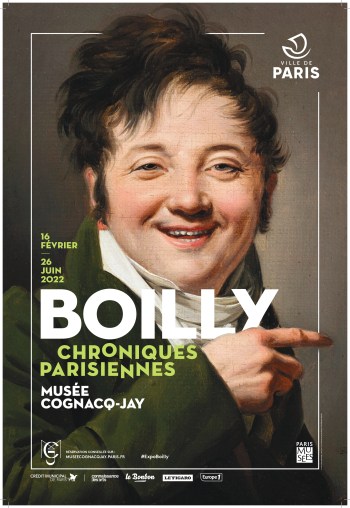 Born in the North of France, Boilly set out to win over the capital at the age of 24, in 1785. He would live there his whole life. Taking little interest in the grand history of Paris, he instead became fascinated by the city’s modernity, its hustle and bustle, and its many spectacles. As a true chronicler of everyday life, Boilly painted an intimate portrait of his generation. The artist developed a fondness for scrutinising the views and faces he came across in the city. He distinguished himself in the art of portraiture by capturing the faces of Parisians on the small formats that would become his trademark. The portraitist was also a keen caricaturist who looked at his fellow citizens with an amused, and perhaps even scathing, eye. His taste for provocation and technical proficiency can also be found in his stunningly illusionistic trompe-l’œil.
The exhibition also showcases the subtle tricks the artist employed to depict himself in his works. In addition to painting derisive self-portraits and using a variety of signatures, he also slid his likeness amongst the protagonists of his crowd scenes, just as Alfred Hitchcock did in his films. These stratagems establish a knowing relationship between the artist and viewer. Throughout the exhibition, visitors are taken along on a fun treasure hunt to find Boilly’s face or clues of his presence.
Organised as a follow-up to the publication of Étienne Bréton and Pascal Zuber’s catalogue raisonné of the artist’s work (Boilly: Le peintre de la société parisienne de Louis XVI à Louis-Philippe, Arthena, 2019), the exhibition is curated by Annick Lemoine and Sixtine de Saint-Lége. On display are several masterpieces never before shown in France on loan from prestigious private collections, including one of the largest, currently held by the Ramsbury Manor Foundation (United Kingdom).
Annick Lemoine, ed., with contributions by Etienne Bréton, Sixtine de Saint-Léger, Côme Fabre, Martial Guédron, Charlotte Guichard, Annick Lemoine, Susan L. Siegfried, Anne-Laure Sol, Francesca Whitlum-Cooper, and Pascal Zuber, Boilly: Chroniques Parisiennes (Paris: Musées, 2022), 160 pages, ISBN: 978-2759605187, €30.
New Book | Libel and Lampoon: Satire in the Courts, 1670–1792
Andrew Bricker will be speaking online (via Zoom) with Marissa Nicosia about his new book on Tuesday, 12 April 2022, at noon (ET) in a session sponsored by the Society of Fellows in Critical Bibliography and the Rare Book School. From Oxford UP:
Andrew Benjamin Bricker, Libel and Lampoon: Satire in the Courts, 1670–1792 (Oxford: Oxford University Press, 2022), 352 pages, ISBN: 978-0192846150, $90.
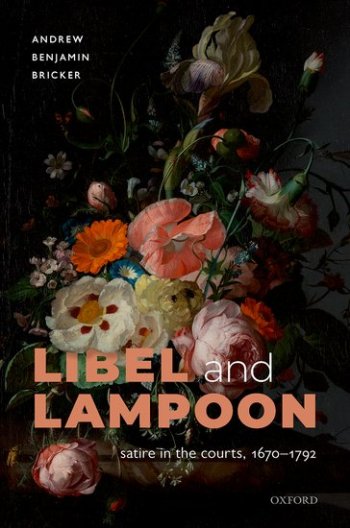 Libel and Lampoon shows how English satire and the law mutually shaped each other during the long eighteenth century. Following the lapse of prepublication licensing in 1695, the authorities quickly turned to the courts and newly repurposed libel laws in an attempt to regulate the press. In response, satirists and their booksellers devised a range of evasions. Writers increasingly capitalized on forms of verbal ambiguity, including irony, allegory, circumlocution, and indirection, while shifty printers and booksellers turned to a host of publication ruses that complicated the mechanics of both detection and prosecution. In effect, the elegant insults, comical periphrases, and booksellers’ tricks that came to typify eighteenth-century satire were a way of writing and publishing born of legal necessity. Early on, these emergent satiric practices stymied the authorities and the courts. But they also led to new legislation and innovative courtroom procedures that targeted satire’s most routine evasions. Especially important were a series of rulings that increased the legal liabilities of printers and booksellers and that expanded and refined doctrines for the courtroom interpretation of verbal ambiguity, irony, and allegory. By the mid-eighteenth century, satirists and their booksellers faced a range of newfound legal pressures. Rather than disappearing, however, personal and political satire began to migrate to dramatic mimicry and caricature-acoustic and visual forms that relied less on verbal ambiguity and were therefore not subject to either the provisions of preperformance dramatic licensing or the courtroom interpretive procedures that had earlier enabled the prosecution of printed satire.
Andrew Benjamin Bricker is an Assistant Professor of English Literature in the Department of Literary Studies at Ghent University and a Senior Fellow at the Andrew W. Mellon Society of Fellows in Critical Bibliography at the Rare Book School at the University of Virginia. He received his BA and MA from the University of Toronto and his PhD from Stanford University. Before joining UGent, he was a Mellon Foundation Postdoctoral Fellow in the Humanities at McGill University and a Killam Postdoctoral Research Fellow at the University of British Columbia.
C O N T E N T S
Introduction: The Perils of Satire
1 Keeping out of Court I: Libel and Lampoon after Hale and Dryden
2 Keeping out of Court II: Swift and the Illicit Book Trade
3 Irony in the Courts: Defoe and the Law of Seditious Libel
4 Naming in the Courts: Pope and the Dunciad
5 Allegory in the Courts: Satire and the Problem of ‘Libellous Parallels’
6 Keeping out of Court III: Caricature, Mimicry, and the Deverbalization of Satire
Epilogue: A Shandean History of the Press
Exhibition | French Taste in Spain, 17th–19th Centuries
Now on view at the Fundacion MAPFRE:
The French Taste and Its Presence in Spain, 17th–19th Centuries
El gusto francés y su presencia en España, siglos XVII–XIX
Fundación MAPFRE, Madrid, 11 February — 8 May 2022
Curated by Amaya Alzaga Ruíz with Gloria Martínez Leiva
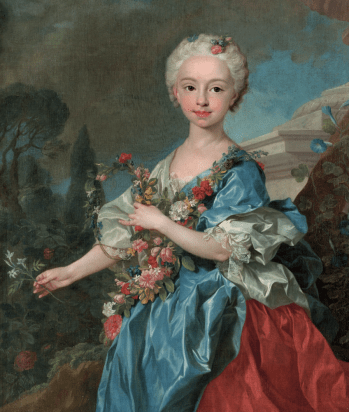
Louis-Michel Van Loo, María Antonia Fernanda de Borbón, Infanta of Spain, detail, ca. 1737, oil on canvas, 88 × 71 cm (Museo de Bellas Artes de Asturias, Repository of the Collection of the IX Count of Villagonzalo; photo by Marcos Morilla).
Through numerous paintings, sculptures, textiles, sumptuary arts, and everyday objects, the exhibition El gusto francés y su presencia en España, siglos XVII–XIX delves into the evolution of French taste in Spain, which until now has been studied only on an ad hoc basis. A cross-cutting project that covers such an extensive historical period cannot be understood without its historical context. In this sense, the exhibition also addresses aspects that make this evolution possible, such as diplomatic relations, the history of collecting, and the construction of national identities. The nearly 110 works on display are from both public and private collections and are all pieces of national heritage. The project commences at the moment when French artworks began to arrive in Spain, as France emerged as a model of European taste, and it concludes when the opposite phenomenon occurred, when Spain became the focus of attraction for French culture, due to the image constructed around its diversity and exoticism throughout the 19th century.
17th Century | Difficult Relations: Portraits, Exchanges, and Gifts
The 1630s and 1640s, under the reign of Louis XIII, who for a time managed to stabilize the power of the crown, witnessed a golden age for French painting. Both Louis XIII and his advisor, Cardinal Richelieu, launched an extremely active artistic policy and commissions proliferated, which encouraged the art market.
Towards 1650, Spain was irrevocably losing its primacy as a world power to the France of Louis XIV, the Sun King. One of the strategies used to seal the peace was to establish alliances through marriages with the Spanish royal house. In this context, it was common for gifts of a very different nature to be exchanged between the two: horses, sumptuary arts, small pieces of furniture and above all portraits. From 1660 onwards, thanks to his marriage to Maria Teresa of Austria, daughter of Philip IV, known as the Planet King—a union that brought the Thirty Years’ War to an end— the exchange of gifts became even more frequent. The queen was portrayed on numerous occasions alone or accompanied by her son Louis, known as the Grand Dauphin of France, as can be seen in María Teresa de Austria y el Gran Delfín de Francia (Maria Theresa of Austria and the Grand Dauphin of France), ca. 1664, by cousins Charles and Henri Beaubrun.
18th Century | The Arrival of French Artists in Bourbon Spain, the Emergence of French Taste
In 1700, with the accession to the throne of Philip V, the Bourbon dynasty, of French origin, was established in Spain, and in the early years of his reign, the king wanted to bring everything he had known in Versailles and Paris to the Spanish court. He commissioned the work on the Buen Retiro, as well as the interior renovation of the Alcázar, and undertook the construction of the Granja de San Ildefonso, in Segovia. In addition, all kinds of furniture, jewelry, and clothing were imported. In 1715, the painter Michel-Ange Houasse came to the Spanish court from France, later being succeeded by Jean Ranc. In 1735, Louis-Michel Van Loo replaced Ranc, and became the King’s principal painter, as well as the director of painting at the Real Academia de Bellas Artes de San Fernando, founded in 1752. From his hand came the portrait María Antonia Fernanda de Borbón, infanta de España (María Antonia Fernanda de Borbón, Infanta of Spain), ca. 1737.
 During this period, artistic transfers between France and Spain were sometimes made by way of Italy, which was home to an important French community fostered by the presence of the Académie de France in Rome, founded by Louis XIV in 1666. Spanish artists traveled to Rome more and more frequently, which gave them the opportunity to become familiar with French art without the need to travel to Paris. This was the case of Francisco Goya, who was able to become acquainted with the work of Nicolas Poussin and Pierre Subleyras during his documented stay in the Italian capital.
The blossoming of French culture and taste in Spain reached its pinnacle during the reign of Charles IV, grandson of Philip V. Born in Portici during the reign of his father Charles III in Naples and Sicily, Charles Anthony of Bourbon (1748–1819) arrived in Spain as a teenager. He was first named Prince of Asturias and then crowned King of Spain and the Indies in 1788. In 1808 he was dethroned, exiled first in France and then in Rome, until his death in Naples. His interest in the sumptuary arts, furniture, painting, and sculpture became apparent at an early age and the best example of this is the Platinum Cabinet in the Casa del Labrador in Aranjuez, which was made entirely by French artists. On the occasion of his marriage to Maria Luisa Teresa of Parma in 1765, Louis XV gave the couple a table service from the porcelain company Manufactura Real de Porcelana de Sèvres, and his cousin Louis XVI, presented them with two paintings by Claude Joseph Vernet.
19th Century | The Romantic Vision of Spain
With the Napoleonic invasion that led to the War of Independence (1808–1814), Spain became the new destination to be explored by the French who, together with other foreign travelers and intellectuals, created what is known today as the ‘romantic image of Spain’. Some of those who contributed to this creation were the writer Victor Hugo and the painter Eugène Delacroix. We can see more specific examples in the exhibition, in the figures of Antonio de Orleans, Duke of Montpensier and Galliera, and Eugenia de Montijo.
The Duke of Montepensier married the sister of Queen Isabella II, the Infanta Luisa Fernanda. After the revolution of 1848 the couple left France, settling in Seville in 1849. Their stay led to a boom in culture and popular events in the city, to the point that Seville came to be nicknamed the ‘Small Court’. Eugenia de Montijo, the daughter of the Duke of Peñaranda, was born in Granada, but spent most of her life in France. Wife of Louis Napoleon Bonaparte, thanks to her education and refinement, she was one of those responsible for exporting the ‘Empire style’ to the Spanish court.
At the end of the 18th century, France and Spain became official allies and a change began to take place with respect to the foreign view of the latter. Spain, which was at peace, proved to be the perfect alternative for more inquisitive spirits, since it was home to magnificent remains from the Roman and Arab civilizations. In this context, Alexandre de Laborde (1773–1842), an officer, scholar and traveler, taking advantage of his diplomatic posting in Madrid, in 1800 penned the story of his travels, in the Voyage pittoresque et historique de l’Espagne. In 1808, he finally published a shorter version, entitled Itinéraire descriptif de l’Espagne, which led a considerable number of artists to Spain, including François Ligier.
In 1826, in Paris, Baron Isidore Justin Taylor began the publication of a Voyage pittoresque en Espagne, en Portugal et sur la Côte d’Afrique, de Tanger à Tétouan. In Paris, where he held the post of Royal Commissioner of French Theater, Taylor promoted the production of Hernani, Victor Hugo’s 1830 play set in the Spanish Golden Age, further catalyzing the Romantic enthusiasm for the Peninsula. At the same time, his involvement in governmental mechanisms allowed him to present himself as the connoisseur par excellence of Spain: in 1835, he was commissioned to assemble a collection of Spanish paintings for the Louvre Museum, a campaign personally financed by King Louis-Philippe, who was eager to acquire a Galérie espagnole, taking advantage of the imminent confiscations of Mendizábal. The two French artists most involved in illustrating the Baron’s work were Adrien Dauzats and Pharamond Blanchard, who also helped to locate the paintings destined for Louis Philippe’s Spanish gallery.
Although the perception of ‘Spanishness’ in France varied throughout the 19th century, after the 1848 Revolution, it became increasingly frequent to associate Spanish culture with the image of an archaic and free people, in contrast with the rigid rules of bourgeois society. Starting in 1850, several artists, among them Gustave Doré, Jean-Baptiste Achille Zo, and Édouard Manet, began to exhibit paintings in French salons featuring gypsies, beggars, vagabonds and working class ‘majos’. Made after their respective trips to Spain, in most cases they tried to exalt the Spanish Golden Age with the figures of Velázquez and Ribera at the forefront.
Amaya Alzaga Ruíz, ed., El Gusto francés y su presencia en España, siglos XVII–XIX (Madrid: Fundación MAPFRE, 2022), 331 pages, ISBN 978-8498447972, 50€.
New Book | Luxury after the Terror
From Penn State UP:
Iris Moon, Luxury after the Terror (University Park: Pennsylvania State University Press, 2022), 272 pages, ISBN: 978-0271091617, $105. Also available as an ebook.
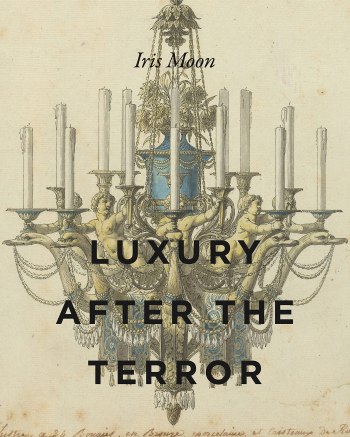 When Louis XVI was guillotined on January 21, 1793, vast networks of production that had provided splendor and sophistication to the royal court were severed. Although the king’s royal possessions—from drapery and tableware to clocks and furniture suites—were scattered and destroyed, many of the artists who made them found ways to survive. This book explores the fabrication, circulation, and survival of French luxury after the death of the king.
Spanning the final years of the ancien régime from the 1790s to the first two decades of the nineteenth century, this richly illustrated book positions luxury within the turbulent politics of dispersal, disinheritance, and dispossession. Exploring exceptional works created from silver, silk, wood, and porcelain as well as unrealized architectural projects, Iris Moon presents new perspectives on the changing meanings of luxury in the revolutionary and Napoleonic periods, a time when artists were forced into hiding, exile, or emigration. Moon draws on her expertise as a curator to revise conventional accounts of the so-called Louis XVI style, arguing that it was only after the revolutionary auctions liquidated the king’s collections that their provenance accrued deeper cultural meanings as objects with both a royal imprimatur and a threatening reactionary potential.
Lively and accessible, this thought-provoking study will be of interest to curators, art historians, scholars, and students of the decorative arts as well as specialists in the French Revolution.
Iris Moon is Assistant Curator in the European Sculpture and Decorative Arts Department at the Metropolitan Museum of Art and the author of The Architecture of Percier and Fontaine and the Struggle for Sovereignty in Revolutionary France. She teaches at The Cooper Union for the Advancement of Science and Art.
C O N T E N T S
List of Illustrations
Acknowledgements
Introduction
1 Death and Dispersal: The 1793–94 Revolutionary Auctions at Versailles
2 Henry Auguste: Precious Metals in the Age of Terror
3 Jean-Démosthène Dugourc: Political Fantasies of the Arabasque
4 Aubert-Henri-Joseph Parent: Carving in Exile
5 Alexandre Brongniart: Fragile Terrains
Coda
Notes
Bibliography
Index










 Enfilade
leave a comment