Exhibition | The King’s Animals

Now on view at Versailles:
Les Animaux du Roi / The King’s Animals
Château de Versailles, 12 October 2021 — 13 February 2022
Curated by Alexandre Maral and Nicolas Milovanovic
From its location in the heart of a vast forest in the Île-de-France region, the Palace of Versailles has always fostered a dynamic relationship with the animal kingdom. From animals as objects to be studied or collected to those used as political attributes and symbols of power, the exhibition explores the bond between the court of Versailles and animals—whether ‘companion animals’ (primarily dogs, cats, and birds), exotic beasts, or ‘wild’ creatures. It also brings two long-lost areas of the estate back to life: the Royal Menagerie and the Maze. Once the pride and joy of Louis XIV’s gardens, they can still be admired today in drawings, paintings and testimonies from the period.
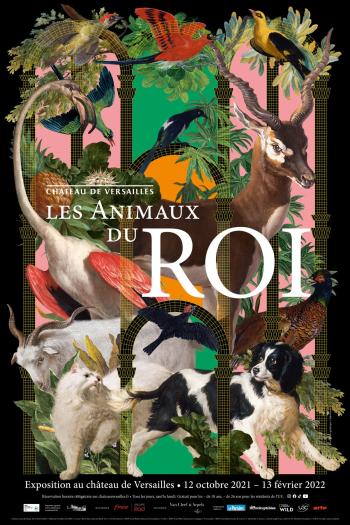 The Royal Menagerie, which the Sun King had installed close to the Grand Canal, was home to the rarest and most exotic animals—from coatis to quaggas, cassowaries to black-crowned cranes (nicknamed the ‘royal bird’)—constituting an extraordinary collection in which the king took ever greater pride. The animals in the menagerie were also a great source of inspiration for the artists of the time: they helped Claude Perrault with his Histoire naturelle, as well as serving the Royal Academy of Sciences as subjects for dissections and, later, Louis XV and Louis XVI, in their naturalism pursuits.
In addition to decorative items from the interior of the menagerie—particularly the paintings by Nicasius Bernaerts—on display are well-known garden sculptures, such as those in the Latona Fountain and the Maze. The latter comprised no fewer than 300 animals made from lead, arranged into a scene from Aesop’s fables and depicting a vision of the world in which animals make political, often moralising, always educational, pronouncements. In all, 37 sculptures recovered from the erstwhile grove will be on display.
More information about the Labyrinth (in French) is available here»
As well as the actual animals that were collected and studied, animal symbolism was used to represent power. The exhibition illustrates the link between the establishment of Versailles as a seat of power—from the construction of the palace itself on the site of Louis XIII’s old hunting lodge—and animal symbolism. Part of the exhibition is devoted to the daily hunt—a key activity pursued by warrior kings in times of peace as a form of training and demonstration of power. The hunt, consequently, features prominently in royal iconography.
 The animals themselves will return in droves to Versailles, because they never disappeared completely. They live on in the work of the king’s top painters; from Bernaerts, Boel and Le Brun, to Desportes and Oudry, many artists produced portraits of these exotic, wild and more familiar animals. As well as paintings, on view are portraits woven by the Gobelins Manufactory plus animals that were dissected, engraved, then preserved at the Academy of Sciences and in the King’s Garden, which is now the National Museum of Natural History. The exhibition also includes the skin of the Asian elephant gifted to Louis XV, which was donated to the Pavia Museum by Napoleon, and the skeleton of the very first elephant at Versailles, which was presented to Louis XIV by the king of Portugal and lived at Versailles for 13 years.
Finally, the exhibition addresses the role at court of companion animals for both the royal family and courtiers. As is evident from many portraits, companion animals were present everywhere, enlivening the royal apartments and brightening up the daily lives of children and adults alike. Many of the sovereigns, such as Marie Lesczcynska, wife of Louis XV, chose to surround themselves with their favourite animals. The court’s interest in the animal world led to greater sensitivity towards animals, in direct contrast to the Cartesian theory of animal-machines. Madame Palatine and, later, Madame de Pompadour, were particularly passionate about them.
Exhibition Curators
• Alexandre Maral, Curator General, Head of the Sculpture Department of the Musée National des Châteaux de Versailles et de Trianon
• Nicolas Milovanovic, Head Curator of the Paintings Department of the Louvre Museum
Alexandre Maral and Nicolas Milovanovic, eds., Les Animaux du Roi (Paris: Lienart éditions / musée national des châteaux de Versailles et de Trianon, 2021), 464 pages, ISBN: 978-2359063455, 49€.
New Book | Le prince et les animaux
From Lavoisier:
Joan Pieragnoli, Le prince et les animaux: Une histoire zoologique de la cour de Versailles au siècle des Lumières, 1715–1792 (Brussels: Éditions de l’Université de Bruxelles, 2021), 295 pages, ISBN: 978-2800417615, €27.
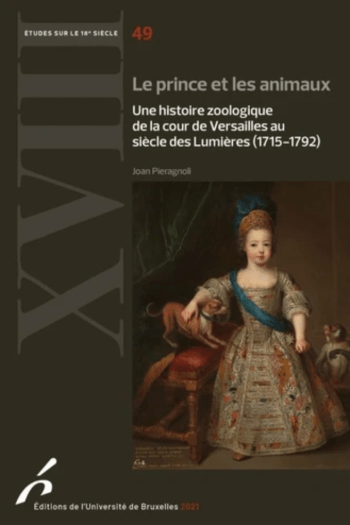 Entre utile et futile, les animaux accompagnent l’existence quotidienne du prince dont les chiens et les chevaux réclament de monumentaux bâtiments à Versailles. Mais au siècle des Lumières les animaux favorisent aussi l’apparition d’un Versailles intime à travers l’artisanat du luxe et de multiples constructions zoologiques de fantaisie.
Durant le règne de Louis XIV, les animaux contribuent à ériger Versailles en véritable monument à la gloire du prince, car ils sont des symboles de pouvoir et deviennent le prétexte de bâtiments grandioses. Cependant, au XVIIIe siècle, les derniers Bourbons délaissent ostensiblement leur principale demeure.
L’histoire zoologique proposée ici, en considérant les pratiques de chasse et la gestion des populations animales qu’elles impliquent, prétend d’abord expliquer cette désaffection. Elle invite également à évoquer un Versailles méconnu, où l’architecture zoologique de fantaisie consacre l’apparition d’une demeure intime au sein de la résidence officielle. Moins qu’à la magnificence, les animaux se trouvent désormais associés à la quête de l’existence privée confortable privilégiée par le roi et son entourage. À travers l’artisanat, l’industrie du luxe et la gastronomie les bêtes participent d’une consommation somptuaire qui définit l’art de vivre des Lumières. Mais l’opinion, indisposée par le coût des ménageries et celui des équipages, juge sévèrement des dépenses qui permettent aux princes de se comporter comme de simples particuliers. Le faste équestre et cynégétique, notamment, joue un rôle prépondérant dans l’effondrement de la monarchie, car les réformes destinées à limiter le nombre de chiens et de chevaux nécessaires au service de la cour interviennent trop tard. Déjà, la Révolution éclate et conduit à des choix autrement plus radicaux.
Docteur en histoire, Joan Pieragnoli s’est spécialisé dans l’étude des animaux durant la période moderne et a consacré plusieurs articles et ouvrages à la Ménagerie de Versailles. Il a récemment collaboré au Dictionnaire Louis XIV (Robert Laffont, 2015) dont il a signé les notices dédiées aux animaux et a publié La cour de France et ses animaux, XVIe–XVIIe siècles (PUF, 2016).
S O M M A I R E
Les animaux : un « habitus du prince » ?
Le cadre social Le cadre administratif et architectural • Le contexte anthropologique
I | Les animaux et le retour de la cour à Versailles
1 Les animaux et la Maison du roi
Les équipages de vénerie • Les équipages de fauconnerie • Les équipages et les animaux de la Chambre • Les écuries du roi
2 Les temps retrouvés de la chasse
Les saisons et les chasses • Les séquences de la chasse • L’économie de la chasse
3 Repeupler la Ménagerie
Protagonistes de l’approvisionnement et itinéraires • Les animaux : peuplement et transport • Les grandes étapes de l’approvisionnement
II | Les animaux et la privatisation des plaisirs royaux
4 L’architecture royale : bâtiments zoologiques et vie sociale
Situation et fonction des constructions royales • Les animaux et la distribution du corps de logis • Les basses-cours et les autres dépendances d’utilité
5 La société des chasses royales
Les chiens et les membres des équipages • La maison régnante • Les courtisans
6 Le renouveau de l’alimentation carnée
L’approvisionnement de la viande et du poisson • La redistribution de la viande sur les tables de la cour • La structure de la consommation
III | Les animaux au crépuscule de Versailles
7 Des animaux de bonne compagnie
L’animal aimé : les témoignages artistiques • Le bestiaire de l’intime • Le soin et la nourriture
8 La Ménagerie : abandon et renouveau d’une institution royale
La Ménagerie : une institution obsolète ? • Le renouveau du peuplement de la Ménagerie • Le fonctionnement quotidien
9 Les animaux à l’heure des réformes
L’héritage du règne de Louis XV et les premières mesures de Louis XVI • Les grandes réformes • Le fonctionnement quotidien
Conclusion générale
Exhibition | Simon Watson: Portrait of a House

From Dublin’s Kevin Kavanagh gallery and Dürer Editions:
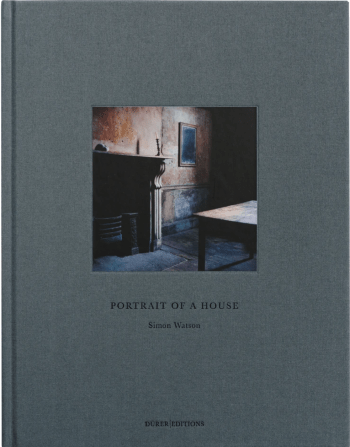
Simon Watson: Portrait of a House
Kevin Kavanagh, Dublin, 14–30 October 2021
In Portrait of a House, Watson explores an eighteenth-century Georgian house on Dublin’s storied Henrietta Street. The house (Number Twelve) has a history of transformation, from the grand city home of wealthy merchants to the inner-city tenement dwelling for the poverty stricken. In a gentle Proustian fashion, the house reveals a quiet melancholy and the slow passing of time. The photographs were made over several years. The work is intended to be a poetic and intimate portrait.
 For over 30 years Simon Watson has exhibited his photographs in Europe and the U.S. including solo shows at the late Richard Anderson Gallery in New York and the Auschwitz Museum in Poland. More recently he has shown his paintings at the Galerie Rideau de Fer in France. His work is included in museums and in public and private collections worldwide. Watson has been a regular contributor to The New York Times T Magazine, W Magazine, Vogue, and Vanity Fair. His recent book The Lives of Others was published by Rizzoli in 2020.
Simon Watson, Portrait of a House (Dürer Editions, 2021 ), 64 pages, ISBN: 978-1838314309 , first edition of 1000 copies, €45; special edition of 50, €350; limited edition of 10, €750; collector edition of 5, €1850.
New Book | The Best Address in Town: Henrietta Street
From Four Courts Press:
Melanie Hayes, The Best Address in Town: Henrietta Street, Dublin and Its First Residents, 1720–80 (Dublin: Four Courts Press, 2021), 312 pages, ISBN: 978-1846828478, €30 / $40.
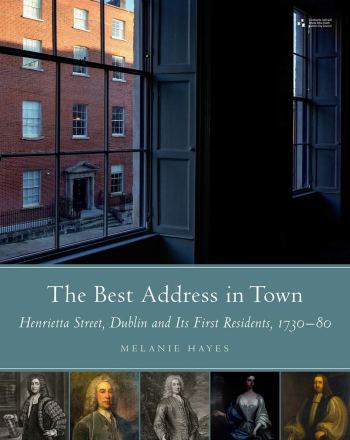 Once Dublin’s most exclusive residential street, Henrietta Street was, throughout the eighteenth century, home to the country’s foremost figures from church, military, and state. Here, in this elegant setting on the north side of the city, peers rubbed shoulders with property tycoons, clerics consorted with social climbers, and celebrated military men mixed with the leading lights of the capital’s beau monde, establishing one the principle arenas of elite power in Georgian Ireland. Looking behind the red-brick facades of the once-grand Georgian town houses, this richly illustrated volume—commissioned by Dublin City Council Heritage Office in conjunction with the 14 Henrietta Street museum—focuses on the people who originally populated these spaces, delineating the rich social and architectural history of Henrietta Street during the first fifty years of its existence. By weaving the fascinating and often colourful histories of the original residents around the framework of the buildings, in repopulating the houses with their original occupants, and by offering a window into the lives carried on within, this book presents a captivating portrait of Dublin’s premier Georgian street, when it was the best address in town.
Melanie Hayes is an architectural historian, specialising in Ireland’s eighteenth-century architectural and social history. She was an academic researcher during the development of the 14 Henrietta Street museum by Dublin City Council, and continues to be involved with the museum. Melanie currently works as a research fellow on an Irish Research Council laureate project, CRAFTVALUE, at Trinity College Dublin, exploring a new skills-based perspective on the architecture of Britain and Ireland from 1680 to 1780.
New Book | 14 Henrietta Street: Georgian Beginnings, 1750–1800
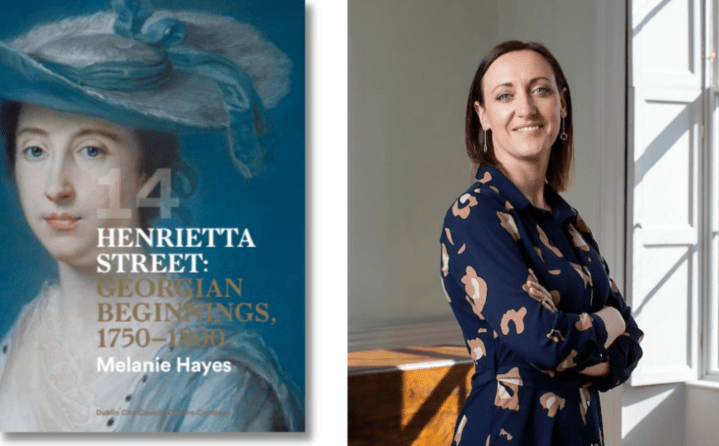
From the 14 Henrietta Street museum:
Melanie Hayes, 14 Henrietta Street: Georgian Beginnings, 1750–1800 (Dublin: Dublin City Council Culture Company, 2021), ISBN: 978-0995744660, €18.
In 1800 Henrietta Street was one of the most elegant and elite addresses in all of Georgian Dublin, home to some of the most powerful members of the Anglo-Irish ruling class. 14 Henrietta Street: Georgian Beginnings explores the early history of the house, its first residents—the Molesworths, Bowes, and O’Brien families—and the lives lived behind the red brick facade. This book is one of three new publications commissioned by the 14 Henrietta Street museum that uncover the lives of the people who lived at the house and the surrounding areas.
Melanie Hayes is an architectural and cultural historian, specialising in Ireland’s eighteenth-century architectural and social history. Melanie was part of the historian research team at 14 Henrietta Street, and continues to be involved as a historian for the museum. Dr Hayes currently works as a post-doctoral research fellow, on an Irish Research Council advanced laureate project, CRAFTVALUE, at Trinity College Dublin.
Exhibition | On Stage! Costume Designs
From the press release for the exhibition:
On Stage! Costume Designs from the Edmond de Rothschild Collection
Louvre, Paris, 28 October 2021 – 31 January 2022
Curated by Jérôme de La Gorce, Mickaël Bouffard, and Victoria Fernández Masaguer
 The Edmond de Rothschild Collection boasts 1,644 sumptuous costume designs for balls, ballets, masquerades, and operas given in France from the reign of François I to that of Louis XIV. Acquired in the late 19th century by Baron de Rothschild, they constitute an extraordinary resource for understanding the world of spectacle during the Ancien Régime. The exhibition showcases a hundred of the finest pieces from this unique corpus.
Cette exposition réunit une sélection d’une centaine de feuilles provenant de l’un des plus importants fonds de dessins d’habits de spectacle, celui des volumes de Costumes de fêtes, de ballets et de théâtre au temps de Louis XIV offerts par le baron Edmond de Rothschild (1845–1934) au musée du Louvre. Leur richesse permet de dévoiler la diversité d’invention des artistes qui habillèrent les divertissements montés à la Cour de France et de Lorraine du milieu du XVIe siècle à l’aube du XVIIIe siècle : le Primatice, Jacques Bellange, Daniel Rabel, Henri Gissey et Jean Berain notamment. Les véritables ouvrages textiles ayant disparu pour la plupart, ces dessins sont des sources inestimables pour l’histoire du costume, de la danse, de la musique et des spectacles en France durant cette période.
Divisée en quatre sections, cette exposition consacre une première salle à l’atelier du dessinateur de costumes qui entend explorer la transmission de modèles entre les différentes générations d’artistes et les spécificités techniques propres à ce type de dessin. Le parcours propose ensuite de suivre les principaux genres spectaculaires représentés dans ces recueils, qui correspondent aux intérêts de l’un des plus grands collectionneurs de dessins de fêtes et divertissements de la fin du XVIIe et du début du XVIIIe siècle, Claude Pioche, sieur Du Rondray (1660/1665–1733), à qui une partie des feuilles assemblées dans ces volumes aurait appartenu :
Les divertissements équestres : les costumes des cavaliers et des chevaux deviennent l’un des attraits majeurs de ces compétitions destinées tant à prouver la valeur que la galanterie des concurrents dans la lice. Par leur magnificence et l’émerveillement qu’ils suscitent, ils contribuent à l’affirmation du pouvoir.
Les bals, ballets et mascarades : dans la seconde moitié du XVIe siècle, un caractère à la fois bizarre et poétique guide les artistes qui produisent des « habits de masques » pour les bals et mascarades. Au temps de Louis XIII, le sérieux et le grotesque se mêlent aux influences mythologiques, exotiques et bucoliques, codes que le ballet de Cour et la comédie-ballet se réapproprient au cours du XVIIe siècle.
Les tragédies en musique : ce nouveau genre musical français réunit une multitude de chanteurs, danseurs, musiciens et acrobates qu’il est nécessaire d’habiller harmonieusement. C’est le défi que relève le créateur des Menus Plaisirs Jean Berain, en faisant preuve d’une invention sans pareil dans la variation des coupes, des couleurs et des ornements.
Grâce à une campagne de restauration conduite par l’atelier de restauration du département des Arts graphiques du musée du Louvre, l’ensemble du corpus de dessins de costumes, soit 1644 feuilles, a été restauré et remonté dans des papiers de conservation neutre.
Commissaires de l’exposition
• Mickaël Bouffard, chargé de recherche, Centre d’Étude de la Langue et des Littératures Françaises (CELLF)
• Jérôme de La Gorce, directeur de recherche émérite, CNRS
• Victoria Fernández Masaguer, chargée d’études documentaires, département des Arts graphiques, musée du Louvre
Jérôme de La Gorce, Mickaël Bouffard, et Victoria Fernández Masaguer, En scène! Dessins de costumes de la collection Edmond de Rothschild (Paris: Louvre éditions / Lienart, 2021), 232 pages, ISBN: 978-2359063240, 29€.
Addressing Equity and Community Building in Museum Contexts
From the press release (20 October 2021), via Art Daily:

Cover Image: Titus Kaphar (b. 1976), Darker Than Cotton, 2017, oil on canvas, 63 x 36 inches (Jackson: Mississippi Museum of Art, Gift of The Gallery Guild, Inc., 2018.008 / ©Titus Kaphar).
The Center for Art & Public Exchange at the Mississippi Museum of Art, in Jackson, MS, today announced the release of two publications in service to the art museum sector thanks to generous support from the W.K. Kellogg Foundation. Established in 2018, CAPE’s mission is to use original artworks, exhibitions, programs, and engagements with artists to foster mutual understanding and inspire new narratives about contemporary Mississippi. The publications, CAPE Toolkit and Compassion, Art, People, and Equity: The Story of the Center for Art and Public Exchange at the Mississippi Museum of Art, are intended to serve as road maps for other art museums grappling not only with how to enact pledges to demonstrate diversity, equity, access, and inclusion during national awakenings regarding antiracism and social justice but also how to authentically serve their communities.
CAPE Toolkit by CAPE Managing Director Monique Davis is a digital publication that offers a model intended to guide institutional transformation by investigating equity, transparency, and truth in a community. It is available on the Museum’s website.
“CAPE’s goal is to align actions with methods,” said Davis. “To develop programs that would meaningfully connect with the community, we first opened ourselves to the adjustments we knew we would have to make in our own institution. In harmony with our community’s expectations and keyed to its values, our goals are simple in articulation and very complicated in execution. We do not simply say what or with whom we stand. Rather, we discover and embody truth.”
Compassion, Art, People, and Equity: The Story of the Center for Art and Public Exchange at the Mississippi Museum of Art by art critic and writer Seph Rodney, PhD, describes CAPE’s establishment, its partners and participants, and its signature programs as a blueprint for promoting change internally and externally. The 21-page softcover is available on the Museum’s website.
Rodney explained, “CAPE’s purpose is inhabited by the feelings, wishes, and concerns of the community. The weaving of narratives around and through works of art begins when we can see the work and wrestle with its meanings. CAPE programs address a variety of sensitive subjects: labor, social status, justice, identity, visibility, accessibility, age, race, gender, sexuality, education (formal and otherwise), socioeconomic class, personal belief, myths, territory, land, power, and care of the soul. At the intersection of art and life, there is the potential for transformation, for healing.”
Betsy Bradley, director of MMA, said, “Our partnership with Tougaloo College in 2017 that activated conversations around art and civil rights, confirmed the need for honest dialogue in and about Mississippi. We knew that the conversations had to extend from the curatorial department to connect with our visitors and more broadly. Thus began CAPE, dedicated to the exploration of ideas about race and equity as inspired by looking closely at artworks together. We recognized that our staff, all expertly trained, and trustees would benefit from learning responsible ways to elicit and manage these difficult conversations. Ultimately, we moved more intimately into the heart of equity at all levels. As our journey continues, we hope these publications inspire colleagues embarking on their own.”
MMA staff and trustees training partners included the Liz Lerman Critical Response Process℠ that focused on a system of observation and inquiry by Museum visitors, and the William Winter Institute for Racial Reconciliation (Winter Institute) in Jackson created opportunities for shared understandings in discussions of race and equity issues.
CAPE Toolkit Components
Community Advisory Council (CAC) was established in 2019 and developed a series of engagements for residents of Jackson and adjacent counties.
“CAC members are engaged in the Museum’s on-going planning and operations as collaborators and partners, providing their experience and wisdom,” said Davis. “Our goal is to make the Museum not only a safe space but a brave space for exchange.”
The Innovation Lab was a physical space in the Museum where visitors were invited to respond to and participate in the curatorial process and discuss their experiences as visitors. The goal was multifold:
• to consider and challenge traditional modes of presenting information;
• to invite visitors to become co-curators to inform new modes of presentation;
• to investigate how people experience artworks in relationship to one another and what MMA’s role is in facilitating these interactions;
• to reflect on the process of identifying and incorporating new insights and directions into future exhibitions.
Re:Frame is an ongoing series of staged dialogues about issues of contemporary significance seen through the lens of the visual arts. Topics have included mass incarceration and the Mississippi State Penitentiary’s Parchman Farm, minority farm ownership, economic injustice, disenfranchisement, and the significance in contemporary life of the cotton industry’s fraught history. In consultation with the Winter Institute, Re:Frame dialogues have included collaborations with the Southern Poverty Law Center, Mississippi Center for Justice, Mississippi Minority Farmers Alliance, and a wide range of local voices including artists, former Parchman inmates, farmers, chefs, musicians, and podcasters.
The W.K. Kellogg Foundation grant also supported the creation of two types of engagements with artists: the In-State Residency program and the National Artist-In-Residency program. Both programs were developed to engage artists and communities in a collaborative exploration of Mississippi places and their histories. Their objectives are to co-produce art that fosters deeper understanding and honors personal truths. In-State artists included Mark Geil, daniel johnson, and Charles Edward Williams. The national program featured Jeffrey Gibson, Nick Cave, and Shani Peters. Peters’ residency was supported by The Andrew W. Mellon Foundation.
Monique Davis is Managing Director for the Center for Art and Public Exchange (CAPE) at the Mississippi Museum of Art (MMA) where she also serves as the Chief Equity and Inclusion Officer. CAPE is a W.K. Kellogg Foundation- and Andrew W. Mellon Foundation-funded initiative that uses artwork, exhibitions, engagement with artists, and programming as a vehicle to have conversations about race and equity. Davis is responsible for creating brave spaces that expand visitors’ perspectives and reveal our shared humanity. She is deeply committed to the belief that art has the power to transform and inform us. Prior to her tenure at the Museum, Monique served as the Senior Program Manager for Parents for Public Schools of Jackson. Her primary responsibility was teaching parents how to be effective advocates for their children by creating workshops to help parents navigate bureaucratic, and often dehumanizing, systems. Her career has been a winding path that has resulted in her owning and operating a restaurant, advocating for homeless veterans at the federal level, and creating safe spaces for nursing mothers. Her board affiliations include Shift Collective (Chair); Visit Jackson (Treasurer); USDAC (United States Department of Arts and Culture) Cultural Agent for Mississippi; Coleman Center for the Arts (Treasurer); and Alternate ROOTS (member and former Chair). Davis is a CPA and a graduate of Howard University.
Seph Rodney, PhD, was born in Jamaica, and came of age in the Bronx, New York. He joined the staff at Hyperallergic in 2016, became an editor a year and a half later, and is currently the opinions editor and a senior critic writing on visual art and related issues. He has also written for The New York Times, CNN, NBC Universal, and American Craft Magazine and penned catalogue essays for Crystal Bridges and the artists Meleko Mokgosi, Teresita Fernandez, and Joyce J. Scott, among others. He has appeared on television on the AM Joy show with Joy Reid and the Jim Jefferies Show on Comedy Central. His book, The Personalization of the Museum Visit, was published by Routledge in May 2019. In 2020, he won the Rabkin Arts Journalism Prize and can be heard weekly on the podcast The American Age. His doctorate in museum studies was earned from Birkbeck College, University of London. He has taught research methodology courses at Parsons School of Design and writing courses at the School of Visual Arts. He has also been a visiting art critic at the Yale School of Art.
Exhibition | La Surprise: Watteau in Los Angeles
Opening next month at the The Getty:
La Surprise: Watteau in Los Angeles
The Getty Center, Los Angeles, 23 November 2021 — 20 February 2022
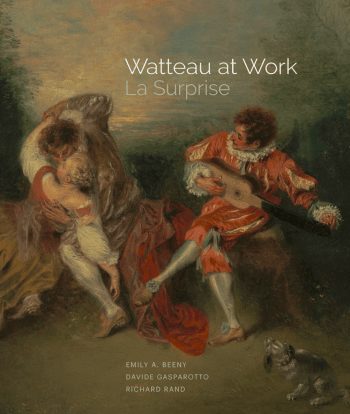 Graceful scenes of courtship, music and dance, strolling lovers and theatrical characters: this is the imaginary world conjured by the greatest French painter and draftsman of the 18th century, Antoine Watteau (1684–1721). Los Angeles is home to an extraordinary group of Watteau’s works. This focused exhibition, marking the 300th anniversary of the artist’s death, brings together a dozen of them from public and private collections and celebrates the Getty’s recent acquisition of an exquisite example: the painting La Surprise. The picture belongs to what was a new genre of painting invented by the artist himself—the fête galante. These works do not so much tell a story as set a mood: one of playful, wistful, nostalgic reverie. Esteemed by collectors in Watteau’s day as a work that showed the artist at the height of his skill and success, La Surprise vanished from public view in 1848, reemerging only in 2007. The Getty Museum acquired the painting in 2017.
Emily Beeny, Davide Gasparotto, and Richard Rand, Watteau at Work: La Surprise (Los Angeles: J. Paul Getty Museum, 2021), 88 pages, ISBN: 978-1606067352, $25.
La Surprise by Antoine Watteau has never before been the subject of a dedicated publication. Marking the three hundredth anniversary of Watteau’s death, this book considers the painting within the context of the artist’s oeuvre and discusses the surprising history of collecting works by the artist in Los Angeles.
Emily A. Beeny, former associate curator of drawings at the J. Paul Getty Museum, is curator in charge of European paintings at the Fine Arts Museums of San Francisco. Davide Gasparotto is senior curator of paintings and chair, curatorial affairs, at the J. Paul Getty Museum. Richard Rand is associate director for collections at the J. Paul Getty Museum.
C O N T E N T S
Timothy Potts, Director’s Foreword
Acknowledgments
Richard Rand, Jean Antoine Watteau, Three Hundred Years Later
Davide Gasparotto, Rediscovering a Masterpiece: Watteau’s La Surprise
Emily Beeny, Quelle Surprise! Watteau in Los Angeles
Plates
Works in the Exhibition
References
Index
Colloquium | Sculpteurs et sculptures du XVIe au XIXe siècle
From Fine Arts Paris:
Du palais au jardin, de l’atelier au cabinet de l’amateur : Sculpteurs et sculptures du XVIe au XIXe siècle / Hommage au travail de Geneviève Bresc-Bautier
Auditorium du Petit Palais, Musée des Beaux-Arts de la Ville de Paris, 8 Novembre 2021
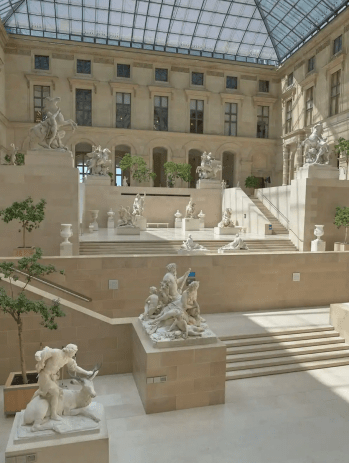 Fine Arts Paris organise en collaboration avec le département des Sculptures du musée du Louvre un colloque et une publication en hommage au travail de Mme Geneviève Bresc-Bautier.
Des historiens de l’art qui comptent pour Geneviève Bresc-Bautier, pour avoir été ses élèves ou pour avoir été associés à ses recherches ou à ses expositions, lui présentent un ensemble de communications en écho à ses centres d’intérêt : la Renaissance française, la sculpture de jardin, les bronzes, les moulages d’après l’Antique, le décor du palais du Louvre, le statut et la formation des sculpteurs…
Ce premier florilège préfigure les futurs Mélanges offerts à Geneviève Bresc-Bautier, dont la souscription sera ouverte à cette occasion et dont la parution est prévue en 2022. Cet ouvrage, coordonné par le département des Sculptures du musée du Louvre, réunira les textes présentés le 8 novembre et bien d’autres, proposés par des conservateurs, universitaires, restaurateurs et historiens de l’art de diverses générations, dont les recherches sur la sculpture du Moyen Âge au XIXe siècle et sur l’histoire du Louvre, ont été marquées par son exemple.
Réservation conseillée par email à rsvp@finearts-paris.com. Les personnes ayant réservé auront accès en priorité aux sièges disponibles. Pass sanitaire requis et port du masque obligatoire dans l’auditorium.
P R O G R A M M E
14.00 Accueil et introduction, présentation du volume d’articles réédités
• Sophie Jugie, directrice du département des Sculptures du musée du Louvre
14.15 Sculpture du XVIe au XVIIIe siècle
• Marion Boudon-Machuel (professeur d’histoire de l’art moderne à l’Université de Tours), Geneviève Bresc-Bautier, le ciseau sous la plume : contributions à l’Histoire de la sculpture de la Renaissance en France
• Pascal Julien (professeur d’Histoire de l’Art moderne à l’Université de Toulouse II), Satyres en Arcadie : méditation et séductions dans la sculpture de jardin, XVIe–XVIIe siècles
• Françoise de La Moureyre (historienne de l’art), Un portrait du roi sculpté à Rome par Clérion
• Sophie Mouquin (maître conférences en histoire de l’art moderne à l’Université de Lille), « Cette piété là est le véritable amour » : une allégorie virtuose et savante d’Aubert Parent
15.45 Pause
16.15 Histoire des moulages
• Elisabeth Le Breton (conservatrice au département des Antiquités grecques, étrusques et romaines, chargée de la gypthotèque du musée du Louvre), Académie de France à Rome : un plâtre daté de 1686
16.35 Histoire du Louvre
• Guillaume Fonkenell (conservateur en chef au musée de la Renaissance à Ecouen), Scibec de Carpi au Louvre
• Sophie Picot-Bocquillon (responsable du pôle documentaire de la Conservation des Œuvres d’Art Religieuses et Civiles de la Ville de Paris), Un sculpteur à l’ombre du Louvre : Francisque Duret et les décors architecturaux du palais
17.30 Conclusions et remerciements
Un ouvrage est consacré à la réédition d’un ensemble d’articles consacrés, entre 1979 et 2012, à ces sculpteurs méconnus que Geneviève Bresc-Bautier s’est attachée à faire connaître, en l’occurrence des sculpteurs actifs à Paris dans la première moitié du XVIIe siècle : Francesco Bordoni (1574–1654), Jean Séjourné (mort en 1614), Christophe Cochet (connu depuis 1606- mort en 1634), Hubert Le Sueur (connu de 1596 à 1658), Toussaint Chenu (connu depuis 1621-mort en 1666) et Thomas Boudin (vers 1570–1637). Une édition de Fine Arts Paris et In Fine Éditions, 25€.
New Book | My Monticello
From Macmillan:
Jocelyn Nicole Johnson, My Monticello: Fiction (New York: Henry Holt and Co., 2021), 224 pages, ISBN: 978-1250807151, $27.
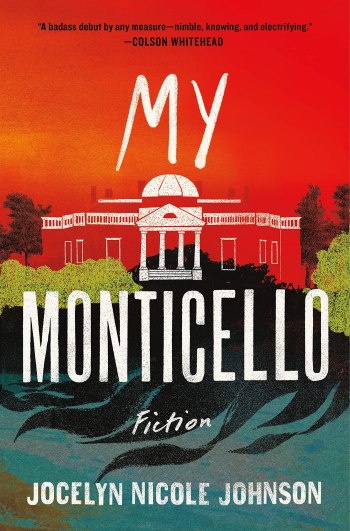 A young woman descended from Thomas Jefferson and Sally Hemings driven from her neighborhood by a white militia. A university professor studying racism by conducting a secret social experiment on his own son. A single mother desperate to buy her first home even as the world hurtles toward catastrophe. Each fighting to survive in America.
Tough-minded, vulnerable, and brave, Jocelyn Nicole Johnson’s precisely imagined debut explores burdened inheritances and extraordinary pursuits of belonging. Set in the near future, the eponymous novella, “My Monticello,” tells of a diverse group of Charlottesville neighbors fleeing violent white supremacists. Led by Da’Naisha, a young Black descendant of Thomas Jefferson and Sally Hemings, they seek refuge in Jefferson’s historic plantation home in a desperate attempt to outlive the long-foretold racial and environmental unravelling within the nation.
In “Control Negro,” hailed by Roxane Gay as “one hell of story,” a university professor devotes himself to the study of racism and the development of ACMs (average American Caucasian males) by clinically observing his own son from birth in order to “painstakingly mark the route of this Black child too, one whom I could prove was so strikingly decent and true that America could not find fault in him unless we as a nation had projected it there.” Johnson’s characters all seek out home as a place and an internal state, whether in the form of a Nigerian widower who immigrates to a meager existence in the city of Alexandria, finding himself adrift; a young mixed-race woman who adopts a new tongue and name to escape the landscapes of rural Virginia and her family; or a single mother who seeks salvation through “Buying a House Ahead of the Apocalypse.”
United by these characters’ relentless struggles against reality and fate, My Monticello is a formidable book that bears witness to this country’s legacies and announces the arrival of a wildly original new voice in American fiction.
Jocelyn Nicole Johnson’s writing has appeared in Guernica, The Guardian, Kweli, Joyland, phoebe, Prime Number Magazine, and elsewhere. Her short story “Control Negro” was anthologized in Best American Short Stories 2018, guest edited by Roxane Gay, and read live by LeVar Burton as part of PRI’s Selected Shorts series. Johnson has been a fellow at Hedgebrook, Tin House Summer Workshops, and VCCA. A veteran public school art teacher, Johnson lives and writes in Charlottesville, Virginia.










 Enfilade
leave a comment