Workshop | Diderot and 18th-Century Human Simulacra
From H-ArtHist:
Diderot and 18th-Century Human Simulacra
Freie Universität Berlin, 5 October 2017
Registration due by 3 October 2017
The workshop aims to explore the different aesthetical and anthropological dimensions of the ‘mannequin’ metaphor in Diderot’s “Paradoxe sur le comédien,” which Diderot introduces as a model for actors/actresses at the very beginning of his acting theory. Central questions of the workshop include, but are not limited to, the following: Why does Diderot use a tool for visual artists to exemplify his idea of the ideal actor/actress? What is the specificity of the mannequin compared to other types of human simulacra such as the statue, the marionette, and the automat?
In order to analyse this specific metaphor and to explore possible answers to these questions, the workshop will approach the subject from two angles. The first approach consists of a comparative analysis between the mannequin’s function as an art tool for painters or sculptors and Diderot’s conception of the ideal actor/actress. Such an analysis implies a comparison between Diderot’s theoretical works on theatre and his theoretical writings on visual art, as for example his ‘Salons’. The second approach consists of a historical contextualisation of Diderot’s concept of the human body in the broader philosophical and scientific discourse of his time.
The workshop will focus on the mannequin’s specificity while comparing it to other human simulacra of that time, such as Jacques de Vaucanson’s famous automata or the moving statue of Condillac’s “Traité des sensations.” The workshop will also discuss other forms of simulacra present in Diderot’s works, as they appear for instance in the Encyclopédie.
The workshop will be held in French and English. Please register via email by October 3rd: marie.igelmann@fu-berlin.de. Freie Universität Berlin, Institut für Theaterwissenschaft, Grunewaldstr. 35, 12165 Berlin-Steglitz, Room 103. The workshop is organised by Marie-Irène Igelmann (Freie Universität Berlin) in the context of the Dahlem Junior Host Program of the Dahlem Humanities Center.
S C H E D U L E
9.45 Opening and Introduction
10.00 L’automate chez Diderot: le vivant et le mécanique (Aurélia Gaillard, Université Bordeaux Montaigne)
11.00 Coffee break
11.15 L’esthétique de la singularité: abstraction et figuration du personnage chez Condillac et Diderot (Manuel Mühlbacher, LMU München)
12.00 Aesthetic and Scientific Concepts of 18th-Century Mannequins (Marie-Irène Igelmann, Freie Universität Berlin)
12.45 Lunch break
15.00 The Encyclopédie, Similarity, and the Simulacrum (Thari Jungen, Graduate School “Performing Citizenship,” Hamburg)
15.45 The Notion of Genius in Diderot’s ‘Salon de 1767’ (Christian Hartwig Steinau, Freie Universität Berlin/LMU München)
16.30 Coffee break
16.45 Concluding Discussion
Colloquium | Eighteenth-Century Court Culture

From Munich’s Zentralinstitut für Kunstgeschichte:
Hofkultur des 18. Jahrhunderts
Teil I: Dresden, Nymphenburg, Benrath: Schlösser und Bäder
Zentralinstitut für Kunstgeschichte München, Munich, 25 October 2017
17.30 Peter Heinrich Jahn (Dresden/München), ‘Die Begierde, den Beifall aller zu erheischen, lässt ihn häufig den Plan ändern’: Der Dresdner Zwinger als Planungsproblem
Der berühmte Dresdner Zwinger war 1709 als Orangeriegarten des benachbarten Residenzschlosses begonnen worden und endete zwei Jahrzehnte später nach mehreren Konzeptwechseln, ohne dass die Ursprungsfunktion jemals aufgegeben worden wäre, als unvollendet gebliebenes Sammlungsgebäude, das einen Turnierplatz umschloss. Als sprunghaft agierender Dilettantenarchitekt war der als August der Starke bekannte königliche Auftraggeber Impulsgeber für zahlreiche „Planungsprobleme“, die sein Hofarchitekt Matthäus Daniel Pöppelmann durch In-die-Form-Bringen zu lösen hatte. Das heutzutage in durcheinander geratener Ordnung überlieferte historische Planmaterial zum Dresdner Zwinger lässt dessen kunsthistorische Auswertung ebenfalls zu einem „Planungsproblem“ werden, das durch Rekonstruktion einer logischen Planungsabfolge gelöst werden will.
18.30 Kristina Deutsch (Münster), Zwischen Rückzug und Repräsentation: Schlossbäder der Wittelsbacher in Nymphenburg und Benrath
Keine andere Dynastie des Alten Reichs hat uns so viele Schlossbäder hinterlassen, wie die Wittelsbacher. Diese sehr kunstvoll gestalteten Räume waren als Orte des Rückzugs konzipiert, zuweilen dienten sie aber auch gesellschaftlichen Anlässen. In beiden Fällen vermitteln Architektur und Ausstattung höfischer Bäder ein bestimmtes Bild des Herrschers oder der Herrscherin, das es im Rückgriff auf die tatsächliche Nutzung zu analysieren gilt.
Hofkultur des 18. Jahrhunderts
Teil II: Rom und Paris in Schwerin: Jean-Laurent Le Geay (1710–1786), Architektur und Gartenkunst
Zentralinstitut für Kunstgeschichte München, Munich, 6 December 2017
16.30 Johannes Erichsen (München), Jean-Laurent Le Geay: Architektur für den Schweriner Hof und die Quellen der Inspiration
17.30 Iris Lauterbach (München), Le spectacle de la nature: Die Gärten des Schweriner Hofes im 18. Jahrhundert im europäischen Kontext
18.30 Hans Lange (München), Die grüne Pyramide für Ludwigslust
19.00 Sigrid Puntigam (Schwerin), Herzog Friedrich von Mecklenburg-Schwerin als dilettierender Architekt
Die Teilnahme ist frei. Wir bitten um Ihre Anmeldung unter hofkultur@zikg.eu.
Study Day | Collectors and the Country House Library
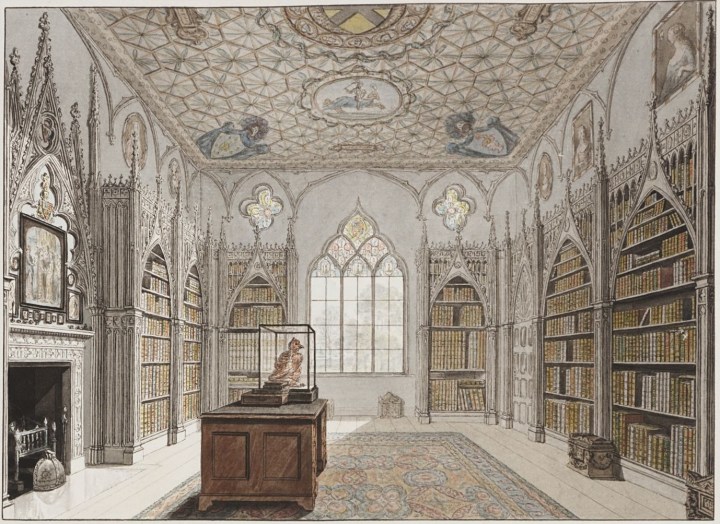
John Carter, View of the Library at Strawberry Hill, watercolour, 23.7 × 28.8 cm, from Horace Walpole, A Description of the Villa … at Strawberry-Hill (Strawberry Hill, 1784). The Lewis Walpole Library, Yale University.
◊ ◊ ◊ ◊ ◊
From Strawberry Hill:
Collectors and the Country House Library
Strawberry Hill, 19 October 2017
The shelves of Horace Walpole’s Library at Strawberry Hill, emptied in the great sale of 1842, have recently been filled with the loan of books from the library of Aske Hall, North Yorkshire. To celebrate this event, we are holding a study day on Collectors and the Country House Library. Particular themes are the evolution of country house libraries and how the libraries of art collectors such as Walpole support and enrich our understanding of their broader collections. Country house libraries may develop over generations of owners, but they may also strongly reflect the personality and interests of one collector, whether as bibliophile or in the broader history of collections of works of art. We will be looking not only at Walpole, but at a broad range of other collectors and their collections to show how much these libraries can reveal. Refreshments including a light lunch will be provided. For further information, please contact claire.leighton@strawberryhillhouse.org.uk. This event is kindly sponsored by the Delmas Foundation
P R O G R A M M E
9.30 Coffee
9.50 Welcome
10.00 Morning Papers
• Megan Aldrich, Saxon or Gothic? An Antiquarian Library at Stowe
• Stephen Clarke, ‘Quite a Paradise of Well-Conditioned, Beautiful Books’? Horace Walpole’s Library at Strawberry Hill
11.00 Break
11.10 Keynote Paper
• Mark Purcell, The Country House Library
12.05 Claire Reed, The Library at Osterley Park House
12.35 Lunch and tours of the house
2.15 Afternooon Papers
• Giles Mandelbrote, A Metropolitan Collector: The Library of Sir Richard Ellys (1682–1742) at Blickling Hall
• David Pearson, Bugs and Bindings: Eighteenth-Century Insect Rolls
• Stephen Lloyd, The Library of the Earls of Derby at Knowsley Hall
3.30 Questions and final discussion
Symposium | Basic Instincts

Joseph Highmore, Pamela in the Bedroom with Mrs Jewkes and Mr B. (detail), 1743–44, oil on canvas, 62.7 × 75.7 cm (London: Tate). Part of the series Four Scenes from Samuel Richardson’s Pamela.
◊ ◊ ◊ ◊ ◊
From The Foundling Museum:
Basic Instincts: Art, Women, and Sexuality in the Eighteenth Century
Keynes Library, School of Arts, Birkbeck, University of London, 20 November 2017
This symposium has been organised alongside the Foundling Museum exhibition Basic Instincts (on view from 29 September 2017 until 7 January 2018). Curated by Jacqueline Riding, historical consultant, author, and Honorary Research Fellow in the School of Arts at Birkbeck, University of London, Basic Instincts explores Georgian attitudes to love, desire, and female respectability through the radical paintings of Joseph Highmore (1692–1780). The symposium will draw out some of the key themes of the exhibition, focusing on the depiction of women and sexuality in eighteenth-century culture. Tickets are £40 (£30 concessions and Foundling Friends), with booking information available here.
P R O G R A M M E
10.00 Coffee and registration
10.20 Welcome from Kate Retford (History of Art Department, Birkbeck, University of London)
10.30 Jacqueline Riding (Curator of Basic Instincts, and Honorary Research Fellow in the School of Arts, Birkbeck, University of London), Basic Instincts: Love, Passion, Violence
11.00 Panel 1 | Highmore and His Context
• Kate Retford (Senior Lecturer in Art History at Birkbeck, University of London), Joseph Highmore, Time, and Miss Whichcote’s Marriage
• Kirsten Tambling (PhD candidate, History of Art, Birkbeck, University of London), ‘Into the Thickest Part of the Grove’: Hogarth’s ‘outdoor’ Before and After’
• Emma Barker (Senior Lecturer in Art History at the Open University), Sentiment and Seduction: Cross-Channel Connections in Art and Literature
12.30 Lunch
14.00 Tour of Basic Instincts exhibition with Kathleen Palmer (Curator at the Foundling Museum)
15.30 Panel 2 | Art, Women, and Sexuality
• Joanne Begiato (Professor in History, Oxford Brookes University), The Tender Mother in the Eighteenth Century: Bosoms and Bliss?
• Mary Peace (Senior Lecturer in English, Sheffield Hallam University), Reversing the Harlot’s Progress? The Figuring and Refiguring of Magdalens at the London Magdalen Hospital in the Eighteenth Century
• Karen Lipsedge (Associate Professor in English Literature, Kingston University), ‘Imagine They See’: Pamela and Visual and Literary Depictions of the Eighteenth-Century Interior
17.00 Closing remarks
Workshop | Printing Time: French Almanacs
From the workshop programme:
Printing Time: Workshop on French Almanacs
Waddesdon Manor, Buckinghamshire, Monday 16 October 2017
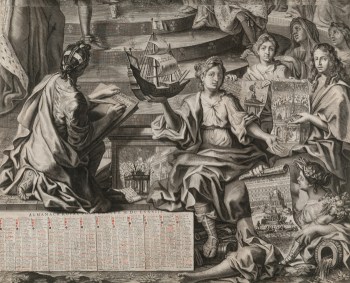
Almanac for the Year 1683 (The Universal Festivities), detail; published by Pierre Landry (ca. 1630–1701), Paris; etching, engraving and letterpress on paper (Waddesdon / National Trust, acc. no. 2669.4.3).
This is to announce a workshop at Waddesdon Manor in conjunction with the exhibition Glorious Years: French Calendars from Louis XIV to the Revolution. The workshop will explore themes around the production and consumption of French 17th-and 18th-century almanacs (book and print formats), while also looking at the broader context of the history of Time and its depiction during this period. Our distinguished speakers are drawn from across disciplines.
To register an interest in attending please email diane.bellis@nationaltrust.org.uk. A charge of £25 covers all catering costs. To secure a place, please call the Waddesdon booking office 01296 820414 (open 10:00–16:00) to pay using either a debit or credit card. If you have any dietary requirements, please let us know when you book your place.
P R O G R A M M E
10:00 Registration and coffee (Manor Restaurant)
10:30 Welcome and introduction by Pippa Shirley (Head of Collections, Waddesdon) and Rachel Jacobs (Curator, Waddesdon)
10:50 Morning Presentations
• Maxime Préaud (formerly conservateur général, département des Estampes et de la Photographie, Bibliothèque nationale de France), Les relations entre la France et l’Angleterre pendant le règne de Louis XIV, selon les almanachs muraux français
• Stephen Boyd Davis (Professor of Design Research, Royal College of Art), La Science des Temps: New Ideas of Time in the Eighteenth Century
12:10 Visit the exhibition Glorious Years with curator Rachel Jacobs and Adam Dant (Artist), The Mother of Parliaments: Annual Division of Revenue: A Print for the British Electorate, 2017. Information on Dant’s commissioned almanac is available here.
13:00 Lunch in Manor Restaurant
14:30 Afternoon Presentations
• Véronique Sarrazin (Maître de conférence d’histoire modern, Université d’Angers, Laboratoire CERHIO), Livres et estampes, deux économies de l’almanach dans la 1ère moitié du XVIIIe siècle à Paris
• Matthew Shaw (Librarian of the Institute of Historical Research, School of Advanced Study), Almanacs for a New Era: The French Republican Calendar
16:00 Drinks with a chance to visit the manor and exhibition
Symposium | The Room Where It Happens
From Harvard Art Museums:
The Room Where It Happens: On the Agency of Interior Spaces
Harvard Art Museums, Cambridge, 13–14 October 2017

Stephen Sewall, Copy of Inscription on Dighton Rock (detail), 1768, black ink on paper (Peabody Museum of Archaeology and Ethnology, Harvard University, 967-28-10/45474, digital file 99270006).
This symposium explores the spaces of artistic, artisanal, and intellectual production. From the artist’s studio to the alchemist’s lab, from the stateroom to the secret chamber, from the brick and mortar hall to the winding corridors of cyberspace, rooms and their contents have long impacted history, and transformed their inhabitants. Held in conjunction with the Museums’ special exhibition The Philosophy Chamber: Art and Science in Harvard’s Teaching Cabinet, 1766–1820, this symposium brings together artists, architects, and historians to consider the spaces where objects and ideas are generated.
This project is supported in part by major grants from the Terra Foundation for American Art and the Henry Luce Foundation. The exhibition and catalogue were also supported in part by the following endowed funds: the Bolton Fund for American Art, Gift of the Payne Fund; the Henry Luce Foundation Fund for the American Art Department; the William Amory Fund; and the Andrew W. Mellon Publication Funds, including the Henry P. McIlhenny Fund.
All events will take place at Menschel Hall, Lower Level, Harvard Art Museums, 32 Quincy Street, Cambridge, MA. All symposium events are free and open to the public, but registration is required. For details on the programs, including how to register, visit the Harvard Art Museums website.
F R I D A Y , 1 3 O C T O B E R 2 0 1 7
6:00pm Keynote Lecture
• Making Room: Cartography, Collecting, and the Construction of Empire, Louis Nelson (Professor of Architectural History and the Associate Dean, School of Architecture, University of Virginia)
S A T U R D A Y , 1 4 O C T O B E R 2 0 1 7
10:00 Rooms for Looking: Parlor / Museum / Studio
• ‘No One Could Prevent Us Making Good Use of Our Eyes’: Enslaved Spectators and Southern Plantation Spaces, Jennifer Van Horn (Assistant Professor of Art History and History, University of Delaware)
• The Room of Broken Bodies: Civil War Wounds, the Army Medical Museum, and Perceiving Re-Unification, Julia B. Rosenbaum (Associate Professor and Chair, Art History, Bard College; Director of Research and Publications, The Olana Partnership, Olana State Historic Site)
• The Symposium on Habitability: Robert Irwin, NASA, and the Case of the Artist as a Meta-Scholar, Boris Oicherman (Cindy and Jay Ihlenfeld Curator for Creative Collaborations, Weisman Art Museum, University of Minnesota)
11:30 Rooms for Making: Library / Laboratory / Model
• ‘A Scene in a Library’: Inventing and Destroying Enlightenment Photography at Soho House, Matthew Hunter (Associate Professor, Department of Art History & Communication Studies, McGill University)
• Connected Interiors: Learning Architecture and Observation in Meiji Japan, Matthew Mullane (Ph.D. candidate, School of Architecture, Princeton University)
• Interior as Microcosm: The Production of Epistemologies, Ethics, and Identities at Biosphere 2, 1991–94, Meredith Sattler (Assistant Professor of Architecture, California Polytechnic State University, San Luis Obispo)
2:00 Virtual Rooms: Theater / Period Room / Cockpit
• A Machine of Visibility: Paul Nelson’s Surgical Theater at the Cité Hospitalière de Lille, Nicholas Robbins (Ph.D. candidate, Department of the History of Art, Yale University)
• Visiting Mrs. M.—–‘s Cabinet: Period Room as Pedagogy, Sarah Anne Carter (Curator and Director of Research, The Chipstone Foundation)
• Bedroom Aviators—Flight Simulation and the Domestic Realm, Chad Randl (Visiting Lecturer in Architecture, Cornell University)
3:45 Closing Remarks
• Follies and Wonder Rooms, Mark Dion (Conceptual Artist)
Introduced by Ruth Erickson (Mannion Family Curator, The Institute of Contemporary Art, Boston)
Symposium | Fluctuating Alliances: Art, Politics, and Diplomacy
From the programme for the upcoming conference:
Fluctuating Alliances: Art, Politics, and Diplomacy in the Modern Era, 16th–18th Centuries
Technische Universität, Berlin, 21–22 September 2017
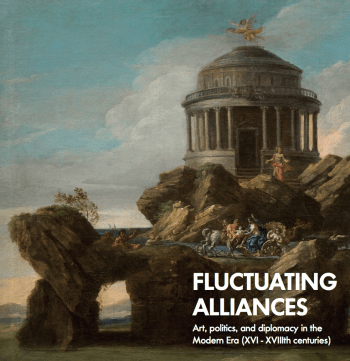
Sebastiano Conca, The Education of Achilles, 1727, oil on canvas, 59 × 74 cm (Madrid, Museo del Prado, inv. P02869).
In January 1722 after a few days of heavy rain in Rome the ephemeral ‘macchina d’arti cio’ built to celebrate the wedding between the Prince of Asturias and Isabel d’Orleans was finally burnt before the Palazzo di Spagna. The machine, designed by Domenico Paradisi, showcased a clear message of unity and power between the former enemies, France and Spain. At the summit, allegories of both countries shook hands before the representation of the Four Continents. This functioned as a gentle reminder to their enemies after the years of turmoil surrounding the War of Spanish Succession, which had deeply affected the balance of power in Europe.
Fluctuating Alliances: Art, Politics, and Diplomacy in the Modern Era (s. XVI–XVIII), the first International Symposium on Transnational Relations and the Arts, seeks to explore the role played by prints, drawings, and others kinds of artistic production, such as music and literature, which represented the changing alliances among kings, rulers, and countries in the fluctuating early modern political environment. Taking as an example the War of Spanish Succession, but not limited to it, we encourage researchers to explore the uses of art for that purpose.
T H U R S D A Y , 2 1 S E P T E M B E R 2 0 1 7
9:15 Welcome by the convenor
9:30 War and Peace
Chair: Guy Rowlands (University of St. Andrews, UK)
• Alberto Rodríguez Martínez (UPO, Sevilla), An Impossible Peace: Views and Representations of the Twelve Years Truce from 1609 to 1621
• Anna Lisa Schwartz (Germanisches Nationalmuseum, Nuremberg), Iunguntur Iupiter et Sol: Picturing Peace between Louis XIV and Charles VI after the Treaty of Rastatt (1714)
• Francisco Zamora Rodríguez (CHAM-Centro de Humanidades, UNL-Lisboa), Microcon ictos e imagen en espacios portuarios ‘neutrales’ durante la Guerra de Sucesión Española
11:20 Coffee break
11:40 Jesuits and Diplomacy
Chair: Pilar Diez del Corral Corredoira (TU, Berlin)
• Lise Puyo (University of Pennsylvania), The 1676 Huron-Wendat Wampum Belt: Indigenous Negotiations with the Divine
• Mar García Arenas (CHAM-Centro de Humanidades, UNL-Lisboa), Las implicaciones diplomáticas de la reconciliación entre Roma y Lisboa a través de la numismática conmemorativa, 1769–70
13:00 Lunch break
14:30 Negotiating with Faith
Chair: Francisco Zamora Rodríguez (CHAM-Centro de Humanidades, UNL-Lisboa)
• Amanda Van der Drift (The University of Queensland, Brisbane), Picturing Politics and Diplomacy in the Early Years of the Franco-Ottoman Alliance (XVI)
• Pierre-Olivier Oullet (Université du Québec à Montréal, Canada), France Bringing Faith to the Hurons of New France: The Regent Anne of Austria and the Taking over of the Colony by Louis XIV
• Iris Haist (Graphischen Sammlung, Kunstsammlungen Chemnitz), Herrschaft aus Marmor und Papier – Die Grabmonumente für Maria Clementina Sobieska und Jacob III. Stuart als Repräsenta- tionsinstrumente der römisch-katholischen Kirche
F R I D A Y , 2 2 S E P T E M B E R 2 0 1 7
9:00 Court and Diplomatic Celebrations
Chair: Nicole Hegener (Humboldt Universität, Berlin)
• Philippa Woodcock (University of Warwick/ Oxford Brookes/ CNAM Paris), L‘ambition de l‘Espagnol: Reworks and Frontiers in Bourbon Paris
• Roland Béhar (École Normale Supérieure, Paris), Le héros qui sauve du monstre marin : les fêtes de 1612 et l’émulation symbolique franco-espagnole
10:10 Coffee break
10:30 Court and Diplomatic Celebrations, continued
Chair: Pilar Diez del Corral Corredoira (TU, Berlin)
• Danièle Lipp (Wien Universität), The Habsburg Emperor Charles VI and the Politics of Recruitment for His Music Chapels
• Luis Méndez Rodríguez and Rocío Orellana (Universidad de Sevilla), Arte y diplomacia en el siglo XVIII: La corte española en el Lustro Real
11:20 Final discussion with closing remarks by Diego Valverde Villena (Director of the Instituto Cervantes)
Conference | The Art of the Box
From the conference summary:
The Art of the Box
15th Annual National Trust / Waddesdon Manor Conference
Waddesdon Manor, Buckinghamshire, 3 October 2017

Late 19th-Century Box, for Seated Nymph, attributed to Étienne Maurice Falconet (Waddesdon / National Trust; acc. no. 5615; photo by Mike Fear © National Trust, Waddesdon Manor).
This year the National Trust/Waddesdon Manor conference explores boxes made for storing, packing, and transporting works of art. Speakers will consider what these boxes tell us about the perception, protection, and mobility of works of art (in times of peace and war), about the categorization, use, and sensory appreciation of the objects they were designed to contain.
The conference will begin with registration and coffee at 10.00 and end with a glass of wine at 6.00. Lunch and tea will be provided, and there will be an opportunity to look round Waddesdon Manor and the current exhibitions. To book a place, please email diane.bellis@nationaltrust.org.uk. There is a charge of £25, which covers all catering costs (please indicate any specific dietary requirements). This can be paid with a debit or credit card by telephoning the Waddesdon Booking Office 01296 820414.
P R O G R A M M E
10.00 Registration and coffee
10.30 Welcome and introduction by Pippa Shirley and Christopher Rowell
10.45 Juliet Carey (Senior Curator, Waddesdon Manor/The Rothschild Collection), Storing and Staging: Edmond de Rothschild’s Boxes for Porcelain and Sculpture
11.30 Olivia Fryman (Exhibition Assistant Curator, Royal Collection), Trunks, Cases, and Cabinets for Royal Furnishings and Household Goods, 1660–1714
12.15 James Rothwell (National Trust Adviser on Silver), Fit for the Cart, the Battleship, and the Palace: Boxes for Silver in Stuart and Georgian Britain
1.00 Lunch and opportunity to see Manor and exhibitions
2.30 Tessa Murdoch (Deputy Keeper, Victoria and Albert Museum, Department of Sculpture, Metalwork, Ceramics and Glass), Framing Time: Cases for English and French Clocks, 1660–1760
3.15 Laura Langelüddecke (Assistant Curator, Wallace Collection), Mobile Make-up: Travelling Toilette Services in the Eighteenth Century
4.00 Tea
4.30 Anita Bools (National Trust Adviser on Photographic Materials), An Open and Shut Case: Cased 19th-Century Photographs from the National Trust
5.15 A display of boxes from the collection at Waddesdon, introduced by Mia Jackson (Curator of Decorative Arts, Waddesdon Manor/The Rothschild Collection), followed by closing discussion
6.00 Drinks
◊ ◊ ◊ ◊ ◊
Note (added 13 September 2017) — In the original posting, I misidentified the box as being for the Nymph Entering the Water. In fact, as indicated in the the French, it was created to hold the Seated Nymph. The updated posting also includes a full schedule with times. –CH
Exhibition | Becoming a Woman in the Age of Enlightenment
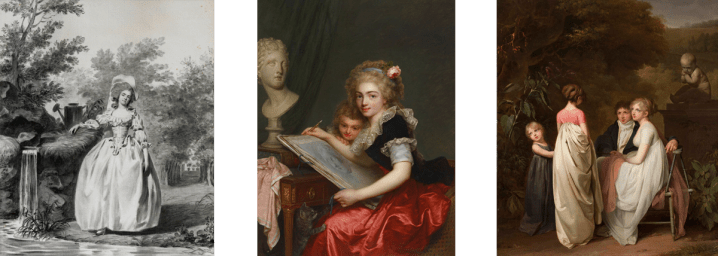
Jacques-Antoine-Marie Lemoine, Woman Standing in a Garden, 1783, black chalk and brush with gray wash on off-white laid paper; Antoine Vestier, Allegory of the Arts, 1788, oil on canvas; and Louis-Léopold Boilly, Conversation in a Park, oil on canvas. All on loan from The Horvitz Collection.
◊ ◊ ◊ ◊ ◊
From the Harn Museum of Art:
Becoming a Woman in the Age of Enlightenment: French Art from The Horvitz Collection
Harn Museum of Art, University of Florida, Gainesville, 6 October — 31 December 2017
Ackland Art Museum, The University of North Carolina at Chapel Hill, 26 January — 8 April 2018
Crocker Art Museum, Sacramento, 13 May — 19 August 2018
Smith College Museum of Art, Northampton, MA, dates TBA
Curated by Melissa Hyde and Mary D. Sheriff
Organized by Alvin Clark
Becoming a Woman in the Age of Enlightenment: French Art from the Horvitz Collection is primarily an exhibition of drawings but will include pastels, paintings, and sculptures selected from one of the world’s best private collections of French drawings. The exhibition will feature nearly 120 works by many of the most prominent artists of the eighteenth century, including Antoine Watteau, Nicolas Lancret, François Boucher, Jean-Honoré Fragonard, as well as lesser-known artists both male and female, such as Anne Vallayer-Coster, Gabrielle Capet, François-André Vincent, Philibert-Louis Debucourt. Ranging from spirited, improvisational sketches and figural studies, to highly finished drawings of exquisite beauty, the works included in the exhibition vary in terms of style, genre, and period.
Becoming a Woman will be organized into thematic sections that address some of the most important and defining questions of women’s lives in the eighteenth century. These include: how the stages of a woman’s life were measured; what cultural attitudes and conditions in France shaped how women were defined; what significant relations women formed with men; what social and familial rituals gave order to their lives; what pleasures they pursued; and what work they accomplished. The aim is to bring new insights to the questions of what it meant to be a woman in this period, by offering the first exhibition to focus specifically on representations of women of a broad range of ages and conditions.
The exhibition will offer fresh perspectives on a subject that still has direct relevance to our times but that has not been the focus of a significant exhibition for decades. Through its conceptual framework, thematic organization, and its emphasis on historical context, the exhibition will provide viewers opportunities to consider what issues pertaining to women’s lives seem to have changed or persisted through time and across space. Although the circumstances and the specifics have changed, many issues remain with us today and can still provoke contentious debates. Pay equity, reproductive rights, gender-discrimination, violence against women, work-family balance, the ‘plight’ of the alpha-female, and the devaluation of the stay-at-home mom, are but a few of the women’s issues that are still hotly contested in the media, in cultural production of all kinds, in politics, and in public and private life.
Becoming a Woman is curated by Melissa Hyde, Professor of Art History, University of Florida Research Foundation Professor, University of Florida, and the late Mary D. Sheriff, W.R. Kenan J. Distinguished Professor of Art History, University of North Carolina, Chapel Hill; the exhibition is organized by Alvin L. Clark, Jr, Curator, The Horvitz Collection and The J.E. Horvitz Research Curator, Harvard Art Museums/Fogg.
The catalogue is available from ArtBooks.com:
Melissa Hyde, Mary D. Sheriff, and Alvin Clark, Becoming a Woman in the Age of Enlightenment: French Art from The Horvitz Collection (Boston: The Horvitz Collection, 2017), 208 pages, ISBN: 978 099126 2526, $39.

François Boucher, Young Travelers, black chalk on cream antique laid paper, framing line in black ink, laid down on a decorated mount, 295 × 188 mm; Jacques-Louis David, Andromache Mourning the Death of Hector, pen with black ink and brush with gray wash over traces of black chalk on cream antique laid paper, 293 × 248 mm; Jean-Baptiste Greuze, The Chestnut Vendor, brush with gray and brown wash on cream antique laid paper, 385 × 460 mm. All works on loan from The Horvitz Collection.
◊ ◊ ◊ ◊ ◊
From the Lecture and Symposium Schedule:
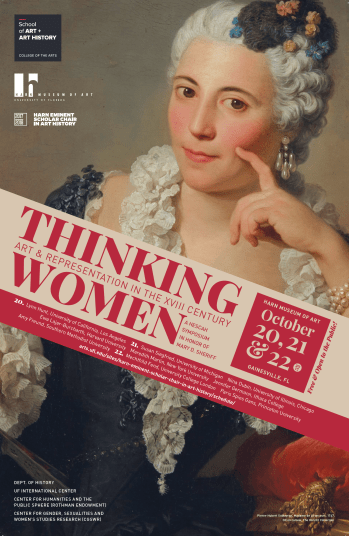
Thinking Women: Art and Representation in the Eighteenth Century
A Symposium in Honor of Mary D. Sheriff
Harn Museum of Art, University of Florida, Gainesville, 20–22 October 2017
• Keynote Address: “The Woman Artist and the Uncovering of the Social World,” Lynn Hunt, Distinguished Research Professor, University of California, Los Angeles
Art, women, and society came together in surprising ways at the end of the eighteenth century. ‘Society’ only began to be conceptualized as an object for study at the end of the 1700s, in particular in reaction to the French Revolution. Art, especially engraving and painting, helped make society visible to itself. Women could join the art world but rarely as fully fledged members, and as a consequence they occupied a kind of in-between position that made them especially attuned to social relations. The life and work of Marie-Gabrielle Capet will be highlighted to show how the social world could be uncovered.
 • “Fashion in Time: Visualizing Costume in the Eighteenth Century,” Susan Siegfried, Denise Riley Collegiate Professor of the History of Art and Women’s Studies, Department of Art History, University of Michigan
• “Beauty Is a Letter of Credit,” Nina Dubin, Associate Professor, Department of Art and Art History University of Illinois, Chicago
• “Chardin: Gender and Interiority,” Ewa Lajer-Burcharth, William Dorr Boardman Professor of Fine Arts, Department of History of Art and Architecture, Harvard University
• “The Global Allure of the Porcelain Room,” Meredith Martin, Department of Art History, New York University
• “Pictured Together? Questions of Gender, Race, and Social Rank in the Portrait of Dido Elizabeth Belle and Lady Elizabeth Murray,” Jennifer Germann, Associate Professor, Department of Art History, Ithaca College
• “Becoming an Animal in the Age of Enlightenment,” Amy Freund, Associate Professor & Kleinheinz Family Endowed Chair in Art History, Southern Methodist University
• “Marguerite Lecomte’s Smile: Portrait of a Woman Engraver,” Mechthild Fend, Reader in the History of Art, Department of History of Art, University College London
• “Exceptional, but not Exceptions: Women Artists in the Age of Revolution,” Paris Spies Gans, Doctoral Candidate, Department of History, Princeton University
The final program, with times, is available here»
At the Ackland Art Museum at UNC, Chapel Hill, there will be a sister symposium in Mary’s honor entitled “Taking Exception: Women, Gender, Representation in the Eighteenth Century,” 1–3 February 2018.
◊ ◊ ◊ ◊ ◊
Note (added 14 October 2017) — The posting has been updated with additional information, including details on the catalogue, venues, and the conferences.
Conference | Collections, Displays and the Agency of Objects
From the conference programme:
Collections, Displays and the Agency of Objects
Cambridge University, 20–22 September 2017
Registration due by 10 September 2017
Conference organized as part of the BMBF project Parerga and Paratexts – How Things Enter Language: Practices and Forms of Presentation in Goethe’s Collections in collaboration with the Department of Art History in Cambridge.
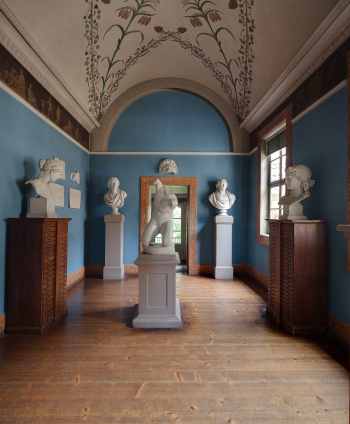
Brückenzimmer of Goethe’s House, Weimar.
2 0 S E P T E M B E R 2 0 1 7
6:00 Welcome and Introduction
6:30 Opening Lecture
• Ivan Gaskell (Bard Graduate Center), Display Displayed
2 1 S E P T E M B E R 2 0 1 7
9:00 Session I
Moderator: Johannes Grave (Universität Bielefeld)
• Ruth Bielfeldt (Ludwig-Maximilians-Universität München), Do Things Talk? On the Practice of Epigraphein in Greek Sanctuaries
• Elsje van Kessel (University of St. Andrews), The Street as Frame
• Peter Schade (National Gallery, London), The Framing of Sebastiano del Piombo’s The Raising of Lazarus
• Hannah Williams (Queen Mary University of London), Staging Belief: Immersive Encounters and the Agency of Religious Art in 18th-Century Paris
12:15 Lunch break
2:00 Encounters with Objects
4:15 Session II
Moderator: Wolfgang Holler (Klassik Stiftung Weimar)
• Eelco Nagelsmit (ETH Zürich), Interiority on Display: Models of Holy Sites in Halle Pietism
• Thomas Schmuck (Klassik Stiftung Weimar), Vestiges of Earth History: Objects and Order in Goethe’s Geological Collections
• Diana Stört (Martin-Luther-Universität Halle-Wittenberg), Goethe’s Cabinets as Epistemic Furniture
2 2 S E P T E M B E R 2 0 1 7
9:00 Session III
Moderator: Cindy Kang (The Barnes Collection)
• Mechthild Fend (University College London), Order and Affect: The Museum of Dermatological Wax Moulages at the Hôpital Saint Louis in Paris
• Juliet Carey (Waddesdon Manor, The Rothschild Collection), Staging Things: Framing the Rothschild Collection at Waddesdon Manor
• Dario Gamboni (Université de Genève), Ready-made Eye-opener: Models, Functions and Meanings of the Ironwork in Albert C. Barnes’s Displays
11:45 Lunch break
2:00 Encounters with Objects
4:15 Session IV
Moderator: Valérie Kobi (Universität Bielefeld)
• Noémie Étienne (Universität Bern), Unfolding the Specimen: Display and Diorama in New York, 1900
• Angela Matyssek (Philipps-Universität Marburg), Death by/Life by Wall Label
5:45 Final Discussion and Conclusions










leave a comment