Conference | Fans as Images, Accessories, and Instruments of Gesture
From H-ArtHist:
‘Num’rous Uses, Motions, Charms, and Arts’: Fans as Images, Accessories, and Instruments of Gesture in the 17th and 18th Centuries
Der Faecher als Bild, Accessoire und gestisches Instrument im 17. und 18. Jahrhundert
Kunsthistorisches Institut, Universität Zürich, 29 November — 1 December 2017
Organized by Danijela Bucher, Fabienne Ruppen, and Miriam Volmert
This interdisciplinary conference discusses the cultural role of European folding fans in art, fashion, and material culture in the seventeenth and eighteenth centuries. In eighteenth-century Europe, fans became important fashion accessories across social classes and were almost omnipresent in social interaction. Painted and printed fans presented a wide variety of social knowledge through fast and fleeting pictures, in this way conveying personal statements of those who carried them. Early modern fan depictions were often inspired by or based on Renaissance and contemporary paintings. In the course of the eighteenth century, fan leaves displayed an increasing variety of cultural themes, thereby also functioning as souvenirs as well as conveyors of political and social messages.
The conference aims to take a closer look at the pictorial and intermedial interplay of ornamental patterns, figurative elements, and artistic subject matters against the background of European fan manufacture, artistic networks and international trade. Furthermore, it seeks to closer examine fans as gender-specific instruments of gesture and communication. The conference is funded by Schweizerischer Nationalfonds zur Förderung der wissenschaftlichen Forschung (SNF), Graduate Campus der Universität Zürich, and UZH Alumni. Please direct any questions to miriam.volmert@khist.uzh.ch.
2 9 N O V E M B E R 2 0 1 7
20.00 Welcome and introduction
3 0 N O V E M B E R 2 0 1 7
9.15 Welcome (Bettina Gockel) and introduction (Danijela Bucher and Miriam Volmert)
9.30 I | Fans as Accessories and Instruments of Gesture
Moderation: Danijela Bucher and Miriam Volmert
• Pascale Cugy, ‘La Dame paroist badiner avec son Eventail qu’elle porte au coin de sa bouche’: Les éventails dans la gravure de mode féminine sous Louis XIV
• Allison Goudie, The 18th-Century Mask Fan: More than the Sum of its Parts
• Pierre-Henri Biger, Faux et vrais langages de l’éventail
11.00 Coffee
11.30 II | History Painting on Folding Fans in the late 17th and in the 18th Centuries
Moderation: Fabienne Ruppen
• Christl Kammerl-Baum, Bilder-Sprache auf Fächern – eine ikonographische und ikonologische Bedeutungsanalyse anhand eines Fallbeispiels
• Georgina Letourmy-Bordier, De Coriolan à la rosière de Salency, le héros et l’incarnation de la vertu au XVIIIe siècle
12.30 Lunch
14.00 III | Fans as Media of Memory and Souvenirs in the 18th Century
Moderation: Miriam Volmert
• Mary Kitson, ‘Thanks for the Memory’: Typical Imagery of the Grand Tour Fan Leaf
• Heiner Krellig, Souvenir der Grand Tour: Ein Fächer als Erinnerung an Venedig
• Adelheid Müller, Reputation in Falten: Elisa von der Reckes Autographenfächer, ein Zeugnis selbstvergewissernder Positionierung
15.30 Coffee
16.00 IV | Fans as Political Media in 18th-Century France
Moderation: Danijela Bucher
• Aurore Chéry, La représentation de la famille royale de France sur les éventails du XVIIIe siècle
• Rolf Reichardt, Bild-Kompositionen revolutionärer Faltfächer in Frankreich, 1789–94
17.00 Discussion
1 D E Z E M B E R 2 0 1 7
9.00 Introduction
9.15 V | Artistic Networks, Paths of Reception, and Production Sites
Moderation: Patrizia Munforte
• Kirsty Hassard, Sarah Ashton and Her Contemporaries: Female Fan Makers and Publishers in 18th-Century London
• Geneviève Dutoit, Les éventails décorés d’après les œuvres d’Angelica Kauffmann à la fin du XVIIIème et du début du XIXème siècle
10.15 Coffee
10.45 VI | Fans in the Context of Historical Material and Textile Cultures
Moderation: Katharina Haack
• Suet May Lam, From Ephemeral to Eternal: Unfolding Early Modern ‘Fashion’ for Asia
• Isa Fleischmann-Heck, Textile Dekore auf Fächerblättern des 18. Jahrhunderts – Formen, Erscheinung, Wirkung
11.45 End of Public Conference Program
Afternoon Workshop (Limited to Conference Speakers) at the Collection Centre of the Swiss National Museum, Affoltern am Albis
14.30 Round Table | Fans in Museum Collections
Markus Leuthard, Welcome
• Mathilde Semal, L’éventail du XVIIIe siècle, véritable attribut social ? La richesse des montures de la collection Preciosa (Musée du Cinquantenaire, Bruxelles)
• Annette Kniep/Maike Piecuch, Neulagerung und Konservierung der Fächer im Bernischen Historischen Museum – Konzept und Umsetzung
• Yolaine Voltz, Principes et compromis de la restauration des éventails : étude de cas particuliers
15.30 Guided Tour
Conservation and Restoration of Fans in the Swiss National Museum with Nikkibarla Calonde, Véronique Mathieu, and Isabel Keller
Conference | Münster Castle at 250

Johann Conrad Schlaun, Palace at Münster, 1767–87, constructed for Maximilian Friedrich von Königsegg-Rothenfels (1708–1784), the Archbishop-Elector of Cologne and the Bishop of Münster from 1761 to 1784 (Photo: Wikimedia Commons).
◊ ◊ ◊ ◊ ◊
From H-ArtHist, with a copy of the conference flyer here:
Das Münsteraner Schloss: Fürstbischöflicher Residenzbau am Ende des 18. Jahrhunderts
Das Münsteraner Schloss, Münster, 7–8 December 2017
Internationale Tagung organisiert vom Institut für Kunstgeschichte und der Zentralen Kustodie der Universität Münster
 Am 26. August 2017 jährte sich die Grundsteinlegung des Fürstbischöflichen Residenzschlosses in Münster zum 250. Mal. Der bedeutende Bau, der seine Zweckbestimmung nur gut anderthalb Jahrzehnte erfüllen konnte und heute als Hauptgebäude der Westfälischen Wilhelms-Universität genutzt wird, ist vielfach Gegenstand kunsthistorischer Forschungen gewesen. Diese betrafen insbesondere die Klärung der Planungs- und Baugeschichte sowie die Stellung des Schlosses im Oeuvre seines Entwerfers, des fürstbischöflichen Architekten Johann Conrad Schlaun.
Im Lichte neuerer, stärker kulturgeschichtlich orientierter Forschungsansätze möchten wir das Jubiläum nutzen, um neue Fragen an den Bau zu richten: Wie lässt sich das Münsteraner Schloss im Kontext fürstbischöflicher Residenzen im Heiligen Römischen Reich kontextualisieren? Auf welche Modelle höfischer Repräsentations- und symbolischer Kommunikationskultur bezieht es sich, und welche eigenen Akzente wurden dabei gesetzt? Welchen konkreten Nutzungen wurde das Schloss unterworfen? In welche Beziehung tritt es zur Stadt?
Die Tagung ist öffentlich. Eine Anmeldung ist nicht erforderlich; eine Teilnahmegebühr wird nicht erhoben.
D O N N E R S T A G , 7 D E Z E M B E R 2 0 1 7
13.30 Begrüßung/Einführung
14.00 Werner Freitag (Münster), Tridentinische Reform und katholische Aufklärung: Das Fürstbistum Münster im 18. Jahrhundert
14.45 Gerd Dethlefs (Münster), Das Schloss und die Politik. Voraussetzungen und Folgen 1688–1803
16.00 Stefan Kummer (Würzburg), Die Würzburger Residenz als fürstbischöfliches Schloss
16.45 Georg Satzinger (Bonn), Die Dreiflügelanlage als Problem: Schloss Weißenstein in Pommersfelden
19.00 Abendvortrag | Elisabeth Kieven (Rom/Osnabrück), Schlossbau gegen Ende des Ancien Régime. Das Fürstbischöfliche Schloss in Münster im europäischen Kontext
F R E I T A G , 8 D E Z E M B E R 2 0 1 7
9.15 Marc Jumpers (Bonn), Das Schloss zu Münster als Residenz eines geistlichen Reichsfürsten: Innenraumdisposition und Zeremoniell unter Kurfürst und Fürstbischof Maximilian Friedrich von Königsegg-Rothenfels
10.00 Kristina Deutsch (Münster), Vom Luxus der Privatheit: Das Gelbe Kabinett und die fürstbischöflichen Appartements im Münsteraner Schloss
11.15 Katharina Krause (Marburg), Bauen ohne Messlatte: Die Münsteraner adligen Wohnhöfe in einer Residenzstadt ohne Schloss
12.00 Eva-Bettina Krems (Münster), Das Münsteraner Schloss: Ein- und Ausblick
Konzeption
Eva-Bettina Krems
Jens Niebaum
Journées d’Étude | Académies d’Art et Mondes Sociaux, 1740–1805
From the study day programme:
Académies d’Art et Mondes Sociaux, 1740–1805
Mobilité des artistes, dynamique des institutions : dessiner la cartographie des échanges
Université Toulouse – Jean Jaurès, 9–10 November 2017
En partenariat avec le Centre allemand d’histoire de l’art, Paris
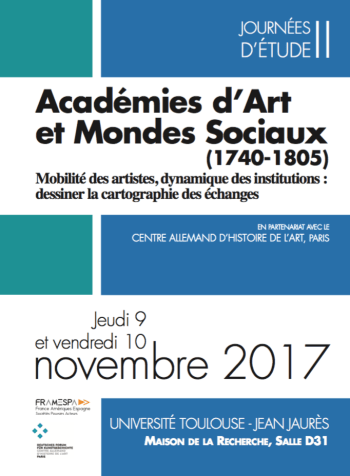 Deuxième volet des journées d’étude conduites par le programme de recherche ACA-RES sur Les académies d’art et leurs réseaux dans la France préindustrielle, cette rencontre mettra l’accent sur la question des circulations artistiques. La seule aspiration parisienne ne saurait rendre compte des dynamiques d’échanges qui se mettent en place au cours de la seconde moitié du XVIIIe siècle, alors même que certaines institutions de province apparaissent comme centres et nœuds de liens multiples. Les provinces marquent souvent une autonomie vis-à-vis de la capitale. Une nouvelle cartographie demande ainsi à être repensée.
L’étude des relations entre les individus et les institutions académiques à l’échelle nationale et européenne, par le biais de voyages, séjours, correspondances épistolaires, sera au cœur des discussions pour voir si les mouvements dépendent des aléas des carrières (itinérance, migration, exil, fuite, opportunités de commandes ou de protections, etc.) Ces derniers peuvent tout autant répondre à un souhait d’implantation durable qu’à une stratégie de progression professionnelle. D’ailleurs la notion de « mobilité » peut aussi être entendue du point de vue de l’ascension sociale.
Pour les institutions, le voyage s’intègre-t-il avant toute chose dans une perspective de perfectionnement pédagogique et de formation du goût ? Quels bénéfices les déplacements d’artistes et d’amateurs, comme les affiliations institutionnelles, offrent-ils aux établissements artistiques, en termes d’élargissement de réseaux, d’enrichissement des collections et de rayonnement culturel ? Au-delà de la réalité des frontières et des proximités géographiques, à rebours d’une construction idéologique « nationaliste », quelles forces – culturelles, économiques, relationnelles – sont-elles à l’œuvre ?
Dans le prolongement des acquis de la précédente manifestation de décembre 2016 (voir sur la page Internet d’ACA-RES, dans la rubrique « Les Ressources », Actes des journées d’étude), mais en étendant la période envisagée au-delà des premières années de fondation des établissements, il s’agira d’envisager la mobilité des artistes – des peintres, des sculpteurs et des architectes autant que des ornemanistes voués à la fabrique – sans perdre de vue la lecture sociale et culturelle de ces institutions écloses au siècle des Lumières. Les villes aux portes des frontières du royaume, comme celles sensibles à l’appel du Grand Tour par leur position de carrefour des routes, seront étudiées en priorité.
Ces journées d’étude entendent privilégier le dialogue entre spécialistes et jeunes chercheurs, tout en gardant l’ouverture vers d’autres disciplines des sciences humaines, en particulier la sociologie et les humanités numériques. Le dispositif de la rencontre privilégiera les débats. Chaque intervenant présentera son étude de cas en fonction des thèmes retenus pour les demi-journées. Le temps de parole, volontairement très restreint, suffira à dégager les principaux points qui seront ensuite repris et discutés de façon collégiale au cours des tables-rondes. Les après-midis seront consacrés à des ateliers de travail participatifs.
J E U D I , 9 N O V E M B R E 2 0 1 7
9.00 Matin
Ouverture, Markus Castor (Centre allemand d’histoire de l’art, Paris)
Conférence introductive, Gaëtane Maës (Université Lille 3, IRHiS UMR 8529), De la nécessité de repenser les dynamiques de circulations artistiques et la notion de « modèle » parisien
I. Séance de travail : Voyages et correspondances d’académiciens
Conférences de 10mn par intervenant
• Ariane James-Sarrazin (Institut national d’histoire de l’art), La mobilité des responsables et des professeurs des écoles de dessin dans le Grand Ouest
• Émilie Roffidal (CNRS, FRAMESPA UMR 5136), Jean-Michel Verdiguier (1706–1796), une ambition espagnole
• Dominique d’Arnoult (Université de Lausanne), Jean-Baptiste Perronneau (v. 1715–1783), Académies et écoles de dessin, jalons de ses voyages en France et en Europe
• Gérard Fabre (Musée des Beaux-arts de Marseille), Jacques Beaufort (1721–1783), un académicien entre Marseille et Paris
• Candice Humbert (Université Grenoble Alpes, LARHRA UMR 519), Louis-Joseph Jay (1755–1836), de Montpellier à Grenoble, quels parcours pour quelles ambitions?
Table-ronde avec l’ensemble des intervenants et les organisateurs ; Pascal Julien (Université Toulouse – Jean Jaurès, Laboratoire FRAMESPA UMR 5136), modérateur.
12.00 Pause déjeuner
14.00 Après-midi
I. Atelier de travail : Comment documenter les déplacements ?
Chaque communicant parle 5min
Interviennent tous les participants qui présentent le matériel et les méthodes employés pour étudier les circulations : correspondances, registres, inventaires, vies d’artistes, discours, presse locale, mais aussi sources visuelles (portraits, estampes), etc.
Une collaboratrice d’ACA-RES, Clémentine Souchaud, présente les modalités de diffusion numérique des sources documentaires sur Nakalona.
V E N D R E D I , 1 0 N O V E M B R E 2 0 1 7
9.00 Matin
II. Séance de travail : Grands axes de circulations et logiques des flux
Conférences de 10mn par intervenant
• Gaëtane Maës (Université Lille 3, IRHiS UMR 8529), Le nord de la France, une attractivité entre Paris et Bruges ?
• Fabienne Sartre (Université Paul-Valéry-Montpellier 3) et Marjorie Guillin (Université Toulouse – Jean Jaurès, FRAMESPA UMR 5136), Toulouse, Montpellier et le réseau des académies languedociennes
• Lucas Berdu (Université Toulouse – Jean Jaurès), Le voyage d’Italie de quelques académiciens toulousains
• Nelly Vi-Tong (Université de Bourgogne, Centre Georges Chevrier, UMR 7366), Hors des frontières de la Bourgogne : opportunités et carrières des élèves de l’École de dessin de Dijon
• Anne Perrin Khelissa (Université Toulouse – Jean Jaurès, Laboratoire FRAMESPA UMR 5136), L’Italie, entre fantasmes et réalités à l’Académie de Lyon
Table-ronde avec l’ensemble des intervenants et les organisateurs ; Stéphanie Trouvé (Université Paul-Valéry-Montpellier 3), Projet de recherche LexArt, modératrice.
11.00 Pause brunch
13.00 Après-midi
II. Atelier de travail : Valorisation et visualisation des déplacements
Discussion libre
Deux stagiaires du programme ACA-RES, Florie Valton et Lucas Berdu, interviennent. Ils présentent la base de données et les résultats obtenus à l’issue de leur mission (cartes, graphiques, formalisation et interprétation).
Utilité, pertinence, limites et enjeux des outils numériques en histoire de l’art ? Tous les participants sont invités à réagir aux avancées et perspectives du programme, au regard de leurs propres recherches et expériences.
Conférence conclusive
Martine Azam (Université Toulouse – Jean Jaurès, LISST UMR 5193), Le point de vue du sociologue sur la notion de circulation
15.00 Fin des journées d’étude
Exhibition | El Greco to Goya: Masterpieces from The Bowes Museum
Now on view at The Wallace Collection:
El Greco to Goya: Spanish Masterpieces from The Bowes Museum
The Wallace Collection, London, 27 September 2017 — 7 January 2018

Claudio Coello, Portrait of Mariana of Austria, Queen of Spain, 1683–93 (County Durham: The Bowes Museum).
The Wallace Collection presents El Greco to Goya: Spanish Masterpieces from The Bowes Museum, the first London exhibition of Spanish art from The Bowes Museum in County Durham, including works by Goya and El Greco. This collaborative exhibition between the Wallace Collection and The Bowes Museum celebrates the partnership between these two great museums. Like the Wallace Collection, The Bowes Museum is the product of one family’s obsession with collecting great works of art. John Bowes and Richard Wallace—both illegitimate sons of aristocratic fathers—bequeathed collections of international significance to the nation.
The exhibition spans three centuries and explores one of the largest collections of Spanish art in Britain. On display are El Greco’s The Tears of Saint Peter, thought to be the artist’s earliest interpretation of this subject, Goya’s psychologically penetrating Portrait of Juan Antonio Meléndez Valdés and disturbing Interior of a Prison, plus perhaps less well known but outstanding works such as Antonio de Pereda’s, Tobias Restoring His Father’s Sight. The works chosen explore a period of huge social, religious, and political upheaval in Spain, providing a microcosm of the changes in style and subject matter during this period. The paintings complement works by Velázquez and Murillo on permanent display at the Wallace Collection.
Xavier Bray, Wallace Collection Director: “El Greco to Goya is not only an unprecedented opportunity to see Spanish art of extraordinary power and significance in London, but also the beginning of an exciting relationship between the Wallace Collection and The Bowes Museum. Both institutions share a commitment to making great art accessible to wider audiences and we are looking forward to working closely together to develop a long term connection between London and the North East.”
◊ ◊ ◊ ◊ ◊
Symposium: El Greco to Goya
The Wallace Collection, London, 25 November 2017
This major international, one-day symposium on Spanish painting, accompanies the exhibition El Greco to Goya: Spanish Masterpieces from The Bowes Museum. The aim of the symposium is to explore in greater depth the remarkable collection of Spanish paintings on loan from The Bowes, our regional partner, which is outstanding in both its quality and range. Speakers include Xavier Bray, Peter Cherry, Edward Payne, María Cruz de Carlos Varona, Bernadette Petti, Juliet Wilson Bareau, and Véronique Gerard Powell. Tickets are £25 (£10 for students) and can be purchased by following this link.

Francisco de Goya, Interior of a Prison, 1793–94 (County Durham: The Bowes Museum).
P R O G R A M M E
9:30 Registration
9:50 Welcome
10:00 Morning Session
• Bernadette Petti (Assistant Curator of Fine Art, The Bowes Museum), An Overview of Four Centuries of Spanish Art in The Bowes Museum
• Véronique Gerard-Powell (Senior lecturer, University of Paris, Sorbonne), A Reluctant Purchase: El Greco’s Tears of St Peter
• Peter Cherry (Lecturer, Trinity College Dublin), Foreign Food: Spanish Still Life in the British Isles
• María Cruz de Carlos Varona (Lecturer, Universidad Autónoma de Madrid), Claudio Coello’s Portrait of Mariana of Austria
1:00 Lunch Break
2:00 Afternoon Session
• Xavier Bray (Director, The Wallace Collection), Goya and Religion: Early Works for the Spanish Church
• Juliet Wilson-Bareau (Independent Academic), Goya’s Prisons: Of the State, of the Church, and of the Mind
• Edward Payne (Head Curator: Spanish Art, The Auckland Project), A Museum in the Making: The Spanish Gallery in Bishop Auckland
4:30 Close
Strawberry Hill Study Day | Portraits, Authenticity, and Copies
From the conference programme and flyer:
Portraits, Authenticity, and Copies in the 17th and 18th Centuries
Strawberry Hill, Twickenham, 2 November 2017
‘Truth is the sole merit of most antiquities; and when we cannot discover the truth, what value is there in dogmatic error about things that have no intrinsic value?—and such were all our pictures before Holbein, and infinitely the greater part of our pictures since!’
–Horace Walpole to Sir John Fenn, in response to a query about a historic portrait, 17 September 1774
 Horace Walpole’s Strawberry Hill was famously full of portraits, many of them collected as part of the broader antiquarian effort to form a narrative of British and European history. In this, as in other fields of painting, there was much less emphasis on the ‘original’ than there is today. But, as a historian, Walpole was greatly exercised by questions of authenticity, although his own collection of portraits included many later copies, both specially commissioned and unrecognized, as well as misdescriptions and deliberate fakes.
This study day will focus on issues and practices around meaning and authenticity in portraits in the 17th and 18th centuries. It is linked to the recent installation in the Holbein Chamber of digital facsimiles, made by Factum Arte, of George Vertue’s accurate copies, made in 1743, of 33 of Holbein’s famous drawings of the court of Henry VIII. Their acquisition in 1758 prompted Walpole to create the Holbein Chamber, inspired by Queen Caroline’s closet at Kensington Palace, where the original drawings were shown.
Refreshments including a light lunch will be provided; price £60.
Booking information is available here»
Queries: please email claire.leighton@strawberryhillhouse.org
P R O G R A M M E
9.30 Coffee
9.50 Welcome
10.00 Morning Session
• Michael Snodin (Strawberry Hill), Copies and Copying at Strawberry Hill
• Charlotte Bolland (National Portrait Gallery), Copying Portraits in the 16th and 17th Centuries
• Victoria Button (V&A), Holbein and Vertue: Materials, Techniques, and the Art of Copying
• Silvia Davoli (Strawberry Hill), Walpole, George Vertue, and Holbein
12.15 Lunch and tours of the house including a curator’s tour of the Holbeins
2.10 Afternoon Session
• Kate Retford (Birkbeck College), Copies and Connections: Portrait Practice in Eighteenth-Century Britain
• Stephen Lloyd (Derby Collection, Knowsley Hall), Copy or Authentic Likeness? Horace Walpole’s Collecting of Portrait Miniatures and Drawings at Strawberry Hill
• David Alexander (Fitzwilliam Museum), The Work of the Harding Family
3.45 Tea
Exhibition | Becoming a Woman in the Age of Enlightenment
While, as a rule, I don’t re-post announcements, because this one now includes important details that were previously omitted—additional information regarding the catalogue, venues, and the conferences—I’m glad to make an exception. I wish I could be there next weekend for what sure to be an amazing conference! –CAH
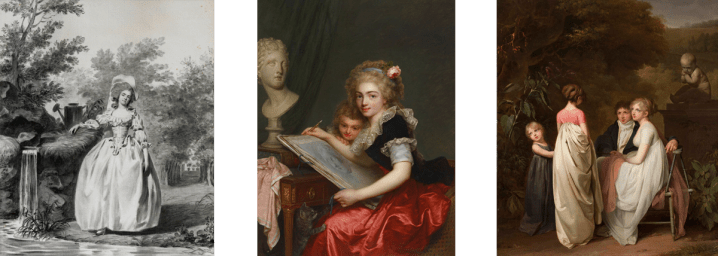
Jacques-Antoine-Marie Lemoine, Woman Standing in a Garden, 1783, black chalk and brush with gray wash on off-white laid paper; Antoine Vestier, Allegory of the Arts, 1788, oil on canvas; and Louis-Léopold Boilly, Conversation in a Park, oil on canvas. All on loan from The Horvitz Collection.
◊ ◊ ◊ ◊ ◊
From the Harn Museum of Art:
Becoming a Woman in the Age of Enlightenment: French Art from The Horvitz Collection
Harn Museum of Art, University of Florida, Gainesville, 6 October — 31 December 2017
Ackland Art Museum, The University of North Carolina at Chapel Hill, 26 January — 8 April 2018
Crocker Art Museum, Sacramento, 13 May — 19 August 2018
Smith College Museum of Art, Northampton, MA, dates TBA
Curated by Melissa Hyde and Mary D. Sheriff
Organized by Alvin Clark
Becoming a Woman in the Age of Enlightenment: French Art from the Horvitz Collection is primarily an exhibition of drawings but will include pastels, paintings, and sculptures selected from one of the world’s best private collections of French drawings. The exhibition will feature nearly 120 works by many of the most prominent artists of the eighteenth century, including Antoine Watteau, Nicolas Lancret, François Boucher, Jean-Honoré Fragonard, as well as lesser-known artists both male and female, such as Anne Vallayer-Coster, Gabrielle Capet, François-André Vincent, Philibert-Louis Debucourt. Ranging from spirited, improvisational sketches and figural studies, to highly finished drawings of exquisite beauty, the works included in the exhibition vary in terms of style, genre, and period.
Becoming a Woman will be organized into thematic sections that address some of the most important and defining questions of women’s lives in the eighteenth century. These include: how the stages of a woman’s life were measured; what cultural attitudes and conditions in France shaped how women were defined; what significant relations women formed with men; what social and familial rituals gave order to their lives; what pleasures they pursued; and what work they accomplished. The aim is to bring new insights to the questions of what it meant to be a woman in this period, by offering the first exhibition to focus specifically on representations of women of a broad range of ages and conditions.
The exhibition will offer fresh perspectives on a subject that still has direct relevance to our times but that has not been the focus of a significant exhibition for decades. Through its conceptual framework, thematic organization, and its emphasis on historical context, the exhibition will provide viewers opportunities to consider what issues pertaining to women’s lives seem to have changed or persisted through time and across space. Although the circumstances and the specifics have changed, many issues remain with us today and can still provoke contentious debates. Pay equity, reproductive rights, gender-discrimination, violence against women, work-family balance, the ‘plight’ of the alpha-female, and the devaluation of the stay-at-home mom, are but a few of the women’s issues that are still hotly contested in the media, in cultural production of all kinds, in politics, and in public and private life.
Becoming a Woman is curated by Melissa Hyde, Professor of Art History, University of Florida Research Foundation Professor, University of Florida, and the late Mary D. Sheriff, W.R. Kenan J. Distinguished Professor of Art History, University of North Carolina, Chapel Hill; the exhibition is organized by Alvin L. Clark, Jr, Curator, The Horvitz Collection and The J.E. Horvitz Research Curator, Harvard Art Museums/Fogg.
The catalogue is available from ArtBooks.com:
Melissa Hyde, Mary D. Sheriff, and Alvin Clark, Becoming a Woman in the Age of Enlightenment: French Art from The Horvitz Collection (Boston: The Horvitz Collection, 2017), 208 pages, ISBN: 978 099126 2526, $39.

François Boucher, Young Travelers, black chalk on cream antique laid paper, framing line in black ink, laid down on a decorated mount, 295 × 188 mm; Jacques-Louis David, Andromache Mourning the Death of Hector, pen with black ink and brush with gray wash over traces of black chalk on cream antique laid paper, 293 × 248 mm; Jean-Baptiste Greuze, The Chestnut Vendor, brush with gray and brown wash on cream antique laid paper, 385 × 460 mm. All works on loan from The Horvitz Collection.
◊ ◊ ◊ ◊ ◊
From the Lecture and Symposium Schedule:
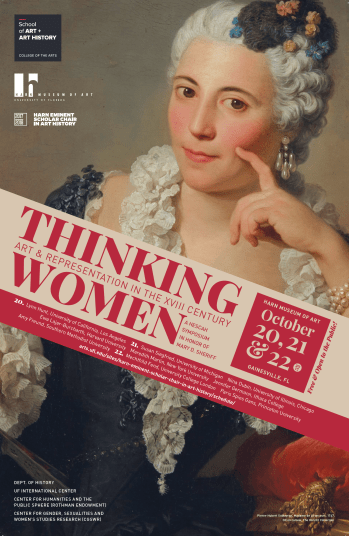
Thinking Women: Art and Representation in the Eighteenth Century
A Symposium in Honor of Mary D. Sheriff
Harn Museum of Art, University of Florida, Gainesville, 20–22 October 2017
• Keynote Address: “The Woman Artist and the Uncovering of the Social World,” Lynn Hunt, Distinguished Research Professor, University of California, Los Angeles
Art, women, and society came together in surprising ways at the end of the eighteenth century. ‘Society’ only began to be conceptualized as an object for study at the end of the 1700s, in particular in reaction to the French Revolution. Art, especially engraving and painting, helped make society visible to itself. Women could join the art world but rarely as fully fledged members, and as a consequence they occupied a kind of in-between position that made them especially attuned to social relations. The life and work of Marie-Gabrielle Capet will be highlighted to show how the social world could be uncovered.
 • “Fashion in Time: Visualizing Costume in the Eighteenth Century,” Susan Siegfried, Denise Riley Collegiate Professor of the History of Art and Women’s Studies, Department of Art History, University of Michigan
• “Beauty Is a Letter of Credit,” Nina Dubin, Associate Professor, Department of Art and Art History University of Illinois, Chicago
• “Chardin: Gender and Interiority,” Ewa Lajer-Burcharth, William Dorr Boardman Professor of Fine Arts, Department of History of Art and Architecture, Harvard University
• “The Global Allure of the Porcelain Room,” Meredith Martin, Department of Art History, New York University
• “Pictured Together? Questions of Gender, Race, and Social Rank in the Portrait of Dido Elizabeth Belle and Lady Elizabeth Murray,” Jennifer Germann, Associate Professor, Department of Art History, Ithaca College
• “Becoming an Animal in the Age of Enlightenment,” Amy Freund, Associate Professor & Kleinheinz Family Endowed Chair in Art History, Southern Methodist University
• “Marguerite Lecomte’s Smile: Portrait of a Woman Engraver,” Mechthild Fend, Reader in the History of Art, Department of History of Art, University College London
• “Exceptional, but not Exceptions: Women Artists in the Age of Revolution,” Paris Spies Gans, Doctoral Candidate, Department of History, Princeton University
The final program, with times, is available here»
At the Ackland Art Museum at UNC, Chapel Hill, there will be a sister symposium in Mary’s honor entitled “Taking Exception: Women, Gender, Representation in the Eighteenth Century,” 1–3 February 2018.
Symposium | The Greenwich and Foundling Hospitals

From The Foundling Museum:
Art, Charity, and the Navy: The Greenwich and Foundling Hospitals
Greenwich and London, 30 October 2017
In this one-day symposium explore similarities in the origins, artistic involvement, and philanthropic purpose of the Foundling Hospital and the Greenwich Royal Hospital for Seamen.
The Foundling Hospital and the Greenwich Royal Hospital are eighteenth-century institutions with many similarities, both charitable hospitals with strong ties to maritime Britain. The Foundling Hospital was the first children’s charity in Britain, established by Royal Charter in 1739 by Captain Thomas Coram, a shipwright in the American colonies. The Royal Hospital for Seamen, Greenwich, was established by Royal Charter in 1694 and from 1712 also incorporated a naval school.
Along with presentations and discussion with expert speakers, the day includes:
• A tour of the Chapel at the Old Royal Naval College, formerly the place of worship for the inhabitants of the Royal Hospital for Seamen
• The opportunity to see the Foundling Museum’s historic Court Room and Picture Gallery, displaying works of art by Hogarth, Gainsborough, Highmore, Ramsay, and many others
• A visit to the exhibition Basic Instincts
• Lunch, tea and coffee, and early evening drinks reception
Speakers include Will Palin (Director of Conservation, Old Royal Naval College), Christine Riding (Head of Arts and Curator of the Queen’s House), Caro Howell (Director of the Foundling Museum), and Jacqueline Riding (Honorary Research Fellow at Birkbeck, University of London, and Curator of the exhibition Basic Instincts).
Morning, Queen’s House, Royal Museums Greenwich and the Old Royal Naval College; afternoon, Foundling Museum. Participants will make their own way between the two sites. Tickets £50, £40 concessions and Foundling Friends.
The programme is available here»
Images: Left, Samuel Wale, Greenwich Hospital, ca. 1748 (London: The Foundling Museum) and right, Richard Wilson, The Foundling Hospital, ca. 1746–50 (London: The Foundling Museum).
Conference | Fashion and Textiles between France and England
From the conference website:
Moving Beyond Paris and London: Influences, Circulation, and Rivalries
in Fashion and Textiles between France and England, 1700–1914
IHTP and Musée Cognacq Jay, Paris, 13–14 October 2017
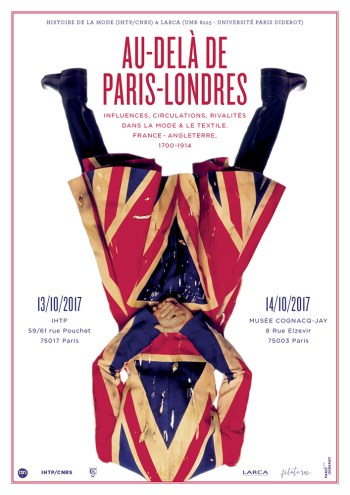 Co-organised by the LARCA/ Paris Diderot, the IHTP-CNRS and the Musée Cognacq Jay, the conference will take place in the IHTP 59/61 rue Pouchet, 75017 on the 13th and in the Musée Cognacq Jay, 8 rue Elzevir 75003 Paris on the 14th.
The keynote addresses will be given by Lesley Miller (Head of Textile and Dress at the V&A, London) and Zara Anishanslin (History, University of Delaware). The event is free and open to all, but registration is compulsory.
F R I D A Y , 1 3 O C T O B E R 2 0 1 7
9.00 Welcome and Coffee
9.30 Mapping Cross-Channel Textile Rivalries
• Fabrice Bensimon, Lace makers between Nottingham and Calais, 1816–1860
• Luc Rojas, Observer la fabrique de Coventry: Les rubaniers stéphanois à la recherche d’information
• Courtney Wilder, Band Apart: Printing ‘Rainbow’ Designs for Walls and Wardrobes in Alsace and Northern England, 1819–1851
11.00 Coffee Break
11.30 Keynote Address
• Lesley Miller (conservatrice en chef des collections mode et textiles au Victoria & Albert Museum, Londres), Lyon in London: Seduction by Silk at the End of the Seven Years War
12.30 Lunch
14.00 Entente cordiale ? Aesthetic and Economic Circulations of Embroidery
• Tabitha Baker, From Lyon and Paris to London: Commercial Networks within the French Embroidery Trade and the Role of the English Gentleman Consumer, 1748–1785
• Isa Fleischman-Heck, Manly French Style Versus Feminine English Taste: Pictorial Embroideries in France and England at the End of the 18th Century
15.00 Coffee Break
15.15 Competing for Cotton
• Jessica Barker, Toile de Jouy / Cloth of England: Copperplate Textile Printing in England and France, 1752–1820
• Ariane Fennetaux, Franco-British Cotton Rivalries: Empire, Trade, and Technology in the 18th Century
S A T U R D A Y , 1 4 O C T O B E R 2 0 1 7
9.30 Welcome and Coffee
9.50 Opening Remarks by Rose-Marie Mousseaux (Directrice du Musée Cognacq-Jay)
10.00 Business Means Business: Fashion Trades and Commercial Strategies
• Pierre-Henri Biger, Eventails et éventaillistes entre la France et l’Angleterre aux XVIII et XIXe siècles
• Audrey Millet, Protéger les dessins textiles: L’invention de la propriété industrielle comme négation du processus créatif, une compétition France-Angleterre (XVIIe–XIXe siècles)
• Véronique Pouillard and Waleria Dorogova, Couture Limited: The Short Lived Britanisation of French Fashion
11.30 Coffee Break
12.00 Keynote Address
• Zara Anishanslin (University of Delaware), An English and Even a Female Hand: Anna Maria Garthwaite, Anglo-French Rivalry, and the Gendered Politics of Flowered Silk
13.00 Lunch
14.30 Embodying Fashion Rivalries
• Elise Urbain Ruano, Une figure pré-romantique? La duchesse d’Orléans et la mode anglaise à la veille de la Révolution française
• César Imbert, Une garde-robe au service de l’Empire: l’influence vestimentaire d’Eugénie en Angleterre
• Matthew Keagle, More than Red and White: Franco-British Reform and Military Dress in the Late Ancien Régime
16.30 Guided Tour of the Cognacq-Jay Collections with Director Rose-Marie Mousseaux
Conference | Landscape Now
From the Paul Mellon Centre:
Landscape Now
Paul Mellon Centre for Studies in British Art, London, 30 November – 1 December 2017

Spreading Oak with Seated Figure, Unknown (British) 1850s (New York: The Metropolitan Museum of Art, Gift of Hans P. Kraus Jr., 2007).
The pictorial representation of the landscape has long played an important role in the history of British art. It has been central to writers from Gilpin and Ruskin onwards, and was the subject of sustained scholarly attention in the 1980s and 1990s with the emergence of a social history of art. Writers such as John Barrell, Anne Bermingham, Stephen Daniels, Christiana Payne, Michael Rosenthal and David Solkin not only helped transform interpretations of British landscape painting, but made the study of such imagery seem essential to a proper understanding of British art itself.
Over the past two decades the centre of gravity of British art studies has shifted. An imperial turn has characterized some of the most ambitious scholarship in the field; a raft of powerful new voices have shifted attention to the Victorian and modern periods, and to the imagery of urban life; and there has been a dramatic growth of interest in such topics as print culture, exhibition culture, and the material culture of the work of art. With these developments, existing approaches to the study of landscape pictures lost some of their urgency and relevance.
However, this same period has seen the growth of a broader interest in landscape images in adjacent disciplines, driven in part by political and environmental imperatives. A newly energised category of ‘nature writing’, associated with authors such as Robert Mcfarlane and Helen MacDonald, has gained widespread currency beyond the purely academic arena. Cultural geographers such as David Matless and film-makers such as Patrick Keillor have offered nuanced investigations of the British landscape in their work, asking us to think afresh about its relationship to national identity, memory and post-imperial decline. And while many scholars in the humanities, in an age of globalisation and deepening ecological concern, have felt compelled to think about landscape on a vastly expanded basis, others have been driven to offer a new and suggestive focus on the local.
The moment thus seems ripe for a major art-historical reassessment of the image of the British landscape, taking account these and other emergent concerns. This international conference, the third in an annual series organised collaboratively by the Paul Mellon Centre, the Yale Center for British Art, and the Huntington Library, Art Collections, and Botanical Gardens, is designed to offer an opportunity for such a reassessment.
£20 Concession Rate (students and 60+) for 30 Nov and 1 Dec (ID is required on the day). £35 Standard Rate for 30 Nov and 1 Dec. NB: We are not selling tickets to individual days.
T H U R S D A Y , 3 0 N O V E M B E R 2 0 1 7
9.30 Registration
10.00 Introduction and Welcome – Mark Hallett (Director of Studies, Paul Mellon Centre), Amy Meyers (Director, Yale Center for British Art), and Steven Hindle (W.M. Keck Foundation Director of Research, The Huntington Library)
10.30 Panel 1 | Local Landscapes
Chaired by Martin Postle (Deputy Director for Grants & Publications, Paul Mellon Centre)
• Anna Reid (PhD candidate, University of Northumbria), ‘The Nest of Wild Stones: Paul Nash’s Geological Realism’
• Anna Falcini (Associate Lecturer in Contemporary Art Practice, Bath Spa University; Ph.D. Candidate in Fine Art Practice, University of the Creative Arts, Canterbury), ‘Re-illuminating the Landscape of the Hoo Peninsula through the Media of Film (the Porousness of Past & Present)’
11.30 Coffee Break
12.00 Panel 2 | Colonial Landscapes
Chaired by Sarah Victoria Turner (Deputy Director for Research, Paul Mellon Centre)
• Julia Lum (Doctoral Candidate, History of Art, Yale University), ‘Fire-stick Picturesque: Colonial Landscape Art in Tasmania’
• Rosie Ibbotson (Lecturer in Art History and Theory, Te Whare Wānanga o Waitaha University of Canterbury, New Zealand), ‘The Image in the Imperial Anthropocene: Landscape Aesthetics and Environmental Violence in Colonial Aotearoa New Zealand’
13.00 Lunch at the Paul Mellon Centre
14.30 Panel 3 | Liquid Landscapes
Chaired by Steve Hindle (The Huntington Library)
• Stephen Daniels (Professor Emertitus of Cultural Geography, University of Nottingham), ‘Liquid Landscape’
• Kelly Presutti (Fellow at Dumbarton Oaks), ‘Strategic Seascapes: John Thomas Serres and the Royal Navy’
• Gill Perry (Emeritus Professor of Art History, The Open University), ‘Landscaping Islands in Contemporary British Art: Floating Identities and Changing Climates’
16.00 Tea Break
16.30 Panel 4 | Landscape and the Anthropocene
Chaired by Martin Myrone (Lead Curator, British Art to 1800, Tate Britain)
• David Matless (Professor of Cultural Geography, University of Nottingham), ‘The Anthroposcenic: Landscape Imagery in Erosion Time’
• Mark A. Cheetham (Professor of art history, University of Toronto), ‘Outside In: Reflections of British Landscape in the Long Anthropocene’
17.30 Drinks Reception at the Paul Mellon Centre
F R I D A Y , 1 D E C E M B E R 2 0 1 7
10.00 Keynote Lecture
Chaired by Mark Hallett (Paul Mellon Centre)
• Tim Barringer (Chair and Paul Mellon Professor of the History of Art, Yale University), ‘Thomas Cole and the White Atlantic’
11.30 Coffee Break
12.00 Panel 5 | Anglo-American Landscapes
Chaired by Scott Wilcox (Deputy Director for Collections, Yale Center for British Art)
• Matthew Hunter (Associate Professor, Department of Art History and Communication Studies McGill University), ‘Drawing By Numbers: Anglo-American Landscape and the Actuarial Imagination’
• Julia Sienkewicz (Assistant Professor of Art History, Roanoke College in Salem), ‘On Place and Displacement: Benjamin Henry Latrobe and the Immigrant Landscape’
13.00 Lunch at the Paul Mellon Centre
14.15 Panel 6 | Re-Making Landscapes
Chaired by Hammad Nasar (Senior Fellow, Paul Mellon Centre)
• Val Williams (Professor of the History and Culture of Photography and Director of Photography and the Archive Research Centre (PARC), University of the Arts London, London College of Communication) and Corinne Silva (Research Fellow, PARC, University of the Arts London, London College of Communication), ‘The Re-making of the English Landscape: In the Footsteps of W.G. Hoskins and F.L. Attenborough’
• Terry Perk (Interim Director of Research, Students, Associate Head of School of Fine Art and Photography, and Reader in Fine Art, University for the Creative Arts) and Julian Rowe (MA, visual artist), ‘Mapping the Apocalypse: Jonah Shepherd and the Kentish Landscape’
13.15 Break
15.30 Panel 7 | Exhibiting Landscape
Chaired by Martina Droth (Deputy Director of Research and Curator of Sculpture, Yale Center for British Art)
• Gregory Smith (Senior Research Fellow at the Paul Mellon Centre), The ‘Connoisseur’s Panorama’: Thomas Girtin’s Eidometroplis and a New Iconography for the City’
• Nick Alfrey (Honorary Research Associate, Department of History of Art, University of Nottingham), ‘1973 and the Future of Landscape’
16.30 Tea Break
17.00 Panel 8 | Landscape Now?
• Mark Hallett (Paul Mellon Centre) Tim Barringer (Yale University)
• Sarah Monks (Lecturer in Art History, Director of Admissions for School of Art, Media and American Studies, University of East Anglia)
• Alexandra Harris (Professorial Fellow, Department of English, University of Birmingham)
• Amy Concannon (Assistant Curator, British Art, 1790-1850, Tate Britain and Doctoral Candidate, University of Nottingham)
Journée d’étude | Jacques-François Blondel
From the conference flyer:
Jacques-François Blondel et l’enseignement de l’architecture:
La dernière leçon de l’architecture « à la française »
Cité de l’architecture et du patrimoine, Paris, 14 December 2017

Gabriel de Saint-Aubin, Blondel démontrant des machines dans l’académie d’architecture, 1770, Recueil de poésies de Sedaine, 1770 (Chantilly, Musée Condé).
Dernier héraut de l’architecture à la française, Jacques-François Blondel (1708/9–1774) a formé dans son école privée et à l’Académie royale d’architecture parmi les architectes les plus renommés de la seconde moi é du XVIIIe siècle et du début du siècle suivant : Claude-Nicolas Ledoux, Étienne-Louis Boullée, Alexandre Brongniart ou William Chambers… La pédagogie révolutionnaire qu’il développa dans l’enseignement de l’architecture tout au long de sa carrière a connu une ample diffusion en France, en Europe et même, outre-Atlantique, jusqu’au Québec. Si certains architectes l’appliquèrent à la lettre, d’autres s’en affranchirent et allèrent au-delà des leçons professées par le maître.
Organisée en partenariat avec la Ville de Metz et l’École na onale supérieure d’architecture de Nancy, cette journée d’étude internationale est centrée sur le rôle de Jacques-François Blondel dans l’enseignement de l’architecture. Elle annonce l’exposition monographique Blondel, architecte des Lumières qui sera présentée à Metz, à l’Arsenal, du 13 avril au 13 juillet 2018 et l’exposition-dossier que la Cité de l’architecture et du patrimoine lui consacrera la même année. Cette rencontre se propose de revenir sur les idées ainsi que les méthodes pédagogiques dispensées par J.-F. Blondel, et de relire, au travers d’un prisme neuf, les fondamentaux de son enseignement. La participation à cette journée est gratuite; inscription en ligne obligatoire. Contact: jean-marc.hofman@citedelarchitecture.fr.
◊ ◊ ◊ ◊ ◊
9.00 Accueil
9.20 Ouverture de la journée d’étude
• Corinne Bélier (Directrice du musée des Monuments français)
• Lorenzo Diez (Directeur de l’École nationale supérieure d’architecture de Nancy)
• Dominique Gros (Maire de Metz)
9.45 Jacques-François Blondel : état de la recherche, Aurélien Davrius (Maître-assistant à l’École nationale supérieure d’architecture de Paris-Malaquais, Laboratoire LIAT)
10.15 Jacques-François Blondel, un professeur innovant à l’Académie royale d’architecture ?, Hélène Rousteau-Chambon (Professeur d’histoire de l’art moderne à l’université de Nantes)
10.45 Blondel et les Mansart : une leçon particulière, Philippe Cachau (Docteur en histoire de l’art)
11.15 Pause-café
11.45 Les savoirs théoriques et techniques transmis par Blondel au travers de l’exemple du matériau plâtre, Christelle Inizan (Chargée d’études et de recherches, Médiathèque de l’architecture et du patrimoine, Centre de recherches sur les Monuments historiques)
12.15 L’influence de J.-F. Blondel sur le cours d’architecture de l’École des Ponts et Chaussées, Théodore Guuinec (Architecte DE-HNOMNP, historien du patrimoine)
12.45 Questions ouvertes aux intervenants
13.00 Pause-déjeune
14.30 L’enseignement de l’expérience architecturale chez Blondel et ses collègues anglais, Sigrid de Jong (Chercheur à l’université de Leyde, Pays-Bas)
15.00 « Como ha hecho el Sieur Blondel, en Francia… » Réflexions sur l’influence de la théorie architecturale française autour de Jacques-François Blondel en Espagne, 1750–1800, Adrián Almoguera (Doctorant contractuel en histoire de l’architecture Université de Paris Sorbonne / Centre André Chastel)
15.30 Le Précis d’architecture (1828) de l’abbé Jérôme Demers et le prolongement de l’enseignement de Blondel au Canada au XIXe siècle, Marc Grignon (Professeur d’Histoire de l’art à l’Université Laval) et Pierre-Édouard Latouche (Professeur au département d’histoire de l’art à l’Université du Québec à Montréal)
16.15 Pause
16.30 L’École des arts de Jacques-François Blondel ou l’invention d’une pédagogie des relations entre architecture, sculpture et peinture, Laure Chabanne (Conservateur du patrimoine, musée et domaine nationaux du palais de Compiègne)
17.00 « Le Grand Blondel », Jean-Marie Pérouse de Montclos (Directeur de recherche honoraire au CNRS)
17.30 Vers une conception « évolutionnaire » de l’architecture : Jacques-François Blondel et la question du jugement professionnel dans la théorie de Peter Collins, Denis Bilodeau (Professeur tulaire à l’École d’architecture de l’Université de Montréal)
18.00 Questions ouvertes aux intervenants
18.20 Conclusion de la journée, Pierre Caye (Directeur de recherche au CNRS)
19.30 Visite de la galerie des moulages










leave a comment