Workshop | Probing Provenance
From the workshop flyer:
Probing Provenance: Sources, Methods and Implications
Institute for Historical Research, London, 28 March 2018

Monogram bookplate: M L y C (Provenance Online Project) by Provenance Online Project (flickr) Penn Libraries call number: IC55 G9315 590p 1591.
The Society for the History of Collecting is pleased to announce a workshop on provenance on 28th March 2018. Organised at the Institute for Historical Research (IHR), Senate House in London, it will bring together distinguished researchers with a range of geographical and period expertise: Kate Hill, Claire Wintle, Alexis Ashot, Niko Munz, Melanie Aspey, and Alexandra Gerstein). The aim is to have a broad methodological discussion that introduces provenance as a concept and a practice: what skills it requires; what sources it can draw on; how it can be effectively deployed; what other histories and processes it can illuminate. The event will run from 10.00 until 13.00 in Wolfson Room 1 of the IHR. It is open to all, and doctoral students and early career researchers are especially welcome to attend.
Provenance is a central tool and indispensable concept within the history of collecting. Not only does it permit scholars to retrace the chain of lost collections, and to reconstruct the biography of an object. Provenance can also act as badge of esteem, a promise of authenticity, a financial asset and a narrative device. In recent years, it has generated not just vast digital databases centred on the art market, but also fascinating international exhibitions and intense clashes over the restitution of cultural property. Provenance is not merely one more research tool, then. Rather, it is central for understanding the itinerary of objects and the transformative effects of ownership.
The workshop has been organized by Adriana Turpin (Chairman of the Society), Tom Stammers (University of Durham), Silvia Davoli (Strawberry Hill Trust/ University of Oxford), and Barbara Pezzini (University of Manchester/ National Gallery). Booking, via Eventbright, is essential. For any questions about the day please contact Tom Stammers: t.e.stammers@durham.ac.uk.
Conference | Art History Before English
From the Kunsthistorisches Institut in Florenz:
Art History Before English: Negotiating a European ‘Lingua Franca’ from Vasari to the Present
Kunsthistorisches Institut in Florenz, Florence, 8–10 March 2018
Organized by Alessandro Nova in collaboration with Robert Brennan, Marco Mascolo, and Oliver O’Donnell within the framework of the research project Languages of Art History
 The expansion of art historical scholarship across cultural and linguistic boundaries reveals problems with the inherited vocabularies of the discipline. Today, for better or worse, English has become an ever more prominent common language of academic discourse, art history being no exception, and yet the problems this development poses are not without historical precedent within the European tradition of art writing.
Alongside the task of adapting classical concepts to modern usage, scholars have long had to contend with what was arguably the ‘lingua franca’ of art historical discourse in their own time: Italian in the 16th and 17th centuries, French in the 17th and 18th, and German in the 19th and 20th. This conference seeks to leverage this succession of dominant languages in order to shed light on the present assumption of English as a ‘lingua franca’ of art history. In so doing, the conference seeks to evaluate how Italian, French, and German have decisively shaped the discipline, assembling a cache of certain terms, concepts, and modes of thought—often to the exclusion of others—that remain central across a wide variety of languages in the field today.
T H U R S D A Y , 8 M A R C H 2 0 1 8
14:30 Introduction
Alessandro Nova, C. Oliver O’Donnell, and Robert Brennan
15:00 Panel 1 | Inventions of Academic Languages
Chair: Alessandro Nova
• Massimiliano Rossi (Università del Salento, Lecce), Di lotta e di governo: Lessico, codici e categorie critiche degli scritti accademici sull’arte dagli Umidi alla Crusca
• Robert Williams (University of California, Santa Barbara), Terms of Art
16:20 Coffee Break
16:50 Panel 1, continued
Chair: Marco Mascolo and Robert Brennan
• Jacqueline Lichtenstein (Université Paris-Sorbonne), The Conferences of the Royal Academy of Painting and Sculpture: A New Discourse on the Arts
• Olivier Bonfait (Université de Bourgogne), La lingua francese e la scrittura della storia dell’arte, 1660–1700
• John Leavitt (Université de Montréal), Language Ideologies and the Inventions of Art History
F R I D A Y , 9 M A R C H 2 0 1 8
9:30 Panel 2 | Assimilation and Transformation of Academic Models
• Alessandra Russo (Columbia University), Antiguidade and Pintura: Concepts Redefined by a Novel Artistic Universality
• Francesca Terrenato (Università degli Studi di Roma La Sapienza), In the Manner of Vasari: Italian Loanwords and Calques in Karel van Mander’s Schilder-Boeck (1604)
10:50 Coffee Break
11:20 Panel 3 | In the Shadow of the Academy
Chair: Alexander Nagel
• Michael Fried (Johns Hopkins University), Reading Diderot in America
• Stephen Bann (University of Bristol), Historical Genre: Negotiating a Hybrid Concept in and outside of 19th-Century France
12:40 Lunch Break
14:00 Panel 4 | Translating and Untranslating Art Writing
Chair: Brigitte Sölch
• Elisabeth Décultot (Universität Halle), Winckelmanns Sprachen: Kunsttheorie als Übersetzung
• Andreas Beyer (Universität Basel), Art Historical Untranslatables
• Christopher S. Wood (New York University), Why did the ‘Renaissance’ Resist Translation?
16:00 Coffee Break
16:30 Site Visit
Chapel of Saint Luke, Basilica della Santissima Annunziata, led by Fabian Jonietz (Kunsthistorisches Institut in Florenz) — for speakers only
S A T U R D A Y , 1 0 M A R C H 2 0 1 8
9:30 Panel 5 | Ekphrasis in the 20th Century
Chair: Andreas Beyer
• Marco Mascolo (Kunsthistorisches Institut in Florenz), Roberto Longhi e la sua ricezione, tra ekphrasis e connoisseurship
• Émilie Passignat (Università Ca’ Foscari, Venezia), Nello specchio della traduzione: l’ecfrasi longhiana alla prova della lingua francese
10:50 Coffee Break
11:20 Panel 6 | Art History and Social Science
Chair: Hana Gründler
• C. Oliver O’Donnell (Kunsthistorisches Institut in Florenz), Schapiro and Lévi-Strauss: Structuralist Arguments among Color Field Paintings
• Whitney Davis (University of California, Berkeley), Reading-In: Franz Boas and the Languages of the Anthropology of Art
12:45 Concluding Discussion
Image: Joseph Kosuth, Ten Locations of Meaning, 2009
Symposium | Continuing Curiosity: The Art of the Peales
From the Philadelphia Museum of Art:
Continuing Curiosity: The Art of the Peales
Philadelphia Museum of Art, 17 February 2018
On Saturday, 17 February, five Peale scholars share their ongoing research in the context of the Museum’s new publication, The Art of the Peales in the Philadelphia Museum of Art: Adaptations and Innovations. Registration required, $20 (Philadelphia Museum of Art members free). Included in the fee is general museum admission for Friday evening’s ‘Gallery Conversation’ (starting at 5:45pm), which includes an installation discussion with scholars, along with musical programming.
Morning Session | 10:30–12:30
• Welcome and introduction, Carol Soltis (Project Associate Curator, Philadelphia Museum of Art)
• ‘Pealed all Around’: The Making of Curious Revolutionaries at the American Philosophical Society, Amy Noel Ellison (Andrew W. Mellon Post-Doctoral Curatorial Fellow, American Philosophical Society)
• Under My Skin: Raphaelle Peale’s Venus Rising from the Sea-A Deception and the Hidden Mechanisms of Disease, Lauren Lessing (Mirken Director of Academic and Public Programs, Colby College Museum of Art)
Afternoon Session | 1:30–4:30
• Looking ahead with Charles Peale Polk, Linda Simmons (Curator Emerita, The Corcoran Gallery
• Replicating Nature: The Peales and Their Still Lifes, Lance Humphries (Executive Director, Mount Vernon Place Conservancy)
• Hanging Shakespeare: Charles Willson Peale and Benjamin West at PAFA in 1807, Wendy Bellion (Professor, Sewell C. Biggs Chair in American Art History, University of Delaware)
Study Day | Pots, Prints & Politics: Ceramics with an Agenda
From the programme:
Pots, Prints, and Politics: Ceramics with an Agenda
The British Museum, London, 16 February 2018

Creamware Mug, Staffordhire, ca. 1803 (London: The British Museum).
Join British Museum curators from the Departments of Asia, Prints and Drawings, and Britain, Europe, and Prehistory in this one-day study day—held in conjunction with the exhibition Pots with Attitude: British Satire on Ceramics, 1760–1830—addressing historical and modern ceramics that have political and other messages, which have been inspired by prints and printmaking.
Since the introduction of paper and woodblock printing in China around AD 600, through to the invention of woodcuts printed on paper and the printing press in Germany in the 15th century, the print medium has been used around the world to disseminate ideas and knowledge. Ceramic artists across time and cultures have adapted these graphic sources as painted or transfer-printed images applied onto glazed or unglazed surfaces to express issues including piety, propaganda, self-promotion, gender, national, and regional identities.
This study day is open to all and will draw on the over 500,000 records catalogued by the Prints and Drawing department, which can be searched on the British Museum’s collection online. Stevenson Lecture Theatre, British Museum, Friday, 16 February 2018; £15 / £12.50 concessions. Book online here.
P R O G R A M M E
9:30 Registration
10:00 Session A
• Patricia Ferguson (Project Curator, Monument Trust, 18th-Century Prints and Ceramics, Britain, Europe and Prehistory, and Prints and Drawings), Introduction
• Yu-ping Luk (Curator: Chinese Paintings Prints and Central Asia, Asia), Woodblock Prints and Images on Ceramics in China: Some 14th- to 17th-Century Examples
• Dora Thornton (Curator: Renaissance Collection, Waddesdon Bequest, Britain, Europe and Prehistory), ‘Take Note’: Looking at Italian Renaissance Potters, Printmaking, and Politics through the Lens of the British Museum Collection
11:00 Coffee Break
11:30 Session B
• Eloise Donnelly (Collaborative Doctoral Award Student, Britain, Europe and Prehistory), Prints, Pots, and Protestantism: The Thomas Collection of German Stoneware
• Jessica Harrison-Hall (Curator: Chinese Ceramics, Percival David, Asia), Shameless Self-Promotion? European Eighteenth-Century Prints and Chinese Pots
12:30 Lunch — available for purchase in the Museum cafes
14:00 Session C
• Sheila O’Connell (Former Curator, British Prints, Prints and Drawings), Jefferyes Hamett O’Neale (fl.1750–1801): Pots and Prints
• Patricia Ferguson (Project Curator, Monument Trust), Spode and the French Invasion Scare: Profiteering or Propaganda?
• Antony Griffiths (Former Keeper, Department of Prints and Drawings), Thoughts on Prints and Pots: Beyond Politics
15:15 Coffee Break
15:45 Session D
• Mary Ginsberg (Research Fellow, Asia), Appropriated Heroes: Prints, Pots, and Politics in Revolutionary China
• Eleanor Hyun (Curator, Korean Collections, Asia), Circulating Images: North Korean Pots and Prints
16:30 Tour of Pots with Attitude: British Satire on Ceramics, 1760–1830, in Room 90a.
Conference | Circulating Crafts
I’m always interested to see how one might extend the significance of a CAA panel beyond the conference itself. Here’s an interesting attempt with programming in Paris and LA. Last month I noted the first CAA panel, but I didn’t connect it to these other events. –CAH
From the programme:
Circulating Crafts: Art, Agency, and the Making of Identities, 1600–2000
Paris, 24 January 2018 / Los Angeles, 21 February 2018
Organized by Yaëlle Biro and Noémie Étienne
 Circulation and imitation of cultural products are key factors in shaping the material world—as well as identities. Many objects or techniques that came to be seen as local, authentic and typical are in fact entangled in complex transnational narratives tied to a history of appropriation, imperialism, and the commercial phenomenon of supply and demand.
In the 17th and 18th centuries, artists and craftspeople in Europe appropriated foreign techniques such as porcelain, textiles, or lacquers that eventually shaped local European identities. During the 19th century, Western consumers looked for genuine goods produced outside of industry, and the demand of Bourgeois tourism created a new market of authentic souvenirs and forgeries alike. Furthermore, the 20th century saw the (re)-emergence of local ‘Schools’ of art and crafts as responses to political changes, anthropological research, and/or tourist demand. This multi-part conference will explore how technical knowledge, immaterial desires, and political agendas impacted the production and consumption of visual and material culture in different times and places. A new scrutiny of this back and forth between demanders and suppliers will allow us to map anew a multi-directional market for cultural goods in which the source countries could be positioned at the center.
Contacts: yaelle.biro@metmuseum.org and noemie.etienne@ikg.unibe.ch
2 4 J A N U A R Y 2 0 1 8
Part 1 | Workshop: Circulating Crafts
La Colonie, 178 boulevard Lafayette, 75010 Paris
9.00 Welcome and Introduction by Yaëlle Biro and Noémie Étienne
9.15 Session A
• Ariane Fennetaux (Université Paris Diderot), From Coromandel with Love: The Glocalisation of Indian Cottons in the 17th and 18th Centuries
• Chonja Lee (Bern University), Made in Switzerland: How Swiss Indiennes Became Autochtone and Dressed the World at the Same Time
• Aziza Gril-Mariotte (Université de Haute-Alsace), Modèles, emprunts et circulation des formes occidentales dans les toiles peintes au XVIIIe siècle
11.15 Coffee break
11.30 Session B
• James Green (University of East Anglia), Appropriating Kongo Colors: Red, White and Black in 19th-Century English Trade Cloth
• Manuel Charpy, CNRS, Lille), Changing Sides? Consumption and Political Uses of Western Clothing in Congo, 1830–1960
13.00 Lunch break
14.00 Session C
• Thomas Grillot (CNRS, Paris), Marketing Family Heirlooms: Three Generations of American Indian Artists in the Northern Plains
• Rémi Labrusse (Université Paris-Nanterre), Hybridité et identité en Algérie à la veille de l’invasion française: le cas du palais du Bey de Constantine
15.20 Coffee break
15.35 Session D
• Julien Volper (Tervuren Museum), Du Bénin à l’Inde en passant par le Congo: Origines, in uences et voyages d’objets africains du XIXe et du XXe siècles
• Jonathan Fine (Ethnologisches Museum, Berlin), Crafting Culture: The Co-Production of ‘Bamum’ Art in the 1920s
• Gaëlle Beaujean (Musée du quai Branly – Jacques Chirac), Sirène, vierge, charmeuse de serpent et Atlantique
17.35 Discussion
2 1 F E B R U A R Y 2 0 1 8
Part 2 | Conference Panels: Art, Agency, and the Making of Identities, 1600–2000
College Art Association, Convention Center, Los Angeles
2.00 Panel I
• Helen Glaister (SOAS, University of London / Victoria & Albert Museum, London), The Picturesque in Peking: European Decoration at the Qing Court
• Dorothy Armstrong (Royal College of Art / Victoria & Albert Museum, London), A Transnational Loop: Pakistan’s Repossession of the Oriental Carpet Imaginary and its Production
• Tingting Xu (University of Chicago), The Rivers Folded: Souvenir Accordion Panoramas in the Late 19th-Century Global Tourism
• Karen Milbourne (Smithsonian National Museum of African Art), Lozi Style: King Lewanika and the Marketing of Barotseland
4.00 Panel II
• Ashley Miller (UC Berkeley), ‘What is Colonial Art and Can It Be Modern?’: Moroccan Modernisms at the Art Deco Exposition in Paris, 1925
• Victoria Rovine (University of North Carolina), A Wider Loom: Textiles and Colonial Politics of Authenticity in the Soudan Français
• Gail Levin (The City University of New York), Frida Kahlo’s Invention of Jewish Identity
• Niko Vicario (Amherst College), From Duco to Comex: The Politics of Synthetic Paint in the Americas
Illustration: French textile design for the West African slave trade market, Nantes, 18th century., “L’album des indiennes de traite de Favre, Petitpierre et Cie” (Henry-René d’Allemagne, La Toile imprimée et les indiennes de traite, Paris, Gründ, 1942, plate 69).
Symposium | Taking Exception: Women, Gender, Representation
From the symposium announcement:
The 2018 Bettie Allison Rand Symposium in Art History
Taking Exception: Women, Gender, Representation in the Eighteenth Century
A Symposium in Honor of Mary D. Sheriff
Ackland Art Museum, University of North Carolina at Chapel Hill, 1–3 February 2018
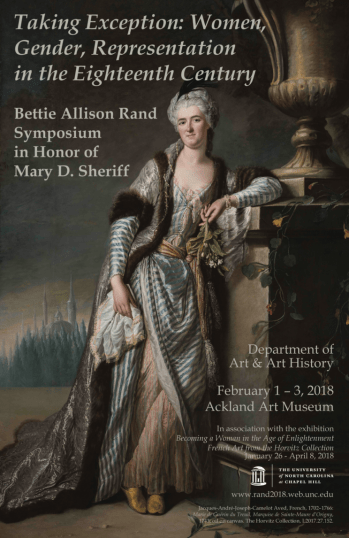 The 2018 Bettie Allison Rand Symposium will take place in tandem the Ackland Art Museum exhibition, Becoming a Woman in the Age of Enlightenment: French Art from the Horvitz Collection (open in Chapel Hill from 26 January until 8 April 2018). The exhibition is curated by Melissa Hyde, Professor of Art History, University of Florida Research Foundation Professor, University of Florida, and the late Mary D. Sheriff, W.R. Kenan Jr. Distinguished Professor of Art History, The University of North Carolina at Chapel Hill. It is organized by Alvin L. Clark, Jr, Curator, The Horvitz Collection and The J.E. Horvitz Research Curator, Harvard Art Museums/Fogg.
Through a generous gift to the UNC Arts and Sciences Foundation, William G. Rand established this lecture series in memory of his late wife, Bettie Allison Rand. This funding allows the Department of Art to bring one or more eminent art historians to UNC-CH every other year for residencies of various lengths. While they are in Chapel Hill, these scholars present a series of lectures and interact with undergraduate and graduate art history and studio art students. More information about the series can be found here.
Speakers will include
• Vivian Cameron, Independent Scholar
• Susanna Caviglia, Assistant Professor of Art, Art History & Visual Studies, Duke University
• Melissa Hyde, Professor of Art & Art History, University of Florida
• Anne Lafont, Director of Studies, L’Ecole des Hautes Etudes En Sciences Sociales
• Christopher Johns, Norman L. and Roselea J. Goldberg Professor of History of Art, Vanderbilt University
• Dorothy Johnson, Roy J. Carver Professor of Art History, University of Iowa
• Kathleen Nicholson, Professor Emerita of the History of Art and Architecture, University of Oregon
• Suzanne Pucci, Professor of Modern & Classical Languages, Literatures, & Cultures, University of Kentucky
• Abigail Solomon-Godeau, Professor Emerita of the History of Art & Architecture, University of California Santa Barbara
• Susan Taylor Leduc, Independent Scholar
• Michael Yonan, Associate Professor of Art History and Archaeology, University of Missouri
A memorial for Mary D. Sheriff will be held on Saturday, February 3rd at 1:00pm.
For more schedule details and to register to attend, visit the symposium website.
Contact: Tania C. String, tcstring@email.unc.edu
Conference | Telling Her Story
From the Women’s History Network:
Telling Her Story: Women’s History, Heritage, and the Built Environment
Wrest Park, Bedfordshire, 19 March 201
Organized by Megan Leyland, Roey Sweet, and Andrew Roberts
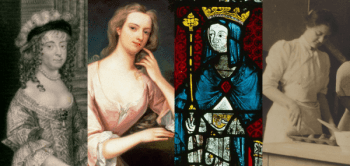 Telling Her Story will bring together heritage professionals and academics to explore the diverse roles and experiences of women at historic sites. Whether in country houses or castles, women have played a pivotal role in shaping the built environment and in influencing the course of history. Yet, more often than not, their voices are marginalised or missing from the historical record and from interpretation at heritage sites.
This conference seeks to uncover the many and varied experiences of women at historic properties in the care of English Heritage and other heritage organisations. It aims to move beyond stock biographies of famous and extraordinary women to discover the many diverse stories of women from all walks of life, to offer new perspectives on better-known individuals and to critique narratives and interpretations which continue to be constructed principally around the experiences of men.
This conference is being jointly organised by English Heritage and the University of Leicester, and has been generously supported by the Women’s History Network Small Grant Scheme. Dr. Megan Leyland (English Heritage), Prof. Roey Sweet (University of Leicester), Dr. Andrew Roberts (English Heritage).
Tickets, £30, are available by calling our dedicated ticket sales team on +44(0) 370 333 1183. A limited number of free tickets for students / unwaged are available; to apply, please contact megan.leyland@english-heritage.org.uk with why the conference is relevant to your research, interests, or work. Tickets will be allocated on a first come first serve basis. Please note, this programme is subject to change.
P R O G R A M M E
9:30 Coffee
10:00 Welcome and Introduction
10:10 Castles and Warfare
• Rachel Delman (University of Oxford), Writing medieval women back into castle narratives
• Karen Dempsey (University of Reading), Outside the can(n)on: Telling inclusive stories of the medieval past
• Jessica Malay (University of Huddersfield), Anne Clifford’s transformation of Westmorland through the construction of households
• Emma Turnbull (University of Oxford), Remembering resistance: Female activism during the English Civil Wars
10:10 Silent Voices
• Helen Bates (University of Leicester), The truth, the whole truth and nothing but the truth? New interpretations of women at Lincoln Castle Victorian Prison
• Nigel Cavanagh (Network Archaeology), An alternative focus for industrial heritage: Women’s lives in Elsecar, ca. 1780–1870
• Kate O’Neill (RCA/ V&A), Capturing the invisible? Photography and female domestic servants in the country house, 1850–1920
• Elena Settimini (University of Leicester), Demeter’s daughters: The representation of women within a vineyard landscape
12:00 Lunch
1:00 Eighteenth-Century Female Patronage
• Ruth Larsen (University of Derby), Beyond the withdrawing room: Exploring notions of gendered spaces in the eighteenth-century country house
• Lydia Hamlett (University of Cambridge), Revealing women’s stories through mural painting, 1680–1720
• Amy Boyington (University of Cambridge), Female architectural patronage in eighteenth-century Britain
1:00 Written out of History
• Judith Phillips (Bowes Museum/ Teesside University), Mrs. Bowes’s mansion, museum, and galleries: Joséphine Bowes and The Bowes Museum
• Louise Devoy (Royal Observatory, Greenwich), Observatory life: Adding domestic history and female voices to the story of the Royal Observatory
• Eleanor Sier (Toynbee Hall), Kate Bradley (University of Kent), and Lucinda Matthews-Jones (Liverpool John Moores University), Toynbee Hall: Mother of settlements
2:15 Coffee
2:30 Connecting People, Space, and Place
• Hannah Worthen (University of Hull), Gender and the hidden histories of English landed estates
• Emma Purcell (University of Leicester), The impact of heiresses on the Montagu property network, ca. 1749–1827
• Jon Stobart (Manchester Metropolitan University), Housekeeper, correspondent and confidante: The under-told story of Mrs Hayes of Charlecote Park, ca. 1740–60
2:30 Heritage Industry Approaches
• Rachael Lennon (National Trust), Challenging histories: Women and power
• Morvern French and Stefan Sagrott (Historic Environment Scotland), Telling their stories: From warriors to witches, and everything in between
• Megan Leyland (English Heritage), Telling the story of England: Women’s history at English Heritage
4:00 Closing Discussion / Tour
Exhibitions and Posters
Exhibition material on display throughout the conference includes The Women of Wrest Park (the Wrest Park Volunteer History Group, English Heritage), Uncovering Women’s Voices in the Richmond Castle Cell Block (the Richmond Castle Cell Block Project volunteers, English Heritage), and Marble Hill Revived (English Heritage), as well as academic posters.
Conference | CAA 2018, Los Angeles
Please pay particular attention to the HECAA session, Imitation, Influence, and Invention in the Enlightenment, chaired by Heidi Strobel and Amber Ludwig, which takes place Wednesday morning at 8:30, and the ASECS session The 1790s, chaired by Julia Sienkewicz, scheduled for Friday afternoon at 2:00. In addition, a few spots for the American Institute for Conservation’s annual ‘Learning to Look’ workshop on Eighteenth-Century Mexican Painting, held at LACMA in connection with the exhibition Pintado en México, 1700–1790: Pinxit Mexici, have generously been reserved for Enfilade readers (please see details below and email Rebecca Rushfield at wittert@juno.com to RSVP). Finally, with more and more thematic offerings, I’ve inevitably missed material relevant to the eighteenth century; so, please don’t be bashful about noting panels omitted below. –CH
106th Annual Conference of the College Art Association
Los Angeles Convention Center, 21–24 February 2018
In 2018, CAA will return to LA for its 106th Annual Conference. The four-day event will be held at the Los Angeles Convention Center from Wednesday, February 21 through Saturday, February 24. The conference consists of over 300 presentations, panel discussions, workshops, special events, and exhibitions exploring the study, practice, and history of art and visual culture. As the best-attended international forum in the visual arts, the Annual Conference creates a community of practitioners, scholars, and the general public seeking to learn and connect. Attendees expand their professional networks, meet with potential employers, and strengthen their skills in professional-development workshops. CAA’s annual gathering facilitates networking opportunities and enables the exchange of ideas and information with colleagues from across the globe.
◊ ◊ ◊ ◊ ◊
Historicizing Loss in Early Modern Europe
Wednesday, 21 February, 8:30–10:00am
Chair: Julia Vazquez (Columbia University)
• Losing Battles: The Memory of Perfection in Sixteenth-Century Italy, Francesca Borgo (Getty Research Institute)
• Villalpando’s View of the Zócalo of Mexico City and the Destruction of the Viceregal Palace in 1692: History or Politics?, Luis Javier Cuesta Hernández (Universidad Iberoamericana, Mexico City)
• Wax, Fire, and the Search for an Imperishable Medium, circa 1754, Oliver Wunsch (Harvard University)
◊ ◊ ◊ ◊ ◊
Imitation, Influence, and Invention in the Enlightenment (HECAA)
Wednesday, 21 February, 8:30–10:00am
Chairs: Heidi A. Strobel (University of Evansville) and Amber Ludwig (Independent Scholar)
• Contextualizing Carmontelle’s Profile Pictures: A Re-examination of an Amateur Artist’s Face-books, Margot Bernstein (Columbia University)
• Invention for imitation: The Troubled Status of Macklin Bible Paintings, Naomi Billingsley (University of Manchester)
• Fashion, Subjectivity, and Sociability in the Amateur Copy: Fleury Richard à la Hortense de Beauharnais, Marina Kliger (New York University)
• Artistic Copies, Imitation, and Exchange Value: The Case of Colonial Mexico’s Academy of Art, Oscar E. Vázquez (University of Illinois at Urbana-Champaign)
◊ ◊ ◊ ◊ ◊
State of the Art (History): Re-Examining the Exam (AHPT)
Wednesday, 21 February, 10:30–12:00
Chairs: Karen D. Shelby (Baruch College, The City University of New York/Art History Teaching Resources) and Virginia B. Spivey (Independent Scholar/Art History Teaching Resources)
• Agency in Test Design as Motivation for Art History Students, Eleanor Moseman (Colorado State University, Department of Art and Art History)
• Assessing Applied Art History: The eBay Project, Lisa Langlois (SUNY Oswego)
• When the Projector Fails: Transforming the Slide Exam, Martha Hollander (Hofstra University)
• Breaking Binaries: The Magic Square Essay Exam, Janice Simon (University of Georgia)
• Reacting to the Past: Game Play as a Replacement for Traditional Assessment Methods, Mary Frances Zawadzki, (Texas A&M)
• One Objective, Four Ways to Meet It: Replacing High-Stakes Exams with Multi-Option Creative Projects, Cara Smulevitz (San Diego Mesa College)
• EVERY BODY: Physical Engagement and Making in Portfolio Assessments for the General Education Art History Survey, Susannah Kite Strang (Arrupe College of Loyola University Chicago)
• Synthesizing the Survey, Illustrating the Timeline: Rethinking History Assignments for Design Students, Alexa Griffith Winton (Ryerson School of Interior Design)
• Alternative Student Projects for Assessment in Art History Courses, Michele Wirt
◊ ◊ ◊ ◊ ◊
The French Fragment: Revolution to Fin-de-Siècle, Part I
Wednesday, 21 February, 10:30–12:00
Chairs: Emily Eastgate Brink (University of Western Australia) and Marika Knowles (Harvard University)
• Painting History in the Shadow of the Guillotine, Stephanie O’Rourke (University of St. Andrews)
• The Artist Underwhelmed by the Grandeur of Antique Monuments: Fragment and Counter-Fragment, Mark Ledbury (University of Sydney)
• Broken Guardians: The Lamassu and Fragmented Historical Vision in Nineteenth-Century France, Sarah C. Schaefer (University of Wisconsin, Milwaukee)
• Fragments and Fragmentary Vision in Nineteenth-Century Architectural Photographs, Peter Sealy (University of Toronto)
◊ ◊ ◊ ◊ ◊
Travel, Diplomacy, and Networks of Global Exchange in the Early Modern Period, Part I
Wednesday, 21 February, 10:30–12:00
Chair: Justina Spencer (Carleton University)
• Roots, Routes, and Resignification: The Life Changing Travels of Louis XIV Prints and Medals, Robert Wellington (Australian National University)
• ‘The Noblest Building of all the East’: The Porcelain Pagoda of Nanjing in Europe, 1665–1762, Kara Lindsey Blakley (The University of Melbourne)
• Cultivating a Global Vision from Afar: Travel Journals Depicting the Port of Nagasaki During the Edo Period (1603–1868), Russell Kelty (Art Gallery of South Australia)
◊ ◊ ◊ ◊ ◊
Free/Open Workshop, Learning to Look: Eighteenth-Century Mexican Painting
Wednesday, 21 February, 12:30–2:00pm
Organized by Rebecca Rushfield
For this installment of the American Institute for Conservation’s annual ‘Learning to Look’ workshop, Ilona Katzew, curator, and Joe Fronek, conservator, will discuss the material aspects of works in the LACMA exhibit, Pintado en México, 1700–1790: Pinxit Mexici, in the museum’s galleries with participation from workshop attendees. Advance registration required. Please RSVP to Rebecca Rushfield at wittert@juno.com by February 16, 2018.
◊ ◊ ◊ ◊ ◊
Art, Agency, and the Making of Identities at a Global Level, 1600–2000, Part I
Wednesday, 21 February, 2:00–3:30pm
Chairs: Noémie Etienne (Bern University) and Yaelle Biro (The Metropolitan Museum of Art)
• The Picturesque in Peking: European Decoration at the Qing Court, Helen Glaister (SOAS, University of London/Victoria and Albert Museum, London)
• A Transnational Loop: Pakistan’s Repossession of the Oriental Carpet Imaginary and its Production, Dorothy Armstrong (Victoria and Albert Museum/Royal College of Art, London)
• The Rivers Folded: Souvenir Accordion Panoramas in the Late Nineteenth-Century Global Tourism, Tingting Xu (University of Chicago)
• Lozi Style: King Lewanika and the Marketing of Barotseland, Karen E. Milbourne (Smithsonian National Museum of African Art)
◊ ◊ ◊ ◊ ◊
Circumventing Censorship in Global Eighteenth-Century Visual Culture
Wednesday, 21 February, 2:00–3:30pm
Chairs: Lauren G. Kilroy-Ewbank (Pepperdine University) and Kristen L. Chiem (Pepperdine University)
• The Pueblo Revolt and the Art of Resistance, Caroline Jean Fernald (Millicent Rogers Museum)
• Ganymede, Eros, and Winged-Phalli, Joseph Cotter (Pennsylvania State University)
• Censoring the Sultan? Imperial Epigraphy and Popular Exegesis, David Simonowitz (Pepperdine University)
• Seditious Words, Innocuous Images? Qing Literary Inquisitions and the Visual Realm, Kristen L. Chiem (Pepperdine University)
◊ ◊ ◊ ◊ ◊
Travel, Diplomacy, and Networks of Global Exchange in the Early Modern Period, Part II
Wednesday, 21 February, 4:00–5:30pm
Chair: Justina Spencer (Carleton University)
• Matters of Resemblance and Remembrance, between Istanbul and Venice, Elizabeth Rodini (Johns Hopkins University)
• Ottoman Diplomatic Ceremonies as seen through the Eyes of the Flemish Artist Pieter Coecke van Aelst (1533), Talitha Maria G. Schepers (The Courtauld Institute of Art)
• Texture, Touch, and Color in the Ottoman Costume Book: On the Interpretation of Transcultural Art, Elisabeth Fraser (University of South Florida)
◊ ◊ ◊ ◊ ◊
All in the Family: Northern European Artistic Dynasties, ca. 1350–1750 (HNA)
Wednesday, 21 February, 4:00–5:30pm
Chair: Catharine Ingersoll (Virginia Military Institute)
• Visualizing the Francken Family Legacy: On the Gallery Paintings of Frans II Francken (1581-1642), Jamie Richardson (Bryn Mawr College)
• David Teniers II as a Brueghel, Lloyd DeWitt (Chrysler Museum of Art)
• Marketing Matriarchy: Maria Sibylla Merian, her Daughters, and their Blooming Watercolors, Catherine Powell (The University of Texas at Austin)
• The Far-flung Bendls: Stylistic Connections between Four Generations of an Early Modern Sculptural Family, Mirka C. Døj-Fetté (Princeton University)
◊ ◊ ◊ ◊ ◊
Objects of Change? Art, Liberalism, and Reform across the Eighteenth and Nineteenth Centuries
Wednesday, 21 February, 4:00–5:30pm
Chairs: Caitlin Beach (Columbia University) and Emily Casey (St. Mary’s College of Maryland)
• Engraving’s ‘Immoveable Veil of Black’: Phillis Wheatley’s Portrait and the Politics of Technique, Jennifer Chuong (Harvard University)
• Fire Prevention, Prefabrication, and Containing: Techniques of Managing Labor across the Early Nineteenth-Century British Atlantic, Jonah Rowen (Columbia University)
• A Visual Riot: Reform and Dissent in The History of Pennsylvania Hall (1838), Emily S. Warner (Vassar College)
• Archive Against Crime: Cesare Lombroso and Seeing the Criminal, Not the Crime, in Post-Risorgimento Italy, Nicole Coffineau (University of Pittsburgh)
◊ ◊ ◊ ◊ ◊
Yale University Press Exhibitor Session: Art and Architecture ePortal
Wednesday, 21 February, 4:00–5:30pm
Chairs: Patricia Fidler (Yale University Press) and Sara Sapire (Yale University Press)
Yale University Press has recently received grants from the Andrew W. Mellon Foundation to create an electronic portal for art and architectural history content. YUP believes that building a dynamic and specialized destination for scholarly content will be of significant value to the field. Backlist and out-of-print titles are currently being converted into ePub for the site and extensive metadata tagging of images is underway. Importantly, fair use is being asserted for the images used on this scholarly platform. While the initial content is from YUP and some of its exclusive museum partners, including its project partner the Art Institute of Chicago, the intention is for the portal to accommodate scholarly content from other university presses and museums. The site has also been built to publish born-digital content, which could provide a welcome new option for scholars and publishers alike, and features the ability to create custom coursepacks for teaching purposes. Members from YUP’s ePortal team will provide a formal demonstration of the beta site and will encourage questions and discussion from attendees. The Press will also collect important feedback from the audience (i.e., potential users) in the form of a questionnaire, which will inform further work on the project.
◊ ◊ ◊ ◊ ◊
Routledge, Taylor & Francis Exhibitor Session: How to Get Published and How to Get Read
Thursday, 22 February, 8:30–10:00am
Chair: Geraldine Richards (Routledge, Taylor & Francis)
This panel discussion is designed for scholars and artists looking to submit an article or book proposal for academic publication. Whether you are a seasoned publishing veteran or new to the publishing landscape, this session offers practical advice on how to get published and how to get read with helpful tricks and tips from journal editors, book authors, and visual arts Routledge staff.
◊ ◊ ◊ ◊ ◊
Envisioning Time in Early Modern China
Thursday, 22 February, 8:30–10:00am
Chair: Daniel M. Greenberg (Columbia University)
• The Temporality of the Rebus, Sophie Volpp (University of California, Berkeley)
• The Artful Time Machine: Horology, Art, and History, Lihong Liu (University of Rochester)
• Guest Ritual and the Shape of History, Daniel Greenberg (Columbia University)
Discussant: Patricio Keith Fleming Moxey (Barnard College)
◊ ◊ ◊ ◊ ◊
The ‘Three Empires’ Redux: Islamic Interregionality in the Age of Modernity (HIAA)
Thursday, 22 February, 10:30–12:00
Chairs: Chanchal Dadlani (Wake Forest University) and Ünver Rüstem (Johns Hopkins University)
• Transcultural Compilations in Eighteenth-Century Ottoman Albums: Connecting the Islamicate World through Material Exchange and Literary Imagination, Gwendolyn Collaço (Harvard University)
• Remembering Rūm: Worldly Milieus and the ‘Bastard’ Architecture of Colonial Modernity in a Hindu Pilgrimage Site, Sugata Ray (University of California, Berkeley)
• The Nasir al-Din Shah Album: A Narrative of Collecting from the Mughals to the Qajars, Naciem Nikkhah (University of Cambridge)
• Imperium Camera: How Photography Revolutionized Islamicate Empires in the Nineteenth Century, Staci Gem Scheiwiller (California State University, Stanislaus)
• Discussant: Anastassiia Botchkareva (Independent Scholar)
◊ ◊ ◊ ◊ ◊
The Audience as Producer, 1750–1900
Thursday, 22 February, 4:00–5:30pm
Chair: Todd Cronan (Emory University)
• On Hogarth’s Murder (Considered as one of the Fine Arts), Gordon Hughes (Rice University)
• The Figure of the Audience in Late Nineteenth-Century French Art, Bridget Alsdorf (Princeton University)
• Paranoiac Vision, Marnin Young (Yeshiva University)
• Art Against the Audience: Mallarmé and Frank Walter Benn Michaels (University of Illinois at Chicago)
◊ ◊ ◊ ◊ ◊
Teaching and Writing the Art Histories of Latin American Los Angeles (AHSC)
Thursday, 22 February, 6:00–7:30pm
• Decolonizing Art History: Institutional Challenges and the Histories of Latinx and Latin American Art, Charlene Villaseñor Black (UCLA, Keynote Speaker)
• Xerografia: Copyart in Brazil, 1970–1990: Local Art Histories and Common Points Across the Art Histories of Vastly Different Countries, Erin Aldana (Guest Curator and Research Scholar, University of San Diego)
• Félix González-Torres as a (Post)Latino Artist, Elizabeth Cerejido (University of Florida, Gainesville)
• Chicana/o Remix: Rethinking Art Histories and Endgames, Karen Mary Davalos (University of Minnesota, Twin Cities)
• Voids of the Aggregate: Materializing Ethnic Mexicans in Mission Revival and Spanish Colonial Revival Architecture in Southern California, Carolyn J. Schutten (University of California Riverside)
◊ ◊ ◊ ◊ ◊
A Critical Conversation on Affect Theory, Neuroscience, and Art-Science Collaborations
Friday, 23 February, 2:00–3:30pm
Chair: Anna Sigrídur Arnar, Minnesota State University Moorhead
• From Novalis to Neuroscience: Models for Art History, James Elkins (School of the Art Institute of Chicago)
• Knowing and Not-Knowing Matter, Sally McKay (McMaster University)
• Neuropower, Warren Neidich (Weissensee Kunst Hochschule Berlin)
• Discussants: Eduardo Kac (School of the Art Institute of Chicago) and Barbara Maria Stafford (University of Chicago, Emerita)
◊ ◊ ◊ ◊ ◊
Collaboration on Paper
Friday, 23 February, 2:00–3:30pm
Chairs: Lisa Pon (Southern Methodist University) and Dario Donetti (Kunsthistorisches Institut in Florenz Max Planck Institute)
• Inventing the New St. Peter’s: Drawing and Emulation in Renaissance Architecture, Dario Donetti (Kunsthistorisches Institut in Florenz Max Planck Institute)
• Drawing Together: Painters and Architects in Eighteenth-Century France, Basile Baudez (Université Paris Sorbonne)
• Drawing as Development: Competition, Collaboration, and Internationalism at the University of Baghdad, Michael Kubo (University of Houston)
• Discussant: Cammy Brothers (Northeastern University)
◊ ◊ ◊ ◊ ◊
The 1790s (ASECS)
Friday, 23 February, 2:00–3:30pm
Chair: Julia A. Sienkewicz (Roanoke College)
• Love and Loss Sublime: Claude-Vernet’s Death of Virginia (1798) at the End of the Eighteenth Century in France, Thomas Beachdel (Hostos Community College, City University of New York)
• The Status of the Artist in the Wake of the French Revolution: A Crisis told through Caricature, Kathryn Desplanque (University of North Carolina)
• Revolution and Artistic Reaction: The French 1790s, Daniella Berman (Institute of Fine Arts, New York University)
◊ ◊ ◊ ◊ ◊
Materials, Makers, and Commissions: Moving Objects between Asia, Europe, and the Americas during Early Modern Globalization
Saturday, 24 February, 10:30–12:00
Chair: Anton Schweizer (Kyushu University)
• Locating the Hispano-Philippine Ivory, Stephanie Porras (Tulane University)
• ‘Please Send a Picture of Feathers…’: Mexican Featherwork in Japan and the Transfer of a New World Phenomenon, Sofía Sanabrais (Independent Scholar)
• The Economy of Japanese Export Lacquer in Eighteenth-Century France, Monika Bincsik (The Metropolitan Museum of Art)
• Puppets for the Margravine: Rediscovering Japanese Ephemera of the Seventeenth Century, Anton Schweizer (Kyushu University)
◊ ◊ ◊ ◊ ◊
Update (added 28 January 2018) — Unfortunately, the original version of this posting omitted the panel Travel, Diplomacy, and Networks of Global Exchange in the Early Modern Period, Part II, scheduled for Wednesday, 21 February, 4:00–5:30pm.
Conference | Porcelain Circling the Globe
Looking ahead to next summer, from the conference programme:
Porcelain Circling the Globe: International Trading Structures and the East Asia Collection of Augustus the Strong (1670–1733)
The Porzellansammlung Dresden, 13–14 June 2018
The Porzellansammlung Dresden will host the international conference Porcelain Circling the Globe: International Trading Structures and the East Asia Collection of Augustus the Strong (1670–1733) in Dresden, Germany, on 13–14 June 2018. Over two days, the conference will discuss the porcelain trade conducted by individual dealers working outside of the dominant trading companies in the 17th and 18th centuries. It will focus on private networks in and beyond Asia, as well as the emergence of collecting East Asian art in Europe.
A significant focus of the conference will be on the former royal collection of Augustus the Strong (1670–1733), Elector of Saxony and King of Poland. Augustus was an avid collector of East Asian prints, lacquer work and textiles, and accumulated over 25,000 examples of East Asian porcelain, of which around 8,000 objects are extant at the Porzellansammlung Dresden. The provenance of many of these objects is remarkably well-documented as they were recorded in the early 18th century in extensive royal inventories. Considering the number of porcelain dealers specifically mentioned in these unique records, one must ask the question of how important and influential these private networks were for the formation of East Asian porcelain collections—not only in Saxony, but also in other parts of Europe in the 17th and 18th centuries.
The conference will discuss the extent and importance of these private networks, and will debate the phenomenon of trading and collecting East Asian objects from both the traders’ as well as the collectors’ perspectives, with the purpose of investigating interactions between agents from different cultures and backgrounds. The conference is part of the research project Microstructures of Global Trade: East Asian Porcelain in the Collection of Augustus the Strong in the Context of the Museum Inventories of the 18th Century, sponsored by the Deutsche Forschungsgemeinschaft (German Research Foundation). To join the mailing list for further details and updates, please write to ruth.simonis@skd.museum.
W E D N E S D A Y , 1 3 J U N E 2 0 1 8
9:00 Registration
9:30 Welcome by Marion Ackermann (SKD) and Julia Weber (SKD)
10:00 Panel 1 | Local Markets
Chair: Stacey Pierson
• Jingdezhen’s porcelain and the merchant route books in late imperial China – Anne Gerritsen (Universiteit Leiden)
• Imperial wares in the Dresden Porcelain Collection: Possibilities of Provenance – Sun Yue (Palace Museum Beijing) )
• The Chinese junk’s intermediate trade in Japanese porcelain for the West between the late 17th century and 1730s – Miki Sakuraba (National Museum of Japanese History)
12:00 Lunch break
13:30 Panel 2 | Trading Structures and Global Connections
Chair: Regina Krahl
• Let’s carefully balance it! Safavid adaptations of Chinese blue-and-white porcelain – Amelia Macioszek (Freie Universität Berlin)
• Some aspects of the Dutch porcelain trade in Asia in relation to the collection of Augustus the Strong – Christiaan Jörg (Groninger Museum, Universiteit Leiden)
• Chinese porcelain and the Netherlands – Jan Van Campen (Rijksmuseum Amsterdam)
15:00 Coffee break
15:30 Panel 3 | From Seller to Buyer: Collecting Porcelain in Europe
Chair: Cora Würmell
• ‘His Electoral Highness wishes to have a porcelain service mounted with gold’: The role of the agents and dealers supporting the East Asian porcelain collection of Elector Max Emanuel of Bavaria (1662–1726) – Max Tillmann (Independent scholar)
• From Cathay to Versailles: Oriental porcelain in the Louis XIV’s collection – Stephane Castelluccio (Centre André Chastel, Paris)
• Collecting Kakiemon porcelain in Holland and beyond – Menno Fitski (Rijksmuseum Amsterdam)
16:30 Discussion
18:00 Welcome reception and open galleries in the Porzellansammlung at the Zwinger Palace
T H U R S D A Y , 1 4 J U N E 2 0 1 8
9:30 Registration
10:00 Panel 4 | The Dresden Royal Collection of East Asian Porcelain
Chair: Christiaan Jörg
• The Dresden Porcelain Project: The 18th-century collection reassessed – Cora Würmell (SKD)
• Writing the Japanese Palace inventories 1721–27 and 1779 – Karolin Randhahn (Independent scholar)
• The King’s personal shopper: Count Lagnasco’s porcelain acquisitions in the Netherlands for Augustus the Strong, 1716/1717 – Ruth Sonja Simonis (SKD)
12:00 Lunch break
13:30 Panel 5 | Objects in Transfer
Chair: Ruth Sonja Simonis
• Augustus the Strong and his collection of Chinese prints and drawings: From China to Europe – Anita Xiaoming Wang (Independent scholar)
• From Europe to Dresden – Cordula Bischoff (Independent scholar)
• Early exported Arita wares in the collection of Augustus the Strong – Tomoko Fujiwara (Kyushu Ceramic Museum)
• Export or exported? Challenging classifications of traded porcelains – Stacey Pierson (SOAS University of London)
14:50 Discussion
15:20 Closing words
16:30 Visit to the Japanese Palace (optional)
20:00 Public concert at Chinesischer Pavillon (optional)
F R I D A Y , 1 5 J U N E 2 0 1 8
10:00–14:00 Optional visit to the workshops at the Meissen Manufactory
Conference | Global Encounters and the Archives
From The Lewis Walpole Library:
Global Encounters and the Archives: Britain’s Empire in the Long Eighteenth Century
The Graduate Club, New Haven, 9–10 February 2018
As part of the Lewis Walpole Library’s celebration of Horace Walpole’s tercentenary and the 100th anniversary of W.S. Lewis’s Yale class of 1918, the library is working with Steve Pincus, Bradford Durfee Professor of History, Yale University, to organize a two-day conference on Friday and Saturday, February 9 and 10, 2018, to consider how current multi-disciplinary methodologies invite creative research in archival and special collections at the Lewis Walpole Library and beyond. Planned thematic sessions include “What is Empire?,” “Conceptualizing Political Economy,” “Slavery,” “Indigenous Peoples,” “Diplomacy,” and “Material Culture.” This conference is organized in association with the exhibition, Global Encounters and the Archives: Britain’s Empire during the Age of Horace Walpole. The conference will be held at The Graduate Club, 155 Elm Street, New Haven Connecticut 06511.
F R I D A Y , 9 F E B R U A R Y 2 0 1 8
9:45 Registration and Coffee
10:15 Opening Remarks
10:30 1 | What is Empire?
• Onur Ulas Ince , School of Social Sciences, Singapore Management University
• Douglas Fordham, Art History, University of Virginia
• James Vaughn, History, University of Texas, Austin
12:00 Lunch
1:00 2 | Conceptualizing Political Economy
• Ashley L. Cohen, English, Georgetown University
• David Stasavage, Silver Professor of Politics, New York University
• Abigail Swingen, Department of History, Texas Tech University
2:30 3 | Indigenous Peoples
• Brendan Kane, History, University of Connecticut
• Gregory E. Dowd, History, University of Michigan
• Maxine Berg, History, University of Warwick
S A T U R D A Y , 1 0 F E B R U A R Y 2 0 1 8
9:45 Coffee
10:15 Welcome
10:30 4 | Slavery
• Marissa Fuentes, History and Women’s and Gender Studies, Rutgers University
• James Oakes, Distinguished Professor, American History, The Graduate Center, CUNY
• Julia Gaffield, History, Georgia State University
12:00 Lunch
1:00 5 | Material Culture
• Robbie Richardson, English, University of Kent
• Catherine A. Molineux, History, Vanderbilt
• Margaret M. Bruchac, Anthropology, University of Pennsylvania
2:30 6 | Alliance and Diplomacy
• Eric Hinderaker, History, University of Utah
• Sarah Rivett, English, Princeton University
• Holly Shaffer, Art History, Brown University
• Stephen Conway, History, University College London










leave a comment