Symposium | Collecting Murillo in Britain and Ireland
From The Wallace Collection:
Collecting Murillo in Britain and Ireland
The Wallace Collection, London, 14 May 2018

Bartolomé Esteban Murillo, The Annunciation, ca.1665–70 (London: The Wallace Collection, P68).
“Oh wonderful Spain. Think of this romantic land covered in Moorish ruins and full of Murillos.” Benjamin Disraeli’s 1830 letter attests to the prominent of Murillo in the minds British travellers and collectors. In celebration of the 400th anniversary of Bartolomé Esteban Murillo’s birth, the Wallace Collection, in collaboration with the Centro de Estudios Europa Hispanica, will be exploring this further by hosting an international one-day symposium on Monday, 14th May 2018 entitled Collecting Murillo in Britain and Ireland. Speakers include Thierry Morel, Veronique Gerard Powell, Xanthe Brooke, Hugh Brigstocke, Isabelle Kent, Xavier Bray, Claudia Hopkins, Thomas Bean, Hilary Macarney and Philip McEvansoneya. The papers delivered will form the basis of a new volume on the subject which will be published by CEEH.
Registration is available here»
P R O G R A M M E
9.30 Registration
9.50 Welcome
10.00 Session 1 | Early Displays of Works by Murillo in Britain
• Thierry Morel (Director and Curator at Large, Hermitage Museum Foundation), Sir Robert Walpole’s Spanish Pictures
• Véronique Gerard Powell (Honorary Senior Lecturer, Sorbonne University), From Lord Godolphin to John Blackwood and Lawrence Dundas: The First British Purchasers of Murillo
11.00 Tea and coffee
11.30 Session 2 | British Collectors in Seville and Madrid
• Xanthe Brooke (Curator of Continental European Art, Walker Art Gallery), Collecting Murillo in Seville: The Case of Julian Benjamin Williams (d.1866) and Frank Hall Standish (1799–1840)
• Hugh Brigstocke (Independent scholar), William Eden: The Discovery of Murillo with his Friends in Spain, Travel and Collecting
• Isabelle Kent (Enriqueta Harris Frankfort Curatorial Assistant, The Wallace Collection), The Curious Case of General Meade (1775–1849): His Collection in Madrid and Its Dissemination
13.00 Break for lunch
14.00 In-Situ Talk in the Great Gallery
• Xavier Bray (Director, The Wallace Collection) and Isabelle Kent, William Buchanan and James Irvine
14.30 Session 3 | Artists and Scholars, Travellers to Spain
• Claudia Hopkins (Lecturer, University of Edinburgh), ‘All Softness’: Murillo through British Artists’ Eyes
• Thomas Bean (Independent scholar), Hand-Book for Travellers in Spain and Richard Ford
• Hilary Macartney (Lecturer, University of Glasgow), Accessing Murillo: Stirling Maxwell’s Contribution to Scholarship, Collecting, and Taste in Britain
16.00 Session 4 | Other Major Collectors
• Philip McEvansoneya (Lecturer, Trinity College Dublin), Collecting and Displaying Murillo in Ireland
Conference | Structuring Fashion: Foundation Garments
From H-ArtHist and the Bavarian National Museum:
Structuring Fashion: Foundation Garments through History
Bayerisches Nationalmuseum, Munich, 13–14 September 2018
Organised by Johannes Pietsch and Jenny Tiramani
Registration due by 30 June 2018
 This conference will focus on undergarments that have shaped fashionable silhouettes. It will cover a broad timespan from the Middle Ages up to the 21st century. Conducted in English, the event will be held in Munich to celebrate a special exhibition and the launch of an exciting new book. The Bayerisches Nationalmuseum preserves the world-famous pair of silk bodies worn by Countess Palatine Dorothea Sabina around 1598. This extremely rare garment will be presented to the public exclusively from September to December 2018, coinciding perfectly with the publication of this pair of bodies in the new volume of the Janet Arnold series Patterns of Fashion 5: The Cut and Construction of Bodies, Stays, Hoops and Rumps, c.1595–1795, presenting over 40 garments in great detail. Internationally renowned experts including Valerie Steele (FIT New York), Alexandra Palmer (ROM Toronto), Peter McNeil (UTS Sydney), Amalia Descalzo (ISEM Madrid), and Denis Bruna (MAD Paris) will be among the speakers of the conference.
Seats are limited to 160 (and only 50 for the excursion), so anyone planning to participate should register soon. Registration ends on 30 June 2018.
T H U R S D A Y , 1 3 S E P T E M B E R 2 0 1 8
9:30 Morning Session
• Jenny Tiramani, Patterns of Fashion and Un-Fashion
• Beatrix Nutz, ‘Petites mameletes, … Dures comme pumete’: Shaping the Medieval Ideal of Beauty
• Amalia Descalzo Lorenzo, Spanish Artificial Undergarments in the Habsburg Period
• Johannes Pietsch, Establishing Identity: Stays and Bodices in Germany, 1600–1800
13.15 Lunch break
14:15 Afternoon Session
• Denis Bruna, Early 18th-Century Panniers in Contemporary Sources
• Sébastien Passot, From Garsault to the Encyclopedia: The Mechanical Construction of Hoops and Stays in 18th-Century French Literature
• Peter McNeil, ‘Conspicuous Waist’: From Macaroni Men to the ‘Despots of Fashion’, 1760–1830
• Thessy Schoenholzer Nichols, Bodice for an Active Life: It Does Not Have to Be ‘Hard to Hold’—Case Histories of Female Upper Dresses, from the Late Middle Ages to the 18th Century, in Italy
17:15 Guided tours
20:00 Evening event
F R I D A Y , 1 4 S E P T E M B E R 2 0 1 8
9:00 Morning Session
• Adelheid Rasche, Crinolonomania and More: Caricatures on Hoop Petticoats
• Pernilla Rasmussen, Robe the Cour at the Swedish Court
• Luca Costigliolo, The Evolution of the Drafting Method of Patterns for Bodies, Stays, and Corsets
11:15 Lunch break and guided tours
15:15 Afternoon Session
• Kerstin Hopfensitz, From Heubach to the World: A Centre of German Corset Production
• Alexandra Palmer, The Origin of the Species: Christian Dior’s New Look Woman
• Valerie Steele, The Corset in Modern Fashion
On Saturday, 15 September, an additional excursion to the Miedermuseum will be offered; this small museum dedicated to corsetry is situated in Heubach, a former centre of the European corset industry.
Conference | Collage, Montage, Assemblage, 1700–Present
From the conference website:
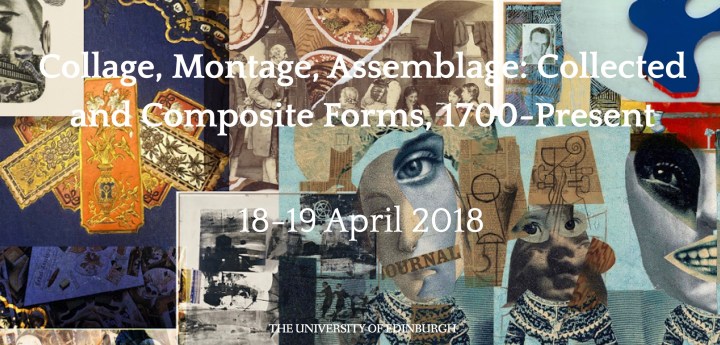
Collage, Montage, Assemblage: Collected and Composite Forms, 1700–Present
University of Edinburgh, 17–19 April 2018
Organized by Cole Collins and Freya Gowrley
T U E S D A Y , 1 7 A P R I L 2 0 1 8
14.00 Registration and Coffee
14.15 Exhibiting Collage
In Conversation: FREYA GOWRLEY and PATRICK ELLIOT
15.00 Collage in the Museum and Archive
ALLAN MADDEN (The University of Edinburgh), Piecing Together the Narrative: Une semaine de bonté in the library, the archive and the gallery
BRIDGET MOYNIHAN (The University of Edinburgh), Scrappy Contexts: Archival and Digital Interventions on the Edwin Morgan Scrapbooks
15.45 Collage and Subjecthood
TOM DAY (The University of Edinburgh), Jeff Keen, Pop Film Collagist
COLE COLLINS (The University of Edinburgh), Collage as Feminist Strategy and Methodology
17.00 Wine Reception
W E D N E S D A Y , 1 8 A P R I L 2 0 1 8
9.00 Registration and Coffee
9.35 Keynote
LUCY PELTZ (National Portrait Gallery, London), Facing the Text: An Introduction to Extra- Illustration in Britain from the Eighteenth to the Twentieth Century
10.40 Panel 1 | Publications
KAREN DI FRANCO (University of Reading and Tate Britain), The alchemical, the instruction, and the cut up: The performance of collage in the writing of Ithell Colquhoun, Carolee Scheemann, and Kathy Acker
HANNAH VINTER (Kings College London), Historical engagement as textual collage in Ursula Krechel’s Landgericht
ALISON HORGAN (University of Sheffield), ‘Gaudy colours’ and ‘disfigur’d shapes’: The patchwork and Thomas Percy’s Reliques of Ancient English Poetry (1765)
TOBIAS VOGT (Freie Universität, Berlin), Collage avant la lettre: Printed materials in drawings before 1900
10.40 Panel 2 | Bodies
LISA LEE (Emory University), Primal Gestures: Thomas Hirschhorn’s Ur-Collages
GRÁINNE RICE (The University of Edinburgh), ‘I can’t see the joins’: Collage and cut-up bodies in the work of Steven Campbell (1953–2007)
KATHERINE ISELIN (University of Missouri- Columbia), Erotic Aesthetics in Collage Inspired by Giulio Romano’s I Modi
KATIE ANANIA (Harvard University and Hunter College New York), Wheat Paste and Poor Taste: Carolee Schneemann’s Paper Performances, 1966–68
12.25 Lunch
13.25 Panel 3 | Materialities
CATRIONA MACLEOD (University of Pennsylvania), Writing with Scissors: Romantic Collage Poetics
LUCIE WHITMORE (University of Glasgow), Chic rag-and-tatter modes’: Remnant Fashions 1914–18
STEPHANIE KOSCAK (Wake Forest University), A Royal Tête-a-Tête: Decorating (and Decorating with) Engraved Pictures of Kings and Queens in Eighteenth-Century England
EKATERINA KOCHETKOVA (Lomonosov Moscow State University), Assemblage as Method of Garden-Making: The Case of Ian Hamilton Finlay
13.25 Panel 4 | Intimacies, Collaborations, and Emotions
BETHAN BIDE (Middlesex University), Stitching yourself back together: Finding memory, emotion, and creativity in the composite garments made under the ‘Make Do and Mend’ scheme in WW2 Britain
ROGER ROTHMAN (Bucknell University), Topographie Anecdotée du Hasard: A Multi-Authored Literary Collage
MAYA WASSELL SMITH (Cardiff University and National Maritime Museum), Cigarette Cards and the Sentimental: Sailor Collage in the Long Nineteenth Century
MADELEINE PELLING (University of York), ‘Your Affectionate Queen’: Queen Charlotte, Mary Delany, and the Art of Friendship
15.05 Coffee
15.35 Panel 5 | Legacies and Influences
FREYA GOWRLEY (Institute of Advanced Studies, Edinburgh), Reflective and Reflexive Forms: Intimacy and Medium Specificity in British and American Sentimental Albums, 1780–1850
IRENA KOSSOWSKA (Copernicus University in Torun and Polish Academy of Sciences in Warsaw), Modernist Synethesia and a Dialog with the Old Masters: Polish Photo-Collage and Photomontage of the 1930s
TALIA KWARTLER (The Museum of Modern Art, New York), Suzanne Duchamp’s Dada Collages, 1916–21
REBECA ACOSTA (Humboldt Universität, Berlin), ‘Composite Johnson’: Renderings of Samuel Johnson by John Hawkins and Vladimir Nabokov
15.35 Panel 6 | Technologies and Digitality
LUCY WHITEHEAD (Cardiff University), ‘Inlaid’ and ‘Intercalated’: Victorian Biography as Collage Form
BROOKE LEETON (University of Georgia), Meaning and/in Digital Collage
CRAIG BUCKLEY (Yale University), An Architecture of Clippings: Reyner Banham and the Redefinition of Collage
CAITLIN WOOLSEY (Yale University), Imaging Orality in the Sound and Visual Collages of Henri Chopin
17.30 Performance
FLORIAN KAPLICK, Kurt / ANNA \ Paul
A recital collage using texts from Kurt Schwitters and Paul Auster
18.30 Wine Reception
T H U R S D A Y , 1 9 A P R I L 2 0 1 8
9.00 Registration and Coffee
9.15 Panel 7 | Identities
RACHEL MIDDLEMAN (California State University, Chico), Collage as a Feminist Strategy in the Work of Anita Steckel
SUSAN LAXTON (University of California, Riverside), Psicofotógrafa: Grete Stern and the Administration of the Unconscious
KATE SCHNEIDER (University of Cambridge), A Short History of Postwar Reconstruction via Humphrey Jennings’s Swiss Roll Collages
BEATRIZ MANTEIGAS (University of Lisbon), Collage on the Life and Work of R.B. Kitaj
9.15 Panel 8 | Intermedialities
PATRICIA ZAKRESKI (University of Exeter), A Patchwork Novel: Tessellation and Women’s Writing in the 1870s
FLORIAN KAPLICK (Musician and Speech Performance Artist), Composing collages with texts and collaging compositions with music
CHRISTINA MICHELON (University of Minnesota, Twin Cities), Printcraft: Reclaiming and Renaming Early Collage Practices
DAVID NELSON (University of Pennsylvania), City of Paper: The Materiality of Montage in Alfred Döblin’s Berlin Alexanderplatz
10.55 Coffee
11.25 Panel 9 | Ethnographies and Geographies
ORLA FITZPATRICK (National Museum of Ireland), From the medieval to the modern: Decoration, collage, and photography in the album work of Lady Louisa Tenison (1819–1882)
MOLLY DUGGINS (National Art School, Sydney), Crafting the Colonial Environment through Album Assemblage
JOANNA PAWLIK (University of Sussex), Collaging Surrealism in Ted Joans’ The Hipsters (1961)
DEBRA HANSON (Virginia Commonwealth University in Qatar), Interventions: Collage, Black Bodies, and a New History of Modernism
13.10 Lunch
14.15 Panel 10 | Display and Dissemination
COLE COLLINS (The University of Edinburgh), Loss of Texture: Displaying the Collages of Kurt Schwitters
ROCÍO ROBLES TARDÍO (Universidad Complutense de Madrid), Mies van der Rohe: Working with Collage, Thinking about Replicas, 1939–43
KAYLEE ALEXANDER (Duke University), Cut, Copy, Paste: A Truthful Picture of the Paris Catacombs
14.15 Panel 11 | Historiographies
JESSICA BARNESS and STEVEN MCCARTHY (Kent State University and University of Minnesota, Twin Cities), Coding and Decoding: Collage as Communication Design Scholarship
ZOE KINSLEY (Liverpool Hope University), Coherence and Customisation in the Scrapbooks of Dorothy Richardson (1748–1819)
MATTHEW BOWMAN (University of Suffolk), Collage as Model
SAMUEL BIBBY (Art History), ‘How to present your ideas effectively and make them stick’: Historiography as Collage
16.00 Keynote
ADRIAN SUDHALTER (Art Historian and Curator, New York), The Museum of Modern Art’s 1948 Collage Exhibition
17.00 Closing Remarks
Reading and Conference | Walpole’s ‘The Mysterious Mother’
Presented by the Lewis Walpole Library and the YCBA:
Horace Walpole’s The Mysterious Mother: A Staged Reading
Yale Center for British Art, New Haven, 2 May 2018
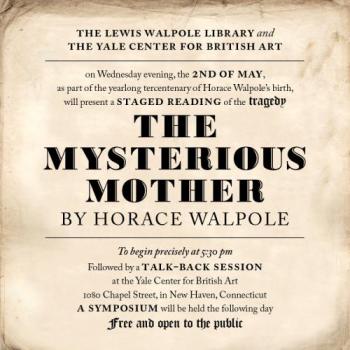 As part of the year-long celebrations of the tercentenary of Horace Walpole’s birth, the Lewis Walpole Library and the Yale Center for British Art are collaborating to present a staged reading of The Mysterious Mother—abridged by David Worrall (Emeritus Professor of English at Nottingham Trent University) and directed by Misty G. Anderson (ReLindsay Young Professor of English, University of Tennessee). Completed just a few years after Walpole’s celebrated gothic novel The Castle of Otranto (1764), this under-appreciated tale of incest and intrigue was initially circulated only among the author’s friends. Walpole never permitted it to be performed during his lifetime except as a private theatrical. Following the reading there will be a talk-back session moderated by Catherine Sheehy (Professor of the Practice of Dramaturgy and Dramatic Criticism, Yale University). This event is free and open to the public. Wednesday, 2 May 2018, 5:30pm, Yale Center for British Art.
◊ ◊ ◊ ◊ ◊
Horace Walpole’s The Mysterious Mother: A Mini-Conference
Yale Center for British Art, New Haven, 3 May 2018
Organized by Jill Campbell and Cynthia Roman

Diana Beauclerk (1724–1808), The Mysterious Mother, Act 3d, Scene 3, 1776 (The Lewis Walpole Library, Yale University).
10:00 Reading The Mysterious Mother
Chair: Jill Campbell, Professor of English, Yale University
• Nicole Garret, Lecturer, Department of English, SUNY Stony Brook
• Cheryl Nixon, Associate Provost, Associate Professor, Department of English, University of Massachusetts, Boston
•Matthew Reeve, Associate Professor Art History, Queen’s University
• Dale Townshend, Professor of Gothic Literature, Manchester Metropolitan University
• Nicole Wright, Assistant Professor, University of Colorado, Boulder
12:00 Lunch
1:15 Breakout session with Cynthia Roman, Curator of Prints, Drawings, and Paintings, The Lewis Walpole Library, to view Diana Beauclerk’s drawings of The Mysterious Mother. Attendance is limited, and advance registration is required.
2:00 Staging The Mysterious Mother
Chair: Misty Anderson, Lindsay Young Professor of English, University of Tennessee
• Al Coppola, Associate Professor of English, John Jay College, CUNY
• Marcie Frank, Professor of English, Concordia University
• Judith Hawley, Professor of English, Royal Holloway, University of London
• Jean Marsden, Professor of English, University of Connecticut
• David Worrall, Professor Emeritus, Nottingham Trent University
Journée d’études | Représenter le conflit et le désordre au XVIIIe siècle

Jan van Huchtenburg, La Bataille de Ramilies entre Français et Anglais le 23 mai 1706, 1706–33, 116 × 153 cm
(Amsterdam, Rijksmuseum)
◊ ◊ ◊ ◊ ◊
As noted at Groupe de Recherche en Histoire de l’Art Moderne (GRHAM). . .
Représenter le conflit et le désordre au XVIIIe siècle (1715–1799)
Institut national d’histoire de l’art (INHA), Paris, 13 April 2018
Cette journée d’étude est consacrée au thème du conflit au XVIIIe siècle, et plus particulièrement sur ses représentations, ses significations et les manières de le mettre en scène. La borne chronologique choisie inclut tous les supports visuels (gravure, peinture, sculpture, architecture) afin de voir comment, mises en synergie, les différentes formes d’art expriment, de façon plus ou moins évidente, la notion de conflit, de trouble et de désordre.
Comment figure-t-on le conflit ou l’idée de conflit au XVIIIe siècle ? Quelles sont les ruptures visuelles éventuelles avec le XVIIe siècle ? La Révolution française semble résumer le XVIIIe siècle or, pendant toute la première partie du règne, il existe des conflits religieux, militaires ainsi que des troubles liés à la politique intérieure. C’est aussi l’époque où l’aspect scientifique et les sciences naturelles font l’objet de nombreuses représentations. Ainsi, on s’aperçoit que la nature et ce qui l’environne, peut faire écho à l’idée de désordre (peinture de paysage, grandes fêtes révolutionnaires…). Il serait donc intéressant de mettre en valeur l’aspect technique : existe-t-il une technique propre à la représentation du conflit ? Quels liens entre technique et expression picturale pouvons-nous établir dans ces représentations de conflits ? Enfin, au-delà d’un désordre dans l’espace public, il serait également intéressant de traiter l’aspect conflictuel au sein de l’espace privé, dont l’intimité des familles entre en résonance avec l’essor de la bourgeoisie au XVIIIe siècle.
Comité organisateur: Lucille Calderini (Paris 1/INHA), Bastien Coulon (Paris 1) et Charlot te Rousset (Lille 3).
P R O G R A M M E
9.45 Accueil des participants
10.00 Introduction, Etienne Jollet et Lucille Calderini
10.30 Conflit et Animalité
• Loreline Pelletier (Doctorante, Université Lille 3), Comme chien et chat: Représenter le conflit animal dans la peinture du XVIIIe siècle
• Lydia Vazquez (Professeure, Université du Pays Basque, UPV/EHU) et Juan Manuel Ibeas Altamira (Professeur Adjoint, Université du Pays Basque, UPV/EHU), Le monde à l’envers chez Goya: Pouvoir féminin, puissance animale
• Chloé Perrot (Doctorante, Université Paris 1 Panthéon-Sorbonne), Fouler le joug rompu, représenter des actes d’insurrection dans l’Iconologie par figures (v. 1795)
12.15 Discussion et déjeuner
14.30 Conflit et Royauté
• Clara Auger (Doctorante, Université Rennes 2), Portraits et représentations allégoriques de Philippe V d’Espagne: Une interprétation française du triomphe royal ?
• Charlotte Rousset (Doctorante, Université Lille 3), Les victoires militaires de Louis XV dans ses médailles: Justifier la guerre au nom de la paix
15.30 Pause
15.45 Conflit et Politique
• Camilla Murgia (Professeure, EPSU et Université de Genève), Représenter la guerre, fabriquer la paix: Les éventails de la période révolutionnaire et du Directoire
• Bastien Coulon (Doctorant, Université Paris 1 Panthéon-Sorbonne), Le désordre et la paix: La peinture d’histoire en France à l’épreuve du Traité de Paris (1763)
16.45 Discussions et conclusion de la journée
Conference | Fashioning the Early Modern Courtier, 1550–1750

From the conference website:
Fashioning the Early Modern Courtier, 1550–1750
St John’s College Cambridge, 16 May 2018
This one-day conference will explore the ways in which clothing contributed to the gendered (self)fashioning of the courtier in early modern Europe (ca. 1550–1750), examining both its symbolic significance and its action on and interaction with the body.
Recent historical research has emphasised how early modern courts were crucial sites for the elaboration and diffusion of specific corporeal models aspiring to shape the ideal man and woman. Fashion, then as now, provides a very material setting that has the power to promote specific patterns of thought and action.
Our speakers will explore how male and female courtiers skilfully constructed their identity and negotiated their social status through sartorial trends and beautification techniques. Rooted within a broader culture of corporeal interpretation, fashion represented an effective way of asserting political allegiance and even expressing criticism ad hominem. Sovereigns could assert their power by clothing the royal entourage and enforcing vestiary policies. Courtiers in turn could play a role in shaping the image and body of the monarch through gift-giving.
Embracing a corporealist perspective, we endeavour to integrate a semiotic reading of dress with accounts of its fundamentally embodied nature, both in its creation and in its wearing. Symbolic sartorial practices engaged directly with the material body, re-shaping and de-forming the silhouette. Clothes and accessories could provide support and protection, whilst sometimes constituting a hindrance to even the simplest of movements.
We will also investigate the diffusion of new fashions, materials, and techniques. Circulation patterns within the court will be analysed alongside interactions with the city and mutual influences between international centres of power. We will reconstruct the complex network of tailors, craftsmen and merchants which orbited around the court, moving across all social classes and providing a key point of connection between aristocratic courtiers and urban bourgeoisie. We will also consider alternative dissemination mediums such as portraits, early examples of single-leaf broadsheets and bound books displaying fashion plates.
Gathering an international group of speakers including fashion curators, makers, and academics from a variety of fields, the aim of our conference is to challenge traditional top-down models of fashion circulation as well as provide a more nuanced and complete narrative bringing into play all the different actors involved. We also seek to demonstrate how a study of the clothed body provides a privileged gateway into the world of court politics and a unique opportunity to access the courtiers’ embodied experiences.
Registration details are available here»
P R O G R A M M E
9:15 Registration
9:45 Welcome Address
10:00 Panel 1
• Mark De Vitis (University of Sydney), The Fashioned Body as Materialised Critique at the Court of Louis XIV
• Jemma Field (Brunel University London), Between Scotland and England: The Journey of Elite Female Fashion in 1603
• Catherine Stearn (Eastern Kentucky University), She-Wolves in Queen’s Clothing: Exploring the Relationship between Dress, Female Courtiers and Monarchical Authority at the Court of Elizabeth I
11:15 Coffee and tea
11:30 Panel 2A
• Natasha Awais-Dean (King’s College London), Three Houres a Buttoning: Embellishing Male Dress in Early Modern England
• Sarah Crowe (Goethe University & Staedel School, Frankfurt), The Semiology of the Ruff in the Early Dutch Golden Age to 1648
• Jane Partner (University of Cambridge), Reading the Early Modern Body: The Case Study of Textual Jewellery
11:30 Panel 2B
• Lacy Gillette (Florida State University), Cataloguing the Character of Couture: An Examination of Jost Amman’s Sixteenth-Century Printed Costumes
• Abigail Gomulkiewicz (University of Cambridge), From Subject to Monarch: Male Gift-Giving at the Court of Elizabeth I
• Juliet Claxton (King’s College London), ‘His Wife Was the Rich China-Woman That the Courtiers Visited So Often’: The Role of the Merchant at the Stuart Court
12:45 Lunch
13:30 Keynote Address
• Evelyn Welch (King’s College London)
14:45 Panel 3A
• Rebecca Morrison (QMUL and the V&A), The Diplomacy of the Dress Fitting: Exploring Relationships between the Mantua-Maker and Client in the Construction of Eighteenth-Century Court Dress
• Astrid Castres (École nationale des chartes, Paris), Producing Garments for the Court: Innovations and Technical Transfers in Parisian Fashion Workshops during the Sixteenth Century
• Moïra Dato (European University Institute, Florence), The Lyonnais Silks as Objects of Conspicuous Consumption in Eighteenth-Century French Court
14:45 Panel 3B
• Beth Walsh (University of East Anglia), The Late Stuarts and Their Political Cravats
• Isabella Rosner (University of Cambridge), ‘Grave Hogen Mogen, High and Mighty Frogs!’: The Mysteries of Seventeenth-Century Frog Pouch Fashion
• Kimberley Foy (Durham University), Points of Connection: Lace, Internationalism, and Political Authority in England, 1565–1625
16:00 Coffee and tea
16:15 Panel 4
• Marc W. S. Jaffré (University of St Andrews), Adorned with Stones of Inestimable Size and Value’: Tailors, Taste and Fashion at the Court of Louis XIII, 1610–1643
• Lindsay Dupertuis (University of Maryland), Dressed for Battle: Military Costume and Aristocratic Fashion in Sixteenth-Century Italy
17:15 Keynote Address
• Maria Hayward (University of Southampton)
18:00 Closing Remarks
18:15 Wine Reception
Conference | Artistic Trade between Spain and Its Viceroyalties

Plaza Mayor in Lima, 1680, oil on canvas
(Madrid: Museo de América)
◊ ◊ ◊ ◊ ◊
From the conference flyer:
Artistic Trade between Spain and Its Viceroyalties, 1500–1800
Keynes Hall, King’s College, University of Cambridge, 22 June 2018
This is the first conference in the United Kingdom devoted to artistic trade between Spain and its viceroyalties. Referring to Cambridge’s Spanish and colonial art collections and with the indispensable support of the King’s College Nigel Glendinning studentship, this conference brings together scholars specialized in the art from the Spanish Viceroyalties. The speakers will trace the artworks from their production, their movement with the help of agents and their collection and display at their destination. For further information, please contact Akemi Herráez Vossbrink at alh64@cam.ac.uk, and register for free at Eventbrite.
P R O G R A M M E
9:15 Akemi Herráez Vossbrink (University of Cambridge), Introductory Remarks
9:30 Keynote Speaker | Luisa Elena Alcalá (Universidad Autónoma de Madrid), Passageways of Art in the Atlantic World: Artists, Patrons, and Agents
10:00–11:30 | Workshops and Artists Producing Art for the Spanish Viceroyalties and Transitory Spaces
Chaired by Akemi Herráez Vossbrink (University of Cambridge)
• Holly Trusted (Victoria and Albert Museum), Shipwrecked Ivories: The Confluence of East and West
• Piers Baker Bates (The Open University), Traveling between the Viceroyalties: Artistic Translation in the Sixteenth-Century Hispanic World
• Escardiel González Estevez (Universidad de Sevilla), Alonso Vázquez between Seville, Mexico, and Manila, 1603–1608: The Paradigm of a ‘Global Artist’
13:30-15:00 | The Role of Agents Commercializing Artworks between Spain and Its Viceroyalties
Chaired by José Ramón Marcaida López (University of Saint Andrews)
• Sandra Van Ginhoven (Getty Research Institute, Research Associate), Spanish Transatlantic Agents and the Flemish Guilliam Forchondt in the Overseas Paintings Trade
• Corinna Gramatke (Technical University of Munich Chair of Conservation-Restoration), ‘The Portable Europe’: European Artworks for the Jesuit Province of Paraguay, 1608–1767
• Eduardo Lamas Delgado (Royal Institute for Cultural Heritage, Brussels), Madrilenian Painters and America: Artistic Production for Overseas Trade Networks and Their Possible Agents
16:00–17:30 | Collecting and Display in Private, Civil, and Religious Spaces in the Spanish Viceroyalties
Chaired by Jean Michel Massing (University of Cambridge)
• Kathryn Santner (Leverhulme Trust Fellow, ILAS, London), Conventual Art Collections and Artistic Exchange in the Colonial Viceroyalties
• Isabel Oleas Mogollón (University of Delaware), The Divine and the Self: Uses and Meanings of Mirrors in Quito’s Jesuit Church
• Veronika Winkler (Ludwig-Maximilians-Universität, München), Witnessing the Saint’s Life: Patrons and Hagiographical Painting Cycles of Viceregal Peru
ASECS 2018, Orlando

2018 American Society for Eighteenth-Century Studies Conference
Hilton Orlando Buena Vista Palace, 22–24 March 2018
The 49th annual meeting of the American Society for Eighteenth-Century Studies takes place at the Hilton Orlando Buena Vista Palace. HECAA will be represented by the Anne Schroder New Scholars’ Session, chaired by David Pullins and scheduled for Friday morning. Our annual luncheon and business meeting follows immediately after that panel. A selection of 26 additional panels is included below (of the 211 sessions scheduled, many others will, of course, interest HECAA members, including the return of the Women’s Caucus Masquerade Ball). For the full slate of offerings, see the program.
H E C A A E V E N T S
Anne Schroder New Scholars Session (HECAA)
Friday, 23 March, 11:30–1:00, Palm I
Chair: David PULLINS, The Frick Collection
1. Margot BERNSTEIN, Columbia University, “Playing Footsie with Carmontelle: Misbehavior and Missteps in a Selection of Eighteenth-Century Profile Pictures”
2. Lauren WALTER, University of Florida, “Doctor, I think they have a case of Anglomanie: Marie Antoinette and the Princesse de Lamballe”
3. Maura GLEESON, University of Florida, “Imag[in]ing the Queen as Muse: A Closer Look at Fleury François Richard’s Portrait of la Reine Hortense”
◊ ◊ ◊ ◊ ◊
Historians of Eighteenth-Century Art and Architecture Luncheon
Friday, 23 March, 1:00–2:30, Tangerine 4
◊ ◊ ◊ ◊ ◊
O T H E R S E S S I O N S R E L A T E D T O T H E V I S U A L A R T S
T H U R S D A Y , 2 2 M A R C H 2 0 1 8
Women, Portraiture, and Place
Thursday, 22 March, 8:00–9:30, Palm D
Chairs: Heidi A. STROBEL, University of Evansville, and Christina LINDEMAN, University of South Alabama
1. Laura ENGEL, Duquesne University, “Women in White: The Countess of Blessington, Elizabeth Inchbald, and Embodied Memory”
2. Kaitlin GRIMES, University of Missouri-Columbia, “The Materiality of Textiles and the Feminization of ‘Things’ in the Gendered Spaces of Rosalba Carriera’s Pastel Portraits”
3. Catherine M. JAFFE, Texas State University, “Women, Fashion, and Self-Fashioning: Two Portraits of María Lorenza de los Ríos, Marquesa de Fuerte-Híjar”
4. Sandra Gómez TODÓ, University of Iowa, “Portraying the Female Masquerader: Fashionability, Public Legitimacy, and the Moralities of the Mask in Georgian Masquerade Portraits”
◊ ◊ ◊ ◊ ◊
Biblical Painting in Eighteenth-Century Britain
Thursday, 22 March, 8:00–9:30, Palm F
Chair: Naomi BILLINGSLEY, University of Manchester
1. Mary PEACE, Sheffield Hallam University, “Reversing the Harlot’s Progress? The Figuring and Refiguring of Magdalens at the London Magdalen Hospital in the Eighteenth Century”
2. Bénédicte MIYAMOTO, Université Sorbonne Nouvelle – Paris 3, “1768–1805 – Hanging Biblical Paintings at the Royal Academy”
3. William LEVINE, Middle Tennessee State University, “Retaining the Visual Aura of Biblical Violence in a Commercial Culture in Some Illustrations to Macklin’s English Bible”
◊ ◊ ◊ ◊ ◊
New Scholarship in Art History (SEASECS)
Thursday, 22 March, 8:00–9:30, Sago 1
Chair: Melissa HYDE, University of Florida
1. Jessica FRIPP, Texas Christian University, “From Salon to Salon: Cochin’s and La Tour’s Portraits at the Salon of 1753”
2. Susanna CAVIGLIA, Duke University, “The Aesthetics of Walking in Rome”
3. Franny BROCK, University of North Carolina at Chapel Hill, “Madame de Genlis’ New Method and Women Drawing Teachers in Eighteenth-Century France”
4. Hyejin LEE, University of North Carolina at Chapel Hill, “Ballooning Memorabilia and the Politics of Remembering Aerial Voyages at the End of the Ancien Régime”
◊ ◊ ◊ ◊ ◊
Currents of Empire: Toward a Global Material Culture
Thursday, 22 March, 9:45–11:15, Palm H
Chairs: Douglas FORDHAM, University of Virginia, and Emily CASEY, St. Mary’s College of Maryland
1. Romita RAY, Syracuse University, “Made in China? Tea in Colonial Calcutta”
2. Susan J. RAWLES, Virginia Museum of Fine Arts, “Academic Strategies and the Semiotics of Style: The Matter of Identity in British-Atlantic Portraiture”
3. Rachel ZIMMERMAN, Independent Scholar, “Banyans in Brazil: Elite Dress and Narratives of Interimperial Exchange”
4. Monica Anke HAHN, Temple University, “‘Harlequin Nabob’: Tilly Kettle in India”
◊ ◊ ◊ ◊ ◊
Inventing the Modern Stage in Eighteenth-Century France
Thursday, 22 March, 9:45–11:15, Palm K
Chair: Laurence MARIE, Columbia University
1. Aaron WILE, USC, “Coypel’s Theatricality: The Politics of Affect in the Regency”
2. Alexandra SCHAMEL, University of Munich, “Comedic Style and Anti-illusionism in Marivaux’s Arlequin poli par l’amour”
3. Maria G. TRAUB, Neumann University, “The Woman Who Changed French Theater”
4. Kalin SMITH, McMaster University, “Backstage with the Whigs”
◊ ◊ ◊ ◊ ◊
Letting the Cat out of the Bag: The Cultural Work of Eighteenth-Century Pets
Thursday, 22 March, 9:45–11:15, Palm I
Chairs: Joanna M. GOHMANN, The Walters Art Museum, and Karissa E. BUSHMAN, University of Alabama in Huntsville
1. Bryan ALKEMEYER, The College of Wooster, “Drowned Cats in Eighteenth-Century English Literature”
2. Amanda STRASIK, Eastern Kentucky University, “Reconsidering Girls and Pets in Eighteenth-Century French Art”
3. Tara ZANARDI, Hunter College, CUNY, “Hounds at the Hunt: Charles III, Bourbon Legitimacy, and Empire”
4. Stephanie Alice HOWARD-SMITH, Queen Mary University of London, “Horace Walpole’s ‘Dogmanity’: Lapdogs and Male Sociability, 1738–1789”
◊ ◊ ◊ ◊ ◊
Mesmer Now
Thursday, 22 March, 11:30–1:00, Palm A
Chair: Michael YONAN, University of Missouri
1. Sara LULY, Kansas State University, “That Healing Feeling: Mesmerism and Materiality in Alissa Walser’s Am Anfang war die Nacht Musik (2011)”
2. Bruno BELHOSTE, Université de Paris, Sorbonne, “Mesmer’s Theory of Instinct and the Invention of Magnetic Somnambulism”
3. Oksana RYMARENKO, Russian State University for the Humanities, “The Long History of Mesmerism in Russia”
◊ ◊ ◊ ◊ ◊
Roundtable: How to Publish in an Eighteenth-Century Studies Journal
Thursday, 22 March, 4:15–5:45, Palm A
Chair: Matthew WYMAN-MCCARTHY, Eighteenth-Century Studies
1. Eve Trevor BANNET, Studies in Eighteenth-Century Culture
2. Tita CHICO, The Eighteenth Century: Theory and Interpretation
3. Robert MARKLEY, The Eighteenth Century: Theory and Interpretation
4. Sean MOORE, Eighteenth-Century Studies
5. Cedric D. REVERAND II, Eighteenth-Century Life
◊ ◊ ◊ ◊ ◊
Men of Parts and Parts of Men: Rethinking Eighteenth-Century Masculinity
Thursday, 22 March, 4:15–5:45, Palm K
Chair: Mary Beth HARRIS, Purdue University
1. Jeremy CHOW, University of California, Santa Barbara, “Part (of) Man?: The Exceptional Eunuch”
2. Sarah E. BERKOWITZ, University of Virginia, “Below Stares: Servants and the Anxiety of Domestic Masculinity”
3. Kelsey BROSNAN, Rutgers University, “Les Académiciennes and the Fragmented Male Nude”
4. Karen J. MANNA, University of Central Oklahoma, “Masculinity in Revolution: Comedy and Satire on the Late Eighteenth-Century Stage”
◊ ◊ ◊ ◊ ◊
The Eighteenth Century on Film (NEASECS)
Thursday, 22 March, 4:15–5:45, Sago 3
Chair: John H. O’NEILL, Hamilton College
1. Christopher C. NAGLE, Western Michigan University, “Austen’s Audio-Vision”
2. Kristin O’ROURKE, Dartmouth College, “Dressing and Undressing in the Rococo: Fantasies and Meanings of the Toilette on Screen”
3. Florian VAULEON, Purdue University, “The Eighteenth Century as Entertainment: The Changing Cinematic Representation of the French Revolution”
4. Nicole GARRET, Stony Brook University, “Where are the Jacobite Women in Outlander?”
◊ ◊ ◊ ◊ ◊
Street Scenes
Thursday, 22 March, 4:15–5:45, Sago 1
Chair: James WATT, University of York
1. Meredith GAMER, Columbia University, “Street Theater: ‘Vulgar’ Visualities from Tyburn Tree to the Newgate Drop”
2. Emily THAMES, Florida State University, “Views of Eighteenth-Century San Juan, Puerto Rico, in the Work of José Campeche (1751–1809)”
3. Alison O’BYRNE, University of York, “Picturing the Streets in Thomas Malton’s Picturesque Tour (1792)”
4. Ian NEWMAN, University of Notre Dame, “Porous Buildings”
◊ ◊ ◊ ◊ ◊
Members Reception
Thursday, 22 March, 6:00–7:30
◊ ◊ ◊ ◊ ◊
F R I D A Y , 2 3 M A R C H 2 0 1 8
Roundtable: Engaging with the Scholarship of Mary Sheriff (SEASECS)
Friday, 23 March, 8:00–9:30, Sago 4
Chair: Michael YONAN, University of Missouri
1. Katherine ARPEN, Auburn University
2. Meredith GAMER, Columbia University
3. Elizabeth C. MANSFIELD, Getty Foundation
4. Paula Rea RADISICH, Whittier College
5. Heidi A. STROBEL, University of Evansville
◊ ◊ ◊ ◊ ◊
The Imprint of Women: Printmakers, Printsellers, and Print Publishers
Friday, 23 March, 9:45–11:15, Palm L
Chairs: Cynthia ROMAN, The Lewis Walpole Library, Yale University, and Cristina S. MARTINEZ, University of Ottawa
1. Paris Amanda SPIES-GANS, Princeton University, “Maria Cosway’s ‘Genius’ for Print”
2. Heather MCPHERSON, University of Alabama at Birmingham, “Caroline Watson and the Theatre of Printmaking”
3. Kelsey D. MARTIN, University of North Carolina at Chapel Hill, “Divine Secrets of a Printmaking Sisterhood: The Professional and Familial Networks of the Hortemels and Hémery Sisters”
4. Amy TORBERT, Harvard Art Museums, “‘Hannah Humphrey, Widow Print Seller’: Women Publishing and Selling Prints in London, 1740–1800”
◊ ◊ ◊ ◊ ◊
Back to Black: Goya and Color (Ibero-American SECS)
Friday, 23 March, 9:45–11:15, Palm J
Chair: Frieda KOENINGER, Sam Houston State University
1. Eva SEBBAGH, Université Paris-Sorbonne (Paris-IV), “When Color Turns Into Setting: Ways and Means of the Use of Solid Colors in Goya’s Painting”
2. Elena DEANDA, Washington College, “Singing the Blues and Muddying the Waters: Goya, Cadalso, and the Color of Desire”
3. Guy TAL, Shenkar College of Engineering, Design, and Art, “The Pastel Colors of Goya’s Witches’ Sabbath”
◊ ◊ ◊ ◊ ◊
Eighteenth-Century Sauce-Boxes
Friday, 23 March, 9:45–11:15, Palm F
Chair: Jade HIGA, University of Hawaii
1. Beth CSOMAY, Duquesne University, “Enchanting Elvira: Mary Robinson’s Radical in Vancenza: Or The Dangers of Credulity”
2. Paula Rea RADISICH, Whittier College, “Saucy Face: Quentin de la Tour’s L’Auteur qui rit (The Artist Laughing) (1737)”
3. Sara TAVELA, Misericordia University, “Getting Saucy in Centlivre”
◊ ◊ ◊ ◊ ◊
Roundtable: Soft Materials, I
Friday, 23 March, 11:30–1:00, Palm J
Chair: Timothy CAMPBELL, University of Chicago
1. Daniel O’QUINN, University of Guelph, “Damask between Skin and Paper: The Soft Materials of Intimate Transculturation”
2. Douglas FORDHAM, University of Virginia, “Aquatint and ‘Soft’ Imperial Power”
3. Sarah T. WESTON, Yale University, “Transparent, Reflective, and Opaque Surfaces in Bernardin de Saint-Pierre’s Paul et Virginie”
4. Annika MANN, Arizona State University, “The Fomite”
5. Alicia L. KERFOOT, SUNY College at Brockport, “Frances Burney’s Embroidered Mourning Piece: The Wanderer and the Materiality of Grief”
◊ ◊ ◊ ◊ ◊
Roundtable: Soft Materials, II
Friday, 23 March, 4:30–6:00, Palm J
Chair: Timothy CAMPBELL, University of Chicago
1. Sean SILVER, University of Michigan, “How Soft are Networks?”
2. Amelia RAUSER, Franklin and Marshall College, “Soft Neoclassicism: Looking Hard at Fashionable Dress”
3. Ashley HANNEBRINK, Harvard University, “Sculpting in Clay: The Softness of Neoclassical Terracotta Models”
4. Sara LANDRETH, University of Ottawa, “Cavendish’s 3D Printing: Soft Materials and Vanishing Figures”
5. David A. BREWER, The Ohio State University, “On Folding”
◊ ◊ ◊ ◊ ◊
Description d’une personne…ou de toutes sortes d’objets: Portraits in the Eighteenth Century (Society for Eighteenth-Century French Studies)
Friday, 23 March, 4:30–6:00, Palm F
Chair: Barbara ABRAMS, Suffolk University
1. Corinne STREICHER-ANGLADE, Université du Québec à Montréal, “Le Portrait (dé) voile” / “Portraiture (Un) Veiled”
2. Servanne WOODWARD, The University of Western Ontario, “Visagéités élusives” / “The Evasive Qualities of Facial Portraiture”
3. Mira MORGENSTERN, City College of New York, CUNY, “Seeing / through Portraits in La Nouvelle Héloise”
◊ ◊ ◊ ◊ ◊
S A T U R D A Y , 2 4 M A R C H 2 0 1 8
Material Culture in Eighteenth-Century Europe
Saturday, 24 March, 8:00–9:30, Palm K
Chair: Birgit TAUTZ, Bowdoin College
1. Monika NENON, University of Memphis, “Blue Hearts and Snuff Boxes: The Role of Objects in German Literary Circles of Sensibility”
2. Magelone BOLLEN, Independent Scholar, “Furnishing with Scissors: The Augsburger Klebealbum (ca. 1783)”
3. Lindsay DUNN, Texas Christian University, “Behind the Looking Glass: Marie-Louise, House of Habsburg-Lorraine, and Identity”
4. Sabine VOLK-BIRKE, Martin-Luther-University Halle-Wittenberg, “Sacred Pleasure / Idolatrous Vice: The Rosary”
◊ ◊ ◊ ◊ ◊
Goethe and the Visual Arts
Saturday, 24 March, 8:00–9:30, Palm F
Chair: Matt FEMINELLA, University of Alabama, Tuscaloosa
1. Andrea MEYERTHOLEN, University of Kansas, “Polarity, Empiricism, and Abstraction: Goethe and the Emergence of Abstract Art”
2. F. Corey ROBERTS, Calvin College, “From Aesthetic Experience to Artistic Inspiration: Visual Arts as the Impetus for Poetic Creation in Goethe’s Early Writings”
3. Peter ERICKSON, Colorado State University, “The ‘Primitive Hut’ in Eighteenth-Century Architecture Theory: Laugier, Goethe, Hegel”
◊ ◊ ◊ ◊ ◊
Non-Human Encounters
Saturday, 24 March, 8:00–9:30, Sunburst 2
Chair: Catherine CHIABAUT, Yale University
1. Nathan D. BROWN, Furman University, “Voltaire’s Lion: The Limits of Human(ism) in Voltaire’s Le Marseillais et le Lion”
2. Pichaya DAMRONGPIWAT, Cornell University, “Birth and the Posthuman: Cats, Rabbits, and Frankenstein’s Monster”
3. Philippe S. ROBICHAUD, Université du Québec à Trois- Rivière/Paris-Sorbonne, “Un bruit d’une espèce nouvelle: Vitalist Materialism and the Human Voice”
4. Alexander WRAGGE-MORLEY, University College London, “The Connoisseur as Centaur: Humans, Animals, and Aesthetic Experience, 1700–1750”
◊ ◊ ◊ ◊ ◊
Freakery: The Limits of the Body
Saturday, 24 March, 9:45–11:15, Palm H
Chair: Stan BOOTH, University of Winchester
1. Erika MANDARINO, Tulane University, “M. de Listonai’s Moon Men, or, The Sixth Sense of Selenopolis”
2. Chris MOUNSEY, University of Winchester, “Sea-Green Incorruptible: Benjamin Martin and Other Prosthetic Eyes”
3. Charlotte ROBINSON, University of Winchester, “The Animate Extension: Jane Barker and her Amanuensis”
4. Karissa E. BUSHMAN, University of Alabama in Huntsville, “Disability and Damaged Bodies in Goya’s Works”
◊ ◊ ◊ ◊ ◊
The Visual Text and the Textual Visual
Saturday, 24 March, 9:45–11:15, Palm L
Chair: Leah ORR, University of Louisiana, Lafayette
1. Tili Boon CUILLÉ, Washington University in St. Louis, “Illustration as Mediation in Duclos’ Acajou et Zirphile”
2. Elizabeth DEANS, George Washington University, “Dabbling in Design: Architectural Albums as Autodidactic Tools for Amateurs”
3. Teri DOERKSEN, Mansfield University, “Teasing the Text, or, Miss Tit-Ups Visits the Convent: Illustration Cards as Eighteenth-Century Fanfic”
4. Andreas MUELLER, University of Northern Colorado, “Visualizing Trauma and Transgenerational Memory in Defoe’s A Journal of the Plague Year”
◊ ◊ ◊ ◊ ◊
Maker’s Knowledge
Saturday, 24 March, 9:45–11:15, Palm K
Chairs: Ruth MACK, SUNY Buffalo, and Sean SILVER, University of Michigan, Ann Arbor
1. Lynn FESTA, Rutgers University, “Bricoleur Realism (or Maker’s Knowledge as Reality Effect)”
2. Crystal LAKE, Wright State University, “Making Fictions: Early Readers and Their Crafts”
3. Maggie MCGOWAN, Yale University, “Cultivating Skill in William Cowper’s The Task”
4. Chloe Wigston SMITH, University of York, “Craft and Chemistry in the School of Arts”
◊ ◊ ◊ ◊ ◊
Art, Alchemy, and Royal Rivalry: The Eighteenth-Century Manufactory
Saturday, 24 March, 9:45–11:15, Palm F
Chair: Tara ZANARDI, Hunter College, CUNY
1. Elizabeth LIEBMAN, Independent Scholar, “Recreating Adam: Artificial Stone in Eighteenth-Century Britain”
2. Sarah GRANDIN, Harvard University, “‘De la plus grande estendue’: Savonnerie Carpets and the Manufacture of Grandeur under Louis XIV”
3. Agnieszka Anna FICEK, The Graduate Center, CUNY, “Courtly Figures: Collecting Meissen and the Creation of National Identity in the Court of Augustus II and Beyond”
4. Matthew MARTIN, National Gallery of Victoria, Melbourne, “Porcelain and Royal Power—The Royal Sèvres Manufactory”
◊ ◊ ◊ ◊ ◊
Sharing the World through Travel Writing and Painting (SEASECS)
Saturday, 24 March, 2:00–3:30, Sunburst 1
Chair: Denis GRÉLÉ, University of Memphis
1. Charles A. GRAIR, Texas Tech University, “Georg Forster, Johann Goethe, and the Development of Modern Travel Narratives in Germany”
2. Lauren DISALVO, Dixie State University, “The ‘Flying Figures’ of Roman Wall Painting and the Female Portrait in the Long Eighteenth Century”
3. Mandy PAIGE-LOVINGOOD, University of North Carolina at Chapel Hill, “Agency in Absence: Contextualizing Jean-Baptiste Debret’s Slave Images in the Long Eighteenth Century”
◊ ◊ ◊ ◊ ◊
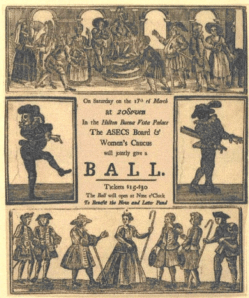 Masquerade Ball
Saturday, 24 March, 9:00pm
To Benefit the ‘Now and Later Non-Tenure Track Fund’
Sponsored by the ASECS Executive Board and the Women’s Caucus; tickets and masks available for purchase at the door (cash or check)
SAHGB Architectural History Workshop, 2018
The Society of Architectural Historians of Great Britain
Workshop for Doctoral Students and Early Career Scholars
The Gallery, London, 17 March 2018
The Society is pleased to announce the programme for this year’s Architectural History Workshop on Saturday 17 March 2018 at The Gallery, 70 Cowcross Street, London, EC1 6EL. This is our annual event for Postgraduate Students and Early Career Scholars, convened by the Society’s PhD Scholars, to share and develop their ideas through ‘lightning’ rounds, where contributors are invited to speak for ten minutes either as a short developed paper, discursive ramble, thematic exploration, or any format that explores and presents their PhD research.
The Workshop will also include a Careers in Architectural History Roundtable, featuring Ben Cowell, Director of the Historic Houses Association, and Neal Shasore, Leverhulme Early Career Fellow at Liverpool School of Architecture. The full programme and registration form can be found on our website. As places are limited, booking is essential. Register online until 10 March 2018.
Conference | The Properly Dressed Window
From Winterthur:
The Properly Dressed Window: Curtain Design Over Time
Winterthur, Wilmington, Delaware, 15–16 May 2018
Join Winterthur staff, visiting scholars, designers, and fellow ‘textilians’ for a two-day program of lectures and hands-on workshops. For information and registration, please call 800.448.3883. Registration opens on February 6, 2018. Read The Journal of Antiques and Collectibles article on curtains at Winterthur.
Sandy Brown, with an introduction by Linda Eaton and a foreword by Thomas Jayne, The Well-Dressed Window: Curtains at Winterthur (New York: The Monacelli Press, 2017), 208 pages, ISBN: 9781580934589, $50.
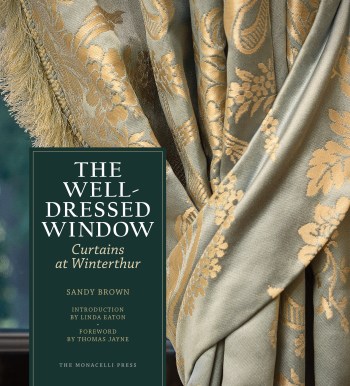 Today Henry Francis du Pont, the force behind the transformation of Winterthur from a family house to the premier museum of American decorative arts, is recognized, along with Henry Davis Sleeper and Elsie de Wolfe, as one of the early leaders of interior design in this country.
Working with architects, curators, and antiques dealers, du Pont created some 175 room settings within the house. He assembled his rooms using architectural elements from historic houses along the East Coast and filled them with an extraordinary collection of American furniture and decorative arts. Du Pont’s unique talent was his ability to arrange historically related objects in a beautiful way, in settings that enhanced their shape and form through the choice of color, textiles, and style.
Du Pont paid particular attention to the design of the curtains, and The Well-Dressed Window surveys his achievement, explaining how the fabrics were selected as well as their relationship to the architecture and other decorative elements in the rooms. Forty rooms are presented, each specially photographed to show the overall space in addition to details of fabric and trim. A series of stereoviews taken in the 1930s as well as other period photographs reveal the evolution of the window treatments and upholstery over nearly sixty years. Of particular interest is du Pont’s seasonal changing of the curtains, which were rotated throughout the year as the lighting and colors in the surrounding garden shifted.










leave a comment