Symposium | Ideals and Nations: Reception of Winckelmann’s Aesthetics
From Christ Church (with a PDF file of the program available here). . .
Ideals and Nations: New Perspectives on the European Reception of Winckelmann’s Aesthetics
Sir Michael Dummet Lecture Theatre, Christ Church College, University of Oxford, 29 June 2018
Organized by Fiona Gatty and Lucy Russell
To commemorate the Winckelmann anniversaries 2017/2018, Christ Church Library is preparing an exhibition and series of events in collaboration with the Faculty of Medieval and Modern Languages, University of Oxford and the Ure Museum of Greek Archaeology, University of Reading. Winckelmann and Curiosity in the 18th-Century Gentleman’s Library explores the scholar’s varied influence on the arts in Britain, through printed media, architecture, and decorative arts. The exhibition will be launched with a symposium on Ideals and Nations: New Perspectives on the European Reception of Winckelmann’s Aesthetics.
Registration information is available here»

Anton von Maron, Portrait of Johann Joachim Winckelmann, 1767, oil on canvas, 136 × 99 cm (Weimar: Stadtschloss).
P R O G R A M M E
9.30 Registration
10.15 Welcome from Martyn Percy (The Dean of Christ Church), Fiona Gatty (Oxford), and Lucy Russell (Oxford)
10.30 Session 1: Keynote Lecture
• Alex Potts (Michigan), Winckelmann: Historicity and Multiple Temporalities in the Art of Antiquity
11.15 Coffee and Biscuits
11.45 Session 2: France and Italy
• Fiona Gatty (Oxford), Clothing the Ideal: Winckelmann and the Costume Dictionaries of Late 18th-Century France
• Lucy Russell (Oxford), The Winckelmann Dilemma: Italy’s Nationalistic Response, 1755–1834
13.00 Lunch
14.30 Session 3: Germany and England
• TBC, From Winckelmania to the Wehrmacht: Receptions of Winckelmann in the German-Speaking World
• Helen Slaney (Roehampton), Winckelmann in English Travel Writing
15.45 Tea and Biscuits
16.15 Session 4: Keynote Lecture
• Elisabeth Décultot (Halle), History of Art and Ethnology: Winckelmann’s Panorama of the Ancient Peoples and Its Reception in the 18th Century
17.30 Drinks reception to launch the Ure Museum (University of Reading)/Christ Church Library collaborative exhibition Winckelmann in Italy: Curiosity and Connoisseurship in the 18th-Century Gentleman’s Study
19.30 Conference Dinner
Conference | Frenemies in British Art, 1769–2018
From EventBrite:
Frenemies: Friendship, Enmity, and Rivalry in British Art, 1769–2018
The Royal Academy of Arts, Lecture Theatre, London, 19–20 July 2018
Organized by Georgina Cole, Mark Hallett, Mark Ledbury, and Sarah Victoria Turner

Joshua Reynolds, Colonel Acland and Lord Sydney: The Archers, 1769, oil paint on canvas, 236 × 180 cm (London: Collection of Tate, T12033).
From the earliest histories of art, the friendships and rivalries of artists have been the subject of anecdote and gossip. For that reason they have been associated with the popular storylines of art, rather than with the scholarly discourse of art history. However, the wide-ranging re-evaluation of affect and emotion that is taking place in the humanities, and the increasing recognition of a synchronic, network model of understanding rather than a diachronic, emulative one in art history, have served to suggest that artistic friendships and rivalries are key agents in the production and reception of works of art. This methodological shift has helped art historians perceive the significance of interpersonal relationships to art-making. It has drawn attention to the sociability of artists, and to the entwining of their personal and professional networks. Meanwhile, across other disciplines, the impact of friendship, personal networks and communities of rivalry upon cultural production have been the subject of important studies. Furthermore, the idea of productive or inhibiting enmities (a more awkward but still profoundly important category of affective relationship) is also becoming a fruitful avenue of exploration.
The long history of British art furnishes many examples of complex and productive friendships and bitter, crushing rivalries. The Royal Academy, from its foundation to today, is one major locus of such complex affective networks, as has been its annual summer exhibition. In conjunction with the exhibition The Great Spectacle: 250 years of the Summer Exhibition, to be held at the Royal Academy between June and August of 2018, and curated by the Paul Mellon Centre’s Mark Hallett and Sarah Victoria Turner, this conference seeks to explore the impact of friendships and enmities on subject matter and artistic method, as well as on the formation of artistic careers and on the reception of works of art. We aim to re-evaluate elevate these relationships, shifting them from the peripheral status of cultural gossip to central aspects of making and meaning.
The symposium is funded by the Paul Mellon Centre for British Art and convened by Georgina Cole (The National Art School, Sydney), Mark Hallett, Mark Ledbury (The Power Institute, University of Sydney) and Sarah Victoria Turner.
T H U R S D A Y , 1 9 J U L Y 2 0 1 8
11.00 Registration and coffee
11.30 Welcome and Introduction
11.45 Session 1: Antagonism in the Academy, Part I
Chair: Georgina Cole (The National Art School, Sydney)
• Martin Postle ‘Alas, Poor Sir Joshua!’: James Barry and the Gentle Art of Making Frenemies
• Esther Chadwick, Mortimer’s Reynolds: Imitation and Independence in the Fifteen Etchings (1778)
12.45 Lunch break
14.15 Session 2: Antagonism in the Academy, Part II
Chair: Mark Ledbury (The Power Institute, University of Sydney)
• Wendy Bellion, Formal Old Fools? Joseph Wilton Sculpts William Pitt
• Zoë Dostal, Alliances, Grievances, and Failed Ambitions in Henry Singleton’s Royal Academicians
15.15 Break
15.30 Session 3: Victorian Networkers
Chair: Sarah Victoria Turner (Paul Mellon Centre)
• Pamela Fletcher, A Victorian Networker: The Case of Augustus Egg
• Robert Wilkes, ‘My quondam friend’: Frederic George Stephens, William Holman Hunt, and the Pre-Raphaelitism Controversy
16.30 Tea break
17.00 Final Panel with Mark Hallett (Paul Mellon Centre) and Georgina Cole
F R I D A Y , 2 0 J U L Y 2 0 1 8
8.30 Private view of The Great Spectacle: 250 Years of the Summer Exhibition
10.00 Coffee break
10.30 Session 5: Friendship and Difference
Chair: Sarah Victoria Turner
• David Cottington, Affective Relations and Professionalism: Friendship and the Artistic Avant-garde in London and Paris, c. 1888–1915
• Eleanor Jones, Barbara Ker-Seymer and Edward Burra: Staging and Framing Friendship in Interwar British Art
11.30 Break
11.45 Session 6: Formal Relations
Chair: Mark Ledbury
• Benjamin Harvey, The Society of Frenemies: Roger Fry, Walter Sickert, and the Art of Paul Cézanne
• Helen Ritchie, ‘Upholding the Dignity of Pots’ vs. ‘Flash and Bombastic’: Bernard Leach and William Staite Murray
12.45 Lunch break
14.00 Session 7: Family and Friends
Chair: Mark Hallett
• Hester Westley, The Family We Choose: Informing Friendships in the Art School Studio from the ‘Artist’s’ Lives’ Archive
• Hammad Nasar, Cumbrian Cosmopolitanisms: Li Yuan-chia & Friends
• Amy Tobin, Sibling Rivalry in the Women’s Art Movement
15.30 Tea break
16.00 Wrap-up discussion with Georgina Cole, Mark Ledbury, Sarah Victoria Turner, and Mark Hallett
Journée d’études | L’Ananas, le fruit roi
Later this month at Versailles: pineapples!
L’Ananas, le fruit roi
Château de Versailles, 22 June 2018
Produit de la consommation globale, l’ananas domestiqué par les Amérindiens, fut découvert par les Européens lors de la conquête Espagnole au XVIe siècle. Importé du Nouveau Monde, notamment du Brésil et des Caraïbes, il fut cultivé sous serres dans les jardins royaux en Europe dès la fin du XVIIe siècle. Portant un même nom, la plante, et son fruit, ont nourri l’imaginaire des arts décoratifs (textile, mobilier et objets d’arts). L’ananas-plante vit au jardin, l’ananas-fruit est goûté à la table, et tous deux sont dotés d’une iconographie variée.
 P R O G R A M M E
10.00 Accueil et introduction de la journée
10.30 Yves-Marie Allain (Jardin des plantes de Paris-MNHN), Ananas, le fruit couronné des princes et… des marins
11.00 Gabriela Lamy (Château de Versailles), L’ananas dans les jardins d’Île-de-France au XVIIIe siècle: Objet de curiosité ou production fruitière de luxe
11.30 Élisabeth Caude (Château de Versailles), À Malmaison, le goût de l’impératrice Joséphine pour l’exotisme
12.00 Discussion
12.30 Pause déjeuner
14.00 Kathryn Jones (Royal Collection Trust), The King-Pine: The Pineapple on the English Royal Table (Le fruit roi: L’ananas à la table royale d’Angleterre)
14.30 Matthieu Creson (Centre André Chastel, Paris), L’ananas dans les natures mortes hollandaises au XVIIe siècle
15.00 Noémie Étienne (Université de Berne), Liotard et l’ananas: Faire exotique à Genève avant 1800
15.30 Aziza Gril-Mariotte (Université de Haute-Alsace), Ananas et dérivés, le goût de l’exotisme dans les indiennes au XVIIIe siècle
16.00 Corinne Thépaut-Cabasset (Château de Versailles), L’ananas dans tous ses états
16.30 Discussion
17.00 Clôture de la journée d’étude
Conference | Sir Richard Wallace and His Age

Alexandre Desgoffe, Works of Art from the Collection of Sir Richard Wallace, 1880
(Staatliche Kunsthalle, Karlsruhe)
◊ ◊ ◊ ◊ ◊
From the registration page:
Sir Richard Wallace and His Age: Connoisseurs, Collectors, and Philanthropists
The Wallace Collection, London, 15–16 November 2018
This year the Wallace Collection is celebrating the two-hundredth anniversary of the birth of Sir Richard Wallace. Taking Sir Richard Wallace and his collection as its starting point, our two-day international conference will look at aspects of collecting and collections in London and Paris in the wake of the upheavals of the Franco-Prussian War and the Commune in 1870–71, considering essentially the period between 1870 and 1900. The first day of the conference will consider the impact on the Anglo-French art market of the political and social upheavals in France in 1870–71, including the dispersal of collections and the movement of collectors, as well as the curatorship of private art collections. The second day will focus on two themes: the subject of the morning session will be loans to exhibitions from distinguished collections and the motivations that drove them; the afternoon will showcase works of art in the Wallace Collection acquired by Sir Richard Wallace.
T H U R S D A Y , 1 5 N O V E M B E R 2 0 1 8
9.30 Registration and coffee
10.00 Xavier Bray (Director, The Wallace Collection), Welcome and introduction
10.15 Suzanne Higgott (Curator, The Wallace Collection), Setting the scene, or Why Sir Richard Wallace subscribed towards the proposed submarine tunnel between England and France in 1872
10.30 Olivier Hurstel (Curatorial Fellow, European Decorative Arts and Sculpture, Philadelphia Museum of Art), Hertford-Wallace properties in Paris based on the information available in the French archives
10.40 Morning Session
Chair: Adriana Turpin (IESA International)
• Robert Tombs (Fellow of St John’s College, Cambridge), The Rise and Fall of the New Babylon
• Thomas Stammers (Assistant Professor, Department of History, University of Durham), Salvage and speculation: The London art market after the Franco-Prussian War (provisional title)
• Anthony Geraghty (Department of History of Art, University of York), An Imperial Collection in Exile: The Empress Eugénie in Farnborough, 1880–1920
• Mathieu Deldicque (Conservateur du Patrimoine, Musée Condé, Chantilly), ‘Wishing to preserve the complete estate of Chantilly for France’: The duc d’Aumale and the settlement of Chantilly on the Institut de France
12.30 Lunch break
13.45 Afternoon Session
Chair: Alastair Laing (Curator Emeritus of Pictures and Sculpture, The National Trust)
• Suzanne Higgott (Curator, The Wallace Collection), Sir Richard Wallace as the custodian of his collection
• Joseph Friedman (Honorary Visiting Fellow of the Department of History of Art, University of York, and Senior Research Fellow in the History of Art and Architecture, University of Buckingham), ‘Inhabited Museums’: London’s treasure houses in the age of Sir Richard Wallace
• Helen Jones (Research Librarian, Wallace Collection Library), More than mere ornaments: Female visitors to Richard Wallace’s art collection
• Mathieu Deldicque (Conservateur du Patrimoine, Musée Condé, Chantilly), The picture hang devised by Henri d’Orleans, duc d’Aumale, at Chantilly
• Natalie Zimmer (Curatorial Assistant, The Wallace Collection), Captured for eternity: Visual recording of collections in the nineteenth century
• Olivier Hurstel ( Curatorial Fellow, European Decorative Arts and Sculpture, Philadelphia Museum of Art), Edouard Lièvre (1828–1886), From art books editor to designer: On the importance of art books in shaping taste in the nineteenth century (provisional title)
• Silvia Davoli (Research Curator Strawberry Hill, The Horace Walpole Collection), Richard Wallace and the acquisition of the Nieuwerkerke and Both de Tauzia collections: The Parisian network (provisional title)
16.40 Discussion
F R I D A Y , 1 6 N O V E M B E R 2 0 1 8
9.45 Registration and coffee
10.15 Morning Session
• Lindsay Macnaughton (PhD researcher, Durham University/The Bowes Museum), Displaying philanthropy and patriotism: The Wallaces in focus
• Suzanne Higgott (Curator, The Wallace Collection), Good intentions, mixed motives: Sir Richard Wallace’s loan exhibition at the Bethnal Green Museum, 1872–75
• Kathryn Jones (Senior Curator of Decorative Arts, Royal Collection Trust), ‘Successful designs ought not to be restricted to the palaces’: Victoria, Albert and the exhibitions
• Eloise Donelly (AHRC Collaborative Doctoral Candidate, University of Cambridge and the British Museum), ‘The Expansion of Art’: The English Rothschilds and loan exhibitions, 1850–97
• Suzanne Higgott (Curator, The Wallace Collection), From loans to legacy: The transformation of the Wallace Collection from a private collection into a national museum
12.30 Lunch break
13.45 Afternoon Session
• Helen Jacobsen (Senior Curator, The Wallace Collection), Sir Richard Wallace: Shaping a national collection
• Suzanne Higgott and Tobias Capwell (Curators, The Wallace Collection), Two paintings by Blaise-Alexandre Desgoffe of works of art and arms and armour in Sir Richard Wallace’s collection
• Tobias Capwell (Curator, The Wallace Collection), Armour and the man: Three triumphs of Sir Richard Wallace, collector of arms
• Speaker to be announced, Fragonard’s A Boy as Pierrot
• Ada de Wit (Assistant Curator, The Wallace Collection), Collecting the World: An Asante trophy head and Chinese Imperial wine cups
• Stephen Duffy (formerly Senior Curator, The Wallace Collection), Sir Richard Wallace and contemporary painting
• Jeremy Warren (Honorary Curator of Sculpture, Ashmolean Museum, Oxford and Sculpture Research Curator, The National Trust), Sir Richard Wallace and small bronze sculptures
16.35 Discussion
17.30 Round-table discussion with Xavier Bray (Director, The Wallace Collection), Christian Levett (Private Collector), Olivier Gabet (Director, Musée des Arts décoratifs, Paris), Ian Wardropper (Director, The Frick Collection, New York), and Emilie E.S. Gordenker (Director, Mauritshaus, The Hague)
18.30 Drinks reception in the Porphyry Court at the Wallace Collection
Symposium | Silver in Georgian Ireland
From the Irish Georgian Society:
Silver in Georgian Ireland
National Museum of Ireland, Dublin, 30 May 2018
Organized by Alison FitzGerald, Emmeline Henderson, and William Laffan
 The Irish Georgian Society, Maynooth University, and the National Museum of Ireland are partnering to deliver a symposium on Wednesday, 30th May 2018 focusing on silver in Georgian Ireland. The symposium will showcase new research by established and emerging scholars and examine the circumstances in which silver objects were made, used, valued, and displayed in Georgian Ireland.
The symposium will appeal to both a specialist audience and the general public. It seeks to offer a variety of engaging perspectives on one of Dublin’s foremost artisanal trades during a period when new commodities, novel technologies, and fashionable imports were transforming the market for luxury goods. The programme of talks will be complemented by a tour of the National Museum of Ireland’s silver galleries, an unrivalled display of Irish silver from the period, which will allow both experienced and novice silver scholars the opportunity to consider the artefact evidence at first hand.
2018 marks the 21st anniversary of the opening of the silver galleries at the National Museum of Ireland, Collins Barracks. It thus represents a timely moment to reflect on one of the highlights of the decorative arts collection, which has not been explored before in the context of such a focused study day. The inclusion of speakers from the United Kingdom and Europe allows for a nuanced view of silver in Georgian Ireland, considering how the movement of people, patterns, and plate in the early modern world affected what was crafted and coveted in Irish towns and cities.
Silver in Georgian Ireland has been made possible through sponsorship from an anonymous donor, Ecclesiastical Insurance, Paul Mellon Centre for the Studies in British Art, and Weldon of Dublin. The symposium has been convened by Dr Alison FitzGerald, Lecturer, Maynooth University, who is responsible for providing the academic programming; Emmeline Henderson, IGS Assistant Director and Conservation Manager; and William Laffan, IGS Committee Member. The symposium forms an action of the Irish Georgian Society’s Conservation Education Programme, which is supported by Merrion Property Group and Heather and John Picerne.
P R O G R A M M E
9.30 Registration
10.00 Welcome from Audrey Whitty (Keeper of the Art and Industrial Division, Decorative Arts and History, National Museum of Ireland)
10.10 Session One
Chair: David Fleming (Irish Georgian Society Committee Member and Lecturer, Department of History, University of Limerick)
• Alison FitzGerald (Lecturer, Department of History, Maynooth University), Changed Utterly? Continuity and Change in Dublin’s Silver Trade during the Long Eighteenth Century
• Toby Barnard (Emeritus Fellow in History, University of Oxford), ‘Making the Grand Figure’: The Social Currency of Silverware in Georgian Ireland
• John Bowen (Master Warden, The Company of Goldsmiths of Dublin), Smaller Cities: Irish Provincial Silver in the Georgian Era
11.40 Coffee Break
12.05 Session Two
Chair: Donough Cahill, Irish Georgian Society, Executive Director
• Damian Collins (Postgraduate student, Department of History, Maynooth University), ‘The Metal Stamp’d by Honest Fame’: The Production and Consumption of Gold and Silver Boxes in Georgian Dublin
• Bert De Munck (Department of History, Centre for Urban History, University of Antwerp), Marks of Craftsmanship? An Historical View on the Politics of Branding and Hallmarks
1.20 Lunch and Tour of the NMI silver galleries with Michael Kenny (Former curator in the NMI’s Art and Industrial Division)
2.50 Session Three
Chair: Alison FitzGerald (Lecturer, Department of History, Maynooth University)
• Thomas Sinsteden (Independent Scholar), Plate Inventories as Evidence: The Dukes’ of Ormonde Plate
• Jessica Cunningham (Independent Scholar), ‘Taken or Destroy’d’: The Household Silver of Castlecomer House, 1798
• Zara Power (Independent Scholar), The Magnetism of Fine Gems: Jewellery in Eighteenth-Century Ireland
• Tessa Murdoch (Deputy Keeper, Department of Sculpture, Metalwork, Ceramics and Glass, V&A), Elite Gift Exchange: A Case Study of Emily Lennox’s Christening Bowl
5.00 Closing Remarks by Emmeline Henderson (Irish Georgian Society, Assistant Director and Conservation Manager)
Symposium | (Re-)Forming Sculpture

Installation view of Lynda Benglis at The Hepworth Wakefield, 6 February – 1 July 2015
Courtesy the artist and Cheim & Read, New York
◊ ◊ ◊ ◊ ◊
From the University of Leeds:
(Re-)Forming Sculpture
University of Leeds and The Hepworth Wakefield, 26–27 June 2018
The Association for Art History’s 2-day Summer Symposium organised by the Doctoral and Early Career Research Network.
Keynote Speakers
• Martina Droth, Deputy Director of Research, Exhibitions, and Publications | Curator of Sculpture, Yale Center for British Art
• Rebecca Wade, Assistant Curator (Sculpture), Leeds Museums and Galleries, based at the Henry Moore Institute
The eighteenth-century offerings come on the second day of the conference:
11.35 Session 4: Sculpting Ceramics
Chair: Caroline McCaffrey-Howarth
• Ashley Hannebrink (Harvard University), Reforming the Past: Figures of Antiquity in Eighteenth-Century French Porcelain
• Elizabeth Saari Browne (Massachusetts Institute of Technology), Modelling Enlightenment: Clodion’s Bacchic Sculpture and the Materialist Pleasures of Touch
• Catherine Roche (University of Westminster), Crafting Sculpture: Embodied Perspectives of Sculptural Ceramics
• Phoebe Cummings (University of Westminster), Fugitive Objects
The full programme is available here»
Conference | ECSSS 2018, Glasgow
From ECSSS:
Networks of Enlightenment
31st Annual Conference of the Eighteenth-Century Scottish Studies Society
University of Glasgow, 17–21 July 2018
 ECSSS returns to the city of Glasgow after twenty-eight years to hold its first-ever conference at Glasgow University—one of the central sites of the Scottish Enlightenment. The theme of this conference is Networks of Enlightenment and will look at areas of interdisciplinary interest from philosophical, literary, and scientific networks through to English, Continental, and transatlantic connections.
The conference will commemorate the tercentenary of the births of two major Scottish Enlightenment figures, whose medical, literary, ecclesiastical, antiquarian, and other networks were extensive: the Glasgow-educated anatomist and collector Dr. William Hunter (1718–1783) and Hugh Blair (1718–1800), the eminent preacher and professor of rhetoric and belles lettres at the University of Edinburgh.
The conference will run from the afternoon of Tuesday 17 to lunchtime on Saturday 21 July. Registration opens on the afternoon of 17 July at 2pm, followed by the opening keynote then, in the evening, a civic reception in Glasgow City Chambers. Wednesday 18 July is the first full day of panels. Thursday has panels in the morning followed by the conference trip to Dumfries House and to Alloway in Ayshire. On Friday, we have another full day of panels followed by the conference dinner. The conference closes Saturday with panels in the morning, including special sessions in celebration of the tricentenary of William Hunter, followed by a closing keynote and reception courtesy of the Hunterian Museum.
The preliminary conference programme can be downloaded pdf file here
Symposium | Global Impact of Asian Aesthetics on American Art
From the University of Delaware:
Global Impact of Asian Aesthetics on American Art and Material Culture
Winterthur, Wilmington, Delaware, 10–14 October 2018
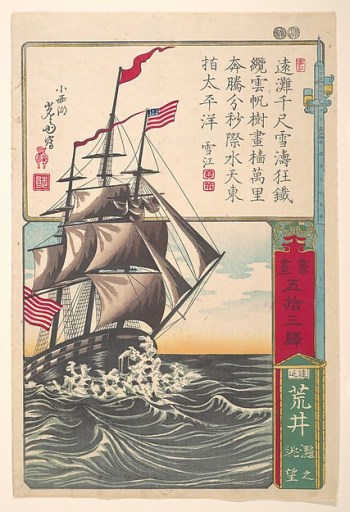
Utagawa Yoshimori, An American Sailing Ship off Arai, 1872; polychrome woodblock print, ink and color on paper (New York: Metropolitan Museum of Art, 2007.49.243).
How do design ideas, patterns, and aesthetics travel across the globe, even when objects themselves do not?
The idea behind this project’s question grew out of a string of provocative inquiries that emerged following exhibitions and recent projects that our alumni and faculty members of the University of Delaware have worked on in the past 10 years (Collecting China [UD-Winterthur, DE], Asia in Amsterdam [PEM, MA], Made for the Americas [MFA Boston, MA], among others). While existing scholarship has recognized the global circulation of objects, artistic forms in the American field sometimes have less to do with the mobility of actual objects from Asia than with translations of Asian aesthetic influences that create new forms in new regions. This project therefore explores ideas about transcultural circulation beyond the concept of objects as commodities, by urging researchers to collaboratively study ideas and influences, across time and space, which have inspired, integrated, and re-generated new aesthetics in and beyond America.
‘Asia’ and ‘America’ are taken in this project as pointers to encourage a mapping of global and multi-directional flow of aesthetics and aesthetic translation, not merely an exchange between Asia and North America. Our long-term goal is to generate a multi-level investigation that comprehensively encompasses Asia, Europe, the Americas and other related world regions into the study of American art and material culture.
For details about the symposium, a graduate student workshop and presentation, and a living repository site for research data, please visit the website. All events are free and open to the public, but registration is required. Lodging is also available at discounted price for registered participants.
Roundtable Panelists
J. Ritchie Garrison (University of Delaware, Winterthur Program, Newark)
Michael Leja (University of Pennsylvania, Philadelphia)
Partha Mitter (University of Sussex, emeritus, Oxford)
Alexandra Munroe (Guggenheim Museum, New York, New York City)
Nasser Rabbat (MIT, Cambridge)
Moderated by Vimalin Rujivacharakul (University of Delaware, Art History, Newark)
Speakers (by the order of team members’ last names)
Team 1
Glenn Adamson (New York & London)
Ming Tiampo (Carleton University, Ottawa)
Team 2
Jens Baumgarten (Universidade Federal de Sao Paulo, Brazil)
Dennis Carr (Museum of Fine Arts, Boston)
Team 3
Ned Cooke (Yale, New Haven)
Dorothy Ko (Barnard/Columbia, New York City)
Team 4
Karina Corrigan (Peabody Essex Museum, Salem)
Femke Diercks (Rijksmuseum, Amsterdam)
Team 5
Linda Eaton (Winterthur Museum, Garden & Library)
Giorgio Riello (University of Warwick, England)
Team 6
Lee Glazer (Freer|Sackler Galleries, Washington DC)
Stacey Pierson (School of Oriental and African Studies, England)
Team 7
Medill Harvey (American Wing, Metropolitan Museum, New York City)
Forrest McGill (Asian Art Museum, San Francisco)
Team 8
Liu Chang (Tsinghua University & Palace Museum, Beijing)
Greg Landrey (Winterthur Museum, Garden & Library, Winterthur)
Team 9
Darielle Mason (Philadelphia Museum of Art, Philadelphia)
Asma Naeem (National Portrail Gallery, Washington DC)
Team 10
Marco Musillo (Kunsthistorisches Institut in Florenz, Florence)
Catharine Dann Roeber (Winterthur Museum, Garden & Library, Winterthur)
Conference | HECAA at 25, November 2018
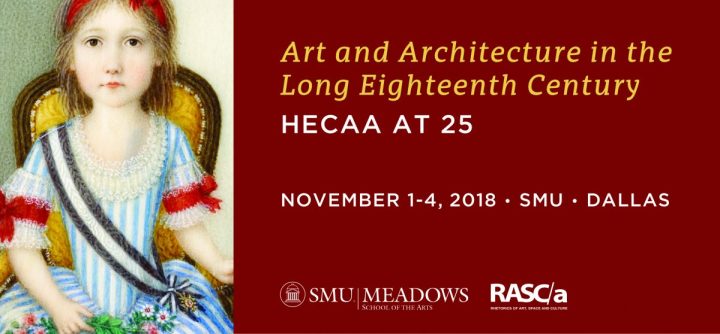
Francisca Efigenia Meléndez y Durazzo, Portrait of a Girl, ca. 1795, tempera on ivory, 5 × 5 cm (Dallas: Meadows Museum, SMU, Museum Purchase with funds from The Meadows Foundation, MM.08.01.20).
From SMU:
Art and Architecture in the Long Eighteenth Century
HECAA at 25, Conference Program and Registration
Southern Methodist University, Dallas, 1–4 November 2018
The Art History Department, its graduate program in the Rhetorics of Art, Space, and Culture (RASC/a), and the Meadows School of the Arts at Southern Methodist University are proud to announce the program for Art and Architecture in the Long Eighteenth Century: HECAA at 25, a conference to be held 1–4 November 2018 in celebration of the twenty-fifth anniversary of the founding of the Historians of Eighteenth-Century Art and Architecture.
HECAA at 25 will present recent research on eighteenth-century visual culture, consider questions of historiography and pedagogy, and chart paths for the future of the field. The program also includes visits to the Meadows Museum, the Dallas Museum of Art, and the Kimbell Art Museum.
Come to Texas, y’all!
For the program and conference information, visit: smu.edu/HECAA25
Registration information is available here»
Questions? Contact us at hecaa25@gmail.com.
Conference | American Latium
Next month at the Center for American Studies in Rome, from the conference flyer:
American Latium: American Artists and Travellers in and around
Rome in the Age of the Grand Tour
Centro Studi Americani, Palazzo Mattei di Giove, Rome, 7–8 June 2018
Organized by Christopher M.S. Johns, Tommaso Manfredi, and Karin Wolfe
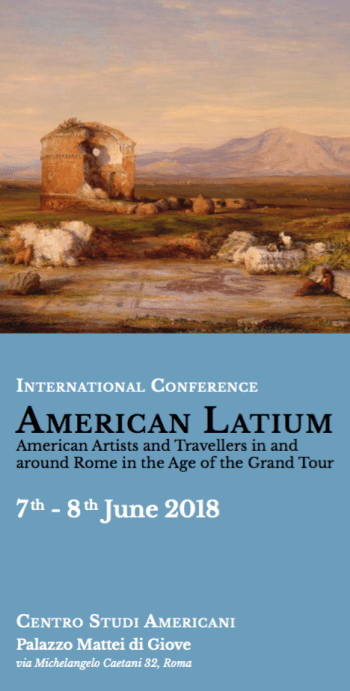 American Latium addresses the pioneering origins of the artistic relations between America, Rome, and its environs from the eighteenth century up until 1870, in order to define the extraordinary impact of the arts of Rome, from antiquity through to the modern period, that in large part resulted in the birth of a national American aesthetic. Interdisciplinary in nature, this conference will put forward new research and new research approaches to the study of cultural travel and cultural exchange, including exploring the reverse side of this story of exchange, foregrounding the experiences and the contributions of the first Italians who travelled to America in search of work opportunities and cultural acclaim.
Organised by Centro Studi Americani, Roma; Accademia Nazionale di San Luca, Roma; Department of History of Art, Vanderbilt University, Nashville; and Dipartimento PAU, Università Mediterranea di Reggio Calabria.
T H U R S D A Y , 7 J U N E 2 0 1 8
9.15 Welcome, Paolo Messa (Centro Studi Americani)
9.30 Francesco Moschini (Accademia Nazionale di San Luca), Il Principe e il Presidente: Riflessioni sull’incontro londinese tra Antonio Canova e Benjamin West
10.00 The American Grand Tour in Europe: Origins and Dynamics
Chair: Christopher M.S. Johns (Vanderbilt University)
• Jonathan Yarker (Lowell Libson & Jonny Yarker, Ltd), Copying Old Masters for the New World: American Eighteenth-Century Painters in Rome
• Sarah Cantor (University of Maryland, Adelphi), James Bowdoin III and Ward Nicholas Boylston in Italy: American Collectors in the Later Eighteenth Century
• Vincent Pham (University of California San Diego), Benjamin West, the American School, and the Remediation of History Painting
• Martin Postle (Paul Mellon Centre for Studies in British Art), London between America and Continental Europe: Art and Academies
• Duccio K. Marignoli (The Marignoli di Montecorona Foundation), Benjamin West’s Portrait of Benjamin Franklin: New Themes and New Approaches for a New Nation
13.00 Lunch Break
14.00 American Rome and Latium: Image, Sites, and Itineraries
Chair: Tommaso Manfredi (Università Mediterranea di Reggio Calabria)
• Fabrizio Di Marco (Sapienza Università di Roma), Luoghi e itinerari statunitensi a Roma dalla ne del Settecento a metà dell’Ottocento
• Nicholas Stanley-Price (Independent Scholar), The Final Destination: Early American Presence at the Protestant Burying- Ground in Rome
• Mary K. McGuigan (Independent Scholar), Scenery Found: John Gadsby Chapman and Open-Air Oil Sketching in and around Rome, 1830–77
• Luca Attenni (Università degli Studi Roma Tre), John Izard Middleton: Un archeologo americano nel Lazio
• Francesco Petrucci (Palazzo Chigi, Ariccia), La ‘Scuola dei Castelli Romani’ e la Locanda Martorelli ad Ariccia: Artisti e intellettuali dall’Europa all’America nel XIX secolo
• Lisa Beaven (LaTrobe University, Bendigo), Sense and Sensibility Part I: American Artists Experiencing the Roman Campagna
• David R. Marshall (University of Melbourne), Sense and Sensibility Part II: American Artists Experiencing the Roman Campagna, The Tor de’ Schiavi
F R I D A Y , 8 J U N E 2 0 1 8
9.00 Americans and the Artistic Culture of Rome: From Old Masters to New
Chair: Karin Wolfe (British School at Rome)
• Wendy Wassyng Roworth (University of Rhode Island), Angelica Kauffman’s Portraits of Americans in Rome and a Self-Portrait in Philadelphia
• Christopher M.S. Johns (Vanderbilt University), John Singleton Copley in Rome: The Challenge of the Old Masters Accepted
• Tommaso Manfredi (Università Mediterranea di Reggio Calabria), La Roma di Charles Bul nch: un itinerario culturale al tempo di Pio VI
• Maria Cristina Loi (Politecnico di Milano), L’idea di Roma di Thomas Jefferson e il suo viaggio in Italia
• Francesca Orestano (Università degli Studi di Milano), John Neal, the Old Masters, and the American Muse
• John F. McGuigan Jr. (Independent Scholar), A Painter and a Diplomat: The Two Careers of James E. Freeman and Their Correspondences
• Pier Paolo Racioppi (Fondazione IES Abroad Italy, Roma), Vivere e creare nell’Antico: Le dimore e gli studi romani degli scultori Crawford, Story ed Ezekiel
• Kevin Salatino (The Art Institute of Chicago), Undressing America: Nineteenth-Century Expatriate Sculptors in Rome and the Question of Nudity
13.30 Lunch Break
14.30 Rome in America: Transpositions of Ideas, Art, and Artists
Chair Francesco Moschini Accademia Nazionale di San Luca
• Mario Bevilacqua (Università degli Studi di Firenze), Piranesi in Eighteenth-Century America: Ancient Models for the New Nation
• Karin Wolfe (British School at Rome), Imagining Liberty: The Roman Sculptor Giuseppe Ceracchi in America
• Giovanna Capitelli (Università della Calabria), An Ecclesiastical Network? Altarpieces Sent from Rome to the United States during the Second Half of the Nineteenth Century in the Papacy of Pius IX
• Tiziano Antognozzi (Independent Scholar), From One Capitol to the Other: Exploring Constantino Brumidi’s Agency across the Atlantic
• Linda Wolk-Simon (Fairfield University Art Museum), ‘In the Beginning There Was the Word’: American Writings on Raphael from the Founding Fathers to the Gilded Age
17.00 Discussion










leave a comment