Conference | Digital Art History: Practice and Potential

From the Paul Mellon Centre:
Digital Art History: Practice and Potential
Paul Mellon Centre and the Courtald Institute of Art, London, 11 October 2017
Organized by Hana Leaper, Sophie Hatchwell, and Fern Insh
The first conference of the Early Career Researchers in British Art Network in partnership with The Courtauld Institute of Art’s Digital Art History Research Group (#DAHRG) and the Paul Mellon Centre for British Art
This conference, organised under the auspices of the Early Career Researchers in British Art Network, and Digital Art History Research Group (#DAHRG), provides a platform for Early Career Researchers engaged or interested in digital art history to showcase their work, develop skills, and think broadly about how digitisation can innovate, challenge convention, and inform art-historical practice.
In recent years, academics and institutions engaged in the Digital Humanities have brought together new technologies with historical research and scholarship. As a result, departments and institutions dedicated to the study of the Digital Humanities are becoming increasingly commonplace. Concurrently, art historians have sought to define what Digital Art History is, with eminent scholars such as Johanna Drucker and Diane M. Zorich interrogating its place within disciplinary practice and theory and many conferences and publications devoted to specifically defining what Digital Art History means. By inviting an emergent generation of scholars together, this conference intends to move beyond defining Digital Art History. Instead, we consider how digital technology integrates with and enhances art historical methodologies and theories in today’s digital world.
Convened by Dr Hana Leaper (Paul Mellon Centre), Dr Sophie Hatchwell (University of Bristol), and Dr Fern Insh (Courtauld Institute of Art)
S C H E D U L E
9.30 Registration and introduction at the Paul Mellon Centre
10.00 Panel 1 | Practice: Exploring the Nexus of Digital Technologies and Art Historical Research
• Élodie Gössant, Reconstructing a Lost Country House: The Case of Erlestoke Park (Wiltshire)
• Phillippa Plock and Colette Warbrick, Digital/ized Art History at Waddesdon Manor
• Shu-Chi Shen, Revisualising, Reconstruction and Recreation: The Case Study on a Digital Exhibition in the National Palace Museum
11.30 Break
12.00 Panel 2 | Potential: Evolution and Synthesis of Art Historical Methodologies
• Nirmalie Alexandra Mulloli and Christina Bartosch, Exhibitions of Modern European Art, 1905–15: Building Metadata to Reveal Artist Exhibition Strategies and Advance Theoretical Possibilities of Exhibition Spaces
• Ricarda Brosch and Adam Knight, The Quantitative Turn: Big Data Ethics in Digital Art History
• Rosário Salema de Carvalho and Inês Aguiar, Match! Image recognition issues on Az Infinitum: Azulejo Indexation and Referencing System
1.30 Lunch
1.30 Workshop Session
• Fern Insh, App Building for History and Heritage
3.30 Break
4.00 Roundtable Discussion
• Early Career Researchers’ Role in Developing Digital Practice
6.00 Lecture, at the Courtauld Institute of Art
• Emma Stanford, The Art of Losing: A Wishlist for Responsible Digitization
7.15 Reception
Abstracts are available here»
Symposium | Art of Power: The 3rd Earl of Bute, Politics, and Collecting
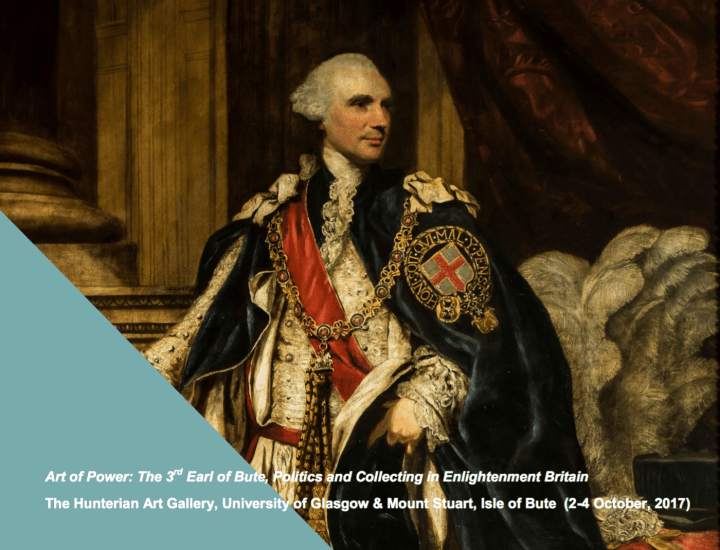
From the symposium flyer:
Art of Power: The 3rd Earl of Bute, Politics, and Collecting in Enlightenment Britain
The Hunterian Art Gallery, University of Glasgow and Mount Stuart, Isle of Bute, 2–4 October 2017
In 2017, the Mount Stuart Trust and The Hunterian Art Gallery, University of Glasgow, are hosting a major exhibition merging art, biography, politics, and cultural history. Art of Power: Masterpieces from the Bute Collection uncovers the fascinating Enlightenment figure, John Stuart, 3rd Earl of Bute (1713–1792), and his collection of rarely-seen masterpieces. A three-day interdisciplinary symposium inspired by themes of the exhibition will explore the dynamic interplay between art, politics, and collecting so evident in the life of the 3rd Earl of Bute. In sessions open to the public, papers will be delivered on day one in Glasgow. Days two and three will take place at Mount Stuart (with only a very limited number of spaces) and will include tours of the house, archives, and collection highlights.
Confirmed Speakers
Desmond Shawe-Taylor (Royal Collection), Rosie Razzall (Royal Collection), Anne T. Woollett (J. Paul Getty Museum), Anthony Lewis (Glasgow Museums), Wayne E. Franits (Syracuse University), Graham Rowe (University of Derby), Heiner Krellig (independent), Janet Stiles Tyson (Birkbeck), Oliver Cox (Oxford), Peter Black (Hunterian), Mungo Campbell (Hunterian), and Caitlin Blackwell (Mount Stuart)
Symposium | Saint-Cloud to Bernardaud: French Porcelain, 1690–2000
From The French Porcelain Society:
Saint-Cloud to Bernardaud: New Horizons in French Porcelain, 1690–2000
The French Porcelain Society Symposium
The Wallace Collection, London, 20–21 October 2017
Organized by Aileen Dawson

From top left: Saint-Cloud Vase, 1695–1710 (New York: The Metropolitan Museum of Art); Bastien & Bugeard Clock, 1848–58 (Paris: Musée des Arts décoratifs); Mennecy Jug, 1760 (London: Victoria and Albert Museum); Villeroy Monkey, 1745 (New York: The Metropolitan Museum of Art); Guérhard & Dihl Vase, 1797–1804 (Clandon Park, National Trust); and Bernardaud Vase, 2015, by Hervé Van Der Straeten.
The symposium will present ground-breaking new research on a broad range of French porcelain factories operating from the late 17th century up to the present day. Many of these factories have at times been unjustly neglected in favour of the royal factory at Sevres, even though their productions could at times rival its splendid output, and all were responding to the same changes in taste and fashion. Papers will focus on Saint-Cloud, Chantilly, Mennecy, and factories in Eastern France, such as Strasbourg and Niderviller, those operating in Paris in the late 18th and 19th centuries, such as Dihl, Shoelcher and Dagoty, and the Limoges factories in production in the 19th century and up to the present day. The location, capitalisation, techniques of manufacture, employment of artists, sculptors and designers, marketing and clientèle will be explored by some twenty leading international scholars.
The symposium is organized by Dr Aileen Dawson, former curator at The British Museum. It is open to members and non-members of The French Porcelain Society, and bursaries may be available for scholars who wish to attend. The registration fee is £100 (non-FPS members £110, students £70) with additional fees for lunches and an evening reception. Please contact FPSenquiries@gmail.com.
P A P E R S
17th and 18th Centuries
• Errol Manners, The Porcelain of Villeroy
• Nicole Duchon, Mennecy Villeroy: Some Surprising New Discoveries
• Pamela Roditi, Two Travellers: Robinson and Clara
• John Whitehead, The Painter Piat-Joseph Sauvage: his work on porcelain at Dihl
• Iris Moon, Use Your Illusion: Niderviller Ceramics and Rococo Aesthetics at the 18th-Century French Border
19th Century
• Tamara Préaud, Brongniart and the ‘Exposition des Produits de l’industrie (1819–1844)
• Audrey Gay-Mazuel, Parisian Porcelain Makers and the Mid-19th-Century Rococo Revival
• Sonia Banting, A Little-Known Maker of pâte-sur-pâte: Charles Pillivuyt (1810–1872) and His Porcelain Factory in the Berry Region
• Virginie Desrante, Jules Lesme and Limoges in the Style of Bernard Palissy
• Howard Coutts, Paris and Other French Porcelain in the Bowes Museum
• Régine de Plinval de Guillebon, Dagoty, Porcelain Manufacturer to the Empress Josephine: Designs and Their Realisation
20th Century
• Hélène Huret, Arists and Designers at Bernadaud, Limoges, from Kees Van Dongen to Jeff Koons, Know-How and Invention
Conference | Early Modern Collections in Use
From the conference flyer:
Early Modern Collections in Use
The Huntington Library, Art Collections, and Botanical Gardens, San Marino, 15–16 September 2017

Ferrante Imperato, Dell ’Historia Naturale, 1599, detail from a double plate (Los Angeles: Getty Research Institute).
From cabinets of curiosities, auction houses, and libraries to stables, menageries, and laboratories, early modern collections played a key role in the creation and transmission of knowledge. But how were these collections used in their own time? Speakers will explore the relationships between space and knowledge through the discussion of a range of themes in the history of collecting: from management to performance, from visitation to dissemination. Cumulatively, the papers will offer a new basis for thinking not only about the origins and content, but also about the functions and dynamics of early modern collections.
Conference registration and optional lunches by reservation only. The registration fee is $25 (students free), with buffet lunches for $20 each day. Please visit The Huntington website for more information. Funding provided by The Huntington’s William French Smith Endowment and The USC-Huntington Early Modern Studies Institute.
F R I D A Y , 1 5 S E P T E M B E R 2 0 1 7
8:30 Registration and coffee
9:30 Welcome by Steve Hindle (The Huntington) and remarks by Elizabeth Eger and Anne Goldgar (King’s College London)
10:00 Session 1 | Conceptualizing
Moderator: Anne Goldgar
• Paula Findlen (Stanford University), Why Put a Museum in a Book? Ferrante Imperato and Natural History in Sixteenth-Century Naples
• Peter Mancall (University of Southern California and The USC-Huntington, Early Modern Studies Institute), Birds of (Early) America
12:00 Lunch
1:00 Session 2 | Displaying
Moderator: Elizabeth Eger
• Vera Keller (University of Oregon), Johann Daniel Major (1634–1693) and the Experimental Museum
• Mark Meadow (University of California, Santa Barbara), Quiccheberg, Prudence, and the Display of Techne in the Brueghel/Rubens Allegories of the Senses
2:45 Break
3:00 Session 3 | Performing
Moderator: Arnold Hunt (University of Cambridge)
• Dániel Margócsy (University of Cambridge), Stables as Collections for Breeding: The Production of Knowledge and the Reproduction of Horses
• Anne Goldgar (King’s College London), How to Seem a Connoisseur: Learning to Perform in Early Modern Art Collections
S A T U R D A Y , 1 6 S E P T E M B E R 2 0 1 7
9:00 Registration and coffee
9:30 Session 4 | Hiding
Moderator: Peter Mancall
• Jessica Keating (Carleton College), Hidden in Plain Sight: The Kunstkammer of Holy Roman Emperor Rudolf II
• Victoria Pickering (The British Museum), Sealed and Concealed: The Visible and Not-so-Visible Uses of a Botanical Collection
11:30 Lunch and time to view exhibition, Visual Voyages: Images of Latin American Nature from Columbus to Darwin (led by exhibition curator Daniela Bleichmar)
1:00 Session 5 | Visiting
Moderator: Kim Sloan (The British Museum)
• Elizabeth Eger, Collecting People
• Felicity Roberts (King’s College London), Sir Hans Sloane’s Museum and Animal Encounters
2:45 Break
3:00 Session 6 | Disseminating
Moderator: Miles Ogborn (Queen Mary University of London)
• Alice Marples (The John Rylands Research Institute, University of Manchester), ‘Raised to High Eminence By the Excitement’: Collections and the Creation of ‘Provincial’ Medical Education
• Daniela Bleichmar (University of Southern California), The Interpretation of Mexican Indigenous Objects in Collections in Early Modern Europe and New Spain
4:45 Concluding Roundtable
Arnold Hunt (University of Cambridge), Miles Ogborn (Queen Mary University of London), Kim Sloan (The British Museum), and Mary Terrall (University of California, Los Angeles)
Study Day | 300 Years of Silk

One of a pair of shoes, ca 1720; leather sole, with brocaded silk uppers with silk woven in Spitalfields
(London: V&A, T.446&A-1913)
◊ ◊ ◊ ◊ ◊
300 Years of Silk: A Study Day at Gainsborough’s House
Gainsborough’s House, Sudbury, Suffolk, 26 September 2017
Join us for 300 Years of Silk, an exclusive Silk Study Day held at Gainsborough’s House in Sudbury, Suffolk. Hosted by textile specialists Mary Schoeser and Kate Wigley of the School of Textiles, Coggeshall, and Keeper of Art & Place Louisa Brouwer of Gainsborough’s House, this event will feature a series of informative lectures, interactive handling sessions and a curator-led tour of the current exhibition, Silk: From Spitalfields to Sudbury (17 June — 8 October 2017). The daylong programme will include opportunities to study a range of silk textiles from the eighteenth to twentieth centuries in close detail and will offer privileged access to the Sudbury silk mill Vanners Silk Weavers, with guided tours led around this vibrant working factory in the afternoon.
Organised to accompany the current exhibition Silk: From Spitalfields to Sudbury at Gainsborough’s House, this Study Day will explore the fascinating history of the English silk industry, focussing on the town of Sudbury, Suffolk—regarded today as Great Britain’s most important centre for silk manufacture. Sudbury now produces more woven silk textiles than anywhere else in the nation, with four working firms still in operation: Vanners Silk Weavers, The Gainsborough Silk Weaving Company, Stephen Walters & Sons, and The Humphries Weaving Company. Dating back to the early years of the nineteenth century, Sudbury’s nascent silk industry was facilitated by the town’s former history as a wool centre, to which many family members of the Sudbury-born artist Thomas Gainsborough, R.A. (1727–1788) plied their trade.
Open to students, curators, and textile enthusiasts alike, this Study Day offers full access to Gainsborough’s House in the historic market town of Sudbury, located just 1 hour 20 minutes by train from London Liverpool Street. The day will run from 10am to 5pm and cost £80 per person (inc. VAT). Tickets will include tea, coffee, and biscuits upon arrival, followed by a light sandwich lunch in the afternoon. For further enquiries and to reserve your place, please contact louisa@gainsborough.org. Limited places are available so early booking is recommended.
Symposium | Enlightened Princesses: Britain and Europe, 1700–1820
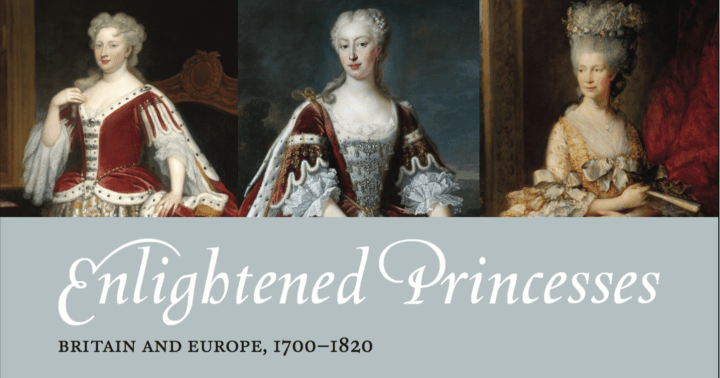
From the Paul Mellon Centre for Studies in British Art:
Enlightened Princesses: Britain and Europe, 1700–1820
Kensington Palace, Hampton Court Palace, and the Tower of London, 29–31 October 2017
Caroline of Ansbach (1683–1737), Augusta of Saxe-Gotha (1719–1772), and Charlotte of Mecklenburg-Strelitz (1744–1818), three Protestant German princesses, became variously Princess of Wales, Queen Consort, and Princess Dowager of Great Britain. Recent research has explored how in fulfilling these roles they made major contributions to the arts, the development of new models of philanthropy and social welfare, the promotion and support of advances in science and medicine, as well as trade and industry, and the furthering of imperial ambition. While local contexts may have conditioned the forms such initiatives took, their objectives were rooted in a European tradition of elite female empowerment.
This symposium, Enlightened Princesses: Britain and Europe, 1700–1820, will bring together eminent academicians and museum scholars to investigate the role played by royal women-electresses, princesses, queens consort, reigning queens, and empresses—in the shaping of court culture and politics in Europe of the long eighteenth century.
Papers will explore the following themes:
• Royal women as political agents
• Royal women: networks and conversations
• Royal women as patrons of art and architecture
• Royal women and the crafting of image
• Royal women: engaging with nature and technology
The symposium will take place 29–31 October 2017 at Kensington Palace, Hampton Court Palace, and the Tower of London. The programme will include special tours of the Enlightened Princesses exhibition at Kensington Palace, followed by two full days of lectures, themed panels, and discussions at Hampton Court Palace and the Tower of London.
The fee for attending the conference is £100. Reduction are available for a limited number of students on application to the symposium organiser. The symposium organiser can be contacted at emily.knight@hrp.org.uk.
Co-organised by Historic Royal Palaces, the Yale Center for British Art, and the Paul Mellon Centre for Studies in British Art, London, in association the exhibition Enlightened Princesses: Caroline, Augusta, Charlotte, and the Shaping of the Modern World, on view at Kensington Palaces, 22 June – 12 November 2017.
S U N D A Y , 2 9 O C T O B E R 2 0 1 7
14.00 Exhibition tour 1
15.00 Exhibition tour 2
16.00 Exhibition tour 3
Tea served in Orangery from 14.00 to 17.00
M O N D A Y , 3 0 O C T O B E R 2 0 1 7
9.00 Registration and coffee
9.30 Welcome from Adrian Phillips and Amy Meyers
9.45 Keynote Lecture
• Joanna Marschner, Enlightened Princesses: Britain and Europe, 1700–1820
10.30 Break
10.45 Session 1 | Royal Women as Political Agents
Moderator: Lisa Ford
• Elise Dermineur, Queens Consort as political agents: A tentative research framework through the example Queen Louisa Ulrika of Sweden (1720–1782)
• Heather Carroll, ‘Charlotte has the breeches’: The shifting political perception of Queen Charlotte
• Allison Goudie, ‘A woman of great feminine beauty, but of a masculine understanding’: Queen Maria Carolina of Naples and Canova’s statue of the king ‘as Minerva’
• Martin Eberle, Luise Dorothea: Duchess of Saxony-Gotha-Altenburg
13.00 Lunch
14.00 Session 2 | Royal Women: Networks and Conversations
Moderator: Lucy Peltz
• Elizabeth Montagu, ‘Queen of the Bluestockings’: Women and literary authority in the age of Enlightenment
• Lisa Skogh de Zoete, Queen Hedwig Eleanora—A Liebhaberin of the arts: Political culture and sources of knowledge as part of Northern German Court Culture
• Merit Laine, Creative conversations: Queen Louisa Ulrika and the formulation of Swedish court culture in the Age of Liberty
• Sonja Fielitz, ‘A silent but impressive language’: The quietly worked female empowerment of Charlotte of Mecklenburg-Strelitz
16.00 Tea
16.30 Discussion
Moderators: Sebastian Edwards and Desmond Shawe-Taylor
17.30 Drinks and musical programme with harpsichord virtuoso Nathaniel Mander
T U E S D A Y , 3 1 O C T O B E R 2 0 1 7
9.00 Registration and coffee
9.30 Welcome by Joanna Marschner and Amy Meyers
9.45 Session 3 | Royal Women as Patrons of Art and Architecture
Moderators: Aurélie Chatenet-Calyste and Desmond Shawe-Taylor
• Tara Zanardi, Material Temptations: Isabel de Farnesio and the politics of the interior
• Veronica Biermann, ‘Let’s have a look’: G.L. Bernini’s mirror for Queen Christina and her self-image
• Christopher Johns, Two Queens and a villa: Enlightenment sociability in Turin
• Christopher Baker, Augusta, Princess of Wales and Jean Etienne Liotard
• Heidi Strobel, Queen Charlotte as patron of female artists
13.00 Lunch
14.00 Session 4 | Royal Women and the Crafting of Image
Moderator: Matthew Storey
• Heather Belnap Jensen, Dynastic dressing: The portraits of Caroline Bonaparte Murat, Queen of Naples and the art of costume
• Eva-Lena Karlsson, Sofia Albertina: A Swedish princess from Rococo to Biedermeier
15.00 Session 5 | Royal Women: Engaging with Nature and Technology
Moderator: Joanna Marschner
• Tessa Murdoch, Measuring time at the Hanoverian Court: Caroline, Augusta and Charlotte as promoters of clock and watch-making in London
• Emily Roy, Catherine the Great’s Russian mountain: The imagery of the Thunder Stone
16.25 Tea
17.00 Discussion
Moderator: Helen Watanabe-O’Kelly
◊ ◊ ◊ ◊ ◊
Note (added 19 September 2017) — An updated schedule has replaced the previous, provisional programme.
Note (added 26 October 2017) — Several small changes were made to the programme and corrected in the posting above; a final copy is available here.
Conference | Morgan: Mind of the Collector
From H-ArtHist:
Morgan: Mind of the Collector
Wadsworth Atheneum Museum of Art, Hartford, CT, 10–11 November 2017
J. Pierpont Morgan (1837–1913) spent over twenty years traveling the globe to amass the largest collection of art and cultural artifacts of his time. Estimated to have exceeded 20,000 works of art, Morgan’s collections represent a broad historical and geographic range of art and cultural artifacts. Acting on his father’s wishes, J.P. Morgan’s son, Jack, donated more than 1,350 works collected by his father to the Wadsworth Atheneum in his native Hartford. In fall 2017, the Wadsworth Atheneum will mark the centennial anniversary of Morgan’s gift and its historical impact with an exhibition, Morgan: Mind of the Collector. The Wadsworth Atheneum will host an international symposium in conjunction with the exhibition to reexamine and showcase the latest research about Morgan’s collection and how he shaped the identity of the collector in the modern age.
For more information or to register, please contact faculty@wadsworthatheneum.org. Hotel discounts are available for the attendees of the conference at the Hartford Marriott Downtown.
F R I D A Y , 1 0 N O V E M B E R 2 0 1 7
12:00 Registration
1:15 Introduction
• Neil Harris (University of Chicago), Morgan the Collector
1:45 1 | Morgan and the Biblical Lands (chair, Steven Tinney, University of Pennsylvania)
• Yelena Rakic (Metropolitan Museum of Art, New York), Discovering the Ancient Near East
• Lyle Humphrey (North Carolina Museum of Art, Raleigh), Morgan in Egypt
• John Bidwell (Morgan Library & Museum, New York), Morgan’s Bibles
3:30 Break
3:45 2 | The Romance of History (chair, Christine Brennan, Metropolitan Museum of Art)
• Christine Brennan (Metropolitan Museum of Art, New York), Morgan and Medieval Art
• Roger Wieck (Morgan Library & Museum, New York), Morgan and Manuscripts
5:15 Exhibition Viewing and Reception
6:30 Speakers’ Dinner
S A T U R D A Y , 1 1 N O V E M B E R 2 0 1 7
10:00 3 | Building a Beautiful Life (chair, Colin Bailey, Morgan Library & Museum)
• Wolfram Koeppe (Metropolitan Museum of Art, New York), Gold and Garnets: A Love of Precious Objects
• Linda Roth (Wadsworth Atheneum Museum of Art, Hartford), Prince’s Gate, London
• Alice Cooney Frelinghuysen (Metropolitan Museum of Art, New York), From Gilded Age Interior to Renaissance Palazzo: Morgan’s New York House
12:00 Lunch
1:00 4 | The Politics of Collecting: The Global Network (chair, Inge Reist, Center for the History of Collecting at the Frick Collection)
• Catherine Scallen (Case Western Reserve University, Cleveland), Turning to the Experts
• Jennifer Tonkovich (Morgan Library & Museum, New York), Morgan’s Experts and Dealers in London and Europe
• Barbara Pezzini (National Gallery, London), Collecting British Paintings
3:00 Break
3:15 5 | Crafting a Legacy (chair, Jennifer Tonkovich, Morgan Library & Museum)
• Charlotte Vignon (Frick Collection, New York), Morgan and Duveen: The Formation and Dispersal of a Collection
• Jo Briggs (Walters Art Gallery, Baltimore), Morgan and His Fellow American Collectors
5:00 Reception and Exhibition Viewing
Conference | Beyond Reproductive Printmaking
From H-ArtHist:
Beyond Reproductive Printmaking: Prints and the Canon of European Painting, ca. 1500–1810
Diesseits und jenseits von Reproduktion: Druckgrafik und der Kanon der europäischen Malerei
Dresden, 18–19 September 2017
Registration due by 8 September 2017
Eine kooperative Veranstaltung des Kupferstich-Kabinetts der Staatlichen Kunstsammlungen Dresden und des Institutes für Kunst- und Musikwissenschaft der TU Dresden (Lehrstuhl für Mittlere und Neuere Kunstgeschichte) / joint conference of the Cabinet of Prints, Drawings and Photographs of the Dresden State Art Collections and the Institute of Art and Music of the Technical University Dresden
Venues
Studiensaal des Kupferstich-Kabinetts und Hans-Nadler-Saal im Residenzschloss, Gemäldegalerie Alte Meister im Zwinger / Print room of the Cabinet of Prints, Drawings and Photographs, Hans-Nadler-Saal and Old Masters Picture Gallery, Dresden
Organization Team
Susanne Magister, M.A.
Sabine Peinelt-Schmidt, M.A.
Contact
beyond-reproduction-2017@gmx.de
For the lectures on 19th September we kindly ask for registration via email no later than 8th September 2017. We would like to invite all interested guests to the public evening lecture of Dr. Rudolf Rieger in the print room of the Cabinet of Prints, Drawings and Photographs on 18th September 2017 at 6.30pm.
M O N D A Y , 1 8 S E P T E M B E R 2 0 1 7
18:30 Öffentlicher Abendvortrag im Studiensaal des Kupferstich-Kabinetts
• Rudolf Rieger (Bonn), Adam von Bartsch (1757–1821) als Graphiker: Die Reproduktion von Handzeichnungen alter Meister zwischen Faksimileanspruch, normativen Rezeptionsvorgaben und künstlerischer Interpretation
T U E S D A Y , 1 9 S E P T E M B E R 2 0 1 7
9:30 Registration
10.00 Section I | Collecting Interpretative Prints: Now and Then
Moderated by Jürgen Müller (Dresden)
• Gudula Metze (Dresden), Königliches Kunst-Kompetenzzentrum. Das Dresdener Kupferstich-Kabinett als Kunstsammlung, Wissensspeicher und Forschungsstelle im 18. Jahrhundert
• Rieke van Leeuwen (Den Haag), Reproductive Prints in the Collection of the Rijksbureau voor Kunsthistorische Documentatie (RKD)
11.25 Section II | Translation and Technique
Moderated by Stephanie Buck
• Rena M. Hoisington (Baltimore), Étienne Fessard’s Prints of the Chapel of the Hôpital des Enfants Trouvés in Paris, 1751–59
• Caroline O. Fowler (New Haven), Defacing Raphael in the Eighteenth Century
12:30 Lunch
14.00 Section III | Mobile Motifs and Changes of Meaning
Moderated by Susanne Magister (Dresden)
• Ralf Bormann (Frankfurt a.M.), Das Nachleben reproduzierter dionysischer Sarkophagmotive im Kunstbetrieb der Académie Royale
• Christine Moisan-Jablonski (Warsaw), Geographical Metamorphoses: The influence of a composition attributed to Justus van Egmont and that of the “Elements” cycle, engraved by Jeremias Falck, on print series produced by German publishing houses
• Aude-Line Schamschula (Heidelberg), Der Herkules-Zyklus von Frans Floris. Druckgrafik als Medium der Rezeption
15.50 Section IV | Interpretative Prints as Sources for the History of Reception
Moderated by Sabine Peinelt-Schmidt (Dresden)
• Uta Neidhardt (Dresden), Gillis van Coninxloo – ein Meister des Spätwerks? Die Bedeutung grafischer Reproduktionen für die Rekonstruktion und Rezeption des Schaffens eines Hauptmeisters der flämischen Landschaftskunst
• Marina Daiman (New York), ‘Diverse opere grandi le quale vanno in stampa’: Rubens’s Fame, Theft, and the Business of Prints
• Alice Ottazzi (Torino / Paris), The Role of Mezzotint in Shaping International Reputations: An Aspect of the Reception of the English School in France
M O N D A Y , 1 8 S E P T E M B E R 2 0 1 7
The following lectures of the first day of the conference are reserved for the speakers due to space limitations of the print room.
11:00 Registration
11:45 Welcome by Stephanie Buck, Jürgen Müller, Susanne Magister, and Sabine Peinelt-Schmidt
12:30 Jaqueline Klusik-Eckert (Erlangen), Stichkopien: Phänomen der Rezeption oder Hinweis auf einen Paragone?
12:50 Christien Melzer (Bremen), Im Zeichen der Lilie. Französische Druckgraphik zur Zeit Ludwigs XIV.
13:10 Evelyn Wöldicke (Berlin), Gemäldereproduktionen im Clairobscur-Holzschnitt? John Baptist Jackson und die Geschichte eines gescheiterten Versuchs
13:30 Zalina V. Tetermazova (Moskow), Colour Prints by Gabriel Scorodoomoff (1754–1792): Between Painting and Graphic Arts
13:50 Giorgio Marini (Firenze), Giuseppe Longhi’s La Calcografia: Theory and Techniques of Neoclassical Reproductive Printmaking
14:45 Pause and Change of Location
Gemäldegalerie Alte Meister der Staatlichen Kunstsammlungen Dresden, im Zwinger, Dresden
15:45 Martin Schuster (Dresden), Moderation and Introduction
Visit to the Old Masters Picture Gallery with presentation of preparatory drawings and prints from the Recueil d’Estampes d’après les plus célèbres Tableaux de la Galerie Royale de Dresde
Workshop | Translation Phenomena: Texts as Artistic Intermediaries
From H-ArtHist:
Translation Phenomena: Texts as Artistic Intermediaries
Übersetzungsphänomene: Texte als künstlerische Vermittlungsinstanzen
Friedrich-Alexander-Universität Erlangen-Nürnberg, Erlangen, 17–18 July 2017
In der Epoche der Frühen Neuzeit war Kunstproduktion in hohem Maße konditioniert durch die zentrale und ubiquitäre Kulturtechnik des Übersetzens. Die Übersetzung und Relektüre antiker Texte befeuerte das humanistische imitatio-Denken und inspirierte vielfältige Adaptionen theoretischer Konzepte, vorbildhafter Werke und motivischer Konstellationen. Der Workshop wird sich jedoch nicht primär auf die verhältnismäßig gut erforschte Antikenrezeption konzentrieren, sondern die konsekutiven Übersetzungswellen in den Blick nehmen, die bislang wenig Aufmerksamkeit gefunden haben. Die Veranstaltung thematisiert Konzepte und Praktiken des Übersetzens in ihrer Relation zu Bildender Kunst und Architektur im Zeitraum ca. 1550–1800. Vorrangig sind dabei zwei Prozesse zu untersuchen, die transnationale kulturelle Transfers betreffen: Zum einen geht es um die frühneuzeitlichen innereuropäischen Übersetzungsdynamiken (die Übertragung von Kunst- und Architekturtraktaten z. B. aus dem Italienischen ins Deutsche und Englische und die dabei vorgenommene Kommentierung bzw. Neu-Interpretation plurivalenter Passagen), zum anderen gilt es, die künstlerische Transformation der in solchen Traktaten kodifizierten Vorbilder und Normen sowohl innerhalb als auch außerhalb Europas zu analysieren.
Ort: Haus „kreuz + quer“, Bohlenplatz 1, 91054 Erlangen. Der Eintritt ist frei; eine Anmeldung ist nicht erforderlich.
Konzeption und Kontakt: Prof. Dr. Christina Strunck (Friedrich-Alexander-Universität Erlangen-Nürnberg), christina.strunck@fau.de
M O N D A Y , 1 7 J U L Y 2 0 1 7
14.15 Christina Strunck (Friedrich-Alexander-Universität Erlangen-Nürnberg), Begrüßung und Einführung
14.30 Ulrike Kern (Goethe-Universität Frankfurt am Main), Vom Festland zur Insel: Kunsttheoretische Übersetzung im frühneuzeitlichen England
15.30 Kaffeepause
16.00 Constanze Keilholz (Georg-August-Universität Göttingen), Vignolas Regola in Europa: Zur Transformation der Titelillustration eines frühneuzeitlichen Bestsellers
17.00 Paolo Sanvito (Università degli Studi di Napoli Federico II), Übersetzung und Interpretation von Textquellen zum antiken Theaterbau: Debatten an der Accademia Olimpica in Vicenza, von Daniele Barbaro (1567) bis Enea Arnaldi (1762)
T U E S D A Y , 1 8 J U L Y 2 0 1 7
9.00 Kristoffer Neville (University of California, Riverside), Leonhard Christoph Sturm as Reader and Critic: Architectural Translation and Synthesis in Germany in the Early Eighteenth Century
10.00 Carolin Scheidel (Friedrich-Alexander-Universität Erlangen-Nürnberg), Palladios I Quattro Libri in England: Transformation und Rezeption der illustrativen Elemente
11.00 Kaffeepause
11.30 Daniela Lunger-Šterbová (Univerzita Karlova, Prag), Johann Ferdinand Schor und seine Architekturmanuskripte: Erforschung der theoretischen Quellen seiner Vorlesungen
12.30 Abschlussdiskussion
Conference Session | Water, Gods, and the Iconography of Power
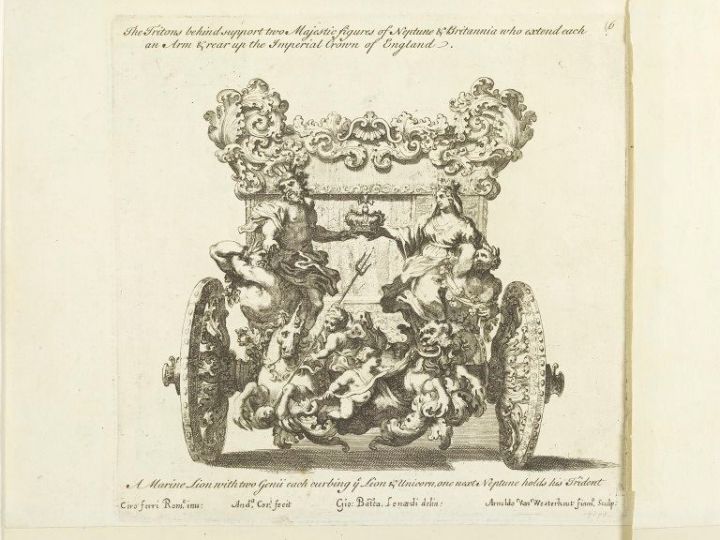
Design for a Carriage Built by Andrea Cornely after a design by Ciro Ferri, engraving published in An Account of His Excellence, Roger Earl of Castelmaine’s Embassy from His Sacred Majesty James the II King of England, Scotland, France and Ireland &c. To His Holiness Innocent XI (London, ca. 1687). London: V&A 19393. Inscriptions read: “The Tritons behind support two Majestic figures of Neptune & Britannia who extend each / an Arm & rear up the Imperial Crown of England’ and in the lower center of the plate, “A Marine Lion with two Genii each curbing ye Lion & Unicorn, one next Neptune holds his Trident.”
◊ ◊ ◊ ◊ ◊
From the programme:
A donde Neptuno reina: Water, Gods and the Iconography
of Early Modern Power (16th–18th Centuries)
CHAM Conference—Oceans and Shores: Heritage, People, and Environments
Lisbon, 13 July 2017
Organized by Pilar Diez del Corral
Since Antiquity, the personification of water—rivers or seas—has been a recurrent elements in the iconography related to power. From the Tigris to the Ganges, from the Mare Nostrum to the Atlantic Sea, water seems to have been an essential element in the visual display of powerful monarchies and empires. After the European discovery of the Americas, oceans started also to play an extraordinary role in allegorical representations, especially in Spain and Portugal, though elsewhere, too. This panel approaches water iconography, especially as related to oceans, as a mode of representation of power during the early modern period, addressing its role in politics and culture.
Universidade Nova de Lisboa, Faculdade de Ciências Sociais e Humanas
Room 2, Edificio I+D, Avenida de Berna, 26-C
P R O G R A M M E
9.30 Welcome by Pilar Diez del Corral (Technische Universität, Berlin)
9.40 Morning Session, Part I
• Liana De Girolami Cheney (University of Massachusetts, Lowell), Giorgio Vasari’s Neptune as Cosimo I de’ Medici: Element of Water as a Political Symbolism
• Ilaria Bernocchi (University of Cambridge), Heroic Portraiture and Political Supremacy: ‘Andrea Doria as Neptune’ in Medals, Plaquettes, and the Heroic Portrait by Agnolo Bronzino
• Linda Briggs (University of Manchester), Gods and Monsters: Representations of Water in the Royal Entries of Henri II and Charles IX of France
11.00 Coffee break
11.30 Morning Session, Part II
• Jeremy Roe (Universidade Nova de Lisboa), From Image to Allegory: Faria e Sousa on Camoes’ Poetic Images of Neptune
• Carla Alferes Pinto and Cristina Brito (Universidade Nova de Lisboa), About Gods, Neptunian Man, and Horse Mackerels: The Ocean in the Representation of Power in Infanta Beatrice’s Wedding Theatre Play (1521)
• Christopher Kreutchen (Technische Universität, Dortmund), Moved by the Elementary Power of Neptune
13:00 Lunch break
14:00 Afternoon Session, Part I
• Laura García Sánchez (Universidad de Barcelona), The Vision of the New World through the Literature and Theatre of the Golden Age: Oceans and Seas, Myths and Gods
• Diego Solá (Universidad de Barcelona), ‘Iberi Imperii finis limes et orbis erit’: China, Spain, and the Ocean through Propagandistic and Cartographic Representations (XVI–XVII Centuries)
• Filipa Araujo (Universidade de Coimbra), Reis d’ Aquém e d’Além-Mar: Emblematic Representations of Water in Portuguese Royal Festivities (17th Century)
• Álvaro Pascual Chenel (Universidad de Valladolid), Rivers and Oceans in Royal Iconography and Spanish Monarchy Representation during the Modern Age
15:40 Coffee break
16:00 Afternoon Session, Part II
• Giacomo Montanari (Università degli Studi di Genova), The Neptune’s Palace: Iconographies of the Power into the House of Stefano Durazzo in Genova
• Fernando Miguel Jalôto (Universidade Nova de Lisboa), ‘Il gran Monarca è questi, che sempre dominò su’l Gange e’l Tago’: Aquatic Metaphors and Allegories to the Reign of John V in Contemporary Musical Works
• Fernando Morato (Ohio State University), Mar Portuguez: The Atlantic Ocean as Stage for Portuguese Domination of the Americas
17:00 Concluding discussion










leave a comment