Symposium | Full Circle: The Medal in Art History
◊ ◊ ◊ ◊ ◊
From the symposium flyer:
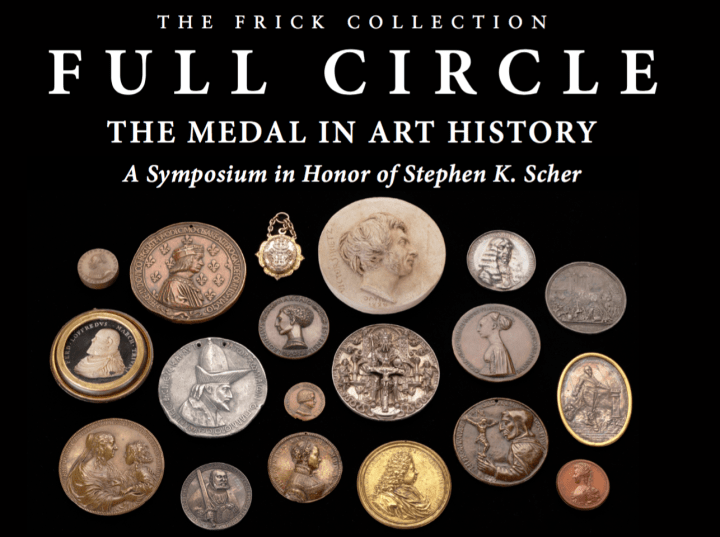
Full Circle: The Medal in Art History — A Symposium in Honor of Stephen K. Scher
The Frick Collection, New York, 8 September 2017
On the occasion of the exhibition The Pursuit of Immortality: Masterpieces from the Scher Collection of Portrait Medals, The Frick Collection will hold a symposium on Friday, September 8, 2017, in honor of Stephen K. Scher’s many contributions to the study of medals. This symposium builds on the work of Scher and others who have sought to re-center the medal in art-historical discourse, and aims to bring this important class of object to the attention of the broader scholarly community and the public. The symposium is free, but registration is required.
• Susan Dackerman (Visiting Scholar, Getty Research Institute), Making Prints, Making Medals
• Ilaria Bernocchi (Doctoral Candidate, University of Cambridge), ‘Inventing’ Identity: Medals and Heroic Portraits in the Italian Renaissance
• Emily Fenichel (Assistant Professor, Florida Atlantic University), Michelangelo’s Portrait Medal: Thee Penitent Artist in His Final Years
• Jeffrey Collins (Professor, Bard Graduate Center), Egentium Votis: Francesco Riccardi, Giovacchino Fortini, and the Art of Self-Promotion
• Martin Hirsch (Curator, Staatliche Münzsammlung, Munich), Papal Medals and the Interplay of Prints, Paintings, and Numismatics
• Hannah Williams (Leverhulme Early Career Research Fellow, Queen Mary University of London), Portrayal and Commemoration: Medal Engravers at the French Academy of Painting and Sculpture
• Iris Moon (Visiting Professor, Pratt Institute), Kneeling Man in Chains: Recasting Invisibility and Absence in the Wedgwood Anti-Slavery Medallion
• Anna Seidel (Researcher, Hamburger Kunsthalle), ‘The Revival of the Medal’: Medals and Plaquettes at the Origin of Alfred Lichtwark’s Sculpture Collection at the Hamburger Kunsthalle
• Emerson Bowyer (Searle Associate Curator of European Painting and Sculpture, Art Institute of Chicago), History in Relief
The above order of speakers is provisional.
Conference | A Manorial World
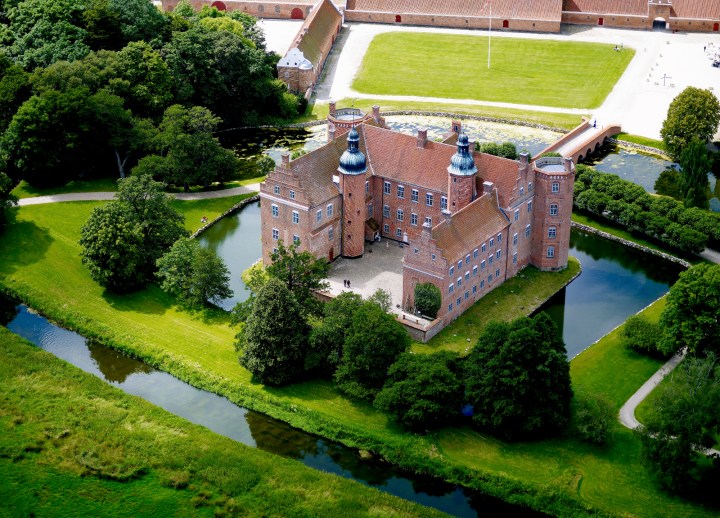
Gammel Estrup Manor, a Renaissance manor house 12 miles east of Randers in Jutland, Denmark.
◊ ◊ ◊ ◊ ◊
From the conference programme:
A Manorial World
Gammel Estrup Manor (near Randers, Denmark), 21–23 September 2017
Registration due by 1 September 2017
Manors and country houses were for centuries a fundamental characteristic of European societies. Notwithstanding national and regional differences across Europe, manors and country houses were in most countries an economic, administrative, and political cornerstone in society. Historical processes towards democratization have pushed the manors and country houses towards the periphery, but still manors and country houses occupy an important position in society, not least in the public memory and the heritage sector. They continue to capture the imagination of tourists and visitors, as well as the scholarly interest from researchers from a wide range of academic fields such as history, architecture, archaeology, art history, anthropology, geography, and heritage studies.
 The conference will examine transnational similarities and differences in the historic role, the management and the functions of manors and country houses, as well as the present-day influence and use of estate landscapes. Not just the grand estates but all manors and country houses, large and small, have had a notable influence, and they still play an important role in the physical outline as well as the identity of place in contemporary European rural communities.
The conference will bring together curators and academics with an ambition to expand and nuance the notion of manors and country houses as European cultural heritage. In order to encourage the interdisciplinary discussion among participants, the conference does not schedule parallel sessions—all presentations will be addressed to the assembled conference audience.
The programme includes two conference days and one excursion day with visits to outstanding country houses in Jutland. The conference is held 21–23 September at Gammel Estrup – The Manor Museum, Denmark and it is organized by the Danish Research Centre for Manorial Studies at Gammel Estrup. The conference fee is 195€; the fee includes two conference days and an excursion day, catering during the conference, and a conference dinner on Thursday. The closing date for registration is 1 September 2017. To register, please send an e-mail to mf@gammelestrup.dk. More information about the programme, excursion, and how to register is available here.
◊ ◊ ◊ ◊ ◊
T H U R S D A Y , 2 1 S E P T E M B E R 2 0 1 7
8.15 Bus from Randers to Gammel Estrup
8.45 Coffee and registration
9.15 Welcome (Mette Bock, Danish Minister of Culture), Else Søjmark (Chair for Culture Municipality of Norddjurs), and Britta Andersen (Gammel Estrup – the Manor Museum)
10.00 Keynote
• Carsten Porskrog Rasmussen (Museum Sønderjylland, DK), The Creation of a Manorial Landscape in Schleswig
11.00 Dutch Landscapes and Country Houses
Chair: Yme Kuiper (University of Groningen, NL)
• Yme Kuiper (NL), The Invention of the Dutch Landscape in the Golden Age?
• Gerrit van Oosterom (NL), The Danish Connection: How Dutch-Danish Oxen Trade Influenced the Development of the Manorial Landscape South of Amsterdam
• Lenneke Berkhout (NL), Joseph Dinant: Fontanier-grottier to the Prince of Orange, Successful Client, and Transnational Broker
• Martin van den Broeke (NL), Trying a New Research Model: Country House Culture on the Island of Walcheren
12.20 Lunch
13.30 Keynote
• Arne Bugge Amundsen (University of Oslo, N), Manorial Landscape of Norway
14.30 The House and the Family
Chair: Mikkel Venborg Pedersen (The National Museum of Denmark, DK)
• Stefanie Schuldt (D), Christina Piper’s Manorial World in Skåne
• Kristine Dyrmann (DK), The Social World of Funens Country Houses: The Pocket Books of Sybille Reventlow, Countess at Brahetrolleborg, 1779–1787
• Jon Stobart (UK), Ancient and Modern, English Country House, ca. 1700–1830
• Tora Holmberg (S), Choosing a Manor Dwelling? Class, Gender, and Housing Choices in Contemporary Sweden
16.15 Bus from Gammel Estrup to Hotel Randers
18.15 Bus from Hotel Randers to Clausholm
19.00 Conference dinner at Clausholm
F R I D A Y , 2 2 S E P T E M B E R 2 0 1 7
8.15 Bus from Randers to Gammel Estrup
9.00 Keynote
• Heike Düselder (Museum Lüneburg, D), Heritage Management, Museums, and Manors
10.00 Gardens and Landscapes
Chair: Jonathan Finch (University of York, UK)
• Ismo Häkkinen (SF), Kultaranta: Three Lives of a Garden
• Lars Jacob Hvinden-Haug/Aina Aske (N), Reconstructing Historical Gardens: Negotiations and Debates, the Larvik Case
• Annegreth Dietze-Schirdewahn/Lei Gao (N), New Knowledge about the Manorial Austrått Landscape in Ørland, Norway
11.00 Coffee
11.30 Sustainability in the Country House Landscape
Chair: TBC
• Gerdy Verschuure-Stuip (NL), The Regional Country House Landscape
• Els van der Laan (NL), Gardens and the Green Heritage Landscape
• Rodrigo Dias (P), The Tagus Estuary Quintas: Lisbon Estate Landscape
12.30 Lunch
13.30 Managing the Manorial Landscape
Chair: Paul Zalewski (Europa-Universität Viadrina, D)
• Elyze Storm-Smeets (NL), Heritage Lost and Found
• Garry Keyes (DK), To Be or Not to Be a Manor House?
• Willemieke Ottens (NL), Who Is Better in Landscape Management? Private Owners vs. Heritage Organisations?
• Janneke van Dijk (NL), Private Heritage and Public Functions
15.00 Keynote
• Fred Vogelzang (Kenniscentrum voor kasteel en buitenplats, NL), New Functions for Castles and County Houses: The Fall and Rise of Heritage?
15.00 Coffee
16.15 Discussion
16.45 Guided tour at Gammel Estrup – the Manor Museum
18.15 Bus from Gammel Estrup to Randers
S A T U R D A Y , 2 3 S E P T E M B E R 2 0 1 7
8.15 Bus leaves Randers
8.45 Visit to Rosenholm (tbc)
10.30 Guided tour and lunch at Bidstrup
13.00 Arrival at Randers railway station
14.00 Arrival at Aarhus airport
15.10 SAS flight to Copenhagen
Details are subject to change.
◊ ◊ ◊ ◊ ◊
In October 2015 the European Network for Country House and Estate Research (ENCOUNTER) was founded at Gammel Estrup – the Manor Museum, Denmark, by a group of European researchers, curators, professionals in the heritage sector and others with an academic interest in the field.
The aim of the network is to form European partnerships between scholars and cultural institutions who share a professional interest in research and interpretation of manor and country house history. It aims to explore and highlight regional variations and notable similarities in the history of castles and manors across Europe from 1500 to the present and will discuss how estates and estate landscapes are preserved and interpreted as cultural heritage today.
Members of the network wish to cross traditional boundaries between history, archaeology, art history, architecture and heritage management and to further international transdisciplinary partnerships between researchers and professionals in universities and museums.
Symposium | The Pleasures of the Historical Imagination
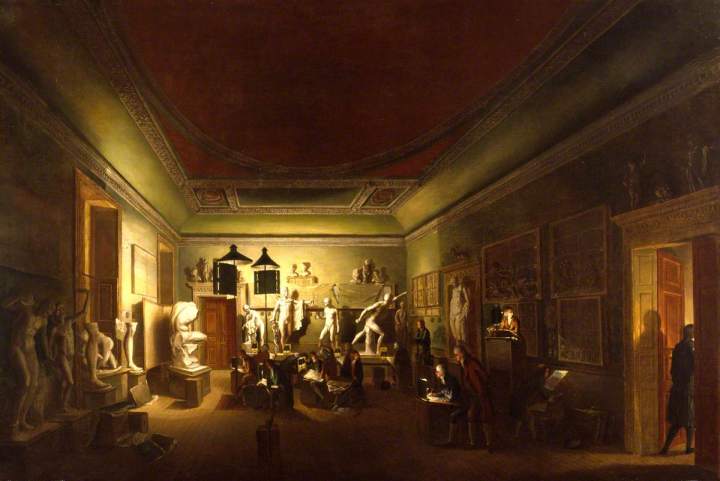
Attributed to Johann Zoffany, The Antique Room of the Royal Academy at New Somerset House, 1780–83
(London: Royal Academy of Arts)
◊ ◊ ◊ ◊ ◊
From the symposium schedule (which includes abstracts of the papers). . .
The Pleasures of the Historical Imagination: A Dialogue with John Brewer
European University Institute, Villa Salviati, Florence, 22–23 June 2017
Organized by Silvia Sebastiani, Matthew Hunter, and Fredrik Albritton Jonsson
John Brewer’s work has cut a wide swathe through political, cultural, and economic history. To mark his retirement from teaching, this symposium gathers his former students, interlocutors, and friends for an exchange of conversation, discussion, and convivial disagreement, along with an update from John on his current research. These twenty-one papers are not retrospective tributes in the manner of a traditional Festschrift but rather an occasion to report on exciting new findings in the many different fields touched by John’s scholarship.
T H U R S D A Y , 2 2 J U N E 2 0 1 7
9.30 Welcome and Introduction
9.45 1. Politics and the State
Chair: Eckhart Hellmuth (Ludwig-Maximilians Universität, München)
• Joanna Innes (University of Oxford), Britain and the Liberation of Europe: Napoleon and After
• Paul Monod (Middlebury College), Eighteenth-Century European Politics: Ideology or Culture?
• Holly Brewer (University of Maryland), Creating a Fashion for Slavery in the Stuart Court(s)
• Kathleen Wilson (Stony Brook University), Provincializing Britain: English Theatre in an Imperial Public Sphere, or, Modernity at the Margins
11.15 General Discussion
12.15 Lunch
14.00 2. Cultural History
Chair: Arthur Legger (University of Amsterdam)
• Xenia von Tippelskirch (Humboldt-Universität zu Berlin), Imagining the Italian Renaissance around 1900
• Sophie Maisonneuve (Université Paris Descartes/IIAC), Collecting Recorded Music, 1877–2017: From Document to Experience
• Alexis Schwarzenbach (Lucerne University), The Great Wave: Katagami, Mangas and Other Japanese Artefacts Exported to the West around 1900
• Michèle Cohen (UCL Institute of Education, University of London), The Grand Tour: Fashioning ‘Citizens of the World’ or ‘Worthy Citizens of England’?
15.00 General Discussion
16.00 Coffee Break
16.30 3. Art History and Visual Culture
Chair: Malcolm Baker (University of California Riverside)
• Davide Lombardo (NYU in Florence), Repressed? Daumier and the Massacres of June 1848: Drawings, Paintings, and Lithographs
• Flaminia Gennari Santori (Gallerie Nazionali d’Arte Antica di Palazzo Barberini e Palazzo Corsini), ‘Your Reader Is a Martian Who Understands Everything’: Readers, Viewers, and Visitors, Past and Present
• Mark Hallett (Paul Mellon Centre), The War of the Portraitists: Artistic Competition and the Dynamics of Exhibition Culture in Georgian London
• Matthew C. Hunter (McGill University), Thick Slicing: Frederic Edwin Church’s Actuarial Imagination
17.30 General Discussion
F R I D A Y , 2 3 J U N E 2 0 1 7
10.00 4. Intellectual History and History of Science
Chair: Lawrence Klein (Unversity of Cambridge)
• Silvia Sebastiani (EHESS, Paris), At Tea with Madame Chimpanzee: A ‘société de spectacle’ in 1730s London
• Jan Albers (Independent Writer and Museum Consultant), ‘I Don’t Like History, But Do You Know What Happened Here?’ Writing a Cultural History of the Landscape
• Alexander Geppert (NYU), The Pleasures of the Imagination in Space, or: the Alien Contact Phenomenon
• Nick Wilding (Georgia State University), Forging the Moon
11.30 General Discussion
12.30 Lunch
14.00 5. Consumption and Economic History
Chair: Laurence Fontaine (CNRS)
• Fredrik Albritton Jonsson (The University of Chicago), Anthropocene History
• John Styles (University of Hertfordshire), Industrial Revolution: From Production to Consumption, and Back Again
• Dawn Lyon (University of Kent), What is a Fish Worth? Sensory Knowledge, Labour, and the Production of Value at Billingsgate Fish Market
• Frank Trentmann (Birkbeck, University of London), Material Histories: Scales, Objects, and Networks
15.00 General Discussion
16.00 Coffee Break
16.30 John Brewer, Remarks and new projects
17.00 Concluding Discussion
Workshop | Landscapes of the Long 18th Century in South Asia
From H-ArtHist:
Landscapes of the Long 18th Century
Mediating Places, Powers, and Pasts in South Asia and Beyond
Forum Transregionale Studien and the Museum for Asian Art, Berlin, 21–23 June 2017
Organized by Dipti Khera and Hannah Baader
This workshop seeks to explore how painters, poets, historians, and intellectuals have imagined landscapes and urbanisms in and of early modern South Asia, particularly over the course of the long eighteenth century. The mediation of memory and place in pictorial and literary practices in this time period was shaped by aesthetic and philosophical ideas and an epistemic situation that had deeper genealogies in the subcontinent and the broader Asian and Islamic world. Nonetheless, images, moods and ideologies encapsulated in British landscape painting and colonial photography have constructed the dominant lens that has shaped historical inquiries into spatial imaginings in the South Asian context. The focus on the long eighteenth century enables us to establish conversations between the intersections, connections, and comparisons that emerged in visual practices commissioned by diverse patrons from regional kings, Mughal emperors, trans-regional merchants, and British officers.
W E D N E S D A Y , 2 1 J U N E 2 0 1 7
18.00 Evening Lecture
• Tim Barringer (Yale University), The Panorama as Global Landscape
T H U R S D A Y , 2 2 J U N E 2 0 1 7
10.00 Welcome and Introduction from Hannah Baader (Arthistories/ Kunsthistorisches Institut in Florenz, Max-Planck-Institut) and Dipti Khera (NYU/ Arthistories Fellow 2015–16)
10.30 Morning Session
Chair: Lamia Balafrej (ArtHistories Fellow 2016–17/Wellesley College)
• Sunil Sharma (Boston University), The Pastoral Landscape in Early Modern Persian Poetry and Painting
• Chanchal Dadlani (Wake Forest University), History Without Words: Mughal Architecture in the ‘Amal-i Salih.
• Hannah Baader (Forum Transregional Studies/Kunsthistorisches Institut in Florenz, Max-Planck-Institut), Seascape and Landscape, Florence 1604
14.30 Afternoon Session, Part I
Chair: Monica Juneja (Universität Heidelberg)
• Yuthika Sharma (Edinburgh College of Art), Picturing Place: Topography as Mughal Identity in Late 18th-Century Delhi
• Dipti Khera (NYU, Arthistories Fellow 2015-16), The Art of Feeling Place: Udaipur’s Affective Assertions
16.40 Afternoon Session, Part II
Chair: Ning Yao (CAHIM Fellow 2016-17)
• Nobuko Toyosawa (Oriental Institute of the Czech Academy of Sciences), Mediating the Sense of Place from Tokugawa to Meiji Japan
• Lihong Liu (Rochester University), Long Day and Sleepless Night: Temporal Sensitivity in Chinese Landscape Painting
F R I D A Y , 2 3 J U N E 2 0 1 7
9.45 Study Session in the Museum for Asian Art with Raffael Gadebusch, New ‘Perspectives’: Landscape and Architecture as Subject Matter in Late 18th-Century Indo-Islamic Painting (speakers and invited guests only)
14.00 Afternoon Session
Chair: Venugopal Madipatti (Art Histories Fellow 2016–17/Ambedkar University Delhi)
• Francesca Orsini (SOAS University of London), The Work of Description: Shifting Modes of Poetic Description of Places in 19th-Century Urdu Narratives
• Tim Barringer (Yale University), The Proleptic Picturesque of Joseph Bartholomew Kidd
Symposium | Movement and Circulation in North American Art
From H-ArtHist and the Freie Universität Berlin:
At Home and Abroad: Movement, Influence, and Circulation in North American Art
John F. Kennedy Institute for North American Studies, Freie Universität Berlin, 28–29 June 2017
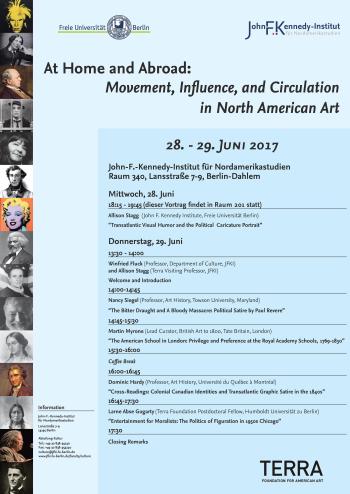 This international symposium will explore transcultural exchanges of North American artists and art objects from the late eighteenth century to the early twentieth century. Papers will address the movement and displacement of North American artists and the circulation of physical art objects in North America and Europe, such as paintings and prints, during a broad time frame. Issues of audience and viewership across North America and Europe will also be considered, along with the varied forms of influence and knowledge from sources such as newspapers, letters, and copies of graphic material.
Seeking to stimulate an interdisciplinary exchange, this symposium brings together invited scholars and curators working in universities and museums in the United States, Canada, Germany, and the United Kingdom.
The symposium is organized by Dr. Allison Stagg, Terra Foundation for American Art Visiting Professor at the John F. Kennedy Institute for North American Studies, Freie Universität Berlin.
◊ ◊ ◊ ◊ ◊
W E D N E S D A Y , 2 8 J U N E 2 0 1 7
18:15 Allison Stagg (John F. Kennedy Institute for North America Studies), Transatlantic Visual Humor and the Political Caricature Portrait
T H U R S D A Y , 2 9 J U N E 2 0 1 7
13:30 Welcome and Introduction from Winfried Fluck (Professor, Department of Culture, John F. Kennedy Institute for North American Studies) and Allison Stagg (Terra Visiting Professor of America Art, John F. Kennedy Institute)
14:00 Nancy Siegel (Professor, Art History, Towson University, Maryland), The Bitter Draught and a Bloody Massacre: Political Satire by Paul Revere
14:45 Martin Myrone (Curator, Tate Britain, London), The American School in London: Privilege and Preference at the Royal Academy Schools, 1769–1830
15:30 Coffee break
16:00 Dominic Hardy (Professor, Art History, Université du Québec à Montréal), Cross-readings: Colonial Canadian Identities and Transatlantic Graphic Satire in the 1840s
16:45 Larne Abse Gogarty (Terra Foundation Postdoctoral Fellow, Humboldt Universität, Berlin), Entertainment for Moralists: The Politics of Figuration in 1950s Chicago
17:30 Closing remarks
Workshop | Watteau, Gersaint, et le Pont Notre-Dame, 1720
◊ ◊ ◊ ◊ ◊
From the programme (which includes additional information on participants). . .
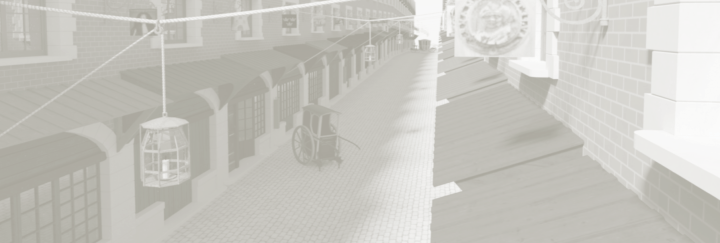
Watteau, Gersaint, et le Pont Notre-Dame en 1720: Exploration
virtuelle du pont habité le plus monumental de l’histoire de Paris
Pôle Sciences et Cultures du Visuel, Tourcoing, 30 June 2017
Journée-atelier organisée dans le cadre de la restitution du projet PEPS – CNRS Réseau National des MSH
À l’intersection de l’histoire urbaine, de l’histoire de l’art, de la culture matérielle et visuelle, de la musicologie et de l’informatique, la restitution numérique du pont Notre-Dame offre une exploration visuelle, spatiale et sonore inédite du pont habité le plus monumental de l’histoire de Paris. Mené par une équipe pluridisciplinaire de chercheurs en informatique, en sciences historiques et de professionnels spécialisés en infographie 3D et en traitement sonore, il s’attache à restituer non seulement le sens des espaces, des matériaux et des volumes de cette architecture disparue, mais aussi à rendre sensible l’ambiance lumineuse et sonore de son environnement. Ces relectures du passé (tant du point de vue de l’éclairage que du son) offrent l’intérêt de recontextualiser finement la maquette du pont Notre-Dame et de révéler la distance qui existe entre passé et présent par le prisme du sensible. Une attention particulière sera portée à la restitution de la boutique du plus célèbre marchand du pont, Edme-François Gersaint, pour qui Jean-Antoine Watteau peignit, en 1720, la fameuse Enseigne de Gersaint, (Berlin, Schloss Charlottenburg). Le choix de la date retenue se justifie donc par un évènement artistique majeur dans l’histoire du pont Notre-Dame et plus généralement dans l’histoire de l’art : la présentation éphémère, en façade de la boutique de Gersaint, de ce tableau singulier, unique en son genre. L’apport de la restitution en 3D permettra d’avancer de nouvelles propositions quant au dispositif de présentation de cette peinture qui permettront de mieux en apprécier l’originalité et la portée provocatrice.
Cette journée-atelier offrira l’occasion à des chercheurs partageant un intérêt commun pour le potentiel offert par les outils numériques d’échanger sur les expériences et projets en cours dans les domaines de l’histoire urbaine, de l’histoire de l’art et du patrimoine.
Entrée libre sous réserve des places disponibles. Inscription obligatoire, avant le 22 juin 2017, auprès de Sophie Raux, sophie.raux@univ-lyon2.fr.
Pôle Sciences et Cultures du Visuel
99 Bld Descats, 59200 Tourcoing
Métro ligne 2, arrêt Alsace
P R O G R A M M E
9.30 Accueil des participants
10.00 Table ronde organisée par l’équipe projet
Youri Carbonnier, Frédéric Foveau, Claudio Gallego, Quentin George, Prosper Groux, Laura Louvrier, Mylène Pardoen, Sophie Raux, Sophie Reculin, Christophe Renaud, François Rousselle En présence de Guillaume Glorieux
11.15 Restitutions visuelles et sonores
• Expériences immersives visuelles, sonores, interactives ou non avec casques HTC VIVE
• Découverte de la maquette virtuelle du Pont Notre-Dame sur écran géant 4K
• Présentation par Julien Wylleman et Samuel Degrande du dispositif de réalité virtuelle du pôle SCV
12.30 Déjeuner
14.00 Partage d’expériences autour des enjeux du numérique dans la restitution du patrimoine matériel et sonore
• Nicolas Moucheront, L’histoire du pont Notre-Dame vue au XVIIIe siècle par l’architecte Pierre-Louis Moreau
• Renato Saleri, Le pont au Change, Lyon
• Patrick Callet, Polychromie, dorures et effets merveilleux médiévaux Mylène Pardoen : Entendre l’histoire est-ce possible ?
Workshop | Transplanted Places: Garden Design
From H-ArtHist:
Transplanted Places: Garden Design and Shifting Cultural Geographies, 1650–1800
Museum of Asian Art, Berlin (Dahlem), 22–24 June 2017
Organized by Joachim Rees and Jeong-hee Lee-Kalisch
 Please register by 15 June 2017 via email: Arbeitsbereich-Rees@geschkult.fu-berlin.de. Additional information is available here.
T H U R S D A Y , 2 2 J U N E 2 0 1 7
18:00 Welcome from Joachim Rees and Jeong-hee Lee-Kalisch
18:10 Keynote Address
• Hans von Trotha (Berlin), A Garden is a Garden is a Garden: Reestablishing a Discourse on the Art of Gardening in the Beginning of the Twenty-first Century
F R I D A Y , 2 3 J U N E 2 0 1 7
9:30 Travelling, Collecting, Gardening
Chair: Klaas Ruitenbeek (Berlin)
• Marianne Klemun (Vienna), Connecting Spaces: Mobile Meanings of Plants
• Lianming Wang (Heidelberg), Exotic Plants and Transplanted Spaces in Eighteenth-Century Beijing
• Stefan Schweizer (Düsseldorf), Mountains, Rivers, Monuments: Landscape and Territory as Symbolic Features in Early Modern European Gardens
13:00 Lunch
14:30 Gardens and the Geography of Opposition and Dissent
Chair: Sebastian Fitzner (Berlin)
• Jeong-hee Lee-Kalisch (Berlin), Veins and Bones: Garden Landscape as Representation of the Cosmic Organism
• Jongsang Sung (Seoul), Garden as a Secluded Paradise: Seventeenth-Century Joseon Scholar Kosan Yoon Seondo’s Garden
• Franziska Bub (Berlin), The Wörlitz Landscape Garden: A Place of Opposition and Retreat in the Second Half of the Eighteenth Century
• Joachim Rees (Berlin), Colonies Lost and Regained: Landscape Gardening and Contested ‘Colonial Fantasies’ in Late Eighteenth-Century Germany
S A T U R D A Y , 2 4 J U N E 2 0 1 7
9:00 Gardens and the Aesthetics of Itinerancy
Chair: Gert Gröning (Berlin)
• Wybe Kuitert (Seoul), Raising Children: The Garden and Japan Perceptions of Constantijn Huygens
• Anna Ananieva (London), Curiosity for the East: Imagination and Knowledge of Chinese Culture in Eighteenth-Century Russia
• Yoonjung Seo (Berlin), King Chongjo (r. 1776–1800) and His Political Ambition Represented in the Royal Garden: Focusing on the Gatherings at the Jade Stream in Ch’angdok Palace
• Sheng-Ching Chang (Taipei), The Enlightenment of Prussia through the Far East: From the Planning of the Royal Gardens of Potsdam to Nineteenth-Century Urban Greening
13:30 Lunch
S U N D A Y , 2 5 J U N E 2 0 1 7
Excursion to Berlin-Marzahn: Gardens of the World | Gärten der Welt
Symposium | Reportage and Representation
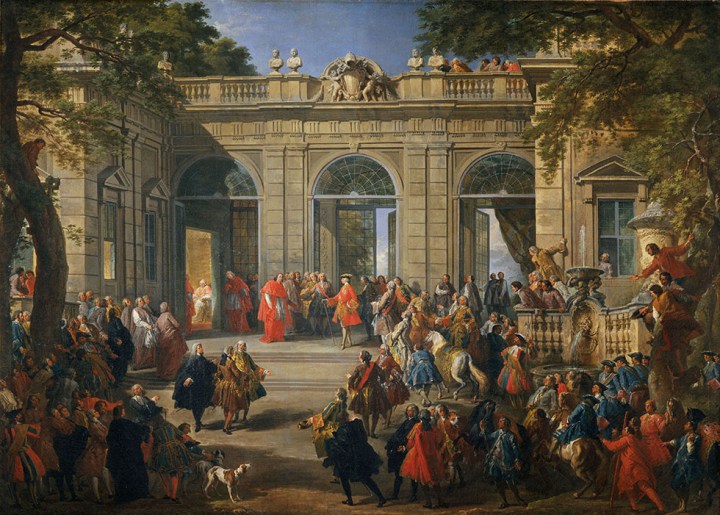
Giovanni Paolo Panini, King Charles III Visiting Pope Benedict XIV at the Coffee House of the Palazzo del Quirinale, 1746, 124 × 174 cm
(Naples: Museo Nazionale di Capodimonte)
◊ ◊ ◊ ◊ ◊
I’m dreadfully sorry to be late with this announcement (the event is just now wrapping up at The Getty), but I imagine the schedule is still useful for those of us not there to appreciate what a good day it must have been. –CH
Reportage and Representation: View Painting as Historical Witness
The Getty Center, Los Angeles, 28 May 2017
On the occasion of the exhibition Eyewitness Views: Making History in Eighteenth-Century Europe (on view at the Getty Center May 9–July 30, 2017), this scholarly symposium investigates the artistic framework and historical context of eighteenth-century view paintings recording contemporary events.
P R O G R A M
9:00 Registration and coffee
9:30 Welcome from Richard Rand (J. Paul Getty Museum)
9:45 Session 1: Princes, Popes, and Ambassadors
Moderator: Davide Gasparotto (J. Paul Getty Museum)
• Alberto Craievich (Ca’ Rezzonico, Venice), Regattas in Venice, 1680–1791
• Christopher Johns (Vanderbilt University, Nashville), Papal Diplomacy and Public Spectacle from Clement XII to Pius VI
• Stéphane Loire (Musée du Louvre, Paris), Giovanni Paolo Panini as a Witness of Public Life in Rome for the French Ambassadors
• Susan Tipton (Ludwig-Maximilians-Universität, Munich), Ambassadors on Stage in Eighteenth-Century Europe: Paintings of Diplomatic Ceremonies and Their Original Settings
12:30 Lunch
2:00 Session 2: Constructing Reality
Moderator: Louis Marchesano (Getty Research Institute)
• Edgar Peters Bowron (formerly The Museum of Fine Arts, Houston), Bernardo Bellotto’s Historical Views of Dresden, Vienna, and Warsaw
• David Marshall (University of Melbourne), Staging Rome: Giovanni Paolo Panini as Vedutista and Designer
3:00 Coffee break
3:30 Session 3: Patronage and the Market
Moderator: Jeffrey Collins (Bard Graduate Center, New York City)
• Francis Russell (Christie’s, London), Venetian Vedutisti and English Buyers: Some Connections and Footnotes
• Charles Beddington (London), Meeting Demand in Canaletto’s Venice
• Respondent: Jeffrey Collins (Bard Graduate Center, New York City)
R E L A T E D L E C T U R E
From Public Spectacle to Public Sphere: New Anthropologies of the Enlightenment
The Getty Center, Los Angeles, 27 May 2017
Larry Wolff, professor of history at New York University, considers how the baroque public spectacle—so essential to the rituals of the court and the church—began to give way in the eighteenth century to more informal and participatory forms of sociability and discussion, as reflected in eighteenth-century paintings of public occasion. Saturday, May 27, 5:00pm.
Symposium | Beautiful Sciences: Collecting under Joseph II
From H-ArtHist with additional information available from ÖAW and the programme:
Schöne Wissenschaften: Sammeln, Ordnen und Präsentieren unter Kaiser Joseph II
Österreichische Akademie der Wissenschaften (ÖAW), Vienna, 19–20 June 2017
Registration due by 14 June 2017
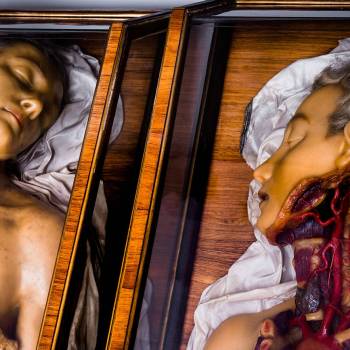
Anatomical wax models, Josephinum, Vienna (Photo: Michael Nagl).
Beautiful Sciences focuses on the collections under Emperor Joseph II (1741–1790) and makes them the entry point to a far-reaching analysis of their history and of how they were understood scientifically and by the public in late eighteenth-century Vienna. Historical art and scientific collections will be discussed, as well as their interconnected systems of systematization and organization. This interdisciplinary conference will explore how these various disciplines approach parallel contents, times, and places through their different methodical approaches and in their respective fields. From the perspective of collecting, organizing, and presenting, we will examine the extent to which the Josephine collections concentrate the ideas of the Enlightenment and translate them into practice, spread and popularise them, and thus turn them into places of knowledge and learning. Such a process was exemplary for the paradigm change emerging at that time, one that is still active today.
Konzept und Organisation: Nora Fischer und Anna Mader-Kratky
Anmeldung bis 14. Juni 2017 unter: kunstgeschichte@oeaw.ac.at
Kontakt: anna.mader@oeaw.ac.at, nora.fischer@oeaw.ac.at
M O N T A G , 1 9 J U N I 2 0 1 7
13.30 Werner Telesko (Direktor des Instituts für kunst- und musikhistorische Forschungen der ÖAW), Begrüßung
Nora Fischer (Wien), Einführung
14.00 Die Sammlungen: Konstitutionen von Wirklichkeiten und Wissensformen
Moderation: Gudrun Swoboda (Wien)
• Christa Riedl-Dorn (Wien), „Ordnung muss sein“ – Von der Naturaliensammlung zu den „Vereinigten k.k. Naturalien-Cabineten“
• Anna Maerker (London), „Spielwerk für Kinder“? Die Wachsmodellsammlung des Josephinums im Spiegel der Öffentlichkeit
• Bernhard Woytek (Wien), Systematische Numismatik. Wien und die Ordnung antiker Münzen im 18. und frühen 19. Jahrhundert
• Nora Fischer (Wien), Zwischen „Augenbelustigung“ und einer „dem Auge sichtbaren Geschichte der Kunst“. Zur Ordnung der kaiserlichen Galerie von 1781
18.00 Abendvortrag
Emma Spary (Cambridge), Placing Objects between Art and Nature in the Late Eighteenth-Century French Collection
D I E N S T A G , 2 0 J U N I 2 0 1 7
9:00 Betrachtungsweisen und Denksysteme
Moderation: Anna Mader-Kratky (Wien)
• Hans Christian Hönes (London), Winckelmann im Sammlungsraum. Armut macht Geschichte
• Kristine Patz (Berlin), Unter verkehrten Vorzeichen: Zur Musealisierung kunst- und naturwissenschaftlicher Sammlungen im Wechselspiel von ästhetischer Inszenierung und Wissenschaftlichkeit
• Christian Benedik (Wien), Das Primat der Wirtschaftlichkeit: Die Etablierung länderübergreifender Baunormen im staatlichen Bauwesen in der zweiten Hälfte des 18. Jahrhunderts
• Markus Krajewski (Basel), Wie ordnet sich Habsburg?
12.30 Mittagspause
14.00 Methoden und Konzepte der Präsentation und Publizität
Moderation: Werner Telesko (Wien)
• Andrea Seidler (Wien), Verwaltetes Wissen: Zum gelehrten Journalismus im Josephinischen Wien
• Thomas Wallnig (Wien), Wissen in Wien um 1780: Kontexte, Netzwerke, Institutionen
• Eva Kernbauer (Wien), Kunst als Wissensform? Martin Ferdinand Quadals Darstellung des Aktsaals der Wiener Akademie
2017 Mount Vernon Symposium
Next month at Mount Vernon:
Under My Vine & Fig Tree: Gardening, Landscape, and Design in the Age of Washington
Mount Vernon, 2–4 June 2017
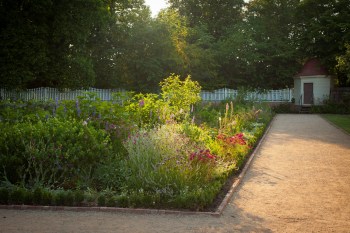
Morning sunlight highlights colorful beds in George Washington’s upper garden with seed house in the background, 2012. Photo by John Henley.
Join leading gardeners, historians, horticulturalists, archaeologists, and preservationists as they reconsider the importance of gardening, landscapes, and design in early America. Learn how Washington and his contemporaries shaped the natural world to achieve beauty through gardening, profited through agriculture, and conveyed civic values through landscape design—and how these historic methods remain relevant in today’s world. Revisit long-lost gardens, explore contemporary creations inspired by the past, and come face-to-face with the most authentic 18th-century plantation landscape in the United States.
F R I D A Y , 2 J U N E 2 0 1 7
12:30 Registration
1:00 Welcome and Introductions
1:15 William Rieley (Landscape Architect for The Garden Club of Virginia), Proportion without Mathematics in Early Virginia Landscapes
2:00 William C. Welch (Professor and Landscape Horticulturist for Texas A & M University), Exploring our Southern Gardening Heritage
2:45 Break
3:15 Dean Norton (Director of Horticulture at George Washington’s Mount Vernon), George Washington’s Mount Vernon Landscape
4:15 Landscape and Mansion Tours
5:45 Reception
6:30 Dinner
S A T U R D A Y , 3 J U N E 2 0 1 7
8:45 Welcome and Introductions
9:00 Forrest Pritchard (full-time sustainable farmer and New York Times bestselling author), Restoration Agriculture: Building Fertility and Protecting our Watershed through Sustainable Farming
10:00 Break
10:15 Luke Pecoraro (Director of Archaeology at George Washington’s Mount Vernon), ‘We have done very little investigation there; there is a great deal yet to do’: The Changing Historic Landscape of George Washington’s Mount Vernon
11:00 Bruce Ragsdale (recently served as Mount Vernon’s inaugural fellow in the Georgian Papers Programme at the Royal Archives at Windsor Castle), The Landscape of Improvement: Washington, George III, and the Picturesque Farm
12:00 Lunch
1:30 Morrie Heckscher (Curator Emeritus of the American Wing at The Metropolitan Museum of Art), Creating Central Park
2:30 Break
3:00 Joseph P. Gromacki (Chicago-based attorney, collector of American decorative arts, and avid gardener with a keen interest in heirloom plants), Kelton House Farm: Celebrating the History of Gardening in Colonial America
3:45 Gabriele Rausse (Director of Gardens and Grounds at Thomas Jefferson’s Monticello), Jefferson and Wine
5:00 Reception and Wine Tasting
6:30 Dinner, Whiskey Tasting, and Tours, George Washington’s Distillery and Gristmill
S U N D A Y , 4 J U N E 2 0 1 7
7:45 Optional Episcopal Service and Tour at Nearby Historic Pohick Church, where George Washington Attended and Served as Vestryman
9:30 Leslie B. Grigsby (Winterthur’s Senior Curator of Ceramics and Glass), Blooms Transported: Ceramic Vases and Floral Ornament
10:15 Thomas Ranier (Thomas Rainer is a landscape architect, teacher, and author living outside of Washington, D.C.), The Garden of the Future: Re-Imagining the American Yard
11:00 Break
11:30 Curator-led Tours of Lives Bound Together: Slavery at George Washington’s Mount Vernon










leave a comment