Conference: Art in Roman Palaces
Display of Art in Roman Palaces, 1550-1750
The Getty Center, Los Angeles, 2-3 December 2010
Rome—with its cardinals and international ambassadors to the papal court, its ancient barons and its newcomers trying to appear as if they descended from Caesar, all building, expanding, remodeling, and furnishing magnificent palaces, or trying to rent quarters befitting their needs and status—provided a powerful model for how the elites of Europe and beyond should live with an abundance of art. Here, display of art was calibrated to the ceremony of life and work in these great houses, to an etiquette and hierarchy that applied to every person, space, and thing.
This two-day conference is part of a Getty Research Institute research project on display in Roman houses from 1550 to 1750, two centuries that encompass the beginnings of collecting, as it is generally understood today, and the end of the “baroque,” by which time a very different concept of the interior had taken shape. Different media categories, moveable and immoveable—such as frescoes, cabinet pictures, tapestries, sculpture, and architecture—have been studied, yet little attention has been given to their integration into ensembles in which people conducted their lives. The wealth of microhistories on collecting allows for a broad-gauged analysis of display, and how it informed emerging concepts of art and art history. Conference presentations will explore the social and cultural context for display, the circuitry of production and the art market, access to interiors, and the processes by which desire was negotiated into concrete aesthetic environments that responded to the contingencies of life and change.
Admission is free. Reservations required for each day.
For more information or to make a reservation, visit the Getty website»
Colloquium on French Agrarian Architecture
From the INHA website:
L’art de bâtir aux champs: Modernité du patrimoine rural et théorie des constructions agricoles
Institut national d’histoire de l’art, Paris, 14-15 October 2010
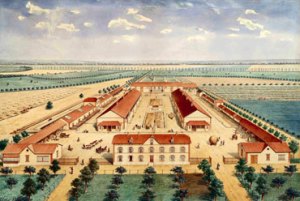
Vue aérienne d’ensemble de la ferme de Platé d’Armand Moisant. Archives départementales d’Indre-et-Loire.
Le colloque L’art de bâtir aux champs, organisé en partenariat par l’Institut national d’histoire de l’art et la Direction des patrimoines du ministère de la Culture et de la Communication, rassemble des chercheurs ayant contribué aux travaux des services de l’Inventaire, dans le domaine du bâti rural et agricole, et des chercheurs participants au programme de l’INHA sur la théorie et la bibliographie du livre d’architecture français.
Il s’agit de mettre en exergue une période durant laquelle, à partir de la fin du XVIIIe siècle, l’architecture agricole donne lieu à un nombre croissant de publications. Celles-ci témoignent à la fois de l’actualité de ce domaine et de l’intérêt que lui portent des auteurs variés, architectes, ingénieurs ou propriétaires souvent rassemblés au sein des sociétés d’agriculture. Elles défi nissent également le cadre d’une production qui abandonne les pratiques traditionnelles, au profi t de méthodes plus rationnelles.
Aux marges du domaine qui était alors celui de l’art architectural, cette production imprimée coïncide avec une certaine démocratisation de la maîtrise d’ouvrage : les édifices « propres à loger les animaux » ou les granges et les hangars construits avec soin dans quelques demeures aristocratiques depuis la Renaissance italienne, étaient désormais un enjeu, pour un nombre croissant de commanditaires.
The colloquium program is available here»
Symposium: Arts of Spanish America and Early Global Trade
From the Denver Art Museum:
At the Crossroads: The Arts of Spanish America and Early Global Trade, 1492–1850
Mayer Center for Pre-Columbian and Spanish Colonial Art, Denver Art Museum, 12-13 November 2010
 During the era of early global trade instigated by the voyages of Columbus, Spanish America served as a crossroads for trade between Europe and Asia. Trade goods were exchanged between all areas and inspired artists to appropriate motifs, styles, and techniques previously unknown to them. The impact of trade on the arts of all regions and the transmission of objects and ideas between Spanish America, North America, Europe, and Asia will be included.
◊ ◊ ◊ ◊ ◊
S P E A K E R S
Karina Corrigan (Peabody-Essex Museum – Salem, MA), Chinese Export Silver to the Americas
Claire Farago & James Cordova (University of Colorado – Boulder), Casta Painting and Self-Fashioning Artists in New Spain
Dana Leibsohn (Smith College – Northampton, MA), Made in China / Made in Mexico
Jaime Mariazza F. (Universidad de San Marcos – Lima, Peru), Royal Funerary Rites in 17th-Century Lima: The Catafalque of Margaret of Austria
Maria Bonta de la Pezuela (Sotheby’s – New York), The Perils of Porcelain: Chinese Export Porcelain in the Mexican Colonial Market
Donna Pierce (Denver Art Museum), Asian Trade Goods in Colonial New Mexico
Sara Ryu (Yale University – New Haven), Transatlantic Icons of Conquest: Cristos de caña in New Spain and the Canary Islands
William Sargent (Peabody-Essex Museum – Salem, MA), Asian Ceramics in New England
Suzanne Stratton-Pruitt (Independent Scholar – New York), From Spain to Peru: Paintings by the Dozen
Charlene Villasenor Black (University of California – Los Angeles), Saints’ Cults and Conversion in the Global Hispanic World
Rare Books Workshop in Bloomington — Latin for Title Pages
RBMS Regional Workshop: Latin for Rare Materials Catalogers
Indiana University Bloomington, 22 October 2010, 9:00-4:30
Registration deadline: 1 October 2010
This Rare Books and Manuscripts Sections regional workshop is intended for rare materials catalogers with little or no familiarity with Latin. The workshop will provide tools for navigating the title page, including identifying the key verbs and inflected forms of nouns for persons, places, and things in order to accurately record title and remainder of title information, author(s) and other names, editions, and publication information (i.e. DCRM(B)/AACR2 descriptive areas 1, 2, and 4), and any related notes. Among the issues addressed will be identifying and expanding contracted forms, Latin terminology used for publishing, and other issues unique to Latin materials.
Presenters: Jennifer MacDonald (University of Delaware) and Jennifer Nelson (The Robbins Collection, University of California Berkeley School of Law). Registration materials are available online. Registration is limited to 30 participants. Fees: ACRL member – $189; Nonmember – $239. Join ACRL today to take advantage of valuable members-only discounts, professional connections, and community. Questions: Contact Tory Ondrla at tondrla@ala.org, or call 312-280-2515.
Reynolds Conference in Geneva
Sir Joshua Reynolds: What’s New?
Université de Lausanne / Musée d’art et d’histoire de Genève, 16-18 September 2010
Colloque Internation organisé par Jan Blanc (Université de Genève) et Pascal Griener (Université de Neuchâtel)
Ce colloque est le premier événement scientifique organisé en Suisse autour de la carrière, de l’œuvre et de l’univers de Sir Joshua Reynolds (1723-1792). Il est aussi l’un des premiers, depuis la dernière grande exposition rétrospective consacré au premier Président de la Royal Academy, à Londres et à Paris (1986), à faire le point des recherches et des travaux les plus récents sur le peintre et son temps. Dans le cadre d’un lieu de rencontres et d’échanges entre les chercheurs et le grand public, il s’agira de permettre aux spécialistes confirmés ainsi qu’aux jeunes chercheurs de se rencontrer, de comparer leurs analyses et de croiser leurs réflexions autour d’un peintre autour duquel de nombreuses questions restent en suspens ou discutées.
Thursday, 16 September 2010
2:00 Jan Blanc et Pascal Griener, Accueil – Ouverture
R E Y N O L D S E N S O C I É T É
2:30 Bénédicte Miyamoto-Pavot, Reynolds en contexte: l’acquisition des arts en Grande-Bretagne au XVIIIe siècle
3:00 David Spurr, Authorial gestures: Reynolds’ literary portraits
Discussion – Pause
4:00 Frédéric Ogée, Hogarth et Reynolds
4:30 Christopher Martin Vogtherr, The Hertford family painting by Reynolds: A case study in British collecting patterns
Discussion – Pause
5:30 Georges Starobinski, Esprit d’enfance et ton pastoral: un contrepoint musical aux fancies de Joshua Reynolds
Discussion
Fin de la première journée
Friday, 17 September 2010
R E Y N O L D S E N P R A T I Q U E S
9:00 Giovanna Perini, Reynolds in Rome: Notes from the New York and family sketchbooks
9:30 Donato Esposito, Drawn to drawings: Reynolds and the drawn line
10:00 Rica Jones, «Some new stratagem of painting the face all red or all blue or all purple at the first sitting» : Reynolds and the world of portraiture in the 1740s
Discussion – Pause
11:00 Colin Harrison, Reynolds in miniature
11:30 Martin Postle, «New light on an old war horse » : Reynolds’s equestrian portrait of Lord Ligonier
12:00 Cristina S. Martinez, Reynolds and Ramsay: On Tradition, the Nation and the Law
Discussion – Déjeuner
R E Y N O L D S E N T H É O R I E S
2:00 Une table ronde avec Olivier Knechciak et Patrick Vincent, Reynolds, Blake, Wordsworth: Reynolds romantique?
Discussion – Pause
3:30 Iris Wenderholm, The President as reader: Sir Joshua Reynolds and his library
4:00 Elisabeth Martichou, Reynolds and Abbé Du Bos: Towards art criticism?
Discussion – Pause
5:00 James A. W. Heffernan, History, portraiture, landscape: The unruly trio of Reynolds’ Discourses
5:30 Iris Wien, Joshua Reynolds: Myths and metaphors
Discussion
Saturday, 18 September 2010
L É G E N D E S E T S U R V I V A N C E S
10:00 Renate Prochno, Reynolds and Gainsborough: The creation of a legend
10:30 Karen Junod, « A Picture of the Mind » : Biography, Portraiture, and Edmund Malone’s An Account of the Life and Writings of the Author Sir Joshua Reynolds (1797)
Discussion – Pause
11:30 Sam Smiles, Turner’s debt to Reynolds
12:00 Camilla Murgia, Du modèle à l’anti-modèle: la perception de la théorie artistique de Reynolds chez les Préraphaélites
Discussion
The program is available here as a PDF file.
Symposium Examines Classicism and Buen Gusto in Latin American Art
On the heels of the exhibition on Charles IV as patron and collector, comes this University of North Texas Symposium. From the conference website:
The Politics of Taste in 18th- and 19th-Century Latin America
Meadows Museum, Dallas, 17 September 2010 (organized by the University of North Texas)
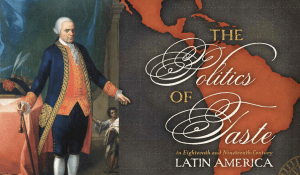 As the Bourbon monarchy took the Spanish throne in 1700, the art, architecture, and visual culture of Latin America began a gradual transformation. A defining moment in this evolution was the establishment of the Royal Academy of San Carlos in 1785 in Mexico City, a time that corresponded to the escalation of the Bourbon Reforms across the Indo-Hispanic Americas. The new academy set standards of neoclassicism and buen gusto (good taste) and sought to impose these protocols on colonial society. In Latin America, however, these two domains existed in an ambiguous relationship to one another. For example, good taste did not necessarily refer to neoclassical style. To complicate matters further, the results of artistic reform were not as expected by the proponents of the Academy. Rather than sweeping transformation in the visual arts, Latin American artists and institutions produced works that reveal cultural hybridity, the persistence and assimilation of traditional colonial styles and genres, as well as the transformation of European neoclassical forms themselves into American expressions.
This symposium poses a number of questions to interrogate this period of stylistic transition. By what processes were academic and/or neoclassical art, conforming to standards of buen gusto in Spain, transformed in Latin America? As the term “neoclassical” is not period language, what can examining period notions of buen gusto tell us about the American assimilation of European academic and/or neoclassical styles and genres? How was possessing buen gusto consciously political in Latin American contexts? What are the issues in contexts beyond Mexico City and New Spain, such as Cuba? How was neoclassicism deployed with respect to forced labor in the countryside? How did American antiquity enter discourses about neoclassicism and taste? How were the arts of taste expressed in early national contexts in Latin America? This symposium seeks more contextual understandings of this complex phenomenon in Latin American art history.
Program
9:00 Introduction
9:15 Susan Deans-Smith, University of Texas at Austin
10:00 Ray Hernández-Durán, University of New Mexico
10:45 Kelly Donahue-Wallace, University of North Texas
11:30 Paul Niell, University of North Texas
12:15 Luncheon
1:30 Charles Burroughs, Case Western Reserve University
2:15 Robert Bradley, University of Texas Pan American
3:00 Magali Carrera, University of Massachusetts Dartmouth
3:45 Stacie G. Widdifield, University of Arizona
4:30 Discussion
Colloquium on the History of Paris
The full program for this international colloquiem is available at the CIERL website:
History of Paris
Musée de la civilisation, Québec, 22-25 September 2010
Colloque international du Cercle interuniversitaire d’étude sur la République des lettres (CIERL)
Qu’il s’agisse de considérations sur la voirie ou les projets d’embellissement, sur les aspects sociaux, économiques ou poli-ques de la ville, sur l’architecture, la naissance du tourisme ou l’apparition du promeneur urbain, qu’il s’agisse des chroniques intimes ou officielles qui en ont scandé et organisé les péripétes, qu’il s’agisse encore du faste des entrées royales ou de la misère du peuple, des rumeurs ou des modes, des peintures ou des fictions qui l’ont mis en scène, le Paris d’Ancien Régime a fait l’objet depuis plusieurs décennies de nombreux travaux qui ont collectivement contribué tant à la restitution de la réalité « historique » de la capitale qu’à la mise au jour d’un imaginaire de la ville tissé au fil des représentations. Sociologues, anthropologues, historiens, spécialistes de l’urbanisme ou de l’architecture, mais aussi littéraires, historiens de l’art, ou encore spécialistes de l’histoire des mentalités ont ainsi, chacun selon les paradigmes de leur discipline, les champs de leur corpus et les horizons de leur théorie, proposé un contenu spécifique à l’Histoire de Paris, de ses lieux, de ses monuments, de ses habitants, des événements, heureux ou tragiques, officiels ou anonymes, collectifs ou individuels, qui s’y sont produits. . .
Conference: ‘Fictions of Art History’ at The Clark
As noted at The Art History Newsletter, The Clark turns its attention to the relationship between art history and fiction this fall. Conference participants include not only art historians but photographers, critics, novelists, and poets. Included among the seventeen speakers are Thomas Crow and Mark Ledbury. From The Clark’s website:
Fictions of Art History
Sterling and Francine Clark Art Institute, Williamstown, MA, 29-30 October 2010
Clark Conferences question the definition of art history and explore the discipline’s relationships with other modes of understanding and cultural phenomena. The aim of the 2010 conference is to address the complex relationship between art history and fiction, a relationship that will be investigated in art historians’ need to tell stories, their viewing practices, their rhetoric, their writing, and in the interest of art historical work beyond the academy.
Conference: ‘Visual & the Verbal’ Occasioned by Barry Exhibition
The Visual and the Verbal in the Eighteenth Century
University of Kent, 5 November 2010
Sponsored by the Paul Mellon Centre
 The conference is being organised in conjunction with the exhibition In Elysium: Prints by James Barry, co-curated by Ben Thomas and Jon Kear. The conference will conclude with a drinks reception and exhibition viewing. Attendance at the conference, reception and exhibition is free but spaces are limited to 50. Please contact Jennie Batchelor (J.E.Batchelor@kent.ac.uk) to reserve a place. Places will be allocated in order of date of application.
Programme
9:00-9:30 Registration
9:30-10:00 Jenny Uglow (Kent), ‘Hogarth and Fielding: an Irregular Alliance’
10:00-11:00 Peter de Bolla (King’s College, Cambridge), ‘The Necessity of Judgement’
11:00-11:30 Coffee/tea break
11:30-12:30 John Barrell (York), ‘War and the Moral Economy in North East Wales, 1794’
12:30-13:30 Lunch (provided for speakers only)
13:30-14:30 Harriet Guest (York), ‘The Death of James Cook and the American Crisis’
14:30-15:30 Michael Rosenthal (Warwick), ‘Describing the Colony: The British in New Holland, c. 1788-1823’
15:30-16:00 Coffee/tea break
16:00-17:00 Michael Phillips (York), ‘No. 36 Castle Street East: A Reconstruction of James Barry’s House, Painting and Printmaking Studio’
17:30 Drinks reception and viewing of the exhibition In Elysium: Prints by James Barry
Claremont Garden Lecture
Claremont Garden Lecture by Timothy Mowl
Claremont House, Esher (just outside of London), 5 September 2010

Timothy Mowl at Iford Manor (Photo by Jason Ingram)
Claremont Fan Court School is pleased to announce the inauguration of its Claremont Garden Lecture Series beginning with the opening lecture on Sunday afternoon, 5 September, in the School’s Mansion. Timothy Mowl, author and Professor of Architecture and Designed Landscapes at the University of Bristol, has accepted the invitation to deliver the opening address. This annual lecture series will provide access to the school’s portion of Claremont with Brown’s picturesque and sweeping park and to provide an historical context for this viewing through Prof. Mowl’s lecture. The Claremont Garden History Lecture series is being established as a forum for the discussion and promoting of garden history scholarship. Its goals include the presentation of the latest in academic research as well as the sharing of the private portion of the park and garden with the general public. The long term goal is to increase the public’s appreciation of designed landscapes and to better understand their original cultural context. The Open Day will start at 1 p.m. with the grounds and mansion open to the public. At 4:30 p.m. Prof. Mowl will present the inaugural lecture, followed by a question and answer session and book signing. Admission will be 10.00 GBP which includes access to the grounds,mansion and lecture.
Professor Timothy Mowl is a popular and prolific author and speaker, well known to both garden history scholars and the public. His ongoing project, Historic Gardens of England, supported by grants from the Leverhulme Trust, is modeled after Sir Nicolaus Pevsner’s Buildings of England. Upon completion, the nationwide project will present historic landscapes and gardens in separate texts, county by county. Ten books have been published to date. Prof. Mowl is an engaging speaker with a long-standing interest in the cultural context of designed landscapes – the people who designed and lived in what are now considered historic buildings and gardens.
Claremont Fan Court School is situated on grounds originally purchased by Sir John Vanbrugh for his own house and then developed by him for Thomas Pelham-Holles, the Duke of Newcastle. The Duke of Newcastle used Claremont as one of his principle residences from 1769 to 1774. He expanded the extent of the park and developed it extensively with Charles Bridgeman and William Kent. It was subsequently reshaped by Lancelot “Capability” Brown for Clive of India. During the 19th century, Claremont was the home of Princess Charlotte, Prince Leopold and Princess Victoria before she became Queen. Claremont remained a royal residence during most of the 19th century as a favorite of Queen Victoria’s. A portion of the original garden has been open to the public and owned by the National Trust since 1949, but the portion owned by the school has only occasionally been open to the public. Having a Grade 1 listed landscape that exhibits the successive work of Vanbrugh, Bridgeman, Kent and Brown is a resource that students of garden history, cultural geography and, in Claremont’s case, British royal history will find endlessly fascinating and informative.










leave a comment