Exhibition | Almost Real Art: A Satirical Archaeology of the RA
From the Royal Academy:
Almost Real Art: A Satirical Archaeology of the RA Collections and Library
Royal Academy of Arts, London, 1 November 2012 — 17 February 2013

Mark Hampson, The Remarkably Talented Thomas Gainsborough, 2012, mixed media © Mark Hampson
Since 2010, artist Mark Hampson has been working ‘in residence’ at the Royal Academy and from his studio in Kent on a collaboration with the RA Collections, Library and Archives. Exploring the RA’s holdings during this two-year period, he has created a satirically inspired ‘archaeological’ response to its complexities of information and histories. The resulting work exploits and distorts the ‘official’ biography of the RA, corrupting the apparent facts to produce newly imagined narratives that are rooted in the lives and works of some of the great artists who have been connected with the Academy.
Hampson’s imaginings take concrete form in a series of mock-historical artworks combining image and text, made in collaboration with commercial sign-makers. Alongside these, the artist offers up alternative versions of art societies, unions and academies that encourage us to ask why places like the RA exist, how its history has shaped it, and how different it might have been had it been subjected to other influences and ideas. Registering the enormous impact that individual personalities have had on the institution, he explores the clichéd image of the Romantic artist as eccentric, obsessive and self-mythologising. Throughout, however, Hampson’s satire is balanced by a deep affection for the institution and those who have made it, a feeling which has only grown the deeper he has probed its history.
Bringing together high and folk art, the fairground and the museum, history and anachronism, fact and fakery, Hampson has produced what he describes with characteristic ambiguity as ‘almost real art’.
Artist’s Talks
Tuesday 4 December 2012
Tuesday 5 February 2013
Mark Hampson gives an informal introduction to his work.
Meet at 3:30 pm in the Tennant Gallery. Free with an exhibition ticket.
Exhibition | White Gold: Meissen Porcelain
I’m afraid this one almost slipped by without notice, though you still have two months to see it. From The Frick:
White Gold: Highlights from the Arnhold Collection of Meissen Porcelain
The Frick Collection, New York, 13 December 2011 — 6 January 2013

Teapot, Meissen porcelain, c.1729–31, The Arnhold Collection; photograph: Maggie Nimkin
New Portico Gallery Opens with Presentation of Sculpture and Selections from an Important Promised Gift of Meissen Porcelain from Henry H. Arnhold
Since December 13, visitors to The Frick Collection have been able to enjoy a new gallery — the first major addition to the museum’s display spaces in nearly thirty-five years. The inspiration for this initiative, which involves the enclosure of the portico in the Fifth Avenue Garden, comes from the intention of museum founder Henry Clay Frick (1849–1919) to build an addition to his 1914 mansion for his growing Collection of sculpture. The project was postponed in 1917 following the United States entry into World War I, and Mr. Frick died before it could be resumed. In recent years, the institution has placed greater focus on sculpture through critically acclaimed exhibitions and several key acquisitions, while also evaluating the effectiveness of the display and lighting of such objects. Another area of increased focus has been the decorative arts. When talks began with renowned porcelain collector Henry H. Arnhold about a promised gift, the idea to create a gallery both for sculpture and the decorative arts was revisited. The architecture firm Aedas developed a plan to integrate the outdoor garden portico into the fabric of the museum, and groundbreaking occurred last winter. Aedas, formerly known as Davis Brody Bond Aedas, is one of the leading practices in the United States engaged in a range of museum and landmark structure commissions.
The Portico Gallery for Decorative Arts and Sculpture opened in late December with an inaugural exhibition of works drawn from Henry Arnhold’s promised gift of 131 examples of Meissen porcelain from the early years of this Royal Manufactory’s production. . . White Gold: Highlights from the Arnhold Collection of Meissen Porcelain will feature approximately seventy of these objects, presented along with a group of eighteenth-century sculptures by Jean-Antoine Houdon (1740–1828). Among the latter works is the full-length terracotta Diana the Huntress, a signature work at the Frick that returns to view having been recently cleaned and treated. It finds a permanent home in the new portico gallery, while the ongoing display of other sculptures and ceramics will rotate periodically.
Exhibition | Coaches from Versailles on View at Arras
From the exhibition website:
Roulez Carrosses! Le Château de Versailles à Arras
Musée des Beaux-Arts, Arras, 17 March 2012 — 10 November 2013
Curated by Béatrix Saule, Jean-Louis Libourel, and Hélène Delalex
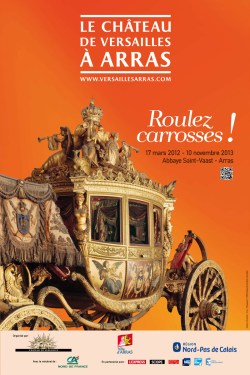 Roulez Carrosses!, the inaugural exhibition of the partnership signed in 2011 between the Château de Versailles, the City of Arras and the Nord-Pas-de-Calais Region, is a landmark event. It is the first French exhibition to be devoted to horse-drawn vehicles. Berlin coaches, royal and imperial carriages from the Versailles collection have all taken the road for Arras, to be admired here until November 2013. The Musée des Beaux-Arts is thus hosting paintings, sculptures, sledges, sedan chairs, horse harnesses and several outstanding carriages such as the coaches of Napoleon I’s marriage procession, Charles X’s coronation coach or the impressive funeral hearse of Louis XVIII. From Louis XIV to the Third Republic, these little-known vehicles will offer a journey through the History of France. Chronologically displayed over 1,000 m², these works are set against a backdrop of innovative scenography combining reconstructions, activities, immersion and multimedia. The exhibition provides an opportunity to discover Versailles and its collections whilst at the same time highlighting the historical links between Arras and the former residence of kings. It will also provide an insight into the operation
and evolution of horse-drawn vehicles.
Curatorship
Béatrix Saule, Director of the Musée National des châteaux de Versailles et de Trianon
Jean-Louis Libourel, Honorary Chief Curator of Heritage
Hélène Delalex, Heritage Conservation Manager at the Château de Versailles
◊ ◊ ◊ ◊ ◊
As Didier Rykner judges in his review for The Art Tribune (24 September 2012) . . .

Sedan Chair for the King’s House Versailles, Musée national des châteaux de Versailles et de Trianon Photo : RMNGP/G. Blot
Even if it is much longer than the usual three-month period, this is a true exhibition, not a lineup of works; it is accompanied by a beautiful scholarly catalogue on a subject which is not often studied; it does not replace the display of the permanent collections as the exhibition rooms occupy the space acquired at the Saint-Vast Abbey; it does not deprive visitors going to the lending museum from seeing major works there since the Musée des carrosses (a rather exaggerated term given the usual presentation conditions) is rarely open to the public; and, above all, it will result in enduring benefits for the coach collection as well as for the Musée des Beaux-Arts itself. . . .
The museum staging by Frédéric Beauclair is very well done. Paintings, sculptures and drawings round out the presentation of the carriages illustrating their use, the way they functioned and the context in which they were produced. Visitors will also discover some little-known works. . . .
The full review is available here»
◊ ◊ ◊ ◊ ◊
Eight short videos accompany the exhibition:
◊ ◊ ◊ ◊ ◊
From the Château de Versailles bookshop:
Béatrix Saule, ed., Roulez Carrosses! Le Château de Versailles à Arras (Paris: Skira Flammarion, 2012), 256 pages, ISBN: 9782081278172, 40€.
 Roulez carrosses! is the first exhibition in France devoted to horse-drawn coaches and carriages and, in this case, historical examples, all totally luxurious in every detail and all different: carriages for the outings of the children of Louis XVI, a sumptuous berline for the wedding of Napoleon I, the hearse of Louis XVIII, the coronation coach of Charles X, etc. Other outstanding masterpieces from the collections of Versailles accompany them: a series of paintings by Van der Meulen, major royal portraits, or unique vehicles like these fantasy sledges in which Louis XV and then Marie-Antoinette were pulled over the snow-covered walks of the park of Versailles. This book describes episodes from the political history of the palace, dynastic events and customs of the court, narrated and commented on here by eminent historians. Fans of handsome horse-drawn vehicles will discover the grand coaches for ceremonial occasions – from the “modern coach” invented in the reign of Louis XIV to the coaches for state ceremonies of the presidents of the Republic – along with their technical innovations, the refinement of their accessories and the extreme lavishness of their ornamentation, at a time when the art of French coach-building was at its apogee.
Exhibition | Nude Men in Vienna
With the advertising for this exhibition having been covered sensationally by the international press, the focus on contemporary work has obscured the late eighteenth-century offerings. Press release from the Leopold Museum:
◊ ◊ ◊ ◊ ◊
Nude Men from 1800 to the Present / Nackte Männer
Leopold Museum, Vienna, 19 October 2012 — 28 January 2013
Curated by Elisabeth Leopold and Tobias Natter
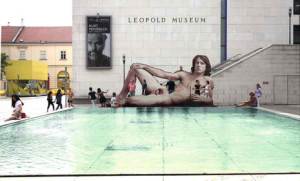
Ilse Haider, Mr. Big, installed at the Leopold Museum
The endless flood of images intrinsic to today’s lifestyle has given unprecedented public prominence to the depiction of male nudes. At the same time seemingly firmly established categories such as masculinity, body, and nakedness are apparently being redefined on a broad social basis, resulting in a new interpretation of male gender roles. These developments have prompted the Leopold Museum to embark on a topical as well as historical journey through the visual arts in search of the male nude, a quest leading predominantly from the longing for antiquity prevalent in art around 1800 to contemporary art. The exhibition Naked Men: Power & Powerlessness through the Ages also represents the fulfillment of the museum’s long-cherished ambition to present a counterpart to the highly successful 2006 exhibition Body – Face – Soul curated by Elisabeth Leopold, which explored the female image in art from the 16th century to the present. Thus, the current presentation constitutes a continuation of this theme, except that its focus is now on the opposite sex.
The exhibition Naked Men: Power & Powerlessness through the Ages is based on works by Egon Schiele, Richard Gerstl and Anton Kolig – three artists who are more comprehensively represented in the Leopold Museum than in any other institution and in whose oeuvre the depiction of the male nude features prominently. Schiele’s male nudes can be seen as unconditional explorations of the self, as expressions of inner emotions and as body images situated between vulnerability and provocation. Gerstl followed the tradition of Christian iconography with the first of his two life-sized self-portraits, while he elevated the fragmentation of form to a principal in the second with his wild brushstrokes. Kolig was captivated by the depiction of naked young men all his life and dedicated his drawings almost exclusively to this motif.
Based on eminent examples from its own collection and complemented by loaned works from all over Europe, the Leopold Museum’s exhibition will set out in two main directions, examining the depiction of the male nude in contemporary art, while also exploring the Old Masters’ approach to the subject from the Renaissance all the way back to antiquity. The exhibition unites examples of many different genres, including painting, sculpture, graphic arts, photography and new media, with special emphases on the following themes:
The Measure of All Things: The Male Body and Art Academies
Ever since the Renaissance, the naked male body was considered to be an important object of study and an indispensable part of the academies’ curriculum, which was one of the reasons that women were denied access to art academies for so long. The presentation affords insights into the life drawing rooms of European art academies from the Baroque period onwards and illustrates to what an extent all eyes were focused on the naked man, though he himself was the only one to remain naked.
Longing for Antiquity and the Male Ideal
For centuries, the depiction of the male nude was only legitimized by ancient art. These restrictions prompted the emergence of various artistic strategies that reinterpreted ancient ideals under the guise of antiquity. This is illustrated in the exhibition with examples from the period around 1800 up until the present.
The Naked Self
While Klimt still believed that nakedness and truth coincided in the Nuda Veritas, Schiele began to make his own body the object of his paintings. Expressionism brought with it a radical examination of the self, which saw the artists exposing themselves both physically and existentially and exploring the use of their own nudity as a sphere of political influence.
In the Sights of Women
The battle of female desire and male denial is not often addressed in the visual arts, but it has its historical sources both in the biblical story of Joseph and the Wife of Potiphar and in the ancient mythological traditions of Narcissus and Adonis. The emancipation of women as artists has brought with it a new basis for the depiction of such conflicts. Nowadays, female artists also have access to male nude models and are free to interpret and depict this motif at their will, currently often with a view to deconstructing gender and gender asymmetries.
Bathers — On the Beach
In the second half of the 19th century depictions of naked people in nature abounded. These renderings had their origin in a reassessment of man’s position in nature. Based on early depictions such as Dürer’s The Men’s Bath, the exhibition features many eminent examples of such encounters and get-togethers of naked men, from Cézanne to Mapplethorpe.
◊ ◊ ◊ ◊ ◊
In the United States, the English edition of the catalogue will be distributed by The University of Chicago Press:
Catalogue: Elisabeth Leopold and Tobias Natter, eds., Nude Men from 1800 to the Present (Vienna: Hirmer, 2013) ISBN: 9783777458519, $50.
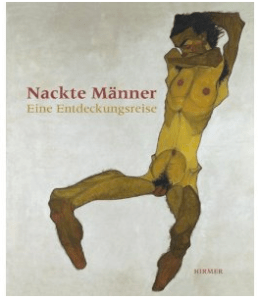 Rodin’s Thinker. Da Vinci’s Vitruvian Man. Pigalle’s controversial portrayal of the philosopher Voltaire. From its earliest days, art history is rife with representations of nude men. But while there is no shortage of studies of art celebrating the female form, the male nude has suffered from relative neglect. This book seeks to correct this imbalance with a collection of paintings, sculptures, and photographs that challenge conceptions of the body and masculinity, many of which continue to have considerable cultural resonance today.
Beginning with a look at art completed in life-drawing classes popular across European academies, the book moves on to representations of masculinity throughout the French Revolution, including works by Johann Heinrich Füssli and Antonio Canova; provocative Sturm und Drang paintings by Edvard Munch and contemporaries; and late impressionist works. The unsettling self-portraits of Austrian artists Egon Schiele and Richard Gerstl exemplify an extreme candor that characterized the early twentieth century. Other twentieth-century artists whose work is included in this book are Jean Cocteau, David Hockney, Andy Warhol, Nan Goldin, and Louise Bourgeois.
With nearly four hundred full-color illustrations, the book also includes insightful essays examining topics like male identity, depictions of desire in modern art, and the use of nude men in advertising.
◊ ◊ ◊ ◊ ◊
Note (added 2 February 2013) — The sensational coverage is likely to continue. As reported by the AFP, viewers are invited to step out of their own clothes for a special viewing on February 18, “Our museum will be a clothes-free zone for one evening. . . Nudists, naturists are welcome!”
Exhibition | Loutherbourg: Torments and Chimeras
From the Musée des Beaux-Arts in Strasbourg:
Philippe-Jacques de Loutherbourg: Torments and Chimeras
Musée des Beaux-Arts, Strasbourg, 17 November 2012 — 18 February 2013
Curated by Dominique Jacquot and Olivier Lefeuvre
 This exhibition in his native city marks the bicentenary of the death of the “Anglo-French” painter Philippe-Jacques de Loutherbourg. It will be the first retrospective of this artist in France and the only one since the exhibition which took place in London in 1973.
With more than a hundred works, both paintings and works on paper, from public and private collections in France, Britain and the United States, it aims to show all the facets of his art. In Paris, the artist was successful at a very early age, from 1763, and was acclaimed by Diderot, who regarded him as a prodigy. In 1771 he settled in London and adapted perfectly to the English environment. He became a member of the Royal Academy, had his portrait painted by Gainsborough and was acknowledged by his peers and the public alike as one of the most important painters of his time.
His private life was hectic. After working in Paris with the painter Casanova (the brother of the famous adventurer), he quickly fell out with him and, after a brief, stormy marriage, dropped everything to go and settle in London. There he gave up painting for a while, dispensing medical care by the “magical” laying on of hands, echoing the experiments of the famous Cagliostro, with whom he shared a brief friendship, and of Mesmer.
In London, Loutherbourg was in touch with the world of the theatre, the source of a fascinating aspect of his work. While he is known mainly for his pastorals and his landscapes, in which he at times depicts the perilous or sublime aspects of Nature, he was also a strikingly original historical painter, drawing his subjects from the Bible or from modern history, and his most memorable qualities are thus his versatility and great technical facility.
The approach of the exhibition is chronological, while keeping to certain thematic threads :
. Pastorals
. Shipwrecks
. Historical Painting (the Bible and Battles)
. English Landscapes
. Nature’s Perils
The artist’s graphic output is another of the revelations of this exhibition, which includes the considerable collection from the Strasbourg Prints and Drawings Cabinet.
An Alsatian by birth but with the talent of a European, Loutherbourg had the makings of a character from fiction. He embodied the Enlightenment while at the same time wholly prefiguring Romanticism.
Exhibition curators : Dominique Jacquot, Head Curator of the Strasbourg Fine Arts Museum, Olivier Lefeuvre, art historian.
Exhibition | Drawings from the Osiris Donation at Malmaison
From the Château de Malmaison:
Un Semblant de Bonheur: Dessins de la Donation Osiris
Musée National du Château de Malmaison, Rueil-Malmaison, 24 October 2012 — 21 January 2013
Curated by Céline Meunier and Alain Pougetoux
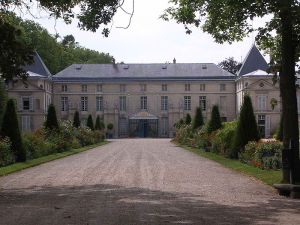
Château de Malmaison (Wikimedia Commons)
This exhibition presents, for the first time together, all the [47] drawings of Daniel Iffla, called ‘Osiris’, who donated Malmaison to the French State in 1906. This unique collection contains drawings from the 16th, 17th, 18th and 19th centuries, from Dutch, Flemish, Italian and French masters. Among the most famous you will find Aelbert Cuyp and Frans van Mieris, Francesco Guardi, Giambattista Tiepolo and Giulio Romano, Jacques Callot and François Boucher… But also some of Osiris’s contemporaris as the Orientalist artist Alexandre Bida or the animalier Antoine-Louis Barye. Several techniques are represented among them, as you will see with the delicate watercolors of Eugène Lami, illustrator of Alfred de
Musset’s poems.
◊ ◊ ◊ ◊ ◊
The more complete, French description:
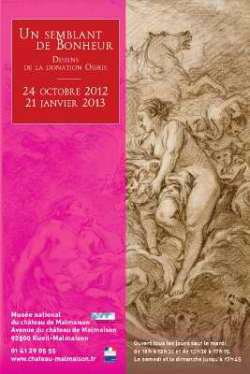 En 1906 Daniel Iffla dit Osiris, après avoir offert en 1903 le château de Malmaison à l’Etat, lui fait don de sa collection personnelle d’œuvres d’art, à charge pour celui-ci de l’exposer dans un pavillon à son nom. Après la réouverture en 2011 du pavillon consacré à la présentation de cette collection (200 peintures, sculptures, meubles et objets d’art) le musée a souhaité mettre en valeur l’ensemble des dessins dont la trop grande fragilité ne permet pas une présentation permanente dans cet espace.
Ces quarante-sept dessins et aquarelles, font ainsi l’objet d’une exposition exceptionnelle qui va permettre de les présenter au public tous réunis pour la première fois. Une part importante d’entre eux appartient aux XVIIème et XVIIIème siècles. Parmi ces dessins anciens on rencontre des maîtres hollandais et flamands comme Hendrick de Clerck, Aelbert Cuyp ou Frans van Mieris, des artistes italiens comme Francesco Guardi et Giambattista Tiepolo, ou Giulio Romano, mais aussi des français tel Jacques Callot, et surtout une magnifique série de quatre dessins de
François Boucher. (more…)
Exhibition | Benjamin West: General Wolfe and the Art of Empire
From UMMA:
Benjamin West: General Wolfe and the Art of Empire
University of Michigan Museum of Art, Ann Arbor, 22 September 2012 — 13 January 2013
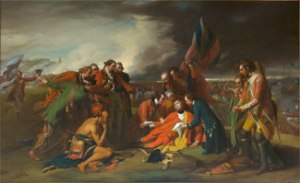
Benjamin West, The Death of General Wolfe, 1776 (William L. Clements Library, University of Michigan)
How is it that an American painter came to define the British Empire? Benjamin West’s iconic painting The Death of General Wolfe (1776) depicts the death of James Wolfe, the British commander at the 1759 Battle of Quebec, one of Great Britain’s most famous military victories, during what in this country is known as the French and Indian War. In conflating a momentous contemporary event with the genre of large-scale history painting, West flouted the conventions of academic painting and the work became one of the most celebrated paintings in Britain. The artist went on to produce six versions of the painting, one of which belongs to the William L. Clements Library at the University of Michigan. Through approximately 40 works, from Michigan, Canadian, and British collections, this ambitious and thematically focused exhibition will include the Clements canvas as well as other depictions of James Wolfe and his death on the battlefield. A fully illustrated catalogue published by the Museum as part of its UMMA Books series accompanies the exhibition.
Exhibition | Discovering Eighteenth-Century British America
From UMMA:
Discovering Eighteenth-Century British America: The William L. Clements Library Collection
University of Michigan Museum of Art, Ann Arbor, 22 September 2012 — 13 January 2013
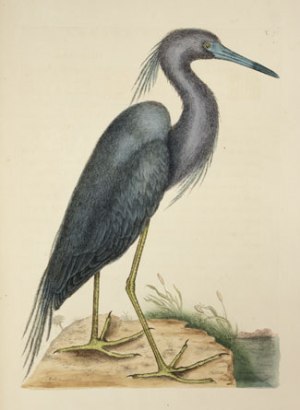
Mark Catesby, The Natural History of Carolina, Florida, and the Bahama Islands, 1731-43, hand-colored engravings (William L. Clements Library, 16791)
This significant exhibition provides glimpses of British America in the 1700s and is designed to complement the Museum’s concurrent exhibition Benjamin West: General Wolfe and the Art of Empire, which features the Clements collection’s major painting The Death of General Wolfe. William L. Clements assembled an outstanding array of primary sources on North America dating between 1492 and 1800, with a heavy emphasis on early European exploration and discovery and the eighteenth-century wars for control of the continent. The exhibition features a mix of rare items from Mr. Clements’s original donation and pieces the Library has acquired since 1923 to complement and enhance its strength in eighteenth-century American history.
This exhibition is part of the UM Collections Collaborations series, co-organized by and presented at UMMA and designed to showcase the renowned and diverse collections at the University of Michigan. The UM Collections Collaborations series is generously supported by the Andrew W. Mellon Foundation.
Display | The Geometry of War: Fortification Plans
From the University of Michigan:
The Geometry of War: Fortification Plans from Eighteenth-Century America
William L. Clements Library, University of Michigan, 15 October 2012 — 15 February 2013
 The eighteenth century was a time of intensive military activity in Europe and in the Americas. Much of this centered on fortified towns or positions. The period from the 1680s to the French Revolution has been called the “classic century of military engineering,” a time when earlier forms of artillery fortifications were perfected and frequently tested in battle.
Designing, constructing, and recording fortifications was the job of the military engineer. He followed well-tested principles of design, based on geometry, to construct fortified places. These were recorded in detailed plans, many of surprising beauty and complexity. The Clements Library is rich in examples, manuscript and printed, and offers a sample illustrating the science of fortification in eighteenth-century America.
Exhibition | Guglielmo Du Tillot and the Enlightenment
From the University of Parma:
Guglielmo Du Tillot Regista delle Arti nell’Età dei Lumi
Palazzo Bossi Bocchiarma, Parma, 28 October 2012 — 27 January 2013
Curated by Gianfranco Fiaccadori, Alessandro Malinverni, and Carlo Mambriani
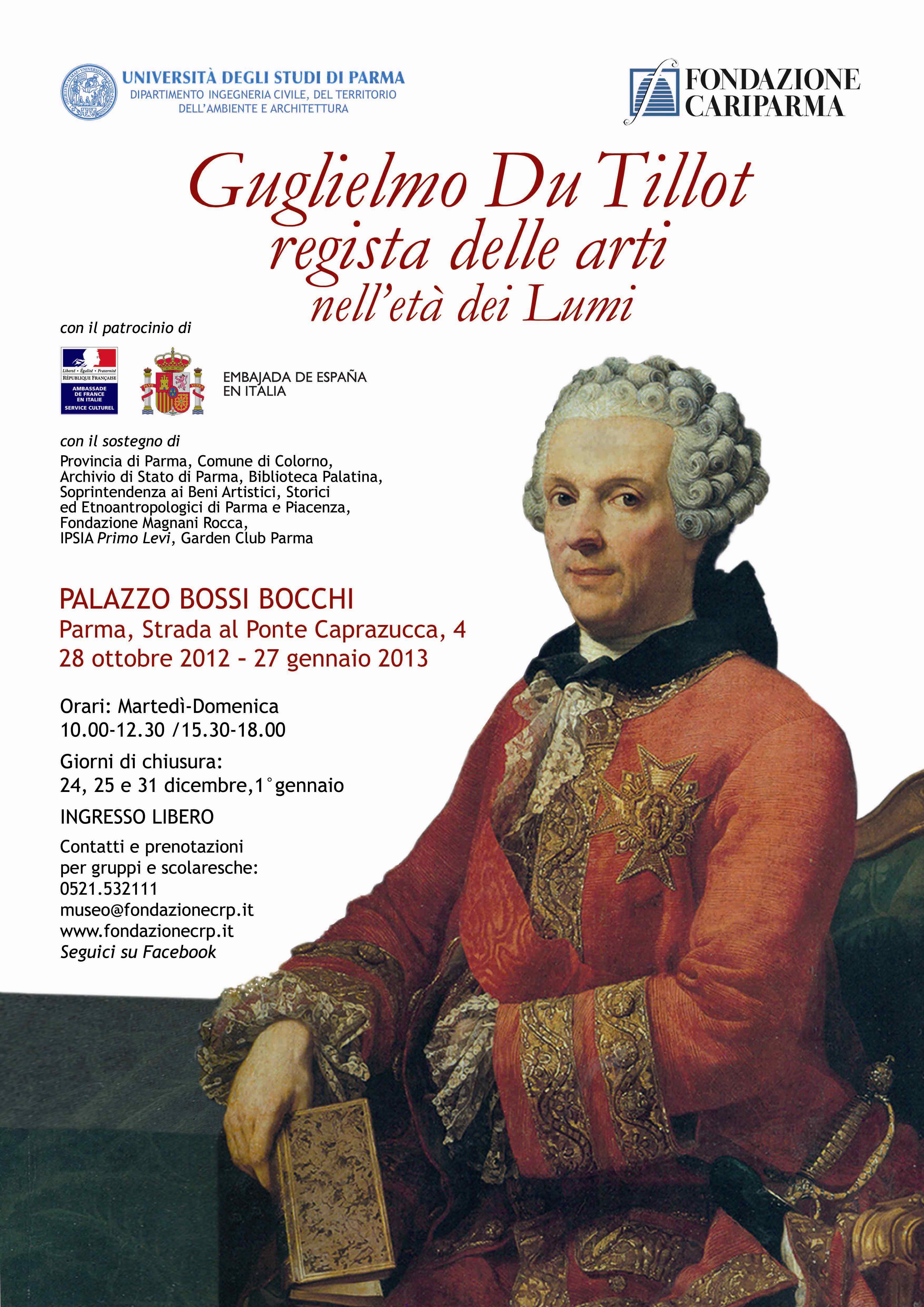 La mostra Guglielmo Du Tillot, regista delle arti nell’età dei Lumi si terrà a Palazzo Bossi Bocchi dal 28 ottobre 2012 al 27 gennaio 2013 (inaugurazione sabato 27 ottobre ore 18,00). L’esposizione, che si fregia del patrocinio delle ambasciate di Francia e di Spagna in Italia, è stata realizzata in collaborazione con Biblioteca Palatina di Parma, Soprintendenza per i Beni Storici Artistici ed Etnoantropologici di Parma e Piacenza, Archivio di Stato di Parma e IPSIA “Primo Levi” di Parma; l’obiettivo è di raccontare a un vasto pubblico l’impatto culturale e artistico della figura di Du Tillot, Intendente della Real Casa inizialmente e Primo ministro in seguito. Attraverso un ricco panorama di opere, talvolta inedite, di pittura, scultura, architettura, incisione, numismatica e arti decorative, nonché di preziosi volumi conservati nei fondi antichi della Biblioteca Palatina e della Biblioteca di Busseto, verrà illustrata la riforma artistica e culturale che permise al piccolo stato borbonico di emergere in Italia e in Europa come non era accaduto nemmeno sotto la dinastia farnesiana, facendo di Parma l’«Atene d’Italia».
Il percorso della mostra – ideata e curata da Gianfranco Fiaccadori e Alessandro Malinverni (Università di Milano) e Carlo Mambriani (Università di Parma) – si articola in due sezioni: la prima, preceduta da un inquadramento biografico del protagonista, è incentrata sulla trasformazione di Parma in «Atene d’Italia»: il ruolo del ministro, di Annetta Malaspina e della loro cerchia; le nozze dei principi come eventi di propaganda artistica e dinastica; l’istituzione dell’Accademia e l’appoggio fornito ai suoi artisti; il rinnovo delle residenze, delle manifatture e del tessuto urbano. La seconda sezione è dedicata alla committenza privata di Du Tillot a Parma e a Parigi, durante il breve esilio: l’allestimento delle sue residenze, gli acquisti di libri e di opere d’arte, gli artisti prediletti.
Tra i numerosi artisti presenti in mostra, oltre all’architetto Ennemond Alexandre Petitot, fedele collaboratore del ministro, e ai vincitori dei concorsi accademici degli anni Sessanta, si segnalano i protagonisti della ritrattistica settecentesca parmense, come Giuseppe Baldrighi e Pietro Melchiorre Ferrari, ed europea, del rango di Jean-Marc Nattier, Anton Raphael Mengs, Laurent Pecheux e Louis-Michel Van Loo.










leave a comment