Speaking of Food in the Eighteenth Century . . .
From the MFAH:
English Taste: The Art of Dining in the Eighteenth Century
Rienzi, The Museum of Fine Arts, Houston, 17 September 2011 — 29 January 2011
Installation by Ivan Day
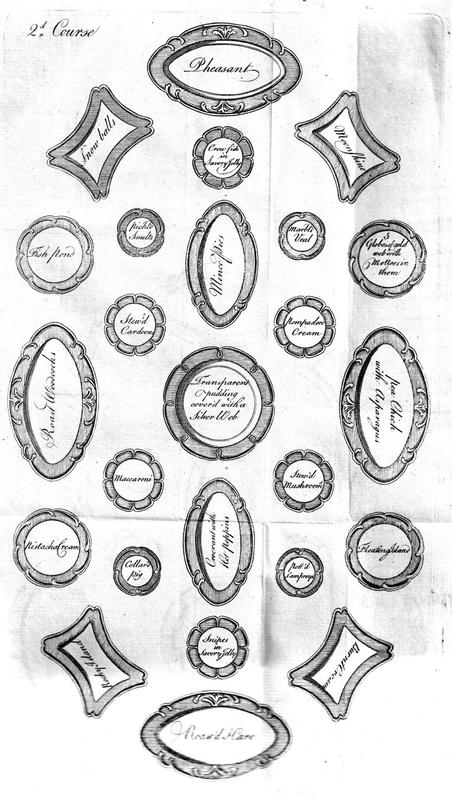
Elizabeth Raffald, "Directions for a Grand Table," illustration from "The Experienced English Housekeeper" (Manchester: Printed by J. Harrep, 1769), p. 361
The 18th-century English dinner table was a feast for the eyes. In order to impress their guests and assure them that they were dining amid fashionable people of consequence, hosts served sumptuous dishes, adorned with towering sugar constructions and amusing trompe l’oeil (fool-the-eye) jellies of playing cards or bacon and eggs, all on exquisite silver and porcelain.
Rienzi re-creates this elaborate dining experience in English Taste: The Art of Dining in the Eighteenth Century. The first special exhibition ever held at Rienzi, the MFAH house museum for European decorative arts, English Taste treats you to a dining-room extravaganza typical of a 1760s English country house. Lifelike fish, fowl, and flummeries—complete with lavish, Georgian silver fittings and place settings—grace the table, created with guidance from the influential period cookbook The Experienced English Housekeeper by Elizabeth Raffald, the “Martha Stewart of the 18th century.”
Eminent English food historian Ivan Day uses Raffald’s recipes to create the faux foods—perhaps shockingly realistic to 21st-century eyes—which include roasted pheasant, beaked snipe, flummery jellies, and a larded hare. The meal also features macaroni and cheese (yes, this dish did exist in the 18th century!) made with imported pasta. Raffald’s illustration “Directions for a Grand Table” from 1769 serves as the design template for the installation.
◊ ◊ ◊ ◊ ◊
More information and terrific images from Raffald’s book are available from Kansas State University Library’s online Cookery Exhibition.
◊ ◊ ◊ ◊ ◊
From the MFAH:
 Rienzi is situated on four acres of wooded gardens, about three miles from downtown Houston in the historic River Oaks neighborhood. Formerly the home of philanthropists Carroll Sterling Masterson and Harris Masterson III, Rienzi was designed by prominent Houston architect John Staub in 1952. Opened to the public in 1999, Rienzi now houses a substantial collection of European decorative arts, including paintings, furnishings, porcelain, and extensive holdings of miniatures. Rienzi welcomes some 8,000 visitors a year for tours, family programs, lectures, concerts, and a variety of special events.
At Fairfax House: Revolutionary Fashion and Georgian Cakes
Revolutionary Fashion 1790-1820
Fairfax House, York, 26 August — 31 December 2011
 Our major new exhibition for the autumn and winter season 2011 at Fairfax House is Revolutionary Fashion 1790-1820. Following on from our acclaimed Dress to Impress exhibition of 2010, which focused on changing fashions during the period 1730-1780, this second exploration of Georgian Fashion takes the story from the revolutionary 1790s to the rakish Regency period. The exhibition opens on Friday 26 August 2011.
Uncovering the revolutionary changes in fashion in the last decade of the eighteenth century and exploring the influence of the French Revolution, Industrial Revolution and Napoleonic Wars, Revolutionary Fashion brings together a unique and lavish selection of the highly elegant clothing of Georgian and Regency polite society. Featuring period gowns, shoes and accessories from collections in Yorkshire and beyond, the exhibition will reveal the styles and showcase the ‘real’ clothes worn by Jane Austen’s heroes and heroines, and place the dazzling kaleidoscope of late Georgian fashions in its social, cultural and historical context.
◊ ◊ ◊ ◊ ◊
 If possible, you might consider visiting the exhibition on September 17:
Georgian Cakes and Baking
Fairfax House, York, 17 September 2011
Join Peter Brears, renowned food historian, in the Fairfax kitchen as he reveals the sophistication of Georgian York’s baking tradition and demonstrates the cakes, biscuits and baked goods that could be enjoyed in the eighteenth-century City. This demonstration day includes a display of Yorkshire Country House baking, and food tastings will be available for all visitors.
A 2007 profile of Brears from the Yorkshire Post is available here, and there’s a fine review of Brears’ 2010 book, Jellies and Their Moulds, at AustenOnly.
Exhibition: Pictorial Embroideries at Boston’s MFA
From the MFA:

Embroideries of Colonial Boston: Pictorial Embroideries
Museum of Fine Arts, Boston, 2 April — 28 August 2011
The embroideries of colonial Boston girls and women have long been treasured family possessions and are now much sought after by collectors. The charm and craftsmanship of the Adam and Eve samplers, pastoral pictures with leaping stags and galloping hunters, as well as crewelwork bed hangings and delicately embroidered baby caps bring to mind a warm domesticity; however, as a group they also reveal much about the lives of Boston women and their role within colonial society.
During the eighteenth century, many Boston families schooled their daughters in a range of female accomplishments including dancing, deportment, music, painting on glass, and, of course, needlework. In advanced needlework lessons, girls first worked samplers but then quickly passed on to the more decorative embroidered pictures, overmantels, and coats of arms. These pictorial embroideries became cherished family possessions and served as symbols of the family’s prosperity and gentility. This exhibition will explore the pictorial embroideries popular in eighteenth-century Boston and include examples of the pastoral works probably imported from London as well as examples drawn by talented Boston teachers, engravers, and upholsterers. While tent stitch pictures embroidered with wool and silk predominated, some girls embroidered in silk on silk. This form became more popular in the third quarter of the eighteenth century and is associated with the teacher and milliner Elizabeth Murray, whose portrait by Copley will be featured in the show. Her protégés, Janet Day and the Cummings sisters, continued the tradition, and exceptional work by their students survives. Loans from several museum and private collections in New England and the mid-Atlantic will be featured in the show.
Exhibition: Art and Finance in Europe
As we’re now bombarded with bleak financial news, I’m not sure if the timing of this Brussels exhibition is perfect or unfortunate (‘La fête est bientôt finie’). Press release for the exhibition:
◊ ◊ ◊ ◊ ◊
Art et Finance en Europe, Nouvel éclairage porté sur des chefs-d’œuvre du XVIIIe siècle
Musées royaux des Beaux-Arts de Belgique, Brussels, 29 April — 4 September 2011

Peeter Snijers (Anvers 1681 – 1752), Le mois de mai (La constellation des Gémaux)
Cette année, dans le cadre de la série des expositions d’oeuvres provenant de nos collections et se rapportant à des thèmes économiques et financiers, nous abordons le XVIIIe siècle. Cette exposition, résultant, une fois encore, d’une fructueuse collaboration avec l’EAPB (European Association of Public Banks), est particulière à plus d’un titre. Elle offre au public une occasion de refaire connaissance avec un certain nombre de fleurons de la collection longtemps placés en réserve, faute de place. Parmi eux, figurent, en nombre significatif, des dons et des legs permettant de rendre hommage aux généreux donateurs : Les Amis des Musées royaux des Beaux-Arts de Bruxelles ; Mme Fernand Saliez-Bautier ; M Léon Mancino ; M. et Mme Émile Tournay-Solvay ; Mme Jean-Jacques Scheemaecker, née Sophie-Pauline van Stalle ; la Douairière De Grez ; M. Frédéric de Villers Masbourg d’Esclaye. Les oeuvres d’art datant du Siècle des Lumières furent, en effet, toujours très appréciées par l’amateur d’art éclairé. Elles sont maintenant présentées, dans le décor adéquat des deux salons rococo, dans le Balat, entre les salles de la donation du Dr et Mme Frans Heulens-Van der Meiren et la salle du néoclassicisme. La combinaison de peintures avec des dessins et sculptures appartenant, eux aussi, à nos collections et datant de la même époque, constitue également une première.
Au XVIIIe siècle, le centre de gravité de la finance se déplace de la Bourse d’Amsterdam vers celle de Londres. Cette évolution concorde avec la domination croissante du Royaume-Uni sur les mers du globe et avec l’avènement de la révolution industrielle. Celle-ci bénéficie du grand progrès enregistré par la science et la technique sous l’impulsion des Lumières. Les idées éclairées des philosophes eurent, cependant, pour conséquence la plus radicale, la Révolution française de 1789. Celle-ci bouleversa totalement l’ordre social. Et avec elle, s’effondrèrent les privilèges, notamment financiers, conférés par le seul droit de naissance, qui étaient si caractéristiques de l’Ancien Régime.
Beaucoup d’oeuvres d’art du XVIIIe siècle datent d’avant la révolution de 1789 et appartiennent à une époque pendant laquelle la vie de la cour de France déterminait, dans toute l’Europe, le savoir-faire et le savoir-vivre (qui ne sont pas pour rien des termes français). Ce fut aussi l’ère où la jeunesse dorée, sans soucis financiers, ne devant pas travailler pour gagner sa vie, complétait sa formation par un Grand Tour joignant les sommets de l’art européen et de la culture antique pour aboutir à Rome. À la vérité, le raffinement de cour bien connu du XVIIIe siècle trouve son écho dans les objets exposés. Mais, en sourdine, vont résonner des bruits toujours plus sinistres. La fête est bientôt finie.
Pour Louis XVI et Marie-Antoinette se dessine l’échafaud. Et lorsque, la dernière année du siècle, Hubert Robert peint ses galanteries, ce n’est plus lui, mais ceux qui ont investi dans la machine à vapeur, qui ont assuré leur avenir et le capitalisme du XIXe siècle.
-Joost Vander Auwera
◊ ◊ ◊ ◊ ◊
English gloss from Eventful:
The fourth Art and Finance in Europe exhibition will concentrate on the 18th century and is convened, in the frame of the Hungarian Presidency of the Council of the European Union, under the patronage of László Andor, Member of the European Commission and Tamás Fellegi, Hungarian Minister of National Development. The exhibition Art and Finance in Europe-18th Century Masterworks in a New Light is composed of some 20 major works from the RMFAB collection. The exhibition comprises masterpieces by, amongst others, Franceso Guardi, Benjami Wolff, Léonard Defrance, Hubert Robert, Joseph Vernet and Sir Joshua Reynolds. Leading art experts, Michel Draguet, Joost Vander Auwera (CVs in annex) have lent their expertise in support of the exhibition. The exhibition is part of a sequence which started in 2008 as a joint initiative between EAPB and RMFB. This year the exhibition exceptionally exposes, in addition to paintings, also drawings and sculptures. Henning Schoppmann Secretary General of the European Association of Public Banks, described the exhibition as “a wonderful opportunity to discover how art and money have been intrinsically connected throughout the centuries and how finance has inspired art, one of the most compelling beauties of life.”
Life & Luxury Programming
From the MFAH:
Programming for the Life & Luxury Exhibition at the Museum of Fine Arts, Houston
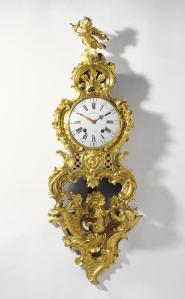
Clock movement by Jean-Romilly Case attributed to Charles Cressent Bracket by Jean-Joseph de Saint-Germain Clock on Bracket (Cartel sur une console) ca. 1758 (Getty Museum)
23 & 24 September 2011
Peter Björn Kerber (J. Paul Getty Museum), Sister Arts: Opera and Painting in Eighteenth-Century Europe
7 & 8 October 2011
David E. Brauer (Glassell School of Art, MFAH), From the Sun King to the Revolution: The Real vs. the Ideal in Eighteenth-Century French Painting
14 & 15 October 2011
Eric T. Haskell (Scripps College), Edens of Excess: Gardens of Eighteenth-Century Paris
Comments Off on Life & Luxury Programming
Reviewed: Life and Luxury in Paris
The exhibition Paris: Life and Luxury in the Eighteenth Century closes today at the Getty. It opens at the Museum of Fine Arts, Houston on September 18th and runs through December 11. With her typically lucid prose, Amanda Vickery reviews the exhibition for The Guardian (29 July 2011). . .
Opulence, bling and luxury provoke powerful responses in an age of austerity, from wistful envy to righteous disgust. Working girls flocked to see lamé gowns on the silver screen in the hungry 1930s, but Marie Antoinette is scorned for wondering why in the 1790s the poor didn’t eat brioche when the bread ran out. “Luxury” sounds so old fashioned, but the word still flourishes in marketing. The 21st-century “luxury goods market” embraces everything from jewels and luggage to private jets. In yoking a brand to luxury, advertisers draw on a vintage notion of refined taste – harking back to a world of connoisseurs, exquisite workmanship and, above all, sophistication.
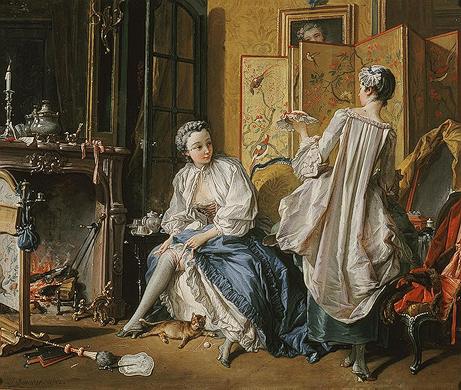
François Boucher, "A Lady Fastening Her Garter (La Toilette)," 1742 (Madrid: Museo Thyssen-Bornemisza)
It is this mélange of consumerism and lifestyle that the Getty exhibition Paris: Life and Luxury in the Eighteenth Century seeks to evoke. It is built round the outstanding collection of French decorative art that Jean Paul Getty, oil tycoon and once America’s richest man, left to his museum at his death. Ancien Regime Paris was the epicentre of European style. “Fashion is to France what the gold mines of Peru are to Spain,” concluded Jean-Baptiste Colbert, Louis XIV’s minister in 1665. French manufacturing was geared to the carriage trade. Demolish the Paris luxury industry, the Baroness d’Oberkirch concluded, and French international supremacy would wither overnight.
Across the channel the British were grinding their teeth. France was Britain’s only real economic and diplomatic rival – the two countries went to war seven times between 1688 and 1815. France was everything the new Protestant parliamentary state abhorred – Catholic, authoritarian, pleasure loving and effervescent. Yet still those thrifty Anglo Saxon Protestants could not contain their desire for French silks, tapestry, porcelain, mirrors, clocks and cabinetwork. “We are the whipped cream of Europe,” sighed Voltaire in 1735. . . .
Read the full article here»
The Wallace Collection’s Reynolds Research Project
Exciting news from The Wallace Collection (22 July 2011) . . .

X-Ray Image of the Portrait of 'Mrs Jane Braddyll', Wallace Collection, 2011
The Wallace Collection Reynolds Research Project is a three year project funded by The Paul Mellon Centre for Studies in British Art. A collaboration between the Wallace Collection and the Conservation and Scientific Departments at the National Gallery, its purpose is to investigate the techniques and materials used by Reynolds by examining twelve of his paintings, which are in the Wallace Collection; and use this research as a basis for their conservation.
To examine the paintings, images are captured using high resolution digital photography, infrared and x-ray, and small paint samples are taken. Initial results have already revealed how complex Reynolds’ technique really was!
This very exciting project will continue to yield new and surprising results, with all the research being made publicly available later in the project. Alongside this, the Wallace Collection will continue to provide updates as new discoveries are made. The first restored painting has already arrived back at the Collection: Mrs Elizabeth Carnac, which can now be seen in the Great Gallery. The project will culminate in an exhibition, catalogue and scholarly conference at the Collection in 2014, which is sure to be well worth the wait!
Exhibition: Marie Leszczynska, Wife of Louis XV
Whilst not as well-known as her eighteenth-century counterparts — Marie Antoinette, Madame du Barry, or her direct rival Madame de Pompadour — Marie Leszczyńska, the wife of Louis XV, was a fascinating figure, and as Queen Consort of France from 1725 to 1768, she contributed to the period’s artistic culture. From the Château de Fontainebleau:
Parler à l’âme et au coeur: Le Goût de Marie Leszczynska
Musée du Château de Fontainebleau, 18 June — 19 September 2011
Curated by Xavier Salmon

Jean-Marc Nattier, “Portrait of Marie Leszczynska, Queen Consort of France,” detail, ca. 1748
De nombreux éléments de décor des Grands et des Petits Appartements du château de Fontainebleau témoignent encore aujourd’hui du goût de Marie Leszczynska (1703-1768), épouse de Louis XV et reine de France de 1725 à 1768. Fille du roi détrôné de Pologne Stanislas Leszczynski, cette princesse était d’autant plus attachée au château que c’est dans la chapelle de la Trinité de ce palais qu’elle épousa le roi de France, le 5 septembre 1725. C’est aussi dans l’appartement de la cour Ovale à Fontainebleau que, le 20 décembre 1765, s’est éteint son fils unique, le Dauphin Louis.
Malgré la dispersion à sa mort du mobilier, des tableaux, tapis, tapisseries, bronzes et objets d’art constituant l’ameublement de ses appartements à Fontainebleau et à Versailles, nombreuses sont les œuvres revenues au cours des deux derniers siècles et figurant à nouveau au sein des collections des deux châteaux, permettant encore d’évoquer la personnalité singulière et peu connue de cette reine. Acquis par le château de Fontainebleau en 2004, le remarquable ensemble de quatre tableaux peints par Jean-Baptiste-Marie Pierre (1714-1789) illustrant les Quatre Saisons était disposé dans le cabinet de retraite de Marie Leszczynska, disparu depuis la création à sa place du boudoir de Marie-Antoinette (1787). Ces peintures constituent un très bel exemple de son goût.
À l’aide d’œuvres peintes par Oudry, Nattier, les Coypel, Vien ou Pierre – et celles exécutées de la main même de la reine – c’est toute une atmosphère à jamais disparue qui est restituée le temps d’une exposition. À cette occasion est présenté au public pour la première fois le fameux « Cabinet des Chinois » livré pour Versailles. Les sept peintures à sujet exotique furent un véritable travail de collaboration entre Marie Leszczynska et les peintres du Cabinet du roi.
◊ ◊ ◊ ◊ ◊
English gloss from Le nouveau Par!s:
A discreet sovereign, Marie Leszczynska, wife of Louis XV, was a true patron of the arts at court. A great painting and music lover (she painted watercolours herself), throughout her life she surrounded herself with great artists from whom she commissioned works with which to decorate her apartments. The Chateau of Fontainebleau, where she was married and where her son Louis Ferdinand de Bourbon died, still bears witness to her refined taste.
This exhibition brings together numerous works from her residence, from the remarkable collection of paintings by Jean-Baptiste Marie Pierre illustrating the Four Seasons, on display in her personal cabinet to paintings by Oudry, Nattier, Coypel and by the queen herself. You can admire the famous “Chinese Cabinet” commissioned for Versailles, a series of seven paintings on exotic themes which was a true work of collaboration between Marie Leszczynska and the painters of the King’s Cabinet. You can also see the furnishings of her apartments: carpets, hangings, bronzes and other works of art.
Exhibition: French Landscape Prints at the Château de Sceaux
In the eighteenth century the Château de Sceaux was home to Louis Auguste de Bourbon, the Duke of Maine (the son of Louis XIV and his royal mistress, Madame de Montespan). The Duchess of Maine, Louise-Bénédicte de Bourbon-Condé, had her children raised at the nearby Petit Château, the building now serving as an exhibition venue for the Musée de l’Île-de-France. Just south of Paris, the commune of Sceaux is served by the RER Line B. From the website of the Domaine de Sceaux:

Le Dessin français de paysage aux XVIIe et XVIIIe siècles
Musée de l’Île-de-France, Petit Château du Domaine de Sceaux (near Paris), 14 May — 15 August 2011
Donnant sur la ville côté cour, partie intégrante du parc départemental côté jardin, le Petit Château du Domaine de Sceaux complète désormais les espaces du musée de l’Île-de-France ouverts au public. Il devient aujourd’hui le lieu de rendez-vous des amateurs d’arts graphiques. Une première exposition consacrée au Dessin français de paysage aux XVIIe et XVIIIe siècles s’y déroule du 14 mai au 15 août.
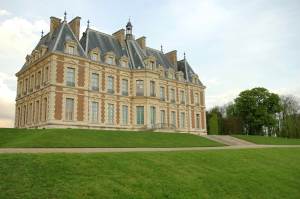
The Château de Sceaux (ca. 1860) houses the Musée de l'Île-de-France. The current château replaced a seventeenth-century house destroyed in the French Revolution. The gardens were laid out by André Le Nôtre in the 1670s.
Préfiguration de la vocation nouvelle du Petit Château, l’exposition consacrée au dessin français de paysage des XVIIe et XVIIIe siècles a permis la réunion d’une cinquantaine d’œuvres provenant de plusieurs grands musées (Besançon, Dijon, Epinal, Marseille, Montpellier, Quimper, Rennes), le Louvre consentant pour sa part à un ensemble de prêts particulièrement important. Le fonds propre du musée de l’Île-de-France vient compléter une sélection valorisant différents types de paysage, servis par une grande diversité de techniques graphiques (pierre noire, sanguine, lavis d’encre, aquarelle…). Que la représentation porte sur des sites rustiques ou urbains, que le cadrage en soit panoramique ou resserré, que l’élément humain y trouve ou non sa place, ces
feuilles se livrent comme autant de visions singulières du
monde, soutenues par des principes esthétiques très affirmés.

Site of the current exhibition of landscape prints, the Petit Château (ca. 1661) is one of the oldest buildings in the park.
Ainsi les dessins de Claude Gellée, de Sébastien Bourdon ou de Pierre Patel, au XVIIe siècle, véhiculent une pensée résolument classique, nourrie de poésie virgilienne appelant à une méditation sereine, tandis que ceux de François Boucher, de Jean-Honoré Fragonard ou d’Hubert Robert, au siècle suivant, cherchent davantage, par leurs rythmes puissants et presque musicaux, à surprendre et déstabiliser le spectateur. Quelques dessins s’imposeront comme d’évidents chefs-d’œuvre, tel l’Ermitage sur un rocher de Jacques Callot, la Vue de Marseille d’Israël Silvestre, ou celle de Rouen par Charles-Nicolas Cochin… Un rendez-vous à ne pas manquer !
En écho à cette exposition, une sélection de 13 dessins du XIXe siècle, issue des collections du musée de l’Ile-de-France, est présentée 1er étage du Château. Avec des feuilles de François-Edme Ricois, Jean-Jacques Champin, Jean-Marie Morel, Jean-Charles Develly, Paul Huet, Jean-Charles Develly, Jean-Lubin Vauzelle et Antoine-Patrice Guyot, la diversité technique et esthétique de la représentation du paysage au XIXe siècle permet de compléter le panorama esquissé au Petit Château.
◊ ◊ ◊ ◊ ◊
More information on the château and the exhibition (including a brief video) is available here»
Exhibition: Reynolds’ Celebrity Portraiture & the Market for Mezzotints
From The Huntington:
Out of the Shadows: Joshua Reynolds’ Celebrity Portraiture
and the Market for Mezzotints in 18th-Century Britain
The Huntington Library, San Marino, CA, 2 July — 26 September 2011

John Raphael Smith after Joshua Reynolds, "Henry George Herbert as 'The Infant Bacchus',” 1776, mezzotint (The Huntington)
One of the most innovative and popular mediums of the great age of 18th-century British art, mezzotint engraving altered the way images were produced and seen by an ever-growing and discerning audience. Building on the tradition of linear printmaking that began with Dürer’s woodcuts in the 15th century, English engravers developed a new tonal technique that provided an unprecedented level of textural refinement and expressive detail through light and shadow, rivaling that of the monumental oil paintings of masters such as Joshua Reynolds, George Romney, and Thomas Gainsborough.
Out of the Shadows: Joshua Reynolds’ Celebrity Portraiture and the Market for Mezzotints in 18th-Century Britain celebrates this rich period of mezzotint with 13 works from The Huntington’s collections. Highlighting the role of mezzotint in the development and dissemination of portraits after those of the most prolific portrait painter of the period, the exhibition includes works by engravers Valentine Green, James Watson, John Dixon, and John Jones, illustrating the popularity, breadth, and richness of mezzotint as a medium, as well as the development and
transformation of artistic production and the role of the artist in
18th-century England.










leave a comment