Exhibition: Revisiting the Regency: England, 1811–1820
From The Huntington:
Revisiting the Regency: England, 1811–1820
The Huntington Library, San Marino, CA, 23 April — 1 August 2011

Thomas Rowlandson, “Vauxhall Gardens,” from "Microcosm of London" (London: T. Bensley, ca. 1808–11)
In October of 1810, England’s King George III slipped into that final madness from which only death would release him, nearly a decade later. The following February, Parliament authorized the king’s estranged and profligate eldest son, the Prince of Wales (the future George IV), to rule in his place as regent. Extravagant, emotional, controversial, and self-indulgent, the prince regent lent his name and many of his characteristics to a glittering era.
In commemoration of the 200th anniversary of this extraordinary decade, The Huntington presents an exhibition titled Revisiting the Regency: England, 1811–1820. Opening April 23 in the West Hall of the Library and continuing through August 1, the exhibition draws on The Huntington’s extensive holdings of rare books, manuscripts, prints, and drawings documenting this historic era.
The term “Regency England” usually evokes Jane Austen’s world of graceful country-house living and decorous village society, the elegance of London’s fashionable elite, or the licentious activities of the prince and his aristocratic Carlton House set. Ladies followed the latest fashions in La Belle Assemblée while gentlemen copied Beau Brummell’s severe elegance. Readers found new works by a generation of England’s greatest poets and novelists: Austen, Lord Byron, John Keats, Samuel Taylor Coleridge, and Sir Walter Scott. Londoners enjoyed a rich theatrical and musical life, watching Edmund Kean’s premiere in Richard III or hearing the first English production of Mozart’s Don Giovanni. Art lovers followed the latest exhibits at the Royal Academy. Under the prince’s patronage, architect John Nash created the fantasy Royal Pavilion at Brighton and remade London’s West End with the new developments of Regent’s Park and Regent Street.
Yet underneath this ordered upper-class surface lay a far more complex and turbulent world: more than a century of intermittent war with France ended at Waterloo, but peace revealed wrenching poverty, social unrest, the strains of rapid industrialization, and growing calls for political reform. The first railroads, gas lighting, and other advances in technology altered the landscape of everyday life. This rich cavalcade of people and events provided irresistible targets for a brilliant generation of visual satirists. The witty, savage, and iconic images of George Cruikshank and his fellow caricaturists, well represented in the exhibition, capture all the vagaries of an extraordinary decade in English arts, letters, science, and society.
Mary Robertson, William A. Moffett Curator,
English Historical Manuscripts
Exhibition: ‘Making History: Antiquaries in Britain’

Making History: Antiquaries in Britain
McMullen Museum of Art, Boston College, 4 September — 11 December 2011
Yale Center for British Art, New Haven, 2 February — 27 May 2012
Making History celebrates the achievements of the Society of Antiquaries of London, the oldest independent learned society concerned with the study of the past. The exhibition, featuring one hundred works selected from the Society’s treasures (with a number of additions from the collections at the Center), focuses on the discovery, recording, preservation, and interpretation of Britain’s past through its material remains. It explores beliefs current before the Society was founded in 1707, and reveals how new discoveries, technologies, and interpretations have transformed our understanding of the history of Britain since the eighteenth century.
 Making History is organized into nine sections. Highlights include antiquities such as a rare Late Bronze Age shield (ca. 1300–1100 BCE) discovered on a farm in Scotland in 1779; an early copy of the Magna Carta (ca. 1225); a medieval processional cross reportedly recovered from the battlefield of Bosworth (1485); the inventory (1550–51) of Henry VIII’s possessions at the time of his death; and a forty-foot-long illuminated “roll chronicle” on parchment detailing the genealogical descent of Henry II from Adam and Eve. Also on display will be an extraordinary collection of English royal portraits painted on panel, from Henry VI to Mary Tudor.
The exhibition is organized by the Society of Antiquaries of London in association with the McMullen Museum of Art, Boston College, and the Center. It will be on display at the McMullen Museum of Art from September 9, 2011, to January 2, 2012, where the organizing curator is Nancy Netzer, Director. The organizing curator at the Center is Elisabeth Fairman, Senior Curator of Rare Books and Manuscripts.
◊ ◊ ◊ ◊ ◊
More information is available at the exhibition website.
Exhibition: Madame Geoffrin
From the Maison de Chateaubriand:
Madame Geoffrin, une femme d’affaires et d’esprit
Maison de Chateaubriand, Vallée-aux-loups, 27 April — 24 July 2011

Entre 1727 et 1766, après Mme de Rambouillet et sa célèbre chambre bleue et avant Mme Récamier, Mme Geoffrin occupe le devant de la scène des salons, éclipsant par son savoir-faire toutes les autres concurrentes de son temps. Aidée dans son entreprise par une fortune confortable que lui procurent ses actions à la Manufacture royale des Glaces, elle crée un cercle qui séduit tous les beaux esprits du temps et connaît un succès au-delà de ses espérances.
Correspondant avec Catherine II, l’impératrice Marie-Thérèse et plus encore Stanislas-Auguste Poniatowski, élu roi de Pologne en 1764, elle fait en 1766 un voyage à Varsovie qui lui octroie une renommée européenne. À Vienne, elle accepte d’être l’ambassadrice de l’impératrice afin de promouvoir en France la renommée de celle que l’on destine au dauphin, Marie-Antoinette. En remerciement, elle reçoit un somptueux service en porcelaine de Meissen, qui sera montré pour la première fois au public, accompagné du grand surtout de glace commandé par Mme Geoffrin afin de pouvoir présenter cette précieuse vaisselle dignement sur sa table.

Jean-Marc Nattier, "Portrait of Madame Geoffrin," 1738 (Tokyo: Fuji Art Museum)
Sans pouvoir évoquer toutes les facettes du personnage, l’exposition permettra d’en mesurer l’envergure par la présentation non seulement de documents d’archives mais de souvenirs lui ayant appartenu ou de tableaux provenant de sa collection, exécutés par François Boucher, Claude-Nicolas Cochin, Joseph Vernet, Carle Van Loo, aujourd’hui conservés essentiellement en collections privées, qui nous livrent les secrets des goûts de cette protectrice des arts. Après un portrait inédit de Mme de Rambouillet par Philippe de Champaigne, l’exposition s’ouvre par des portraits peints de Mme Geoffrin et des portraits psychologiques dressés par sa fille ou les gens de Lettres qui l’ont connue. Suit la section consacrée à la femme d’affaires, évoquée grâce au concours de Saint-Gobain. Puis le visiteur pénètre dans l’intimité de l’hôtel Geoffrin – notamment par deux dessins d’Hubert Robert – et de ses invités. L’exposition s’achève par le retour de Pologne à Paris de notre héroïne, alors au zénith de sa gloire, la fin de sa vie et son rayonnement posthume.
Exhibition: The Eighteenth Century Back in Fashion
From the Palace of Versailles:
Le XVIIIe au goût du jour / A Taste of the Eighteenth Century
Grand Trianon, Château de Versailles, 8 July — 9 October 2011
Curated by Olivier Saillard
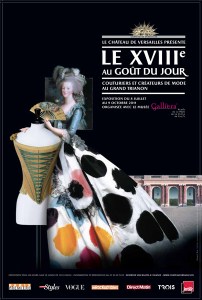 The Palace of Versailles and the Musée Galliera present an exhibition in the apartments of the Grand Trianon dedicated to the influence of the 18th century on modern fashion. Between haute couture and ready-to-wear, fifty models by great designers of the 20th century dialogue with costumes and accessories from the 18th century and show how this century is quoted with constant interest. These pieces come from the archives of maisons de couture and from the Galliera’s collections.
Influencing all the European courts, French culture of the 18th century was embodied by Madame de Pompadour, Madame Du Barry and even more so Marie-Antoinette – paragons of frivolity that has always fascinated the cinema, literature and the fashion world. With its huge powdered hairstyles, whalebone stays and hoop petticoats, flounces, frills and furbelows, garden swings and whispered confidences, the 18th century brought artifice to its paroxysm…
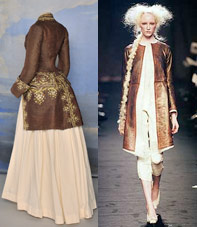 A fantasized style which gives free rein to interpretation: the Boué Sisters in the twenties revive panniers and lace in their robes de style, Christian Dior and Pierre Balmain offer evening gowns embroidered with typically 18th-century decorative patterns, Vivienne Westwood brings back brazen courtesans, fashionable Belles are corsetted by Azzedine Alaïa, Karl Lagerfeld for Chanel invites Watteau with his robes à la française, the Maison Christian Dior adorns duchesses with delicate attires, Christian Lacroix drapes his queens with brocades lavishly gleaming with gemstones and Olivier Theyskens for Rochas summons up the ghost of Marie-Antoinette in a Hollywood film.
While the elegant simplicity in black and white is played by Yves Saint Laurent, Martin Margiela transforms men’s garments into women’s, Nicolas Ghesquière for Balenciaga enhances women in little marquis dressed with lace and Alexander McQueen for Givenchy clothes his marquises in vests embroidered with gold thread. With Yohji Yamamoto, court dresses are destructured and so does Rei Kawakubo with riding coats. While Thierry Mugler hides oversized hoops under the dresses, Jean Paul Gaultier puts them upside down.
Couturiers and fashion designers invite you to discover this 18th century back in fashion, in the Grand Trianon.
◊ ◊ ◊ ◊ ◊
Suzy Menkes’s review for The New York Times (11 July 2011), is available here»
July Issue of ‘The Burlington’
The Burlington Magazine 153 (July 2011)
 • Gerlinde Klatte, “New documentation for the ‘Tenture des Indes’ tapestries in Malta” — Unpublished documents on the Anciennes Indes tapestry set (1708–10) woven by Etienne Le Blond for the Order of St John, Valletta, Malta.
Reviews
• Ann Compton, Review of Rune Frederikson and Eckart Marchand, eds., Plaster Casts: Making, Collecting and Displaying from Classical Antiquity to the Present (Berlin and New York, 2010),
• Rose Kerr, Review of Robert Finlay, The Pilgrim Art: Cultures of Porcelain in World History (Berkeley, 2010)
• Humphrey Wine, Review of the exhibitions, Watteau’s Drawings, Watteau and His Circle
• Todd Longstaffe-Gowan, Review of the exhibition, French Romantic Gardens
• Neil Jeffares, Review of the exhibition, Pastel Portraits
Exhibition: French Romantic Gardens
Thanks to Hélène Bremer for this notice. From the exhibition website:
Jardins Romantiques Français (1770-1840)
Musée de la Vie Romantique, Paris, 8 March — 17 July 2011
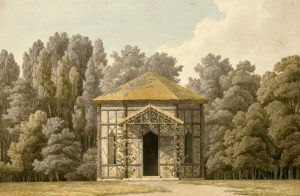
Louis-Hippolyte Lebas, "Le Petit Pavillon du Parc de Malmaison," watercolor (Musée National du château de la Malmaison) © RMN/Gérard Blot -- the building was designed by François Cointereaux around 1790.
Comment proposer aujourd’hui une définition du jardin romantique français, telle est la question que nous nous sommes posée alors que certains des meilleurs spécialistes en réfutent l’appellation. Aussi bien avons-nous usé du pluriel dans le titre « Jardins romantiques » pour évoquer, sans pouvoir être exhaustif, certains parmi les trop multiples reflets du romantisme au jardin.
Au fil des siècles et des saisons, le goût du jardin pittoresque s’est raffiné en un art de vivre à part entière dont les Encyclopédistes puis Beaumarchais avant l’impératrice sont les ambassadeurs écoutés. Au premier rang s’imposent naturellement voyageurs et savants qui rapportent et multiplient, d’un continent à l’autre, moult herbiers
soigneusement conservés au Muséum et rares cultivars
développés dans le secret des pépinières ou à l’arboretum.
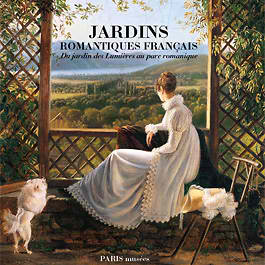
ISBN: 9782759601592, 30€
Au XIXe siècle l’Europe des botanistes résonne tel un bruissant arbre à palabres : on y disserte en latin comme en français sur les principes modernes de la taxinomie et de la dendrologie ; jardinistes et passionnés ouvrent largement les enclos sur la nature environnante et plantent des parcs paysagers. Serres chaudes et palmariums ponctuent les propriétés que leurs commanditaires identifient à leur récente prospérité. Le sentiment du sublime inspire fabriques et cascades, grottes et lacs. Ces nouveaux jardins d’Armide s’ornent de maints caprices secrets : temple de l’amour ou laiterie, chalet ou casino, faux tombeaux ou ménagerie. Pour les délices du vert galant, il n’est pas de sens plus nomade que la vue. Ainsi, la Restauration et la Monarchie de Juillet voient la pratique du jardinage conquérir toutes les couches de la société, et les grands destins du romantisme s’y enracinent. . . .
More information is available here»
◊ ◊ ◊ ◊ ◊
Exhibition catalogue: Daniel Marchesseau, Jardins romantiques français: Du jardin des Lumières au parc romantique (Paris Musées, 2011), 256 pages, ISBN: 9782759601592, 30€.
Exhibition: ‘Scraps: British Sporting Drawings’ at the VMFA
From the VMFA:
Scraps: British Sporting Drawings from the Paul Mellon Collection
Virginia Museum of Fine Arts, Richmond, 18 June — 18 September 2011
Curated by Corey Piper

Thomas Rowlandson, "The Woolpack Inn, Hungerford, Berkshire," detail, 1796, pencil, pen, ink and watercolor (VMFA: Paul Mellon Collection, 85.1037). Copyright VMFA
Taking its title from a series of drawings and prints by Henry Alken depicting sketches of country life, Scraps: British Sporting Drawings from the Paul Mellon Collection features drawings and watercolors that showcase the passing moments of observation that comprise the rich world of British Sporting Art. Works in the exhibition range from pencil sketches which record the artist’s direct observation of animal subjects to more highly finished works which present a more fully developed vision of sport and country life.
The exhibition offers a broader view of artists well known for their sporting paintings and prints such as Henry Alken, James Seymour, Sawrey Gilpin, Edwin Landseer, James Ward and Thomas Rowlandson and reveals them to be skilled draftsmen as well as keen observers of the natural world and the realm of sport. Drawn entirely from the extensive holdings of works on paper in the Mellon Collection at VMFA, this exhibition offers a rare look into the working methods and personal vision of Britain’s greatest sporting artists. (more…)
Exhibition: ‘Revolution!’
From the New-York Historical Society:
Revolution! The Atlantic World Reborn
New-York Historical Society, 11 November 2011 — 15 April 2012
Details of additional venues to be announced later
Curated by Richard Rabinowitz

ISBN: 9781904832942, $65
Revolution! The Atlantic World Reborn, an international exhibition sponsored by the New-York Historical Society, will open in New York in November 2011 and travel to sites in Britain, France, the United States, and Haiti. Occupying about 3,500 square foot (325 m2), the exhibition will feature magnificent paintings, drawings, and prints from collections in a half-dozen countries; historical documents, maps, and manuscripts penned by participants in these revolutions; audio-visual presentations and computer-interactive learning stations; inventive and beautiful works of art commissioned for this exhibition; and curriculum materials for students from kindergarten through graduate school. The exhibition will be fully accessible in English, French, and Haitian Kreyol. Dr. Richard Rabinowitz of the American History Workshop, is Chief Curator of the exhibition. A beautifully illustrated catalog, with scholarly essays by leading scholars in revolutionary studies and edited by Professors Thomas Bender of NYU and
Laurent Dubois of Duke, will accompany the exhibition.

Noel le Mire, "General Washington," 1780, engraving (New York Historical Society)
The exhibition explores the enormous transformations in the world’s politics and culture between the 1763 triumph of the British Empire in the Seven Years War and the end of the Napoleonic Wars 52 years later. For the first time, this story will be told as a single global narrative rather than as chapters within national histories. Opposing the power and reach of European imperial authorities, the diverse men and women of the Atlantic world — natives of Africa, Europe, and the Americas — registered their grievances in both legal argument and violent protest. Their first major outbursts, comprised in the American Revolution, triggered an explosion of radical ideas. And these in turn drew many Britons to the antislavery crusade, then fomented a fierce antagonism to entrenched privilege among French revolutionaries, and finally spawned the astonishing insurrection on the island of Saint Domingue leading to the world’s only successful slave revolt and the establishment of the first nation fully committed to equality and emancipation, Haiti.

John Greenwood, "Sea Captains Carousing in Surinam," ca. 1752-58, oil on bed ticking (Saint Louis Art Museum)
Linking the attack on monarchism and aristocracy to the struggle against slavery, Revolution! explores how thousands of revolutionaries across the Atlantic world made freedom, equality, and the sovereignty of the people into universal goals. The eighteenth-century revolutionaries certainly did not succeed in obliterating every trace of the Ancient Regime, but they invented the notions of human rights, within a world of nation states, that still fire the desire for justice everywhere.
◊ ◊ ◊ ◊ ◊
Exhibition catalogue: Thomas Bender and Laurent Dubois, eds., Revolution! The Atlantic World Reborn (London: Giles, 2011), 288 pages, ISBN: 9781904832942, $65.
Exhibition: ‘Life, Liberty, and the Pursuit of Happiness’
Life, Liberty, and the Pursuit of Happiness: American Art from the Yale University Art Gallery
Speed Art Museum, Louisville, 7 September 2008 — 4 January 2009
Seattle Art Museum, 26 February — 24 May 2009
Birmingham Museum of Art, Alabama, 4 October 2009 — 10 January 2010
Yale University Art Gallery, New Haven, 29 July 2011 — 8 July 2012 (in three parts)

John Trumbull, "The Declaration of Independence, July 4, 1776," 1786–1820 (Yale University Art Gallery)
This exhibition draws upon the Gallery’s renowned collection of American paintings, decorative arts, and prints to illuminate the diverse and evolving American experience from the time of the settlements of the late seventeenth century to the World’s Columbian Exposition in 1893. The more than 200 works in this traveling exhibition—including treasures such as John Trumbull’s Declaration of Independence and Winslow Homer’s Morning Bell—now return to New Haven for a three-part presentation.
Exhibition and publication organized by Helen A. Cooper, the Holcombe T. Green Curator of American Paintings and Sculpture, with Robin Jaffee Frank, the Alice and Allan Kaplan Senior Associate Curator of American Paintings and Sculpture; Elisabeth Hodermarsky, the Sutphin Family Associate Curator of Prints, Drawings, and Photographs; and Patricia E. Kane, Friends of American Arts Curator of American Decorative Arts, all Yale University Art Gallery.
◊ ◊ ◊ ◊ ◊
Exhibition catalogue: Helen A. Cooper, ed., Life, Liberty, and the Pursuit of Happiness: American Art from the Yale University Art Gallery (New Haven: Yale University Press, 2008), 368 pages, ISBN: 9780300122893.
 The American experience—from its colonial beginnings to the modern age—has captured the imagination of all Americans, including its artists. This richly illustrated book explores works from the renowned collections of American paintings, decorative arts, prints, and photographs at the Yale University Art Gallery and creates a vivid portrait of a young country defining itself culturally, politically, and geographically.
Distinguished scholars shed new light on American history by examining some of the most familiar and revered objects in American art—paintings by Trumbull, Peale, Copley, Eakins, Church, and Homer; silver by Revere and Tiffany; furniture by Roux and Connelly; and photographs by Muybridge, among others. The authors discuss how issues of cultural heritage, patriotism, politics, and exploration shaped America’s art as well as its attitudes and traditions.
Exhibition: ‘Georges de Lastic: Amateur, Collector, and Curator’
As reviewed by Bénédict Ancenay for The Art Tribune (18 February 2011) . . .
Georges de Lastic: Le Cabinet d’un amateur, collectionneur et conservateur
Musée de la Chasse et de la Nature, Paris, 7 December 2010 — 14 March 2011
Musée de la Vénerie, Senlis, 7 December 2010 — 14 March 2011
Musée d’Art Roger-Quilliot, Clermont-Ferrand, 4 October 2011 — 5 February 2012
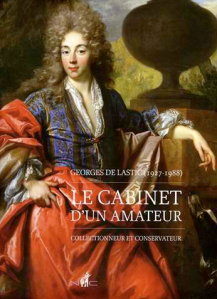
ISBN: 978-2350391021, 42.00€
One man and two exhibitions, Georges de Lastic (1927-1988), a curator and collector, amply deserves this celebration in the two locations which distinctly marked his professional life. . . . An aesthete and historian, both in his professional and personal life, Georges de Lastic assembled a private collection which is now highlighted in the double exhibition presented at the Musée de la Vénerie in Senlis and the Musée de la Chasse et de la Nature in Paris. . . .
In 1970, Georges de Lastic inherited the château de Parantignat, his “little Versailles in Auvergne,” the residence for the Marquis de Lastic for over three centuries which, along with his Parisian apartment on quai de Bourbon, housed his collection of 17th- and 18th- century French paintings acquired over the years at the Drouot auction house and from various art dealers. The ensemble is made up mainly of three artists, the portraitists Nicolas de Largillierre and Hyacinthe Rigaud, representative of the “grand genre” in the Grand Siècle and the Regency, as well as François Desportes, an artist who illustrated the Sun King’s hunting parties. His wife, Françoise de Lastic and his son, Anne-François, who today are in charge of preserving the collection, accepted to lend over sixty paintings, drawings and sculptures. . . .
All of these magnificent pieces now on display to the general public will soon return to their private residence, but the catalogue will remain in testimony. The entries, under the supervision of Pierre Rosenberg, were all written by the most respected specialists of each of the artists in the exhibition. Curators, university scholars, historians or researchers, each has achieved a hymn to the glory of French painting during the Grand Siècle and Georges de Lastic’s refined taste.
A visit to the Marais, at the Musée de la Chasse et de la Nature, is a traditional part of any art lover’s itinerary. They should now add a trip to Senlis to better understand the range and complexity of the Lastic collection. This sidetrip will also allow visitors to rediscover the Musée de la Vénerie, which houses a valuable collection presented with great quality, thus going far beyond the misleadingly limited confines of its name in a historic city which has known how to preserve all of its charm.
The full review is available here»
◊ ◊ ◊ ◊ ◊
Exhibition catalogue: Pierre Rosenberg et al., Le cabinet d’un amateur, Georges de Lastic (1927-1988), collectionneur et conservateur (Paris: Chaudun, 2010), 240 pages, ISBN: 978-2350391021, 42€.










leave a comment