At the Louvre: New Multimedia Exhibition Highlights Sèvres Porcelain
Press release from the Louvre:
Sèvres Porcelain: An Art of Living in the 18th Century
Musée du Louvre, Paris, from 8 June 2011

Vase à fleurs "Duplessis," manufacture de Vincennes, ca. 1752 (Musée du Louvre, département des Objets d’art. N° d’inventaire OA 7610) © 2010 musée du Louvre / Martine Beck-Coppola.
Feast your eyes on the beauty of 18th-century Sèvres porcelain in the Louvre’s magnificent Napoléon III Apartments. Cuttingedge multimedia resources, designed in the context of the Museum Lab project, will help you discover how these porcelain pieces were made and provide an introduction to this aspect of the French art of living. Visit Rooms 93 and 95 on the first floor of the Richelieu Wing, where a multimedia experience awaits you! The displays entitled “Court dining in France” and “Manufacturing technique of soft-paste porcelain” will appeal to new and regular visitors alike, adding an entertaining, interactive dimension to their museum experience.
The manufacturing process of what was referred to as “white gold” was long a well-kept secret and the preserve of the most experienced craftsmen. The animated images in this display offer visitors an insight into traditional manufacturing techniques and the materials that were used to produce soft-paste porcelain since the founding of the Vincennes-Sèvres Manufactory in 1746.
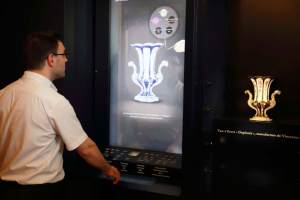 On April 21, 1757, Louis XV held a supper for his guests at the Château de Choisy. The dishes were presented “French style,” which meant that the food was served in successive courses, and guests could help themselves to soups and hors-d’oeuvre, medium and large entrées, roast meats and salads, hot and cold entremets, and desserts. Each course required a specific range of plates and hollow ware. This multimedia display invites museum visitors to the King’s table. They approach the touch-table, select their language, and experience the atmosphere of a royal supper served on Sèvres porcelain.
The porcelain technique was first mastered in France in the mid-18th century, at the Vincennes-Sèvres Manufactory. Technique, form and design constantly evolved as craftsmen emulated FarEastern then European models, and this is reflected in the pieces on display—a vase and tableware in “soft-paste” porcelain (so-called because of the fragility of the enamel). The quality of the colors and elegance of the decoration testify to the skill of the Manufacture’s craftsmen, while the various forms and functions evoke the sophistication of the French art of living in the 18th century. (more…)
Reviewed: ‘Thomas Gainsborough and the Modern Woman’
Benedict Leca, Aileen Ribeiro, and Amber Ludwig, Thomas Gainsborough and the Modern Woman, ed. Benedict Leca (London: Giles Limited, 2010) 196 pages, ISBN: 9781904832850, $49.95.
Reviewed for Enfilade by Susan M. Wager
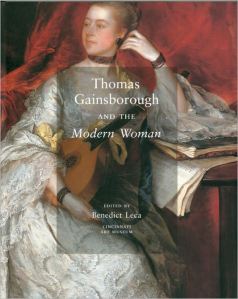 After a visit to Thomas Gainsborough’s studio in October 1760, the socially and culturally accomplished Mary Delany wrote, “There I saw Miss Ford’s picture—a whole length with her guitar, a most extraordinary figure, handsome and bold; but I should be sorry to have any one I loved set forth in such a manner.” The picture in question, Gainsborough’s Ann Ford of 1760, and the ambivalent reactions (like Mrs. Delany’s) it has engendered, is the central focus of Thomas Gainsborough and the Modern Woman. This lavishly illustrated catalogue, published to accompany an exhibition of the same name that originated at the Cincinnati Art Museum in 2010 before traveling to the San Diego Museum of Art earlier this year, was edited by Benedict Leca, Curator of European Painting, Sculpture, and Drawings at the Cincinnati Art Museum.
The portrait of Ann Ford—an eighteenth-century woman who garnered an ambiguous reputation by daring to organize public performances of her talent at the viola da gamba (unusual for a woman at the time)—was acquired by the Cincinnati Art Museum in 1927 and remains a highlight of the Museum’s collection. Leca has cleverly constructed an exhibition around the portrait, enriching our understanding of it through the juxtaposition of several well-selected loans. These include some of Gainsborough’s portraits of other “demireps”—women whose “social and sexual assertiveness combined with their flair for personal style and public exposure ran counter to propriety,” as defined by Leca. The catalogue’s three essays—by Leca, Aileen Ribeiro, and Amber Ludwig—all seem to be underpinned, implicitly, by the question: to what extent were these “demireps” in control of the constructed identities mediated through their painted portraits?
Leca’s approach to this question is decidedly optimistic. Drawing on compelling evidence such as Ann Ford’s published writings on the merits of the female sex, Leca argues that Gainsborough and Ford, in addition to some of his other female sitters, were equal partners in the production of images that challenged circumscribed gender codes and asserted female liberation from masculine control. Leca reads the correlation of Gainsborough’s signature loose brushwork—deemed “feminine” by his contemporaries—with painted passages of conventionally feminine accessories adorning sexually assertive women as the artist’s ironic and progressive rejection of masculinist norms. As Leca writes, Gainsborough’s portraits present “provocative women provocatively painted.”
Ribeiro’s essay considers how the costumes worn by Gainsborough’s demireps participated in the negotiation of reputation, class, and status. Ribeiro subtly complicates Leca’s reading of Ann Ford by evoking scholars who have suggested that paintings of accomplished women like Ford could be seen as relatively traditional presentations of ideal and precious objects of beauty, served up for the viewer’s delectation. Although Ribeiro ultimately disagrees with these readings, her essay nonetheless gestures toward the plurality of interpretations that can be gleaned from images of demireps.
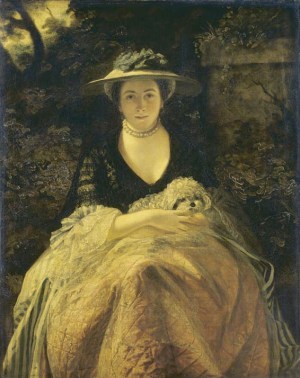
Joshua Reynolds, "Portrait of Nelly O'Brien," ca. 1762-64 (London: Wallace Collection)
Leca and Ribeiro mobilize two different portraits by Joshua Reynolds of the courtesan Nelly O’Brien to make divergent points about Ann Ford. Leca emphasizes the “subversive femininity” and “suggestiveness” of Ford’s pose by contrasting it to Reynolds’s 1762-4 portrait of O’Brien (The Wallace Collection). Whereas Reynolds dissembles the unsavory profession of O’Brien through the imposition of a pyramidal, closed, Marian pose onto her body, Gainsborough flaunts the immodesty and impropriety of Ford’s dynamic, crossed-leg attitude. Ribeiro, however, juxtaposes Ann Ford with a 1763-7 Reynolds portrait of O’Brien (The Hunterian Museum & Art Gallery, University of Glasgow) in order to underscore the formality of Ford’s dress in contrast to O’Brien’s “loose bed-gown.” The latter is far more scandalous than Ford’s costume, which would have been chosen precisely to shore up Ford’s ambiguous reputation. Conflicting readings like these do not detract from the overall thrust of the book; instead, they strengthen it, attesting to the complexity of the images under examination.

Joshua Reynolds, "Portrait of Nelly O'Brien," ca. 1763-67 (Glasgow: Hunterian Museum)
Indeed, complexity characterizes the images addressed by Amber Ludwig in her essay on how portraiture could attach the appearance of virtue to women with dubious reputations. Addressing pictures of Emma Hamilton, she underscores, for instance, tensions between the desires and personality of the sitter and the desires for propriety imposed by her husband or lover.
Thomas Gainsborough and the Modern Woman would be a welcome addition to the libraries of scholars and general readers alike. The catalogue’s clear prose is supplemented by sumptuous, full-color plates and extraordinarily high-resolution details, offering a worthy substitute for individuals who did not see the exhibition, or a handsome aide-mémoire for those who did.
◊ ◊ ◊ ◊ ◊
Susan M. Wager is a Ph.D. candidate in Art History & Archaeology at Columbia University. Her research examines eighteenth-century reproductions after François Boucher in the mediums of gems, porcelain, and tapestries at the intersection of consumer culture, natural history, antiquarianism and connoisseurship, and global exchange.
The Prado Publishes New Acquisitions Catalogue *Only* Online — It’s Free
Is this the future or just an experiment along the way? From the Prado’s website:
José Manuel Matilla, ed., No solo Goya: Adquisiciones para el Gabinete de Dibujos y Estampas del Museo del Prado 1997-2010, exhibition catalogue (Madrid: Prado, 2011), 383 pages, ISBN: 9788484802204.
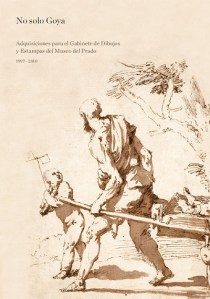 For the first time in the Museum’s history the catalogue has only been published in on-line format. An innovative new format has been designed that combines the benefits of the traditional printed book with the new possibilities offered by digital formats, such as links, attached archives, image enlargement, bibliographies and automatic searches.
The catalogue offers detailed descriptions and reproductions of the 111 works in the exhibition. The texts are written by curators at the Museum and by outside experts with whom the Museum is working on various projects that are currently in progress.
Exhibition: James Cook et al
From the museum:
Cook, Melville, and Gauguin: Three Voyages to Paradise
Maritime Museum of San Diego, 27 May 2011 — 1 January 2012
 Imagine what treasures one would have seen exploring the Pacific islands in centuries past? The Three Voyages to Paradise exhibit is inspired by those very visions as seen through the eyes of Captain James Cook, author Herman Melville, and painter Paul Gauguin.
Highlighting this extraordinary exhibit are original paintings created by the official expedition artists (William Hodges and John Webber), on James Cook’s second and third Voyages of Discovery. Scientific and navigation instruments from Cook’s time as well as personal effects and Cook memorabilia will also be displayed along with Charts and Pacific artifacts from the period. Paintings, engravings and whaling artifacts representative of Herman Melville’s episodic adventure in the South Seas will be interpreted using select examples of his writings.
Central to the exhibition will be a comprehensive collection of original oil and watercolor paintings, woodblock prints, engravings and sculpture by Paul Gauguin. This exhibit will comprise the largest display of three-dimensional Gauguin masterpieces currently seen anywhere in the world, including a newly discovered Gauguin wood carving on display for the first time in America.
This Week’s Romantic Objects Seminar in London: Blake and Varley
Philippa Simpson and Sibylle Erle, Varley’s Visionary Heads and Blake’s The Ghost of a Flea
Institute of English Studies, University of London, 15 June 2011

William Blake, "The Ghost of a Flea," ca. 1819-20, tempera heightened with gold on mahogany support (London: Tate Britain)
Romantic Objects is a seminar series that runs over two terms (Spring and Summer) on Wednesdays 5:30-7:30, as part of the inter-university seminar in Romantic Studies at Senate House, co-organized by Birkbeck and the Open University at the Institute of English Studies. This series of seminars will rethink Romantic period material culture in the tension between Romantic attempts to recenter aesthetic experience as subjective just as a new culture of exhibitions, viewing, and collecting practices defines the centrality of objects. The aim is to provide a forum for graduate students, scholars, and curators working in the period 1750-1850 or on questions relating to objects, exhibitions, material culture.
This week’s seminar features Dr Philippa Simpson (Tate Britain) and Dr Sibylle Erle (Bishop Grosseteste College, Lincoln) on John Varley’s Visionary Heads and William Blake’s The Ghost of a Flea. Erle and Simpson curated the current display of Blake and Physiognomy at Tate Britain. Erle is the author of Blake, Lavater and Physiognomy (2010). Simpson, an expert in late eighteenth-century exhibition culture and the
reception of the old masters, co-curated the exhibition Turner and the
Masters. The seminar takes place Wednesday, 15 June, 17:30-19:30, in
STB8 Stewart House, basement, 32 Russell Square. All are welcome!
Reading:
Alexander Gilchrist, Life of Blake (1863), pp. 249-57, (via Googlebooks)
◊ ◊ ◊ ◊ ◊
Sibylle Erle, Blake, Lavater, and Physiognomy (Oxford: Legenda, 2010), 244 pages, ISBN: 9781906540692, $89.

ISBN: 9781906540692
William Blake never travelled to the continent, and yet his creation myth is far more European than has so far been acknowledged. His early illuminated books, of the 1790s, run alongside his professional work as a copy-engraver on Henry Hunter’s translation of Johann Caspar Lavater’s Essays on Physiognomy (1789-98) — work in which Blake helped to make a likeness of a book about likenesses. For Blake, as for Lavater, Henry Fuseli, Joshua Reynolds, and others of his age, the art of the portrait was to find the right balance between likeness and type. Blake, Lavater, and Physiognomy demonstrates how the problems occurring during the production of the Hunter translation resonate in Blake’s treatment of the Genesis story. Blake takes us back to the creation of the human body, and interrogates the idea that ‘God created man after his own likeness’. He introduces the ‘Net of Religion’, a device which presses the human form into material shape, giving it personality and identity. As Erle shows, Blake’s startlingly original take on the creation myth is informed by Lavater’s pursuit of physiognomy: the search for divine likeness, traced in the faces of their contemporary men.
◊ ◊ ◊ ◊ ◊
Blake and Physiognomy
Tate Britain, London, 8 November 2010 — 17 April 2011
Curated by Philippa Simpson and Sibylle Erle
[There is] not a man who does not judge of all things…by their physiognomy;
that is, of their internal worth by their external appearance.
–Johann Caspar Lavater
Johann Caspar Lavater’s Essays on Physiognomy, translated into English in 1789, catalysed a vogue for the theory that people’s characters could be read in their features. Although this would seem to serve as a model of detached observation and scientific classification, Lavater saw these judgements as stemming from an instinctive understanding of expression and appearance. At the heart of his work was a strongly-held Christian belief, according to which all forms were divinely created, and derived from the one perfect God. Lavater’s ideas were also informed by eighteenth-century codes of racial stereotyping that are deeply troubling to the modern reader.
Many British artists, including William Blake, experimented with physiognomic systems in their work. Blake’s involvement, though, was closer than most. He not only engraved illustrations for the 1789 translation of Lavater’s book but, over thirty years later collaborated with his friend, artist and astrologer John Varley, on a publication entitled Zodiacal Physiognomy. This book sought to attribute character according to time of birth, and Varley used prints after Blake’s works to illustrate different star signs. These enterprises suggest that Blake’s visual language, which often seems highly innovative – even idiosyncratic – may be read in the context of broader pseudo-scientific and artistic trends.
Exhibition: ‘The First Actresses’ in London
Press release rom the NPG:
The First Actresses: Nell Gwyn to Sarah Siddons
National Portrait Gallery, London, 20 October 2011 — 8 January 2012
Curated by Gill Perry, supported by Lucy Peltz

John Hoppner, "Mrs. Robinson as 'Perdita'," 1782 © Chawton House Library, Hampshire
The first exhibition to explore art and theatre in eighteenth-century England through portraits of women will open at the National Portrait Gallery in October 2011. With 53 portraits, some brought together for the first time and others not previously seen in public, the exhibition will show the remarkable popularity of actress-portraits and provide a vivid spectacle of eighteenth-century femininity, fashion and theatricality. The First Actresses: Nell Gwyn to Sarah Siddons will show large paintings of actresses in their celebrated stage roles, intimate and sensual off-stage portraits and mass-produced caricatures and prints, and explore how they contributed to the growing reputation and professional status of leading female performers.
The exhibition will combine much-loved works by artists such as Joshua Reynolds, Thomas Gainsborough, John Hoppner, Thomas Lawrence, Johann Zoffany and James Gillray, with some newly discovered works such as the National Portrait Gallery’s new acquisition of the Three Witches from Macbeth by Daniel Gardner.
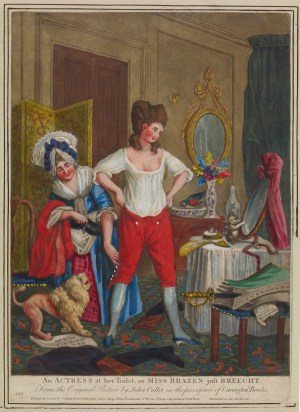
After John Collett, "An Actress at Her Toilet or Miss Brazen just Breecht," ca. 1779
Actresses featured in the exhibition include Nell Gwyn, Kitty Clive, Hester Booth, Lavinia Fenton, Peg Woffington, Sarah Siddons, Mary Robinson, Dorothy Jordan, Elizabeth Farren, Giovanna Baccelli and Elizabeth Linley. Highlights include a little known version of Reynolds’s famous portrait of Sarah Siddons as the Tragic Muse, Hogarth’s The Beggar’s Opera, Gainsborough’s portraits of Giovanna Bacelli and Elizabeth Linley. Important loans include works from the Garrick Club Library, the Royal Shakespeare Company, the National Gallery of Art, Washington, The Fitzwilliam Museum, Cambridge, Tate Britain, the V&A, as well as Petworth, Kenwood and Longleat Houses.
Starting with the emergence of the actress’s profession in the late seventeenth century, The First Actresses: Nell Gwyn to Sarah Siddons will show how women performers, in drama, as well as music and dance, were key figures within a spectacular celebrity culture. Fuelled by gossipy theatre and art reviews, satirical prints and the growing taste for biography, eighteenth-century society engaged in heated debate about the moral and sexual decorum of women on stage and revelled in the traditional association between actress and prostitute, or ‘whores and divines’. The exhibition will also reveal the many ways in which women performers stimulated artistic innovation and creativity and provoked intellectual debate.
As well as focusing on the eighteenth-century actress as a glamorous subject of high art portraits, and the ‘feminine face’ of eighteenth century celebrity culture, the exhibition will look at the resonances with modern celebrity culture and the enduring notion of the actress as fashion icon. As a counterpoint to the exhibition, an accompanying display will show photographic and painted portraits, drawn from the Gallery’s permanent collections, of some of today’s actresses, some of whom have agreed to be the exhibition’s ‘Actress Ambassadors’. A full list will be published prior to opening.
◊ ◊ ◊ ◊ ◊
An exhibition conference will take place on Friday, 11 November 2011.
Exhibition catalogue: Gill Perry with Joseph Roach and Shearer West, The First Actresses: Nell Gwyn to Sarah Siddons (London: National Portrait Gallery, 2011), 160 pages, ISBN: 9781855144118, £30.
Exhibition: ‘Italian Master Drawings’ in Washington
Press release from the National Gallery in DC:
Italian Master Drawings from the Wolfgang Ratjen Collection, 1525–1835
National Gallery of Art, Washington D.C., 8 May — 27 November 2011
Curated by Margaret Morgan Grasselli

Canaletto, "The Giovedì Grasso Festival before the Ducal Palace in Venice," 1763/1766 (Washington DC: National Gallery, Ratjen Collection, Paul Mellon Fund 2007.111.55)
Splendors of Italian draftsmanship from the Wolfgang Ratjen Collection, spanning the late Renaissance to the height of the neoclassical movement, will be showcased at the National Gallery of Art, Washington. On view in the Gallery’s West Building from May 8 to November 27, 2011, Italian Master Drawings from the Wolfgang Ratjen Collection, 1525–1835 will include 65 stunning Italian compositions and study sheets by the most important artists of the period, from Giulio Romano and Pellegrino Tibaldi to Canaletto, all three members of the Tiepolo family, and Giovanni Battista Piranesi.
In 2007, the National Gallery of Art acquired 185 German and Italian works from the Ratjen Collection—one of the finest private European holdings of old master drawings—with the help of 12 generous private donors as well as the Paul Mellon Fund and the Patrons’ Permanent Fund. “We are delighted to celebrate the second part of the Gallery’s acquisition of this exceptional group of German and Italian drawings formed by the great European collector Wolfgang Ratjen,” said Earl A. Powell III, director, National Gallery of Art. “The Italian portion of the collection is an assemblage of works of beauty and power. Italian drawings were in fact Ratjen’s first love, and he worked on this part of his collection with attentive care throughout his years as a collector.”

ISBN: 9781907372216, $50
Wolfgang Ratjen formed his Italian collection of drawings over a period of about 25 years. He grew up with two that had been acquired by his family during his youth—works by Guercino and Giovanni Battista Tiepolo—and he began collecting himself in the early-1970s. He purchased his last Italian drawing, by Giulio Cesare Procaccini, in July 1997. Ratjen’s collection of Italian drawings is best described as a group of single outstanding works, including famous artists as well as artists of lesser renown. For a select few—such as Jacopo Palma il Giovane, Guercino, and Giovanni Battista Tiepolo—he acquired multiple sheets that conveyed different facets of the artists’ styles or represented a variety of media used.
Organized chronologically throughout three galleries, the exhibition will present works that span three centuries, from the last flowering of the Renaissance around 1530 to the height of neoclassicism in the early 19th century. The works represent a dynamic range of techniques, including quick pen and ink sketches, finely nuanced chalk studies, and highly
finished brush drawings. (more…)
Exhibition and Conference: ‘Palladio and His Legacy’
This show which was at the Morgan last summer opens at Notre Dame with a full conference this weekend. My sense is that the exhibition functions rather differently in these two venues — one might think not only about the reception of Palladio but also the reception of the exhibition. From the Snite website:
Palladio and His Legacy: A Transatlantic Journey
The Morgan Library and Museum, New York, 2 April — 1 August 2010
National Building Museum, Washington D.C., 2 September 2011 — 30 January 2011
Snite Museum of Art, Notre Dame, 5 June — 31 July 2011
Carnegie Museum of Art, Pittsburgh, 3 September — 31 December 2011
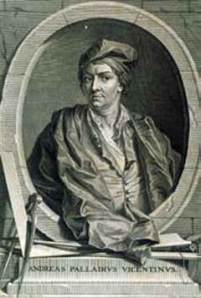
Conjectural portrait of Andrea Palladio, ca. 1715, engraved after Sebastiano Ricci (RIBA British Architectural Library)
This traveling exhibition organized by the Royal Institute of British Architects in association with the Centro Internazionale di Studi di Architettura Andrea Palladio, Vicenza, offers a rare opportunity to see thirty-one drawings by the famous 16th-century architect, Andrea Palladio, along with seven books, fifteen models of related buildings, and eight bas-reliefs of some of the drawings (3-D projections of architectural drawings).
The Late Italian Renaissance master Andrea Palladio (Italian, 1508–1580) is the most influential architect of the last 500 years. His architecture synthesized the lessons of the ancient Romans with the achievements of his predecessors and contemporaries, including Bramante, Raphael, and Michelangelo. Palladio’s mastery of the classical orders, proportion, and harmony was unparalleled. His projects in Venice and the surrounding region set new standards in design and redefined the potential of the art form, especially for domestic structures.
◊ ◊ ◊ ◊ ◊
From Vernacular to Classical: The Perpetual Modernity of Palladio
University of Notre Dame School of Architecture, 10-12 June 2011
Bringing together scholars, practitioners, educators, and students from various disciplines, the conference will explore how the Palladian tradition inspires the evolution of classical architecture. One of the most influential architects in history, 16th-century Italian Andrea Palladio’s impact is evident throughout the United States. Buildings such as the White House, the U. S. Capitol, the U.S. Supreme Court, and the National Gallery of Art bear his imprint. Thomas Jefferson’s Virginia home, Monticello, is modeled after Palladio’s famed Villa Rotonda in Vicenza, Italy. Conference participants will reconnect Palladian ideals to the living tradition that has informed these icons of American democracy and continue to shape vital paradigms for sustainable architecture and urbanism. Two exhibitions, Palladio and His Legacy: A Transatlantic Journey at the University of Notre Dame’s Snite Museum of Art and the New Palladians, an exhibition of 50 international classical architects’ work in the Bond Hall Gallery, also will be held in conjunction with the conference.
C O N F E R E N C E S C H E D U L E (more…)
Turkish Taste at the Frick Opens June 8
In conjunction with the exhibition at the Frick Collection, Turkish Taste at the Court of Marie-Antoinette (opening June 8), the museum is hosting a seminar on Monday, 27 June, 6:00-7:30 p.m. From the Frick’s website:
Carlotte Vignon and Adrienne L. Childs, Turkish Taste at the Court of Marie-Antoinette
The Frick Collection, New York, 27 June 2011
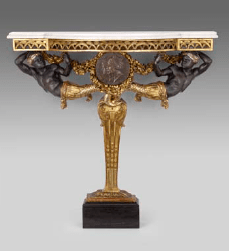
Small Console Table with Supporting Figures of Nubians (one of a pair), c.1780, gilded and painted wood and marble slab (NY: The Frick Collection), photo by Michael Bodycomb
This seminar will offer participants a detailed look at several objects from the special exhibition. Charlotte Vignon will discuss the Frick’s two French console tables, which feature Nubian slaves with pearl-accented turbans, floral garlands, and a frieze of crossed crescents, a symbol of the Ottoman Empire. She will also examine a pair of firedogs from Marie-Antoinette’s Turkish boudoir at Fontainebleau, on loan from the Musée du Louvre, and a pair of wall panels created for the Turkish cabinet of her brother-in-law, the comte d’Artois, from The Metropolitan Museum of Art. Click here to register at the regular rate of $100 per person. Members of The Frick Collection may click here to register at the discounted membership rate of $90 per person. Discounts will be applied upon verification of membership. To register over the phone, please call 212.547.0704.
Exhibition: The Düsseldorf Gallery and Its Catalogue
Press release from the Getty:
Display and Art History: The Düsseldorf Gallery and Its Catalogue
Getty Research Institute, Getty Center, Los Angeles, 31 May — 21 August 2011
Curated by Thomas Gaehtgens and Louis Marchesano
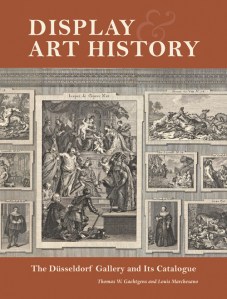
ISBN: 9781606060926, $20
Display and Art History: The Düsseldorf Gallery and Its Catalogue illustrates the making of one of the earliest modern catalogues, La galerie électorale de Dusseldorff (1778), a revolutionary two-volume publication that played a significant role in the history of museums and helped mark the transition from the Baroque to the Enlightenment.
Constructed by Elector Palatine Johann Wilhelm II von der Pfalz between 1709 and 1714, the Düsseldorf gallery is an early example of exhibiting an art collection in a nonresidential structure. It charted the course toward what would eventually become the institution of the public museum. The Düsseldorf gallery featured a new system of display in which the arrangement of objects was determined by art historical principles such as style and school, rather than subject. Published in the second half of the eighteenth century, the Düsseldorf catalogue represented this new display in numerous etchings; the accompanying text sought to educate a broader circle of readers.
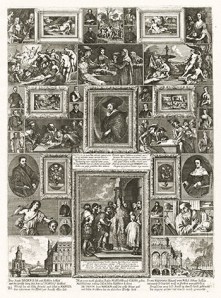
Fictive Wall of Paintings from the Imperial Collection in Vienna, Frans van Stampart and Anton Joseph von Prenner, etching. Prodromus (Vienna, 1735), pl. 21. 88-B2961
Display and Art History: The Düsseldorf Gallery and Its Catalogue, on view at the Getty Research Institute at the Getty Center from May 31 through August 21, 2011, showcases the exquisite watercolors, red chalk drawings, and architectural elevations that were used to produce this revolutionary catalogue. The exhibition explores their role in the printmaking process and underscores their value as precious works of art created by accomplished draftsmen. “We are most fortunate to have an almost complete set of preparatory drawings in our archives, which allows for the reconstruction of this ambitious enterprise and reflects a pivotal moment in the history of art as well as the history of the art museum,” says Thomas Gaehtgens, Director of the Getty Research Institute.
Prince-elector Johann Wilhelm II assembled one of the most important European art collections of the eighteenth century. He constructed a gallery to exhibit his nearly 400 paintings, 46 of which were by Peter Paul Rubens. At the time, many princes were reorganizing their substantial collections in order to convey the message that they not only possessed a wide variety of artistic treasures but were also able to care for them properly and make
them available for study.

Pierre-Louis de Surugue's etching after the "The Night" by Correggio, 1753–1757. Karl Heinrich von Heinecken, Recueil d'estampes d'apres les plus celebres tableaux de la Galerie Royale de Dresde..., vol. 2 (Dresden, 1757), pl. 1.
A generation later, Prince-elector Carl Theodor von der Pfalz, Johann Wilhelm’s nephew and successor, commissioned Lambert Krahe, director of the Düsseldorf Academy and gallery, to rehang the paintings collection following its storage during the Seven Years’ War (1756-63). Krahe broke with the Baroque tradition of decoratively covering entire walls with paintings. Instead, he displayed the paintings in a didactic, symmetrical arrangement ordered by schools, thus introducing a completely new and modern system of organizing art. Rather than hanging paintings frame-to-frame, Krahe integrated space between them, preserving their identity as separate works of art. This new display encouraged viewers to draw comparisons.
The Düsseldorf catalogue similarly fostered learning and education, in addition to celebrating the prestige of the collector. Produced by court architect Nicolas de Pigage, printmaker Christian von Mechel, and linguist Jean-Charles Laveaux, the catalogue illustrates Krahe’s display of paintings on the gallery walls. Unlike earlier catalogues that only provided brief inventories, Pigage’s publication offers an analysis of each painting that was aimed at an educated public. “In this sense, the catalog was very much a work of the Enlightenment, and the princely gallery, accessible to interested visitors,
became more like a museum as we understand it today,” says Gaehtgens.
Louis Marchesano, the GRI’s Curator of Prints and Drawings, adds, “The catalogue no longer simply represented princely magnificence; it now also fostered aesthetic reflection and art historical education.”
◊ ◊ ◊ ◊ ◊
Exhibition catalogue: Thomas W. Gaehtgens and Louis Marchesano, Display and Art History: The Düsseldorf Gallery and Its Catalogue (Los Angeles: Getty Publications, 2011), 104 pages, ISBN: 9781606060926, $20.










leave a comment