The French Revolution at the Musée Carnavalet
As noted in Napoleon.org, an online magazine published by the Fondation Napoléon:
 La Révolution française, trésors cachés du musée Carnavalet / The French Revolution: Hidden Treasures of the Musée Carnavalet
Musée Carnavalet, Paris, 30 September 2009 — 3 January 2010
 The Musée Carnavalet, site of one of the largest and most important collections on the French Revolution, is holding an exhibition dedicated to the events of 1789 and beyond, based on two hundred carefully selected pieces (including drawings, engravings, paintings, objets d’art and sculptures) from its stores. The exhibition is laid out chronologically, and will trace the major events of the Revolution through such works of art and depictions as the Serment du Jeu de Paume, the storming of the Bastille and the Fête de la Fédération. As well as the chronological aspects to the exhibition, themes such as the role of women, the key players in the events, vandalism, religion, fashion and architecture will all be considered. La Révolution française, trésors cachés du musée Carnavalet offers visitors the opportunity to immerse themselves in the events of a period that irrevocably changed society.
◊ ◊ ◊ ◊ ◊
France-Angleterre à Carnavalet, caricatures anglaises au temps de la Révolution et de l’Empire / France and England at the Carnavalet: English Caricatures during the Revolution and the Empire
Musée Carnavalet, Paris, 30 September 2009 — 3 January 2010
Running alongside La Révolution française, trésors cachés du musée Carnavalet is a small display of some forty English caricatures from the Revolution and French Empire periods. At the dawn of the French Revolution, English caricature, infused with a rare irreverence, dominated European satirical production. Its freedom in tone is inherently linked to the press freedom that existed in Britain at the time, which led to comment on not only continental affairs, but those relating to domestic matters too. The characters of Napoleon Bonaparte and the Sans-culottes, and the chaotic political events in France provided a wealth of material and inspiration for the satirists, allowing them to give vent to their patriotism and innovation in equal measure. The images, always lively and often crude, are placed in their historical context, and allow the visitors to develop their understanding of national stereotypes and appreciate the combative satire of French events as interpreted by artists such as James Gillray, Isaac and George Cruikshanks and Thomas Rowlandson.
Yinka Shonibare in DC
Yinka Shonibare, MBE
Smithsonian National Museum of African Art, Washington D.C., 10 November 2009 — 7 March 2010
Curated by Rachel Kent
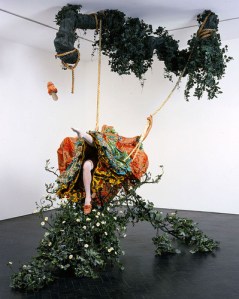
Yinka Shonibare, "The Swing (After Fragonard)," 2001
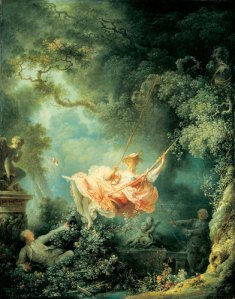
Jean-Honoré Fragonard, "The Swing," 1767 (London: Wallace Collection)
This morning on NPR’s Morning Edition, Susan Stamberg profiled the Yinka Shonibare exhibition now on display at the Smithsonian National Museum of African Art (it was organized by the Museum of Contemporary Art in Sydney). Writing in The New York Times (17 June 2009) of the show when it was at the Brooklyn Museum this past summer, Deborah Sontag described Shonibare as an “erudite and wide-ranging” artist, whom

Rachel Kent
at 47, is a senior figure in the British art world but one who intentionally eludes easy categorization. A disabled black artist who continuously challenges assumptions and stereotypes — “That’s the point of my work really,” he said — Mr. Shonibare makes art that is sumptuously aesthetic and often wickedly funny. When he deals with pithy matters like race, class, disability, colonialism and war, he does so deftly and often indirectly. “I don’t produce propaganda art,” he said. “I’m more interested in the poetic than the didactic.”
While many of the works address contemporary issues through Victorian conventions, there are intriguing eighteenth-century references, too — including this reworking of Fragonard’s Swing.
Etc, Etc.
 Umberto Eco served as guest-curator for the Louvre’s current exhibition Vertige de la Liste (Vertigo of Lists), on view until December 13. The scholar’s celebrity status has garnered lots of attention for the show (in addition to being taken up by the Associated Press, it’s been covered by Spiegel, Salon, and L’Express). The publisher’s description of the book accompanying the show, calls Eco “a modern-day Diderot,” explaining that here he “examines the Western mind’s predilection for list-making and the encyclopedic.” With material ranging from ancient and medieval lists (Homeric catalogues and lists of saints) to early modern “catalogues of plants [and] collections of art,” the eighteenth century would seem like a crucial period, and there is apparently at least one painting by Panini included. Still, for all of the talk of lists, one that seems to be missing (even from the Louvre’s site) is an exhibition checklist. Those of us who are unable to see the show should, however, have a better sense of its contents soon enough; the English edition of The Infinity of Lists: An Illustrated Essay is schedule for publication on November 17.
◊ ◊ ◊ ◊ ◊
Vertige de la Liste
Musée du Louvre, Paris, 2 November — 13 December 2009
The following account of the exhibition comes from Cristina Carrillo De Albornoz’s coverage in The Art Newspaper:
After Robert Badinter, Toni Morrison, Anselm Kiefer and Pierre Boulez, Umberto Eco is the next special guest curator of the Louvre. A noted historian and semiotician before he brought these sensibilities to bear on major novels such as The Name of the Rose and Foucault’s Pendulum, Eco has spent almost two years in residence at the Louvre. His chosen subject is “The Infinity of Lists”, a tour through art, literature and music based on the theme of lists and motivated by his fascination with numbers (until 13 December). “The subject of lists has been a theme of many writers from Homer onwards. My great challenge was to transfer it to painting and music and to see whether I could find equivalents in the Louvre, because frankly when I suggested the subject I had no idea how I would write about visual lists,” says Eco.
“The starting point for my ‘list of lists’ was Homer’s Iliad: firstly the creation of Achilles’ shield by Hephaestus, which not only symbolises perfect form but is in itself a work of art on which is engraved what is considered an allegory of the creation of the universe, an overall vision of Homer’s world. And secondly, the part where he lists all the ships leaving for the Trojan war.” Eco plays with these two opposing dimensions—perfect form and the list—in an attempt to rationalise the world. “The shield of Achilles is the epiphany of form, and every picture in an artist’s search for that form is a shield of Achilles,” concludes Eco. “Behind each list is the sense of ineffability.”
This impulse has recurred through the ages from music to literature to art. Eco refers to this obsession itself as a “giddiness of lists” but shows how in the right hands it can be a “poetics of catalogues.” From medieval reliquaries to Andy Warhol’s compulsive collecting, Umberto Eco reflects in his inimitably inspiring way on how such catalogues mirror the spirit of their times. . . .
For the full article, click here»
Full Circle: French Neoclassicism in Greece
From the website of the National Gallery in Athens:
Le goût à la grecque – The Birth of Neoclassicism in France: Masterpieces from the Louvre
National Gallery, Athens, 28 September 2009 — 11 January 2010
The exhibition includes paintings, sculptures, tapestries, drawings and prints, as well as furniture and miscellaneous objects, such as candlesticks, silverware and porcelain, vases, snuff boxes, watches (by Joseph-Marie Vien, Hubert Robert, Jean-Baptiste Greuze, Louis Jean-François Lagrenée, Louis-Claude Vassé, Jean-Jacques Caffieri, Auguste Pajou, Jean-Charles Delafosse, René Dubois etc.). The exhibition spans the period of the reign of Louis XV, which marked the transition from the highly ornamental Rococo style to a classicizing artistic trend, inspired by the Greek antiquity. Excavations in southern Italy, the subsequent interest in a more systematic approach and classification of the excavation material and of the art of antiquity, as reflected in numerous relevant publications, along with the intellectual atmosphere of the Enlightenment, are some of the factors that contributed to the shaping of this new artistic style. The material on display is organised in sections which correspond to the artistic predilections of eminent society members of the period, in which a new taste emerged: le goût à la grecque.
French Drawings in D.C.
It’s shaping up to be quite an autumn for French drawing exhibitions in the United States. In addition to the shows at the Getty, the Frick, and the Morgan, the National Gallery presents a sampling from its permanent collection. As noted in a press release from the museum’s website:
Renaissance to Revolution: French Drawings from the National Gallery of Art, 1500–1800
National Gallery, Washington D.C., 1 October 2009 — 31 January 2010

Margaret Grasselli, ISBN 978-1848220430
Some 135 of the most significant and beautiful drawings made over a period of three centuries by the best French artists working at home and abroad and by foreign artists working in France will be on view in Renaissance to Revolution: French Drawings from the National Gallery of Art, 1500–1800 in the Gallery’s West Building from October 1, 2009, through January 31, 2010. This is the first comprehensive exhibition and catalogue to focus on the Gallery’s permanent collection of French old master drawings, which is remarkable for its breadth, depth, and individual masterpieces. “One of the true glories of the National Gallery of Art’s holdings of graphic art is its outstanding collection of French old master drawings,” said Earl Powell, director, National Gallery of Art. “The exhibition Renaissance to Revolution and the accompanying catalogue celebrate the singular originality, elegance, and spirit of French draftsmanship.”

Antoine Coypel, "Seated Faun," 1700/1705, red and black chalk heightened with white chalk on blue paper, 16 x 11 inches (DC: NGA)
Among the National Gallery of Art’s extensive holdings of approximately 100,000 works on paper, the collection of 6,000 European drawings includes more than 900 French old master drawings which stand out as a particular treasure. The French group has deep roots in the earliest days of the museum’s existence, with the first of these works arriving in 1942, just a year after the Gallery opened its doors to the public. Over the next 67 years, thanks to the generosity of innumerable donors, the collection has evolved into one the Gallery’s strongest and most comprehensive, and one of the finest in the Western Hemisphere.
Organized chronologically, Renaissance to Revolution presents a visual journey through the development of drawing in France, from its first flowering during the Renaissance through its neoclassical incarnation during the political and social upheavals of the French Revolution at the end of the eighteenth century. Lorrain, and Antoine Watteau, as well as many less well-known artists. All major stylistic trends and many of the greatest and best-known artists from these centuries are represented by a rich array of works executed in a variety of styles and media and covering a wide range of functions, subjects, and genres. . . .

François-André Vincent, "The Drawing Lesson," 1777, brush and brown wash over graphite, 13 x 15 inches (DC: NGA)
Within the exceptionally rich collection of eighteenth-century drawings, the major artists—Boucher, Fragonard, Jean-Baptiste Greuze, Gabriel de Saint-Aubin, Hubert Robert, and Watteau, among others—are each represented by several works of outstanding quality. Some magnificent pieces by less familiar masters are featured as well, including François-André Vincent’s Drawing Lesson (1777), arguably the most perfect representation of eighteenth-century French elegance, taste, and gallantry; Étienne-Louis Boullée’s monumental neoclassical design for a metropolitan church from 1780/1781; and a large and beautiful pastoral scene executed in pastel and gouache, Shepherds Resting by a Stream (1779) by Jean-Baptiste Pillement. Also noteworthy is a striking group of portraits by several of the leading pastellists of the period, including outstanding examples by Maurice-Quentin de La Tour and Jean-Baptiste Perronneau, as well as a particularly dashing portrait of a young woman by Adélaïde Labille-Guiard from 1787. One of the youngest drawings in the exhibition is the neoclassical portrait Thirius de Pautrizel (1795) by David, an active participant in the revolution, made when he was imprisoned for his radical politics.
A particular strength within the Gallery’s collection of French drawings is the genre of book illustration. This is represented throughout the exhibition beginning with the work by Poyet and includes distinctive pieces by such famous masters as Boucher, Fragonard, Jean-Michel Moreau the Younger, and Saint-Aubin, as well as outstanding examples by other supremely gifted but less widely known artists, such as Hubert-François Gravelot and Charles Eisen.
Margaret Morgan Grasselli, curator of old master drawings, National Gallery of Art, is curator of the exhibition. Published by the National Gallery of Art in association with Lund Humphries, Renaissance to Revolution: French Drawings from the National Gallery of Art, 1500-1800 features an introductory essay and comprehensive entries on the exhibited drawings with 260 full-color illustrations.
On Sunday, 13 December 2009, at 2pm, Grasselli will deliver the lecture Playing Favorites: A Personal Selection of French Drawings from the National Gallery of Art and sign copies of the catalogue.
Paragone in Eighteenth-Century England
From the Henry Moore Institute’s website:
Subject/Sitter/Maker: Portraits from an Eighteenth-Century Artistic Circle
Henry Moore Institute, Leeds, 15 August — 14 November 2010
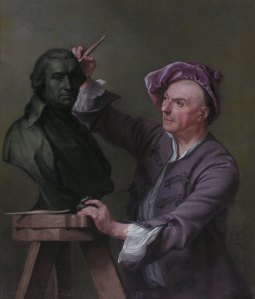
Andrea Soldi, "Louis François Roubiliac at Work on a Bust of David Garrick," 1757 (Garrick Club)
This small exhibition sets up close comparisons between the painted and the sculpted portraits of the actor David Garrick and the sculptor Louis François Roubiliac, asking us how we measure likeness, and how we understand the concept of the professional homage, as one artist depicts another.
◊ ◊ ◊ ◊ ◊
In The Observer (23 August 2009), Rachel Cooke writes that the exhibition
is truly a pint-sized show in the sense that it can be seen in less time than it would take you to drink one: it consists, in fact, of just two paintings, two sculptures and one monochrome print. . . [It] prods at the respective merits of sculpture and painting, and their sometimes vexed relationship, by looking at likenesses of the actor, manager and patron of the arts David Garrick and the sculptor who made him his subject more than once, Louis-François Roubiliac. . . A bust of Garrick attributed to Roubiliac is the third piece in Subject/Sitter/Maker . . . Garrick’s face is noble looking, but it also has a varnished quality, one you cannot blame on its media (plaster and paint) alone. He looks so blank, and so still: like a drink, waiting to be poured. But then you remind yourself that he was an actor – the great impersonator – and you begin to wonder whether this lacquered effect was not very deliberate. Next to this bust is a portrait by Andrea Soldi of Roubiliac at work on it. Look at this, and at JW Cook’s print, after Adrien Carpentiers, of Roubiliac modelling a small statue of Shakespeare, and you become doubly convinced. For sure, these are stagey works, Roubiliac’s cuffs artfully unbuttoned and peeled back so as not to impede his progress; and we know that the Shakespeare terracotta on which he is depicted to be working was completed four years earlier. But there is such beadiness in his eyes, such energy in his forearms, and he looks so hungry – though perhaps it was the case that he was actually famished, as well as creatively so: while Garrick grew ever more rich and famous, buying himself a Robert Adam house with grounds by Capability Brown, poor old Roubiliac died penniless. Even in the 18th century, ticket sales were obviously more reliable than the cheques of wealthy men.
An Eighteenth-Century Collection in Leipzig
From the website of the Museum der Bildenden Künste:
Spuren: Die Sammlung Gottfried Winckler
Museum der Bildenden Künste, Leipzig, 3 September — 10 November 2009

Anton Graff, "Carl Gottfried Winckler," 1769
Die bedeutendste Leipziger Kunstsammlung des 18. Jahrhunderts war die von Gottfried Winckler d. J. (1731–1795). Als der Kaufmann Winckler 1795 starb umfasste sein „Kabinett“ ca. 1.300 Gemälde, 2.469 Handzeichnungen, 80.000 Kupferstiche, eine Bibliothek von 6.842 Bänden und eine beachtliche Anzahl von Gemmen.
Es gehört zu den Zufällen der Geschichte, dass der Großteil von Wincklers Sammlung sich in seinem Elternhaus in der Katharinenstraße 22 aufbewahrt wurde, an der Stelle, an der sich heute das Museum der bildenden Künste befindet. Nach Wincklers Tod wurde die Sammlung von seinen drei Söhnen versteigert und damit in alle Winde zerstreut.
Die Rekonstruktion der verschwunden Sammlung ist ein Puzzlespiel. In Leipzig ist nur wenig geblieben: Durch einige „vorzüglich gute“ Stücke – etwas über zwei Dutzend Gemälde – konnte zum Beispiel Maximilian Speck von Sternburg seine Sammlung vermehren. Dennoch gehört Gottfried Winckler zu den Großen in der Kulturgeschichte der Stadt, über den Goethe schrieb, dass er die „einsichtsvolle Freude, die er an seinen Schätzen hegte, sehr gern mit Anderen teilte“. Die Ausstellung wird unterstützt durch die Maximilian Speck von Sternburg Stiftung und ist ein Beitrag zum 600-jährigen Jubiläum der Universität Leipzig.
◊ ◊ ◊ ◊ ◊
For additional information, see this news story on the exhibition (also in German).
Painting in Eighteenth-Century Constantinople
As noted on the website for CODART: Dutch and Flemish Art in Museums Worldwide:
Jean Baptiste Vanmour: A Painter from Valenciennes in Constantinople
Musée des Beaux-Arts de Valenciennes, 3 October 2009 – 7 February 2010
Curated by Emmanuelle Delapierre
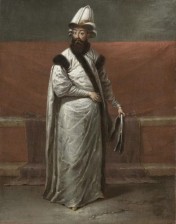
Vanmour, "Grand Vizier Nevsehirli Damat Ibrahim Pasa" (Rijksmuseum)
Jean Baptiste Vanmour (1671-1737) was born in Valenciennes but moved to Constantinople in 1699, where he would live and work for the rest of his life. In Constantinople he painted cityscapes and daily life in the city. He portrayed famous Ottomans such as Sultan Ahmed III and his grand vizier Nevsehirli Damat Ibrahim Pasa. Furthermore, he recorded important ceremonies at the sultan’s court.
From the museum website: 03-05-2009:
Jean Baptiste Vanmour et Valenciennes
Jean Baptiste Vanmour naît à Valenciennes le 9 janvier 1671. Les archives municipales conservent son acte de naissance, ainsi que la trace de sa famille relevée lors du recensement des habitants de la ville en 1699. L’emplacement de la maison natale de Vanmour est également bien connu. Son père et son frère sont comme lui artistes: le premier est ébéniste, le second peintre. Jean Baptiste et son frère reçoivent leur première formation artistique aux Académies de la Ville, célèbres pour la qualité de leur enseignement. Mais à la différence de son frère, Jean Baptiste ne peut pas rester à Valenciennes, faute des autorisations nécessaire pour exercer son métier de peintre, délivrées par la puissante Guilde de Saint-Luc. Contraint par un procès que lui intente la Guilde à quitter la ville, l’artiste part d’abord à Paris, puis à Constantinople, sans doute à l’invitation de l’ambassadeur de France, M. de Ferriol.
Scènes de vie en Turquie au XVIIIe siècle
Arrivé à Constantinople autour de 1699, Jean Baptiste Vanmour y mourra le 22 janvier 1737, sans jamais revenir dans son pays natal. Dans cette contrée d’adoption qui est désormais la sienne, il peint des vues panoramiques des rives du Bosphore, des scènes de la vie quotidienne – rentrée des classes, mariages – et représente encore les principales communautés étrangères de la ville, Arméniens, Grecs, Français, Hongrois… Il nous livre ainsi une témoignage rare de la vie du chaque jour, dans cette cité ô combien cosmopolite. Mieux, il pénètre les rituels de la Cour du Sultan, nous offrants les portraits de Ahmed III, de son Grand Vizir, des plus grands dignitaires, recevant à l’occasion de somptueuses réceptions les ambassadeurs venus d’Europe. Enfin, au-déla des temps protocolaires, Vanmour pénètre encore pour nous le secret des harems ou des repas des Derviches.
L’atelier d’un peintre
Les oeuvres de Jean Baptiste Vanmour consistent essentiellement en de petits tableaux – paysages, portraits, grandes réceptions ou épisodes de la vie quotidienne- peints à l’huile avec un abondance de détails pittoresques. Soigneusement composées, ces scènes étaient souvent préparées par des dessins rehausées de craie blanche et de sanguine. Cette attention n’était certainement pas superflue, de nombreuses commandes émanant des ambassadeurs européens. Jean Baptiste Vanmour répomd à leur souhaits grâce à l’aide de son atelier. Le peintre est assisté de nombreux disciples, originaires de la cité ottomane, qui participent pleinement à la création des tableaux signés par la maître. Aux oeuvres attestées de Jean Baptiste Vanmour Vanmour s’ajoutent ainsi celles produites avec ou par son atelier, mais encore de nombreuses copies plus tardives. Grâce à des photographies de tableaux en cours de restauration, à des radiographies, à des diagrammes, l’exposition du musée de Valenciennes s’attachera pour la première fois à donner les clés d’identification des oeuvres de Vanmour.
◊ ◊ ◊ ◊ ◊
An exhibition dedicated to Vanmour appeared in 2003 and 2004 at the Topkapi Sarayi Müzesi in Istanbul and the Rijksmuseum in Amsterdam. For details of the previous show, including the exhibition catalogue, click here»
Small Exhibitions Now at the V&A
From the V&A’s website:
Europe and the English Baroque: English Architecture 1660-1715
Victoria & Albert Museum, London, 1 May — 9 November 2009

Model for Easton Neston, Northamptonshire, Nicholas Hawksmoor, ca. 1694
Centred on the RIBA’s recently acquired model of Nicholas Hawksmoor’s baroque jewel Easton Neston (1694), this display will look at how continental buildings influenced architecture in Britain between the Restoration in 1660 and the publication in 1715 of the first volume of Colen Campbell’s Vitruvius Britannicus (often taken as the symbolic opening of the Palladian revival). The influence was mostly through the medium of books and engravings as few English architects travelled abroad (exceptions were Christopher Wren, Roger Pratt and William Winde, and, at the beginning of the period, Balthasar Gerbier); consequently there was surprisingly little knowledge of continental architecture gained at first hand, and some of the translations from engraved plate to English buildings could be very surprising.
The display will contain architectural drawings by such luminaries as Christopher Wren, Nicholas Hawksmoor, William Talman and John Vanbrugh, taken partly from the RIBA’s own collection and augmented by loans from a number of British institutions including All Souls, the Queen’s College, Oxford, King’s College, Cambridge, Sir John Soane’s Museum and other institutional and private collections. The display is curated by Roger White and Charles Hind.
◊ ◊ ◊ ◊ ◊
Objects of Luxury: French Porcelain of the Eighteenth Century
Victoria & Albert Museum, London, 18 September 2009 — March 2010

Sugar basin and cover, Saint-Cloud, ca. 1700-20 (V&A: no. 487-1909)
During the eighteenth century France dazzled the rest of Europe through the brilliance of its court. The rich and fashionable lived in a world of unparalleled refinement, fuelling an insatiable market for luxury goods. However, the eighteenth century was also a time of intense scientific enquiry and innovative research which witnessed, throughout Europe, marvellous achievements in this sphere. One of the most exciting discoveries, after centuries of wonder and captivation, was the successful production of porcelain. Known as ‘white gold’, porcelain was produced for use in all aspects of fashionable public and private life; from banquets to boudoirs, from tea drinking to the toilette.
In the absence of known deposits of kaolin (the key ingredient in making true, or ‘hard-paste’, porcelain), a glassy-bodied, artificial, or ‘soft-paste’, porcelain had been produced in France since the end of the 17th century. It was more costly to make than the ‘hard paste’ but its sensuous charm soon earned it universal admiration. Its soft, easily fusible, wax-like glaze allowed colours to fuse deep within it, and its lower firing temperature allowed the use of a much broader range of colours. Of all the factories in France, the most renowned was the Royal Porcelain Manufacture at Sèvres. The protection of Louis XV and the patronage of his mistress, Madame de Pompadour, drew to Sèvres the best alchemists, designers and artists in Europe. The porcelain they produced was unequalled in quality, design and decoration. This display introduces the visitor to the major French factories and demonstrates the wide variety of objects they could provide for their fashionable clientele.
◊ ◊ ◊ ◊ ◊
An 18th-Century Enigma: Paul de Lamerie and the Maynard Master
Victoria & Albert Museum, London, 11 May 2009 — May 2010
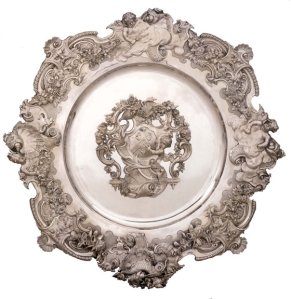
The Maynard Dish, 1736–37 (V&A: on loan from the Cahn family foundation)
Paul de Lamerie (1688-1751) was the greatest silversmith working in England in the 18th century. A Huguenot (French Protestant), he came to London with his parents, fleeing persecution in France. His success lay in his own exceptional creativity in producing stunning objects, but also in his ability as a businessman, retailing some astonishingly spectacular silver using the most effective and innovative suppliers in the trade.
The silver shown here is associated with de Lamerie’s most brilliant craftsman, whose identity is still a mystery, who worked from 1737 to 1745. He is known as the Maynard Master, named after the dish made for Grey, 5th Baron Maynard now in the Cahn family collection. Other masterpieces marked by de Lamerie are from the collection of Sir Arthur Gilbert and this display celebrates the opening of the Rosalinde and Arthur Gilbert Galleries at the V&A in 2009.
For more information about the V&A’s collection of silver by Paul de Lamerie, visit the Paul de Lamerie pages on the website. From there you can also download and print a trail to bring with you to the V&A, to help you find the highlights of the de Lamerie permanent collection across the galleries.
Collecting in Eighteenth-Century Vienna
From Andrew Ayers’s summary of exhibitions in Paris this fall, as reported in Art Info:
Bruegel, Memling, Van Eyck … The Brukenthal Collection
Musée Jacquemart-André, Paris, 11 September 2009 – 11 January 2010
A favorite of the Austrian Empress Maria Theresa, Samuel von Brukenthal (1721–1803) was an insatiable collector, amassing over 16,000 books, hundreds of objets d’art, and more than 1,200 paintings. In 1777, he became governor of his native Transylvania, where, in present-day Sibiu, Romania, he built a palace to house his collections that became a museum after his death. For the first time in France, about 50 major works from the Muzeul National Brukenthal are being shown. The curators’ selection highlights the Flemish paintings, dating from the 15th to the 17th centuries, which were much sought after in mid-18th-century Vienna. Besides the quartet mentioned in the exhibition title (for there were two Pieter Bruegels, father and son), artists such as Jacob Jordaens, David Teniers II, and Titian also feature in the show. Key works include Bruegel the Younger’s copy of his father’s Massacre of the Innocents in Bethlehem (Elder’s: circa 1567; Younger’s: circa 1586–90), Van Eyck’s Man in a Blue Turban (circa 1430), and Titian’s Ecce Homo (1560).
◊ ◊ ◊ ◊ ◊
From the Brukenthal Museum’s website:

Brukenthal Palace in Sibiu, Romania, 1778-1788
Baron Samuel von Brukenthal (1721-1803) was the only representative of the Transylvanian Saxon community who acceded to high public office in the Austrian Empire under the Empress Maria Theresa (1717 – 1780), the first such office being that of Chancellor of Transylvania. The years spent in Vienna, in this capacity, were the years when the Baron started acquiring his collection of paintings, mentioned in Almanach de Vienne (1773) as being one of the most valuable private collections and generally admired by the cultivated Vienna public of the time. Baron’s initial collections (comprising the collection of paintings, a collection of prints, a library and a coin collection) were mostly put together in the period between 1759 and 1774. We have scant information as to how they came into being, the earliest records in the Brukenthal family being the archive concerning acquisition of paintings dating from 1770 (by which time the core of the collection of paintings must have been acquired). Appointed Governor of the Principality of Transylvania, a position that he occupied between 1777 and 1787, Samuel von Brukenthal built a Late Baroque palace in Sibiu, modelled on the palaces in the imperial capital.










leave a comment