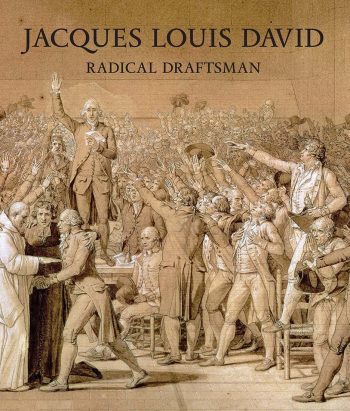
Exhibition | Jacques Louis David: Radical Draftsman
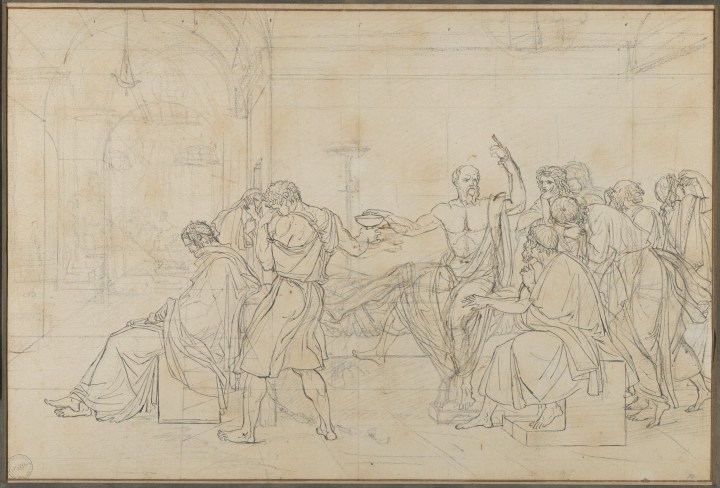
Jacques Louis David, The Death of Socrates, ca. 1786, pen and black ink, over black chalk, touches of brown ink, squared in black chalk, sheet: 11 × 16 inches (New York: The Metropolitan Museum of Art, 2015.149).
◊ ◊ ◊ ◊ ◊
From the press release for the exhibition:
Jacques Louis David: Radical Draftsman
The Metropolitan Museum of Art, New York, 17 February — 15 May 2022
Organized by Perrin Stein
Regarded in his time as the most important painter in France, Jacques Louis David (1748–1825) produced major canvases that shaped the public’s perceptions of historical events in the years before, during, and after the French Revolution. Drawings were the primary vehicle by which he devised and refined his groundbreaking compositions. Jacques Louis David: Radical Draftsman is the first exhibition devoted to works on paper by this celebrated and influential artist. Through some 80 drawings and sketches from the collections of The Met and numerous private and institutional lenders from the United States and abroad—including rarely loaned or newly discovered works—visitors will see the progress of his ideas as he worked to create his masterful paintings. A highlight of the exhibition will be a work in The Met collection, The Death of Socrates (1787)—David’s most important painting in America—which will be displayed along with preparatory drawings that reveal his years-long thought process and planning.
 The exhibition—the first to focus on David’s preparatory studies—looks beyond his public successes to chart the moments of inspiration and the progress of ideas, both artistic and psychological. The works will be presented chronologically, starting with David’s early training in Rome. Sketches from this period represent the vast store of motifs that he mined for decades thereafter, including for his most famous paintings.
The works David submitted to the Salons after returning to France heralded a powerful new neoclassical style that drew its inspiration from classical antiquity. Paintings like The Oath of the Horatii (1784) and The Death of Socrates (1787) won instant acclaim and buttressed his growing reputation as leader of the French school. Several drawings on view demonstrate the artist’s struggles to heighten the psychological impact and create a more powerful overall composition.
Rebelling against the constraints of France’s centralized monarchy in its waning days, David embraced the changes wrought by the Revolution of 1789. His most ambitious project—a depiction of the Oath of the Tennis Court, the event in which representatives of different classes of French society pledged to draft a constitution to counterbalance the absolute authority of the king—was never completed. The exhibition will feature a large presentation drawing that is one of David’s supreme achievements, deftly redeploying the language of the classical past to imbue a contemporary event with the drama and gravitas of a history painting.
David’s support of the more radical faction of the fledgling Republic led to his imprisonment. After his release, he attempted to regain dominance of the French school by exploring themes of national reconciliation through historical subjects like The Intervention of the Sabine Women (1799). Eventually, David reclaimed the spotlight through his support of Napoleon Bonaparte. David’s magisterial canvas memorialized the glittering spectacle in Notre Dame cathedral that marked Napoleon’s ascent from successful general to crowned emperor of France in 1804.
After a string of military defeats led to Napoleon’s downfall and the restoration of the Bourbon monarchy in 1816, David—a former regicide who had lent his talents to gilding the emperor’s image—was banished. He went into exile and spent his final decade working in Brussels.
Jacques Louis David: Radical Draftsman was organized by Perrin Stein, Curator in the Department of Drawings and Prints. The exhibition is accompanied by a catalogue, published by The Metropolitan Museum of Art and distributed by Yale University Press. A related installation, In the Orbit of Jacques Louis David: Selections from the Department of Drawings and Prints, on view 20 January – 10 May 2022, focuses on David’s legacy through works by his pupils and contemporaries (Gallery 690).
Perrin Stein, with contributions by Daniella Berman, Philippe Bordes, Mehdi Korchane, Louis-Antoine Prat, Benjamin Peronnet, and Juliette Trey, Jacques Louis David: Radical Draftsman (New Haven: Yale University Press, 2022), 308 pages, ISBN: 978-1588397461, $65.
Display | In the Orbit of Jacques Louis David
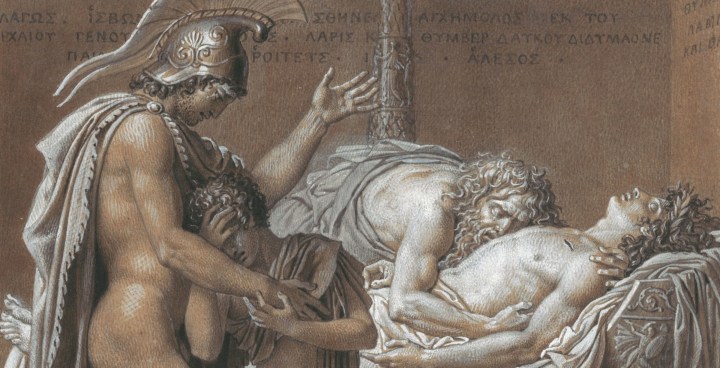
Anne Louis Girodet-Trioson, The Mourning of Pallas (detail), ca. 1790–93, pen and brown ink, brush and gray and brown wash, heightened with white (New York: The Metropolitan Museum of Art, 1996.567).
◊ ◊ ◊ ◊ ◊
Now on view at The Met:
In the Orbit of Jacques Louis David: Selections from the Department of Drawings and Prints
The Metropolitan Museum of Art, New York, 20 January — 31 May 2022
The Department of Drawings and Prints boasts more than one million drawings, prints, and illustrated books made in Europe and the Americas from around 1400 to the present day. Because of their number and sensitivity to light, the works can only be exhibited for a limited period and are usually housed in on-site storage facilities. To highlight the vast range of works on paper, the department organizes four rotations a year in The Robert Wood Johnson, Jr. Gallery. Each installation is the product of a collaboration among curators and consists of up to one hundred objects grouped by artist, technique, style, period, or subject.
This installation highlights the broad range of accomplishments of artists working at the same time as French painter Jacques Louis David (1748–1825). Whether they emulated his manner or sought their own paths, shared his political beliefs or condemned them, artists of this period could hardly escape the impact of David’s work.
Works on view by David’s peers, pupils, and rivals explore the creativity and capacity for transformation that marked this vital period that spanned the last years of the French monarchy, the Revolution, the rise of Napoleon, and ultimately, the restoration of the Bourbon monarchy. The fast pace of political change accentuated the intertwined nature of art and politics, which permeated all levels of artistic production—from large-scale paintings to the decorative arts and fashion—as this selection of drawings and prints attests.
This display complements the exhibition Jacques Louis David: Radical Draftsman (17 February – 15 May 2022).
Exhibition | Materials of Empire: Colonial Narratives, 1700–1860
Now on view at Rienzi:
Materials of Empire: Colonial Narratives, 1700–1860
Rienzi, The Museum of Fine Arts, Houston, 15 January — 31 July 2022

Portuguese, Earrings from a Parure, ca. 1780–1820, emeralds, diamonds, and yellow gold with silver overlay (Museum of Fine Arts, Houston, the Rienzi Collection).
Materials of Empire: Colonial Narratives 1700–1860 explores objects from the Rienzi Collection that shed light on the links between Europe, Africa, the Americas, and India. This small exhibition examines the stories objects reveal as well as conceal, and places them within the context of entangled legacies and experiences of empire.
Exploration, war, scientific expeditions, and religious missions feature prominently in the history of Europe during the 18th and 19th centuries. These factors fueled an age of discovery in which thousands of ships transported explorers, merchants, and migrants from Europe to far-reaching destinations.
Vessels bound back to Europe carried cargo such as gold, silver, sugar, and tobacco. The ships also transported millions of enslaved men, women, and children from Africa to points across the empires to serve as labor in the cultivation of the new materials. Every crossing brought new encounters and confrontations between people and ways of life, resulting in a complex cultural landscape.
Rienzi, the MFAH house museum for European decorative arts, presents special exhibitions twice a year.
Exhibition | Flesh and Bones: The Art of Anatomy
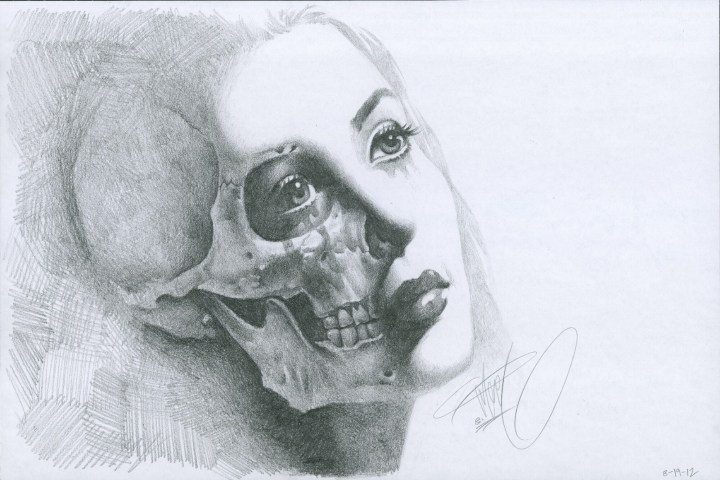
Love & Hate, 19 August 2012, OG Abel (Abel Izaguirre), graphite on paper, 12 1/2 × 19 1/2 × 3 inches (Los Angeles: Getty Research Institute, 2013.M.8. Gift of Ed and Brandy Sweeney © OG Abel).
◊ ◊ ◊ ◊ ◊
From the press release for the exhibition opening this month at The Getty:
Flesh and Bones: The Art of Anatomy
Getty Research Institute, Getty Center, 22 February — 10 July 2022
Curated by Monique Kornell
Featuring works of art from the 16th century to today, the Getty Research Institute exhibition Flesh and Bones: The Art of Anatomy explores the theme of anatomy and art and the impact of anatomy on the study of art.
“Flesh and Bones celebrates the connection between art and science and the role of art in learning,” said Mary Miller, director of the Getty Research Institute. “This exhibition draws on the Getty Research Institute’s rich and varied holdings to tell the story of two disciplines that have long been intertwined. I believe visitors will find meaningful connections with the way artists and scientists have inspired one another for centuries.”
 From spectacular life-size illustrations to delicate paper flaps that lift to reveal the body’s interior, the body is represented through a range of media. In Europe, the first printed anatomical atlases, introduced during the Renaissance, provided new visual maps to the body, often composed of striking images. Landmarks of anatomical illustration such as the revolutionary publications of Vesalius in the 16th century and Albinus in the 18th century are represented as well as little-known rarities such as a pocket-size book of anatomy for artists from over 200 years ago. The exhibition, which explores important trends in the depiction of human anatomy and reflects the shared interest in the structure of human body by medical practitioners and artists, is organized by six themes: Anatomy for Artists; Anatomy and the Antique; Lifesize; Surface Anatomy; Three Dimensionality; and The Living Dead. The last looks at the motif of the representation of the dead as living, with skeletons and anatomized cadavers capable of motion rather than inert on a dissecting table.
“Artists not only helped create these images but were part of the market for them, as anatomy was a basic component of artistic training for centuries,” said exhibition curator Monique Kornell. “Featuring selections from the GRI’s impressive collection of anatomy books for artists as well as prints, drawings, and other works, this exhibition looks at the shared vocabulary of anatomical images and at the different methods used to reveal the body through a wide range of media, from woodcut to neon.”
For artists of the modern era, anatomy is often a medium of expression and a signifier of the body itself, rather than purely an object of study. Robert Rauschenberg’s Booster (1967) and Tavares Strachan’s Robert (2018) are two life-size anatomical portraits as well as symbols of the passing nature of life. Echoing the composite prints of Antonio Cattani’s remarkable life-size anatomical figures from the 1700s in the exhibition, Booster is a fractured self-portrait based on X-rays of the artist that have been joined together.
Strachan’s Robert is not an exact likeness of the man it immortalizes, Major Robert Henry Lawrence Jr., the first African American astronaut, who tragically died in a training accident. In choosing to represent the hidden interior of the body in neon and glass, Strachan, a former GRI artist in residence, makes visible the unique history of Lawrence, while demonstrating an inner structure that equalizes all people.
Anatomists and artists have approached the problem of how best to describe the body’s complex and invisible interior with a variety of representational strategies, ranging from the graphic to the sculptural and, recently, the virtual. From paper-flap constructions that allow viewers to lift and peer under layers of flesh to stereoscopic photographs that mimic binocular perception and project anatomical structures into space, three-dimensionality was inventively pursued in the pre-digital age to cultivate an understanding of anatomy as a synthetic whole.
The exhibition is curated by Monique Kornell, guest curator; guest assistant professor, Program in the History of Medicine, Cedars-Sinai Hospital, Los Angeles, and is accompanied by a richly illustrated publication.
Monique Kornell, with contributions by Thisbe Gensler, Naoko Takahatake, and Erin Travers, Flesh and Bones: The Art of Anatomy (Los Angeles: Getty Research Institute, 2022), 249 pages, ISBN 978-1606067697, $50.
Exhibition | Grand Design: 17th-Century French Drawings
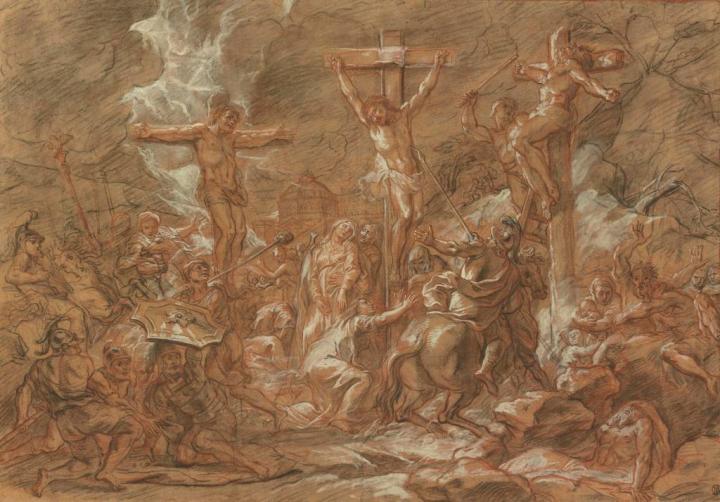
Antoine Coypel, The Crucifixion, 1692, red and black chalk with white gouache heightening on beige paper, 41 × 58 cm
(Los Angeles: The J. Paul Getty Museum, 88.GB.41)
◊ ◊ ◊ ◊ ◊
From the press release for the exhibition now on view at The Getty:
Grand Design: 17th-Century French Drawings
Getty Center, Los Anageles, 8 February — 1 May 2022
Curated by Emily Beeny
Presenting the Getty Museum’s collection of 17th-century French drawings in its entirety for the first time, Grand Design: 17th-Century French Drawings addresses the emergence of a distinctly French school of art and explores the role that drawing played in the process.
“Today we recognize drawings by Nicolas Poussin and Claude Lorrain as landmark achievements of 17th-century European art,” says Timothy Potts, Maria Hummer-Tuttle and Robert Tuttle Director of the J. Paul Getty Museum. “But in fact, drawing lay at the heart of all artmaking in 17th-century France, from the decoration of palaces and churches to the illustration of books. Drawing was where it began.”
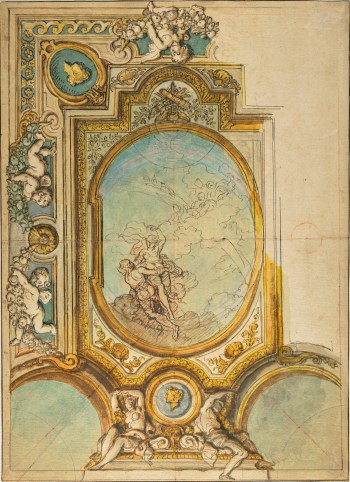
Charles de la Fosse, Studies for a Ceiling Decoration with the Apotheosis of Psyche (detail), ca. 1680, pen and black ink and brush and watercolor over red chalk on paper, 26 × 36 cm (Los Angeles: The J. Paul Getty Museum, 2001.47).
French art came into its own during the 17th century, often called the Grand Siècle, or Great Age, of France. This period witnessed a series of violent political upheavals at home, the first stages of colonial expansion overseas, and the rise of authoritarian absolute monarchy. This turbulent century fostered artistic activity on a scale previously unimagined. Expatriate French artists achieved fame in Rome; a Royal Academy of Painting and Sculpture was founded in Paris; and vast building projects—most notably, the Palace of Versailles—employed whole generations of artists.
This exhibition includes drawings made by Jacques Callot, Simon Vouet, Nicolas Poussin, Claude Lorrain, Charles Le Brun, Hyacinthe Rigaud, and many others. These artists made drawings for many different purposes: designs for ceiling paintings, altarpieces, sculptures, and prints; landscape sketches made outdoors; and nude studies drawn in the studio.
“Drawing helped 17th-century French artists make sense of the world around them, think through compositional ideas, and prepare finished works,” explains Emily Beeny, curator of the exhibition. “Each of these sheets invites us into its author’s creative process, whether observing nature, capturing a portrait likeness, designing a print, or preparing a painting.”
Grand Design: 17th-Century French Drawings is curated by Emily Beeny, curator in charge of European paintings at the Fine Arts Museums of San Francisco, and former associate curator of drawings at the Getty Museum. This exhibition is presented concurrently with another exhibition focused on 17th-century French art: Poussin and the Dance.
The checklist is available as a PDF file here»
Installation | In Dialogue
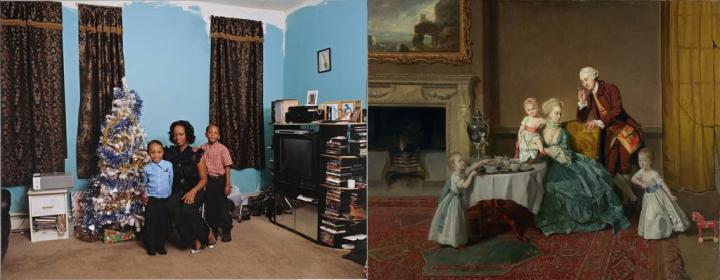
Left: Coulson Family, 2008, by Deana Lawson, pigment print, 33 × 43 inches (Getty Museum, 2021.53.2. © Deana Lawson). Right: John, Fourteenth Lord Willoughby de Broke, and His Family, ca. 1766, by Johann Zoffany, oil on canvas, 40 × 50 inches (Getty Museum, 96.PA.312).
◊ ◊ ◊ ◊ ◊
Closing this weekend at The Getty:
In Dialogue
Getty Center, Los Angeles, 9 November 2021 — 13 February 2022
In Dialogue is a series of temporary installations in the Museum’s permanent collection galleries. This presentation places photographs made during the past fifty years by five women from Japan, Mexico, and the United States in conversation with European paintings, decorative arts, and sculptures created predominantly by men before 1900. Through compelling and sometimes unexpected juxtapositions, these installations invite visitors to engage with diverse perspectives and recurring themes across different media, styles, cultures, and time periods. Look for photographs by Diane Arbus, Chris Enos, Deana Lawson, Asako Narahashi, and Daniela Rossell, in the North, East, and South Pavilions.

Left: Pink Roses, 1980, by Chris Enos, Polaroid dye diffusion print, 24 × 21 inches (Getty Museum, 84.XP.465. © Chris Enos). Right: Vase of Flowers, 1722, by Jan van Huysum, oil on panel, 32 × 24 inches (Getty Museum, 82.PB.70).
Exhibition | Botanical Expressions
Part of the Nature by Design series at the Cooper Hewitt:
Botanical Expressions
Cooper Hewitt, Smithsonian Design Museum, New York, 7 December 2019 — 25 September 2022

‘Hans Sloane’ Plate, Manufactured by Chelsea Porcelain Manufactory, soft paste porcelain, vitreous enamel, 22.5 cm diameter (New York: Cooper Hewitt, Smithsonian Design Museum, 1957-11-8).
Interpretations of botanical forms wind their way through the decorative arts of the late 18th through the early 20th centuries. Botanical Expressions focuses on key figures—Christopher Dresser, Emile Gallé, William Morris, and Louis Comfort Tiffany—whose knowledge of the natural sciences and personal practices of gardening enriched their creative output as designers. A timeline of objects reflects botanicals in form and pattern, highlighting shifting styles across geography and media in textiles, ceramics, glass, wallcoverings, and more. Significant loans from Smithsonian Libraries include illustrated guidebooks that designers used for natural research and drawing instruction.
At the turn of the 20th century, the intersection of botanical study with design practice stimulated an array of plant forms and motifs in furnishings, glassware, ceramics, textiles, and more. Botanical Expressions reveals how designers, inspired by nature and informed by scientific knowledge, created vibrant new designs in America, Britain, France, and the Netherlands. Blossoming vases, plantlike stuctures, fanciful garden illustrations, and a diversity of vegetal and floral patterns reveal how nature and design dynamically merged.
An increasing number of designers, trained as botanists, advocated for the beauty and order of nature’s systems, colors, and patterns. Many manufacturers operated in proximity to gardens for natural study and stocked books of botanical illustrations as resources for their designers. These primary sources, on loan from Smithsonian Libraries, appear alongside the objects they influenced.
Since the 19th century, the garden was often seen as a refuge from industry and a natural source of plenty and pleasure. This history of botanical expressions in design illuminates a reflection on the critical role of nature within our world.
Exhibition | Foreign Exchange: 18th-Century Design on the Move

Tea and Sugar Caddies, made by William Cripps (d. 1767, active in England, 1758–1767), silver; each approximately 15 cm high (New York: Cooper Hewitt, Smithsonian Design Museum, 1960-1-1-a/d). In addition to Foreign Exchange, the pair was previously on display as part of the exhibitions Rococo: The Continuing Curve, 1730–2008 and The Cooper-Hewitt Collections: A Design Resource.
◊ ◊ ◊ ◊ ◊
Now on view at the Cooper Hewitt:
Foreign Exchange: 18th-Century Design on the Move
Cooper Hewitt, Smithsonian Design Museum, New York, 22 January — 25 September 2022
Drawing from the museum’s permanent collection, Foreign Exchange: 18th-Century Design on the Move explores the unprecedented circulation of labor, skills, aesthetics, and luxury goods across international borders in the 18th century. The exhibition traces the movement of people, ideas, and objects across borders, challenging notions of foreign and domestic, community member and outcast, and national style.
Exhibition | Ingres avant Ingres
The exhibition, on view at the Musée des Beaux-arts, Orléans, closed January 9. Philip Bordes’s review of the show appeared in the January issue of The Burlington. Here’s the information for the catalogue, published by Le Passage.
Mehdi Korchane, ed., Ingres avant Ingres: Dessiner pour peindre (Paris: Le Passage, 2021), 240 pages, ISBN: 978-2847424638, 35€.
 Catalogue d’exposition sous la direction de Mehdi Korchane, responsable des arts graphiques des musées d’Orléans, avec une préface d’Adrien Goetz et des contributions de Laurence Clivet, Yvan Coquinot, Sidonie Lemeux-Fraitot, François-René Martin, Éric Pagliano, Louis-Antoine Prat, Alice Thomine-Berrada et Florence Viguier-Dutheil.
Ce livre examine la production graphique du jeune Ingres et, ce faisant, propose de suivre l’éclosion progressive de son génie, de l’enfance jusqu’à son départ pour Rome, en 1806. La maestria éblouissante du peintre du XIXe siècle est telle que ses premières années retiennent rarement l’attention. Or, elles constituent une aventure artistique en soi, au cours de laquelle la singularité de l’artiste se manifeste principalement dans l’exercice du dessin. Si la formation académique se fonde depuis toujours sur cette pratique, premier moyen de connaissance et de perfectionnement dans l’imitation de la nature, son expérimentation par Ingres prend une dimension exhaustive révélatrice de son ambition. Première œuvre de virtuosité, le portrait de Jean Charles Auguste Simon (1802-1803), conservé au musée des Beaux-Arts d’Orléans, montre comment l’élève de David se prépare à être peintre au moyen du crayon. Mais le dessin est aussi accompli comme une discipline autonome aux finalités multiples et dans laquelle la modernité se fait jour jusque dans les plus insignifiantes expressions. En analysant ce parcours, l’ouvrage tente de redonner une cohérence à un corpus souvent parasité par les attributions abusives et le dilemme des datations. Il examine aussi les fonctions du dessin dans la pratique du peintre en devenir.
Exhibition | À la mode

Installation view of the exhibition À la mode: L’art de paraître au 18e siècle at the Musée d’arts de Nantes.
◊ ◊ ◊ ◊ ◊
Now on view at the Musée d’arts de Nantes; see particularly the ‘Exhibition in Pictures’:
À la mode: L’art de paraître au 18e siècle
À la mode: The Art of Appearance in the 18th Century
Musée d’arts de Nantes, 26 November 2021 — 6 March 2022
Musée des Beaux-arts de Dijon, 13 May — 22 August 2022
Curated by Sophie Lévy
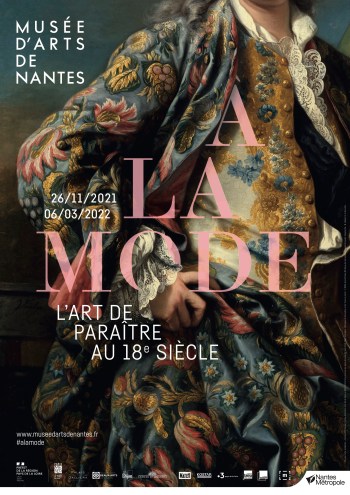 The exhibition À la mode: The Art of Appearance in the 18th Century juxtaposes iconic textile and pictorial items to reveal the reciprocal influences at play between the world of art and the birth of fashion in the 18th century. The exhibition brings together over 200 objects dating from the 18th century from major textile and fine art museums. Iconic paintings are displayed alongside precious textiles, never previously seen drawings, garments, and accessories, some of which have been restored especially for the exhibition.
The exhibition is a special collaboration with the Palais Galliera, musée de la Mode de la Ville de Paris, Paris Musées, and co-produced with the Musée des Beaux-arts de Dijon, which will host the exhibition from 13 May to 22 August 2022.
Chief Curator
• Sophie Lévy, Director and Curator of the Musée d’arts de Nantes
Scientific Curators
• Adeline Collange-Perugi, Curator of early art collections, Musée d’arts de Nantes
• Pascale Gorguet Ballesteros, Chief curator, 18th-Century Fashion and Dolls Department, Palais Galliera, musée de la Mode de la Ville de Paris
• Sandrine Champion-Balan, Chief curator, Collections Development Centre manager, Collections manager, head of modern collections for the curatorial team of the exhibition at the Musée des Beaux-Arts de Dijon
À la mode: L’art de paraître au 18e siècle (Ghent: Éditions Snoeck, 2021), 327 pages, ISBN: 978-9461617101, €35.











leave a comment