Online Talk | Malcolm Baker on Canova’s Three Graces at the V&A

Antonio Canova, The Three Graces (detail), 1814–17 (London: V&A Museum, no. A.4-1994).
This evening (London time), from the V&A:
Malcolm Baker with Kira d’Alburquerque | Canova’s Three Graces and the V&A
Online and in-person, Victoria and Albert Museum, London, 19 January 2023, 7pm
Malcolm Baker joins V&A curator Kira d’Alburquerque for a look at Antonio Canova’s The Three Graces (1814–17) and the campaign to save the celebrated group in the early 1990s. Baker played a significant role in the acquisition of the work for the V&A nearly three decades ago. He joins Kira d’Alburquerque to discuss the campaign to “Save the Three Graces” and how attitudes toward Canova’s sculpture have changed. The talk will be held in-person and on Zoom. Online tickets are £5. If, as a ticket-holder, you have not received a link by noon on the day, contact membershipevents@vam.ac.uk.
Lecture | Matthew Keagle on Military Material Culture
From BGC:
Matthew Keagle, Military Material Culture
Bard Graduate Center, New York, 1 February 2023, 6.00pm

James Byers, Howitzer, Philadelphia, 1777 (Fort Ticonderoga Museum Collections; photo by Gavin Ashworth).
Military history and its related material culture elicit strong opinions. The objects of war shape the technologies, aesthetics, and ideologies of everyday life and reveal their own historiography. In this Alumni Spotlight Lecture, Fort Ticonderoga curator Matthew Keagle shares his experiences working in military material culture and the challenges and distinct opportunities this field offers for scholars and amateur historians.
Matthew Keagle has been involved in curation, exhibitions, research, and interpretation for historic sites and museums in Massachusetts, Rhode Island, Connecticut, New York, Delaware, Virginia, and North and South Carolina. He holds a BA from Cornell University, an MA in American material culture from the Winterthur Museum, and a PhD from Bard Graduate Center. Since joining Fort Ticonderoga in 2014, he has been developing exhibits, conducting research, and delivering programs that explore the eighteenth-century military experience. He has researched and lectured at collections and archives across the US, Canada, and Europe, with a particular focus on military dress in the eighteenth century.
Registration is available here»
Seminar | Holly Shaffer and Sussan Babaie on Food and the Senses

Painting attributed to Muzaffar ‘Ali, from The Coronation of the Infant Shapur II, Folio 538r from the Shahnama (Book of Kings) of Shah Tahmasp by Abu’l Qasim Firdausi, ca. 1525–30, opaque watercolour, ink, silver, and gold on paper.
◊ ◊ ◊ ◊ ◊
From the PMC:
Holly Shaffer and Sussan Babaie on Food and the Senses
In-person and online, Paul Mellon Centre for Studies in British Art, London, 11 January 2023, 5pm
Part of the series In Conversation: New Directions in Art History, which will explore the changing modes and methodologies of approaching visual and material worlds. Running from January to March 2023.
Holly Shaffer | Plants, Gardens, Markets, Delicacies: Food and Art in 18th- and 19th-Century India
Food is ephemeral. Produce can last at most months, while cooked foods remain for a few hours or, with conservation, a few years. Yet artists, cooks, and writers have developed methods of preservation—from documenting the cultivation of plants to transcribing recipes—that acknowledge continuity through memory and repetition as well as change through colonial and environmental factors, artistic ingenuity and loss. In this paper, I will align botanical, ethnographic and narrative manuscript paintings, recipe books, and vessels produced by artists and chefs in north India in the eighteenth and nineteenth centuries with oral histories taken primarily in Lucknow in the twenty-first century. How does thinking through a framework of ephemerality allow multiple items to co-exist and perishable objects to survive? Does art history as a discipline offer a method to study ephemeral arts such as cultivation or cuisine? What might the intersection of food and art—and their different temporalities—offer us as art historians?
Holly Shaffer is Assistant Professor of History of Art and Architecture at Brown University with a specialisation in British and South Asian Art and their intersections. Her book, Grafted Arts: Art Making and Taking in the Struggle for Western India, 1760–1910, published by the Paul Mellon Centre with Yale University Press in 2022, won the AIIS Edward C. Dimock, Jr. Book Prize in the Indian Humanities. She has published essays in The Art Bulletin, Art History, Journal 18, Modern Philology, and Third Text, and has edited volume 51 of Ars Orientalis (2021) on the movement of graphic arts across Asia and Europe. Currently, she is co-curating an exhibition at the Yale Center for British Art on Artists and the British East India Company, and is developing a book project on food and art.
Sussan Babaie | ‘Adorning the Delicious Food Is To Say Grace for the Blessings’: Persian Art and Cookery in the 16th and 17th Centuries
This talk is about rice. The history of rice and its adaptation from a staple food in East Asia to a culinary canvas for innovative recipes, objects, and ceremonies is, I claim, an altogether Iranian story. Thanks largely to the Mongol rule in West Asia, rice was made a widespread agricultural product, just as Persian spread across West, Central, and South Asia as the language of literary high culture, and being a shah, and not a caliph, gained ascendency as the legitimate mode of rulership. Rice, however, does not command its central role as a marker of Iranian cuisine and a source of effect in food—a style nowadays called ‘fine dining’—until the early modern period and especially in Persianate Asia. From the late fifteenth century onwards cookbooks, written by chefs not chroniclers, indicate a form of professionalisation in the cookery crafts. Vessels, amongst which the large, wide, shallow platters are distinctive products of the ceramic arts of the sixteenth and seventeenth centuries in Safavid (1501–1722) Iran, indicate a specialised function, namely for serving rice dishes in a particularly ‘artistic’ manner. The cooks write on how to arrange food in a dish and the dishes carry epigraphic sayings about specific functions of the vessels and the food they were to serve. These—the recipes, the objects for food, and the visual representations of foodways—act as mediators marking the food and the dish as a multisensory experience of rice as art.
Sussan Babaie is Professor of Islamic and Iranian Art History at the Courtauld, University of London. She has curated exhibitions on Persian and Islamic arts at the Metropolitan Museum of Art, at Harvard, Smith College and Michigan University museums, and at the Calouste Gulbenkian Museum in Lisbon. She is the author of the award-winning Isfahan and Its Palaces and co-author of Persian Kingship and Architecture; Shirin Neshat, Honar: The Afkhami Collection of Modern and Contemporary Iranian Art; and Geometry and Art: In the Modern Middle East. Sussan is currently working on a co-curated exhibition about arts of the Great Mongol State for The Royal Academy, London, and on a book about Persian art and food.
Panel Discussion | Revisiting Kubler’s The Shape of Time
From the BGC:
Reading The Shape of Time, 60 Years Later
Bard Graduate Center, New York, 30 November 2022, 6pm
Four perspectives on the seminal text by George Kubler from BGC faculty Meredith Linn, François Louis, Aaron Glass, and Drew Thompson, moderated by Joshua Massey and Jeffrey Collins.
 In 1962, Yale University art historian George Kubler published The Shape of Time: Remarks on the History of Things, a book that challenged traditional notions of style and period in art history. Now, 60 years later, we bring together a historian, an anthropologist, an archaeologist, and an art historian—all members of the BGC faculty—to explore The Shape of Time across geographical and disciplinary boundaries and to rediscover the prescient insights it offers for material culture and object-oriented scholarship.
$15 General | $12 Seniors | Free for people with a college or museum ID, people with disabilities and caregivers, and BGC members.
Meredith B. Linn is assistant professor of historical archaeology at Bard Graduate Center. She holds a PhD in anthropology from Columbia University, an MA in the social sciences from the University of Chicago, and a BA in art history from Swarthmore College. Her work focuses on nineteenth-century New York City, particularly upon the health-related experiences and strategies of Irish immigrants and upon Seneca Village, the predominantly African American community whose land was taken by the City of New York to construct Central Park. She has published articles about both projects and is currently working on a book about each.
François Louis is professor of Chinese art and material culture at Bard Graduate Center. From 2002 to 2008 he also served as editor-in-chief of the journal Artibus Asiae. He obtained his doctorate from the University of Zurich and has published widely on the visual and material culture of medieval China. Recent publications include Design by the Book: Chinese Ritual Objects and the Sanli Tu and the co-edited volumes Antiquarianism and Intellectual Life in Europe and China, 1500–1800 (2012) and Perspectives on the Liao (2013). He is currently working on a history of Liao-dynasty archaeological finds.
Aaron Glass is an associate professor of cultural anthropology at Bard Graduate Center. His research focuses on Indigenous visual art, material culture, media, and performance on the northwest coast of North America, as well as the history of anthropology, museums, and ethnographic representation. Glass’s books include The Totem Pole: An Intercultural History (2010); Objects of Exchange: Social and Material Transformation on the Late Nineteenth-Century Northwest Coast (2011); Return to the Land of the Head Hunters: Edward S. Curtis, the Kwakwaka’wakw, and the Making of Modern Cinema (2014); and Writing the Hamat’sa: Ethnography, Colonialism, and the Cannibal Dance (2021).
Drew Thompson is associate professor of Black studies and visual culture at Bard Graduate Center, where he researches and teaches in the areas of African and Black diaspora visual and material culture. Curating exhibitions is a fundamental part of his teaching and scholarship. He recently co-curated Benjamin Wigfall & Communications Village, the first posthumous survey of the Black American artist Benjamin Wigfall, which opened in September 2022 at the Dorsky Museum before traveling to the Virginia Museum of Fine Arts. He is also at work on an exhibition about African metalwork for the BGC Gallery, scheduled for fall 2023. He authored Filtering Histories: The Photographic Bureaucracy in Mozambique, 1960 to Recent Times (University of Michigan Press, 2021) and numerous publications about the history of photography and contemporary art in Southern Africa.
Joshua Massey is a student at Bard Graduate Center, where he studies American material culture and the ways in which objects are transformed into art through critical and creative interventions. His essay, “The World According to Aldwyth,” appears in the exhibition catalogue for This is Not! Aldwyth in Retrospect (2023–24), and he is the editor of Wordsmithing: The Spoken Art of Lonnie Holley, a forthcoming collection written in collaboration with Bernard Herman and Holley himself. In his spare time, Massey writes poetry, practices film photography, and shops for books he has no time to read.
Jeffrey L. Collins is professor of art history and material culture at Bard Graduate Center, where he specializes in seventeenth- and eighteenth-century Europe and its sphere of influence overseas. He is the author of Papacy and Politics in Eighteenth-Century Rome: Pius VI and the Arts (Cambridge, 2004) and a principal contributor to Pedro Friedeberg (Mexico City, 2009) and History of Design: Decorative Arts and Material Culture, 1400–2000 (New Haven and London, 2013). A fellow of the American Academy in Rome, he has published widely on architecture, urbanism, painting, sculpture, book illustration, museology, metalwork, furniture, and film.
Online Talk | Adrian Johns and Jason Dean on Historia Coelestis (1712)

From the series website:
Adrian Johns and Jason Dean, After Hours with Historia Coelestis (1712)
Zoom, Linda Hall Library of Science, Engineering, and Technology, Kansas City, Missouri, 10 November 2022
On Thursday, November 10, at 7.00pm (CT), the Linda Hall Library of Science, Engineering, and Technology will host the fourth installment of its 2022 After Hours series. The program places Library staff in dialogue with outside scholars, collectors, and other cultural heritage professionals to create wide-ranging conversations about books in the collection.
In the upcoming program, Adrian Johns and Jason Dean will unpack the remarkable story of the 1712 Historiae Coelestis Libri Duo through the material evidence found in the Library’s copy of the 1712 edition, as well as the later, authorized, 1725 edition. Their presentation will also draw on the in-progress work of Emma Louise Hill as she works toward a census of the approximately 15 remaining copies of the 1712 edition. As per usual, the program will be recorded and posted online.
In the spring of 1716, the Astronomer Royal, John Flamsteed, built a pyre on Greenwich Hill near the Royal Observatory. From a safe vantage point, he watched with satisfaction as pages from a book he wrote went up in flames, calling them a good “sacrifice to TRUTH.” This was not done in a fit of frustration with his research, but rather to take back control of work that he felt had been stolen from him. The 1712 edition of Historiae Coelestis, though large, expensive, and beautifully printed, went to press prematurely against Flamsteed’s wishes. The series of events that led to Flamsteed’s furious burning of sections of that edition involved some of the most powerful members of the early Royal Society, including Isaac Newton and Edmond Halley, all embroiled in professional jealousy, intellectual theft, and clandestine printing.
Adrian Johns is Allan Grant Maclear Professor of History at the University of Chicago. Originally educated at Cambridge, he taught at the University of Kent, the California Institute of Technology, and the University of California, San Diego, before arriving in Chicago in 2001. He is the author of The Nature of the Book: Print and Knowledge in the Making (1998), Piracy: The Intellectual Property Wars from Gutenberg to Gates (2009), and Death of a Pirate: British Radio and the Making of the Information Age (2010), as well as dozens of papers on the histories of science, information, and the book. His latest book is The Science of Reading: Information, Media, and Mind in Modern America, forthcoming from the University of Chicago Press. He has been the recipient of awards from the Guggenheim Foundation, the ACLS, the Mellon Foundation, and other bodies, and is currently at work on a history of the policing of information since the Middle Ages.
Jason W. Dean is Vice President for Special Collections at the Linda Hall Library. Prior to coming to the Library, Jason was Director of Special Collections & Archives at Southwestern University. He has previously held positions at the University of Arkansas and Crystal Bridges Museum of American Art. He earned an undergraduate degree in history from Hardin-Simmons University and his MS in Library and Information Science from Syracuse University. He is a member of the Grolier Club, and a past Institute of Library and Museum Services-Rare Book School fellow.
Online Talk | Lelia Packer on 18th-Century Venice
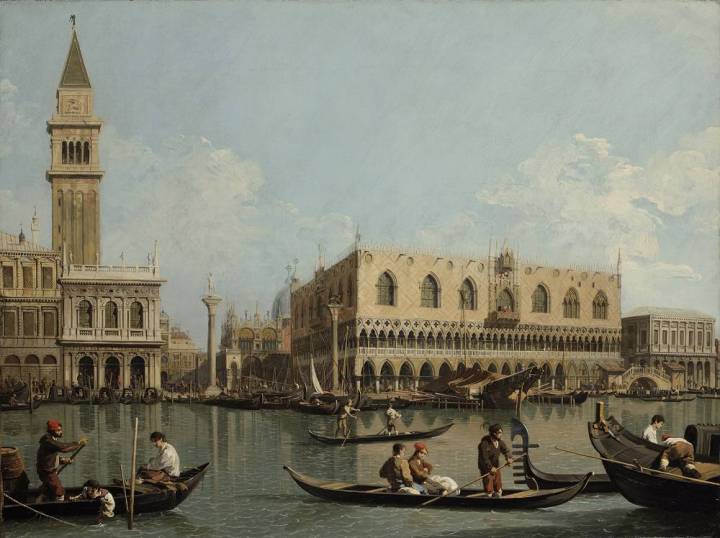
After Canaletto, Venice: The Molo from the Bacino di San Marco, ca. 1740–60, oil on canvas, 52 × 70 cm
(London: The Wallace Collection, P514).
◊ ◊ ◊ ◊ ◊
From The Wallace Collection:
Lelia Packer | Meet the Expert: Experiencing and Painting Venice in the 18th Century
Online, Thursday, 17 November 2022, 13.00 (GMT)
The Wallace Collection holds an impressive collection of vedute, or topographical views, of Venice by Canaletto and Guardi, and by artists working in Canaletto’s circle. In this talk, Dr. Lelia Packer discusses a selection of these works in order to explore Venice as a major tourist destination during the 18th century. What did visitors come to see? What did they do during their visit? And, most importantly, how was the city recorded in paint for them? This talk will be hosted online through Zoom and YouTube. Please click here to register for Zoom.
Lelia Packer is Curator of Dutch, Italian, Spanish, German, and Pre-1600 Paintings at The Wallace Collection.
Lecture | Hugh Roberts on Ince & Mayhew

Marquetry top of one of a pair of tables made by Ince and Mayhew for the Earl of Caledon, 1785.
◊ ◊ ◊ ◊ ◊
From the FHS:
Sir Hugh Roberts | Ince & Mayhew: Interpreting the Record
The Furniture History Society Annual Lecture
In-person and online, Society of Antiquaries, Burlington House, London, 7 November 2022
The lecture marks the publication by Philip Wilson in 2023 of Industry and Ingenuity: the Partnership of William Ince and John Mayhew by Hugh Roberts and Charles Cator. This book is the culmination of many years of research by both authors. It brings together for the first time a corpus of well documented or firmly attributed work by one of the leading metropolitan cabinet-making firms of the eighteenth century, a firm which was as well-known and successful in its day as that of Thomas Chippendale.
By the time furniture history had become established as a serious area of study in the 20th century, much of the furniture produced by this long-lived business had lost its identity and no clear picture of the firm’s output existed. The lecture will examine the process by which the authors have been able to retrieve evidence of some ninety-seven commissions, and to reconnect around three hundred pieces of furniture with patrons and documents.
Admission to the lecture is free for FHS members, but attendance is by ticket only, which must be acquired in advance. Please apply to the Events Secretary by email or post. Numbers are limited to 90. We plan to live-stream the event for those who cannot attend in person.
Sir Hugh Roberts, GCVO, FSA, is Surveyor Emeritus of The Queen’s Works of Art and former Director of The Royal Collection.
Online Talk | Janet Couloute on Black Presence in the Wallace Collection
From The Wallace Collection:
Janet Couloute, Black Presence in the Wallace Collection
Online, Thursday, 20 October 2022, 13.00 (BST)

Govaert Flinck, A Young Archer, ca. 1639–40, oil on oak panel, 66 × 51 cm (London: The Wallace Collection, P238).
To mark Black History Month in Britain, join Janet Couloute for a virtual African Heritage tour of the Wallace Collection. Spanning 400 years of European art, Dr Couloute will place the presumed peripheral and unimportant black male and female figure centre stage. Through a closer look at how artists have created iconographies of blackness and whiteness, Couloute will illustrate how museums such as the Wallace Collection, through more inclusive and open history telling, can encourage visitors to respond more imaginatively to such iconographies. This talk will be hosted online through Zoom and YouTube. Please click here to register for Zoom.
Janet Couloute is a social work academic and art historian interested in revising and expanding current British art-historical canons. With a particular interest in works that are rarely discussed as visual indexes of ‘race’, she is currently working on a research project entitled Renaissance ‘Whiteness’: Reimaging ‘Race’ through the Prism of Early Modern Portraiture. Dr Couloute has also been a Tate guide for twenty years, and has developed an expertise in encouraging gallery audiences to engage with the histories of the Black presence in Europe.
Seminar Session | Clémence Fort on ‘Porcelaines des Sauvages’
This month’s session from the GRHS series on the circulation of knowledge, with information on other GRHS seminar series available here:
Clémence Fort | ‘Porcelaines des Sauvages’
Circulation, appropriation et représentation d’un objet emblème en France au XVIIIe siècle
Diffusion, circulation et appropriation des savoirs – Séminaire du Groupe de Recherche en Histoire des Sociabilités
In-person and online, Université du Québec, Montréal, 21 October 2022, 12.30pm
Avec l’essor du projet colonial en Amérique du Nord au 18e siècle, les « porcelaines des Sauvages » en provenance de Nouvelle-France et issues de la collecte apparaissent dans les collections françaises. Leur circulation engendre des représentations qui documentent les nombreux imprimés de cette époque allant des récits de voyages aux atlas historiques. Naturalistes et amateurs s’intéressent aussi à la manière dont les objets sont fabriqués et imités. Ils les incluent alors dans une culture visuelle scientifique et esthétique nouvelle. Cette présentation examinera la manière dont « les porcelaines des Sauvages » invitent à repenser la géopolitique du collectionnisme à partir des enjeux artistiques, scientifiques et économiques. Nous étudierons la façon dont les « porcelaines des Sauvages » participent à la diffusion esthétique, historique et scientifique de l’entreprise coloniale de la Nouvelle-France au 18e siècle.
Le séminaire privilégiera les circuits et les transmissions de l’imprimé sous toutes ses formes, sans pour autant exclure les autres productions (et marchandises) de la connaissance. Les séances se tiendront en comodal, au local R-4215 à l’UQAM et par visioconférence.
Clémence Fort est actuellement doctorante contractuelle en deuxième année au sein de l’université PSL (ENS) à Paris. Sa thèse intitulée : « Collecter les Americana : la Nouvelle-France dans les cultures visuelles et l’art des Lumières (v. 1700–1763) » est dirigée par Charlotte Guichard. Les recherches de Clémence s’inscrivent au croisement d’une histoire de l’art renouvelée par l’histoire de la collecte, des collections et des cultures visuelles et matérielles.
Seminar Session | Ersy Contogouris on Vigée-LeBrun’s Self-Portraits
This month’s session from the GRHS series on women’s self-portraits, with information on other GRHS seminar series available here:
Ersy Contogouris | Les autoportraits d’Élisabeth Vigée-LeBrun au Salon de 1787
Autoportraits au féminin (XVIe–XVIIIe siècle) –Séminaire du Groupe de Recherche en Histoire des Sociabilités
Université du Québec, Montréal, Thursday, 13 October 2022, 2.00pm
Cette conférence étudiera l’autoportrait qu’Élisabeth Vigée-LeBrun expose au Salon de 1787. Vigée-LeBrun avait été admise à l’Académie royale de peinture et de sculpture en 1783 aux côtés d’Adélaïde Labille-Guiard, portant ainsi à quatre le nombre de femmes membres de l’Académie pour la première fois depuis sa fondation en 1648, et à quinze le nombre total de femmes y ayant été admises. Cette présence féminine à l’Académie n’étant pas appréciée de tous, les années 1780 et les Salons bisannuels de 1783, 1785 et 1787 furent marqué·es par de nombreux débats portant sur la place des femmes dans le plus important espace artistique français. L’autoportrait de Vigée-LeBrun, dans lequel elle se représente avec sa fille Julie, sera mis en dialogue avec les autres œuvres présentées par Vigée-LeBrun à ce Salon afin de réfléchir à ce groupe de tableaux comme une sorte d’autoreprésentation de l’artiste en 1787.










leave a comment