At The Newberry | Jesse Molesworth, On the Orrery
From The Newberry:
Jesse Molesworth, Time and the Cosmos: The Orrery in the Eighteenth-Century Imagination
The Newberry Library, Chicago, 23 February 2013
Please join us on Saturday, 23 February 2013, 2-4pm for the Newberry Library Eighteenth-Century Seminar works-in-progress session with Jesse Molesworth of Indiana University, speaking on the orrery in the eighteenth century.
The first modern orrery, a mechanical device presenting the motion of the solar system, was produced in 1704 by the eminent English clockmakers George Graham and Thomas Tompion. Typically driven by a clockwork mechanism and featuring the planets and their moons revolving around the sun, such devices served throughout the eighteenth century as a crucial means of illustrating the new Copernican view of the cosmos. But it is in this capacity that they served the ulterior purpose of demonstrating precisely the smallness of the individual in relation to the vastness of the cosmos. This paper examines the ways in which those living in the eighteenth century—scientists, artists, writers—reckoned with this unwelcome and ultimately terrifying facet of modernity.
A reception will follow the seminar. This program is free and open to the public, but registration in advance is required. Register online at: http://www.newberry.org/renaissance.
Sponsored by the University of Chicago, DePaul University, Northwestern University, and the University of Illinois at Chicago; and organized by Timothy Campbell, University of Chicago; Lisa Freeman, University of Illinois at Chicago; John Shanahan, DePaul University; and Helen Thompson, Northwestern University.
David Pullins on ‘Robert Adam’s Chinoiseries’
From The Soane Foundation:
David Pullins — Robert Adam’s Chinoiseries
Union Club, New York, 11 February 2013

Robert Adam, Chinoiserie looking-glass design for the state bedchamber, Harewood House (detail)
Feb. 1769. Sir John Soane’s Museum, London (20:73)
Robert Adam is celebrated today as the leading proponent of neoclassicism in England. If we follow conventional stylistic categories, he would be among the least likely architects to venture into the exoticism of the rococo or baroque; however, in three projects dated between 1766 and 1772, Adam produced designs in the Chinese taste, modifying the existing decorative vocabulary of chinoiserie in accordance with the new neoclassical aesthetic he was so pivotal in promoting. A seeming contradiction in terms, Adam’s neoclassical chinoiserie challenges our assumptions not only about the architect but also stylistic categories.
Apart from a chimneypiece at Kenwood House that incorporates panels from a Chinese marble screen, Adam’s chinoiserie works either do not survive or have been greatly modified. His dressing room for Elizabeth Montagu in Mayfair was quickly reconceived by Adam’s competitor James Stuart and his looking-glass designs for Harewood House were probably never executed due to the discouragement of Thomas Chippendale. In the absence of extent work, an important group of drawings in Sir John Soane’s Museum provides the principal source of information about this unexpected facet of Adam’s career. Through a close examination of these drawings in conjunction with archival research conducted in London, Leeds, Edinburgh and Los Angeles made possible by the Sir John Soane’s Museum Foundation, this lecture attempts to reconstruct what we can know about Adam’s chinoiserie designs and his motivation and tactics in producing them.
Time: Monday, 11 February 2013, at 6:30 pm (doors open 6:15)
Location: Union Club, 101 East 69th Street at Park Avenue
Attire: Business- Jacket and Tie required for mene
Tickets can be purchased online at The Soane Foundation’s website
David Pullins is a Ph.D. candidate in the History of Art and Architecture at Harvard University and currently a David E. Finley Fellow at the Center for Advanced Study in the Visual Arts (CASVA) at the National Gallery of Art, Washington, D.C. David received a B.A. in art history from Columbia University and a M.A. as a Peter Jay Sharp Scholar at The Courtauld Institute of Art, where he began his work on Robert Adam. With the support of a Sir John Soane’s Museum Foundation Traveling Fellowship in 2011, David was able to return to work begun in his M.A. and complete the necessary archival research in London and Edinburgh to prepare a forthcoming article on the subject of Adam and chinoiserie.
The Wallace Treasure of the Month for January 2013
January 2013’s Treasure of the Month from The Wallace:
Two Overdoors from Marie-Antoinette’s Bedroom in the Château of Marly
Gallery talks with Christoph Vogtherr, Wallace Collection, London, 11 and 24 January 2013, 1pm
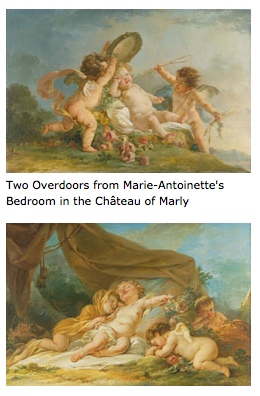 The château of Marly was situated north of Versailles not far from the river Seine. It had been built for Louis XIV between 1679 and 1684. Together with its spectacular park it served as an exclusive retreat for the French King who bestowed invitations as a particular favour to selected courtiers and the Royal family. Marly consisted of a central building for the King and his immediate family (the Royal Pavilion) and twelve pavilions for guests. For a century, the château was repeatedly modernised until it was sold by the Revolutionary government and demolished in 1806.
The two paintings in the Wallace Collection were part of the remodelling of the Queen’s bedroom for Marie-Antoinette in 1781. At that time a mezzanine was added to the room and as a consequence its overall height reduced. The new decoration of the room took these changes into account and new overdoor paintings were required to react to the changed dimensions of the room.
The commission was given by the Direction des Bâtiment (the building administration) to Nicolas-René Jollain (1732-1804) and Hughes Taraval (1729-1785), two members of the Royal Academy. They have since been almost forgotten, and both their works had been acquired by the 4th Marquess of Hertford as by the much better known Fragonard, an indication that the signatures must have been covered. It is, however, possible to link the two works with the overdoors for the Queen’s bedchamber documented in the sources. Their decorative character is in line with Marie-Antoinette’s preferences whose taste in the Decorative Arts was cutting edge while most of the paintings commissioned for her, except portraits by Elisabeth Vigée-Lebrun, are much more conventional. Equally traditional is the iconography of the two works: Putti are depicted as allegories of Sleep (by Jollain) and Awakening (by Taraval), obvious choices for a bedroom.
The overdoors are beautifully decorative works. The figures are arranged in a triangular composition in both works to visually link the pair. Their pastel-like palette responded to the light colour scheme of the room, the slightly elongated figures to their position high up above the doorways. On closer inspection the works show a smoother and more detailed brushwork typical for the late eighteenth century.
The Queen’s apartment was situated in the North-West corner of the building. The two overdoors were inserted into the South and East walls. The different angles of lighting on the paintings respond to their situation relative to the windows. Taravals painting must have been on the South wall where the light falls in from the right, Jollains on the East side of the room, right next to the Queen’s bed where an allegory of sleep is particularly appropriate.
After the French Revolution, the paintings were sold by the revolutionary government together with the entire contents of Marly. A drop-front desk and a corner cabinet by Jean-Henri Riesener in the Wallace Collection (also in the Study) same room once were part of Marie-Antoinette’s furniture in Marly.
Gallery Talks with Christopher Vogtherr: Friday 11 and Thursday 24 January at 1pm.
Further Reading
John Ingamells, The Wallace Collection Catalogue of Pictures III. French before 1815 (London 1989).
Stéphane Castelluccio, Le château de Marly sous le règne de Louis XVI (Paris 1996).
Things: Material Culture at Cambridge, Lent 2013
Programming from CRASSH at the University of Cambridge:
Things: Material Cultures of the Long Eighteen Century
Centre for Research in the Arts, Social Sciences and Humanities (CRASSH), Cambridge, ongoing series
The seminar meets alternate Tuesdays 12.30-2.30pm in the Seminar Room, Alison Richard Building, West Road. A light lunch will be provided.
 The early-modern period was the age of ‘stuff.’ Public production, collection, display and consumption of objects grew in influence, popularity, and scale. The form, function, and use of objects, ranging from scientific and musical instruments to weaponry and furnishings were influenced by distinct and changing features of the period. Early-modern knowledge was not divided into strict disciplines, in fact practice across what we now see as academic boundaries was essential to material creation. This seminar series uses an approach based on objects to encourage us to consider the unity of ideas of this period, to emphasise the lived human experience of technology and art, and the global dimension of material culture. We will build on our success discussing the long eighteenth century in 2012-13 to look at the interdisciplinary thinking through which early modern material culture was conceived, adding an attention to the question of what a ‘thing’ is, to gain new perspectives on the period through its artefacts.
Each seminar will feature two talks each considering a way of
thinking about objects.
22 January 2013 — Altered Things
Luisa Calè (Birkbeck) and Adam Smyth (Birkbeck)
5 February 2013 — Model Things
Simon Schaffer (Cambridge) and Anna Maerker (Kings College London)
19 February 2013 — Re-materialising Things
Jane Wildgoose (Kingston University and Keeper of The Wildgoose Memorial Library) and Mary Brooks (Durham)
5 March 2013 — Royal Things
Cordula Van Wyhe (York) and Desmond Shawe-Taylor (Surveyor of the Queen’s Pictures)
Visit the external blog or subscribe to the group mailing list.
Lectures | Michael Fried, ‘David – Manet, une affinité ignorée’
As noted at Le Blog de l’ApAhAu:
Michael Fried, David – Manet, une affinité ignorée
Collège de France, Paris, 21 and 28 March 2013
Les professeurs du Collège de France, sur la proposition du professeur Marc Fumaroli, ont invité :
Michael Fried (J.R. Herbert Boone Professor of Humanities and the History of Art, John Hopkins University, Baltimore)
à donner une conférence sur le sujet suivant:
David – Manet, une affinité ignorée
Ces leçons auront lieu les jeudis 21 et 28 mars 2013, à 11 heures dans l’Amphithéâtre Maurice Halbwachs, 11, place Marcelin-Berthelot, 75005, Paris.
Lecture | Emma Barker on Chardin and the Domestic Woman
Lecture by Emma Barker — Painting the Bourgeoisie: Chardin and the Domestic Woman
Keynes Library, Birkbeck College, London, 5 December 2012
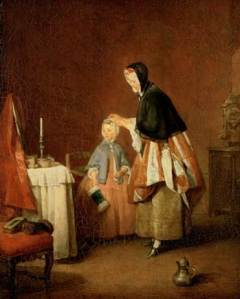 The Birkbeck Eighteenth-Century Research Group is delighted to announce a forthcoming lecture by Emma Barker, Senior Lecturer in Art History at the Open University. Emma Barker’s research focuses on eighteenth and early nineteenth-century French art. Her monograph, Greuze and the Painting of Sentiment, was published by Cambridge University Press in 2005. She has also edited and co-authored several course books for the Open University, including Art and Visual Culture 1600-1850: Academy to Avant-Garde (Tate Publishing, 2012).
7.30pm, Wednesday 5th December 2012, Room 114 (Keynes Library), 43 Gordon Square
All very welcome! For further information, please contact Ann Lewis: a.lewis@bbk.ac.uk
Exhibition | Houghton Revisited: The Walpole Masterpieces
More than sixty paintings from the Hermitage will spend the summer of 2013 back at Houghton Hall. The exhibition curator Thierry Morel will be in New York providing a preview at The Metropolitan Museum of Art on Friday, 7 December 2012, at 6pm.
◊ ◊ ◊ ◊ ◊
From the exhibition website:
Houghton Revisited: The Walpole Masterpieces from Catherine the Great’s Hermitage
Houghton Hall, Norfolk, 17 May — 29 September 2013 [extended to 24 November]
Curated by Thierry Morel

Colen Campbell, James Gibbs, and William Kent, Houghton Hall,
Norfolk, 1722-35 (Photo: 2008, Wikimedia Commons)
◊ ◊ ◊ ◊ ◊
The magnificent art collection of Great Britain’s first Prime Minister, Sir Robert Walpole, sold to Catherine the Great to adorn the Hermitage in St. Petersburg, is reassembled in its spectacular original setting, Houghton Hall, Norfolk, for the first time in over 200 years.
◊ ◊ ◊ ◊ ◊
From the Mail Online (6 October 2012) . . .
Lord Cholmondeley is about to announce plans to stage a very special exhibition next year that will see the triumphant, if temporary, return to the house of about 60 old master paintings from Sir Robert Walpole’s once celebrated collection, the bulk of which was sold to Catherine the Great of Russia in 1779 and which to this day remains one of the greatest treasures of the Hermitage Museum in St Petersburg. To provide an authentic and breathtaking backdrop for the pictures, the principal rooms of the house will be restored to their exact appearance of the early 1740s, a time when Walpole was at the height of his powers. . .
The full article is available here»
Seminars and Lunches at The Paul Mellon Centre
Research Events at The Paul Mellon Centre for Studies in British Art
London, Spring 2013
The spring of 2013 will see the launch of an exciting new programme of research events at the Centre.
The first of a seasonal series of five, fortnightly research seminars will be given by distinguished historians of British art and architecture. These research seminars, which will take place on Wednesday evenings, are intended to showcase original and stimulating research in all areas of British art and architectural history. They will take the form of hour-long talks, followed by questions and drinks, and are geared to scholars, curators, conservators, art-trade professionals and research students working on the history of British art. We are pleased to announce that the papers given in this first series of research seminars will be delivered by members of The Paul Mellon Centre’s Advisory Council.
The spring programme of events will also include a series of five research lunches, geared to doctoral students and junior scholars working on the history of British art and architecture. These research lunches, which will normally take place on alternate Fridays, are intended to be informal events in which individual doctoral students and scholars will talk for half-an-hour about their projects, and engage in animated discussion with their peers. A sandwich lunch will be provided by the Centre on these occasions. We hope that this series, which we look forward to maintaining in the summer and autumn, will help foster a sense of community amongst PhD students and junior colleagues working in the field, and bring researchers from a wide range of institutions together in a collegial and friendly atmosphere.
In order to help us plan for these events, it is essential that all of those who intend coming to individual research seminars and research lunches email the Centre’s Events Co-ordinator, Ella Fleming, on efleming@paul-mellon-centre.ac.uk, at least two days in advance.
◊ ◊ ◊ ◊ ◊
Research Seminars, Wednesdays, 5.30-8.00
January 9 — Mark Hallett (The Paul Mellon Centre for Studies in British Art), ‘Point Counter Point: Sir Joshua Reynolds, Female Portraiture and the Great Room at Somerset House’
January 23 — Christine Stevenson (Courtauld Institute of Art), ‘Architectural Husbandry: ‘Rough Materialls’ and Tough Clients in Eighteenth-Century Britain’
February 6 — Caroline Arscott (Courtauld Institute of Art), ‘Colour as Lure and as Provocation: William Morris’s Tapestry, The Woodpecker’
February 20 — Michael Hatt (University of Warwick), ‘Edward Carpenter and the Domestic Interior’
March 6 — Paul Binski (University of Cambridge), ‘The Heroic Age of Gothic and the Metaphors of Modernism’
◊ ◊ ◊ ◊ ◊
Research Lunches, Fridays, 12.30-2.00
January 18 — Jonny Yarker (University of Cambridge), ‘Learning the Business of Painting in Early Eighteenth-Century Britain: The Example of Hamlet Winstanley’
February 1 — Esther Chadwick (Yale University), ‘Experiments in Liberty: Barry’s Phoenix of 1776’
February 15 — Cicely Robinson (University of York), ‘Reading Reconstructions: The National Gallery of Naval Art c.1839’
March 1 — Emily Mann (Courtauld Institute of Art), ‘Empire Builder: Christian Lilly in the Atlantic World 1688-1738’
March 8 — Carly Collier (University of Warwick), ‘Rediscovering Fresco Painting in Nineteenth-Century Britain’
Book Talk | Simon Werrett on Fireworks
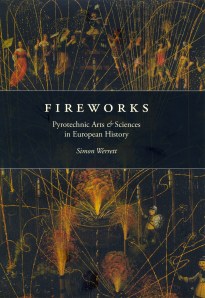 Simon Werrett, The History of Fireworks
Ealing Central Library, 8 November 2012
Simon Werrett will give talk on his book Fireworks: Pyrotechnic Arts and Science in European History at the Ealing Central Library on November 8, 2012 at 6:15pm. Enjoy a free glass of wine courtesy of Waterstones. Green Room, Ealing Central Library, Broadway Centre, Ealing W5 5JY. The event is free, but please book in advance at reading@ealing.gov.uk or in Ealing Waterstones.
Study Day in Sydney To Celebrate Major Ceramics Gift
To celebrate a major gift of maiolica and porcelain, the Art Gallery of New South Wales in Sydney is presenting a study day toward the end of this month. From the museums’ website:
◊ ◊ ◊ ◊ ◊
Renaissance and Rococo Ceramics Study Day: The Arts of Maiolica and Porcelain
Art Gallery of New South Wales, Sydney, 28 October 2012
Discover two of the most significant material innovations in the history of European decorative arts with this study day focused on the extraordinary Kenneth Reed Collection, in the European galleries. Comprising 16th- and 17th-century maiolica (tin-glazed earthenware) and 18th-century porcelain, the Reed Collection offers insight into Renaissance and rococo art and material culture.
Curator Richard Beresford and art historian Mark de Vitis outline the history of the two ceramic traditions, illustrated with examples from the Reed Collection, followed by a demonstration of materials and processes by noted Sydney ceramicist Bronwyn Kemp.
◊ ◊ ◊ ◊ ◊
From the press release (16 October 2012) . . .

Meissen (Germany), Parrots, 1745, hard-paste porcelain, 39 x 27 x 18 cm (on loan from Kenneth Reed) The group was originally modeled by Joseph Joachim Kändler in April 1745 for Augustus III’s consort Maria Josepha of Austria.
Kenneth Reed today announced his intention to bequeath to the Art Gallery of New South Wales his entire private collection of 200 pieces of rare and valuable 18th-century European porcelain valued at $5.4 million. Mr Reed also helped the Gallery acquire an important Italian renaissance maiolica masterpiece, Francesco Xanto Avelli’s Sack of Rome plate of 1530 with his generous donation of $550,000.
‘This most generous gift to the Gallery represents a significant addition to the Gallery’s European collection. Ken has been one of our most generous benefactors in the history of this Gallery’, said Michael Brand, director, Art Gallery of New South Wales.
Mr Reed, a Sydney-based retired lawyer, has been a collector of European paintings and decorative arts for more than 25 years. He says that he was inspired by visits as a child to the Art Gallery of New South Wales where his father used to take the family on Sunday afternoons.
The Gallery is to receive a spectacular group of parrots originally modelled at Meissen by Joseph Joachim Kändler for Augustus III’s consort, Maria Josepha of Austria, superlative examples of Vincennes and Sèvres porcelain, including a rare rose marbré tea service, a unique piece of experimental hard paste from the early 1760s, plus
exquisite Chelsea figures and wares from all periods of the factory’s
production.
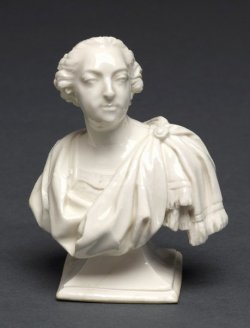
Sèvres, Bust of Louis XV, ca. 1762-63, hard-paste porcelain, 11 x 9 x 6 cm
(on loan from Kenneth Reed)
In the words of Richard Beresford, senior curator of European art, “This promised gift transforms the Gallery’s presentation of European art. We have never owned anything comparable in range and quality to this collection but now the Gallery will be able to show some of the highest quality 18th-century porcelain in the world. The Gallery has had neglected holdings of European decorative arts until now. The decision to show 16th-18th-century ceramics alongside paintings of the same period will add a new dimension to the Gallery’s collection display. The Gallery is now also better placed to respond to an expected rise in public interest in ceramic history.”
In 2010 Kenneth Reed announced a bequest to the Gallery which then consisted of 25 old master paintings, 25 pieces of 18th-century porcelain and 22 pieces of Italian maiolica from the 16th and 17th centuries. The addition to his bequest of this European porcelain brings the total value of the bequest to almost $13 million, ranking Mr Reed among the top benefactors in the Gallery’s history.










leave a comment