Launch of the Centre for Enlightenment Studies at King’s College
Please forgive the short notice, but news of the event is a useful marker of the launch of the Centre for Enlightenment Studies at King’s College London in partnership with the British Museum (stay-tuned for the Centre’s website). –CH
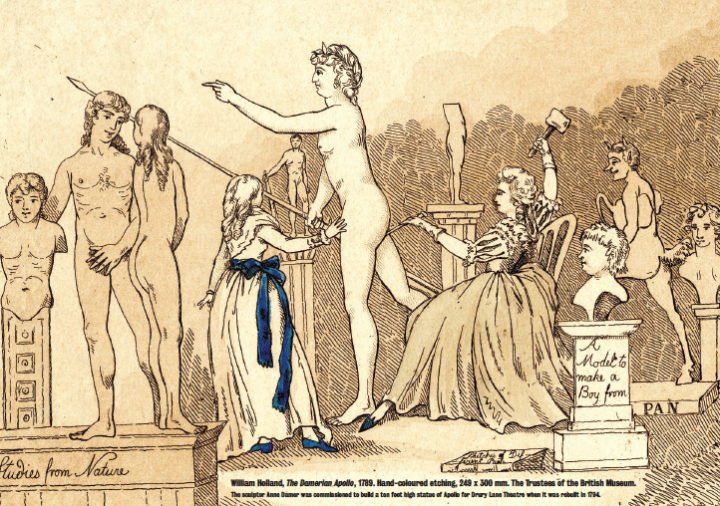
Enlightenment Bodies – from Apollo to Automata
King’s College London, The Strand, London, 15 October 2013
◊ ◊ ◊ ◊ ◊
The Centre for Enlightenment Studies at King’s in partnership with the British Museum, presents Enlightenment Bodies – from Apollo to Automata, on Tuesday, 15 October 2013, 19.30–20.30 at the Edmond J Safra Lecture Theatre, Strand Campus, King’s College London.
Both the aesthetics and the workings of the human body were key themes of the eighteenth-century European Enlightenment. This is, therefore, an ideal topic with which to launch King’s College’s new interdisciplinary research centre, which will bring together our expertise in this area across a wide range of departments, and will build on our close relationship with the Enlightenment Gallery curatorial team at the British Museum. Join us for an exploration of the importance of the human body to Enlightenment life and thought with a panel of experts:
Athena Leoussi, University of Reading, Co-director of European Studies, University of Reading and author of
Nationalism and Classicism: The Classical Body as National Symbol in Nineteenth-Century England and France (1998);
Anna Maerker, Senior Lecturer in History of Medicine, King’s College London, author of Model Experts: Wax Anatomies and Enlightenment in Florence and Vienna, 1775–1815 (2011);
Simon Schaffer, Professor of History of Science, University of Cambridge and TV presenter of Mechanical Marvels and Clockwork Dreams, a recent programme for BBC 4.
The panel discussion will be followed by a drinks reception. The event is free, though booking is required.
Lecture | Anne Lafont on Proposals for an Atlantic Portraiture
From the Institute of Fine Arts at NYU:
Anne Lafont | Proposals for an Atlantic Portraiture: Paris, Philadelphia, Saint-Domingue, ca. 1800
Institute of Fine Arts–NYU, New York, 8 October 2013
 Anne Lafont will consider visual cultures of alterity in the era of Atlantic Revolutions (eighteenth and nineteenth century). First, she will identify an unrecognized body of works and discuss the opportunity of studying it as a whole. Next she will address the pictorial and academic category of portraiture when discussing images of Haitian heroes. Finally, she will consider how three stylistic communities – Paris, Philadelphia, Saint-Domingue – are working together across continents
Anne Lafont is an Associate Professor of Modern Art History at the University of Paris-Est Marne la Vallée and Chief Editor of Perspective, la revue de l’INHA (French National Institute of Art History). A former fellow at the Villa Medici, she devoted her thesis to the painter Anne-Louis Girodet and has since worked on artistic theory and eighteenth- and nineteenth-century visual arts, with a special attention to the revolutionary period, race and aesthetics, and gender issues.
Tuesday, October 8, 12:30pm
Institute of Fine Arts-NYU, Loeb Room, 1 East 78th Street, New York
Reservations are required; please click here.
◊ ◊ ◊ ◊ ◊
Rendez-vous
In Fall 2013, the Institute of Fine Arts, NYU inaugurates Rendez-vous, a seminar on French art (18th to 20th centuries) held monthly throughout the 2013–2014 academic year. International scholars are invited to present their research in an informal and creative setting for approximately 30 minutes, followed by an open discussion with students and colleagues. Rendez-vous focuses on French art in the broadest sense: ‘French’ is interpreted in an extensive way, including global exchanges, political dimension and colonial history, and ‘Art’ includes painting, architecture and sculpture, but also material and visual culture. Rendez-vous offers an occasion to learn about current innovative research by international and engaging scholars. The seminar aims to open up an exchange of methodologies, thoughts and ideas in a participatory atmosphere.
Rendez-vous is organized by Noémie Etienne, IFA/Mellon Postdoctoral Fellow (2013–2015). These lectures begin at 12:30pm in the Loeb Room at the Institute of Fine Arts. They are open to the public, but RSVPs are required.
Upcoming Lectures
8 November 2013 | Chonja Lee, University of Zurich
L’Âme de Lotus: Floral Animations in French Art around 1900
9 December 2013 | Merel van Tilburg, Centre allemand d’histoire de l’art, Paris
Embroidery and Tapestry as History Painting in Belgium and France around 1900: Colonialist Exhibition Pieces by Hélène de Rudder and Georges Rochegrosse
17 February 2014 |Carole Blumenfeld, Palais Fesch-Musée des Beaux-arts d’Ajaccio
Marguerite Gérard: The Most Successful Genre Painter of her Time
Discussion | Perspectives on the English Country House
The National Trust & Apollo present
Perspectives on the English Country House: Preserving our Cultural Heritage
The National Portrait Gallery, London, 23 September 2013
 This event celebrates the publication of this year’s National Trust Historic Houses and Collections Annual. The journal features essays that bring to light the great range of research currently being undertaken at the Trust’s properties, giving us a better and deeper perspective on its work.
Speakers include:
Simon Jenkins, Chairman of the National Trust
Oscar Humphries, Publisher of Apollo Magazine
Nicky Haslam, English interior designer
Robert Sackville-West, on his ancestral home, Knole House
Professor Maurice Howard, speaking about The Vyne
Chaired by Oscar Humphries, Publisher of Apollo Magazine, and Simon Jenkins, Chairman of the National Trust, this panel discussion will examine the personal stories behind a number of great houses, exploring the different ways in which people are connected to, or have been influenced by them – whether that means shaping their aesthetics, their cultural politics, or their academic research.
Discussion begins 7pm. Drinks reception afterwards. Tickets £20. Click here to book tickets.
Lecture | Connecting the East India Company and the Caribbean
Chris Jeppesen is the AHRC cultural engagement fellow working on a project entitled “East Meets West: Caribbean and Asian Colonial Cultures in British Domestic Contexts” with The East India Company at Home team, The Legacies of British Slavery team, and the British Library. From the British Library:
Chris Jeppesen | Uncovering Connections between the East India Company and the Caribbean
British Library, London, 3 July 2013
 Chris Jeppesen, Research Associate at the UCL Department of History, talks about his recent work on the Library’s collections tracing links between the East India Company and the Caribbean through the movement and correspondence of families.
Historians have tended to draw a binary between British involvement in India and the Caribbean. Rarely, do they acknowledge the intricate connections between the Atlantic and Indian Ocean worlds that facilitated the transfer of people, capital and goods during the late eighteenth/early nineteenth centuries. Chris’s ongoing research project based between UCL and the Library, has sought to uncover some of the connections between the East India Company and the Caribbean and to suggest ways that other interested researchers can expand our understanding of these links.
Crucial to many exchanges were family networks that spanned India, Britain and the Caribbean, allowing members access to opportunities that promised wealth and prestige. This talk will seek to demonstrate how by following one family – the Martins of Antigua – through the Library’s collections, one can start to uncover the all too often ignored links between India and the Caribbean.
Organised with support from the Eccles Centre for American Studies. This talk is part of the Summer Scholar’s programme. To book a space please email: summer-scholars@bl.uk
Wednesday, 3 July 2013, 12.30-14.00, Foyle Suite, Centre for Conservation, The British Library. Free, booking essential.
Things: Material Culture at Cambridge, Easter 2013
Programming from CRASSH at the University of Cambridge:
Things: Material Cultures of the Long Eighteen Century
Centre for Research in the Arts, Social Sciences and Humanities (CRASSH), Cambridge, ongoing series
The seminar meets alternate Tuesdays 12.30-2.30pm in the Seminar Room, Alison Richard Building, West Road. Please note that there will not be sandwiches served this term, so the seminar will start promptly at 12.30. You are welcome to join the speakers for lunch afterwards.
 The early-modern period was the age of ‘stuff.’ Public production, collection, display and consumption of objects grew in influence, popularity, and scale. The form, function, and use of objects, ranging from scientific and musical instruments to weaponry and furnishings were influenced by distinct and changing features of the period. Early-modern knowledge was not divided into strict disciplines, in fact practice across what we now see as academic boundaries was essential to material creation. This seminar series uses an approach based on objects to encourage us to consider the unity of ideas of this period, to emphasise the lived human experience of technology and art, and the global dimension of material culture. We will build on our success discussing the long eighteenth century in 2012-13 to look at the interdisciplinary thinking through which early modern material culture was conceived, adding an attention to the question of what a ‘thing’ is, to gain new perspectives on the period through its artefacts.
Each seminar will feature two talks each
considering a way of thinking about objects.
30 April 2013 — Printed Things
Sean Roberts (University of Southern California) and Elizabeth Upper (UL Munby Fellow)
14 May 2013 — Paper, Making, Things
Elaine Leong (Max Planck Institute, Berlin) and Helen Smith (University of York)
28 May 2013 — Handling Things
Melanie Vandenbrouck (National Maritime Museum), Felicity Powell (Artist), and Ben Carpenter (University of Wolverhampton)
11 June 2013 — Painted Things
Matthew Hunter (McGill University) and Mark Hallett (Paul Mellon Centre)
Visit the external blog or subscribe to the group mailing list.
Huguenots of Spitalfields Festival
Thanks to Emma Barker for noting this upcoming festival with events taking place across London:
Huguenots of Spitalfields Festival
London, 8-21 April 2013
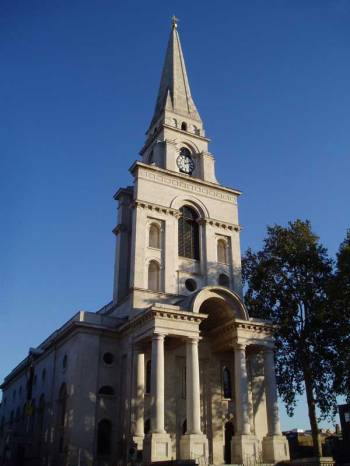
Christ Church, Spitalfields, London
2013 is the year of two significant anniversaries in the intertwined history of the Spitalfields district in London and the silk weaving industry created by Huguenots (French Protestant refugees who fled Catholic France from the 16th century). It is the 250th anniversary of the death of Anna Maria Garthwaite (1690-1763), an outstanding English textile designer who played an important part in the story of the Spitalfields silk weavers. It is also the 415th anniversary of the signing of the Edict of Nantes, on 13th April 1598. This decree by Henry IV of France served as a guarantee to the Protestant Huguenots that their rights to worship would be respected. However, it was revoked by Louis XIV in 1685 with the result that large numbers of French protestants fled to England to escape persecution. Over twenty thousand settled in Spitalfields where there was already an established weaving community.
Come and spend the day in Spitalfield, take a walk and browse around the Market, call in at Christ Church Spitalfields, the finest Baroque church in the country; visit Dennis Severs’ House, drop into the Town House
for coffee and delicious cakes. There is so much to see
and do — you will not be disappointed.
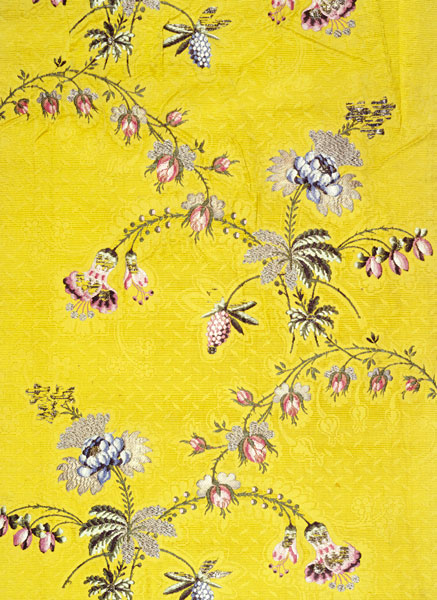
Silk panel, 1748-50 Spitalfields silk (The Museum of London)
Programme of Events
Supported by the Huguenot Society and the Spitalfields Trust
Between 8th and 21st April 2013, a series of activities to commemorate these two anniversaries will take place at different venues in Spitalfields. The celebratory programme will include
Daily Walks – The Immigrants’ Story, Historic Spitalfields, The Silk Weavers of Spitalfields
Talks by experts at the Bishopsgate Institute, Guildhall Library, V&A Museum, London Metropolitan Archives & The Natural History Museum
• Thanksgiving Service on Thursday 11th April at Christ Church, Spitalfields
• Extended opening hours for Dennis Severs’ House
• At Home With Anna Maria: a fundraising soirée on 16th April in Fournier Street with Clare Browne, curator of European textiles at the V&A and Dan Cruickshank
• Tours of Sandys Row Synagogue and Bisopsgate Institute
• The Big Weave: Saturday 13th April, which is an arts & crafts fair in Spitalfields Market. Stitches in Time will be hosting weaving workshops
Round Table Session | New Database: Authors Writing on Art in France
Next month at INHA, as noted at Le Blog de l’ApAhAu:
Auteurs d’écrits sur l’art en France, XVIe-XVIIIe siècles
Institut national d’histoire de l’art, Paris, 4 April 2013
Présentation de la base Auteurs d’écrits sur l’art en France (XVIe-XVIIIe siècles) à l’occasion de sa mise à la disposition de la communauté scientifique par l’intermédiaire de l’application Agorha
L’histoire de l’art s’est constituée en France à partir de discours aux formes, aux intentions et aux constructions multiples dont l’émergence, entre le XVIe et le XVIIIe siècles, a accompagné des pratiques savantes aussi diverses que la création, la collection, l’érudition et la préservation des vestiges du passé. La base de données Auteurs d’écrits sur l’art en France (XVIe-XVIIIe siècles) donne accès à la diversité de ces traditions intellectuelles. Près de 700 notices personnes et 4000 notices bibliographiques composent un répertoire bio-bibliographique introduisant à un vaste corpus d’auteurs et de références telles que recueils biographiques, études antiquaires, littérature de voyage et guides, conférences académiques, textes descriptifs, techniques, théoriques ou critiques. Complément du Dictionnaire critique des historiens de l’art actifs en France de la Révolution à la Première Guerre mondiale, cette nouvelle base de données ne constitue pas seulement un formidable outil documentaire mais dévoile également le processus de construction de la discipline Histoire de l’art comme creuset dans lequel des traditions intellectuelles variées ont fusionné pour donner naissance à un nouveau discours sur l’art passé et présent.
Works in Progress from The Met’s Fellow Program
A series of colloquia take place from 26 February to 30 April 2013. On Tuesday, 9 April, Donato Esposito is scheduled to speak on Reynolds’s collection in the nineteenth-century. The full schedule is available (as a PDF) here»
◊ ◊ ◊ ◊ ◊
The Metropolitan Museum’s Fellowship Colloquium
The Metropolitan Museum of Art, New York, 9 April 2013
The Fellowship Program at The Metropolitan Museum of Art cordially invites you to attend colloquia on works in progress by art history, conservation, and scientific research fellows. The following talks will be held in Bonnie J. Sacerdote Lecture Hall, Ruth and Harold D. Uris Center for Education. These colloquia are made possible in part by Mrs. Henry S. Blackwood.
Moderator: Xavier F. Salomon, Curator, European Paintings
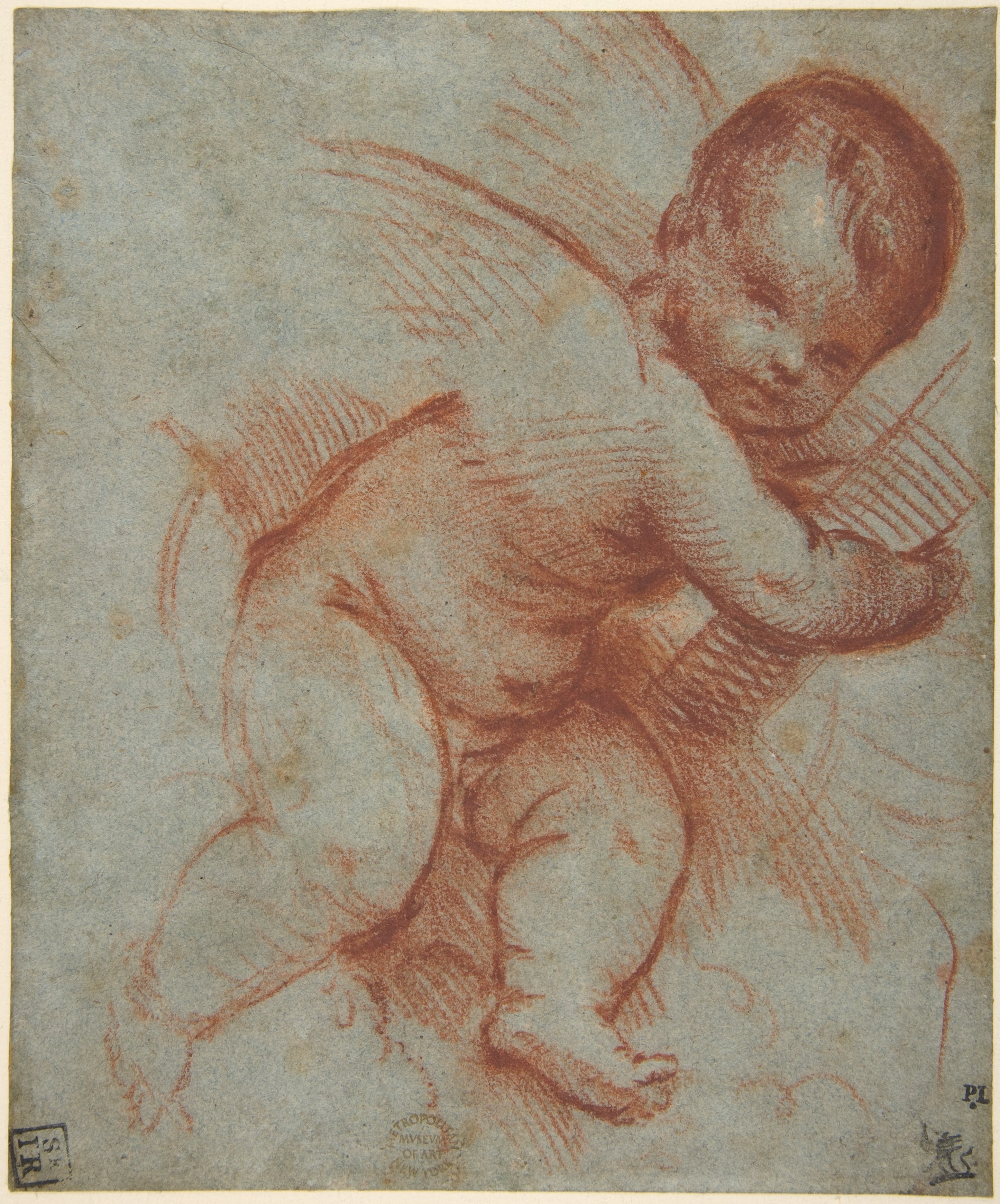
Circle of Titian, Putto Holding the Base of a Cross (New York: Metropolitan Museum of Art, Rogers Fund, 1911). Part of the collection of Joshua Reynolds in the eighteenth century.
10:00 Ronda Kasl (Chester Dale Fellow, European Paintings), “Miquel Alcanyís and Gherardo Starnina: Two Altarpieces from the Valencian Church of San Juan del Hospital”
10:30 Linda Borean (Andrew W. Mellon Fellow, European Paintings), “Self-Portraits and Portraits of Artists in Seicento Venice”
11:00 Valeria De Lucca (Jane and Morgan Whitney Fellow, Musical Instruments), “Roman Heroes / Roman Patrons: Constructing Aristocratic Identity in Seventeenth-Century Rome”
Intermission
11:45 Furio Rinaldi (Andrew W. Mellon Fellow, Drawings and Prints), “Timoteo Viti (1469/70–1523): An Artist and Collector in the Footsteps of Raphael”
12:15 Donato Esposito (Andrew W. Mellon Fellow, Drawings and Prints), “‘Many Curious and Valuable Things’: Sir Joshua Reynolds’s Collection in Nineteenth-Century New York”
12:45 Allen Doyle (Jane and Morgan Whitney Fellow, Robert Lehman Collection), “Michelangelo as Bad Object: Horace
Vernet’s Renaissance”
Exhibition | Plain or Fancy?
Press release (25 February 2013) from The Met:
Plain or Fancy? Restraint and Exuberance in the Decorative Arts
The Metropolitan Museum of Art, New York, 26 February — 18 August 2013
Curated by Luke Syson and Ellenor Alcorn
 The tension in design between austerity and opulence—the simple and the ornate—is a long-standing one. Plain or Fancy? Restraint and Exuberance in the Decorative Arts, on view February 26 through August 18, 2013 at The Metropolitan Museum of Art, invites visitors to consider their own preferences and suggests some of the cultural meanings that have been associated with the two words. The challenge is not to identify quality, or to determine “good taste” versus “bad taste.” Rather the exhibition touches on some historical moments when austerity and flamboyance in design were actively debated. In a departure from a conventional chronological presentation, the show raises a question, encouraging visitors to explore their own reactions. The 40 works of art on view are drawn from the Museum’s holdings of European decorative arts, and include ceramics, metalwork, and works in glass ranging in date from the late 14th to the early 20th century.
The word “fancy” is a shortened form of “fantasy,” which suggests that imagination and exuberance might be seen as prized formal qualities, equally present in a rustic pot and a treasury piece. Fanciness has sometimes been linked to the notion of luxury, and with it, expensive indulgences. In ancient Greece and Rome, costly imported commodities were sometimes seen as a threat to the local economy, and in later centuries condemned as a symptom of an unwelcome social mobility that challenged the existing power structure. But grandeur also had its place in securing the social hierarchy, for example, at the court of Louis XIV. Plainness, by contrast, has tended to be associated with moral virtue and purity.
A century after the Austrian architect Adolf Loos delivered his polemic “Ornament and Crime,” the Modernist aesthetic, which married form with function, remains a dominant influence. But this was not the first time that the merits of ornament had been debated. Court culture in Spain in the 16th century was permeated with the somber gravitas of King Philip II. A contemporary treatise promoting restraint in dress, comportment, and decoration argued: “…a quiet manner is the inevitable mark of a grave and dignified man, ruled by reason rather than by appetite…” These values are expressed in the architecture and metalwork of the period, which is characterized by a distinctive geometric simplicity. Implicit in this taste, which is often referred to as the “Severe Style,” is a rejection of what was seen as the sensuous decadence of Mannerist design.

Coffee and tea service, Sèvres Manufactory. Designer: Hyacinthe Régnier, 1855–61 (New York: The Metropolitan Museum of Art).
Another moment of debate occurred in the 18th century, when the Rococo style was derided by advocates of Neoclassicism. The English artist William Hogarth campaigned for spontaneity and asymmetry, writing in 1753, “Simplicity, without variety, is wholly insipid…” But the same year, the whimsical fantasies of Rococo designers, which were rooted in nature’s capriciousness, were ridiculed as excessive and depraved. The taste for fanciful Chinese subjects was mocked as the “monstrous offspring of wild imagination, undirected by nature and truth.”
Plain or Fancy? points out that aesthetic responses are never neutral. Our judgments have roots in our culture, socioeconomic status, generational values, and aspirations. For some, “plain” is sophisticated, while for others “plain” is dull. The exhibition does not aspire to settle the debate but encourages visitors to consider their own responses to this issue as they experience works of art throughout the Museum. To ask now if people like art “plain” or “fancy” is to ask whether they are aristocrats or revolutionaries, Protestants or Catholics, forward-looking or nostalgic. In looking at works of art, people look at themselves.
The exhibition features an in-gallery and web-based interactive component that encourages visitors to explore, consider, and share their own sensibilities in the decorative arts. Displayed on iPads in the exhibition and as a presentation in MetMedia, it features six works from the installation whose character—whether plain or fancy—can be debated. After viewing the objects, visitors are invited to share their personal opinions in a 120-character tweet (@PlainOrFancy), deciding for themselves whether a work is “plain” or “fancy” and if it suits their personal style.
Plain or Fancy? Restraint and Exuberance in the Decorative Arts is organized by Luke Syson, Iris and B. Gerald Cantor Curator in Charge, and Ellenor Alcorn, Associate Curator, both of the Metropolitan Museum’s Department of European Sculpture and Decorative Arts. Installation design is by Michael Langley, Exhibition Design Manager; graphic design is by Mortimer Lebigre, Graphics Designer; and lighting is by Clint Ross Coller and Richard Lichte, Lighting Design Managers, all of the Metropolitan Museum’s Design Department.
Education programs include exhibition tours and a Friday evening program during which visitors will participate in a multi-sensory exploration of the question of “Plain or Fancy?” through several collection galleries.
◊ ◊ ◊ ◊ ◊
Plain or Fancy? Restraint and Exuberance: A Conversation about Taste
The Metropolitan Museum of Art, New York, 15 May 2013
Wayne Koestenbaum, author, The Queen’s Throat and Humiliation, and Luke Syson, Iris and Gerald B. Cantor Curator in Charge, Department of European Sculpture and Decorative Arts, MMA
The Metropolitan Museum of Art’s exhibition Plain or Fancy? Restraint and Exuberance in the Decorative Arts culls highlights from the Met’s permanent collections to contrast restrained—plain—works of art with richly ornamented—fancy—ones, focusing on those moments in history when pendulum shifts made a sharp swing in one direction or another. Wayne Koestenbaum (The Queen’s Throat, Humiliation), one of today’s most influential and controversial cultural critics, joins Luke Syson, Iris and B. Gerald Cantor Curator in Charge, European Sculpture and Decorative Arts, for a conversation exploring the ways in which stylistic choices may also be moral ones—and how our aesthetic responses are shaped by shame and judgment. Do you like your art “plain” or “fancy”? And what does taste mean, really?
Details for this ticketed event are available here»
Exhibition | In Search of Classical Greece: Travel Drawings
Press release from The British Museum:
In Search of Classical Greece: Travel Drawings of Edward Dodwell and Simone Pomardi, 1805–1806
The British Museum, London, 7 February – 28 April 2013
Curated by John Camp with Ian Jenkins and Kim Sloan

Edward Dodwell, Simone Pomardi, Panorama from the top of the Mousaion Hill, Athens, 1805.
This exhibition will look at Greece through the eyes of the classical scholar Edward Dodwell (about 1777–1832) and his Italian artist, Simone Pomardi (1757–1830). During their travels in 1805–06, they recorded the country and its people in a series of fascinating and spectacular drawings and watercolours. Kindly lent by the Packard Humanities Institute, these works have never been seen in public before. They represent a unique record of an important chapter in the rediscovery of ancient Greece on the eve of the creation of the modern Greek state.
Their landscapes, often featuring the ruins of classical sites, are peopled with modern Greeks and Turks at a time when Greece was under Ottoman rule. Especially fascinating and impressive are five rare surviving panoramas, measuring up to four metres in length, and providing 360 degree views of Corfu harbour, the Acropolis and of Athens and its surrounding countryside.
Dodwell and Pomardi’s travels were part of a great surge of interest in Greece at a time when Napoleon’s military occupation of Rome in 1796 had brought the age of the European Grand Tour to a sudden end. This exhibition will set Dodwell and Pomardi in the tradition of travel in Greece in the age of Enlightenment, examining the motivation and circumstance of such travel as well as its cultural consequences. It will be accompanied by a related display of drawings from the British Museum’s permanent collection exploring the theme of travel in Greece in the Ottoman era and just after the War of Independence.
Throughout the eighteenth century, generations of young men from Europe’s leading families had gone to Italy to complete an education that had comprised, in large part, the learning of Latin and Greek. Rome, Florence and Venice were the cities most visited and for the intrepid traveller there was also Naples. This was the principal city of southern Italy and the stopping-off point for viewing the newly discovered towns of Pompeii and Herculaneum, buried in the eruption of Mt Vesuvius in AD 79. When the occupation of Italy prevented Grand Tourists from visiting Italy, Dodwell and Pomardi, like many travellers, chose to go beyond the established Mediterranean regions of the Grand Tour. The understanding these travellers brought to the archaeological remains of ancient Greece encouraged the taste among British Hellenists for Greek architecture. This gave new vigour to the Greek Revival, already begun in the middle of the 18th century by the expeditions of the Society of Dilettanti. Hellenism, the love of ancient Greece, was to promote a new movement of Philhellenism, a sympathy for modern Greek people and a desire to realise the dream, as Byron put it, ‘that Greece might still be free’.
The beauty of its landscape and romance of its classical ruins were the primary reasons for travel to Greece under Ottoman rule. By the first decade of the nineteenth century a sympathy for the Greek-speaking peoples inspired European travellers to call for independence from Ottoman rule. In the years following the Greek War of Independence, many of the monuments recorded by Dodwell and his companions would change considerably as the new nation swept away the accretions of the late Roman, Christian and Ottoman eras and attempted to restore the purity of the classical remains. With hindsight these removals are controversial and they feed into a larger on-going debate around the creation of and the competing identities of modern Greece.
Dodwell was a talented amateur who signed many of the watercolours and drawings, even though some of them he worked on with Pomardi; others were Pomardi’s own work. Many of them were engraved in Dodwell’s own published accounts of his travels in 1819 A Classical and Topographical Tour Through Greece, During the Years 1801, 1805, and 1806. A few drawings exist in other collections, but the majority, over 800 in total, remained in the possession of Dodwell’s Irish descendants until they were purchased in 2002 by David Packard for the Packard Humanities Institute in Los Altos, California. He was advised by the distinguished American archaeologist John Camp, who has carefully catalogued the collection and made a representative selection of 67 works for the display here. He is the guest curator of this exhibition and the principal author of the accompanying publication which contains additional essays by the British Museum curators Ian Jenkins and Kim Sloan, and by Fani-Maria Tsigakou, Curator of Paintings, Prints and Drawings at the Benaki Museum, Athens.
◊ ◊ ◊ ◊ ◊
◊ ◊ ◊ ◊ ◊
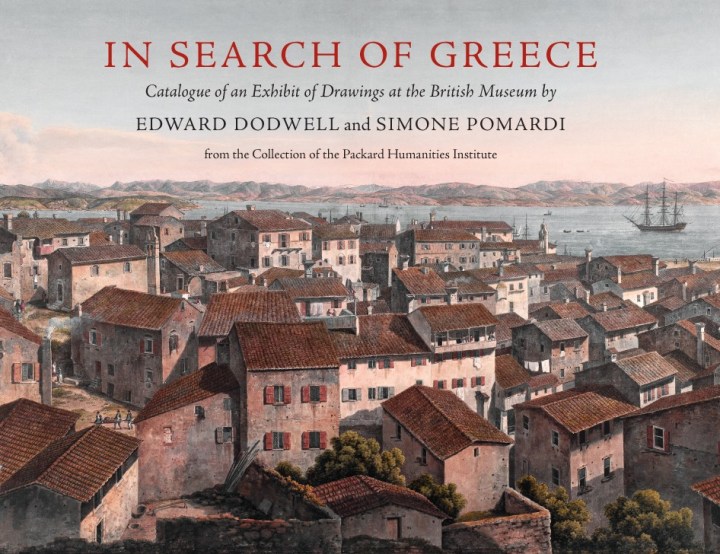
John McKesson Camp, with contributions by Ian Jenkins, Fani-Maria Tsigakou, and Kim Sloan, In Search of Greece: Catalogue of an Exhibit of Drawings at the British Museum by Edward Dodwell and Simone Pomardi from the Collection of the Packard Humanities Institute (Los Altos, CA: The Packard Humanities Institute, 2013), £25.
C H A P T E R S
• Introduction: The Road to Erudite Athens – Ian Jenkins
• Introduction to the Collection – John Camp
• Greece at the Eve of the Nineteenth Century: Poised between Myth and Reality – Fani-Maria Tsigakou
• Seen through a Glass Darkly: Dodwell and Pomardi’s Drawings and Watercolours of Greece – Kim Sloan
◊ ◊ ◊ ◊ ◊
John Camp — In Search of Classical Greece
The British Museum, London, 8 February 2013
Guest curator of the forthcoming Room 90 exhibition In Search of Classical Greece and Director of Athenian Agora Excavations, Professor John Camp, explores the reality of the Classical sites pre-independence, when well-to-do European travellers ‘re-discovered’ ancient Greece.
Friday 8 February, 18.30, BP Lecture Theatre (book early, as it’s expected to sell out)
Tickets £5 (Members/Concessions £3), book online here»
◊ ◊ ◊ ◊ ◊
Note (added 4 February 2013) — Additional information on programming for the exhibition is available (as a PDF) here»










leave a comment